



Login
Get Instant Pricing On 23,000+ Aircraft

>
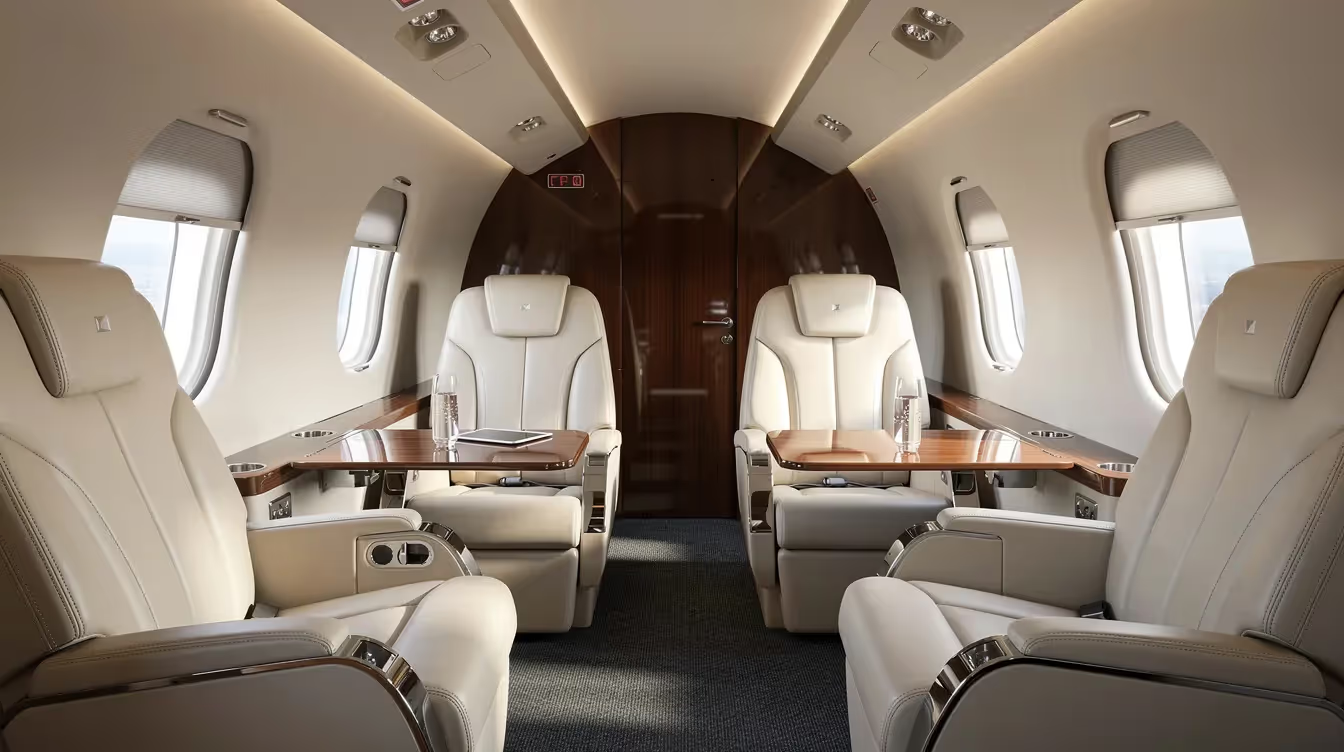
Flying private begins with arriving at a fixed base operator (FBO) facility, where fixed base operators provide essential ground handling services, ramp access, and terminal amenities for private jet travelers—typically just 15 to 30 minutes before departure. Travelers can often drive directly onto the tarmac to board private jets, offering a quick, discreet boarding experience without long security lines or crowded terminals. Passengers go through a different security process than on commercial flights, enabling faster boarding with less hassle. Charter flight options offer a flexible, customizable travel experience compared to commercial airlines. Within minutes of arriving, passengers board the aircraft and taxi to the runway for takeoff, enjoying the comfort and convenience of booking a charter jet for both domestic and international travel.
Once airborne, the private jet in-flight experience differs dramatically from commercial air travel. Modern private jets and private planes often feature advanced HEPA filtration systems that improve air quality and reduce travel fatigue. Cabins maintain lower effective altitudes (around 3,000–6,000 feet) and complete air exchanges more frequently, which helps reduce jet lag and enhances passenger comfort. Noise levels on business jets typically register in the low 70 dB range, quiet enough for normal conversation without raising your voice. Passengers can move freely during the cruise, use devices, or simply enjoy the view. Private planes are available in different cabin classes—light, midsize, and heavy jets—offering varying levels of space, design, and amenities to suit different travel needs and preferences.
Private jets offer customizable in-flight services, including bespoke catering tailored to dietary preferences, and allow passengers to bring pets on board rather than relegating them to cargo, enhancing travel comfort. The cabins can be configured as mobile offices with amenities like high-speed Wi-Fi and conference tables, enabling productivity in flight. Passengers often enjoy greater comfort and space than commercial first class, with more legroom, reclining seats, and some jets even featuring sofas or beds.
Consider a typical 2.5-hour New York–Miami charter on a midsize jet like the Cessna Citation XLS+. The flight spends nearly the entire booked time cruising at 450–500 mph. Compared to commercial flights, private travel can save 3.5 to 5 hours per trip by eliminating long security lines and layovers. Jettly provides access to smaller airports like Teterboro (TEB) near Manhattan or Opa-Locka (OPF) near Miami, shaving 45–90 minutes off ground transport each way, and tools such as an airport locator for private jet charter make it easier to identify the most convenient departure and arrival points. Jettly provides access to more airports than commercial airlines, enabling point-to-point travel and reducing transfer times. By providing access to a broader network of destinations through its platform, Jettly enhances flexibility and convenience for travelers.
The private jet’s in-flight phase is often the most relaxing part of the journey. The flight crew focuses entirely on a small group—typically 4 to 16 passengers—rather than managing hundreds of travelers. Private travel enhances privacy by allowing control over the passenger list, enabling confidential meetings without interruptions.
The experience of a private jet in flight offers a quieter cabin, personalized service, and the ability to work, sleep, or relax without the interruptions common on commercial airlines.
Jettly provides on-demand access to over 20,000 aircraft globally, with instant pricing, pricing transparency, and digital booking for both business and leisure travel.
Real-world routes like New York–Miami (2.5 hours on a midsize jet), Toronto–Vancouver (4.5 hours on a super midsize), and Los Angeles–Las Vegas (under 45 minutes on a light jet) demonstrate practical time savings.
Private jets can be booked as early as months in advance or as late as 24 hours before departure, allowing for flexibility in scheduling and cost efficiency, especially when optimizing routes and aircraft selection.
When booking a private jet, verifying the operator’s credentials, including their FAA Air Carrier Certificate, ensures safety and compliance. Jettly partners with charter companies adhering to strict FAA standards, distinguishing them from illegal operations.
Booking often involves a dedicated account manager who assists with selecting the right aircraft and managing the process.
Most charter operators require a minimum booking of two flight hours, with prices starting roughly between $4,000 and $7,000, even for short trips.
Charter prices can surge 20–40% during high-demand periods like holidays and major events, with total trip costs including additional fees such as aircraft positioning, fuel surcharges, landing fees, crew expenses, and taxes.
Private flights improve health and safety by bypassing crowded airports and offering private cabin environments.
Ready to explore private travel on your terms? Get a quote at Jettly.com.
Private aviation offers distinct advantages that become most apparent once the aircraft is airborne: time savings, privacy, productivity, and comfort. These benefits compound on every trip, especially when you can choose from a wide selection of private charter aircraft tailored to each mission.
A Toronto–Vancouver flight on a super midsize jet like the Bombardier Challenger 350 cruises at 470 mph for about 4.5 hours nonstop. Commercial alternatives through hub airports like YYZ or YVR often add layovers, significantly extending total travel time. Los Angeles to Las Vegas in a light jet like the Embraer Phenom 300 takes under 45 minutes of air time, including a 15-minute check-in, compared to 3+ hours door-to-door on commercial flights. Unlike commercial airlines, private jets are not bound by fixed routes, allowing for direct, customized itineraries that save even more time.
Privacy matters for business travelers and families alike. A closed cabin means no strangers overhearing confidential discussions. Executives can review sensitive documents, hold candid conversations, or simply decompress without interruption.
Productivity transforms flight time into working hours. Many aircraft feature club-four seating with tables suitable for laptop work, video calls, or team briefings. The spacious cabin and low noise floor make concentration easier than in any commercial cabin class. Private jet charters also offer cost efficiency, especially for group travel or when bookings are optimized, making them a smart choice for both business and leisure, particularly when comparing the best private jet charter companies and their services.
Flexibility extends even into flight day. Departure times can often be adjusted on the same day. Private jets use smaller airports closer to their final destinations, significantly reducing ground transport.
When it comes to comfort and amenities, private jets offer a range of cabin classes—light, midsize, and heavy jets—each with distinct cabin designs, space, and features to suit different travel needs and preferences.
When comparing a private jet in flight to commercial options, several differences stand out beyond the boarding process.
Altitude advantage: Private jets often cruise at FL410 to FL510 (41,000–51,000 feet), well above most commercial traffic at 35,000–40,000 feet. This higher altitude often means smoother rides above weather systems.
Fewer interruptions: No overhead announcements beyond essential safety updates. No beverage carts blocking aisles. No crying babies from three rows back.
Direct routings: Private flight avoids connecting flights at major hubs like JFK, LHR, or ORD. Unlike commercial airlines, which are restricted to fixed routes, private jets offer greater flexibility by allowing you to choose direct, customized itineraries. A New York–Boston hop that might take 3+ hours door-to-door, when commercially operated, compresses to about 1.5 hours total when chartered. Travelers considering fractional ownership can review how NetJets leads the private aviation industry to understand another model for accessing private flights, especially with a flexible NetJets alternative like Jettly.
Air traffic control flexibility: Smaller aircraft can request route deviations more easily, potentially avoiding turbulence or weather that larger commercial airlines cannot dodge as readily.
Access to smaller airports: Private jets can use smaller regional airports, not just major hubs, and can access more airports than commercial airlines—over 5,000 in the U.S. alone—enhancing convenience and reducing travel time.
Amenities vary considerably by aircraft category—from functional turboprops to ultra-long-range business jets equipped with features like onboard offices. Cabin classes—such as light, midsize, and heavy jets—offer varying levels of space, luxury, and amenities to suit different preferences and travel needs. Understanding what to expect helps travelers choose the right aircraft for their specific trip, explore a wide range of private and charter airlines, and compare affordable private jet charter options that match their budget.
|
Aircraft Type |
Typical Seats |
Range (miles) |
Ideal Routes |
Best For |
|---|---|---|---|---|
|
Turboprops (Pilatus PC-12) |
6–8 |
1,800–2,000 |
Regional routes, short runways |
Regional hops, small airports |
|
Light jets (Phenom 300) |
6–8 |
1,200–1,800 |
Shorter hops, LA–Denver, Paris–Ibiza |
Short trips, 4–6 passengers |
|
Midsize jets (Citation XLS+) |
7–9 |
2,500–3,500 |
Cross-country, NY–Miami, Toronto–Vancouver |
Cross-country business aviation |
|
Super midsize (Challenger 350) |
8–9 |
3,500+ |
Coast-to-coast, Toronto–Vancouver |
Long-range domestic, business |
|
Heavy jets (Gulfstream G600) |
10–16 |
5,000–6,500 |
International, Dubai–London |
International flights, larger groups |
|
Ultra long range (Global 6500) |
10–16 |
6,600+ |
NY–London, LA–Tokyo |
Long-haul, maximum comfort |
Cabin features typically include leather seats, club seating configurations, and divans that convert to beds on longer-range jets. Noise levels remain low enough for normal conversation or restful sleep. Cabin classes—ranging from light jets to ultra-long-range—offer varying levels of space, luxury, and amenities to suit different travel preferences.
Wi-Fi availability has expanded significantly, with 80–90% of business jets equipped for 2025–2026 operations. Travelers on routes like New York–Los Angeles or London–Dubai should confirm connectivity at booking, as some operators charge separately for high-speed satellite connections, which can be factored into estimates using a private jet charter cost estimator or a dedicated jet card flight cost estimator for route-based pricing.
Modern jets also feature adjustable circadian lighting—cool blues for productive work sessions, warm ambers for rest—along with zoned climate control tailored to passenger preferences.
In-flight catering transforms based on trip length, time of day, and passenger preferences, and services like Jettly Eats, which provide in-flight catering for private jets, make it easy to tailor menus across hundreds of airports.
Simple snacks, soft drinks, and coffee service
Breakfast trays with omelets, fresh fruit, and espresso
Sushi, salads, or light dinner options from local caterers
Kid-friendly meals, snacks, and beverages
Premium wines, spirits, and multi-course meals when requested
Alcohol service follows FAA and EASA regulations. Premium options are often available, but policies vary by operator.
Jettly coordinates catering preferences at booking time. Dietary requirements—vegan, gluten-free, kosher—can be arranged in advance with specific requests.
Cabin configurations differ by aircraft size and mission length. The layout and amenities available are also influenced by the aircraft's cabin class—light, midsize, heavy, or ultra-long-range—with larger cabin classes offering more zones, enhanced privacy, and additional features such as dedicated bedrooms or full lavatories. Understanding typical layouts helps travelers select the right aircraft for their needs.
|
Aircraft Type |
Typical Seats |
Layout Notes |
|---|---|---|
|
Light jets |
6–8 |
Club pairs with fold-out tables |
|
Super midsize jets |
8–9 |
Club seating plus divans convertible to beds |
|
Heavy jets |
10–16 |
Lie-flat berths, separate zones, full lavatories |
|
Ultra long range |
10–16 |
Multiple cabin sections, bedroom suites on some models |
Private jet seats generally recline more than commercial business class and offer more legroom per passenger. A light jet might seat 6 in more space than 12 business-class passengers enjoy commercially.
Executives: Meeting around a club table during a Chicago–Dallas flight
Families: Children spreading out on a divan while parents work
Couples: Relaxing on lie-flat beds during the overnight Europe–US sectors
Jettly’s platform includes cabin diagrams and photos. Reviewing these before confirming helps ensure the aircraft meets expectations for group travel or longer-distance travel.
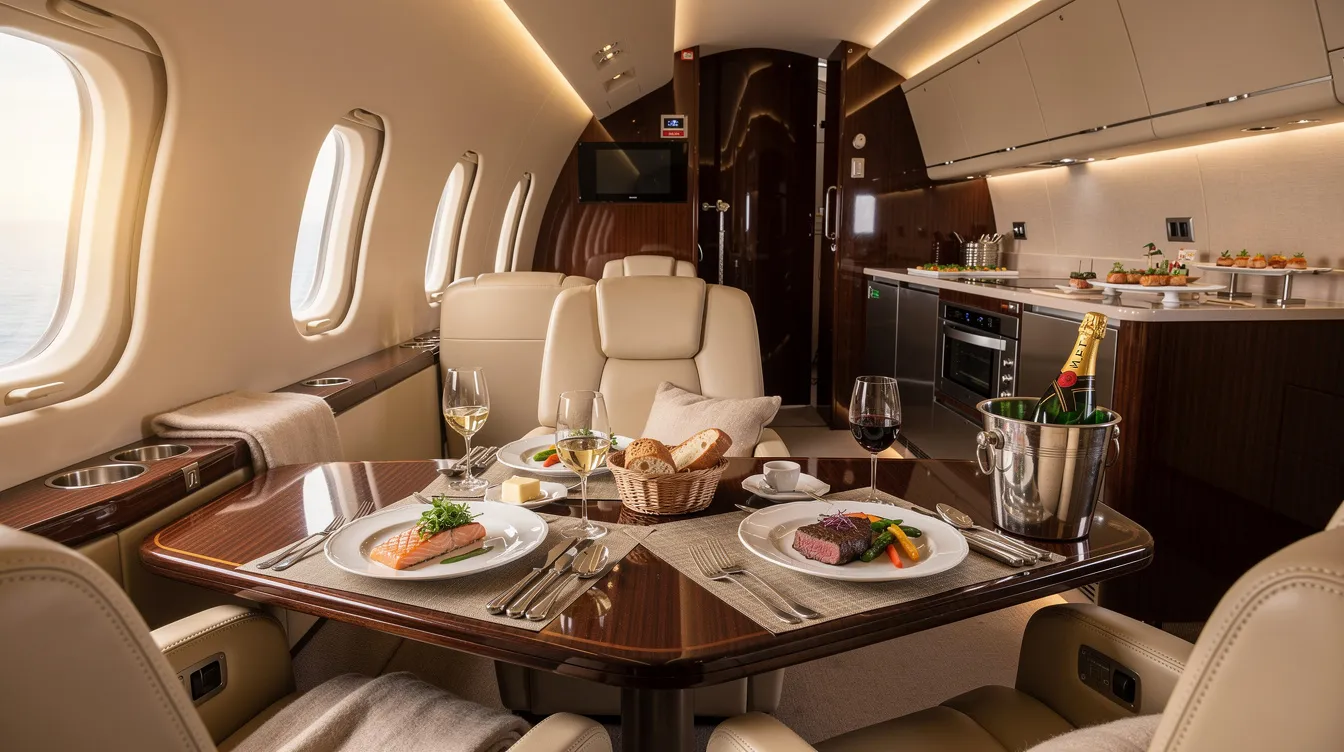
Speed and range during a private jet flight depend heavily on aircraft category and mission profile. Turboprops cruise more slowly but can access short runways. Ultra-long-range jets connect continents nonstop and are ideal for long-haul flights, such as intercontinental journeys, offering exceptional range and comfort for extended travel. Travelers planning cross-border missions can benefit from understanding how private jets fly internationally and navigate regulations.
Most private jets cruise between 400 and 530 mph and can use direct routings unavailable to hub-and-spoke commercial airlines. Unlike commercial flights restricted to fixed routes, private jets offer route flexibility, allowing for more efficient and customized travel. This combination often significantly reduces total journey time.
Consider New York–Los Angeles, approximately 2,450 miles. A super midsize jet completes this nonstop in about 5–5.5 hours, landing at a convenient regional airport rather than fighting through LAX. The same route commercially might involve similar air time, but 2+ additional hours for airport procedures. Charter jet services make it easy to book the right aircraft for your specific travel needs, providing flexibility for both short hops and long-range missions, and there are now many options for getting a seat on a private jet easily and affordably.
Passenger count: More passengers mean more weight and reduced range
Baggage: Heavy luggage affects fuel calculations
Wind conditions: Headwinds reduce range; tailwinds extend it
Fuel reserves: Operators maintain safety margins that affect practical range
Tech stops: Some routes require refueling stops, depending on aircraft type
|
Aircraft Type |
Range (nm) |
Cruise Speed (mph) |
Ideal Routes |
Best For |
|---|---|---|---|---|
|
Turboprops (Pilatus PC-12) |
1,800–2,000 |
260–300 |
New York–Miami, London–Marrakesh |
Regional hops, small airports |
|
Light jets (Phenom 300) |
1,200–1,800 |
400–450 |
Los Angeles–Denver, Paris–Ibiza |
Short trips, 4–6 passengers |
|
Midsize/super midsize jets (Citation XLS+, Challenger 350) |
2,500–3,500+ |
450–480 |
Toronto–Vancouver, New York–San Francisco |
Cross-country business aviation |
|
Heavy jets (Gulfstream G600) |
5,000–6,500 |
510 |
Dubai–London, New York–Paris |
International flights, larger groups |
|
Ultra long range (Global 6500) |
6,600+ |
530 |
New York–London, Los Angeles–Tokyo |
Long-haul flights, such as transcontinental or intercontinental routes; maximum comfort |
Picture a typical private jet in flight on a 3-hour business route, such as Chicago–Dallas. The unique experience of flying on a private plane includes a quiet, spacious cabin and personalized attention. After a quick climb to cruising altitude around 43,000 feet, the cabin crew begins service.
Charter flight arrangements allow for tailored in-flight experiences based on passenger preferences, from custom catering to entertainment options, ensuring every journey is as comfortable and convenient as possible.
Seat belts remain fastened. Crew prepares beverages and confirms meal timing with passengers.
The majority of flight time. Passengers work on laptops, hold meetings, or rest. Hot meals are served. Wi-Fi enables video calls and file transfers. The flight crew provides updates on the weather and the estimated arrival.
Cabin secured for landing. Final snacks or coffee offered. Crew collects service items and confirms ground transport arrangements.
Common passenger activities during a cruise—especially for frequent flyers using private jet memberships for regular travel—include:
Working on presentations or reviewing documents
Making video calls on Wi-Fi-enabled aircraft
Streaming content via onboard tablets or personal devices
Sleeping on divans or reclined seats
Simply enjoying the view from larger windows
Passengers can generally move freely during the cruise, subject to seat belt signs and crew instructions during turbulence.
Most personal electronics are permitted on private flights, with more flexibility than commercial aviation often allows.
Takeoff and landing: Phones should be in airplane mode, similar to commercial rules
During cruise: Full connectivity via onboard Wi-Fi, where installed
Work tools: Laptops, tablets, and phones connect normally once Wi-Fi is active
Many business travelers use the private jet's in-flight Wi-Fi as a mobile office. Tasks that work well:
Sending sensitive files over secure connections
Hosting private conference calls
Team briefings around a cabin table
VPN access for enterprise systems
Some operators charge separately for high-speed satellite connectivity, typically $3–10 per MB on premium systems. Jettly users should confirm Wi-Fi availability and pricing when booking.
Streaming video, cloud-based tools, and VPN access are generally supported on newer aircraft, especially in midsize and long-range business jet fleets.
Private flight crew members are trained to provide personalized service, but practical etiquette helps trips run smoothly.
Address cabin crew by name and make requests conversationally—adjusting temperature, timing meals, or requesting beverages
Wait until the cruise before visiting the cockpit if invited; pilots focus on the takeoff and landing phases
Business travelers should brief the crew in advance on meeting plans so service doesn’t interrupt presentations
Tipping practices vary by region; ask Jettly or the operator for local norms if uncertain
Treat the aircraft respectfully—while it’s chartered, it belongs to the owner or operator

Private jets in flight operate under strict regulations—often exceeding commercial standards in crew training and maintenance requirements.
Charter flight operators must adhere to stringent safety and compliance standards set by aviation authorities to ensure passenger safety and operational reliability.
Most charter flights in North America operate under Federal Aviation Administration Part 135 (or equivalent EASA Part-CC in Europe). These regulations mandate:
Two-pilot crews for most charter operations
Rigorous maintenance schedules
Crew rest requirements (8–10 hours minimum)
Regular training and certification
Third-party safety audits provide additional assurance. Widely recognized standards include:
|
Audit Standard |
What It Means |
|---|---|
|
ARGUS Platinum |
Top 5% of operators by safety criteria |
|
Wyvern Wingman |
Zero incident history requirement |
|
IS-BAO Stage III |
International Standard for Business Aircraft Operations |
Jettly works with vetted operators and displays safety ratings when available. Travelers can filter by audit status when comparing options.
Pre-flight safety briefing from the crew
Seat belts during taxi, takeoff, landing, and turbulence
Lavatory use only during stable cruise
Following crew instructions during irregular operations
Note that very light jets and some turboprops may have limited lavatory facilities. Confirm this for flights over 90 minutes.
Safety measures during private flights follow clear protocols.
Regulations require seat belts during taxi, takeoff, landing, and whenever the crew illuminates the seat belt sign
Turbulence is normal, even on private jets—flying higher can reduce bumps but not eliminate them entirely
Private crews can provide more personalized reassurance to anxious flyers, explaining turbulence forecasts and adjusting altitude where feasible
Noise levels in the low 70 dB range allow normal conversation, reducing fatigue on longer flights
Modern business jets also maintain lower effective cabin altitudes—4,000 to 6,000 feet, even at 45,000 feet true altitude. This reduces hypoxia, fatigue, and jet lag on longer sectors.
Many private travelers bring pets, sports equipment, or sensitive instruments.
Pets:
Most can fly in the cabin rather than cargo
Documentation requirements vary by destination (vaccinations, health certificates)
US, UK, and EU have specific entry rules that must be followed
Share pet details with Jettly at the quote stage
Sports equipment and large items:
Golf clubs, skis, and musical instruments often fit in cargo holds
Confirm dimensions match the aircraft baggage door and hold size
Larger aircraft accommodate oversized items more easily
Prohibited items:
Hazardous materials remain banned under aviation law
Firearms follow strict jurisdiction-specific rules
When uncertain, ask before the flight
Empty-leg flights are one of the best-kept secrets in private jet travel, offering savvy and flexible travelers a cost-effective way to experience the benefits of private aviation at a fraction of the usual charter costs. These flights occur when a private jet needs to reposition—either returning to its home base or heading to pick up its next passengers—flying without any booked travelers on board. Rather than let these valuable flight hours go unused, operators offer empty leg flights at deeply discounted rates, often up to 75% off the standard jet charter price.
For those with flexible travel plans, empty-leg flights open the door to private jet charter experiences that might otherwise be out of reach. While you may need to be flexible with your departure time, route, and aircraft type, the trade-off is significant savings and the chance to enjoy more space, personalized service, and direct access to smaller airports that commercial airlines can’t reach. This makes empty-leg flights especially appealing for leisure getaways, spontaneous business trips, or last-minute travel over longer distances.
Jettly’s global network and digital platform make it easy to browse available empty leg flights, compare options by route and aircraft type, and secure transparent pricing with no hidden fees. Whether you’re looking for a one-way flight between major cities or a unique route to a less-traveled destination, Jettly’s air charter experts can help you find the right aircraft and the best deal for your needs.
In addition to empty-leg flights, frequent flyers can explore other cost-effective options, such as jet cards and membership programs, which offer fixed hourly rates and guaranteed availability for frequent travelers. These private aviation offers provide even more ways to manage charter costs and simplify your travel plans, ensuring you always have access to the right aircraft for your journey.
By leveraging empty-leg flights and other flexible options, travelers can enjoy the luxury and convenience of private jet travel without compromising quality or service. Whether you’re flying for business or leisure, private aviation offers a smarter, more efficient way to reach your final destination—often with more comfort, more space, and more time saved than any commercial alternative. Travelers considering specific regions can also look at private jet charter services in cities like Kolkata, West Bengal, as examples of how localized offerings enhance convenience. Explore Jettly’s empty leg flights and discover how private jet travel can be both accessible and affordable for your next adventure.
Charter costs depend on aircraft size, route length, trip timing, and extras like catering and Wi-Fi. Hourly rates provide a baseline, but all-in pricing tells the real story, whether you’re chartering the whole aircraft, booking a charter jet, or simply buying a seat on a private jet.
Typical hourly rates (2025–2026):
|
Aircraft Category |
Hourly Rate Range |
|---|---|
|
Turboprops |
$2,000–$3,000/flight hour |
|
Light jets |
$3,000–$5,000/flight hour |
|
Midsize/super midsize jets |
$5,000–$8,000/flight hour |
|
Heavy/ultra long range |
$8,000–$14,000+/flight hour |
Example trip costs:
Los Angeles–Las Vegas return (light jet): $12,000–$18,000 total (1 hour each way)
New York–Miami one way (midsize jet): $25,000–$35,000 (2.5 hours)
Toronto–Vancouver round-trip (super midsize): $40,000–$60,000 (4.5 hours each way)
Total price includes flight time, repositioning (if the aircraft must fly empty to reach you), landing and handling fees ($500–$2,000 per stop), crew expenses, fuel surcharges, and applicable taxes. Choosing the right charter jet for your needs can significantly reduce costs, especially for group travel or specific routes.
Jettly’s platform shows instant pricing estimates across its global network of 20,000+ aircraft. Travelers can quickly compare options for the same route and date, seeing transparent pricing with clear cost breakdowns and no hidden additional fees. Charter flight services on Jettly also offer flexible pricing models to suit different travel requirements.
Empty leg flights (discounted empty leg flights with Jettly)
Discounted repositioning legs when aircraft must fly empty to their next booking
Typically range 25–75% cheaper than standard jet charter rates, offering significant cost efficiency for flexible travelers
Ideal for one-way flight needs with flexible timing
Jettly lists available empty legs on its platform, providing pricing transparency so you can easily compare options
On-demand vs. membership models
Traditional jet cards require large upfront commitments
Jettly offers transparent on-demand access without membership fees, ensuring pricing transparency for every booking
Pay only for what you fly
Cost sharing (through crowdsourcing and sharing empty seats)
Split charter costs among colleagues, friends, or family
Per-seat pricing can approach premium economy or business class on some routes, maximizing cost efficiency for group travel
Works well for group travel to events or vacation destinations
Off-peak booking
Fly Tuesday–Thursday instead of Friday–Sunday
Avoid major holidays and event weekends when charter rates peak
Book in advance when possible for better aircraft availability and improved cost efficiency
Efficient routing
Choose the right aircraft for your route—don’t oversize
Avoid unnecessary positioning by selecting operators based near your departure point
Combine legs when planning multiple stops to further enhance cost efficiency
While chartering offers flexibility and convenience, some travelers consider private jet ownership. Understanding the costs and market trends is essential for informed decisions.
For a midsize jet, annual fixed costs typically range between $800,000 to $1.2 million. These include hangar fees, insurance, maintenance, and crew salaries.
Variable costs add approximately $2,200 to $2,800 per flight hour, influenced by fuel prices and engine program enrollment.
New jets generally cost between $30 million and over $80 million, while used models can be found for under $2 million. Most private jets today fall within the $5 million to $30 million price range, with some older jets depreciating below $2 million or even under $1 million.
As of July 2024, there are 24,270 private jets in operation worldwide, with about 63% registered in the United States.
The private jet market remains resilient, with high demand for late-model, program-enrolled aircraft projected for 2026.
Incentives such as the return of 100% bonus depreciation in the U.S. significantly drive year-end purchases.
A well-executed private jet acquisition—from initial search to closing—typically takes 60 to 120 days, assuming a disciplined buyer and cooperative seller.
For travelers weighing ownership versus chartering, these factors highlight the importance of evaluating usage patterns, financial commitment, and operational responsibilities, which can be explored further in a detailed breakdown of how much a private jet really costs.
Jettly’s digital-first platform simplifies what was once a phone-heavy, opaque process by making charter jet and charter flight bookings fast and straightforward. Search, compare, and book online in minutes, or lock in access and pricing through world-class jet card programs.
Enter route and dates: Departure city, destination, travel dates, and passenger count
View instant pricing: Compare private plane options across multiple aircraft types within Jettly’s global network
Filter by preferences: Cabin size, range, amenities, pet policies, and safety ratings
Submit for confirmation: Jettly coordinates with vetted operators to finalize flight details
Receive digital itinerary: Aircraft tail number, crew bios, FBO address, and suggested arrival time
Jettly also coordinates:
Catering preferences and dietary requirements
Ground transportation at departure and arrival airports
Special requests for pets, equipment, or accessibility needs
Jettly’s platform provides access to a wide network of aircraft and destinations, ensuring flexibility and convenience for every traveler.
Travelers typically receive confirmation with all flight details, including the suggested 15–30 minute arrival window at the FBO. Jettly is committed to pricing transparency, so you receive a clear, detailed cost breakdown throughout the booking process.
Learn more about Jettly’s charter options at https://www.jettly.com.
Ready to experience private travel on your terms? Explore flight options or request a quote at https://www.jettly.com.

This FAQ covers practical questions about flying private that weren’t fully addressed in the sections above. Each answer provides clear, actionable guidance, including information on charter jet and charter flight services, the versatility of private planes, and how different cabin classes affect your in-flight experience.
Smart casual or business attire works for most private jet travel. For flights over 2 hours, prioritize comfort—stretch fabrics and relaxed fits travel well.
Cabin temperatures typically range between 68–75°F, but can vary. Layers help: a light jacket or sweater handles cool climbs and warm descents.
There’s no strict dress code in private aviation. Business travelers often wear what they’d wear to their meeting. Leisure travelers dress for their destination. Soft-soled shoes are practical for smaller cabins and boarding stairs.
Some passengers find private jets more comfortable due to smoother climbs, direct routings, and less crowded cabins. However, motion sickness can still occur, especially in turbulence.
Tips for sensitive travelers:
Choose midsize jets or larger for the most stable ride
Request a seat near the wing or center of gravity
Stay hydrated and avoid heavy meals before flying
Discuss medication options with your doctor if prone to air sickness
Ask the crew about current weather conditions and potential turbulence
Crew can sometimes adjust speed or altitude when conditions allow for a smoother ride profile.
Smoking and vaping policies vary by operator, aircraft owner, and jurisdiction. Many flights are designated fully non-smoking.
When smoking is permitted:
It may be restricted to certain cabin areas
Additional cleaning fees often apply (sometimes $500+)
E-cigarette and vaping rules typically follow similar restrictions
Ask about smoking policies when requesting a quote through Jettly. This avoids surprises on flight day and ensures the aircraft matches your needs.
Children regularly fly private for holidays, school breaks, and family events. Many families find it less stressful than commercial flying—no security lines, no gate changes, and no strangers in close quarters.
Practical considerations:
Infants and toddlers may require approved car seats by law
Bring familiar snacks, toys, and tablets for entertainment
Book aircraft with lavatories and cabin space for movement on flights over 90 minutes
Routes like New York–Orlando or London–Geneva are popular family trips
Choosing the right cabin class—such as light, midsize, or heavy jets—can further enhance comfort for families traveling with children, as larger cabin classes offer more space, amenities, and flexibility for movement during the flight.
The spacious cabin and personalized service make longer flights with young children more manageable.
Private jets typically have a higher per-passenger carbon footprint than commercial flights, especially when flying with only one or two passengers. However, cost efficiency can be improved by flying with full loads and optimizing routes, which not only reduces expenses but also minimizes environmental impact.
Steps to reduce impact:
Sustainable Aviation Fuel (SAF): Adoption is up 40% year-over-year, cutting CO2 emissions by up to 80%
Carbon offsets: Available through Jettly and many operators at booking
Efficient aircraft: Modern turboprops and newer light jets burn less fuel than older models
Full loads: Flying with more passengers improves per-person efficiency and enhances cost efficiency
Combined legs: Reduce unnecessary repositioning by planning multi-stop trips efficiently, further supporting cost efficiency
Environmentally conscious travelers can ask Jettly about offset programs and efficient routing when planning their trips.
Flying private with Jettly offers more than just comfort and convenience—it provides a flexible, efficient, and increasingly sustainable way to travel. From instant access to a vast global fleet and transparent pricing to personalized in-flight experiences and environmental responsibility, Jettly simplifies private jet travel on your terms. Whether for business or leisure, exploring private jet options through Jettly ensures you benefit from time savings, privacy, and tailored service while making informed choices about your environmental impact. Ready to experience the advantages of a private jet in flight? Explore flight options or request a quote at https://www.jettly.com.
Share this post:
Jay Franco Serevilla
Apr 11, 2026
|
5
min read
Discover tips and trends in the industry.
5
min read
Jet Number: How Private Jet Tail Numbers, Registration, and Tracking Really Work
Every private jet has a unique jet number, also known as a tail number, which serves as its identification in the aviation world. This alphanumeric code is crucial for air traffic control, legal records, and flight tracking, ensuring safety and compliance. Understanding jet numbers can enhance the private jet booking experience, providing travelers with essential information about the aircraft.
Read More
5
min read
KGRK: Robert Gray Army Airfield & Fort Hood Regional Travel Guide
Robert Gray Army Airfield (KGRK) serves as a vital joint-use airfield for Fort Hood and the Killeen area, facilitating both military and commercial aviation. With a 9,997-foot runway and 24-hour operations, it supports a range of aircraft and offers direct access to Central Texas. This travel guide provides essential information for military personnel, families, and business travelers using KGRK.
Read MoreStay updated with our latest insights and tips to elevate your journey with us.
MEMBERSHIPS AND ASSOCIATIONS



Disclaimer: Jettly operates as a charter broker, offering access to a global digital jet charter marketplace. Jettly is not a direct air carrier and does not own or operate aircraft. All advertised flights are conducted by third-party air carriers that are fully licensed and hold the appropriate Part 135 or Part 121 certifications issued by the Federal Aviation Administration (FAA) or equivalent regulatory authorities under U.S. or foreign law. Jettly complies fully with the U.S. Department of Transportation's Part 295 and Part 298 Charter Broker regulations. Jettly does not carry additional liability insurance. Passengers are covered by aircraft operator insurance. TICO: 50023770


