



Login
Get Instant Pricing On 23,000+ Aircraft

>
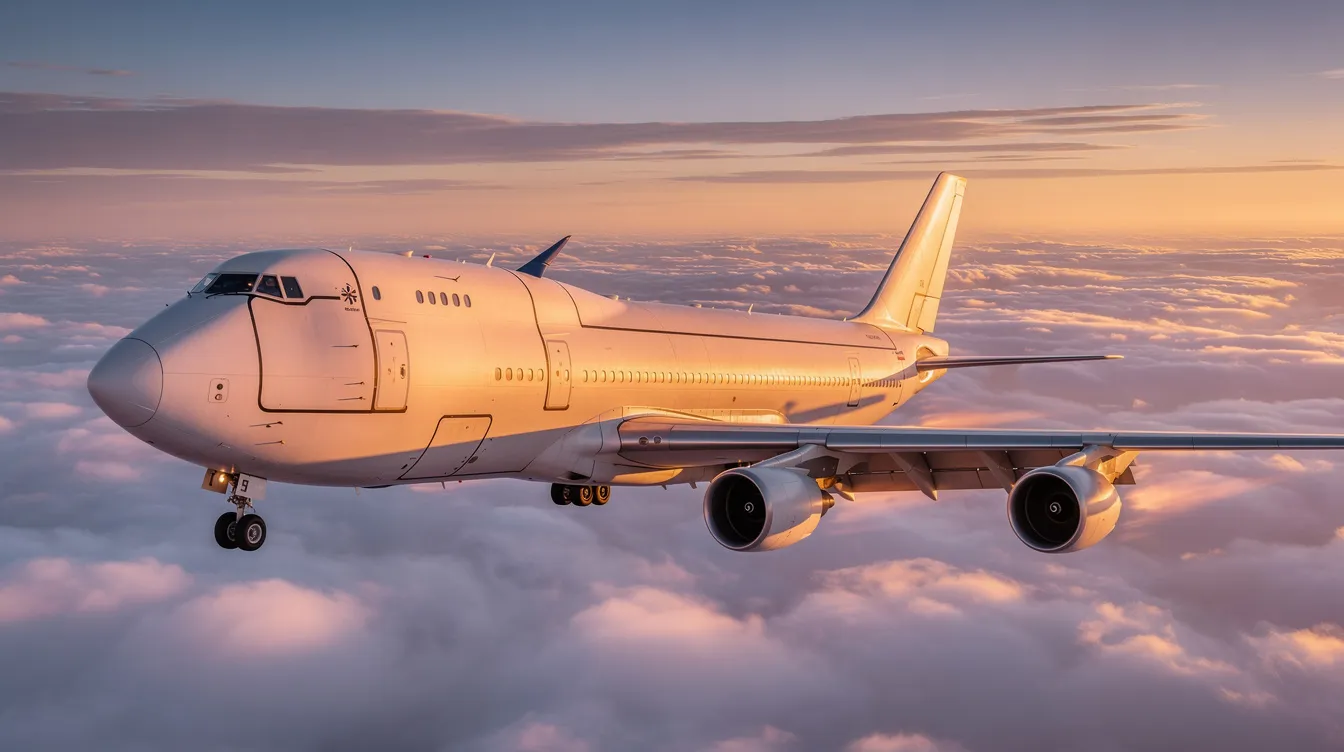
Understanding how much weight cargo planes can carry is essential for anyone planning freight shipments, charter flights, or logistics involving air transport. This guide is intended for shippers, logistics professionals, and anyone interested in understanding air cargo capacity.
Cargo plane weight capacity varies by model size and category, ranging from a few hundred kilograms on small turboprops to well over 100 tonnes on strategic military airlifters. This guide breaks down payload capacity by aircraft type, explains the factors that limit real-world performance, and shows how to match your cargo needs with the right plane.
Modern cargo planes range from small turboprops carrying around 4,500 kg (10,000 lb) to heavy-lift transport aircraft like the Antonov An-124 lifting about 150,000 kg (330,000 lb) of freight. Heavy-lift transport aircraft can carry around 75 to 150 tons or more.
How much weight a cargo plane can carry depends on aircraft type (turboprop, narrow-body, wide-body, military transport aircraft) and mission profile (range, runway length, fuel load).
Passenger planes also move a large share of global freight in their belly holds, but are height-limited and volume-constrained compared with dedicated freighters.
Volume vs. weight affects how cargo is loaded onto planes. Bulky, lightweight goods may fill the hold before hitting payload limits, while dense cargo hits weight limits first.
Shippers and private travelers can use Jettly's on-demand charter marketplace to match their shipment or group size with the right aircraft type from a network of over 20,000 aircraft worldwide, and in some cases even crowdsource private jet flights and share empty seats to optimize costs.
The short answer: it depends entirely on the aircraft. Small single-engine or twin-turboprop aircraft carry under 1,000 lbs, while massive strategic airlifters can carry more than 500,000 lbs. Here is a quick breakdown of typical payload ranges by category:
Small cargo turboprops (e.g., Cessna Caravan, ATR 42F): roughly 1,800–6,000 kg (4,000–13,000 lb). Typical payload capacity for small turboprops is 1,000 to 5,000 lbs, while regional turboprops reach 10,000 to 20,000 lbs.
Converted narrow-body freighters (e.g., Boeing 737-800BCF, Airbus A321P2F): about 20,000–27,000 kg (44,000–60,000 lb). Typical payload capacity for narrowbody freighters is 40,000 to 65,000 lbs.
Wide-body freighters (e.g., Boeing 767-300F, Boeing 777F, Boeing 747-8F): approximately 50,000–140,000 kg (110,000–310,000 lb). Typical payload capacity for widebody long-haul freighters is 100,000 to 250,000 lbs.
Strategic military transport aircraft (e.g., C-130 Hercules, C-5 Galaxy, Antonov An-124): around 20,000–150,000 kg (44,000–330,000 lb). Heavy-lift military airlifters have a payload capacity of 150,000 to 550,000 lbs.
For comparison, an average passenger jet like the Boeing 737-800 has a maximum takeoff weight around 79,000 kg, but most of that budget goes to fuel, passengers, and baggage. Belly cargo in passenger jets typically adds 10 to 25 tons depending on passenger load-far less than what dedicated freighters handle.
Payload is always a balance between cargo weight, fuel needed for range, and safety limits. Aircraft rarely operate at absolute maximum figures on every mission. Businesses and individuals can charter freighters or high-capacity aircraft via Jettly when air cargo timelines or dimensions exceed what standard freight services offer.
Published payload numbers represent ideal maximums. In practice, several factors commonly reduce usable capacity on any given cargo flight. Payload refers to the weight of cargo an aircraft can carry, while maximum takeoff weight (MTOW) is the total weight of the aircraft at takeoff, including empty weight, crew, fuel, and cargo.
Maximum takeoff weight (MTOW) sets the ceiling. MTOW includes empty weight, crew, fuel, and cargo. For example, the Boeing 777F has an MTOW of approximately 347,810 kg (766,000 lb). Once you subtract operating empty weight and mission fuel, the remaining budget is your payload. Aircraft have a maximum takeoff weight influenced by several factors, including structural certification and engine thrust ratings.
Structural payload limits add another constraint. Maximum zero-fuel weight is the total weight of the aircraft excluding usable fuel-it caps how much payload the airframe can physically support regardless of fuel state. Cargo planes are limited by their structural strength when carrying loads, and the maximum landing weight is crucial for safe landings after taking off near MTOW.
Floor loading limits matter for dense items. Cargo weight must comply with maximum weight per square foot of cabin floor. Steel blocks or heavy machinery may need shoring or load-spreading pallets even if total payload capacity has room to spare.
Volume vs weight limitations create a different kind of ceiling. Bulky, low-density cargo like e-commerce parcels or fashion shipments can fill the plane's physical space before reaching weight limits. Conversely, dense metal goods hit weight limits with plenty of empty volume remaining.
Runway performance and weather directly affect allowable weight. Density altitude affects engine performance and requires weight reductions at hot, high-elevation airports. Shorter runways restrict acceleration distance, and runway conditions can restrict how heavy a cargo plane can be at departure. Aerodynamic factors like lift generation also affect cargo weight capacity, particularly in non-standard atmospheric conditions.
Payload vs fuel trade-off affects cargo capacity on long flights-flying farther means burning more fuel, which means carrying less cargo. Cargo must fit through loading doors and within cargo compartments, and cargo distribution affects aircraft stability and load limits. Safety regulations govern maximum weight and loading limits of cargo planes, so operators rarely plan flights at theoretical maximums, maintaining buffers for unforeseen conditions.
Aircraft type is the main lens shippers use to estimate how much cargo can fly on a given route. Here is a breakdown by category, from smallest to largest:
Turboprop cargo planes (e.g., Cessna 208B Caravan, Metroliner, ATR 72F): designed for regional, short-runway operations. Turboprop cargo planes can carry up to 10,000 pounds, with larger regional turboprops like the ATR 72F reaching about 8,200 kg (18,000 lb).
Narrow-body cargo aircraft (e.g., Boeing 737-800BCF, Airbus A321P2F): suitable for domestic and short-haul regional work. Narrow-body cargo planes have a capacity of up to 30,000 pounds, with converted models like the 737-800BCF reaching about 23,900 kg (52,700 lb).
Wide-body cargo planes (e.g., Boeing 767-300F, Boeing 777F, Boeing 747-8F): intended for long-haul freight across continents. Wide-body cargo planes can transport up to 100,000 pounds of cargo at the lower end, with the 747-8F pushing past 130,000 kg.
Military transport aircraft (e.g., C-130J, C-17, C-5M Super Galaxy, Antonov An-124): built for heavy and outsized loads. Military transport aircraft can carry up to 400,000 pounds of cargo.
Many cargo aircraft are modified from passenger planes. The 737-800BCF, A321P2F, and 767-300BCF all began life as wide-body passenger planes or narrow-body passenger aircraft before conversion. These converted freighters commonly provide payload capacities significantly higher than what the original passenger versions could carry as belly freight.
Combination or "combi" aircraft and quick-change configurations historically increased capacity on specific routes but are less common today, having largely given way to dedicated freighters.
|
Aircraft Type |
Typical Payload Range |
Typical Mission |
|---|---|---|
|
Small turboprop |
1,800–4,500 kg (4,000–10,000 lb) |
Regional feeder routes |
|
Regional turboprop |
5,000–8,200 kg (11,000–18,000 lb) |
Short-haul, short runways |
|
Narrow-body freighter |
20,000–27,000 kg (44,000–60,000 lb) |
Domestic, intra-regional |
|
Wide-body freighter |
50,000–134,000 kg (110,000–295,000 lb) |
Long-haul intercontinental |
|
Military strategic transport |
20,000–150,000 kg (44,000–330,000 lb) |
Outsized/heavy lift |
Here are payload figures for several well-known freighters, with range context to help plan real-world cargo flights:
Boeing 737-800BCF: payload around 23,900 kg (52,700 lb). Suited to regional routes like intra-EU or US domestic, with a range of roughly 2,000 nmi at full load.
Boeing 767-300F: payload roughly 52,400 kg (115,500 lb). Widely used by integrators like FedEx and UPS for transcontinental operations.
Boeing 777F: payload about 102,000 kg (224,900 lb). Long-range twin-engine freighter connecting hubs like Hong Kong–Frankfurt or Memphis–Dubai, with roughly 4,970 nmi range at full payload.
Boeing 747-8F: payload about 134,000 kg (295,000 lb) according to Cargolux fleet specifications. One of the highest-capacity commercial freighters, with a main deck volume of approximately 693 m³.
Airbus A330-200F: payload approximately 65,000 kg (143,000 lb). Medium-to-long range wide-body freighter.
Antonov An-124 Ruslan: The Antonov An-124 Ruslan can carry up to 150 tonnes of cargo, with a large cargo hold designed for oversized industrial equipment and humanitarian missions.
For comparison, an average single-aisle passenger aircraft like the Airbus A320 or Boeing 737-800 carries only a few tonnes of freight in its belly hold alongside passenger bags-not tens of tonnes.
Real-world example: Moving 60,000 kg of automotive parts from Europe to North America could fit on a single Boeing 777F (payload ~102,000 kg) or require two Boeing 767-300Fs (each ~52,000 kg). The choice depends on urgency, routing, and airport handling. The maximum bulk piece weight for air cargo is 10,000 pounds, and heavy cargo over 5,000 kg requires specialized handling equipment at both origin and destination.
When using Jettly's platform, shippers can see aircraft options and indicative payload capabilities before requesting a detailed freight charter quote.
Many shipments still fly in the cargo holds of passenger planes, but weight is only one piece of the story. Dimensions and door size play an equally important role.
Typical wide-body passenger planes have cargo-hold height limits of about 160 cm (63 in). That restricts tall freight compared with main-deck cargo on freighters, which may accept pieces 240–300 cm tall. Cargo door clearance is usually slightly less than hold height, and planners must leave a 5–10 cm safety buffer to ensure pallets or crates can physically pass through.
Passenger aircraft prioritize baggage and mail, with limited remaining capacity for general freight. Dedicated freighters, by contrast, design their entire main deck and lower holds for pressurized pallets and containers. Weight distribution also matters: loaded cargo must be spread to avoid exceeding floor PSI limits, and standard Unit Load Devices (ULDs) like LD3 containers help maintain safe aircraft balance.
Jettly's charter experts-working as a broker with certified carriers-can advise whether a particular item should go in a passenger aircraft belly hold or requires a full cargo aircraft charter, drawing on experience with different airframe types similar to those discussed when finding the best cross-country plane for specific missions.
Military cargo planes are designed to transport troops, vehicles, and heavy equipment into austere locations, so they often offer higher payload and volume than comparable civilian types. Here are concrete capacity examples:
Lockheed C-130J Super Hercules: payload around 19,000–21,000 kg (42,000–46,000 lb), able to operate from rough or short runways. The Lockheed C-130 Hercules is the most produced military transport aircraft in history and entered service in 1956. It remains in active service with air forces worldwide.
Boeing C-17 Globemaster III: payload up to about 77,500 kg (170,900 lb), commonly configured to carry tanks, helicopters, or large pallets.
Lockheed C-5M Super Galaxy: payload roughly 127,460 kg (280,000 lb) with intercontinental range. The Lockheed C-5 Galaxy was first delivered on December 17, 1969, and its cargo hold measures approximately 43.8 m in length, 5.79 m in width, and 4.11 m in height. Military cargo aircraft can carry up to 400,000 pounds.
Antonov An-124 Ruslan: The Antonov An-124 Ruslan can carry up to 150 tonnes of cargo, often chartered commercially for outsized industrial loads despite its military design heritage.
Ilyushin Il-76: The Ilyushin Il-76 can carry up to 50 tons of cargo and is notably used by various air forces and civilian operators.
Tactical transport aircraft like the C-130 operate from shorter, rougher airfields but carry less. Strategic aircraft like the C-5M and An-124 provide long-range, very heavy lift capacity for larger mission requirements. Both types play a critical role in humanitarian and disaster-relief operations where large amounts of supplies must land at remote airfields quickly.
While some of these aircraft operate in commercial charter markets-especially the An-124-many remain restricted to military or government forces.
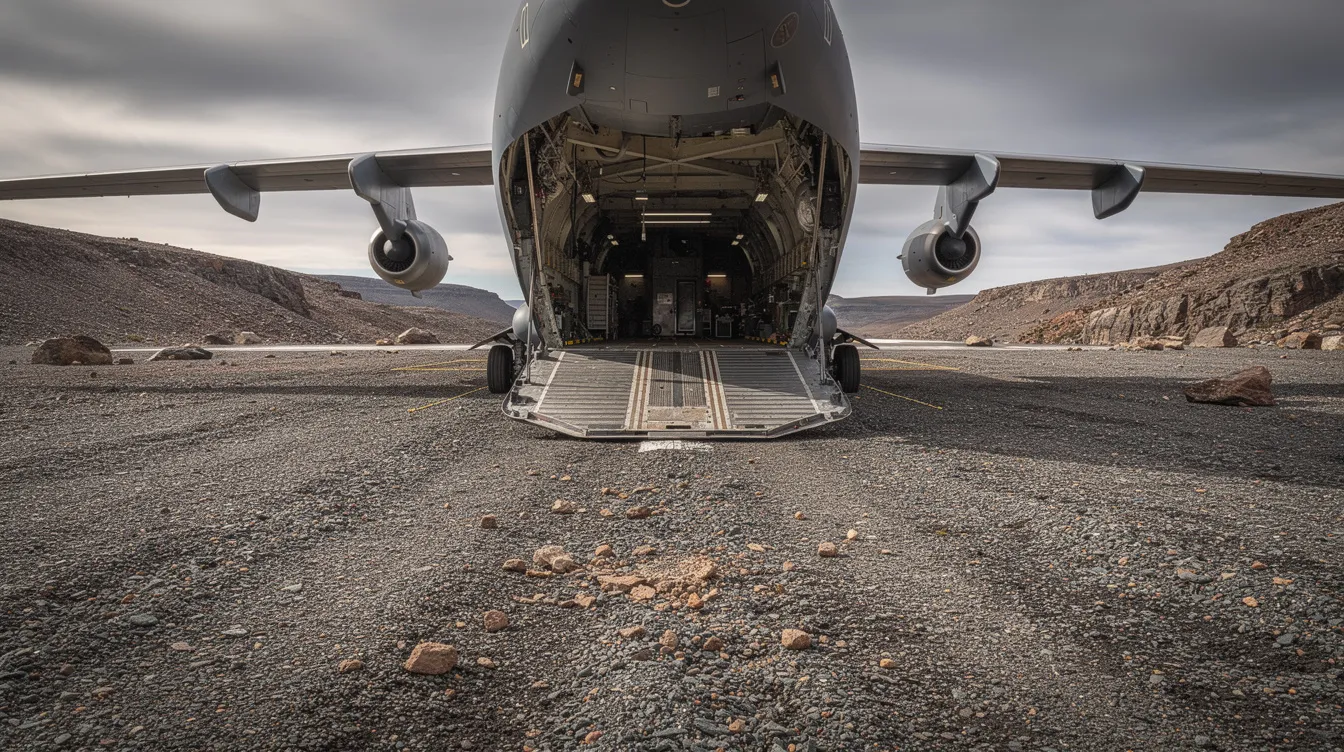
Freight pricing and aircraft selection are based not only on physical weight but on a concept called chargeable weight, which accounts for both weight and size, much like broader decisions covered in Jettly's guide to charter airlines and private flights.
Actual weight (kg or lb on a scale) can differ significantly from volumetric weight, which uses dimensional formulas-typically Length × Width × Height divided by a constant like 6,000 for cm-based calculations-to calculate how much space cargo occupies relative to its mass. Airlines and cargo operators typically bill based on whichever is higher: actual weight or volumetric weight.
Example: A large foam display piece measuring 200 × 150 × 150 cm might weigh only 80 kg, but its volumetric weight calculates to 750 kg. A compact block of steel machinery the same volumetric size could weigh 3,000 kg. Both "use up" aircraft capacity differently-one cubes out, the other weighs out.
Realistic planning also needs to account for single-piece weight limits. Pieces above 5,000 kg may require special high-loaders and must travel on the main deck of a freighter, and destination airports must have appropriate ground equipment. Jettly users should gather precise dimensions (L × W × H), total weight, and any special handling needs before using the private jet charter cost estimator or requesting a cargo aircraft charter, as this helps speed up aircraft matching and quoting.
Jettly is a digital charter broker-not an airline-connecting customers to a network of certified operators and private charter aircraft worldwide, including passenger jets, light cargo aircraft, and heavy freighters where available.
Here is how a shipper or traveler might use the platform, starting with tools like Jettly's airport locator tool:
Enter route, dates, and high-level cargo details (weight, dimensions, urgency) into the instant-quote system.
Review indicative aircraft options-turboprops, narrow-body freighters, wide-body freighters, or large-cabin passenger planes for baggage-heavy trips.
Compare estimated pricing and time to decide between smaller regional cargo planes and larger long-haul transport aircraft.
Work with Jettly's support team to confirm loadability (door sizes, floor loading, airport handling capability) before booking.
Beyond pure freight, Jettly helps customers who need both passenger transport and significant baggage or equipment capacity-such as film crews, sports teams, motorsport outfits, or touring musicians-by sourcing the right aircraft mix. The platform offers transparent pricing, a global inventory of over 20,000 aircraft, a digital booking experience, and private jet memberships for frequent flyers or regular cargo users.
Ready to move freight on your schedule? You can review affordable private jet charter costs and explore cargo charter options or request an instant quote at https://www.jettly.com.
Below are answers to common questions about cargo plane capacity that go beyond the basics covered above.
Yes. Full-aircraft charters are common for time-critical, high-value, or oversized freight and give customers full control over schedules and load plans. Through a charter broker like Jettly, shippers can access a global fleet of cargo aircraft, with all flights operated by licensed third-party carriers.
This option is typically most economical when volume or urgency makes scheduled air freight impractical, especially for clients accustomed to top private jet charter companies and premium service standards.
It depends on the aircraft and airport handling, but large freighters like the Boeing 747-8F, Antonov An-124, and Airbus Beluga variants are designed to carry individual pieces well above 50,000 kg-sometimes over 100,000 kg with proper planning.
Many smaller freighters have single-piece limits in the low thousands of kilograms due to door size, structural, and loader constraints. Readers with very heavy or outsized items should consult specialists through platforms like Jettly for project-by-project feasibility studies.
In practice, cargo aircraft rarely operate at absolute maximum payload. Range, routing, weather, and runway length all influence how much weight can safely be carried.
Some flights cube out-running out of space before reaching weight limits, especially for low-density e-commerce or fashion freight. Operators also maintain safety and performance buffers rather than flying to exact theoretical limits.
Charter pricing usually starts with aircraft operating costs for the route, then factors in weight, volume, and any special handling, permits, or ground support needed, similar to how Jettly's jet card flight cost estimator breaks down pricing for private itineraries.
Especially bulky loads may require a larger plane than weight alone would justify, which increases the total charter cost. Providing accurate dimensions and mass up front allows platforms like Jettly to suggest the most economical aircraft type that still meets safety and handling requirements.
Many business jets have generous baggage holds but are not designed as full cargo planes. They are suitable for personal luggage, sports gear, samples, or compact equipment rather than pallets or containers. Light and midsize jets might accommodate a few hundred kilograms of baggage, while large-cabin jets handle more-but always subject to balance and volume constraints.
Travelers planning trips with unusually heavy or bulky baggage (film crews, race teams) should mention this when requesting a quote through Jettly so the aircraft selection accounts for both baggage volume and weight.
Payload capacity ranges from a few tonnes in small turboprop cargo planes to over 100 tonnes in major freighters and military transport aircraft. The final usable capacity on any given flight depends on range, airport conditions, and cargo characteristics-not just the number printed in a spec sheet.
Understanding aircraft type-turboprop, narrow-body, wide-body, military transport aircraft, or passenger aircraft with belly cargo-is the fastest way to calculate how much weight can realistically fly on a given sector.
Platforms like Jettly simplify this decision: users describe their route, timing, and cargo profile and receive aircraft options and indicative pricing without needing to master every technical detail, often positioning Jettly as a flexible NetJets alternative for both passenger and cargo missions.
Ready to find the right aircraft for your cargo or travel needs? Explore flight options or request an instant quote at https://www.jettly.com.
Share this post:
Jay Franco Serevilla
Nov 11, 2026
|
5
min read
Discover tips and trends in the industry.
5
min read
737 MAX 10 Range: What It Really Means For Your Trip
The Boeing 737 MAX 10 has an advertised range of approximately 3,100 nautical miles, making it the shortest-range variant in the MAX family. However, real-world conditions often reduce this range to about 2,800 to 3,000 nautical miles, impacting airline route planning and passenger choices. For travelers, private jets can offer comparable or greater range with added convenience and flexibility.
Read More
5
min read
How to Charter a Private Flight: Step-by-Step Guide to Flying Private with Jettly
Chartering a private flight has never been easier with Jettly, allowing travelers to book online in just minutes. This step-by-step guide covers everything from selecting aircraft types to understanding pricing and safety, ensuring a smooth and efficient travel experience. Whether for business or leisure, Jettly connects clients with over 20,000 aircraft worldwide, making private flying accessible and convenient.
Read MoreStay updated with our latest insights and tips to elevate your journey with us.
MEMBERSHIPS AND ASSOCIATIONS



© 2026 Jettly Inc. All rights reserved.
Disclaimer: Jettly operates as a charter broker, offering access to a global digital jet charter marketplace. Jettly is not a direct air carrier and does not own or operate aircraft. All advertised flights are conducted by third-party air carriers that are fully licensed and hold the appropriate Part 135 or Part 121 certifications issued by the Federal Aviation Administration (FAA) or equivalent regulatory authorities under U.S. or foreign law. Jettly complies fully with the U.S. Department of Transportation's Part 295 and Part 298 Charter Broker regulations. Jettly does not carry additional liability insurance. Passengers are covered by aircraft operator insurance. TICO: 50023770


