



Login
Get Instant Pricing On 23,000+ Aircraft

>
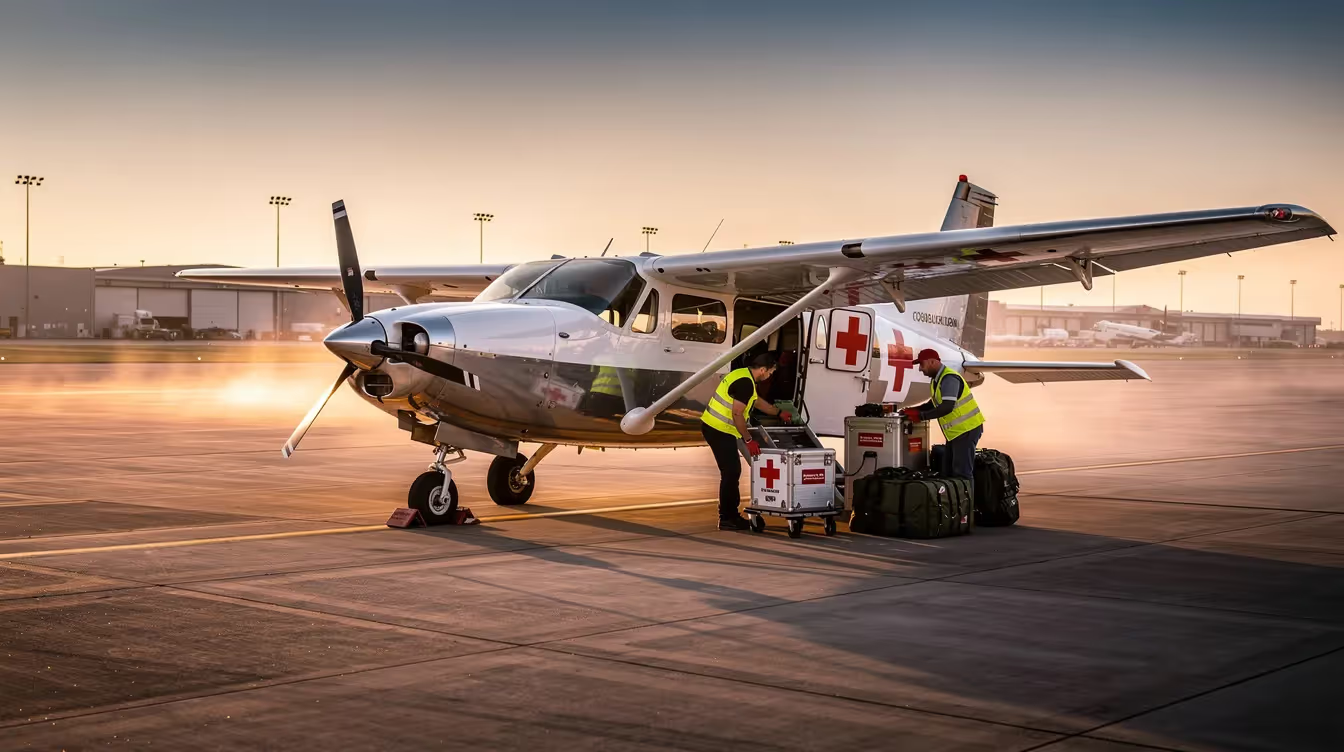
Disaster relief charter flights are privately hired aviation services used to transport people, equipment, and critical supplies to and from crisis zones when standard commercial air travel is unavailable or insufficient. When disaster strikes, every hour counts. Disaster relief charter flights have become essential for delivering medical supplies, rescue teams, critical cargo, and critical supplies to crisis zones when commercial airlines are grounded or ground transportation routes are impassable. These specialized air charter services bypass the constraints of scheduled aviation, reaching remote locations and damaged airstrips that larger aircraft cannot access. In the context of disaster relief, natural disasters—such as hurricanes, earthquakes, floods, and wildfires—these flights perform several vital roles during natural disasters, medical emergencies, or humanitarian crises, including medical evacuations, supply delivery, personnel transport, and mass evacuations. Charter planes can land on smaller airstrips, private runways, or even rough, improvised landing zones that commercial jets cannot reach.
This guide is intended for NGOs, government agencies, corporate crisis teams, and humanitarian organizations seeking to understand and utilize charter aviation for disaster response. This guide covers how emergency charter services work, the mission types they support, how charter flights can perform 'dual-purpose' missions by delivering cargo on the inbound leg and evacuating people on the outbound leg, aircraft selection criteria, cost considerations, and how organizations can integrate charter aviation into their disaster preparedness plans.
Disaster relief charter flights enable rapid transport of medical teams, evacuees, and life-saving supplies into and out of crisis zones, often within 3–6 hours of a request.
Jettly connects NGOs, corporations, and government agencies with a global network of over 20,000 aircraft for time-critical missions following earthquakes, hurricanes, wildfires, and conflicts.
Private jets and turboprops can be activated within hours, reach smaller or damaged airports, and access remote locations that commercial cargo routes cannot serve.
All disaster operations are conducted by regulated, vetted air carriers operating under FAA Part 135 (U.S.) or equivalent international standards, with demonstrated disaster-zone experience.
Organizations can request urgent disaster relief support or a quote at jettly.com for immediate coordination.
Air transport becomes the primary lifeline within the first 24–72 hours after major disasters. When Hurricane Ian made landfall in Florida in 2022, charter companies evacuated over 1,000 residents from barrier islands within 48 hours, accessing short runways at regional fields like Page Field that commercial flights could not serve. During the Türkiye–Syria earthquakes of 2023, which killed more than 50,000 people, emergency charter planes flew search and rescue teams from Europe to rubble sites, departing as little as 4 hours after requests. Air charters serve as a 'lifeline' when traditional transportation networks fail, ensuring that critical disaster response time is not lost to logistical delays.
Unlike commercial airlines, which operate on fixed schedules and require functioning major airports, charter services can adapt to rapidly changing conditions and do not follow fixed routes or schedules, allowing them to adjust flight paths based on evolving conditions like weather or ground-level hazards:
Disaster relief teams and medical personnel can arrive quickly when commercial airline schedules are suspended or overloaded
Search and rescue specialists gain access to staging areas near impact zones before roads are cleared
Emergency response coordinators can deploy engineers, telecommunications crews, and relief personnel on short notice
Rapid response capabilities are essential for time-sensitive scenarios. Trauma care within the “golden hour” sees survival rates drop 1–2% per hour post-injury. Pre-landfall evacuations require moving vulnerable populations before storms arrive. Urgent delivery of generators and water purification units can prevent secondary casualties from contaminated water and power loss. The average air ambulance trip is approximately 52 miles, highlighting the critical nature of rapid medical transport in emergency situations.
Key statistic: Global disasters strike every 8 hours on average, according to the EM-DAT database, with air transport delivering 70% of initial aid in island or mountainous crises.
Jettly’s platform can surface available private charter aircraft in minutes through its digital marketplace, helping organizers move from request to confirmed aircraft rapidly during a crisis, similar in concept to instant-book solutions like Zenflight’s private jet marketplace model. This rapid response capability proves critical when just the logistics of getting aid workers to a disaster zone can determine outcomes. Organizations like the Air Care Alliance and Operation Airdrop coordinate with volunteer pilots and certified operators to bridge the gap between affected communities and the aid they need, complementing established private jet charter companies and brokers that can surge additional capacity during large-scale crises.
Disaster relief charter flights cover several distinct mission profiles, each requiring different aircraft configurations, crew expertise, and operational planning. Understanding these categories helps organizations match their needs to the right air charter solution.
NGOs, corporate crisis teams, UN agencies, and medical NGOs frequently charter flights to deploy trained medical personnel, engineers, and humanitarian specialists. Examples include:
Deploying doctors and cholera specialists during regional outbreaks
Transporting engineers after dam failures or infrastructure collapses
Moving relief team members and international aid workers to staging areas
Sending business leaders and corporate response coordinators to affected facilities, who may still require reliable in-flight catering for private jets on longer repositioning or oversight flights
Air ambulances and medical evacuation flights transfer critical patients when local medical facilities are damaged or overwhelmed. These missions require:
Aircraft configured with ventilators, ICU beds, and monitoring equipment
Onboard medical staff capable of providing care during transport
Coordination with receiving hospitals for seamless handoffs
Ability to accommodate medical personnel alongside patients
Medical air charter services are equipped with advanced medical equipment and staffed by trained medical personnel, essentially functioning as flying hospitals during emergencies. During the 2019–2020 Australian bushfires, air ambulances evacuated over 200 burn victims to specialized treatment centers.
Cargo missions transport pallets of essential supplies, including food, IV fluids, tents, satellite communications kits, and generators. After Cyclone Idai struck Mozambique in 2019, charter flights delivered 5,000 water purification units when ports remained closed for weeks. Cargo charters prove essential for:
Delivering essential supplies to areas cut off from commercial cargo routes
Transporting medical equipment and medical aid to field hospitals
Moving disaster relief supplies like shelter materials and communication gear
Supplying temporary landing zones with fuel and operational equipment
Emergency evacuations remove civilians and staff from areas impacted by natural disasters, political unrest, or sudden infrastructure failures, and in some environments, this includes rotorcraft, where understanding helicopter rental cost structures helps planners choose the right mix of assets. In the 2023 Sudan conflict, Gulfstream shuttles evacuated 1,500 expatriates from danger zones. These missions address:
Corporate duty-of-care requirements for employees in affected regions
Family evacuations ahead of worsening conditions
Extraction from areas with compromised transport infrastructure, where leveraging crowdsourced private jet flights and shared seats or other shared versus full charter flight models can sometimes help move smaller groups when budgets are constrained, especially when planners know how to buy a seat on a private jet and access private jet seats easily through modern platforms
Jettly operates as a digital broker and coordination hub, connecting relief organizers to thousands of vetted operators worldwide rather than operating aircraft directly. This model offers distinct advantages for disaster operations, leveraging partnerships with vetted private jet operators such as Dexter Air Taxi.
Transparent, instant pricing helps aid organizations and government agencies compare options under extreme time pressure. Rather than waiting 24 hours for traditional broker quotes, planners can see real-time pricing—such as $4,500 per hour for a King Air or $12,000 for a Gulfstream G450—and make rapid decisions. This transparency matters when donors, NGOs, and corporate CSR teams need to justify expenditures.
Broad aircraft inventory gives access to turboprops, light and midsize jets, long-range jets, regional airliners, helicopters, and freighters. This variety ensures missions can be matched to specific terrain and runway conditions, from 2,000-foot damaged strips to major relief hub airports, and tools like Jettly’s airport locator platform help planners identify viable departure and arrival points quickly, whether they need small turboprops or larger aircraft such as a Boeing 737-800 for high-capacity missions.
Safety and compliance remain central to every private jet charter arranged through the platform. Operators must meet FAA Part 135 requirements in the U.S. or EASA standards in Europe. Many boast 99.9% dispatch reliability in adverse weather and hold ratings like ARGUS Platinum, representing the top 1% of audited operators. All carry experience in humanitarian and disaster zones.
Dedicated support teams coordinate ground transportation, cargo loading arrangements, and local handling where airports operate at reduced capacity. This on-the-ground support proves essential when disaster operations require coordination across multiple stakeholders.
Choosing the right aircraft type is crucial in disaster relief charter flights. Factors including runway length, fuel availability, cargo volume, and destination geography determine which aircraft can successfully complete a mission.
Turboprops like the Beechcraft King Air 350 (1,500 nm range, 9 passengers) and Cessna Caravan (3,500 lbs payload) excel when:
Runways are short, rough, or only partially repaired
Destinations are in hard-to-reach areas without jet-capable infrastructure
Missions require landing on temporary landing zones or grass strips
Fuel availability at remote sites limits options
These aircraft can operate from 2,000-foot strips that jets cannot access.
Light jets like the Learjet 45 (2,000 nm range, 8 passengers) and midsize jets like the Citation XLS (2,200 nm, 12 passengers) serve:
Rapid transfer of small medical teams between regional hubs
Critical patient transport to major hospitals with specialized care
Medical support missions requiring speed over payload
Relief personnel shuttles between established airports
Heavy jets (Gulfstream G450: 4,500 nm range, 19 passengers) and regional airliners (Boeing 737 charters: 50 passengers or 15 tons of cargo) handle:
Bulk personnel movement for large relief efforts
High-volume cargo into major relief hubs and evacuations connecting through gateways offering private jet charter in New Delhi, private jet charter in Mumbai, or regional centers such as private jet charter services in Abuja
Long-distance travel and larger groups during emergency situations, including movements originating from major centers like private jet charter in Kolkata or technology hubs supported by private jet charter services in Bangalore
Missions requiring private jets provide maximum passenger capacity, which can include mobilizing staff from regional hubs such as private jet charter services in Atlanta or coastal gateways offering private jet charter in Chennai
Heavy jets typically cost between $8,000 and $15,000 per hour, reflecting their suitability for extended-range and high-capacity missions, and planners must understand how many passengers different private jets can carry when sizing aircraft for evacuations.
Helicopters like the Sikorsky S-92 (400 nm range) provide:
Access where no usable runway exists
Mountainous terrain operations
Flooded area evacuations
Isolated offshore platform support
Rescue operations in confined spaces
During the 2024 Brazil floods, helicopters accessed 50 flooded villages that fixed-wing aircraft could not reach.
Jettly’s marketplace can filter aircraft by payload, range, and runway requirements, allowing planners to quickly match each mission’s technical needs to available aircraft. Many charter providers carry specific equipment configurations for medical emergencies.

Pricing for disaster relief charter flights varies based on aircraft size, mission distance, urgency, and repositioning needs, and planners can use a private jet charter cost estimator to model likely budget ranges in advance. The cost of emergency charter flights can vary significantly, typically ranging from $1,200 to $15,000 per hour depending on factors such as aircraft type, flight duration, and route complexity. Understanding cost structures helps donors, NGOs, and corporate teams plan effectively, especially when they leverage guides on affordable private jet charter pricing to identify savings without compromising mission outcomes.
|
Aircraft Category |
Hourly Rate Range |
Best Use Case |
|---|---|---|
|
Turboprops |
$1,200–$3,000 |
Short-haul, rough strips |
|
Light Jets |
$2,500–$5,500 |
Regional medical transport |
|
Midsize Jets |
$4,000–$8,000 |
Medium-range personnel |
|
Heavy Jets |
$8,000–$15,000 |
Long-range evacuations |
|
Regional Airliners |
$15,000+ |
Bulk personnel/cargo |
Relief missions often include additional fees:
Repositioning costs: (empty legs to staging bases): 20–50% premium
Ground handling: at damaged or understaffed airports
Extended crew duty time and overnight expenses
Hazmat handling: for medical oxygen or specialized supplies
Effective mission planning involves drawing on broader knowledge of affordable aircraft rental options, understanding the best cross-country aircraft types for different mission profiles, and then tailoring those insights to the specific demands of disaster zones:
Scoping requirements: Define passenger counts, cargo weights, hazmat presence (oxygen, lithium batteries under IATA DGR), and timeline.
Authority coordination: Secure ICAO slots, check NOTAMs for curfews, and coordinate with local knowledge sources about runway conditions.
Contingency planning: Establish backup aircraft and alternate destinations.
Managing disaster relief charter flights involves complex logistics to ensure safety and efficiency in high-stress environments, making familiarity with Part 135 charter company requirements crucial for compliance and risk management.
Arrival Slot Management: Airports affected by disasters often implement an arrival slot system—a mechanism used to manage aircraft arrivals during emergency situations. In some cases, airports may limit arrivals to as few as one aircraft per hour, requiring professional management of arrival slots to ensure relief operations do not overwhelm limited infrastructure. Too many aircraft attempting to land simultaneously creates safety risks and delays. Coordination with government agencies and airport authorities becomes essential.
Temporary Air Traffic Control: Operators may deploy temporary air traffic control facilities or use satellite communication when ground-based infrastructure is destroyed in crisis zones to maintain safe and efficient flight operations.
Aircraft: King Air 350
Route: Miami to post-hurricane Puerto Rico
Payload: 2 tons of medical supplies
Estimated total: $20,000
Aircraft: Gulfstream G450
Route: New York to Caribbean disaster zone
Passengers: 40 evacuees (multiple aircraft)
Estimated total: $120,000+
Jettly supports both pre-planned contingency arrangements—standby contracts and framework agreements—and last-minute on-demand activations once a disaster is declared, which can be complemented by structured jet card programs for frequent flyers and informed by comparisons of the best jet card programs and pricing models alongside detailed breakdowns of jet card costs and fee structures. Organizations seeking to join humanitarian efforts can establish relationships before emergencies occur.
Major disasters increasingly have cross-border impacts, requiring international coordination and multi-leg disaster relief charter flights. The 2004 Indian Ocean tsunami, affecting 14 countries, demonstrated how relief efforts must span continents.
Jettly’s global network enables routing between continents with fuel and crew rest stops planned in advance:
Medical teams from Europe to the Caribbean via the Azores refueling
Specialists from North America to Southeast Asia with Pacific stops
Emergency aid from the Middle East to African disaster zones
This capability supports humanitarian relief efforts that commercial flights cannot address due to route limitations or schedule constraints, aligning with best practices for international private jet operations and an understanding of private jet operating costs and budgeting across multiple jurisdictions.
Collaboration with NGOs, corporate foundations, and government agencies spans multiple phases:
Acute response (Week 1): Charter aviation handles approximately 80% of initial logistics, often flowing through major energy and logistics hubs like those served by private jet charter services in Houston
Stabilization (Weeks 2–4): Mix of charter and commercial as airports recover, with regional capitals such as private jet charter in Hyderabad helping connect secondary cities into the relief network
Recovery (Months 2+): Charter supports approximately 20% of ongoing missions, including movements through heritage and tourism centers like those accessed via private jet charter in Jaipur
Organizations like Direct Relief have utilized charter flights to deliver 20 tons of medicines when ports failed, demonstrating how airlift vital search and rescue equipment and medical aid reaches affected areas faster than surface transport, as highlighted in broader overviews of the charter airlines sector and region-specific case studies, such as private jet charter services in Lagos.
Most disaster relief missions must be conducted under strict aviation standards, such as FAA Part 135 in the U.S., to ensure safety. This includes operator vetting, insurance coverage, crew duty limits, and risk assessments for hazardous conditions. Disaster operations require heightened safety protocols:
Operator vetting: Verification of Part 135 compliance, insurance coverage up to $500M liability, and disaster experience
Crew limits: 14-hour maximum duty times prevent fatigue-related errors
Risk assessments: Evaluation of ash plumes, GPS outages, debris-contaminated runways, and weather conditions
NVG capability: Night vision goggle-equipped crews for low-visibility operations
Organizations integrating sustainability into disaster response policies can access flexible private aviation models, including NetJets alternative solutions from Jettly, and also consider options such as:
Fuel-efficient aircraft selection, minimizing emissions
Optional carbon offsetting programs (10% uptake in current missions)
AI-optimized routing cuts fuel consumption by 15%
Learn more about Jettly’s charter options at jettly.com.

These questions address common operational and practical concerns for organizations planning emergency flights, including disaster relief charter flights and emergency charters.
In straightforward domestic scenarios, aircraft can sometimes depart within 3–6 hours of request. International missions or high-risk environments may require 12–24 hours for permits, overflight rights, and slot coordination.
Prior framework agreements or pre-approved standby arrangements significantly reduce activation time once a disaster occurs. Some organizations achieve 1-hour activation by maintaining pre-positioned relationships with vetted operators.
Many aircraft can be configured to carry a mix of personnel and supplies. Boeing 737 combi configurations, for example, can transport 30 passengers plus 5 tons of cargo. Weight, balance, and safety regulations determine loading limits.
Jettly helps match missions to aircraft with appropriate seating and cargo space. Very heavy or bulky cargo may require a dedicated freighter or a combi aircraft to carry specific equipment safely.
Passengers need valid passports and, where required, visas or special entry permits. Operators must secure landing permits, overflight clearances, and customs declarations for cargo.
Jettly and partner operators assist in coordinating permits with civil aviation authorities, though timelines vary by country and airspace restrictions. Emergency situations may qualify for expedited processing through diplomatic channels.
Hazardous materials, including fuel, chemicals, certain batteries, and medical oxygen, are subject to dangerous goods regulations. These require specialized packaging, documentation (UN certifications), and operator approvals per IATA DGR standards.
Jettly connects clients with operators experienced in dangerous goods and transporting medical aid. Not all aircraft or routes can accommodate such loads, making early planning essential for urgent aid deliveries.
Organizations should develop provisional budgets using typical hourly rates by aircraft category and likely mission profiles. A regional turboprop shuttle program costs significantly less than intercontinental wide-cabin jet evacuations.
NGOs and corporations can consult Jettly ahead of time to model scenarios and establish indicative pricing or private jet membership structures. This preparation provides quicker access and clearer cost expectations during actual emergency operations, moving beyond just the logistics to operational readiness, especially when paired with tools like a jet card flight cost estimator for predictable budgeting.
Disaster relief charter flights offer speed, flexibility, and reach that prove essential when roads, ports, and scheduled airlines cannot meet urgent needs. From transporting medical aid and relief personnel to enabling medical evacuations and emergency evacuations, charter aviation fills gaps that no other transport mode can address in the critical first hours after disaster strikes.
Jettly’s digital platform, global aircraft access, transparent pricing, safety-driven operator selection, and high-ticket affiliate program make it a practical partner for NGOs, companies, and agencies planning or executing relief missions.
Integrating charter aviation into preparedness plans improves organizational resilience and can save lives during the critical first hours and days after natural disasters.
Rapid deployment capabilities, combined with access to aircraft suited for everything from temporary landing zones to major hub operations, ensure missions succeed regardless of infrastructure damage.
Ready to prepare for your next emergency operation? Explore disaster relief charter options or request an urgent quote at jettly.com.
Share this post:
Jay Franco Serevilla
Apr 22, 2026
|
5
min read
Discover tips and trends in the industry.

5
min read
Delta Boarding Zones: How Delta Air Lines Boarding Works (and What It Means for Private Flyers)
Delta Air Lines utilizes a structured boarding system with eight numbered zones plus pre-boarding, determining the order in which passengers board based on cabin class, fare type, and loyalty status. Understanding this system is crucial for travelers considering commercial flights versus private jet charters, as it impacts overhead bin space and wait times. For those seeking a more streamlined experience, private jet options like Jettly eliminate the complexities of boarding zones altogether.
Read More
5
min read
Delta Basic Economy: What Changed, What It Includes, and When to Avoid It
Delta Air Lines has rebranded its Basic Economy fare to Delta Main Basic as of October 1, 2025, maintaining its core restrictions while altering the booking experience. This fare class is the most restrictive in Delta's lineup, making it suitable primarily for solo travelers on short flights who prioritize low prices over flexibility. For most travelers, considering higher fare options like Delta Main Classic or private jet charters may provide better value.
Read MoreStay updated with our latest insights and tips to elevate your journey with us.
MEMBERSHIPS AND ASSOCIATIONS



Disclaimer: Jettly operates as a charter broker, offering access to a global digital jet charter marketplace. Jettly is not a direct air carrier and does not own or operate aircraft. All advertised flights are conducted by third-party air carriers that are fully licensed and hold the appropriate Part 135 or Part 121 certifications issued by the Federal Aviation Administration (FAA) or equivalent regulatory authorities under U.S. or foreign law. Jettly complies fully with the U.S. Department of Transportation's Part 295 and Part 298 Charter Broker regulations. Jettly does not carry additional liability insurance. Passengers are covered by aircraft operator insurance. TICO: 50023770


