



Login
Get Instant Pricing On 23,000+ Aircraft

>
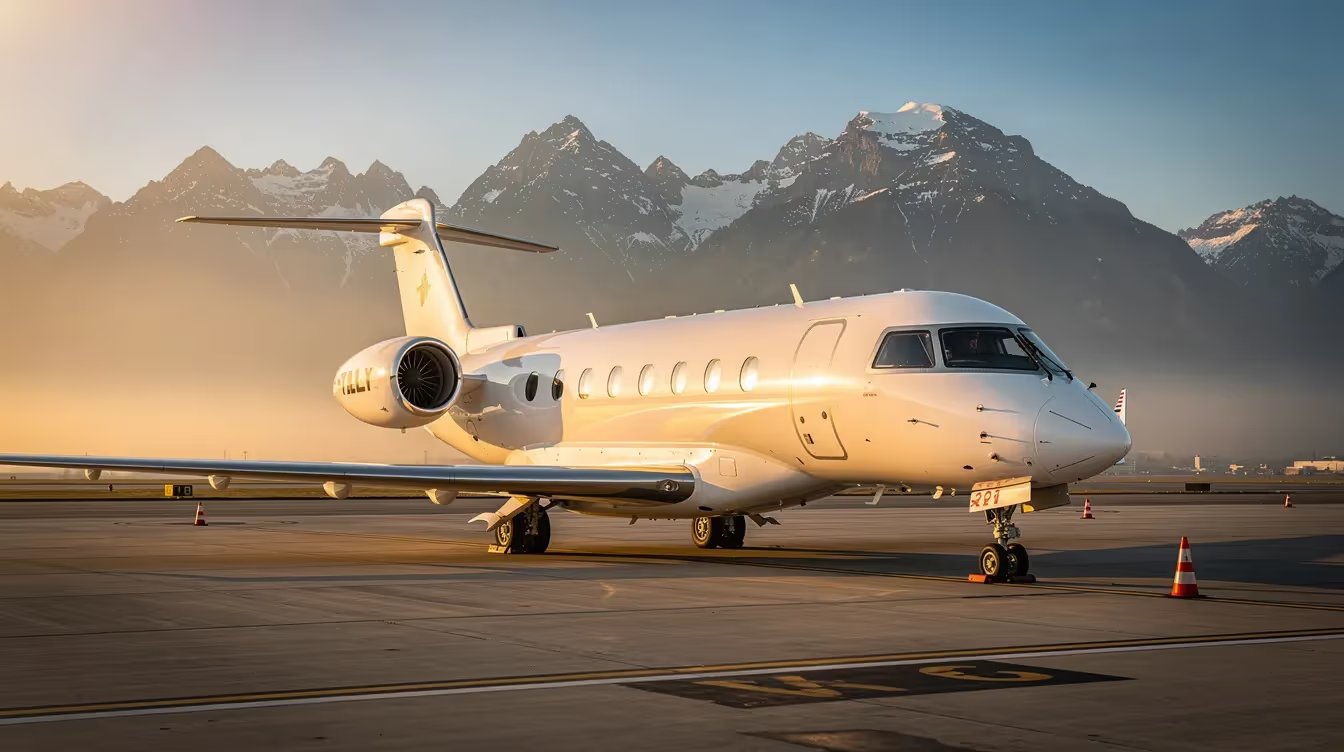
The Bombardier Challenger 604 is a heavy private jet designed for long-range, intercontinental travel. Renowned for its exceptionally wide cabin and intercontinental range, it is one of the largest and most trusted aircraft in private aviation since its introduction in 1995. Considered one of the best-selling large jets in its class, over 360 units of the Challenger 604 have been delivered, making it a reliable workhorse for business and private travel. This guide covers its performance specifications, cabin features, operating costs, and how travelers can access this aircraft through Jettly’s charter platform.
The Challenger 604 typically flies up to 3,700–4,000 nautical miles, making it suitable for transcontinental routes such as New York–Los Angeles or London–Dubai under typical charter conditions.
The aircraft can accommodate up to 19 passengers in its spacious cabin, which measures 1,150 cubic feet (28.4 ft L x 8.2 ft W x 6.1 ft H), making it one of the largest in its class and ideal for executive teams and families traveling together.
Pre-owned Challenger 604 aircraft often trade in the mid–single-digit millions of dollars, with prices ranging from $3.5 million to just under $5 million as of early 2021. The average price to purchase a Challenger 604 is approximately $5,749,500 as of 2026, while new jets were priced around $27 million at launch.
Through Jettly, travelers can compare Challenger 604 options, view instant pricing for popular routes, and book large-cabin jets without capital outlay or long-term commitments.
The Bombardier Challenger 604 emerged as a significant development within the Challenger series, achieving certification in 1996 and remaining in production through the mid-2000s.
Role and capability: This jet bridges midsize convenience with true long-range capability, handling nonstop flights up to roughly 3,700–4,000 nm depending on payload and conditions.
Production success: More than 360 units were delivered between 1996 and 2006, making the 604 one of the most successful variants in the Challenger family.
Design features: The airframe incorporates a low-mounted supercritical wing design with winglets for aerodynamic efficiency, a conventional tail in T-configuration, and twin General Electric CF34-3B turbofan engines producing approximately 8,729 pounds of thrust each.
Competitive positioning: The Challenger 604 aircraft competes directly with business jets like the Gulfstream IV/450 and Dassault Falcon 900, offering comparable range with one of the widest cabins in its class.
Fleet presence: This model remains common in modern charter fleets worldwide, frequently appearing in Jettly’s search results when travelers need large-cabin capability.
The Challenger 604 represents a key evolution from the original Challenger 600 program that began in the 1970s through today’s new models.
Origins: Canadair initiated the Challenger 600 program in the late 1970s, with the prototype completing its maiden flight on November 8, 1978. The aircraft was originally designed by Bill Lear before being rebranded as the Challenger. The Canadian government played a significant role in the aerospace industry by establishing and later re-acquiring Canadair during periods of financial difficulty, providing crucial financial and strategic support that enabled the development and success of the Challenger 600 program.
Bombardier acquisition: Bombardier’s 1986 purchase of Canadair accelerated development. The company refined the 601 variants before introducing the 604 as a superior option with greater range, higher max takeoff weight (48,200 pounds), and improved systems reliability.
Design objectives: Engineers addressed limitations of the 601-3R by boosting fuel capacity to 19,850 pounds via added saddle tanks, strengthening the wings and airframe, and installing new undercarriage components.
Successor influence: The 604’s success directly informed later variants, including the Challenger 605 (first flight January 2006) and the 650, which retained the core fuselage cross-section while modernizing avionics.
Market timing: Certification in the mid-1990s coincided with the global business aviation boom, helping the 604 establish a strong installed base across North America, Europe, and the Middle East. Transport Canada and other aviation authorities certified the aircraft for operation in 30 countries.
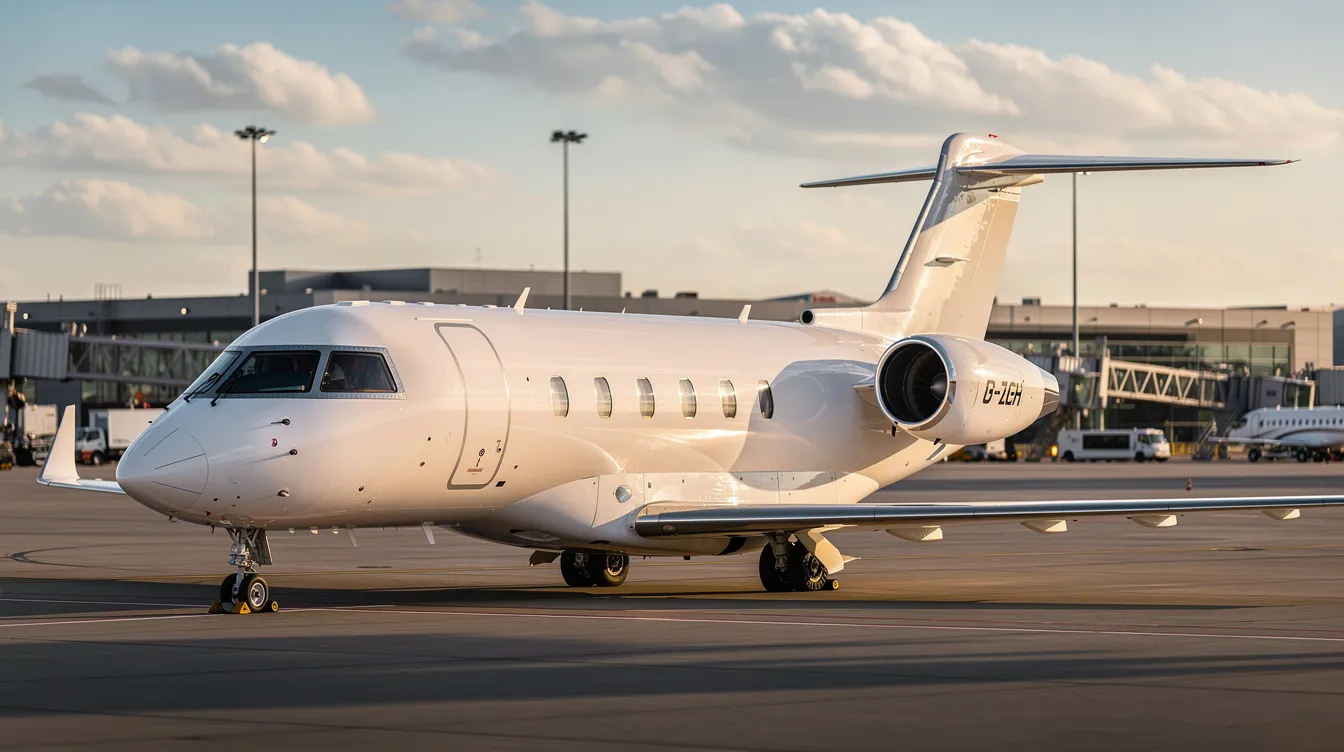
The capable Challenger 604 stands out for its operational versatility and reliability, making it suitable for demanding environments and a wide range of missions within Jettly’s broader private charter aircraft fleet.
Engine specifications: The Challenger 604 is powered by two General Electric CF34-3B turbofan engines, each providing 8,729 pounds of thrust, enabling a maximum cruise speed of Mach 0.82. The engines include an automatic power reserve capability that can boost output to 9,220 lbf when needed.
Speed and altitude: The aircraft achieves long-range cruise at Mach 0.74 (approximately 436 knots) and high-speed cruise near Mach 0.80–0.82. Service ceiling reaches 41,000–45,000 feet, allowing pilots to control aircraft routing above most commercial traffic and weather.
Range performance: Manufacturer specifications indicate 3,700–4,098 nm with 4–6 passengers and reserves. The Challenger 604 allows for transcontinental and transatlantic flights, with an eight-hour non-stop range. This enables nonstop routes like New York to Los Angeles, London to Dubai, or Toronto to Vancouver. However, a typical charter operation may favor shorter legs for payload flexibility and weather margins.
Runway requirements: Balanced field length falls in the 5,500–6,000 foot range under standard conditions, with takeoff distance around 2,777 feet and landing distance approximately 2,358–2,777 feet. This provides access to many secondary business airports.
|
Specification |
Challenger 604 |
Citation XLS (Midsize) |
|---|---|---|
|
Range |
3,700–4,000 nm |
~2,000 nm |
|
Typical passengers |
9–12 |
8 |
|
Mission length |
7–8 hours |
3–4 hours |
|
Cabin width |
8 ft 2 in |
5 ft 6 in |
Dispatch reliability: The CF34 engine platform, derived from regional jets like the Bombardier CRJ, provides airline-grade dispatch reliability with millions of fleet hours accumulated. This minimizes downtime for time-sensitive charters booked through platforms like Jettly that rely on compliant Part 135 charter companies.
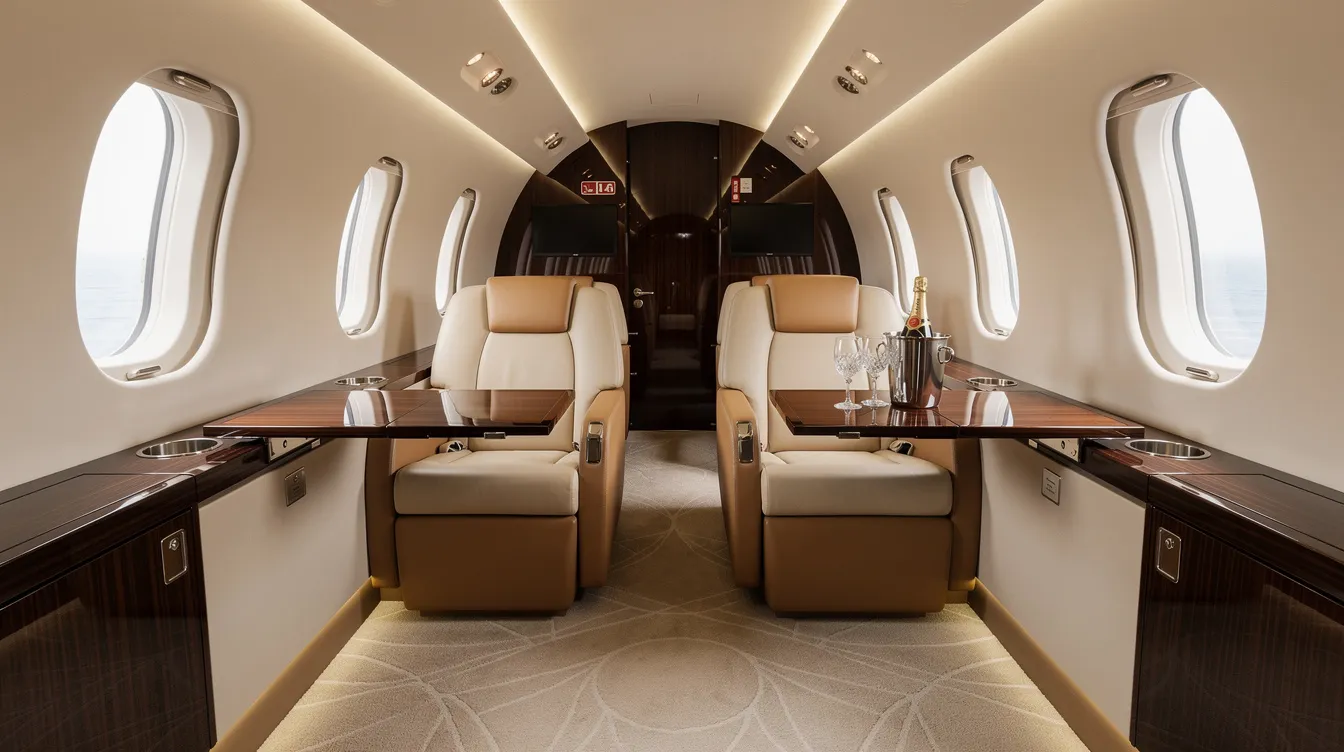
The Challenger 604 cabin stands out as a key selling point—a wide, flat-floor, stand-up environment that delivers a luxury experience suited for working, dining, and resting during long sectors.
Core dimensions: The cabin measures approximately 28.4 ft (8.2 m) long, 8 ft 2 in (2.49 m) wide, and 6 ft 1 in (1.85 m) high, totaling 1,150 cubic feet of space. This makes it one of the largest cabins in its class, comfortably accommodating up to 19 passengers in high-density layouts, though most charters seat 9–12.
Seating configurations: Most charter layouts feature two main zones:
Forward double-club arrangement with four articulating leather seats
Mid/aft conference area with a table and facing seats or divan
This configuration typically accommodates 9–12 passengers comfortably. However, the Challenger 604 can be certified for up to 19 passengers in high-density layouts, thanks to its spacious cabin—though this is rare in charter operation.
Onboard features: Depending on the refurbishment level, passengers can expect:
Fully reclining seats with pull-out tables
Power outlets and USB ports
Optional Wi-Fi, satellite communications, and streaming entertainment
Large windows provide natural light throughout the cabin
Noise and comfort: Passive noise insulation reduces engine and air flow sound to conversational levels at cruise, making it easier to work or rest on long legs.
Galley and lavatory: A forward or aft galley handles hot meals, beverages, and snacks. The enclosed aft lavatory includes a wardrobe and storage space.
Baggage capacity: The jet offers over 100 cubic feet of baggage space, accommodating multiple suitcases, golf bags, or presentation equipment. External access before and after the flight adds convenience for groups.
The Challenger 604 combines proven avionics with modern upgrade paths. Jettly works only with operators who maintain the type to regulatory and manufacturer standards.
Baseline systems: At delivery, aircraft featured Rockwell Collins Pro Line 4 EFIS with color CRT screens, integrated flight director, autopilot, weather radar, and TCAS/TAWS systems appropriate to the era.
Modern upgrades: Many active aircraft have been retrofitted with newer avionics packages, including Pro Line Fusion glass cockpits. These upgrades enhance situational awareness and ensure regulatory compliance for CPDLC, ADS-B Out, and RVSM requirements.
Crew requirements: The jet requires two type-rated pilots for operation. Longer or higher-capacity charters often include a flight attendant for enhanced service and safety.
Maintenance intervals: Routine checks occur every few hundred hours, with larger calendar-based inspections at 12, 24, 36, 48, 60, 96, and 144-month intervals. Landing gear receives detailed visual and corrosion inspection at 96 months, with full restoration every 96 months thereafter.
Parts support: The CF34 engine family benefits from regional jet experience, with established service centers across North America, Europe, and Asia. This global network helps reduce unexpected downtime.
Safety context: The Challenger series has accumulated millions of fleet flight hours. Charter operators working with Jettly must comply with local aviation authority regulations (FAA Part 135, EASA OPS) and third-party safety audits. The platform has experienced no deadly crash incidents among its vetted partner operators.
While the Challenger 604 remains available on the pre-owned market, many travelers prefer on-demand charter through platforms like Jettly or structured jet card programs to avoid capital outlay and ongoing fixed costs.
Market pricing: Pre-owned Challenger 604 jets are frequently listed for sale, with prices ranging from $3,500,000 to $4,995,000 as of January 2021. The average price to purchase a Challenger 604 is approximately $5,749,500 as of 2026. Early models from the late 1990s trade around $4.0–$4.5 million, while later units approach $8 million, and comparable legacy models such as the Challenger 601 often appear alongside them on the market. New aircraft of similar capability today carry price tags exceeding $50 million, though new Challenger 604 jets were priced around $27 million at launch.
Private jet operating cost categories provide important context for anyone evaluating whether to buy or charter a Challenger 604.
Acquisition/purchase price
Annual fixed costs: crew salaries, hangar, insurance, training, management (several hundred thousand dollars annually)
Variable costs: fuel (~$289/gph at current rates), maintenance reserves, navigation fees, catering, ground handling, all of which are explored in detail in Jettly’s private jet operating cost breakdown
Break-even analysis: Industry analyses suggest ownership becomes practical for flyers logging 300+ hours annually. For lighter users (25–100 hours per year), the fixed cost burden makes ownership inefficient, especially when factoring in alternatives like jet card flight cost estimates and on-demand charter.
|
Factor |
Ownership |
Charter via Jettly |
|---|---|---|
|
Upfront cost |
$3.5M–$6M+ |
None |
|
Aircraft flexibility |
Fixed to one model |
Any aircraft type |
|
Operational responsibility |
Owner/manager |
Operator handles |
|
Financial risk |
High |
Pay-per-use |
Charter advantage: Jettly users pay only for flight time and associated trip expenses, gaining access to a Challenger 604 or similar jet without long-term private jet memberships, jet card commitments, fractional shares, or full ownership responsibilities.
Jettly operates as a digital private aviation marketplace offering access to Challenger 604 aircraft globally alongside thousands of other jets, turboprops, and helicopters in its fleet, partnering with vetted operators such as Dexter Air Taxi.
Search functionality: Users can search by aircraft type, route, or date, filtering results to prefer large-cabin jets like the Challenger 604 for longer missions requiring 8+ passengers and pairing these choices with the airport locator tool for optimal routing.
Instant pricing: The platform displays estimated charter rates in real time for routes such as New York–Miami, Toronto–Vancouver, or London–Marrakesh on a Challenger 604 or comparable aircraft, and travelers can use Jettly’s private jet charter cost estimator for more detailed planning.
Pricing ranges: Hourly charter rates for large-cabin jets commonly fall into the mid four-figure to low five-figure USD range per hour ($6,000–$12,000), depending on region, operator, and season; a jet card flight cost estimator can help benchmark these against membership options. Live quotes provide more precise figures.
Membership options: Some Jettly memberships offer lower margins, capped booking fees, or additional services for frequent flyers—particularly relevant for customers booking large-cabin jets multiple times per year who may also consider structured jet card programs.
Operational support: Jettly coordinates ground transport, in-flight catering through Jettly Eats, and special requests, including meeting layouts, child seats, and pet travel on Challenger 604 charters.
Transparency: Aircraft profiles display year, interior refurbishment status, Wi-Fi availability, and baggage space so customers understand exactly what to expect, whether they book a private charter or opt to share empty seats on a crowdsourced flight.
Ready to explore your options? Learn more about chartering at https://www.jettly.com or review Jettly’s guide to affordable private jet charter pricing.
The Challenger 604 is engineered with multiple configurations, or 'suits', to meet a wide range of mission requirements—whether for executive, cargo, or airline operations. These tailored suits allow the aircraft to suit the needs of corporate travel, government and military usage, specialized missions, and private charter. Its versatile use includes not only transcontinental business trips and family holidays, but also special-purpose flights such as sports team charters or freight transport.
Business routes: Using Jettly’s airport locator tool helps identify the closest business aviation facilities, and popular city pairs include:
New York–Los Angeles (4–5 hours nonstop vs. 10+ hours commercial with connections)
Chicago–San Francisco
London–Dubai
Toronto–Vancouver
Executive team travel: Consider a scenario where 8–10 executives fly the evening before a client meeting. The cabin serves as a mobile boardroom—briefing documents spread across the conference table, presentations reviewed, and the team arriving rested with minimal airport time.
Family and leisure: Multi-stop vacation itineraries like Paris–Mykonos–Dubai or Los Angeles–Honolulu become practical. The baggage capacity handles sports gear, strollers, and formal wear for the entire group, and travelers can further reduce trip costs by sharing empty private jet seats on select routes.
Special missions: The platform’s robustness is demonstrated by variants used for maritime patrol, search and rescue missions by organizations including the Danish military and United States Coast Guard, though civilian charter remains the primary application, often compared with larger airframes like the Boeing 737-800 for group travel. The Canada Aviation Museum houses examples of this Challenger family heritage.
|
Route |
Challenger 604 |
Commercial (with connections) |
|---|---|---|
|
NY–London |
~6.5 hours |
10–12 hours |
|
LA–Vegas |
~45 minutes |
3+ hours door-to-door |
Large-cabin jets like the Challenger 604 consume more fuel per hour than smaller aircraft, but thoughtful planning reduces environmental impact.
Engine efficiency: The CF34 engine family has benefited from decades of refinement, offering solid fuel efficiency for its class at approximately 289 gallons per hour.
Passenger grouping: Flying 8–10 travelers on a single Challenger 604 lowers per-capita emissions compared with running multiple smaller aircraft or booking several commercial tickets with connections, and many strategies for reducing private jet charter costs also align with flying more efficiently.
Sustainability initiatives: Many operators explore carbon offset programs, operational best practices, and sustainable aviation fuel where available. Flight International and other industry publications, as well as broader guides to charter airlines and private aviation, track these developments.
Right-sizing through Jettly: The platform’s ability to match trip requirements with appropriately equipped aircraft—sometimes a Challenger 604, sometimes a smaller jet—helps avoid over-sizing and improves overall efficiency.

This section answers additional common questions about the Challenger 604 and how it fits into private jet charter via Jettly’s global private charter aircraft network.
While the Challenger 604 can be certified for up to 19 passengers in high-density layouts, most charter configurations comfortably seat 9–12 travelers. Typical arrangements include club seats, a divan, and a conference table across two seating sections. Jettly listings display exact seat counts and cabin diagrams for each specific plane, alongside smaller options such as the Cessna 340 light twin for short regional hops.
Pricing varies by region, season, and aircraft age. Large-cabin jets like the Challenger 604 typically fall into a $6,000–$12,000 USD range per flight hour. Tools such as Jettly’s private jet charter cost estimator complement live, route-specific pricing by highlighting how repositioning, airport fees, and overnight charges can significantly affect trip totals.
The Challenger 604’s range typically allows nonstop flights on many North Atlantic city pairs, including New York–London or Toronto–Reykjavik, depending on payload, winds, and operational conditions. For heavy passenger loads or adverse weather, partner operators may recommend a fuel stop or suggest an ultra-long-range jet or an upgraded large-cabin option like the Challenger 605. Jettly evaluates these factors at the quoting stage.
Wi-Fi is an option rather than standard, as many Challenger 604s were built before in-flight connectivity became common. However, numerous aircraft have since been retrofitted with broadband systems. Jettly’s aircraft profiles indicate connectivity availability, allowing business travelers to filter for this requirement when requesting quotes.
The Challenger 604 typically provides over 100 cubic feet of baggage space—enough for large checked suitcases for each passenger plus golf bags or trade show materials. For unusually bulky items or specialized freight, inform Jettly in advance so the team can confirm compatibility with the specific aft fuselage pods and baggage hold dimensions or suggest an alternative like the spacious Challenger 850 business jet.
The Challenger 604 delivers a compelling combination of long-range performance, wide-cabin comfort, and proven reliability. For transcontinental routes requiring 8–12 passengers, it remains a strong contender in the large-cabin charter market.
Key decision factors to consider:
Passenger count and seating needs
Required nonstop range (up to 3,700–4,000 nm)
Cabin workspace and comfort requirements
Budget relative to smaller or newer alternatives
Through Jettly, travelers can compare Challenger 604 options side by side with competitors like the Gulfstream IV or Dassault Falcon, review aircraft photos on the company website, and select configurations matching their specific itinerary, often facilitated by partner operators such as Dexter Air Taxi. The platform’s transparent, tech-driven approach removes guesswork from private jet charter.
Ready to experience private travel on your terms? Explore flight options or request a Challenger 604 quote at https://www.jettly.com.
Share this post:
Jay Franco Serevilla
Apr 18, 2026
|
5
min read
Discover tips and trends in the industry.

5
min read
What Airlines Have Had Crashes? Major Airline Accidents, Safety Records, and What They Mean for Air Travel
Many major airlines, including American Airlines and Japan Airlines, have experienced fatal crashes throughout their histories. While these incidents are significant, they must be viewed in context, as air travel remains one of the safest modes of transportation today. Understanding the historical data and safety improvements can help travelers make informed decisions about their flight options.
Read More
5
min read
Elon Musk Aircraft: Inside Elon Musk's Private Jets, Fleet History, and How to Fly Similar Jets with Jettly
Elon Musk's private jet fleet, primarily consisting of Gulfstream models, showcases the intersection of luxury and necessity in modern aviation. This guide explores Musk's aircraft history, the evolution of his fleet, and how platforms like Jettly provide access to similar jets for those who seek the convenience of private travel without ownership. Discover the details of Musk's jets and how they reflect his dynamic lifestyle and business needs.
Read MoreStay updated with our latest insights and tips to elevate your journey with us.
MEMBERSHIPS AND ASSOCIATIONS



Disclaimer: Jettly operates as a charter broker, offering access to a global digital jet charter marketplace. Jettly is not a direct air carrier and does not own or operate aircraft. All advertised flights are conducted by third-party air carriers that are fully licensed and hold the appropriate Part 135 or Part 121 certifications issued by the Federal Aviation Administration (FAA) or equivalent regulatory authorities under U.S. or foreign law. Jettly complies fully with the U.S. Department of Transportation's Part 295 and Part 298 Charter Broker regulations. Jettly does not carry additional liability insurance. Passengers are covered by aircraft operator insurance. TICO: 50023770


