


Login
Get Instant Pricing On 23,000+ Aircraft

>
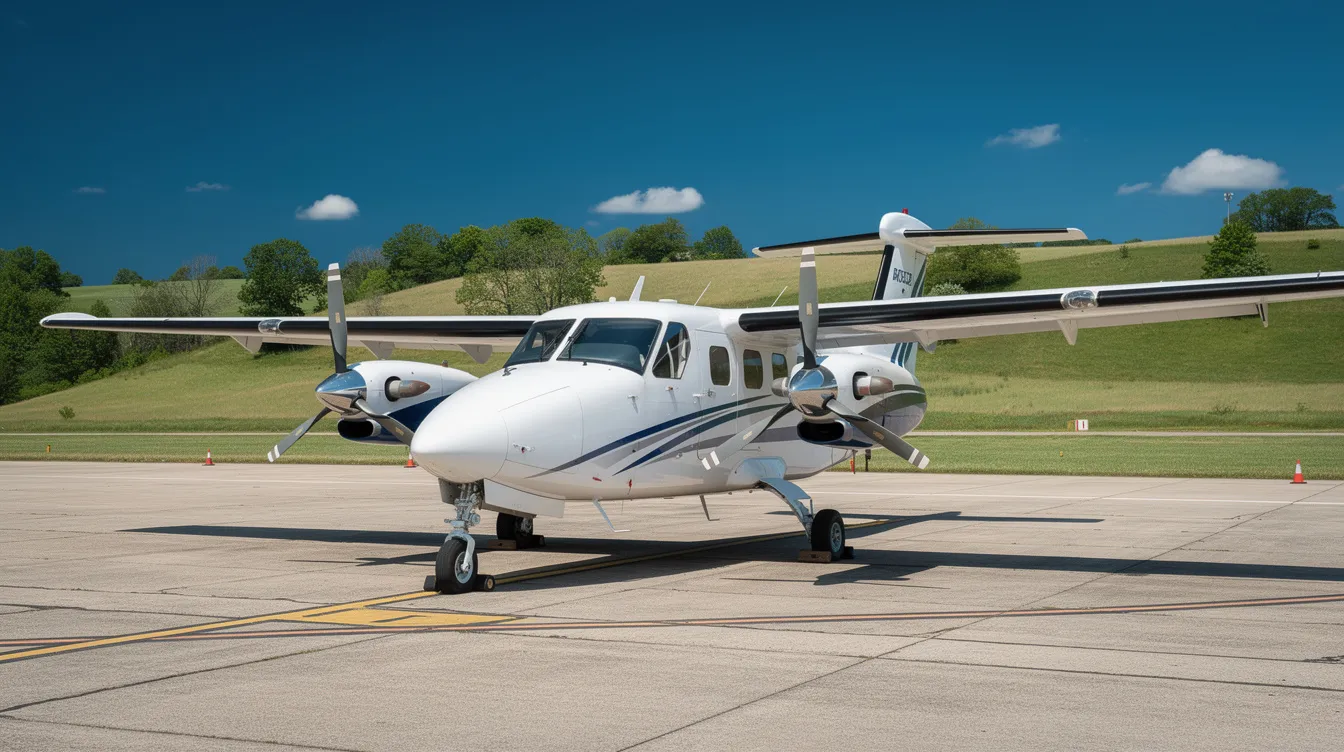
The Cessna 402 is a light twin-engine piston aircraft introduced in the late 1960s for short-haul passenger and cargo flying, and the Cessna 402C remains its most refined, most widely recognized variant. Built as a lower-cost alternative to pressurized twins, the 402 family earned its place in regional commuter service, cargo transport, and corporate travel with a roomy cabin, dependable short-runway capability, and seating for up to 10 passengers in typical configurations. As a light twin-engine piston aircraft, the Cessna 402 is designed to offer reliable performance and flexibility for a variety of regional missions.
For business and leisure travelers comparing practical charter options, aviation enthusiasts researching the type, and charter customers looking at aircraft suited to regional trips, the 402 is still a relevant benchmark. This overview looks at the aircraft’s history, development, design, cabin and performance, operational role, safety and regulatory context, and notable modification paths, while also showing how Jettly’s digital charter marketplace can help travelers book comparable light twin and commuter aircraft for similar missions.
The Cessna 402 evolved from the earlier Cessna 411, which Cessna re-engined and redesigned to better serve commercial operators and the charter market. The prototype flew on August 26, 1965, and production of the Cessna 402 ran from 1966 to 1985, during which over 2,000 units were built.
Late 1960s: The original Cessna 401/402 series was introduced, powered by turbocharged Continental engines producing 300+ hp each with three-bladed, fully feathering propellers.
1970s: The line split into dedicated Businessliner (passenger) and Utiliner (cargo/utility) models. Later models added propeller synchrophasers to reduce cabin noise and vibration. Tip tanks gave way to wet-wing fuel storage in September 1978.
Early 1980s: The improved Cessna 402C arrived with higher gross weight limits, a bonded wet wing, and engines moved outboard for better propeller clearance.
The Cessna 402 is a non-pressurized aircraft and entered service with this design choice, and that simplicity was the point: fewer complex systems meant lower maintenance bills than larger commuter turboprops. A notable modification path later included the Turbo Star 402 turboprop-powered conversion concept, intended to improve payload and climb performance for commercial routes. Aftermarket upgrades such as vortex generators also helped many small regional airlines worldwide extract more capability from the proven airframe.
The Cessna 402C is the best-known variant of the family, often called the workhorse of regional piston twins. It represents decades of incremental refinement packed into one dependable platform, comparable in role to other light Cessna twins like the Cessna 340.
Seating and cabin: The Cessna 402C can accommodate up to 10 passengers (pilot plus nine seats). Interiors are easily removable, so the cabin can be quickly converted from passenger to cargo layout or an all cargo configuration. The Cessna 402 is known for its versatility in cabin configuration, and it features a spacious cabin suitable for various configurations. Many operators fly it single-pilot under commuter regulations, though some require two crew for commercial service.
Airframe features: The design allows for high payload capabilities for its size, with a high aspect-ratio wet wing, unpressurized fuselage, and robust landing gear for varied operational environments. Many 402C aircraft are equipped with vortex generators that improve low-speed handling, achieve a lower minimum control speed, and allow a higher maximum allowable takeoff weight.
Engines and fuel: The aircraft is powered by two Continental TSIO-520 engines, each producing 325 hp. At cruise power, combined fuel burn runs roughly 46 gallons per hour. The engines deliver capable short takeoff and landing performance and solid climb rates for regional hops.
|
Parameter |
Cessna 402C |
|---|---|
|
Cruise speed |
~210–215 knots |
|
Maximum speed |
231 knots |
|
Range (typical) |
~1,200 nautical miles |
|
Service ceiling |
~26,900 ft |
|
Rate of climb |
1,400–1,500 ft/min |
|
Empty weight |
~4,069 lb |
|
Max takeoff weight (standard) |
6,850 lbs |
|
Max takeoff weight (with VGs) |
|
|
Maximum landing weight |
~6,500 lb |
|
Zero fuel weight (modified) |
Increased with VG kit |
|
Length |
~36.38 ft |
|
Passengers |
Up to 10 |
Comfort is practical rather than luxurious. Some charter operators have upgraded avionics to Garmin glass cockpits for modern IFR operations, and propeller synchrophasers help reduce vibration in flight, while services like Jettly Eats in-flight catering can enhance the onboard experience.
The range and passenger capacity of the Cessna 402C make it a natural fit for regional missions. The plane is generally flown on shorter routes between 100 and 400 nautical miles, though it can cover over 1,000 miles when lightly loaded, aligning well with best practices for renting an airplane for regional travel.
Passenger capacity tops out at nine plus the pilot in commuter layouts. Corporate transport or medical configurations may use fewer seats but more mission-specific equipment.
The aircraft handles frequent-hop schedules well: multiple sectors per day connecting small communities to larger hubs, often from smaller airports with shorter runways and limited ground infrastructure that travelers can identify using an airport locator and charter booking tool.
For charter and private use, this balance of carrying capability and range suits small groups or families wanting point-to-point access on regional trips-especially where a light jet may be unnecessary or where runway length is limited.
Jettly's platform can surface aircraft like the 402C or equivalents from its global private charter aircraft inventory for customers who need this kind of seat count and mission flexibility.
Cape Air is one of the best-known operators to build its fleet around the Cessna 402C. Founded in 1989 in New England, the employee-owned airline set out to connect smaller communities with limited transportation options to regional hubs.
Cape Air expanded across the Northeast U.S., the Caribbean, Micronesia, and the Midwest over the following decades, operated hundreds of flights per day during peak season.
The Cessna 402C served as the primary workhorse, with a standard 9-passenger configuration enabling dense schedules on thin routes and higher density routes alike.
Typical missions include Boston to Nantucket and Martha's Vineyard, plus Caribbean island-hop sectors-all shorter routes where the 402C's reliability and runway flexibility shine, similar to how Cessna 207 short-field operations serve remote communities.
Aircraft like tail number N1361G, a 1980 Cessna 402C Utiliner, reportedly flew tens of thousands of hours before retirement, illustrating the type's longevity.
As of late 2024, Cape Air still operated roughly 63 Cessna 402C aircraft alongside about 30 Tecnam P2012 Traveller twins. The airline has also selected the Cessna Caravan, a turboprop, for certain routes going forward, illustrating how regional carriers weigh options like fractional providers and NetJets alternatives such as Jettly. Still, the 402C's proven history and ease of maintenance keep it in many route networks.
The operational patterns Cape Air pioneered-short, frequent, regional flights in small aircraft-mirror many on-demand charter missions booked through platforms like Jettly and the broader charter airline ecosystem.

Like any widely manufactured aircraft with a long service history, the Cessna 402 family has accumulated a safety record shaped by routine operations and a small number of high-profile accidents. According to PlanePHD data, the 401/402 series has a fatal accident rate of about 0.70 per 100,000 flight hours-well below the twin-piston peer benchmark of roughly 1.75.
Key incidents that shaped regulatory focus:
Aaliyah died in a Cessna 402 crash on August 25, 2001, near Marsh Harbour, Bahamas. The FAA and NTSB cited overloading (nearly 1,000 lbs over limits), aft center-of-gravity issues, and pilot qualification concerns.
A Cessna 402C crashed on September 9, 2021, with no casualties, reinforcing attention to maintenance and emergency procedures.
A Cessna 402C crash in Colombia killed all ten on board on January 8, 2025.
The deadliest Cessna 402 crash occurred on July 10, 2026, in The Bahamas.
These events underscore the importance of strict adherence to maximum allowable takeoff weight limits, proper weight-and-balance procedures, and professional pilot training. Modern Part 135 charter operators, including leading private jet charter companies, follow standardized checklists, safety management systems, and regular avionics upgrades to mitigate risk.
Flights arranged through Jettly use regulated operators that comply with national aviation authority rules, including FAA Part 135 in the U.S. or equivalent standards elsewhere, with emphasis on operator certification, maintenance history, and insurance, whether through partners like Dexter Air Taxi and other private jet operators.
The standard maximum takeoff weight of the Cessna 402C is approximately 6,850 lbs. With certain modifications like vortex generators, this can increase to about 7,210 lbs, allowing for an increased payload.
The Cessna 402C typically accommodates up to 10 passengers, including the pilot, making it suitable for small group regional travel.
No, the Cessna 402 is a non-pressurized aircraft, which contributes to its lower operational costs compared to pressurized twins.
The aircraft is powered by two Continental TSIO-520 engines, each delivering 325 horsepower.
The Cessna 402 is ideal for regional commuter service, cargo transport, corporate travel, and short-haul flights, especially in areas with shorter runways.
Yes, the cabin is versatile and can be quickly converted from passenger seating to cargo layout, depending on mission requirements.
The typical range is about 1,200 nautical miles, suitable for many regional routes.
The Cessna 402 offers a balance of payload, range, and operational economy, making it a dependable choice among light twin-engine piston aircraft.
Travelers who appreciate the practicality of the Cessna 402 can book similar light twin and commuter aircraft through Jettly's digital platform. The 402C-style mission profile remains a popular choice for several use cases, especially among travelers using private jet membership programs to access wholesale charter rates:
Regional business trips among secondary cities where commercial connections through major hubs waste hours, where travelers might weigh shared charter flights versus full charters to optimize budget and flexibility.
Family or small-group travel to island or remote destinations with shorter runways, often using smart strategies to get a seat on a private jet at a reasonable cost.
Cargo or mixed passenger/cargo flights where flexibility matters more than cabin luxury, sometimes leveraging crowdsourced and shared charter flights to fill empty seats and reduce costs.
Jettly makes the charter process straightforward: instant search and pricing across thousands of aircraft using tools like its private jet charter cost estimator, the ability to compare options by range, passenger capacity, and operating cost, and on-demand booking without jet cards or fractional ownership commitments. Depending on route distance and group size, the platform may also suggest alternatives such as a turboprop or light jet, helping travelers understand how much private jet charter really costs.
For context, Cessna 402 prices on the resale market currently average around $240,167, and five Cessna 402 aircraft are currently listed for sale-a sign of how active the secondary market remains for this legacy type and how it compares with other affordable aeroplane rental options.
The Cessna 402 has earned its place as one of the most dependable regional aircraft in aviation history. From Cape Air's island-hopping schedules to on-demand charter flights, this plane continues to connect communities and travelers across shorter distances with proven reliability.
Ready to fly a route that fits the Cessna 402's mission profile? Explore charter options or request a quote at https://www.jettly.com.
Share this post:
Jeff Ryan Serevilla
Oct 4, 2026
|
5
min read
Discover tips and trends in the industry.

5
min read
McClellan Jet Services: FBO Facilities, Jet Services, and Charter Alternatives
McClellan Jet Services is a premier fixed-base operator (FBO) at McClellan Airport, offering comprehensive ground support and amenities for private jet travelers. With 24/7 operations, it provides fueling, ground handling, and passenger services, while Jettly's digital platform facilitates seamless private jet charter bookings. Together, they enhance the private aviation experience for business and leisure travelers in Northern California.
Read More
5
min read
Arrow Jets: How Jettly Makes Private Jet Travel Simple, Fast, and Transparent
Jettly revolutionizes private jet travel by offering a digital platform that simplifies the booking process for over 20,000 aircraft worldwide. With instant pricing and transparent cost breakdowns, travelers can easily access fast, direct flights tailored to their needs. This on-demand model eliminates the complexities of traditional jet ownership, making private aviation more accessible and efficient.
Read MoreStay updated with our latest insights and tips to elevate your journey with us.
MEMBERSHIPS AND ASSOCIATIONS



Disclaimer: Jettly operates as a charter broker, offering access to a global digital jet charter marketplace. Jettly is not a direct air carrier and does not own or operate aircraft. All advertised flights are conducted by third-party air carriers that are fully licensed and hold the appropriate Part 135 or Part 121 certifications issued by the Federal Aviation Administration (FAA) or equivalent regulatory authorities under U.S. or foreign law. Jettly complies fully with the U.S. Department of Transportation's Part 295 and Part 298 Charter Broker regulations. Jettly does not carry additional liability insurance. Passengers are covered by aircraft operator insurance. TICO: 50023770


