



Login
Get Instant Pricing On 23,000+ Aircraft

>
If you've ever searched "what airlines have had crashes," the answer is straightforward: virtually every large legacy carrier with decades of operations has experienced at least one fatal crash. Several major airlines have experienced notable accidents throughout aviation history. American Airlines, Japan Airlines, Air France, United Airlines, Turkish Airlines, Pan Am, and many others all appear in public crash databases. But that fact alone tells you very little about how safe any given flight actually is.
This article breaks down what the data means, which airlines appear most often in crash rankings, and why context matters far more than raw numbers. It defines key terms, examines landmark accidents like American Airlines Flight 191 and Japan Airlines Flight 123, and explains how those tragedies reshaped modern aviation safety. It also addresses what all of this means for today's travelers, including those considering private jet charter through platforms like Jettly, which works exclusively with regulated operators meeting strict safety and maintenance standards.
Before diving in, here are three definitions worth knowing:
An aviation accident is any event during aircraft operations in which someone is killed or seriously injured, or the aircraft sustains substantial damage.
A fatal crash is an accident resulting in at least one death among occupants or people on the ground.
A hull loss means the aircraft is damaged beyond economic repair — it's written off entirely.
These distinctions matter because not every hull loss is fatal, and not every fatal crash results in a hull loss. The sections ahead use all three terms.
Despite the attention that airplane crash events receive, air travel has a fatality rate of roughly 0.01 deaths per 100 million miles traveled. That's orders of magnitude safer than driving, where the rate is closer to 1.1 deaths per 100 million miles in the United States.
Consider these comparisons:
Commercial air travel: ~0.01 fatalities per 100 million passenger miles
Passenger vehicles: ~1.1 fatalities per 100 million passenger miles
Motorcycles: ~25+ fatalities per 100 million passenger miles
In 2023, commercial aviation recorded the lowest number of accidents ever, despite global flight volumes reaching near-record highs. The fatal accident rate per million flights dropped from roughly 6 in the 1970s to about 0.5 by 2020, meaning more than 2 million flights occur for every fatal event.
Widely publicized plane crashes involving carriers like American Airlines, Air France, or Japan Airlines are rare relative to tens of millions of annual flights. Most aviation accidents involve general aviation — small, privately operated planes — not large scheduled airlines. Both commercial carriers and charter operators are subject to strict regulatory oversight, maintenance requirements, and crew training mandates.
Analysts and databases like the Aviation Safety Network typically start crash counts around 1970. That date aligns with the mature jet age and the beginning of more consistent global reporting. Counting from earlier decades introduces skew from a period when aviation was less regulated, and record-keeping was unreliable.
Key terms used in rankings:
A fatal event means at least one occupant or ground casualty died in the accident.
A hull loss means the aircraft was destroyed or damaged beyond economic repair.
Some rankings combine both metrics, while others focus only on one.
There are several important caveats:
Some rankings include subsidiary and regional brands. For example, American Eagle Flight operations may be aggregated with American Airlines mainline data, while other sources treat them separately.
Historical raw accident counts are tied to fleet size, total flight volume, and length of operations. An airline that has flown billions of passenger miles over 80 years will naturally accumulate more events than a small regional carrier.
Higher crash counts may partly reflect large fleets and many decades of service, not inherently poor safety. The NTSB and FAA maintain detailed records that are publicly accessible for U.S.-based events.
This section summarizes airlines most frequently cited in public crash statistics. Raw counts do not represent current safety performance.
American Airlines and Air France each have 11 recorded crashes in commonly referenced databases, placing them among global carriers with the highest number of fatal airline flight events since 1970.
When combined counts for American Airlines and American Eagle regional operations are aggregated, the total can reach the mid-teens. American Eagle has recorded five plane crashes as a standalone entry in some sources.
United Airlines has experienced seven crashes historically. Continental Airlines, now merged into United, added additional fatal events from its own decades of operations, especially before the 2000s.
Pan Am and TWA, both now defunct, historically appeared in crash rankings with multiple fatal events. Their accidents often shaped the safety rules still in use today.
The critical context: these airlines have operated hundreds of millions of passengers across billions of miles. Per-flight risk remains extremely low despite their accident counts. Analysis of an airline's crash history should consider fatal accidents relative to total flights, not just raw numbers.
American Airlines is one of the largest carriers in the world, with a history stretching back to the 1930s. Over that time, the airline has recorded nearly 60 hull losses and around 11 fatal crashes in modern jet-age times, including both mainline and some regional operations.
Two events stand out:
American Airlines Flight 191 crashed on May 25, 1979, at Chicago O'Hare. A McDonnell Douglas DC-10 lost its left engine and pylon during takeoff rotation due to improper maintenance involving a forklift. The resulting asymmetric lift and hydraulic failures led to loss of control. All 271 onboard and 2 on the ground were killed, making it the deadliest U.S. airplane crash in aviation history.
American Airlines Flight 587 crashed on November 12, 2001, shortly after takeoff from New York's JFK, en route to Santo Domingo. The Airbus A300's vertical stabilizer separated after the first officer made aggressive rudder inputs in response to wake turbulence. The crash killed 265 people, including several on the ground in Queens, New York.
More recent incidents, including a 2025 American Eagle mid-air collision near Washington, D.C., have drawn attention, but the airline's overall safety profile has improved substantially since the 1970s and 1980s. Maintenance oversight, crew training, and fleet modernization have all contributed to a safer operation across tens of millions of annual flights.
Japan Airlines has maintained a mostly strong safety record across its decades of operation, but it suffered one of the deadliest plane crashes in aviation history.
Japan Airlines Flight 123 crashed on August 12, 1985. The Boeing 747SR was flying from Tokyo to Osaka when its aft pressure bulkhead failed catastrophically about 12 minutes after takeoff. The failure had a direct cause: years earlier, a tailstrike repair had been performed incorrectly, using a single row of rivets where a double row was required. Over time, fatigue cracks developed until the bulkhead ruptured.
The explosive decompression severed all four hydraulic systems and destroyed the vertical stabilizer. The flight crew struggled to control the aircraft for approximately 30 minutes before it crashed into mountainous terrain in Gunma Prefecture. Of 524 people on board, 520 were killed — making it the worst single-aircraft accident in history.
Japan Airlines has had a small number of other fatal accidents, but none approaching the scale of Flight 123. The crash led to sweeping reforms:
Japanese aviation authorities overhauled structural maintenance regimes
Non-destructive inspection standards for fatigue cracks were tightened
JAL established dedicated safety promotion centers
Globally, the crash spurred improvements in fatigue-crack monitoring and inspection of high-cycle aircraft
Beyond American Airlines and Japan Airlines, several other large carriers appear consistently in crash statistics.
Air France has approximately 11 fatal crashes in some databases. The most well-known is Air France Flight 447 (2009), an Airbus A330 that crashed into the Atlantic Ocean en route from Rio de Janeiro to Paris. Pitot-tube icing caused unreliable airspeed readings, and the flight crew's response led to an aerodynamic stall. The crash killed all 228 people on board.
United Airlines and the former Continental Airlines have a combined record of multiple fatal events, most of which involved older aircraft and pre-GPS-era procedures. United's modern safety record reflects decades of fleet renewal and training upgrades.
Turkish Airlines has a significant historical record, highlighted by Turkish Airlines Flight 981 in 1974. A McDonnell Douglas DC-10 experienced explosive decompression due to cargo door design flaws near Paris, killing all 346 people aboard. Turkey Airlines Flight 981 remains one of the deadliest aviation accidents in European airspace.
Malaysia Airlines appears in crash databases partly due to two high-profile events in 2014. Malaysia Airlines Flight 17 was shot down over eastern Ukraine, resulting in 298 fatalities — a security incident rather than an operational safety failure. Malaysia Airlines Flight 370's disappearance that same year prompted global regulatory changes.
Legacy carriers like Pan Am and TWA are now defunct, but their accidents — from the Tenerife Airport Disaster to TWA Flight 800 — remain critical chapters in aviation safety evolution.
Certain specific airline flight disasters, rather than entire airline records, drove fundamental changes in global aviation regulation.
The Tenerife Airport Disaster on March 27, 1977, remains the deadliest airplane crash in history. Two Boeing 747s—one operated by KLM, the other by Pan Am — collided on the runway at Los Rodeos Airport in Tenerife, killing 583 people. The accident exposed critical weaknesses in air traffic control phraseology, cockpit communication, and fog-related procedures, leading to sweeping reforms in crew communication protocols.
The Charkhi Dadri collision on November 12, 1996, killed 349 people when a Saudi Arabian Airlines 747 and a Kazakhstan Airlines cargo plane collided mid-air near New Delhi. The disaster highlighted deficiencies in air traffic control procedures and the lack of collision-avoidance systems in certain aircraft operating in Indian airspace.
China Airlines Flight 140 (1994, Airbus A300 in Nagoya, 264 deaths) demonstrated the dangers of automation mismanagement and mode confusion during a landing attempt.
Nigeria Airways Flight 2120 (1991, 261 deaths) was a harrowing incident caused by maintenance negligence and tire failure, after which the aircraft caught fire and was consumed.
Each incident marks a turning point. The reforms that followed — from standardized radio terminology to mandatory TCAS systems — are part of why modern flying is as safe as it is.
American Airlines Flight 191 is a benchmark case in maintenance-related aircraft accidents.
On May 25, 1979, a DC-10 was departing Chicago O'Hare for Los Angeles. As the aircraft rotated for takeoff, the left engine and its entire pylon assembly separated from the wing. The cause: maintenance crews had used a forklift to lift the engine and pylon assembly as a single unit during removal, stressing the forward attachment points beyond their limits. This created damage that was not visible during subsequent inspection.
The sequence of failure:
The separating engine severed hydraulic lines on the left wing
Leading-edge slats on the left wing retracted asymmetrically
Without slats, the left wing stalled while the right wing continued producing lift
The aircraft rolled and crashed into a trailer park near the runway
The crash killed all 271 on board plus 2 on the ground
Investigators noted that the improper maintenance procedure — using a forklift instead of following the manufacturer's step-by-step disassembly — was the direct mechanical cause. American Airlines Flight 191 is the deadliest U.S. crash on record.
The FAA's regulatory aftermath included:
Mandated slat relief valves to prevent unwanted retraction
Stricter pylon attachment inspection protocols
Standardized engine removal procedures across all carriers
More rigorous independent maintenance oversight
The contrast between this era and current strict maintenance control — applied to both airlines and Part 135 charter operators — is substantial.
American Airlines Flight 587 illustrates how pilot input, training culture, and structural design can interact with fatal consequences.
On November 12, 2001, an Airbus A300-600R departed JFK for Santo Domingo. Shortly after takeoff, the aircraft encountered wake turbulence from a preceding Japan Airlines 747. The first officer responded with several rapid, full-deflection rudder pedal inputs — alternating aggressively between left and right.
Those repeated rudder reversals generated aerodynamic loads on the vertical stabilizer that exceeded its certification limits. The composite stabilizer separated from the fuselage, followed by both engines. The aircraft crashed shortly after into the Belle Harbor neighborhood of Queens. All 260 on board and 5 on the ground were killed.
The NTSB investigation identified several contributing factors:
The A300's rudder system was more sensitive at higher airspeeds than crew members understood
American Airlines' "Advanced Aircraft Maneuvering Program" had inadvertently trained pilots to use large rudder inputs during upset recovery
There was no widespread understanding among pilots about the coupling between aggressive rudder use and structural loads
Outcomes included revised training guidance on rudder use, better documentation of flight control characteristics by the aircraft manufacturer, and updates to simulator programs across the industry. The National Transportation Safety Board also recommended that rudder design load certification standards be revisited.
TWA Flight 800 is one of the most extensively investigated aviation accidents in history and a defining case for midair breakup analysis.
On July 17, 1996, a Boeing 747 departed JFK bound for Paris. Approximately 12 minutes after takeoff, the aircraft exploded about 8 miles off the coast of Long Island over the Atlantic Ocean. All 230 people on board were killed. Debris scattered across a wide area, and the recovery effort lasted months.
The investigation concluded that fuel vapors in the nearly empty center wing fuel tank were ignited by a short circuit in wiring connected to the fuel quantity indication system. The tank's design had assumed ignition sources could be eliminated, rather than addressing the flammability of fuel-air vapors themselves.
The Federal Aviation Administration responded with sweeping changes:
Fuel tank inerting systems became mandatory, injecting nitrogen into tanks to reduce vapor flammability
Wiring separation standards were tightened
Fuel-tank inspection protocols were expanded
Retrofits were required on many large aircraft, particularly those with center wing tanks
This single catastrophe led to systemic engineering changes affecting every major carrier and many charter operators worldwide.
Northwest Airlines Flight 255 demonstrates what happens when procedural discipline breaks down during a critical phase of flight.
On August 16, 1987, an MD-82 was departing Detroit Metropolitan Wayne County Airport for Phoenix. The flight crew failed to extend the flaps and slats to the proper takeoff configuration. The takeoff configuration warning system—designed to alert crew members when flaps or slats are improperly set — did not sound because the P-40 circuit breaker powering it was open.
As the aircraft lifted off, the stick shaker activated, indicating an imminent stall. Performance was inadequate for sustained flight. The aircraft clipped a light pole, struck an overpass, and crash-landed in the roadway. Of 155 people on board, 154 died, along with 2 people on the ground. A four-year-old girl was the sole survivor. Fatalities were extensive, while the small number of injuries reported on the ground varied in severity.
The investigation pointed to:
Crew failure to complete the taxi checklist
Over-reliance on warning systems rather than manual verification
The unexplained loss of power to the warning circuit
Regulatory reforms emphasized cockpit discipline during critical phases, improved redundancy in warning systems (both visual and aural), and stricter checklist adherence training.
Pan Am Flight 759 is a textbook case of how weather conditions at low altitude can overwhelm an aircraft's ability to climb.
On July 9, 1982, a Boeing 727 departed New Orleans International Airport. Shortly after takeoff, the aircraft flew into a microburst — a sudden, intense downdraft accompanied by rapidly shifting wind vectors. The headwind that had been assisting the aircraft's lift abruptly decreased, then reversed.
The jet was unable to climb. It struck trees and houses in the residential neighborhood of Kenner, Louisiana. All 145 people on board and 8 on the ground were killed.
At the time, there was limited technology to detect microbursts. Air traffic controllers had no real-time wind shear data to relay to departing aircraft.
The crash spurred direct regulatory action:
Airports were required to install ground-based wind shear alert systems
Doppler weather radar was deployed at major airports
Airborne predictive wind-shear radar became standard on commercial aircraft
Pilot training for microburst recognition and escape maneuvers was overhauled
Today, both commercial airlines and many charter jets carry advanced weather and terrain-avoidance technology specifically designed to mitigate these risks, and instant-book platforms such as Zenflight private jet operator make it easier for travelers to access such well-equipped aircraft.
Some studies attempt to rank airlines from "safest" to "most dangerous" based on crash and fatality data. These rankings are widely read but often misunderstood.
Typical ranking criteria include:
Number of fatal crashes since 1970
Hull losses relative to fleet size
Fleet age and modernization status
Total flight volume and years of operation
Incident reports filed with regulatory authorities
Large U.S. carriers like Alaska Airlines, Hawaiian Airlines, Delta Air Lines, and American Airlines currently maintain strong safety records despite historic accidents. A recent Alaska Airlines flight, Flight 1282, was a high-profile but non-fatal in-flight emergency rather than a fatal crash. The safety records of airlines can significantly change over time — an airline with a troubled past can become one of the safest through fleet renewal, training investment, and cultural reform.
An airline listed as having "the most crashes" is not necessarily the least safe today. Exposure — millions of flights across decades — drives raw event counts. By contrast, many fatal accidents occur in general aviation, not large scheduled carriers. PSA Airlines, Alaska Airlines, and other regional operators have had isolated fatal events that are counted differently depending on the source.
Rankings serve as starting points for research, not definitive safety verdicts.
Nearly half of all aviation crashes occur during landing or takeoff — the two shortest but most demanding phases of any flight.
|
Flight Phase |
Approximate Crash Count |
|---|---|
|
Landing |
20,330 |
|
Takeoff |
16,061 |
|
Cruise |
11,034 |
Most crashes happen near airports during critical flight phases, where the aircraft is at low altitude, and the crew is managing configuration changes, speed adjustments, and communication with air traffic control.
The cruise phase has far fewer accidents per hour flown. However, when something does go wrong at cruising altitude—- structural failure, catastrophic decompression, or fuel exhaustion — the consequences tend to be more severe because of altitude, speed, and limited options.
Maneuvering near LaGuardia Airport, Portland International Airport, Toronto Pearson International Airport, San Francisco International Airport, or any busy international airport involves elevated workload, and tools like Jettly’s airport locator tool can help travelers understand which airports are available for their routes. This is where crew coordination, terrain awareness (TAWS/GPWS), and traffic collision avoidance systems (TCAS) provide the greatest safety margin.
Aviation accidents almost always involve multiple contributing factors rather than one simple error. Investigators rarely point to a single cause.
|
Cause |
Description |
|---|---|
|
Pilot Error |
Misjudgments during approach, mishandling of automation, poor decision-making under pressure, and failure to follow standard procedures. Pilot error causes most aviation accidents when examined as a contributing factor. |
|
Mechanical Failure |
Engine failure, control system malfunctions, structural failure, and mechanical malfunction in landing gear or hydraulics. Modern aircraft design builds in redundancy to prevent single-point failures from becoming catastrophic. |
|
Improper Maintenance |
Shortcuts in repair procedures, missed inspections, and failure to follow manufacturer guidelines create latent risks that may not emerge until a component fails under stress. |
|
Design Defects |
Catastrophic aviation accidents caused by flaws such as the DC-10 cargo door (Turkish Airlines Flight 981) and the Boeing 747 pressure bulkhead (JAL Flight 123). |
|
External Factors |
Severe turbulence, icing, bird strikes, low fuel situations, runway contamination, and weather conditions that exceed forecasting accuracy. |
|
Organizational Factors |
Fatigue among crew members, rushed turnaround times, inadequate training, and poor safety culture set the stage for errors. |
Pilot error is a leading cause of aviation accidents, encompassing misjudgments during approach, mishandling of automation, poor decision-making under pressure, and failure to follow standard procedures. Pilot error causes most aviation accidents when examined as a contributing factor across all categories of flight.
Mechanical failure covers engine failure, control system malfunctions, structural failure, and mechanical malfunction in landing gear or hydraulics. Modern aircraft design builds in redundancy to prevent single-point failures from becoming catastrophic.
Improper maintenance contributes significantly to aviation accidents. Shortcuts in repair procedures, missed inspections, and failure to follow manufacturer guidelines create latent risks that may not emerge until a component fails under stress.
Design defects can lead to catastrophic aviation accidents, as seen with the DC-10 cargo door (Turkish Airlines Flight 981) and the Boeing 747 pressure bulkhead (JAL Flight 123).
External factors include severe turbulence, icing, bird strikes, low fuel situations, runway contamination, and weather conditions that exceed forecasting accuracy.
Organizational factors such as fatigue among four crew members or six crew members working extended duty periods, rushed turnaround times, inadequate training, and poor safety culture set the stage for errors.
Engine failure is one of the most feared scenarios in aviation, but modern twin-engine jets are designed to fly safely on a single engine. A single engine failure rarely causes a fatal crash by itself.
Cases where engine failure contributed to fatal outcomes typically involved compounding factors, and passengers considering how to get a seat on a private jet should easily understand that reputable operators mitigate such risks through rigorous standards:
Loss of thrust combined with crew mismanagement of the remaining engine
Uncontained engine failures that damaged hydraulic lines, fuel systems, or flight controls
Low fuel conditions that resulted in dual engine failure (extremely rare)
Dual engine failure events are almost always tied to fuel mismanagement, contamination, or volcanic ash ingestion rather than simultaneous mechanical breakdown. Seven passengers or two passengers surviving emergency landing scenarios after engine loss are documented precisely because the aircraft's design allowed continued controlled flight, even on flights where premium services such as in-flight catering for private jets are offered.
Rigorous engine maintenance protocols, monitoring systems, and regulatory maintenance intervals have made catastrophic engine events increasingly rare.
Improper maintenance is not just a matter of an immediate post-maintenance flight going wrong. It creates latent risks — damage or degradation that may not manifest for months or years until catastrophic failure occurs.
Two landmark cases illustrate this:
Japan Airlines Flight 123: An incorrect tailstrike repair using a single row of rivets (where two were required) led to fatigue crack propagation over seven years before the bulkhead ruptured in flight.
American Airlines Flight 191: The use of a forklift to remove the engine/pylon as a single unit — rather than following the manufacturer's sequential procedure — caused hidden structural damage to the pylon attachment.
Other maintenance-related factors include:
Missed corrosion inspections on aging airframes
Failure to replace cargo hold components on schedule
Control cable integrity issues from deferred maintenance items
Aircraft maintenance protocols must comply with FAA standards in the United States, and equivalent standards apply under EASA and other national authorities. Regulators now conduct regular audits, and reputable airlines and charter operators maintain strict documentation, independent quality checks, and tooling standards. Investigators noted in multiple crash reports that systemic maintenance failures — not individual mechanic errors — were the responsible parties.
Pilot error as a category is broad. It includes misjudgments, procedural violations, mishandling of automation, loss of situational awareness, and poor communication within the flight crew.
Crew Resource Management (CRM) was developed specifically to address these issues. CRM training teaches:
Open communication between captain and first officer, regardless of authority gradient
Structured decision-making processes during abnormal situations
Challenge-and-response checklist culture
Workload management during high-task phases
Cases where CRM failures contributed to crashes include:
The Tenerife Airport Disaster, where the KLM captain initiated takeoff without proper clearance, and crew members did not effectively challenge his decision
American Airlines Flight 587, where training culture inadvertently encouraged aggressive rudder use
China Airlines Flight 140, where automation confusion during a landing attempt was not resolved through crew coordination
Pilot training programs are mandated by FAA regulations. Modern airlines and charter operators invest heavily in simulator training, recurrent proficiency checks, and scenario-based CRM exercises. Both commercial crews and charter operators like those in Jettly's network undergo regular evaluation.
Not all fatal accidents stem from airline mistakes or equipment issues.
Air traffic controllers play a critical role in maintaining separation between aircraft. Miscommunication, incorrect clearances, or procedural failures can contribute to mid-air collision events or runway incursions. The Charkhi Dadri collision (1996, 349 deaths) is a stark example — two aircraft at different flight levels were cleared into the same airspace near New Delhi, with catastrophic results.
Weather remains a persistent factor:
Severe turbulence, icing, and low visibility continue to challenge operations
Microbursts and wind shear (as in Pan Am Flight 759) are now detectable but still dangerous
Volcanic ash and thunderstorm cells require real-time avoidance decisions
Security-related incidents — bombings, hijackings, and shoot-downs such as Malaysia Airlines Flight 17 over eastern Ukraine - fall outside typical safety statistics but remain part of overall airline risk history. San Juan, South Carolina, and other regions have seen isolated incidents tied to weather or external factors rather than airline-specific failures.
Modern satellite navigation, advanced radar systems, and collision-avoidance technology have sharply reduced ATC-related fatal accidents compared to earlier decades.
The distinction between commercial airline operations and general aviation is essential for understanding crash statistics.
General aviation aircraft are involved in 78% of all crashes. This category includes small single-engine piston aircraft used for instruction, recreation, and personal transport — not the large jets operated by American Airlines, Delta, or Japan Airlines.
In 2024, the U.S. had approximately 1,417 plane crashes. The vast majority involved general aviation, not scheduled commercial carriers, which is important context for travelers deciding whether to buy a seat on a private jet through shared or semi-private services.
|
Category |
Share of Crashes |
Typical Aircraft |
|---|---|---|
|
General aviation |
~78% |
Single-engine piston, light twins |
|
Commercial airlines (Part 121) |
Small fraction |
Boeing 737, A320, widebodies |
|
Charter/air taxi (Part 135) |
Small fraction |
Business jets, turboprops |
Charter operations range from small piston aircraft to modern business jets. Operations conducted under Part 135 regulations are subject to commercial-grade maintenance, pilot qualification, and safety management requirements, and reputable providers are profiled in resources covering the best private jet charter companies.
Jettly, as a private jet charter platform, connects travelers exclusively with licensed commercial operators that meet these regulated maintenance and pilot qualification standards while also helping clients understand affordable private jet charter options compared with traditional commercial fares. This distinction separates professional charter operations from the general aviation category where most crashes actually occur.
Every major disaster in aviation history has led to specific, measurable safety improvements. Many aviation disasters have led to significant changes in aviation safety protocols and regulations, and they also shape how modern charter airlines and private operators design their safety management systems.
Key reforms tied to specific accidents:
Improved cockpit communication standards (post-Tenerife)
Ground proximity warning systems / GPWS (mandated after controlled-flight-into-terrain accidents)
Fuel-tank inerting systems (post-TWA Flight 800)
Low-level wind-shear alert systems (post-Pan Am Flight 759)
TCAS collision-avoidance systems (post-mid-air collisions)
Rudder design load certification updates (post-Flight 587)
The FAA regulates all civil aviation activities in the U.S. ICAO establishes global aviation safety standards that member states are expected to adopt. In 2014, aviation regulations increased after Malaysia Airlines Flight 370's disappearance, including requirements for improved flight tracking and extended-range communication.
Safety improvements in aviation have been prompted by lessons learned from historical accidents. Airlines and charter operators now use data-driven safety management systems (SMS) to identify risks before accidents occur, analyzing near-miss reports, maintenance trends, and operational data.
Historical crash data is useful context, but it requires interpretation.
Practical guidance for modern passengers:
Focus on an airline's recent safety record, regulatory compliance, and modern fleet rather than only historic fatal crash counts. An airline's record from the 1970s says little about its operations today.
Consider factors like crew training frequency, maintenance standards, and how often the airline is audited by national aviation authorities.
Most major carriers in North America, Europe, and parts of Asia maintain extremely low accident rates. Alaska Airlines, Delta, and American Airlines all have strong current safety profiles.
Analysis of an airline's crash history should always consider fatal accidents relative to total flights - not just absolute numbers.
For travelers evaluating commercial flight versus private flight options, private jet memberships and charter through platforms like Jettly can provide additional visibility into operator credentials, aircraft type, fleet age, and safety ratings before booking.
Jet rescue air ambulance services, emergency landing capabilities, and evacuation statistics all reflect broader improvements in how the industry handles abnormal situations—whether on a commercial airliner or a chartered business jet, including when private jets fly internationally.
Private jet charter operates differently from scheduled airline service, but the safety principles are the same.
Jettly works with a vetted network of operators whose aircraft and crew are regulated under commercial standards, similar in philosophy to fractional leaders described in resources all about NetJets private aviation. In the United States, this means Part 135 certification, which requires:
Maintenance programs approved and audited by the FAA
Pilot duty-time limitations and rest requirements
Recurrent training and proficiency checks
Drug and alcohol testing programs
Many charter aircraft in Jettly's network are modern business jets equipped with advanced avionics, terrain warning systems, TCAS, weather radar, de-icing systems, and emergency slides where applicable - comparable to or exceeding the equipment found on commercial airlines, and similar to those highlighted in guides to the ultimate list of charter airlines.
On-demand charter can also reduce certain operational pressures that affect scheduled airlines. There are no tight connection windows, no over-scheduling to maximize gate utilization, and no pressure to depart in marginal weather conditions just to maintain an on-time performance metric, whether you choose shared charter flights vs. full charters. These factors indirectly support safer decision-making by crew members and highlight why some travelers look for a NetJets alternative like Jettly when prioritizing both safety and flexibility.
No form of flying is entirely risk-free. But travelers can choose operators and platforms that prioritize transparency around safety practices —including operator certifications, aircraft history, and pilot qualifications.
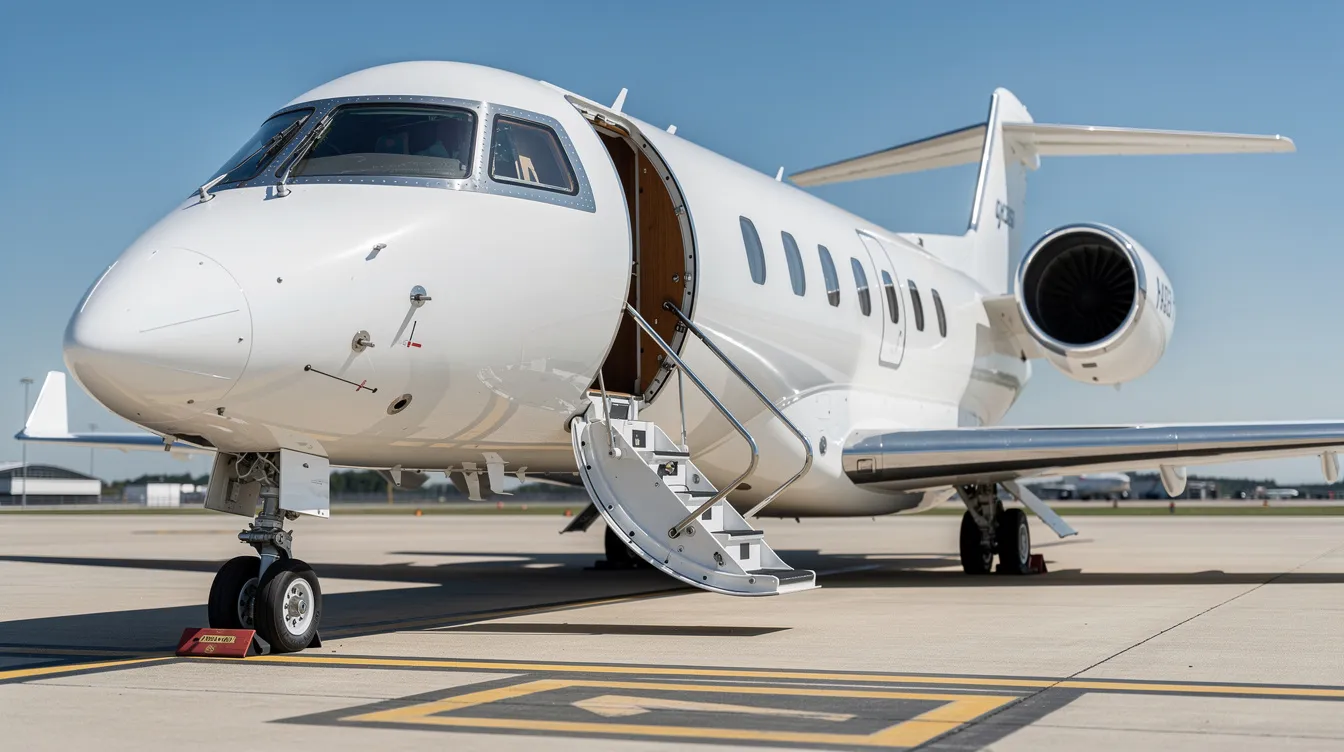
American Airlines and Air France each have 11 recorded crashes in commonly referenced databases since 1970. United Airlines has experienced seven crashes historically. These numbers reflect their long operational histories rather than current safety levels.
A fatal crash is an accident resulting in at least one death among occupants or people on the ground. Not all aviation accidents are fatal, and some fatal crashes may not result in a hull loss.
Air travel has a fatality rate of approximately 0.01 deaths per 100 million miles traveled, making it significantly safer than driving, which has about 1.1 deaths per 100 million miles.
Pilot error is the leading cause of aviation accidents, followed by mechanical failure, improper maintenance, design defects, and external factors such as severe weather.
Nearly half of all aviation crashes occur during the critical phases of takeoff and landing, where workload and operational complexity are highest.
Jettly partners exclusively with licensed commercial operators who meet strict regulatory standards, including FAA Part 135 certification, rigorous maintenance programs, pilot training, and safety management systems.
Both commercial airlines and reputable private charter operators adhere to strict safety regulations. Private charters may offer operational flexibility that can reduce certain pressures found in scheduled airline service, potentially enhancing safety.
Travelers should focus on recent safety records, regulatory compliance, fleet modernization, crew training, and operator transparency rather than historical crash counts alone.
Many major airlines —including American Airlines, Japan Airlines, Air France, United Airlines, and others —have had fatal crashes, especially in earlier decades. American Airlines and Air France each have 11 crashes in commonly referenced databases. United Airlines has seven. These numbers reflect decades of high-volume operations, not current-day risk levels.
Crash counts must be balanced against total flights, modern technology, and continuous safety improvements in both commercial airlines and private charter operations. The incident marks from the 1970s through the 1990s generated the safety rules, technologies, and training standards that make today's aviation environment remarkably safe.
Understanding aviation accident history helps passengers make informed choices without exaggerating risk. Whether evaluating a commercial carrier or a private charter operator, the factors that matter most are recent safety records, regulatory compliance, fleet condition, and crew training.
For travelers interested in private, on-demand air travel, Jettly's transparent, tech-driven platform connects passengers with safe, regulated flights tailored to their schedule and route needs through a global selection of private charter aircraft. Every operator in the network meets commercial safety standards, and travelers can review aircraft details and operator credentials before booking.
Ready to experience private travel on your terms? You can get an instant estimate with Jettly’s private jet charter cost estimator, explore crowdsourced options that share empty seats on private jet flights, or request a quote at https://www.jettly.com.
Share this post:
Jeff Ryan Serevilla
Oct 20, 2026
|
5
min read
Discover tips and trends in the industry.
5
min read
What Airlines Have Had Crashes? Major Airline Accidents, Safety Records, and What They Mean for Air Travel
Many major airlines, including American Airlines and Japan Airlines, have experienced fatal crashes throughout their histories. While these incidents are significant, they must be viewed in context, as air travel remains one of the safest modes of transportation today. Understanding the historical data and safety improvements can help travelers make informed decisions about their flight options.
Read More
5
min read
Elon Musk Aircraft: Inside Elon Musk's Private Jets, Fleet History, and How to Fly Similar Jets with Jettly
Elon Musk's private jet fleet, primarily consisting of Gulfstream models, showcases the intersection of luxury and necessity in modern aviation. This guide explores Musk's aircraft history, the evolution of his fleet, and how platforms like Jettly provide access to similar jets for those who seek the convenience of private travel without ownership. Discover the details of Musk's jets and how they reflect his dynamic lifestyle and business needs.
Read MoreStay updated with our latest insights and tips to elevate your journey with us.
MEMBERSHIPS AND ASSOCIATIONS



Disclaimer: Jettly operates as a charter broker, offering access to a global digital jet charter marketplace. Jettly is not a direct air carrier and does not own or operate aircraft. All advertised flights are conducted by third-party air carriers that are fully licensed and hold the appropriate Part 135 or Part 121 certifications issued by the Federal Aviation Administration (FAA) or equivalent regulatory authorities under U.S. or foreign law. Jettly complies fully with the U.S. Department of Transportation's Part 295 and Part 298 Charter Broker regulations. Jettly does not carry additional liability insurance. Passengers are covered by aircraft operator insurance. TICO: 50023770


