


Login
Get Instant Pricing On 23,000+ Aircraft

>
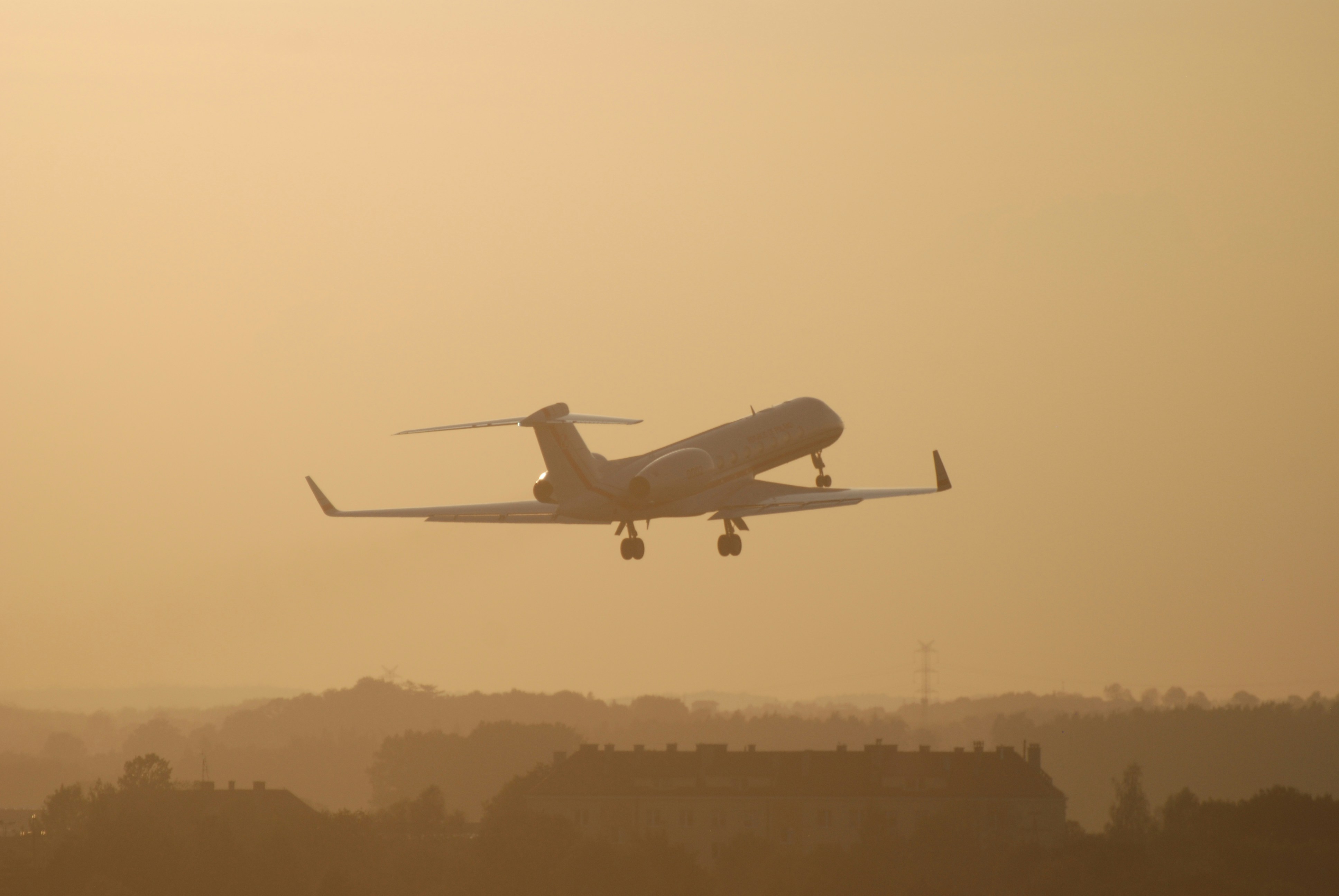
Tiger Woods is a living legend, on the golf course and far beyond it. With 82 PGA Tour wins and 15 major championships, his career has cemented him as one of the greatest golfers of all time. His success has also turned out to be highly lucrative. Fame brought sponsorships, endorsements, and business opportunities, helping Woods become one of the world’s highest-paid athletes. According to recent reports, his net worth surpasses $1 billion.
And what does an elite athlete do with that kind of fortune, especially one who spends his life flying around the world for tournaments? Buy a private jet, of course.
Woods joined the private-jet club in his late 30s, when he bought a roughly $53 million 2008 Gulfstream G550. Tiger Woods' Gulfstream G550 is about more than displaying wealth and status. As Jettly explains below, the jet serves as another tool for a world-class athlete who travels the world and suffers from a set of chronic injuries.
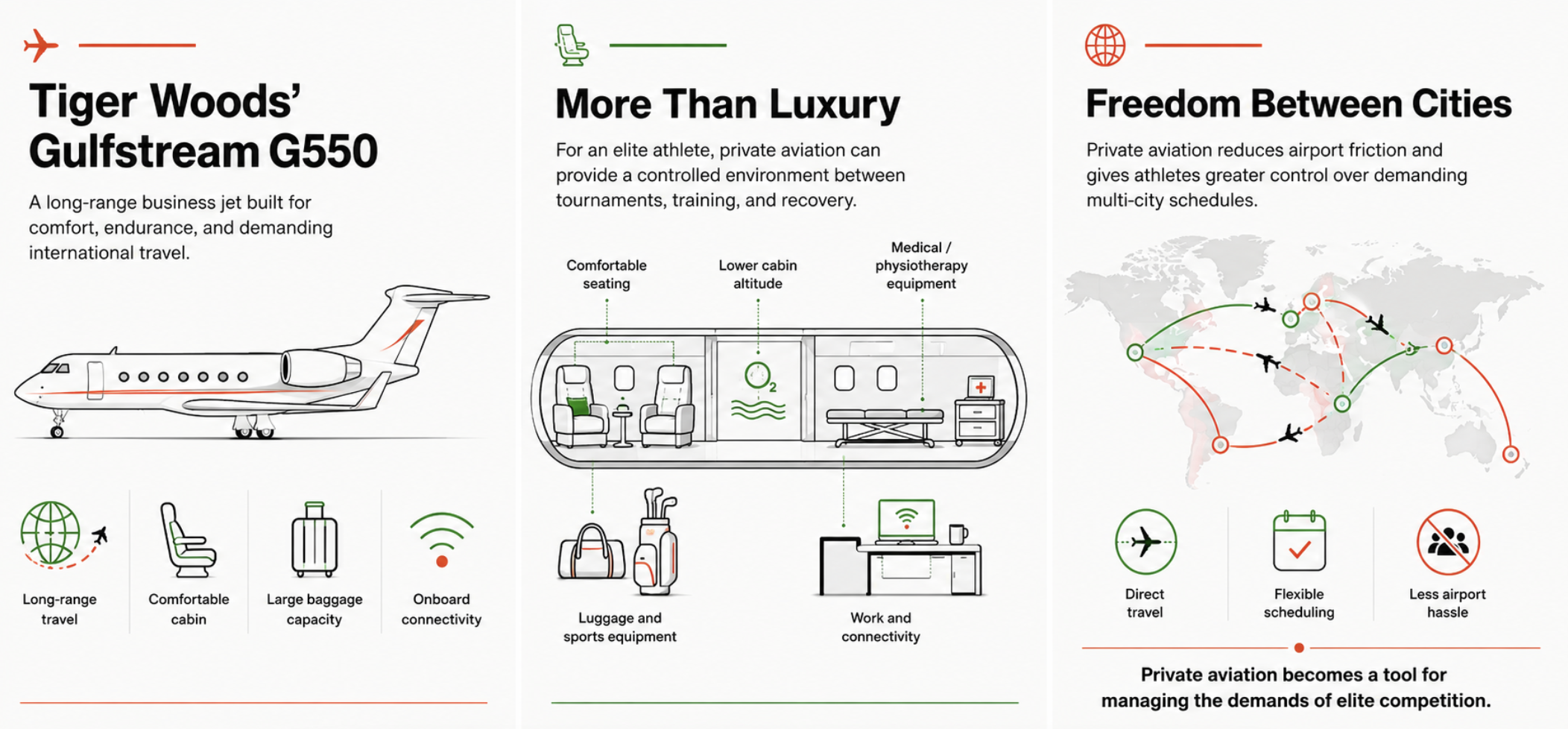
The Gulfstream G550 is an impressive business jet, even without Tiger Woods’ name attached to it. This long-range aircraft can carry up to 18 passengers and fly 6,750 nautical miles (7,770 miles) without stopping. Its combination of range, comfort, and capability has made the G550 a favorite among private owners and charter operators alike.
As for Woods’ plane, there are no official accounts of any special customization work. Still, the plane cabin was designed for maximum comfort, a full galley, plush leather seats, a well-equipped entertainment system, and high-speed internet.
For Tiger Woods specifically, one of the most important reasons for choosing this plane is likely the 6,000-foot cabin altitude pressurization (roughly the level of Colorado Springs). The lower altitude (you typically get 8,000 feet in an older airliner) means better blood oxygenation during flight. For an athlete managing chronic back and leg injuries, this can have real physical benefits since higher oxygen saturation levels during long-haul flights reduce travel fatigue and inflammation.
Another reason for using the G550 jet is the payload and equipment capacity. The G550’s 50-foot cabin and large baggage compartment allow for carrying heavy equipment, medical/physio gear, and support staff/family across long hauls.
The 6,750 nautical miles range allows direct flights between North America, Europe, Asia, and Australia without refueling stops. For a global PGA Tour athlete who constantly travels between cities and continents when playing tour events, this is an important factor.
According to public data from celebrity tracking services, most of the destinations for Tiger Woods’ plane are domestic, but he’s also enjoying flying internationally, whether to tournaments or vacation hotspots, like the Bahamas. In the U.S., he moves between various cities and his home base at Witham Field in Martin County, Florida.
Owning a jet is quite a common occurrence among top-earning global athletes. Big names like Michael Jordan, Jack Nicklaus, Lionel Messi, Cristiano Ronaldo, and Floyd Mayweather Jr. are also particular to the Gulfstream brand as they zip around the world to either participate in sports events or run their global businesses.
Still, plane ownership is not the norm, even amongst well known athletes. In fact, even Tiger Woods used to be a fractional owner of a plane before he bought his own. Direct ownership, like Woods' G550, is generally restricted to the ultra-elite billionaire/top-earner tier due to steep annual fixed overhead costs (hangar, insurance, pilot retainers, scheduled maintenance) regardless of flight hours.
While owning a long-range business jet like the G550 can be seen as a huge status bump, many elite athletes favor private aviation for the freedom it grants, as opposed to having to compete at a global level after spending nine to 12 hours on a commercial plane.
It doesn’t even matter if you’re a first-class passenger. The hassle of going through security and airport crowds with sensitive equipment is enough to convince many of those players who can afford it that flying privately is the way to go.
Share this post:
Roz C
Sep 2, 2026
|
5
min read
Discover tips and trends in the industry.

5
min read
Private Jet Terminal: How FBOs Transform the Private Aviation Experience
Private jet terminals, or Fixed Base Operators (FBOs), enhance the private aviation experience by providing exclusive, efficient services that allow travelers to bypass the long waits and crowded spaces of commercial airports. Operated by companies like Jet Aviation and Signature Aviation, these terminals enable passengers to arrive just 15 to 30 minutes before departure, offering seamless transitions from vehicle to aircraft. Jettly utilizes a global network of over 5,000 FBOs to streamline the entire journey, including check-in, security, and customs clearance, while ensuring personalized service tailored to individual needs. Key factors for selecting an FBO include location, runway length, operating hours, and available ground services, all of which contribute to a more efficient and luxurious travel experience.
Read More
5
min read
Arrow Air: History, Flight 1285, and Its Legacy in Aviation Safety
Arrow Air Flight 1285 crashed on December 12, 1985, shortly after takeoff from Gander, Newfoundland, resulting in the deaths of all 256 people on board, making it Canada's deadliest aviation disaster. The investigation revealed that ice contamination on the wings and an underestimation of the aircraft's weight contributed to the crash, leading to significant changes in aviation safety protocols in Canada. The controversy surrounding the investigation, including a dissenting minority report that proposed alternative theories, ultimately led to the dissolution of the Canadian Aviation Safety Board and the establishment of the Transportation Safety Board of Canada. Today, lessons from this tragedy continue to shape modern aviation practices, emphasizing rigorous safety standards, data-driven flight planning, and transparency in operations, as exemplified by platforms like Jettly.
Read MoreStay updated with our latest insights and tips to elevate your journey with us.
MEMBERSHIPS AND ASSOCIATIONS



Disclaimer: Jettly operates as a charter broker, offering access to a global digital jet charter marketplace. Jettly is not a direct air carrier and does not own or operate aircraft. All advertised flights are conducted by third-party air carriers that are fully licensed and hold the appropriate Part 135 or Part 121 certifications issued by the Federal Aviation Administration (FAA) or equivalent regulatory authorities under U.S. or foreign law. Jettly complies fully with the U.S. Department of Transportation's Part 295 and Part 298 Charter Broker regulations. Jettly does not carry additional liability insurance. Passengers are covered by aircraft operator insurance. TICO: 50023770


