



Login
Get Instant Pricing On 23,000+ Aircraft

>

When people talk about private aviation, the conversation almost always circles back to sustainability—specifically, the optics of taking short hops in a fuel-guzzling jet. But that narrative misses a huge chunk of the industry's actual utility.
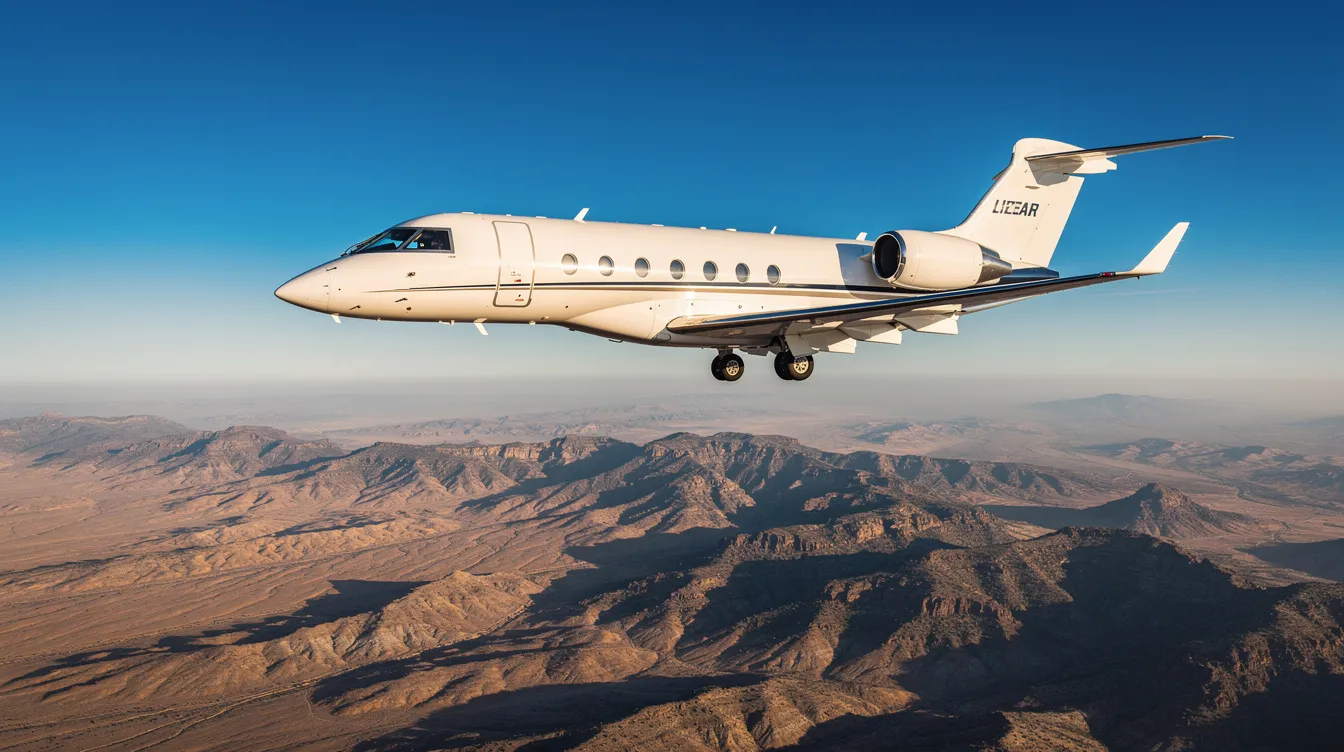
For many individuals and corporations, the true value of a private aircraft isn't skipping the security line for a one-hour flight; it’s the ability to fly halfway around the world without stopping. Modern business jets can now compete directly with commercial airliners in range, a capability that has fundamentally altered how global business is conducted.
The private jet revolution began with developments in the 1950s, but it wasn’t until the 60s that it gained traction with the commercial introduction of the first planes entering service.
One of the earliest and largest was the Lockheed Jetstar, capable of accommodating 10 passengers and boasting a range of 2,604 nautical miles. By 1964, the concept of smaller, faster jets gained popularity with the Learjet 23, which accommodated up to six passengers and had a shorter range of 1,590 nautical miles.
Just two years later, the Gulfstream II upped the expected range of private jets to 3,550 nautical miles. The upshot was that transatlantic flight became not only viable, but desirable.
For the following decade and a half, range improvements were not especially significant, and the incumbent models maintained the status quo until the 1990s. At this point, market pressures and technological improvements paved the way for a new generation of long-range private jets.
Chief among these was the Bombardier Global Express, a family of jets designed to carry at least eight passengers nonstop for at least 6,500 nautical miles. Announced in 1991, it didn’t enter service until 1999. However, demand was so high that no new orders could be placed throughout the decade. And the engineers were able to fulfil the original, lofty range ambitions.
Bombardier might have pushed the envelope in the 1990s and 2000s, but competitors entered the fray quickly to meet the rising demand for long-range private aviation. Most notably, the Gulfstream G650, announced in 2008 and first delivered to a buyer in late 2012, brought the range ceiling to 7,000 nautical miles.
Bombardier responded with the Global 7500 in 2018, achieving a range of over 7,700 nautical miles under ideal operating conditions. The Global 8000 took this to 8,000 nautical miles in 2022, with customer deliveries beginning in 2025.
The Global 7500 and G700 (sibling to the G650) are both recognized by the private aviation experts at Jettly as the current leaders in ultra-long-range service. Most recently, 2025 saw the arrival of the Gulfstream G800 and the Global 8000, both of which push the operational ceiling to 8,000 nautical miles. This effectively allows for nonstop travel between city pairs as distant as Sydney and Los Angeles, or Dubai and Houston.
This technological leap has driven economic growth. According to Grand View Research, the business jet market was valued at $72.15 billion in 2024, with projections to cross $113 billion by 2030. The fact that a mature industry is still seeing nearly 8% annual growth is largely due to this "long-haul" utility.
As business ties deepen between the US, the Middle East, and Asia, the ability to skip layovers becomes a financial asset rather than just a luxury. Analysts predict that 8,500 new jets will be delivered by 2035, generating over $280 billion in sales—a boom driven almost entirely by the demand for extended range.
There are other factors at play, of course. Modern jets can travel farther nonstop than their precursors and do so more efficiently, reducing fuel costs. And as other global pressures and trends seen in recent years continue to crystallize, with more travel between the U.S. and the Middle East for business users and celebrities alike, it’s easy to understand why a focus on long-haul private aviation has become evident.
Private jets in their current form will have a point at which it’s impossible to achieve the leaps in range enjoyed in previous decades. The limiting factor is fuel capacity: Going farther requires larger tanks, and jet fuel is heavy, so larger-capacity planes burn more of it to move from A to B.
It may be many more years before this changes, as new propulsion and fuel sources need to be developed to overcome the limitations of jet plane technology. However, the size of the world and the distances people need to travel won’t change, so the 7,000-8,000 nautical miles achieved by today’s frontrunners should be more than enough for most purposes.
Share this post:
Jay Franco Serevilla
Jan 22, 2026
|
5
min read
Discover tips and trends in the industry.
5
min read
Private Jet from Chicago to Las Vegas: Flight Time, Cost & Best Charter Options
Chartering a private jet from Chicago to Las Vegas offers a swift and convenient travel option, covering approximately 1,500 miles in about 3.5 hours. With various aircraft options available, travelers can enjoy significant time savings and avoid crowded commercial airports. Jettly's platform provides transparent pricing and access to over 20,000 private jets, making it easy to find the right charter for your needs.
Read More
5
min read
Phoenix to Las Vegas Flight Time: How Long Is the Trip and What Are Your Options?
The flight time from Phoenix to Las Vegas averages about 1 hour and 12 minutes for nonstop commercial flights. With three airlines offering direct service, travelers can choose between convenience and speed, or opt for private jet charters for a quicker door-to-door experience. Factors like airport logistics and flight schedules can influence total travel time, making it essential to consider all options before booking.
Read MoreStay updated with our latest insights and tips to elevate your journey with us.
MEMBERSHIPS AND ASSOCIATIONS



Disclaimer: Jettly operates as a charter broker, offering access to a global digital jet charter marketplace. Jettly is not a direct air carrier and does not own or operate aircraft. All advertised flights are conducted by third-party air carriers that are fully licensed and hold the appropriate Part 135 or Part 121 certifications issued by the Federal Aviation Administration (FAA) or equivalent regulatory authorities under U.S. or foreign law. Jettly complies fully with the U.S. Department of Transportation's Part 295 and Part 298 Charter Broker regulations. Jettly does not carry additional liability insurance. Passengers are covered by aircraft operator insurance. TICO: 50023770


