


Login
Get Instant Pricing On 23,000+ Aircraft

>

For the ultra-wealthy, a private jet isn't just transportation—it's brand real estate. Kylie Jenner proved this by customizing her Bombardier Global 7500 into Kylie Air, a flying advertisement for her Kylie Cosmetics empire. The aircraft isn't subtle about it. Every element, from the pink exterior stripe to the neon Kylie bar sign inside, reinforces her brand identity.
This strategy isn't unique to Jenner. Ultra-wealthy entrepreneurs increasingly treat luxury purchases as business assets rather than personal indulgences, Jettly reports. A customized jet signals market success while providing operational utility—two benefits that justify the expense for those at the highest wealth tier.
Jenner's jet exemplifies the trend. It functions as both a status symbol and working tool. The aircraft serves her business operations while simultaneously broadcasting her market position to anyone who sees it on the tarmac or in a social media post.
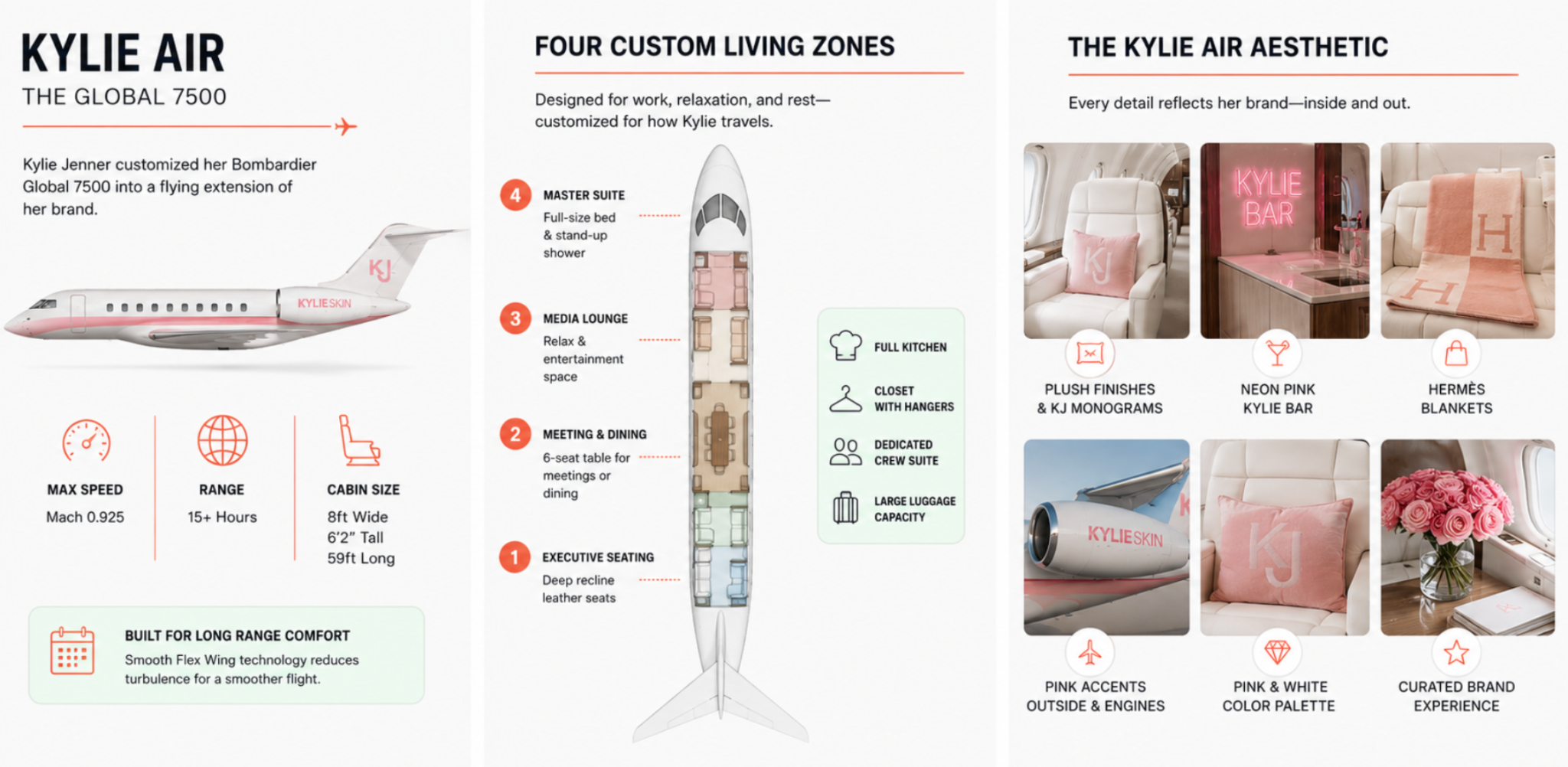
Jenner turned her $73 million Bombardier Global 7500 into a mobile corporate headquarters and branding asset for her billion-dollar beauty empire, Kylie Cosmetics.
Inside and out, the plane has been customized to fit her carefully curated image. The Kylie Air aesthetic is a combination of everything that defines her personal brand, like how the plane’s tail number is N810KJ (her birthday is Aug. 10).
The Flying Mansion’s Tech Specs
Powered by twin GE Passport 20 engines, the Bombardier Global 7500 can reach a max cruise speed of Mach 0.925 (near-supersonic) and is capable of flying 15+ hours non-stop. To put it into perspective, you can fly from LA to London or Dubai.
Furthermore, Bombardier’s Smooth Flex Wing technology reduces turbulence and absorbs most shocks. This means that anyone traveling inside this long-range business jet will have to look out the window to realize they’re in the air and not at home.
Speaking of comfort, the cabin is 8 feet wide and nearly 60 feet long. The cabin has a height of 6 '2", meaning that most can stand fully upright.
These impressive specs make the Bombardier Global 7500 a favorite among the 1%, which is why several other celebrities and mega-billionaire CEOs own one. But this doesn’t mean the plane is off-limits to the rest of the world.
You can still enjoy the experience via private jet rental or fractional ownership.
Every Bombardier Global 7500 comes from the factory with the structural capacity for four distinct living zones, but the layout and purpose of those zones are highly customizable.
Here’s how Jenner turned her private jet into a real flying mansion:
On board, you’ll also find a full-size kitchen, a closet with actual hangers, a dedicated crew suite (right behind the cockpit), and lots of space for luggage.
Out of the factory, the Bombardier Global 7500 looks like a high-end corporate boardroom. The interior is dominated by neutral beige, dark wood veneers and slate gray.
To turn it into Kylie Air, her team stripped away the initial look and replaced it with a pleasant pink-and-white design. Everywhere you look, you see plush white seats, pink satin pillows, KJ monograms, Hermès blankets, and a glowing neon pink Kylie bar sign.
Even the outside of the plane got a pink stripe, with the words “Kylie Skin” on the right side of the door and on the jet engines.
The Kylie Cosmetics founder is not subtle with her message. No one buys a plane of the size and specs of a Global 7500 because of its utility.
By turning her Global 7500 into Kylie Air, the youngest of the Kardashian-Jenners announced her place in the ultra-luxury market. The plane is now an extension of her personal brand, offering her travel flexibility and comfort.
Still, the costs don’t stop here. Owning a plane of this magnitude comes with ongoing costs such as fuel, hangarage, maintenance, crew, and more. The overall costs can go over $5 million a year depending on variable costs such as fuel, maintenance, catering, and landing fees. Still, the jet is not just there for transportation; it’s a lifestyle and status symbol that also facilitates quick travel for those who have essential business around the world.
Share this post:
Jay Franco Serevilla
Jun 18, 2026
|
5
min read
Discover tips and trends in the industry.
5
min read
Southwest 737-800 vs MAX 8: What Flyers Should Know (and How It Compares to Private Jet Travel)
This article compares Southwest Airlines' Boeing 737-800 and MAX 8, focusing on passenger experience, comfort, and features. While both aircraft offer similar seating and service, the MAX 8 boasts quieter engines, modern interiors, and consistent USB charging. For travelers seeking privacy and flexibility, private jet charter options through Jettly present a compelling alternative to commercial flights.
Read More
5
min read
Flight Length: How To Estimate Flight Time Accurately (Especially For Private Jets)
Estimating flight length accurately is crucial for effective travel planning, whether for private jets or commercial flights. Factors such as distance, aircraft type, and wind conditions can significantly impact flight duration. This guide provides insights into estimating flight times and highlights the advantages of private jet travel through platforms like Jettly.
Read MoreStay updated with our latest insights and tips to elevate your journey with us.
MEMBERSHIPS AND ASSOCIATIONS



Disclaimer: Jettly operates as a charter broker, offering access to a global digital jet charter marketplace. Jettly is not a direct air carrier and does not own or operate aircraft. All advertised flights are conducted by third-party air carriers that are fully licensed and hold the appropriate Part 135 or Part 121 certifications issued by the Federal Aviation Administration (FAA) or equivalent regulatory authorities under U.S. or foreign law. Jettly complies fully with the U.S. Department of Transportation's Part 295 and Part 298 Charter Broker regulations. Jettly does not carry additional liability insurance. Passengers are covered by aircraft operator insurance. TICO: 50023770


