


Login
Get Instant Pricing On 23,000+ Aircraft

>
Touring operations spanning five continents face a hard operational constraint: Coordinating shows across global markets demands an aircraft fleet optimized for speed, range, and utilization efficiency. Most celebrity jet owners treat aircraft as occasional luxury assets. Elite touring operations treat them as corporate shuttles.
Taylor Swift is one of the world's most successful recording artists, and she has performed live concerts around the globe during the Eras Tour, while also supporting her now-husband’s career. This would not have been possible without a well-planned international flight strategy.
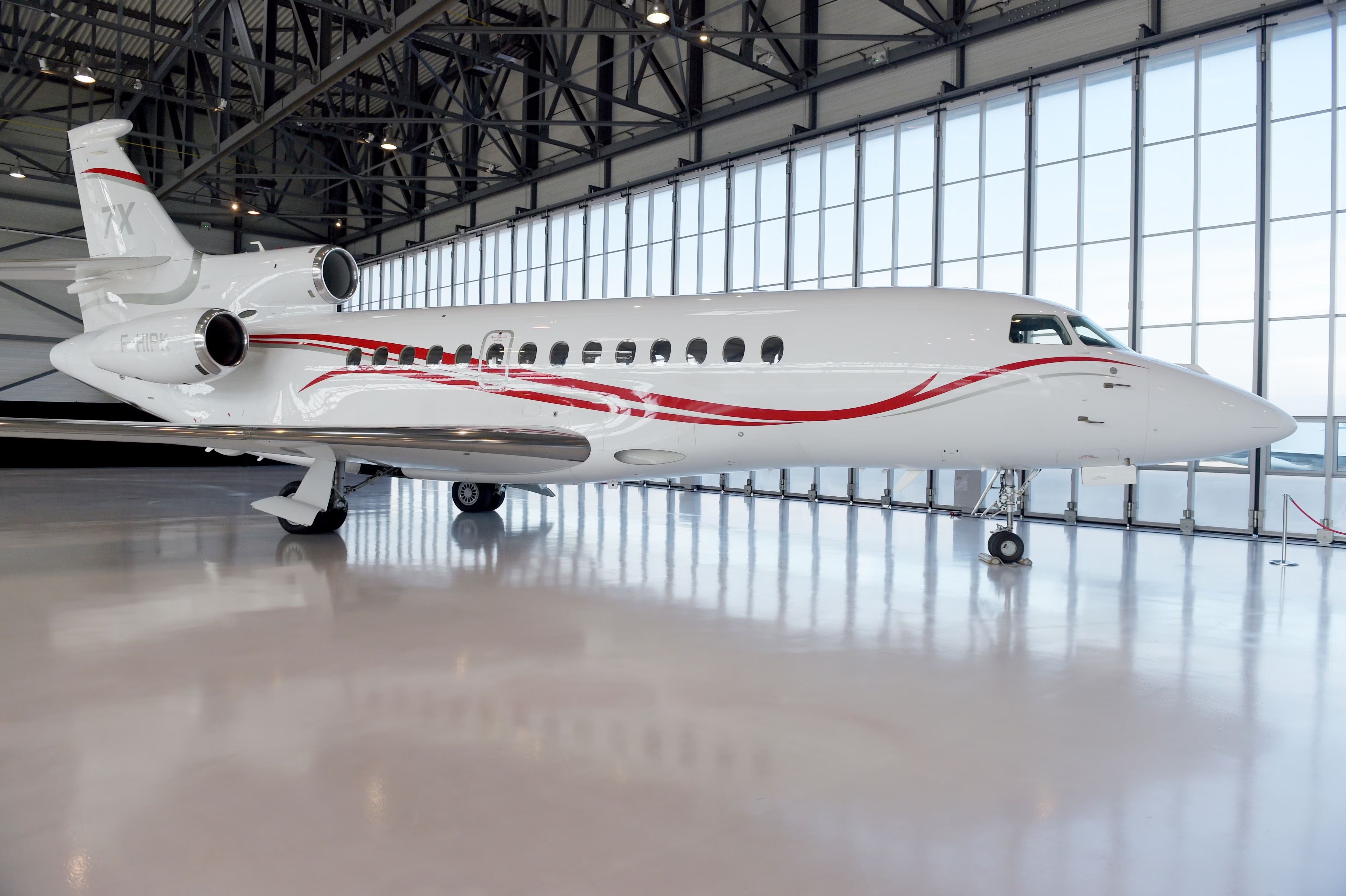
Jettly provides a look at her touring strategy and the role her Dassault Falcon 7X aircraft plays in it.
There is no denying that the Taylor Swift brand is a global phenomenon. From Tokyo to LA, most people recognize the name, even if they’re not fans. Her PR strategy and business acumen are a lesson in corporate strategy.
Her business operations are studied by academic institutions (including Harvard, Stanford, and IESE Business School) as a masterclass in market dominance. Based on the Taylor Swift brand profit margins and total economic multiplier effect, she operates with the efficiency of an elite, top-tier corporation.
Swift’s touring strategy resembles the corporate flight operations of a mid-to-large Fortune 500 company. Just like a top-tier company, her empire spans multiple continents, which is why the Eras Tour is considered one of the most operationally intense private aviation undertakings in modern entertainment history, with over 178,000 miles flown in 2025 alone.

Taylor Swift operates her aircraft exactly like a Fortune 500 company operates its fleet. Time savings matter. Fatigue management directly impacts performance. Security and route flexibility aren't negotiable. These aren't perks; they're operational necessities.
Business leaders don't treat private aviation as a luxury—it's operational infrastructure. When managing global operations, the speed and flexibility gains justify the cost. This is why private jet charter services are on the rise right now: They provide a level of comfort, security, and privacy that commercial airlines simply can't match.
What does Swift’s logistics team do that puts her strategy in line with that of a top-tier company?
Consolidating to a Single Long-Range Aircraft
Recently, Swift transitioned from a multi-aircraft fleet (one Dassault Falcon 50 and one Falcon 900) to a single, highly utilized asset, a Dassault Falcon 7X. Instead of maintaining two almost similar planes, she moved to one that can handle long-range international travel.
The Dassault Falcon 7X has a range of up to 5,950 nautical miles and can easily complete nonstop flights on routes like Sydney to Los Angeles or Tokyo to New York. The jet also features a spacious cabin that seats up to 16 passengers comfortably, and a three-engine design that provides added safety during long flights over oceans.
These features make the Falcon 7X the perfect choice for a record-breaking global tour that included 149 shows across five continents. From a financial perspective, the fleet downsizing helped reduce maintenance costs (like hangar space, crew salaries, and insurance premiums) and maximized the utility of the main plane.
How 225 Annual Flight Hours Define Operational Efficiency
The main differentiator between casual celebrity jet owners and corporate flight departments is utilization, or how often the plane is actually in the air versus sitting in a hangar, costing money. Most celebrities only take their planes out a few times a year, for vacations or major events. But Swift runs her plane like a corporate shuttle.
In 2024, during the peak of the Eras Tour, her Falcon 7X logged 225 flight hours across 98 flights, according to Celebplanes, a celebrity jet tracker. Already in the first half of 2026, the aircraft has logged over 169 flight hours across 81 flights. These are intense operational figures that mirror a corporate shuttle transporting executives between global offices.
The reason her Falcon 7X is out flying so often is the way it’s being used:
Swift's plane operates continuously even when she's not on board. In corporate terms, the asset generates utility or offsets costs when the principal isn't traveling.
However, due to the heightened security measures that her fame and status require and a highly specific schedule, the Falcon 7X experiences a disproportionately high number of repositioning flights (e.g., flying empty to pick Swift up or returning to a secure base hangar rather than staying parked at a public airport). This aspect is not very business-like, but it is necessary in Swift’s world.
Private aviation often comes under scrutiny due to its disproportionate environmental impact per passenger. While this is an important discussion, it’s also an added stress for private plane owners, whether businesses or celebrities.
Swift’s frequent flying is constantly debated on social and classical media alike. And the Eras Tour has rekindled discussions due to its sheer number of flights. Since Swift is a public figure and one of the most recognizable artists in the world, this is often a PR issue that attracts additional expenses.
Since private jets are generally viewed as another productivity tool, most Fortune 500 companies don’t face this kind of public scrutiny.
In an effort to offset her travel carbon footprint, Swift purchased carbon offsets, her team announced several years ago. Though climate scientists have pointed out that ultimately, buying carbon offsets doesn’t lower emissions, this is exactly what most companies would do when public pushback gets intense.
Taylor Swift is a world-renowned celebrity who uses her private jet more than many other celebrities. But for a celebrity of her magnitude, private aviation is the only form of travel that suits her needs.
While she has been criticized for how much her plane is in the sky, she does nothing different from what a Fortune 500 company does. Her jet often operates like a business shuttle instead of gathering dust in a hangar. Both Swift and top-tier businesses consider it a necessity to fly privately without external constraints, and they use their planes accordingly.
Share this post:
Jay Franco Serevilla
Jul 29, 2026
|
5
min read
Discover tips and trends in the industry.

5
min read
New York to Miami Distance: Routes, Flight Times, and Private Jet Options
Traveling from New York to Miami offers various options, including direct flights, driving, and private jet charters. The aerial distance is about 1,090 miles, while driving spans approximately 1,280–1,300 miles. This guide provides insights into travel times, costs, and the best routes for your journey.
Read More
5
min read
NY to Aruba Flight Time: How Long It Takes & The Fastest Ways to Get There
The flight time from New York to Aruba typically ranges from 4 hours 30 minutes to 5 hours, with an average of about 4 hours 43 minutes. Factors such as departure airport and flight type can significantly affect total travel time, especially when considering connecting flights. For those seeking convenience, private jet charters can offer similar in-air times while reducing overall travel duration.
Read MoreStay updated with our latest insights and tips to elevate your journey with us.
MEMBERSHIPS AND ASSOCIATIONS



Disclaimer: Jettly operates as a charter broker, offering access to a global digital jet charter marketplace. Jettly is not a direct air carrier and does not own or operate aircraft. All advertised flights are conducted by third-party air carriers that are fully licensed and hold the appropriate Part 135 or Part 121 certifications issued by the Federal Aviation Administration (FAA) or equivalent regulatory authorities under U.S. or foreign law. Jettly complies fully with the U.S. Department of Transportation's Part 295 and Part 298 Charter Broker regulations. Jettly does not carry additional liability insurance. Passengers are covered by aircraft operator insurance. TICO: 50023770


