


Login
Get Instant Pricing On 23,000+ Aircraft

>
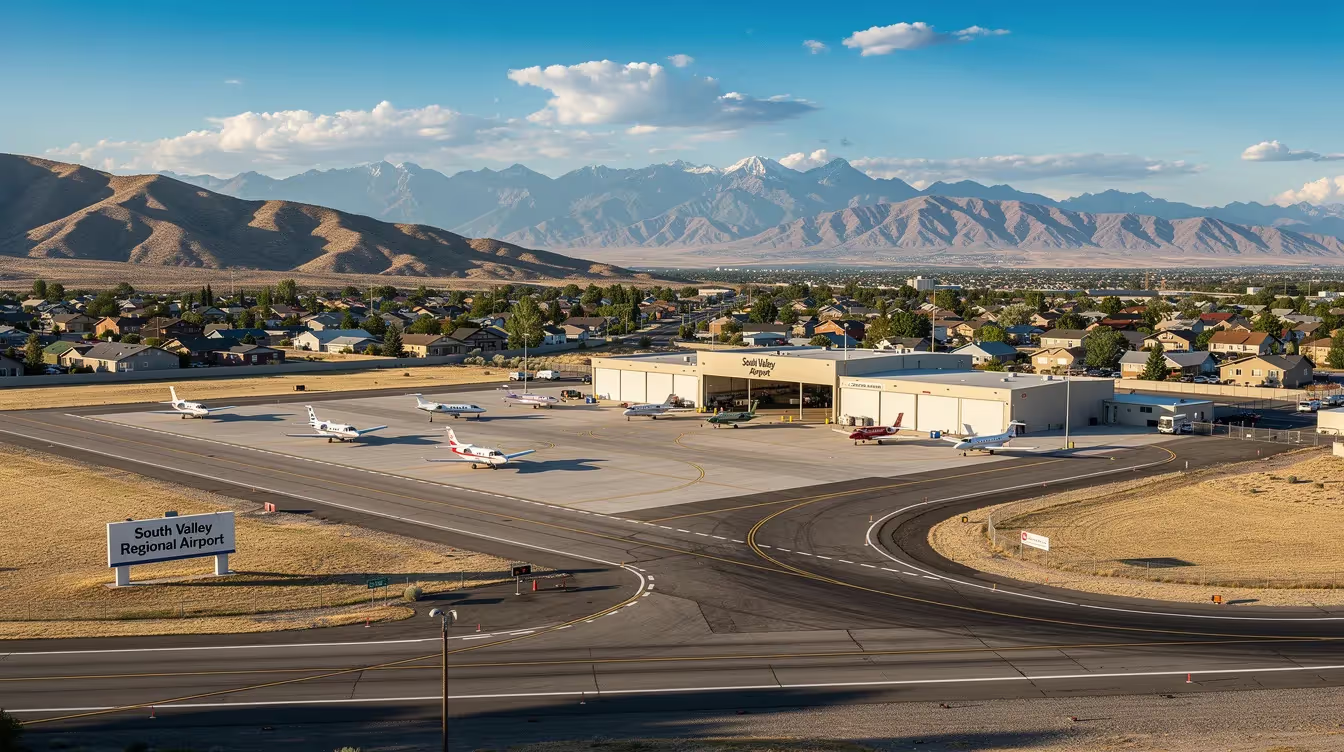
South Valley Regional Airport (KSVR) is a vital general aviation facility serving the Salt Lake City metropolitan area from its location in West Jordan, Utah. This article provides a comprehensive overview of the airport’s infrastructure, facilities, and daily operations, as well as practical visitor information for pilots, private travelers, and aviation enthusiasts. Whether you are seeking details on runway specifications, flight training opportunities, military activity, or private charter options, this guide highlights why South Valley Regional Airport plays a crucial role in supporting business, recreational, and training aviation throughout the region.
South Valley Regional Airport (KSVR) serves as a busy general aviation and training facility in West Jordan, located approximately 13.5 miles south of Salt Lake City International Airport.
The airport operates one runway, Runway 16/34, measuring 5,862 feet long and 100 feet wide on an asphalt surface, capable of handling helicopters, training aircraft, and light business jets.
KSVR hosts a Utah Army National Guard facility operating Black Hawk and Apache helicopters, alongside multiple flight schools serving fixed-wing and rotary-wing students.
The fixed base operator provides Jet A and 100LL fuel, ground services, and passenger amenities, including a lounge and concierge services.
Digital charter platforms like Jettly enable travelers to use South Valley Regional Airport for private flights as a convenient alternative to Salt Lake City International.
South Valley Regional Airport is a public general aviation airport serving West Jordan and the greater Salt Lake City area in Utah. This facility provides essential infrastructure for flight training, helicopter operations, and regional charter services throughout the Intermountain West.
The airport is located at 7365 S 4450 W, West Jordan, UT 84084. Depending on the route selected, the facility sits roughly seven miles to 14 miles southwest of downtown Salt Lake City. The airport is situated just east of the Bangerter Highway and near the eastern side of West Jordan, offering convenient access to major transportation routes. The current ICAO identifier is KSVR—a designation that replaced the historical U42 code. On April 17th, 2025, the airport’s ICAO code changed from U42 to KSVR after many years of lobbying from the airport operator.
The airport supports various aviation services, including business-related flying, law enforcement, recreational flying, flight training, and air charters. Helicopter operations represent a significant portion of daily activity. The Salt Lake City Department of Airports owns and manages this facility as part of a regional system that also includes Salt Lake City International Airport (SLC).
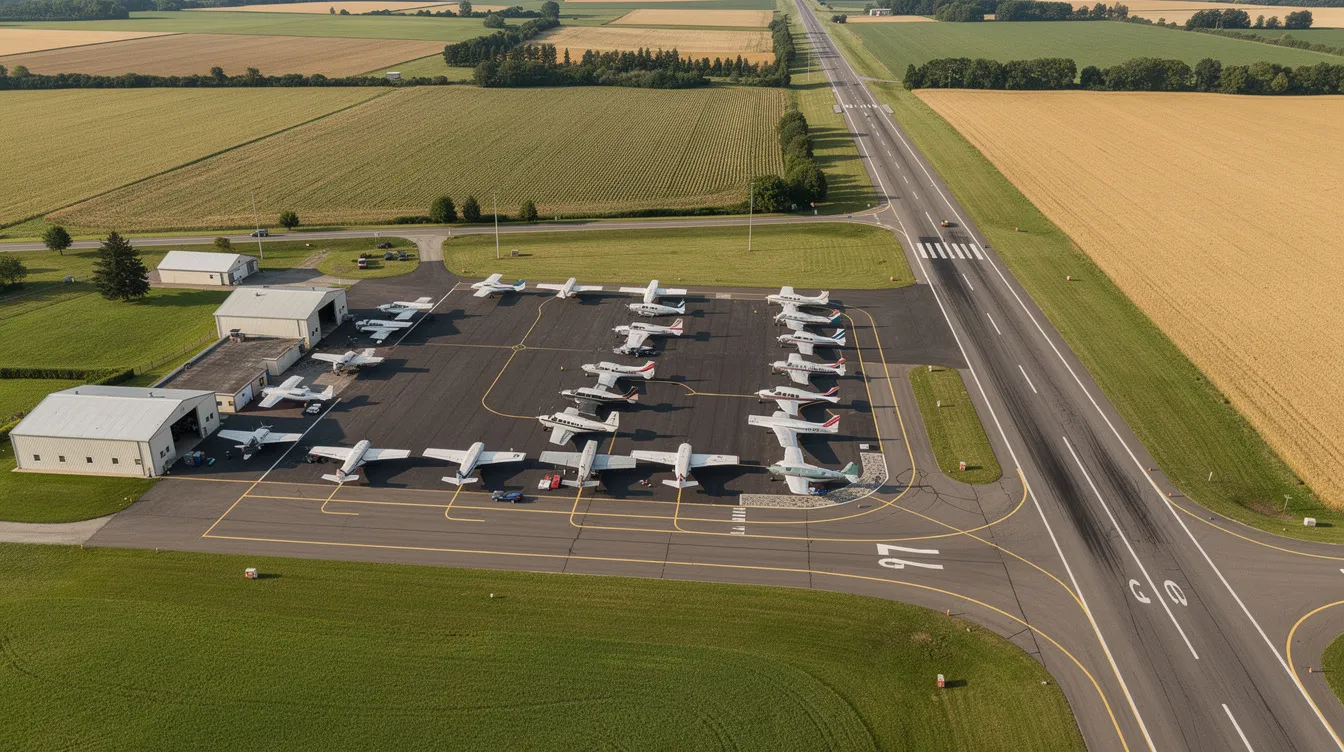
South Valley Regional Airport operates a single runway aligned generally north to south, complemented by a parallel taxiway system. This configuration efficiently serves the diverse mix of training aircraft, helicopters, and business aviation traffic.
The runway at South Valley Regional Airport, designated as 16/34, is 5,862 feet long and 100 feet wide. Runway 16/34 is paved with asphalt and can support a maximum gross weight of 30,000 pounds for aircraft with single-wheel main landing gear and up to 43,000 pounds for those with double-wheel main landing gear configurations. This capacity accommodates most light and midsize business aircraft under typical operating conditions.
KSVR has an elevation of 4,603 feet above mean sea level. This elevation significantly affects aircraft performance, particularly during summer months when density altitude conditions can reduce takeoff and climb performance for jets and turboprops.
The runway features pilot-controlled medium intensity runway lights (MIRL) and four light precision approach path indicators (PAPIs) positioned on the left side of each runway end. Runway end identifier lights (REILs) provide additional visual guidance at each end. The field typically operates without a control tower, using standard CTAF/UNICOM procedures. Pilots self-announce positions on frequency 122.7.
Runway 16 is often favored during prevailing southerly winds, while 34 serves northerly conditions. Local flight training activity can make the pattern busy during peak morning and late afternoon hours, so visiting pilots should anticipate student traffic.
|
Feature |
Details |
|---|---|
|
Runway Designation |
16/34 |
|
Runway Length |
5,862 feet |
|
Runway Width |
100 feet |
|
Surface Type |
Asphalt |
|
Maximum Weight Capacity |
30,000 lbs (single-wheel), 43,000 lbs (double-wheel) |
|
Elevation |
4,603 feet above mean sea level |
|
Lighting |
Pilot-controlled MIRL, PAPIs, REILs |
|
Traffic Control |
Non-towered, CTAF/UNICOM frequency 122.7 |
The main landside area at South Valley Regional Airport features FBO facilities, hangars, and apron space positioned along the runway. The airport features fixed-base operator facilities, maintenance hangars, and aircraft parking aprons with a total of 100 tie-down spaces.
Key facilities and services include:
Full-service FBO offering Jet A and 100 low-lead aviation gasoline, provided by the Salt Lake City Department of Airports
Passenger amenities include a passenger terminal, lounge, flight planning kiosk, conference room, and concierge services
The airport allows outdoor tie-downs and has T-hangar options for aircraft storage
Ground handling services at KSVR include GPU/power cart assistance and aircraft towing services
The airport features 24-hour security personnel
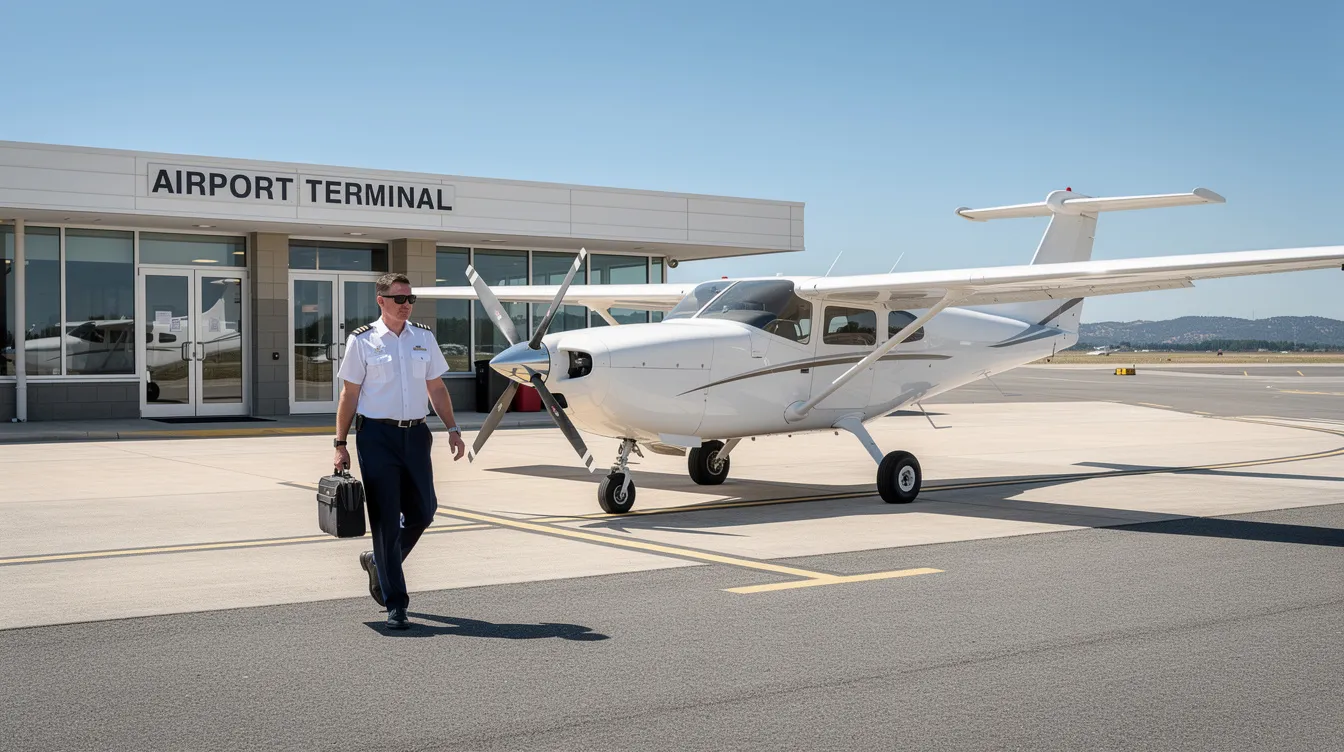
The facility does not feature an on-site commercial transit terminal, maintaining its focus on general aviation operations. Third-party maintenance providers operate on the field for routine inspections and repairs.
Private flyers arriving via a broker like Jettly can coordinate with the FBO for catering, ground transportation arrangements, or chauffeured car services to West Jordan, downtown Salt Lake City, or Park City, including tailored in-flight meals through Jettly’s dedicated catering service. This personalized coordination streamlines the arrival experience compared to commercial terminal procedures.
South Valley Regional Airport hosts a Utah National Guard Army Aviation Support Facility on the field. This military presence contributes to the airport’s operational diversity and activity levels.
The airport has a Utah National Guard Army Aviation Support Facility operating Black Hawk and Apache helicopters. These rotary-wing aircraft conduct training, readiness drills, and support missions across Utah and the broader Intermountain West region.
This military presence influences airfield activity patterns significantly. Pilots should anticipate periodic helicopter training, formation flights, and occasional night operations. Guard aircraft may operate in dedicated training corridors near the airport.
Civilian pilots should be familiar with local procedures, maintain heightened awareness for helicopter traffic, and review published standardized operations guidance for the airport. The shared use of this regional airport by both military and civilian users makes coordination and adherence to traffic procedures especially important for safety.
South Valley Regional Airport functions as a major flight training hub in the Salt Lake Valley, with multiple fixed-wing and helicopter schools operating from the facility. The concentration of training activity shapes the airport’s daily character and traffic patterns.
The airport serves as a training base for multiple flight schools including Randon Aviation, Utah Helicopter, Aerotech Aviation, and Upper Limit Aviation. These operators provide:
Private, instrument, and commercial certificates for fixed-wing aircraft
Helicopter ratings from private through instructor levels
Single-engine and multi-engine instruction
Integrated programs offering both airplane and rotorcraft training
Training operations range from first solo flights to advanced commercial and instructor ratings, creating a diverse traffic mix. KSVR handles over 105,000 annual operations, including a significant presence of helicopter operations and the Utah National Guard.
Pilots visiting for the first time should anticipate high student training activity in the pattern and on practice areas west and south of the airport. The mix of experience levels among pilots requires patience and awareness from all users. Many students commute from Salt Lake City suburbs, while some out-of-state helicopter students relocate to West Jordan for intensive training programs.
South Valley Regional Airport is guided by a formal master plan prepared for the Salt Lake City Department of Airports. This document addresses infrastructure development and capacity planning through the 2030s.
The master plan covers:
Runway and taxiway upgrades
Hangar development to meet growing demand
Safety improvements throughout the facility
Long-term capacity planning for training and charter growth
Public documents have outlined potential future improvements, including additional hangars, ramp expansions, and infrastructure to support growing flight school and helicopter activity.
The ICAO code change from U42 to KSVR in April 2025 followed an extended lobbying effort by the airport operator. This upgrade improves charting consistency across national databases and raises the airport’s profile among digital flight planning platforms and charter users. The four-letter KSVR designation aligns with standard international coding conventions.
Stakeholders hope the higher visibility of KSVR may support long-term objectives, potentially including a control tower installation if traffic growth justifies the investment.
For more details on the airport's master plan and future development, click here to access the official planning documents.
South Valley Regional Airport sits at roughly 4,603 ft elevation in Utah’s Salt Lake Valley. This altitude creates high-density-altitude conditions during the summer months that directly affect aircraft performance calculations.
Typical seasonal patterns include:
Hot, dry summers with afternoon thermals and temperatures frequently exceeding 85°F
Winter conditions bring cooler temperatures, occasional snow, and periodic IFR weather
Spring and fall transition periods with variable winds and scattered clouds or broken clouds patterns
Clear sky conditions predominating through much of the year
Automated weather observations (AWOS on 134.42) provide current data on temperature, dew point, wind speed and direction, and visibility for pilots planning flights into KSVR. This weather information is essential for performance planning.
The combination of elevation and temperature can significantly affect takeoff and landing performance for light jets and turboprops. Charter operators using Jettly factor runway length, payload requirements, and ambient temperature into flight planning. A summer afternoon at 90°F could produce density altitudes exceeding 7,000 feet, meaningfully reducing available performance margins.

Many travelers select South Valley Regional Airport instead of Salt Lake City International for specific advantages. The regional facility offers less congestion, simplified ground procedures, and proximity to West Jordan, South Jordan, and other southern suburbs that can save 20-40 minutes of ground transportation time, especially for those using cost-conscious private jet booking strategies.
Aircraft commonly using Runway 16/34 include:
Turboprops such as King Air and Pilatus PC-12 models
Light jets, including Citation CJ series and Embraer Phenom 100
Some midsize jets under appropriate weight and weather conditions
Digital charter platforms like Jettly connect travelers to on-demand private flights into or out of South Valley Regional Airport. The platform provides instant pricing, airport search and routing tools, detailed private charter aircraft options across categories, and flexible scheduling that aligns with business or personal travel needs.
Jettly’s platform offers access to a large global fleet, allowing travelers to select aircraft categories suited to specific missions—whether business trips to Las Vegas or Denver, family departures to nearby resort destinations, or last-minute travel when commercial schedules from SLC do not align. Travelers can quickly reference private jet charter cost estimates or review a broader guide to affordable private jet charter pricing when budgeting trips.
Typical use cases include executives based in West Jordan flying directly to regional business hubs, families departing from South Valley to nearby ski resorts, and urgent travel requiring same-day arrangements, similar to how travelers use private charter services in major markets like Atlanta, Georgia or international hubs such as Lagos, Nigeria.
Ready to explore private flight options from South Valley Regional? Visit Jettly to compare aircraft and request instant quotes.
Visitors and passengers typically access South Valley Regional Airport by automobile from Salt Lake City and surrounding communities. The airport’s location in West Jordan provides multiple convenient routing options.
Key access information:
Access to KSVR is facilitated by the nearby Bangerter Highway and I-15 and I-215 interchange
From these highways, travelers navigate surface streets to reach the airport entrance on 4450 West
Parking is generally available near the FBO and terminal area
Private charter passengers often coordinate curbside drop-off and pick-up directly with the FBO
KSVR does not have rental car facilities directly on-site; travelers must pre-arrange vehicle delivery with off-site providers or travel to nearby rental hubs
Rideshare services, local taxis, hotel shuttles, or pre-arranged executive car services provide last-mile connections between KSVR, downtown Salt Lake City, Park City, and other regional destinations. Travel time from downtown Salt Lake City typically ranges from 20 to 30 minutes, depending on traffic conditions, making KSVR an efficient gateway for travelers booking through on-demand private jet marketplaces like Dexter Air Taxi on Jettly or instant-book charter platforms such as Zenflight.
South Valley Regional Airport is a public-use general aviation airport open to private owners, flight schools, charter operators, and visiting aircraft that meet standard FAA and local requirements. The airfield accommodates transient traffic, based aircraft, and training operations without restrictions on properly equipped and licensed pilots. However, some facilities, such as specific hangars, flight school training areas, and National Guard sections, are restricted to authorized personnel only.
Many turboprops and light to midsize jets can safely operate from Runway 16/34, subject to weight and performance planning based on temperature and payload. The 5,862-foot runway and 43,000-pound double-wheel weight capacity accommodate most business jets in lighter categories. Larger long-range jets may still prefer Salt Lake City International due to runway length requirements and additional service considerations. Jettly can help travelers determine which aircraft are suitable for departures and arrivals at KSVR based on specific trip details, drawing on expertise similar to a cross-country aircraft selection guide.
The typical aircraft mix includes single-engine training aircraft such as Cessna and Piper models, light twin-engine airplanes used for advanced training, and helicopters operated by schools and the Utah National Guard. Occasional business turboprops and light jets visit for charter operations. The high level of training activity means many aircraft are engaged in pattern work, instrument approaches, and local practice maneuvers throughout the day.
South Valley Regional is substantially smaller and focused exclusively on general aviation, lacking airline terminals and scheduled passenger service found at SLC. Despite its smaller footprint, training activity, helicopter operations, and National Guard missions can make KSVR quite active during certain times—particularly mornings and late afternoons when flight school traffic peaks. Private travelers often appreciate the simpler check-in and boarding process at this regional airport compared to navigating a major commercial hub.
Travelers can use platforms like Jettly to search routes that include KSVR, view indicative pricing, and compare aircraft categories quickly, or use a jet card flight cost estimator when considering prepaid options. Once a flight is selected, the charter operator and FBO coordinate details including departure time, passenger handling, and ground transportation arrangements, which can be further streamlined through structured jet card programs for frequent flyers. Visit Jettly to explore current options or request a tailored quote for flights using South Valley Regional Airport.
South Valley Regional Airport serves as a key general aviation and training hub for West Jordan and the greater Salt Lake City region. The facility’s combination of Runway 16/34, diverse flight schools, military operations, and FBO services creates a versatile base for both local pilots and visiting charter flights.
The airport’s recent transition to the KSVR identifier reflects growing recognition of its role within regional aviation infrastructure. For private travelers seeking alternatives to the congestion of a major commercial hub, South Valley Regional offers meaningful advantages in convenience and efficiency.
Travelers can use digital charter platforms like Jettly to access on-demand flights to and from South Valley Regional, matching aircraft to mission requirements and budget constraints, or explore private jet membership programs that fit recurring travel needs. The platform simplifies comparison across aircraft categories and provides transparent pricing for informed decision-making, similar to other leading private jet charter companies.
Ready to experience private travel on your terms? Explore flight options or request a quote at Jettly.
Share this post:
Jay Franco Serevilla
May 13, 2026
|
5
min read
Discover tips and trends in the industry.

5
min read
What’s Included in Private Jet Catering & Ground Transportation
Private jet catering and ground transportation are essential components of a charter flight experience, ranging from basic snacks to gourmet meals and various vehicle options. This guide provides detailed timelines, dietary accommodations, and a checklist to streamline the booking process, ensuring a smooth and luxurious travel experience. Understanding what's included and how to coordinate these services can help avoid surprises on departure day.
Read More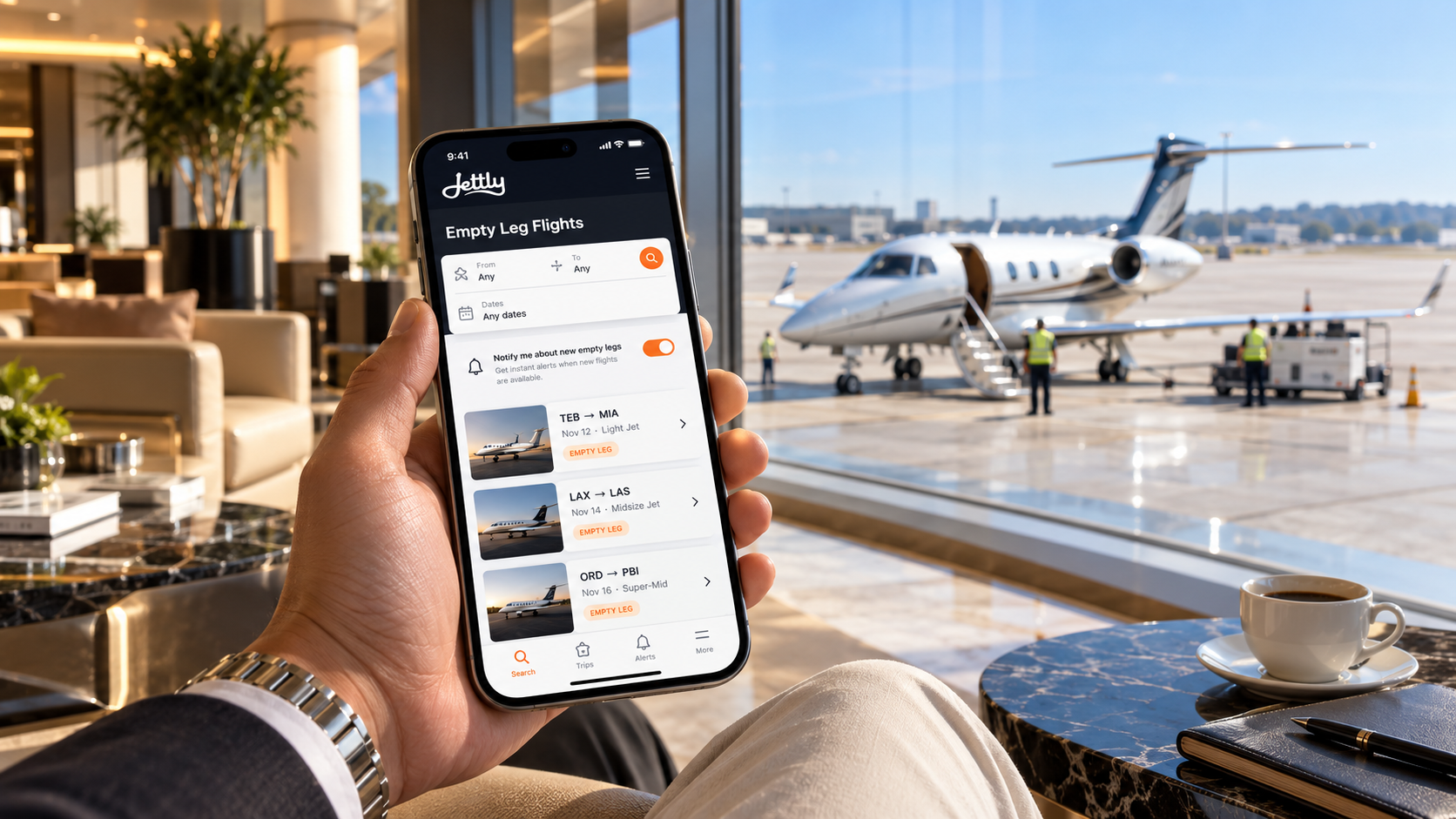
5
min read
How to Book Empty Leg Flights in the Jettly App (iOS & Android)
Booking empty leg flights through the Jettly app offers a cost-effective way to experience private aviation. This guide outlines the steps for finding, booking, and managing these flights on both iOS and Android devices, ensuring a smooth travel experience. Learn how to set alerts, apply filters, and confirm your trip with confidence.
Read MoreStay updated with our latest insights and tips to elevate your journey with us.
MEMBERSHIPS AND ASSOCIATIONS



Disclaimer: Jettly operates as a charter broker, offering access to a global digital jet charter marketplace. Jettly is not a direct air carrier and does not own or operate aircraft. All advertised flights are conducted by third-party air carriers that are fully licensed and hold the appropriate Part 135 or Part 121 certifications issued by the Federal Aviation Administration (FAA) or equivalent regulatory authorities under U.S. or foreign law. Jettly complies fully with the U.S. Department of Transportation's Part 295 and Part 298 Charter Broker regulations. Jettly does not carry additional liability insurance. Passengers are covered by aircraft operator insurance. TICO: 50023770


