



Login
Get Instant Pricing On 23,000+ Aircraft

>
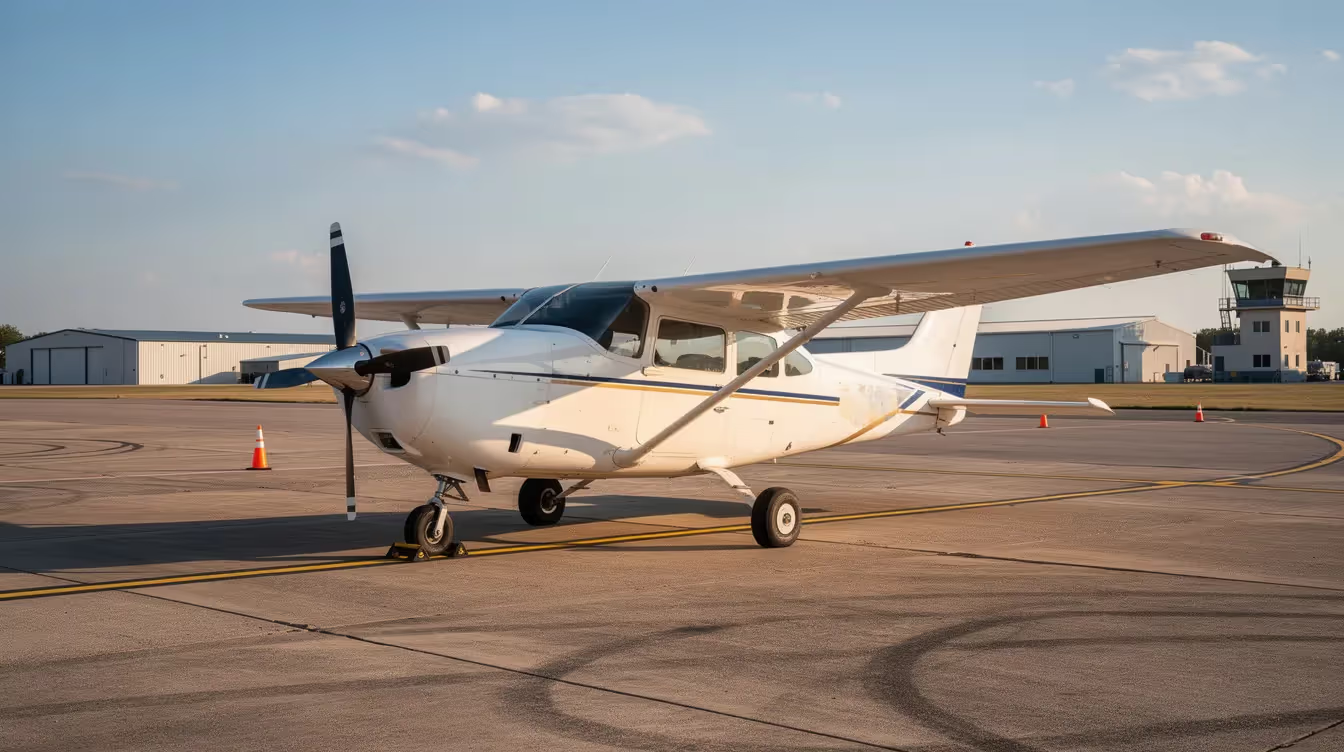
Small aircraft leasing offers an accessible and flexible alternative to outright ownership for pilots, businesses, and aviation enthusiasts. By leasing, customers can enjoy the benefits of private aircraft transportation without the high upfront costs, long-term commitments, and maintenance responsibilities that come with owning a plane. This approach suits a range of users—from individual pilots building flight hours to companies needing reliable regional transportation.
Leasing small aircraft supports business aviation by converting capital expenditures into manageable operating expenses, improving cash flow, and financial flexibility. Additionally, leasing arrangements often include maintenance and insurance provisions, reducing operational burdens. As a result, leasing can be a practical solution for those seeking convenience, cost efficiency, and access to a variety of aircraft types.
This guide explores the key aspects of small aircraft leasing, including lease types, cost benchmarks, operational responsibilities, and how to decide between leasing, owning, or chartering. It also highlights other considerations for customers navigating the evolving landscape of private aviation, especially when using a comprehensive private jet charter and leasing platform like Jettly.
Small aircraft leasing lets pilots and businesses access aircraft from 50-year-old Cessna 150s to modern Cirrus SR22s without full ownership risk.
Typical small airplane dry leases range from 12 to 60 months, while hourly “club” or FBO leases can start under $100 per flight hour for basic trainers.
Choice between leasing, owning, and chartering (via platforms like Jettly) depends mainly on annual flight hours, capital, and flexibility needs.
This article covers lease types, real-world price ranges in 2024–2026, maintenance and insurance responsibilities, and how Jettly helps compare lease vs charter economics.
Small aircraft leasing provides a pathway for pilots and businesses to access two-to-eight-seat piston singles, light twins, and small turboprops under approximately 12,500 lbs maximum takeoff weight—think Cessna 172, Piper PA-28, Diamond DA40, Beechcraft Bonanza, and King Air C90. Rather than tying up hundreds of thousands of dollars in purchase costs, leasing allows access to these airplanes with lower upfront capital and more flexibility.
Typical users span the aviation industry spectrum: private pilots building hours toward commercial licenses, flight school operators expanding training fleets, small businesses flying regional routes like Boston–Buffalo or Calgary–Edmonton, and air-taxi startups launching under their own certificates. These missions often rely on access to a wide range of suitable departure and destination points, which can be planned efficiently using an airport locator tool for private flights. Airlines, as well as private operators, use various lease arrangements—such as wet and dry leases—to manage aircraft fleets, regulatory requirements, and operational flexibility across different jurisdictions. The benefits compared to outright aircraft ownership include reduced capital requirements, the ability to upgrade or switch aircraft type at lease end, and shifting residual value and residual risk to the lessor.
While Jettly is known for on-demand charter and memberships, lease cost benchmarks and trip data from the platform often help clients decide when leasing a small airplane makes financial sense versus simply chartering. For qualifying business use, lease payments may be treated as tax-deductible operating expenses, improving cash flow management.
Lease structures for small aircraft mirror those used for larger business jets and private jets: wet leases, dry leases, and block-time or “club” style lease agreements. Most private pilots first encounter wet leases at flying clubs and FBOs, while dry leases become relevant when assuming more operational control under Part 91 in the U.S. or similar federal aviation regulations in Canada and the EU.
A damp lease is a hybrid leasing arrangement, combining aspects of both wet and dry leases. In a damp lease, the lessor supplies the aircraft, flight crew, and maintenance, while the lessee provides the cabin crew, enabling tailored service options. This flexible option is particularly common in European markets.
The lease structure determines who provides the flight crew, handles maintenance, arranges aircraft insurance, and bears regulatory responsibility—including whether an Air Operator’s Certificate is required. The FAA distinguishes leases primarily by operational control—who is legally responsible for the safety and compliance of the flight. Understanding these distinctions is essential before signing any agreement for a Cessna, Piper, Diamond, or similar small aircraft.
A wet lease for small aircraft means the lessor (typically an FBO or flight school) provides the airplane, instructor or pilot, basic maintenance, and insurance. The lessee pays hourly use plus fuel—or sometimes an all-inclusive “wet” rate.
Common for training aircraft: Cessna 152, Cessna 172, Piper PA-28, and Diamond DA40
Typical durations range from ad-hoc hourly rentals to month-long or seasonal packages (e.g., 50–100 hours over 3–6 months for CPL or IFR training)
Minimal admin burden for the lessee—no separate insurance policy needed, maintenance handled by the lessor
Simple pay-per-hour structure ideal for student pilots and hour-builders
Limitations include less control over scheduling during seasonal peaks at busy fields like Van Nuys (KVNY) or Fort Lauderdale Executive (KFXE), stricter rules on night flying or grass strips, and a higher hourly cost compared to a dry lease arrangement.
Under a dry lease, the lessor supplies only the airframe. The lessee handles pilots, fuel, maintenance compliance, and insurance—typically operating under private Part 91 rules.
Small aircraft dry leases usually run 12–60 months with minimum annual hour commitments between 150 and 400 flight hours
Monthly rates for dry leases typically run between 0.8% and 1.5% of the aircraft's fair market value per month
Common among small businesses or private aircraft owners leasing Cirrus SR22, Beechcraft Bonanza, Piper Seneca, or King Air C90 for regional shuttles
In the EU and UK, dry-leased aircraft operate under the lessee’s privileges or AOC, with EASA/CAA-specific requirements
Dry leases can be structured as an operating lease—keeping the aircraft on the lessor's balance sheet with the lessor bearing residual risk—or as a finance lease, where the lessee is treated as the economic owner for tax and accounting purposes, potentially unlocking tax benefits like depreciation.
Leasing helps businesses avoid financial risks associated with depreciation, as lessees do not own the asset and are not affected by its declining value over time.

Block-time agreements involve prepaying for a package of hours—say 25, 50, or 100 hours on a Cessna 172 or Piper Archer—at discounted rates through flying clubs or airshare programs, and can be complemented by crowdsourced private jet flights and shared empty seats on larger aircraft for longer or higher-end missions.
Club-style access combines membership fees ($200–$500/month) with hourly rates
Aircraft are often based at busy GA airports like London Elstree or similar hubs
Hybrid between pure charter and long-term leasing: predictable access without full lease obligations or capital expenditure
Pilots and small businesses can compare club/block-time pricing against Jettly’s on-demand charter data and broader guidance on affordable airplane rental costs and options to determine when owning or leasing a dedicated small airplane becomes more economical. For leisure-focused flyers, understanding the best weekend plane rental costs and considerations helps put these lease-style commitments into a practical context. These agreements are typically short-term and flexible but require careful review of cancellation policies, minimum usage requirements, and fuel surcharges.
Small aircraft lease cost depends on aircraft age, type (piston vs turboprop), avionics suite, and annual utilization. Prospective lessees should also understand broader private jet rental cost ranges and drivers to benchmark lease economics against charter alternatives. The following figures represent indicative 2024–2026 benchmarks for North American and European markets.
|
Aircraft Type |
Hourly Rate (USD) |
|---|---|
|
Cessna 152 |
$90–$120 |
|
Cessna 172 Skyhawk |
$125–$170 |
|
Piper PA-28 Warrior/Archer |
$130–$175 |
|
Diamond DA40 |
$160–$210 |
|
Typical Dry Monthly Lease Ranges: |
|
|
Aircraft Type |
Monthly Lease Payment (USD) |
|
Older Cessna 172 (1970s–1980s) |
$1,500–$2,500 |
|
Newer G1000-equipped C172S or Cirrus SR20 |
$3,000–$5,000 |
|
Piper PA-34 Seneca or Beechcraft Baron |
$5,000–$9,000 |
|
King Air C90 (small turboprop) |
$12,000–$20,000+ |
Effective cost per flight hour should factor in lease payments, fuel (currently $6–$8/gallon), maintenance reserves, hangar or tiedown fees ($300–$800/month), and insurance, mirroring many of the inputs found in a detailed private jet operating cost breakdown and calculator guide. Jettly’s private jet charter cost estimator and charter price benchmarks by route and aircraft class help lessees test whether a lease is truly cost-effective versus chartering on demand.
Beyond the monthly lease payment, lessees must plan for maintenance, registration compliance, and proper aircraft insurance to keep a small plane legal and safe. Responsibilities differ sharply between wet leases and dry leases, with most administrative and regulatory burden shifting to the lessee under a dry lease arrangement, much like the considerations covered in guides to affordable, budget-conscious aircraft ownership.
Prospective lessees should consult aviation finance, legal, and insurance professionals before signing—especially for cross-border leases between the U.S., Canada, and Europe—and may also benefit from broader context on private jet lease cost and structures. For travelers who prefer avoiding these responsibilities altogether, chartering private aircraft through Jettly offloads maintenance and regulatory complexity to vetted operators.
Even simple aircraft like a Cessna 150 or Piper Cherokee require annual inspections and 100-hour inspections if used for hire, per FAA or EASA rules.
Routine annual inspection on a basic piston aircraft: $1,500–$2,500
Additional costs for magnetos, tires, or avionics repairs can add several thousand dollars in any given year
Many dry leases require maintenance reserves: $20–$40 per flight hour for piston singles, $80–$150 per hour for small turboprops
Leasing agreements often include provisions for maintenance, relieving lessees from the high costs and logistical challenges of keeping the aircraft in peak condition.
All maintenance must comply with manufacturer programs and applicable regulations, with detailed logbooks retained to protect both lessor and lessee interests. Newer aircraft models with modern avionics (Garmin G1000, ADS-B Out, WAAS) may command higher lease rates but often improve dispatch reliability and safety.
Aircraft registration typically remains in the lessor’s name, but the lease must be properly documented. In the U.S., leases are often filed with the FAA Civil Aircraft Registry in Oklahoma City within 24 hours of signing, as required by FAA compliance rules.
Finance companies and aircraft leasing company partners generally do not handle day-to-day regulatory tasks for the lessee
Cross-border leases (for example, N-registered Cirrus leased to a Canadian operator) require aviation counsel to review FAA, Transport Canada, and lien registry requirements
Lessors protect their assets via liens on airframes, engines, logbooks, and warranties recorded in national registries
Lessees should understand any restrictions on subleasing, training use, or commercial carriage—particularly limitations under Part 91 versus Part 135 operation in the U.S., and how these interact with rules for private jets flying internationally when cross-border missions are planned.
Hull and liability insurance is mandatory in nearly all small aircraft financing and dry leasing arrangements, with the lessor named as additional insured and loss payee.
Typical Insurance Ranges:
|
Aircraft Value |
Annual Premium |
|---|---|
|
$150,000 Cessna 172 |
$3,000–$6,000 |
|
Light twin or turboprop |
Significantly higher |
Wet leases through FBOs and clubs usually bundle insurance, but pilots must meet currency and training requirements to be covered—recent checkouts, minimum hours, instrument currency for IFR use. Verify coverage for international flights, night operations, and training missions, as policies can exclude certain activities.
When booking a charter via Jettly, passengers are covered under the operator’s commercial insurance, shifting operational risk away from the end user entirely—a model that depends on compliant Part 135 charter operators and regulations and a broad ecosystem of private and charter airlines in the market.

The choice among leasing, owning, and chartering depends on annual flight hours, need for control, and willingness to handle operational complexity. Generally:
Below 150–200 hours/year: Charter often makes more sense, especially when working with vetted top private jet charter companies
150–400 hours/year with predictable routes: Leasing becomes attractive, though some travelers in this band may also weigh fractional private jet ownership pros and cons
400–600+ hours/year: Ownership may provide the best per-hour economics, with certain flyers opting for fractional jet ownership models as a middle ground
Consider a small regional business flying executives 250–500 nm twice weekly—Chicago to Cleveland, or Munich to Hamburg—totaling 250–350 hours annually. Leasing a Cessna 210 or Beechcraft Bonanza offers consistent availability without purchasing.
Pilot-owners building time for airline careers might dry-lease a trainer (Cessna 172, Piper Archer, Diamond DA40) for intense 6–18 month training periods
Operators wanting to build a small charter or air-taxi business under their own AOC can start with a leased Piper PA-34 or King Air C90
Predictable monthly cash flow, easier upgrades at lease term end, and reduced exposure to resale market surprises
Many clients use Jettly’s charter history and cost data for 12–24 months before committing to a small aircraft lease, ensuring projected utilization justifies fixed costs, while others first explore how renting a plane works in practice alongside a broader context on what drives the cost of a single private flight.
With very high annual utilization—400–600+ hours per year—amortizing the purchase cost of a Cessna 182, Cirrus SR22, or TBM 850 over several years may beat lease or charter cost per hour, especially if the aircraft has been chosen using criteria similar to those in a guide to the best cross-country planes for long trips.
Ownership offers maximum customization: avionics upgrades, interior refurbishments, paint schemes without needing lessor approval, and even selection of budget-conscious single-pilot jets for operators stepping up from pistons
U.S. tax considerations, such as depreciation (MACRS schedules, bonus depreciation where applicable), can be valuable for business aircraft used for qualifying travel
However, owners assume full residual value risk, market downturn exposure, and remarketing effort when selling
Some owner-pilots start by chartering via Jettly, progress to leasing, and finally purchase once their aviation experience and mission profiles stabilize, especially after reviewing broader private jet cost and ownership economics and detailed private jet operating cost structures.
For fewer than 150–200 flight hours annually—occasional family trips from New York to Nantucket in summer or Los Angeles to Palm Springs on weekends—full-time lease or ownership rarely makes financial sense.
Charter via Jettly removes responsibility for maintenance, flight crew hiring, cabin crew (where applicable), hangar fees, and insurance while positioning itself as a flexible, cost-effective alternative to major fractional providers like NetJets
The platform allows choosing aircraft size and type per trip: turboprops, light jets, and midsize private charter, and frequent flyers may benefit from structured jet card programs with fixed hourly rates or flexible private jet memberships for regular travel
Small aircraft leasing offers a practical and flexible solution for pilots and businesses seeking access to private aviation without the full financial and operational commitments of ownership. With various lease structures such as wet, dry, and block-time agreements, lessees can tailor arrangements to their specific needs and flight profiles. Leasing helps manage cash flow, reduce depreciation risks, and often includes maintenance and insurance provisions, making it a cost-efficient choice for moderate to high utilization.
However, for those flying fewer than 150–200 hours annually or with irregular schedules, chartering through platforms like Jettly provides greater flexibility and eliminates the complexities of lease management. Jettly’s transparent pricing, broad aircraft selection, and membership options empower travelers to enjoy private aviation on their terms without long-term commitments.
Ready to experience private travel tailored to your needs? Explore flight options or request a personalized quote at https://www.jettly.com.
Share this post:
Jay Franco Serevilla
Apr 23, 2026
|
5
min read
Discover tips and trends in the industry.

5
min read
Helidosa Aviation Group: Private Jet Charter, Safety Insights, and Alternatives
Helidosa Aviation Group is a leading private aviation operator in the Dominican Republic, offering a range of services including private jet charters and helicopter tours. Established in 1992, the company has expanded its fleet and services to cater to leisure and business travelers across the Caribbean and Americas. While Helidosa boasts a strong safety record, it has faced incidents that travelers should consider when booking.
Read More
5
min read
Jet Number: How Private Jet Tail Numbers, Registration, and Tracking Really Work
Every private jet has a unique jet number, also known as a tail number, which serves as its identification in the aviation world. This alphanumeric code is crucial for air traffic control, legal records, and flight tracking, ensuring safety and compliance. Understanding jet numbers can enhance the private jet booking experience, providing travelers with essential information about the aircraft.
Read MoreStay updated with our latest insights and tips to elevate your journey with us.
MEMBERSHIPS AND ASSOCIATIONS



Disclaimer: Jettly operates as a charter broker, offering access to a global digital jet charter marketplace. Jettly is not a direct air carrier and does not own or operate aircraft. All advertised flights are conducted by third-party air carriers that are fully licensed and hold the appropriate Part 135 or Part 121 certifications issued by the Federal Aviation Administration (FAA) or equivalent regulatory authorities under U.S. or foreign law. Jettly complies fully with the U.S. Department of Transportation's Part 295 and Part 298 Charter Broker regulations. Jettly does not carry additional liability insurance. Passengers are covered by aircraft operator insurance. TICO: 50023770


