


Login
Get Instant Pricing On 23,000+ Aircraft

>
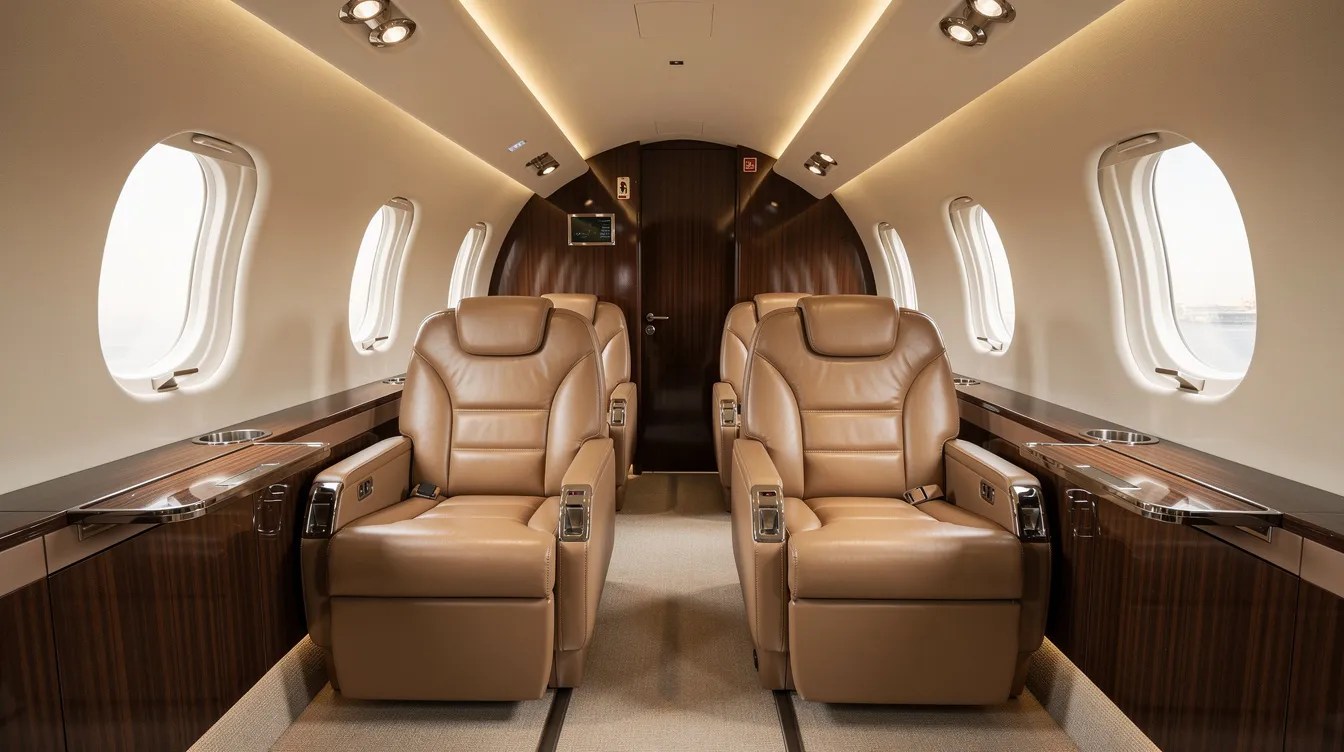
Choosing the right private jet starts with one simple question: how many people need to fly? Seating capacity determines which aircraft fit your group, how much space each person gets, and what the trip will cost. This guide breaks down capacity by jet category, explains how seating layouts change the experience, and shows how Jettly's platform helps travelers match their number of passengers to the right cabin.
Seating capacity on a private jet means the certified passenger seats with seat belts—not crew seats or temporary rest spots.
Seating arrangement and seating layouts (club, divan, conference table) dramatically change comfort even when seat counts look similar.
Typical ranges: light jets hold 4–8, midsize jets hold 6–9, super-midsize jets hold 8–12, and heavy jets hold 10–16+ passengers.
Regulations, weight limits, and weather conditions can reduce usable seats below the advertised figure.
Explore aircraft options and instant pricing on Jettly to find the right cabin for your group size.
In private aviation vocabulary, seating capacity refers to the total number of certified passenger seats equipped with seat belts inside the main cabin. It excludes cockpit crew seats and any positions not approved for taxi, takeoff, or landing.
Two distinct factors matter here: legal capacity—certified by authorities like the FAA, EASA, or Transport Canada—and practical capacity, which accounts for comfort on longer flights.
The concept of seating capacity is not unique to aviation. Legal seating capacity limits occupancy for safety compliance across every kind of venue. Movie theatres must adhere to legal seating capacity regulations. Local fire codes dictate maximum legal seating capacity for any building, and overcrowding can lead to fines and legal issues for venues. Seating capacity calculations ensure compliance with safety regulations whether you are in a stadium, a theatre, or a 10-seat jet.
Standard accessibility guidelines require wheelchair spaces equal to 1% of total capacity, a standard that applies to venues but illustrates how law and design shape every seating decision. Seating capacity is influenced by layout and safety regulations in any setting—aviation simply raises the bar further.
To provide some references for scale, consider how other spaces hold people:
|
Venue Type |
Typical Capacity |
|---|---|
|
Black box theaters |
50–150 seats |
|
Ballrooms and banquet halls |
200–2,000 seats |
|
Broadway and proscenium theaters |
500–2,000 seats |
|
Theaters (general) |
300–3,000 seats |
|
Conference halls |
500–10,000 attendees |
|
Amphitheaters |
5,000–30,000+ seats |
|
Arenas (multi-purpose) |
10,000–20,000 seats |
|
Indoor arenas |
15,000–20,000 seats |
|
Stadiums |
30,000–100,000+ spectators |
Stadiums can accommodate 30,000 to over 100,000 spectators for major events—compare that to other stadiums and even the largest private jets, which top out around 16–19 seats. Unlike a stadium or arena where the team and event organizers pack thousands into tiered rows, private jets trade raw seat quantity for personal space, privacy, and flexible seating style. Conference halls often hold between 500 to 5,000 seats for corporate events, while event capacities vary based on the layout style for seating arrangements, just as different charter and rental models affect affordable aeroplane rent costs and options.
When planning seating arrangements, space allocation per person varies by layout style:
Rectangular tables: Allocate 9–10 square feet per person.
Round tables: Allocate 11–12 square feet per person.
Theater seating: Allocate 6–8 square feet per person.
Reception events (standing): Require about 10 square feet per person.
For example, a 90 ft × 60 ft ballroom (5,400 ft²) can seat approximately 675 attendees in banquet style, with planners typically reserving 8–12% of floor area for aisles and tech tables. These standards highlight how spatial planning and safety regulations influence seating capacity in any environment, much like the practical considerations involved in renting an airplane for private travel.
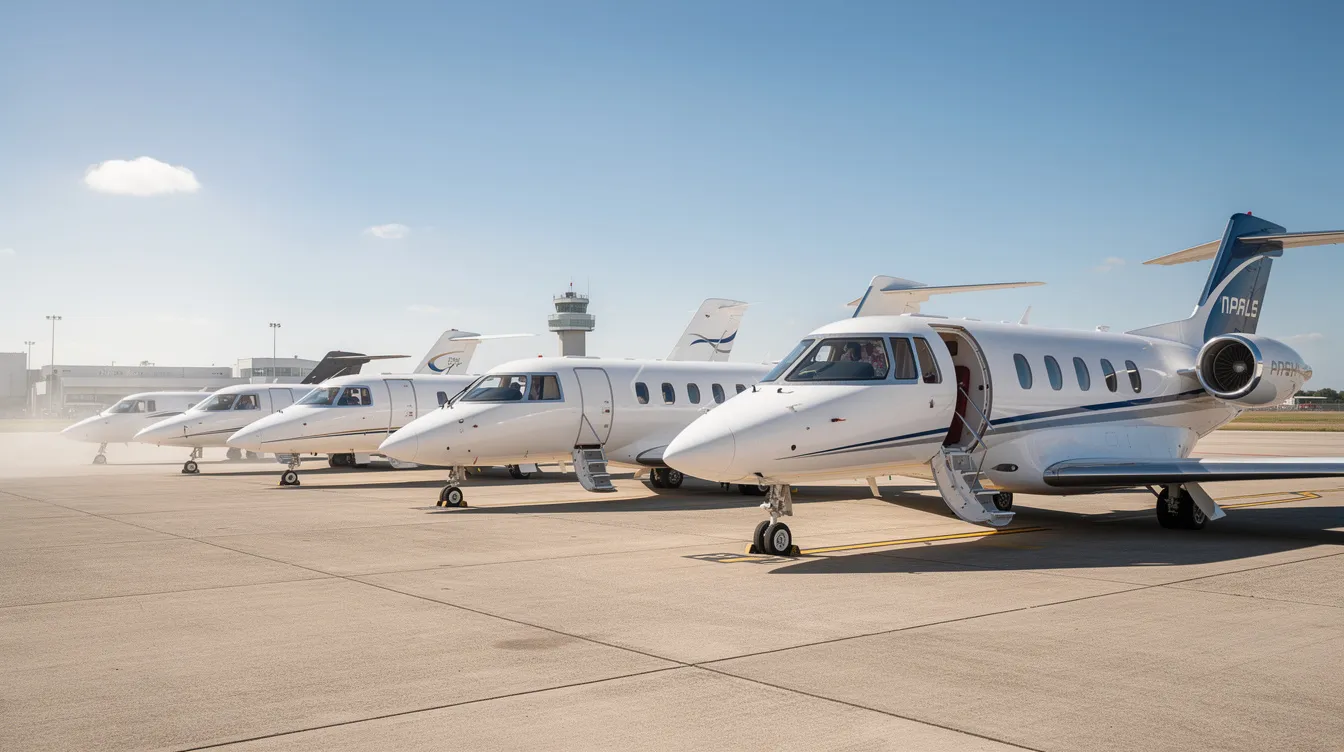
Jettly's marketplace spans thousands of aircraft. Here is a list of how much space and how many seats each category typically provides:
|
Category |
Example Aircraft |
Seats |
Best For |
|---|---|---|---|
|
Turboprop |
Pilatus PC-12, King Air 350i |
6–9 |
Short runways, regional trips |
|
Light Jet |
Phenom 300, Citation CJ3+ |
4–8 |
Short hops (LA–Vegas, London–Paris) |
|
Midsize Jet |
Citation XLS+, Hawker 800XP |
6–9 |
NY–Miami, Toronto–Chicago |
|
Super-Midsize |
Challenger 350, Gulfstream G280 |
8–10 |
NY–Denver, London–Dubai |
|
Heavy / Ultra-LR |
Gulfstream G650, Global 6000 |
10–16+ |
Transatlantic, NY–London, LA–Tokyo |
Within each category, individual aircraft in Jettly's inventory may have different layouts. For instance, one Challenger 350 might fit 8 in a club configuration while another seats 10 with an added divan. Travelers comparing cabin sizes can browse Jettly's private charter aircraft to see how many passengers each model typically accommodates. Learn more in Jettly's guide to how many passengers a private jet can carry. Turboprops are a small but flexible option for regional trips—see Jettly's guide to prop planes for more detail.
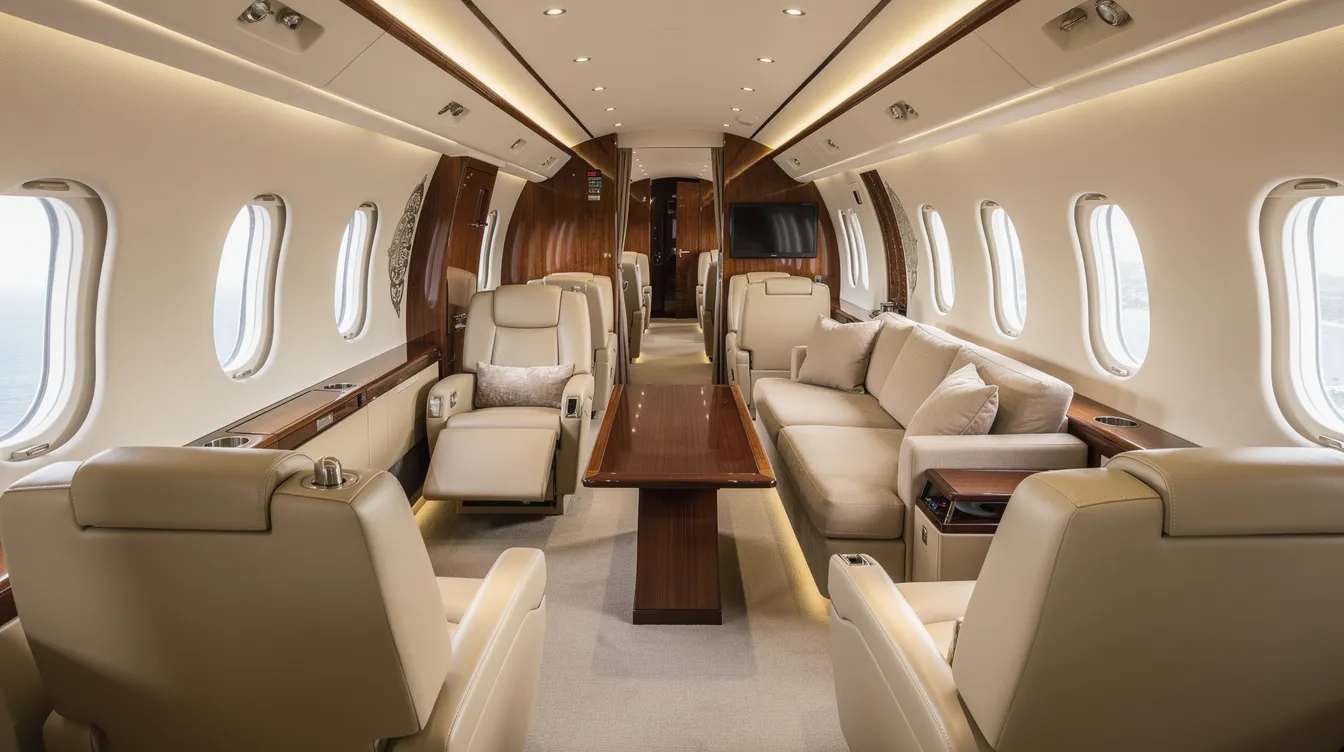
Two jets with identical seating capacity can feel entirely different inside. The shape and functionality of the cabin layout are the determining factors.
Common seating arrangements include:
Club layout: Four seats facing each other, ideal for conversation.
Forward-facing rows: Maximize seat count but reduce room per person.
Divan (sofa): Adds a stage of flexibility for lounging or sleeping.
Conference table: Used on larger jets for in-flight meetings; U-shape seating is ideal for executive briefings in ground venues, and a similar principle applies in the air.
In event planning on the ground, space allocation benchmarks help figure out comfort. The same interest in per-person space applies at altitude, though the figures are obviously much smaller in an aircraft cabin:
|
Ground Layout Style |
Space Per Person |
|---|---|
|
Theatre seating |
6–8 ft² (theater style seating requires 8 ft² per person) |
|
Classroom style |
17 ft² per person |
|
Rectangular tables |
9–10 ft² per person |
|
Round tables |
11–12 ft² per person |
|
Reception (stand-up) |
10 ft² per person |
For context, 60" round tables seat 8–10 people, while 72" round tables seat 10–12 people. A 90 ft × 60 ft ballroom (total area of 5,400 ft²) can seat approximately 675 attendees in a banquet setup—planners typically plan 8–12% of floor area for aisles and tech tables. On a private jet, floor area is measured in dozens of square feet, not thousands, which is why every inch of width, length, and cabin height matters.
Light jets may offer only partial stand-up height—around 4–5 feet. Heavy jets provide true walk-around cabins exceeding 6 feet, with wider aisles and room to move. Some 14–16 seat long-range jets recommend a lower passenger count for overnight missions to hold comfort and bring adequate bedding. Families, in particular, may value the best private planes for families when balancing seating capacity with comfort. Through Jettly, users can review floor plans and photos to see how the actual arrangement translates before making a decision.
Seating capacity connects directly to budget and comfort. Booking too small a jet for the headcount can create issues with luggage capacity, weight limits, or comfort on flights over two to three hours.
Key planning considerations, especially when you start comparing how much it costs to rent a private jet for different cabin sizes:
Cost per person – Aircraft pricing is usually quoted for the total aircraft, not per seat. Fitting 8 passengers on a 9-seat jet saves money compared to splitting across two smaller planes. Understanding how much a private jet costs overall helps put those per-person savings into context. Use Jettly's private jet cost calculator to compare.
Mission profile – A day trip for a corporate team needs a different kind of cabin than a family vacation with small children. A business jet configured for meetings may sacrifice a seat or two for a larger table and workspace, and frequent flyers might compare that to structured access through jet card programs.
Upgrades – Choosing a slightly larger aircraft category can improve privacy and fit everyone's bags without compromise, even if the one-flight cost of a private charter is slightly higher.
Jettly's instant quote tools let users input passenger count, and the system suggests aircraft that accommodate both legal seating capacity and expected baggage for the route, while also surfacing affordable private jet charter options for cost-conscious groups. This means travelers agree on the right size before they commit.
Seating capacity in aviation is tightly regulated—more stringently than fire code limits that govern safe evacuation in a conference venue or a packed arena.
Certification: The FAA, EASA, and Transport Canada certify how many passengers an aircraft can carry based on emergency exit requirements, oxygen systems, and structural design. These rules apply across the global fleet of private jets, influencing how many certified seats each aircraft can legally offer.
Weight-and-balance: On hot days or at high-altitude airports like Denver or Mexico City, full passenger load plus fuel plus luggage may exceed safe limits. Operators may need to leave seats empty or reduce baggage, and tools like an airport locator for private jet flights help planners choose suitable departure and arrival fields. Learn how weight shapes performance and cost.
Part 135 thresholds: In the U.S., aircraft with more than nine passenger seats trigger additional maintenance and crew requirements under FAA Part 135.
Even if a cabin has physical space for extra bars, divans, or jump seats, not all positions may be certified. Jettly works only with licensed operators who follow these standards, ensuring every flight respects certified seating capacity.
Jettly's digital platform makes it straightforward to align group size with the right aircraft. Users enter route, date, and passenger count. The system filters aircraft that legally support that seating capacity and displays upfront pricing across categories.
Travelers can compare profiles side-by-side—checking cabin height, baggage volume, and sample seating layouts. For example, a 4-person executive team might choose a 7-seat light jet for Toronto–New York, while a 12-person family could charter a 14–16 seat heavy jet from London to Mallorca; similarly, smaller groups might review the best plane for a family of four when deciding how much seating capacity they really need.
In addition to aircraft selection, optional services like in-flight catering for private jets and ground transfers become easier to plan once seating capacity and layout are confirmed.
Ready to find the right fit? Explore Jettly's charter options and instant pricing at https://www.jettly.com.
These questions address common seating capacity concerns that come up during planning.
If the passenger count exceeds the original aircraft's certified seating capacity, the broker typically must re-quote on a larger aircraft, which may change price and availability. Locking in an aircraft with one spare seat is a smart move when attendee lists may shift. Jettly can often source alternatives quickly from its network, including options to crowdsource private jet flights and share empty seats, though last-minute changes may be constrained by crew duty rules and airport slots.
Heavy or bulky bags—golf clubs, ski equipment, oversized suitcases—can push a small aircraft toward its weight limit without technically changing certified seat count. An operator may recommend fewer passengers or a larger jet. Sharing luggage details during the quote process helps Jettly match the right aircraft to both people and baggage, especially if you are buying a single seat on a private jet rather than chartering the whole cabin.
Children are generally counted as passengers for seating capacity and safety calculations. Most jurisdictions require an approved restraint for each occupied position. Lap infants under a certain age may be allowed in some regions, but best practice is to provide a dedicated seat. Confirm local regulations and operator policies through Jettly before departure, and consider broader strategies for getting a seat on a private jet easily when planning family travel.
Long-range jets may have higher daytime seating capacity and a lower recommended number of overnight sleepers once seats convert into lie-flat beds. Travelers comparing configurations might also look at the cheapest private aircraft options across different size categories. "Sleeps" refers to comfortable bedding arrangements, not certified safety positions. For red-eye flights, focus on both figures when comparing options, especially if you are evaluating the best personal plane to own versus chartering on demand.
The physical seating arrangement on a given aircraft is mostly fixed, though operators can sometimes adjust details like removable tables or seat orientation. Any changes must respect certified positions and safety rules. Share your preferred setup—conference-style for a board meeting, club seating for family conversation—so Jettly can recommend aircraft whose layouts naturally fit those needs or suggest suitable options within its private jet membership programs.
Selecting the right seating capacity is a crucial step in planning a private jet trip that balances comfort, safety, and cost. Whether traveling with a small executive team or a large family, understanding the certified seat count, cabin layout, and practical space needs ensures a smooth and enjoyable flight experience. Jettly’s platform simplifies this process by offering instant access to a wide range of aircraft with transparent seating details and pricing.
By matching your group size to the ideal jet category and layout, you can optimize your travel plans for convenience and efficiency. Learn more about choosing the right private jet and explore private jet membership programs to enhance your experience. Ready to experience private travel on your terms? Explore flight options or request a quote at https://www.jettly.com.
Share this post:
Jay Franco Serevilla
Aug 9, 2026
|
5
min read
Discover tips and trends in the industry.
5
min read
How Long Is a Helicopter Ride? (From 10-Minute Tours to 2-Hour Charters)
Helicopter rides typically last between 10 minutes and 2 hours, depending on the purpose and distance. Sightseeing flights usually range from 10 to 45 minutes, while point-to-point transfers can take longer. Understanding these timeframes helps travelers plan their itineraries effectively.
Read More
5
min read
N224LD Embraer Legacy 600: Aircraft Overview & Private Charter Guide
The N224LD Embraer Legacy 600 is a 2006 business jet known for its spacious three-zone cabin and long-range capabilities. Operated by Cloud Enterprise Holdings LLC, it offers luxury private charters from Teterboro, NJ. With a maximum range of 3,250 nautical miles, this aircraft is ideal for corporate and family travel, providing comfort and productivity in the air.
Read MoreStay updated with our latest insights and tips to elevate your journey with us.
MEMBERSHIPS AND ASSOCIATIONS



Disclaimer: Jettly operates as a charter broker, offering access to a global digital jet charter marketplace. Jettly is not a direct air carrier and does not own or operate aircraft. All advertised flights are conducted by third-party air carriers that are fully licensed and hold the appropriate Part 135 or Part 121 certifications issued by the Federal Aviation Administration (FAA) or equivalent regulatory authorities under U.S. or foreign law. Jettly complies fully with the U.S. Department of Transportation's Part 295 and Part 298 Charter Broker regulations. Jettly does not carry additional liability insurance. Passengers are covered by aircraft operator insurance. TICO: 50023770


