


Login
Get Instant Pricing On 23,000+ Aircraft

>
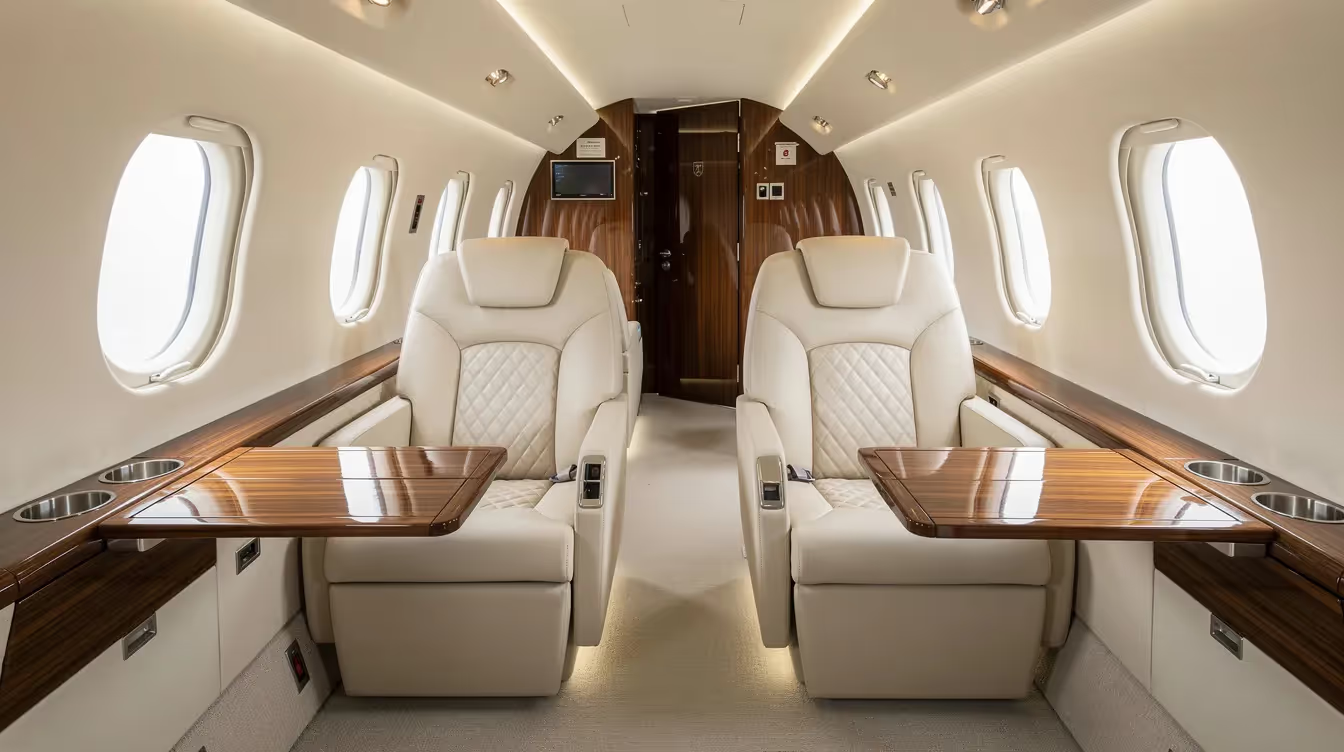
The ride-share private jet model now allows individual travelers to purchase single seats on private aircraft, splitting costs with other passengers while keeping most benefits of private aviation intact.
Flying private used to mean one thing: chartering an entire aircraft at rates that only corporations and the ultra-wealthy could justify. That equation has changed. In the broader context of air travel, private jets for hire are transforming how travelers experience convenience, efficiency, and luxury.
Jettly, a digital private jet charter marketplace founded in 2016, connects travelers with over 20,000 aircraft across 190+ countries. The platform offers access to shared flights, empty leg deals, and full charters—giving travelers multiple ways to fly private without the traditional price barrier. With ride-sharing private jets, passengers can purchase individual seats on private aircraft instead of chartering the entire plane.
Passengers in ride-sharing services may share cabins with others, reducing privacy and personal space compared to full charters.
This guide breaks down how ride-share private jet travel works, who benefits most, and how to evaluate whether shared seats, full charters, or commercial flights make sense for your next trip—complementing Jettly’s detailed guide on how to buy a seat on a private jet. Ride-share private jet services provide lower costs and luxury experiences, making them ideal for solo travelers or small groups on popular routes. Ride-share private jets are especially well-suited for professionals on a business trip who need flexibility, privacy, and efficiency. Private jet ride-sharing typically operates through digital platforms or specialized brokers—often charter companies that ensure safety and operational standards—that coordinate passengers on the same route. A charter company is a provider that offers access to a fleet of private aircraft, holds safety certifications such as FAA Part 135 and the International Standard for Business Aircraft Operations (IS-BAO) certification, and delivers booking convenience and operational reliability for both private and group flights.
This guide is designed for business and leisure travelers interested in affordable private aviation options, helping you understand how ride-share private jets can save time and money compared to traditional charters or commercial flights. Ride-share private jets allow more travelers to experience private aviation without the traditional cost barrier.
Ride-share private jet travel means purchasing individual seats on a private aircraft rather than chartering the entire plane. Multiple unrelated passengers share the flight and split operational costs, which dramatically lowers the per-person expense while retaining core private aviation advantages: access to private terminals, fewer passengers, and faster boarding.
Importantly, ride-sharing services utilize private terminals, allowing passengers to arrive shortly before departure and bypass major security lines. This convenience significantly reduces overall travel time compared to commercial flights.
Jettly is a digital private jet charter marketplace that helps travelers access shared flights, empty-leg flights, and full charters. With a network of over 23,000 aircraft across more than 190 countries, the platform provides instant pricing transparency and flexible booking options for business and leisure travelers seeking alternatives to traditional chartering. Many private jet services offer instant pricing and booking through digital platforms, allowing travelers to compare options and secure flights quickly.
Typical price context matters here. Chartering a private jet typically costs between $5,000 and $9,000 per hour for a 12-seater jet, with the average cost of a one-way private charter flight from New York to Florida ranging from $16,000 to $24,000. For a deeper breakdown of these ranges, Jettly’s guide on how much it costs to rent a private jet explains how aircraft type, distance, and amenities drive pricing. Prices for private jet charters can range from approximately $2,000 to over $17,000 per flight hour, depending on aircraft type and route. Travelers who want to estimate specific trip costs can use Jettly’s private jet charter cost estimator to see how factors like distance, aircraft size, and operating expenses affect pricing. Private jet travel is generally more expensive than commercial flights, making it a luxury option primarily for the wealthy, with costs influenced by factors such as flight duration, aircraft category, and seasonal demand; travelers considering ownership or long-term use can benefit from understanding how much a private jet really costs across different ownership and charter models.
Shared seats on high-demand routes like New York to Miami or Los Angeles to Las Vegas often run between $500 and $1,500 one-way—comparable to last-minute business class fares on commercial airlines. Full private charters, by contrast, range from $2,500 to $9,000 per flight hour depending on aircraft category, with heavy jets exceeding $12,000 per hour. However, travelers should be aware of hidden fees that may not be included in the initial quote, making it essential to choose services that emphasize transparent pricing.
The core benefits of ride-share private jets include significant time savings (arriving 20–30 minutes before departure instead of 2+ hours), access to smaller airports closer to city centers, fewer passengers in the cabin (typically 6–12 versus 200+ on commercial flights), and reduced per-seat cost compared to booking an entire aircraft alone, especially when travelers apply smart strategies for booking the cheapest private jet flights such as empty legs and smaller aircraft.
This article explains the different models of ride-share private jet access, compares them against full charters and commercial flights, covers safety and sustainability considerations, and shows how Jettly fits into a traveler’s options for cost-effective private flying.
Ride-share private jet travel allows passengers to purchase individual seats on private aircraft instead of chartering the entire plane. Semi-private jet flights are shared private jet charters where passengers share the aircraft with a limited number of other travelers, providing a more intimate experience compared to commercial airlines. Private jet ride-sharing typically operates through digital platforms or specialized brokers that coordinate passengers on the same route. Semi-private jet services provide a cost-effective option compared to full private charters, emphasizing accessibility for smaller groups.
Ride-share private jet travel allows passengers to purchase individual seats on private aircraft instead of chartering the entire plane. Semi-private jet flights are shared private jet charters in which passengers share the aircraft with a limited number of other travelers, providing a more intimate experience than commercial airlines. Private jet ride-sharing typically operates through digital platforms or specialized brokers that coordinate passengers on the same route. Semi-private jet services offer a cost-effective alternative to full private charters, emphasizing accessibility for smaller groups.
Ride-share private jet travel is when multiple unrelated passengers share a private aircraft and split the costs. Instead of one party chartering the entire jet, individuals book seats through apps or digital platforms. The aircraft still operates as a private flight—departing from private terminals, avoiding commercial security lines, and serving smaller airports—but the cost is distributed across everyone onboard.
This model differs from commercial airlines in several important ways. Commercial flights carry 100–300+ passengers, operate on fixed schedules from major airports, and require passengers to arrive 1–2 hours before departure. Semi-private flights typically carry 6–12 passengers, depart from Fixed Base Operators (FBOs) with minimal wait times, and often serve city pairs that commercial carriers underserve or overcharge for during peak periods.
Semi-private jet flights are shared private jet charters in which passengers share the aircraft with a limited number of other travelers, providing a more intimate experience than commercial airlines. These flights offer enhanced privacy with fewer passengers, creating a more exclusive environment throughout the journey. The semi-private jet experience often includes a more personalized service, with dedicated staff available to assist passengers throughout their journey, enhancing comfort and convenience.
The distinction from traditional private charter is equally significant. When you charter an entire aircraft, you control departure time, passenger manifest, catering, and routing. With ride-share private jets, you gain most of the terminal and comfort benefits but share the cabin with other travelers and operate within set departure windows. The tradeoff is cost: splitting a $12,000 charter among six passengers brings the per-person price to $2,000—far below what solo chartering would require.
Typical cabin sizes on these flights range from 6–8 seats on light jets like the Citation CJ3 to 8–10 seats on super midsize jets. Semi-private jet flight routes concentrate on high-demand city pairs: New York to Miami, Los Angeles to Las Vegas, Dallas to Aspen, and London to Paris. These corridors generate enough repeat demand to consistently fill seats.
Terminology in this space can get confusing. “Ride share private jet” broadly covers any per-seat private flying arrangement. “Semi private” refers specifically to scheduled flights on fixed routes with set departure times. “Shared charter” describes the dynamic filling of empty seats on an existing booking. These concepts overlap but serve slightly different use cases—a distinction the next section breaks down in detail.
Today’s ride-share private jet options are built on digital marketplaces and charter companies that match unused aircraft capacity with per-seat demand. The charter industry has evolved from traditional models to modern, app-based approaches that emphasize convenience and personalized service, including platforms that crowdsource private jet flights and share empty seats to reduce individual passenger costs. Several distinct models have emerged, each with different tradeoffs between cost, flexibility, and availability.
Part 135 charter companies are FAA-certified operators that adhere to rigorous safety and operational standards, distinguishing them from unregulated 'grey charter' operations. Additionally, many operators pursue the International Standard for Business Aircraft Operations (IS-BAO) certification, a recognized safety benchmark that indicates adherence to best practices in safety management and operational excellence, and travelers can benefit from understanding how Part 135 charter companies work and why they matter when evaluating ride-share operators.
Semi-private operators run fixed routes with set departure windows. A typical example: Friday afternoon departures from New York–Teterboro to Miami–Opa Locka, with Sunday evening returns. Passengers purchase individual seats, and the operator aggregates demand to fill 6–8 seats on light jets like the Cessna Citation or Embraer Phenom 300. These semi-private scheduled flights offer an appealing alternative to both private jets and major commercial airlines, providing the convenience of smaller airports and more flexible scheduling than the rigid timetables of major carriers.
These flights often cost $800–$1,200 per seat on popular routes, serving weekend leisure spikes when commercial first-class tickets hit $1,500 or more. The schedule is predictable but inflexible—you fly when the operator flies.
Shared charter works differently. One traveler or group initiates a charter flight on a specific route (say, Dallas to Aspen) and then opens extra seats to others via a platform. Charter flights offer significant benefits, including time savings, direct access to a wider range of airports, and flexibility for both business and leisure travelers. A detailed comparison of shared charter flights versus full charters can help clarify which option fits different trip profiles. The initiator reduces their cost from the full charter price to a fraction, while passengers joining the flight get access to private aviation at seat-based pricing.
A practical example: a $12,000 midsize jet charter split among six passengers comes to $2,000 per person. The initiator maintains some control over timing, and other passengers benefit from the availability they wouldn’t have otherwise.
Membership programs from platforms like Jettly offer frequent flyers reduced booking fees (typically 10–20% lower), dedicated coordinators, and priority alerts for empty leg flights. Jettly’s range of private jet membership plans gives both business and personal travelers flexible access to wholesale rates without long-term contracts. These programs work well for travelers who log 25–100 hours annually and want predictable pricing without full jet ownership.
Jet card holders typically lock in fixed hourly rates across aircraft categories, avoiding fuel surcharge variability. Dedicated private jet card programs also offer perks such as guaranteed availability, premium catering, and chauffeur services for frequent flyers, and travelers comparing options should understand jet card costs and pricing structures and the broader benefits of jet cards and how they work before committing. Some programs include access to shared flights and repositioning flights at discounted seat prices.
Several variables determine what you’ll pay for a ride share private jet seat, and understanding the true cost of private jet charters, the underlying private jet operating costs, and how one private jet flight cost is actually built can help you budget realistically and spot savings opportunities:
Aircraft category: Turboprops run $1,800–$2,500 per flight hour, light jets $2,500–$4,000, midsize jets $4,000–$7,000, and heavy jets $9,000–$15,000+
Flight duration: Shorter hops like LA to Vegas (45–60 minutes) cost less total than transcontinental routes
Route popularity: High-demand corridors with regular traffic offer better seat availability and pricing
Occupancy: More passengers means lower per-person cost
One-way flights: Opting for one-way flights can provide significant cost savings and flexibility, especially for travelers who do not need round-trip commitments.
Platforms like Jettly surface these options through instant pricing tools and an airport locator tool for private jet travelers, showing travelers what a full charter costs and how that number changes when split among a group.
Understanding when each option makes sense requires examining the practical trade-offs, especially the impact of operating costs on pricing and affordability. For a broader context on how private aviation has evolved and the range of operators available, Jettly’s guide to charter airlines and private flight options provides a useful industry overview. Here’s how ride share private jets, full private charters, and commercial airlines compare across key factors:
|
Factor |
Ride-Share Private Jet |
Full Private Charter |
Commercial Airline |
|---|---|---|---|
|
Price per person |
$500–$2,000 on popular routes |
$2,000–$10,000+ depending on aircraft and group size |
$100–$1,500 (economy to business class) |
|
Privacy |
Moderate (6–12 passengers, may include strangers) |
Maximum (sole cabin occupancy) |
Low (200+ passengers, middle seats) |
|
Schedule control |
Limited (set departure windows) |
Complete (fly any time) |
Fixed (airline schedule) |
|
Airport access |
Private terminals, smaller airports |
Private terminals at any airport |
Major commercial terminals |
|
Booking flexibility |
Advance booking recommended |
On-demand, instant booking is possible |
Wide availability, instant booking |
|
Door-to-door time |
2–3 hours on short routes |
2–3 hours on short routes |
5–7 hours, including airport time |
|
Operating costs—such as fuel, maintenance, and crew salaries—are distributed among passengers in ride-share private jet models, making them more affordable than full private charters, while commercial airlines benefit from economies of scale, keeping prices lower. |
Ride-share private jet seats work best for solo travelers or couples on popular routes who want private-terminal convenience without paying for an entire aircraft. If you’re flying from New York to Miami on a Friday afternoon and business class costs $1,200 while a semi-private seat costs $1,000, the math favors private, especially when you factor in Teterboro’s 12-mile proximity to Manhattan versus JFK’s 20+ miles and longer security lines.
The time savings compound on shorter routes. A Los Angeles to Las Vegas semi-private flight takes 45–60 minutes in the air, with 20–30 minutes of ground time at each end. The same commercial trip includes 60–90-minute flights, 2+ hours of airport processing, ground transportation from LAX, and potential delays.
A full private charter is the right choice for groups of 4–10 people, urgent or complex itineraries, and destinations outside the semi-private network. Multi-city roadshows, same-day returns for business meetings, and custom routes to smaller airports all favor chartering the entire plane.
Selecting the right aircraft for your specific travel needs is crucial—consider factors like passenger capacity, range, and airport accessibility to ensure optimal comfort and efficiency, and review affordable aeroplane rental costs and options to align your choice with your budget, especially if you want a clearer understanding of how renting a plane works from inquiry to takeoff.
Groups traveling together often find that splitting a charter among 6–8 people brings per-person costs below semi-private seat prices while providing complete schedule control. Jettly’s platform makes this comparison easy—input your route and passenger count, and instant pricing shows whether a full charter or shared option delivers better value from its global inventory of private charter aircraft, while resources outlining the cheapest private aircraft options for every budget help contextualize per-hour charter pricing against potential ownership or fractional models.
Commercial airlines maintain advantages in absolute low cost and route breadth. Travelers flying economy for $200, those in regions without strong private aviation infrastructure, and infrequent flyers often find commercial travel the practical choice.
Jettly primarily focuses on on-demand private charters and empty-leg flights, but the platform also helps travelers exploring seat-based or cost-sharing options evaluate their options. Positioned as a flexible NetJets alternative for flying private at a lower cost, the service combines on-demand charters, memberships, and jet cards to suit different travel profiles, supported by tools such as its jet card flight cost estimator for route-specific budgeting and an overview of NetJets as a leading private aviation provider. The instant pricing tool shows the cost of private options alongside commercial alternatives.
Ride-share private jet travel brings several core benefits of private aviation—time savings, flexibility, and comfort—to travelers who previously couldn’t justify the full charter costs. This model offers a premium service, providing a high level of comfort, exclusivity, and a tailored experience for discerning travelers. Here’s what the model delivers:
Splitting a charter dramatically changes the economics of private flying by allowing passengers to share not only the total fare but also the operational expenses, such as maintenance and crew costs, which significantly reduces the cost per person and makes private jet travel more accessible. On shorter routes like Los Angeles to Las Vegas, shared seats often run $400–$900 per person. Commercial business class on the same route costs $250–$400, but the 3+ hours saved at airports and in ground transportation can justify the premium—especially for business travelers valuing their time at $150–$200 per hour.
Empty leg flights push savings even further. These repositioning flights occur when an aircraft needs to return to its base after dropping off passengers. Operators often sell these legs at 50–75% below standard rates, and platforms like Jettly list empty leg flights with significant discounts and alert members to these opportunities on popular routes.
The biggest advantage of private flights over commercial flights often isn’t the time in the air—it’s the time on the ground. Private aviation averages 25% shorter door-to-door times on congested routes, with the gap widening during peak travel periods.
Arriving at a private terminal 20–30 minutes before departure, rather than 2+ hours at a commercial airport, adds up fast. No TSA lines, no boarding groups, no gate changes. You walk from your car to the aircraft in minutes, and deplane directly to a waiting vehicle at your destination.
Smaller airports also mean closer proximity to city centers. Flying into Teterboro for Manhattan or Van Nuys for Los Angeles puts you miles closer to your final destination than the major commercial hubs.
Even on shared private flights, the experience differs dramatically from commercial cabin classes. Fewer passengers (6–12 versus 200+) means quieter cabins, more personal space, and the ability to work or relax without constant announcements and boarding chaos.
Light jets typically offer spacious seating with room to stretch, while midsize and larger aircraft include lie-flat configurations and work tables. Wi-Fi reliability is around 95% on modern private aircraft, compared with 70% on commercial flights—a meaningful difference for business travelers who need to stay connected.
The semi-private jet experience often includes a more personalized service, with dedicated staff available to assist passengers throughout their journey, enhancing comfort and convenience.
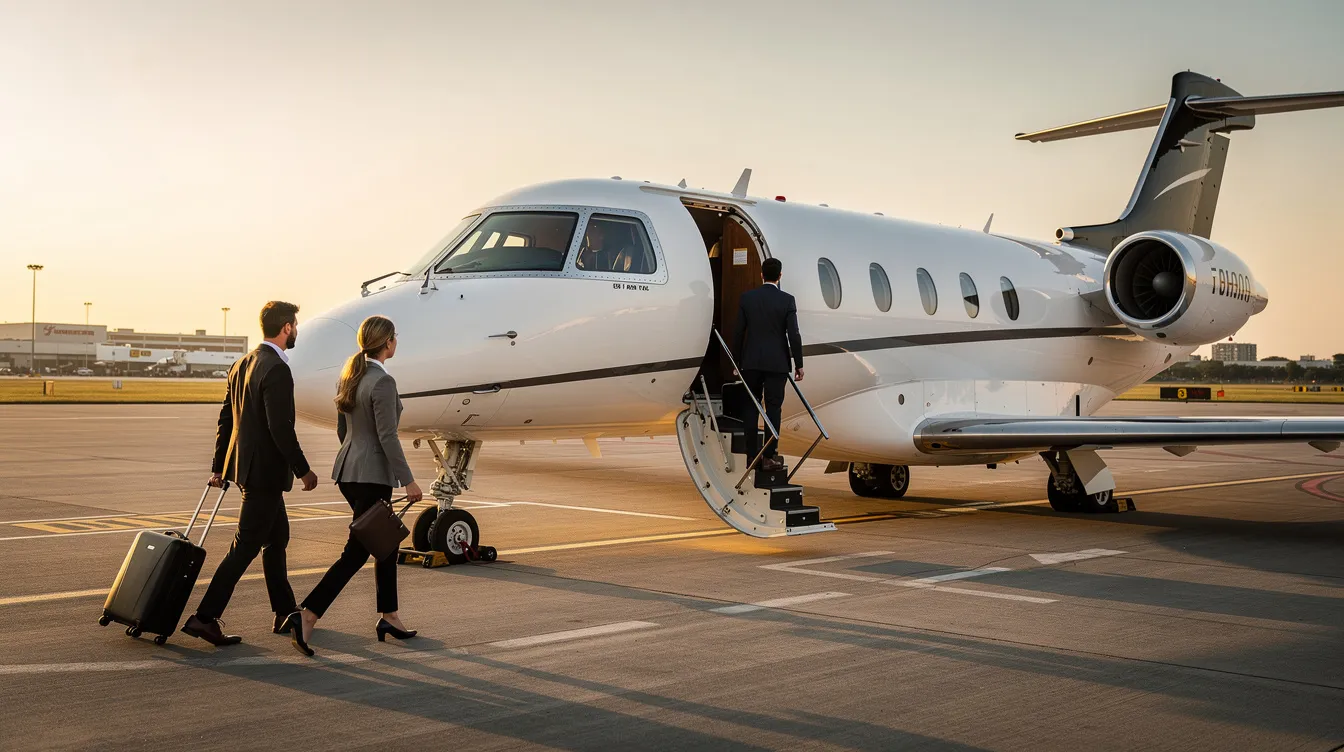
Semi-private models offer more departure windows than single commercial flights on many routes. If the 6 PM departure doesn’t work, there may be an 8 PM option. Shared charters provide even more flexibility if the initiating party accommodates timing requests.
The ability to fly private on your schedule—rather than the airline’s—proves valuable for urgent business trips, time-sensitive meetings, and travel plans that don’t fit commercial routing.
Many private jets offer amenities that elevate the experience of private aviation. Onboard Wi-Fi enables productive work time, tailored catering—often arranged through dedicated services such as Jettly Eats in-flight catering—replaces airline snack boxes with meals matching your preferences, and integrated ground transportation through platforms like Jettly coordinates car services at both ends.
This personalized service extends to baggage handling (no checked-bag fees, no carousel waits), pet policies (many operators allow pets in the cabin), and flexible scheduling that accommodates last-minute changes.
Ride-share private jet options concentrate on corridors with strong, repeat demand among business and leisure travelers. Several companies now offer semi-private jet flight options, providing variety and accessibility for consumers seeking private flight experiences without the ownership costs. Travelers comparing providers can review the best private jet charter companies and their services. These routes generate enough traffic to consistently fill seats at prices that compete with premium commercial fares.
In addition to private jets, some charter companies and digital platforms also offer helicopter rides for sightseeing, special occasions, or short-distance private charters. These helicopter rides offer a customizable, premium aerial experience, making them ideal for travelers seeking unique, personalized journeys, much like private jet lease options provide tailored long-term access for frequent flyers.
New York (Teterboro, White Plains) ⇄ , Miami (Opa Locka, Fort Lauderdale Executive): This corridor sees intense weekend traffic, winter seasonal demand, and year-round business travel. Semi-private seat prices typically range from $800 to $1,500, with availability tightening around holidays and events like Art Basel. Surf Air is an example of a company offering semi-private jet flights on these popular North American routes.
Los Angeles (Van Nuys, Burbank) ⇄ , Las Vegas: At 45–60 minutes of flight time, this route epitomizes the value proposition of ride-share private jets. Shorter flights mean lower total costs, and Las Vegas event traffic (Formula 1, concerts, conventions) creates predictable demand spikes.
Dallas ⇄ , Aspen, or Vail: Ski season drives this corridor, with Texas travelers seeking quick access to the Colorado mountains. Direct flights to Aspen–Pitkin County Airport bypass Denver, adding 3+ hours to commercial itineraries.
London (Farnborough, Luton) ⇄ , Paris (Le Bourget): Business travelers value same-day returns and fast processing at private terminals. Commercial Heathrow–Charles de Gaulle queues often exceed 60 minutes, while private terminal processing takes 15–20 minutes.
Similar dynamics exist on London–Geneva, Paris–Nice, and other short-haul European business routes where time savings justify modest price premiums.
Weekend getaways to luxury destinations drive significant demand for semi-private travel. Last-minute trips to Nantucket, Palm Beach, or Cabo become feasible when shared seats cost $800–$1,500 rather than $8,000 for a full charter.
Major events create booking pressure. Super Bowl weekend sees New York-to-Miami seats sell out 2+ weeks in advance at prices exceeding $1,000. Ski holidays, Art Basel, and music festivals generate similar patterns on relevant routes.
Project teams flying to client meetings in secondary cities often find shared charters more efficient than commercial connections. An executive visiting three cities in one day benefits from the flexible scheduling that private aviation provides.
Urgent site visits, board meetings, and time-sensitive negotiations all favor minimizing travel downtime. Sports teams and touring groups also use shared charter models to move groups efficiently between cities.
Jettly’s marketplace surfaces aircraft on these routes quickly, providing access to private charter or empty-leg alternatives when no seat-based ride-share option exists for specific dates, including vetted operators such as Dexter Air Taxi private jet services.

Even when costs are shared and seats are sold individually, reputable private aviation providers prioritize safety, ensuring peace of mind for travelers. The industry is committed to operational excellence, blending modern technology with high-level operational standards to deliver safe, reliable, and luxurious experiences. Modern technology enhances safety, efficiency, and the customer experience in private aviation, setting new industry standards. When selecting a private jet service, it is crucial to verify that the operator maintains a Part 135 certification, which indicates compliance with safety regulations and operational standards. Top private jet operators often exceed FAA minimum safety standards by implementing additional measures, such as thorough pilot training and regular aircraft maintenance checks. Understanding the regulatory framework and environmental considerations helps travelers make informed choices.
In the United States, ride-share private jet flights operate under FAA Part 135 regulations. This framework requires commercial air operator certification, mandating rigorous pilot training (typically a minimum of 1,500+ hours for captains), aircraft maintenance on manufacturer-specified schedules, and compliance with operational standards equivalent to those for full charter operations.
European operators fall under EASA rules, while Canadian flights follow Transport Canada regulations. Each framework requires operators to hold valid air operator certificates, maintain insurance coverage, and submit to regular inspections.
Third-party audits provide additional verification. ARGUS Platinum and Wyvern Wingman certifications indicate operators meeting enhanced safety standards, with zero tolerance for maintenance lapses and verified pilot qualifications.
Travelers should verify several safety factors before confirming any private flight. Among the essential considerations are:
Pilot experience: Captains on reputable operations average 5,000–10,000 hours, well above regulatory minimums
Third-party audits: Ask whether the operator holds ARGUS or Wyvern certification
Maintenance schedules: Confirm aircraft undergo manufacturer-specified checks (A-checks every 200–600 hours)
Insurance coverage: Verify adequate liability coverage for passengers and baggage
IS-BAO certification: Check if the operator holds International Standard for Business Aircraft Operations certification, reflecting adherence to best safety management practices
Jettly partners only with vetted, licensed operators, filtering out carriers that don’t meet safety standards. The platform’s network includes only Part 135 certificated operators in the US and equivalent certifications in other jurisdictions.
Private terminals conduct security screening adapted to smaller passenger volumes. Metal detectors and bag X-rays provide verification without the volume-driven delays of commercial terminals. Passenger vetting—ID checks and manifest verification—reduces risk while speeding processing.
Fewer touchpoints and controlled access areas also tighten security compared to mass commercial hubs, where thousands of travelers pass through shared spaces hourly.
Shared private flights improve seat utilization compared to half-empty charter flights. Load factors for semi-private operations often reach 70–90%, reducing per-passenger emissions compared with jets carrying 2–3 occupants.
Platforms like Jettly are increasingly supporting carbon offset programs, offering options to purchase offsets from verified providers. Sustainable Aviation Fuel (SAF) adoption is rising across the industry, reaching 1–2% of fuel by 2025 and cutting emissions by up to 80% compared to conventional Jet-A fuel.
Travelers concerned about the environmental impact can request fuel-efficient aircraft. Turboprops and modern light jets consume significantly less fuel than heavy jets on short routes where smaller aircraft suffice.
Jettly operates as a tech-driven private jet charter marketplace with instant pricing across over 23,000 aircraft worldwide. The platform serves travelers seeking on-demand charters, membership benefits, and access to empty-leg flights that provide ride-share-style value without requiring scheduled semi-private routes.
A traveler interested in ride-sharing private jet value can search Jettly by entering the origin and destination (for example, Toronto to Vancouver), then compare aircraft sizes and hourly rates. The platform shows whether an empty-leg opportunity exists on the desired dates, whether a smaller light jet offers sufficient capacity at a lower cost, or whether assembling a group makes more financial sense than waiting for a semi-private seat.
Instant digital booking eliminates back-and-forth negotiations. Travelers see estimated all-in costs before confirmation, including fuel surcharges and fees. Multi-leg itineraries for complex business trips or multi-city vacations can be built within the same booking flow.
Groups can use Jettly to effectively create their own ride share by assembling 4–8 passengers—friends, colleagues, or family—and splitting the cost of a private charter transparently. The platform shows the full charter price and automatically calculates per-person costs.
This approach works particularly well for travelers who want flexible access without full ownership, and many of the same tactics appear in guides on how to easily get a seat on a private jet. This approach works particularly well for:
Family vacations where 6–8 relatives share costs to exclusive destinations
Business teams traveling together for meetings or conferences
Friend groups heading to events, weddings, or holiday destinations
Jettly membership options are designed for frequent flyers who log significant annual hours. Benefits include reduced booking fees (10–20% savings), dedicated account managers who understand your travel patterns, and priority alerts on attractive empty-leg opportunities.
These repositioning flights effectively function like discounted per-seat travel for flexible customers willing to adjust dates or times to match aircraft availability, and frequent flyers may want to compare the best jet card programs on the market to decide which structure fits their travel patterns.
While Jettly is not a pure per-seat, semi-private airline, its marketplace structure and global aircraft inventory allow travelers to achieve many of the same cost and convenience benefits. Whether the right solution is a full charter split among colleagues, an empty-leg match for your route, or a smaller aircraft that fits your party perfectly, the platform surfaces options that traditional charter brokers might miss, including instant-book operators like Zenflight private jet charter services.
Learn more about Jettly’s charter options at https://www.jettly.com.
Turning the idea of a ride-share private jet into an actual trip requires systematic planning. Here’s a step-by-step approach using Jettly as the primary booking tool.
Start by establishing the essential considerations for your journey:
Travel dates: Fixed dates limit options; flexible dates unlock empty leg discounts of 30–50%
Approximate times: Morning departure versus evening affects availability and pricing
Number of passengers: Determines which aircraft type fits and how costs are split
Flexibility: Willingness to fly Thursday night instead of Friday morning can dramatically change pricing
Consider whether you’re traveling solo, as a couple, or with a group. Groups of 4+ often find full charter splits more economical than individual semi-private seats.
Enter your route details into Jettly’s platform. The system returns instant pricing across aircraft categories:
Turboprops: Ideal for short hops under 1 hour, running $1,800–$2,500 per flight hour
Light jets: Efficient for 2–3 hour flights, $2,500–$4,000 per hour
Midsize jets: Better for longer missions with more passengers, $4,000–$7,000 per hour
Heavy jets: Required for transcontinental or international flights, $9,000–$15,000+ per hour
Note the per-person cost if splitting among your group. A $9,000 midsize charter, divided among 6 passengers, equals $1,500 per person—often competitive with commercial business-class plus ground transportation.
Before committing, check whether commercial business class tickets on the same route cost less or more once you factor in:
Total door-to-door time (including airport processing and ground travel)
Proximity of private airports to your actual destination
Productivity value of time saved
Stress and convenience factors
This comparison often favors private aviation on routes under 3 hours with congested commercial airports.
Before booking, confirm:
Operator certification: Part 135 or equivalent, ARGUS/Wyvern ratings if available
Aircraft age and condition: Newer aircraft typically offer better reliability and amenities
Cabin layout: Seats, configuration, and workspace if you need to work
Baggage capacity: Light jets typically allow 50–100 lbs per person; verify for unusual items like skis or golf clubs
Special services: Catering preferences, Wi-Fi availability, ground transportation coordination
Complete booking through Jettly’s platform. Share the itinerary with other travelers who are contributing to the cost, so everyone knows departure times and terminal locations.
Plan to arrive at the private terminal 20–45 minutes before departure. Coordinate ground transportation at your destination—Jettly’s concierge or local partners can arrange car service to your final destination.
This section addresses common questions about eligibility, logistics, and practical considerations for ride-share private jet travel.
Policies vary by operator, but many private jets allow children of all ages and pets in the cabin, provided safety requirements and local regulations are met. On shared or semi-private flights, pet rules may be stricter to accommodate other passengers—some operators require 24-hour advance notice for allergen considerations.
Travelers should confirm pet size limits, carrier requirements, and vaccination documentation through the booking platform before confirming. Families seeking maximum flexibility and cabin control often prefer full private charters booked via Jettly, where they determine who and what travels in the spacious cabin.
Luggage allowances depend on aircraft type and passenger count. Smaller aircraft, such as turboprops and light jets, typically accommodate one medium suitcase and one personal item per person—roughly 50–100 lbs total per passenger. Larger jets and lower passenger loads allow more generous baggage capacity.
Verify exact limits (weight and piece count) before confirming any semi-private or shared flight to avoid repacking at the terminal. When booking through Jettly, travelers can see approximate baggage capacity by aircraft type and discuss unusual items—golf clubs, skis, musical instruments, and helicopter ride equipment—with support staff in advance.
Most seat-based ride share private jet routes operate domestically or on short-haul regional corridors due to customs and immigration complexities. Some transborder routes exist—US to Canada, UK to EU destinations—where traffic volume supports seat-based models.
Full private charters for international flights remain widely available through Jettly, including long-range aircraft such as the Gulfstream G650 and Bombardier Global 6500 for nonstop intercontinental trips. Travelers considering international private travel should contact Jettly for route-specific guidance on visa considerations, customs clearance, and airport options, or review destination-specific resources such as private jet charter services in Kolkata, West Bengal or private jet charter services in Bangalore, Karnataka.
For popular routes and weekend dates—New York to Miami in winter, Los Angeles to Las Vegas around major events—booking 1–2 weeks in advance increases the chance of finding seats at good prices. Guaranteed availability requires advance planning on high-demand corridors.
Last-minute opportunities exist, particularly empty leg flights where operators need to reposition aircraft. However, routes may not align perfectly with your travel plans, and flexibility on timing helps. Travelers comparing membership-style options should also consider NetJets card costs and pricing tiers. Using Jettly to monitor pricing early lets you lock in options or explore cost-splitting with a group if semi-private seats are limited.
Value depends on the route, schedule, and traveler priorities. On shorter, congested routes with heavy airport delays, time savings and reduced stress easily justify modest price premiums over business class. A traveler valuing their time at $150–$200 per hour can quickly recoup a $500 premium by saving 3+ hours.
For longer flights or routes with frequent commercial service and efficient airports, business class may prove more economical while still offering comfort. The spacious seating and personalized service of private aviation won’t match, but the cost benefits may outweigh convenience factors.
Run a side-by-side comparison using Jettly’s instant charter pricing versus commercial fares. Factor in ground travel time, productivity potential, and the stress-free travel experience of private terminals when making your decision.
For specific questions about your route or travel dates, contact Jettly directly or explore options on the platform. If you share travel content with an audience, consider Jettly’s high-ticket affiliate program for private jet referrals as an additional revenue stream.
Ride-share private jet options bridge the gap between commercial airlines and traditional private charters. They deliver many private aviation benefits—time savings, exclusive and comfortable experience, access to private terminals—at a lower per-seat cost than chartering an entire plane. For travelers seeking these advantages without the full charter price tag, shared models offer a compelling middle ground.
The main advantages hold consistently across use cases: less time at airports, access to smaller airports closer to city centers, fewer passengers sharing your cabin, and flexible routing on popular city pairs worldwide. Whether flying for business or leisure, these factors translate to measurable value for frequent travelers and occasional flyers alike.
Jettly’s digital platform provides transparent pricing across over 23,000 aircraft, enabling passengers to choose between full private charters, empty legs, and group cost-sharing to reach a budget that works. The marketplace approach surfaces options that match specific needs—from turboprops for short hops to heavy jets for long-haul missions.
Ready to experience private travel on your terms? Explore flight options or request a quote at https://www.jettly.com.
Share this post:
Jay Franco Serevilla
Apr 11, 2026
|
5
min read
Discover tips and trends in the industry.

5
min read
Private Jet San Jose to Las Vegas: Charter Costs, Flight Time & Best Options
Chartering a private jet from San Jose to Las Vegas is a popular choice for both business and leisure travelers, offering significant time savings and flexibility. With flight times around 1 to 1.25 hours and costs starting at approximately $5,000, this route connects Silicon Valley with the entertainment capital efficiently. Jettly provides instant pricing and a wide range of aircraft options, making the booking process seamless.
Read More
5
min read
Fighter Jet Ride Along Price: What It Really Costs to Fly Like a Fighter Pilot
Discover the true costs of a fighter jet ride-along, ranging from $400 for aerobatic flights to over $35,000 for supersonic experiences. This guide helps you understand pricing factors, including aircraft type, flight duration, and location, ensuring you get the best value for your thrilling adventure. Whether you're an aviation enthusiast or looking for a unique gift, this information is essential for planning your unforgettable flight.
Read MoreStay updated with our latest insights and tips to elevate your journey with us.
MEMBERSHIPS AND ASSOCIATIONS



Disclaimer: Jettly operates as a charter broker, offering access to a global digital jet charter marketplace. Jettly is not a direct air carrier and does not own or operate aircraft. All advertised flights are conducted by third-party air carriers that are fully licensed and hold the appropriate Part 135 or Part 121 certifications issued by the Federal Aviation Administration (FAA) or equivalent regulatory authorities under U.S. or foreign law. Jettly complies fully with the U.S. Department of Transportation's Part 295 and Part 298 Charter Broker regulations. Jettly does not carry additional liability insurance. Passengers are covered by aircraft operator insurance. TICO: 50023770


