


Login
Get Instant Pricing On 23,000+ Aircraft

>

Booking a private plane international flight changes how travelers move across borders. Instead of navigating crowded commercial hubs, passengers clear customs faster, choose their exact departure time, and tailor every detail of the journey to fit their schedule.
Jettly is a digital private jet charter marketplace providing access to over 20,000 unique aircraft worldwide, including long-range jets suited for intercontinental routes, without requiring a jet card or fractional ownership commitment.
Private jet charter is ideal for nonstop routes like New York to London, Los Angeles to Tokyo, or Toronto to Paris. Operators handle overflight permits, airport slots, and customs coordination behind the scenes.
Flying private internationally saves significant time. Travelers can check in just 15 minutes before departure at private terminals (FBOs) and access secondary airports closer to final destinations.
Private jet charters offer access to over 20,000 aircraft, and private aircraft can land at thousands of airports not served by commercial airlines, giving travelers far more flexibility than scheduled service.
This article covers costs, aircraft types, paperwork, safety, and how to book an international private charter flight through Jettly.
Crossing a national border by private jet adds layers that domestic flights simply don't have. Customs, immigration, overflight permits, landing authorizations, and longer range requirements all come into play. The passenger experience still feels seamless, but there is more coordination behind the scenes.
On international legs like New York to London or Miami to São Paulo, the operator must secure overflight and landing permits from each country's aviation authority. Jettly's partner operators handle this paperwork so clients can focus on the trip itself. International private flights often require larger, heavy jets-think Gulfstream G650, Bombardier Global 6000, or Dassault Falcon 7X-with extended range, high-speed cruise, and full galleys for sectors lasting 7 to 12 hours.
Security clearance for private flights often takes less time compared to commercial airlines. Private flights allow for faster check-in at private terminals compared to standard airport security. Here is a quick comparison:
|
Factor |
Domestic Private Flight |
International Private Flight |
|---|---|---|
|
Airport time before departure |
15–30 minutes |
15–30 minutes (plus advance paperwork days prior) |
|
Security experience |
Private screening, minimal queues |
Private screening plus customs and immigration |
|
Routing flexibility |
High-many airports, flexible timing |
Constrained by permits, airspace rules, curfews |
|
Aircraft size |
Light to midsize jets often sufficient |
Heavy or ultra-long-range jets typically required |
The core motivations are straightforward: time savings, privacy, airport flexibility, and schedule continuity across time zones for both business and leisure trips.
Private aviation can save time by reducing lengthy airport procedures and allowing closer access to final destinations. Instead of connecting through a commercial hub, travelers can fly nonstop from Teterboro (near New York) to Paris–Le Bourget or London–Farnborough, saving two to three hours compared to commercial flights through major terminals. By contrast, a commercial aircraft like the Airbus A330-300 accommodates 250 to 300 passengers and operates on fixed schedules through congested airports. Private jet charters save significant travel time by eliminating those bottlenecks entirely.
Flying privately offers greater scheduling flexibility compared to commercial airlines. Executives hold board meetings or investor briefings on transatlantic charter flights, while families enjoy private cabins without crowds. Departure times adjust to fit the client: leave early if everyone arrives, delay for a late meeting in Frankfurt, or add a stop in Zurich mid-journey.
Private jets allow for customized itineraries and flexible scheduling. Lie-flat seats, quiet cabins, and tailored catering across multi-hour legs help passengers arrive rested. Through Jettly, travelers select from thousands of operators worldwide, aligning aircraft, budget, and schedule without long-term jet card contracts or ownership commitments.
International private aviation requires meticulous planning and coordination for compliance with regulations. But Jettly's platform and account managers simplify each step so the complexity stays behind the curtain.
Booking a private plane requires submitting passenger details and obtaining necessary flight permits. In practice, booking a private jet can be done in four simple steps: inquire, select, confirm, and fly.
The process begins on Jettly's platform. Travelers enter their departure city (say, New York), destination (London or Dubai), dates, number of passengers, and baggage needs. The platform returns instant price estimates across multiple aircraft types-from super midsize jets to ultra-long-range cabin aircraft.
Jettly's team then refines options based on range, regulatory requirements such as ETOPS for oceanic crossings, and overflight approvals. Drawing on its global inventory of private charter aircraft, they propose aircraft that can fly the route nonstop where possible. For a deeper look at the booking process, Jettly's guide on how to book a private jet walks through each step.
Once the traveler confirms, the charter agreement is signed, slots and permits are secured, and extras are arranged: in-flight catering, ground transportation, Wi-Fi priority, or on-board interpreters. Before departure, the team sends FBO details, arrival times, passport requirements, and any destination-specific rules such as visa-on-arrival versus advance visa.
Throughout, Jettly acts as a charter broker coordinating with certified operators, verifying documentation, insurance, and crew qualifications against local regulatory standards.
Aircraft choice matters on international flights, especially over oceans and remote regions. Jettly's fleet inventory spans everything from light jets to ultra-long-range aircraft, and aviation experts on the platform help match the right plane to the route.
For the longest missions, heavy jets typically have a range of 7,000 miles, making them suitable for routes like New York to Dubai or Toronto to Tel Aviv. The Gulfstream G-V has a range of 7,480 miles and is a popular choice for transatlantic and transcontinental crossings. Heavy jets can fly up to 7,000 miles nonstop, with cabins seating 8 to 14 passengers in comfort.
Super midsize options like the Citation Longitude or Gulfstream G280 suit shorter transatlantic flights-New York to Shannon or Boston to Reykjavik-offering a balance of range and cost.
Light jets typically fly distances up to 1,500 miles, making them viable for Caribbean hops from Miami to Nassau, intra-Europe legs like Nice to Ibiza, or short cross-border flights. Beyond conventional jets, the world of private aviation includes diverse aircraft types-even the Mil Mi-26 helicopter can accommodate up to 83 passengers for specialized missions, though it serves a very different role than business jets; understanding the best private plane manufacturers can further refine long-haul aircraft choices.
|
Aircraft Class |
Typical Range |
Cabin Size |
Ideal Routes |
|---|---|---|---|
|
Light jets |
Up to 1,500 miles |
4–7 passengers |
Caribbean, intra-Europe |
|
Super midsize |
2,000–4,000 miles |
8–9 passengers |
North Atlantic short crossings |
|
Up to 7,000 miles |
10–14 passengers |
Full transatlantic, Middle East |
|
|
Ultra-long-range |
7,000–8,500+ miles |
12–18 passengers |
Asia–US, intercontinental nonstop |
Baggage, pets, and special cargo-sports equipment, film gear-also factor into aircraft selection beyond just range and price.
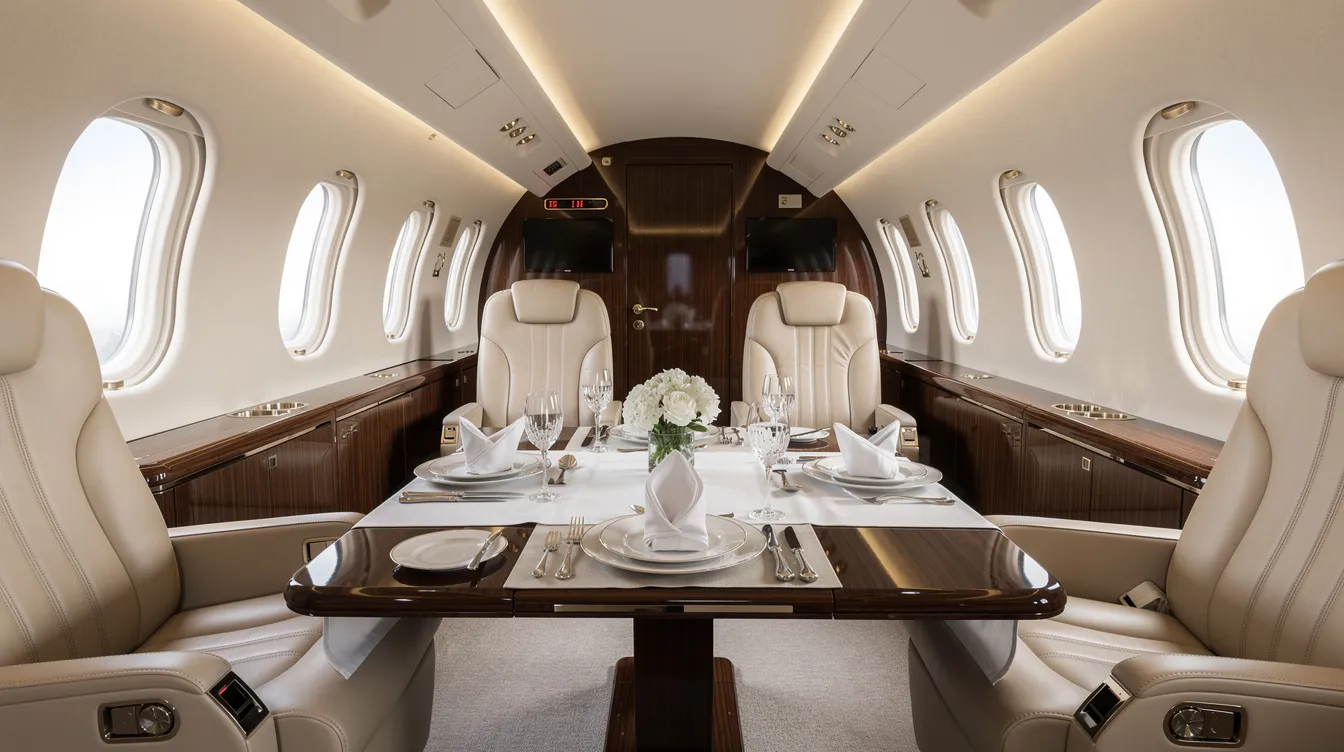
Private jet charter costs vary based on distance and aircraft type. International missions cost more than domestic, but the pricing becomes predictable once broken into its components.
Hourly rates for 2024–2026 fall into these general ranges, reflecting trends across the global fleet of private jets:
Light jets: ~$3,000–$5,000/hr
Midsize jets: ~$4,500–$7,000/hr
Heavy/long range jets: ~$8,000–$15,000+/hr
A small plane rental costs around $2,800 for 40 minutes on a short regional hop. A 1.5-hour flight in a midsize jet costs about $34,500. Gulfstream G-V jets average $12,000 per hour to rent, so a seven-hour transatlantic crossing runs well over $84,000 before handling fees and extras. For a full breakdown, Jettly's cost calculator provides live estimates.
Key cost drivers include route length (New York to London versus New York to Dubai), aircraft size, repositioning legs, overnight crew costs, fuel surcharges, and handling fees at international airports. Charter costs can range from $240 to $3,600 in Costa Rica, showing how dramatically price varies by destination and aircraft.
On-demand air charter pricing suits occasional international trips, while jet card models fix hourly rates for frequent travelers. To compare options in detail, Jettly's jet card flight cost estimator helps calculate approximate pricing for specific routes. One option doesn't always save money over the other-it depends on how often you fly.
Jettly's instant quote tool lets travelers compare multiple aircraft on the same route and explore savings by adjusting departure airports or flying on off-peak days. Additional optional costs include premium catering via Jettly Eats in-flight catering, in-flight medical personnel, ground transfers, and carbon offset add-ons.
Private jets offer direct access to over 5,000 airports globally, and private aircraft can land at thousands of airports not served by commercial airlines. That airport flexibility often saves an hour or more on each end of the trip, a theme explored in broader guides to charter airlines and private flights.
Jettly frequently arranges private charter on popular international routes: New York to London, New York to Paris, Los Angeles to Cabo San Lucas, Toronto to London, Miami to Nassau, and New York to Geneva. These city pairs benefit from secondary airport access-Teterboro and White Plains near New York, Farnborough and Luton near London, Le Bourget near Paris-where FBOs reduce congestion and ground time considerably, and travelers can use Jettly's airport locator tool to identify convenient departure and arrival options.
Route planning differs by region. North Atlantic crossings follow NAT tracks between North America and Europe. Polar routes connect North America and Asia. Shorter regional hops across the Caribbean or within the EU are more straightforward but still require permit coordination.
Jettly's partner operators coordinate slots at capacity-constrained airports-London during summer, Geneva during major conferences-and adjust schedules to align with permit windows and curfew rules. A finance team might fly New York to Zurich to Frankfurt and back over three days, or a family could plan a trip from New York to Rome with a stopover in Lisbon.
Private travel does not remove immigration rules. It changes how and where they are experienced, often making them faster and more private.
Passengers still must go through customs and immigration when flying privately. Valid passports and visas remain mandatory for international destinations regardless of whether the flight is a private charter or a commercial airline seat. Regulations vary by citizenship and destination.
Customs and immigration are typically handled at private terminals or dedicated facilities, often with officers meeting the aircraft on arrival for quick processing. Typical documentation includes a passenger manifest with passport details submitted in advance, plus any health or vaccination certificates required by the destination.
Rules around bringing goods, cash, baggage, or pets across borders still apply. Passengers remain responsible for customs declarations. Operators or Jettly's partners can advise on restrictions involving agricultural products, high-value items, or currency limits.
Travelers should discuss planned destinations and nationalities with Jettly early in the planning process. Visa lead times, advance approvals like ESTA for the US or eTA for Canada, and destination-specific entry requirements all need to be factored into the timeline.
Picture a 7 to 10 hour crossing: flat-bed seating, a quiet cabin, and a menu designed around your preferences. Private flights typically provide tailored passenger experiences regarding meals and cabin configuration. Private jet charters provide a more comfortable travel experience than commercial airlines on these long sectors.
Heavy and long-range jets offer separate zones for working, dining, and sleeping. Typical seating ranges from 10 to 16 passengers, with options to convert seats and divans into beds. The cabin space is designed to cater to both productivity and rest.
In-flight services through Jettly's partner operators include customized catering matching dietary needs, premium beverages, espresso service, kids' menus, and regional cuisines suited to routes like New York to Tokyo or London to Dubai. Most international-capable jets are equipped with high-speed Wi-Fi for video conferencing, streaming, and confidential work, though coverage can vary over certain oceans.
Modern jets feature adjusted cabin pressurization, noise-reduction design, and amenity kits. Personalized travel experiences extend to branding the cabin for a corporate roadshow, bringing pets on board in the main cabin, or requesting baby cots and medical monitoring units where operationally feasible.

International private flights are heavily regulated. Safety standards for charter operators often mirror or exceed those of commercial airlines.
Key regulatory frameworks include the FAA (United States), EASA (Europe), Transport Canada, and equivalent authorities in every country along the route. Third-party safety audits from organizations like ARGUS, Wyvern, and IS-BAO add another layer of scrutiny. Jettly works only with licensed operators holding valid Air Operator Certificates and appropriate international approvals, including ETOPS certification for certain oceanic routes.
Typical safety checks cover maintenance records, crew duty time limits, captain experience levels on long-range jets, and recurrent training on international and oceanic procedures. Operational risk management on international legs includes weather routing, diversion airport planning, fuel reserves, and modern avionics for oceanic communication, and these same standards apply when Jettly connects travelers with vetted operators such as Dexter Air Taxi and Zenflight.
Passengers receive clear safety briefings before every flight. Jettly's support team and the operating carrier's 24/7 operations center monitor flights and help manage disruptions or reroutes in real time.
Jettly is a tech-driven private jet charter platform that centralizes searching, pricing, and booking of international private flights in one digital interface, giving members access to private jet memberships and a broad catalog of private charter aircraft.
Users open an account, search global routes, and receive instant pricing from a global network of over 20,000 aircraft. Filters narrow results by range, cabin size, and departure airport. The platform handles on-demand charter flights for those who fly occasionally, while membership options offer lower effective per-hour rates or added personalized service for frequent travelers-without locking them into traditional ownership.
Unlike shared flights or rigid fractional programs, Jettly's model is built around flexibility. The platform helps manage complex itineraries: multi-leg international business tours, seasonal family trips, and one-way relocations, with integration into ground transportation where available, while complementary services like crowdsourced private jet flights and shared empty seats can make certain trips more cost-effective.
Support tools include digital itineraries, notifications about flight details like schedule adjustments or slot confirmations, document upload for passports, and 24/7 assistance for changes, upgrades, or rerouting mid-trip. Whether the demand is a last-minute New York to London crossing or a planned multi-city European tour, the platform adapts, much like the flexible options described in Jettly's guide on how to get a seat on a private jet easily.
Compared to legacy private aviation models, Jettly's positioning centers on transparent pricing, broad aircraft choice across the globe, and the kind of convenient digital experience modern international travelers expect. For travelers ready to discover what on-demand private jet travel looks like, the platform is designed to suit a wide range of travel needs and is often considered a compelling NetJets alternative for international flyers.
Private flights generally produce higher carbon emissions per passenger compared to commercial flights, especially on long international sectors. Travelers should be aware of this tradeoff.
Newer long-range jets with advanced engines and wing designs are significantly more fuel-efficient per mile than older models, making aircraft choice an environmental as well as a cost decision. Some operators offer access to Sustainable Aviation Fuel (SAF) at major hubs in North America and Europe, which can reduce lifecycle CO₂ emissions compared to conventional jet fuel.
Carbon offset programs allow travelers to voluntarily fund vetted environmental projects based on the estimated emissions of their charter flight. These calculations are often available per leg within Jettly's or partner tools.
Best practices for environmentally conscious travelers include consolidating multi-city trips into efficient loops, selecting appropriately sized aircraft to avoid flying a heavy jet for four passengers, and minimizing unnecessary repositioning where itinerary flexibility allows. Jettly follows developments in sustainable aviation and can help clients choose operators with active sustainability policies.
These FAQs address practical questions that first-time international private flyers commonly ask. Each answer covers a specific concern not fully detailed in the sections above, complementing Jettly's broader overview of how to buy a seat on a private jet for different budget levels and trip types.
For common routes like New York to London, 3 to 7 days is usually sufficient. Complex itineraries, peak seasons, or destinations requiring unusual overflight permits may need 1 to 2 weeks. Some permits can take up to 30 days in rare cases. Last-minute trips are sometimes possible within 24 hours when aircraft and permits align.
Contact Jettly as early as possible to secure better aircraft choice and pricing, even if exact dates are not yet fixed.
One-way international private charter is common and fully available through Jettly, especially on high-traffic routes where aircraft can find return demand. Some routes may still price in repositioning costs, but Jettly's marketplace model helps compare operators to find favorable one-way pricing.
Round-trip bookings with a flexible return can sometimes save money if the same jet and crew remain with the client over several days. It depends on the route and timing.
Pets are usually welcome on private jets, but international rules can be strict. Requirements depend on origin, destination, and species. Typical needs include a microchip, up-to-date vaccinations including rabies, health certificates, and in some cases quarantine or advance import permits for countries like the UK or Australia.
Jettly and its partner operators help coordinate with destination authorities and airport handlers, but the traveler is responsible for providing valid documentation.
Private charter offers more flexibility than commercial options. Departure times can often be adjusted and routings updated, subject to aircraft availability, crew duty limits, and new permit or slot requirements.
Jettly's 24/7 support team and the operating carrier's dispatch work together to replan the itinerary, including new airport choices or added stops. Significant changes may affect the final price, particularly if they extend aircraft and crew days or require new positioning flights.
While charter operators carry mandatory aviation insurance, travelers should still consider separate travel insurance for medical emergencies, trip interruption, and lost or delayed baggage at hotels or transfers. Policies that cover international medical evacuation are especially important when visiting remote locations.
Consult a qualified insurance advisor and inform them that the trip involves private jet charter flights. Standard travel policies may not automatically cover private aviation scenarios, so it is worth verifying before you embark on the journey.
International private jet travel makes the most sense when schedules are tight, multiple countries need to be visited in a short window, or comfort and privacy across the world genuinely matter. Whether it is a three-city investor roadshow or a leisure trip with the family, flying private puts control over departure times, airports, and onboard environment squarely in the traveler's hands.
Jettly's digital marketplace handles pricing transparency, aircraft selection from a fleet spanning the globe, and coordination with certified operators-so the traveler can plan and hire the right aircraft without guesswork. From first-time flyers to seasoned private aviation clients, the platform is built to suit anyone ready to explore international routes on their own terms and compare the best private jet charter companies in the wider market.
For anyone considering a private plane international flight from hubs like New York, Miami, Toronto, or any city worldwide, the next step is simple.
Ready to fly on your terms? Explore flight options or request a quote at https://www.jettly.com. Instant pricing is available for thousands of global routes.
Share this post:
Jay Franco Serevilla
Aug 5, 2026
|
5
min read
Discover tips and trends in the industry.

5
min read
Jetout vs. Jettly: How Modern Private Aviation Is Changing for Travelers and Crew
Jetout and Jettly represent two distinct models in private aviation, catering to different traveler needs. Jetout focuses on regional co-ownership with a dedicated fleet, while Jettly offers a global digital marketplace for on-demand charter services. Understanding these options can help travelers make informed decisions based on their flight frequency and preferences.
Read More
5
min read
Sentient Jet LLC: Jet Cards, the Sentient Certified Network, and Modern Private Aviation
Sentient Jet LLC revolutionized private aviation by introducing the jet card model in 1999, offering prepaid flight hours at fixed rates. This article explores the advantages and disadvantages of Sentient Jet's structured approach compared to on-demand charter solutions, helping travelers make informed decisions based on their flying habits and preferences.
Read MoreStay updated with our latest insights and tips to elevate your journey with us.
MEMBERSHIPS AND ASSOCIATIONS



Disclaimer: Jettly operates as a charter broker, offering access to a global digital jet charter marketplace. Jettly is not a direct air carrier and does not own or operate aircraft. All advertised flights are conducted by third-party air carriers that are fully licensed and hold the appropriate Part 135 or Part 121 certifications issued by the Federal Aviation Administration (FAA) or equivalent regulatory authorities under U.S. or foreign law. Jettly complies fully with the U.S. Department of Transportation's Part 295 and Part 298 Charter Broker regulations. Jettly does not carry additional liability insurance. Passengers are covered by aircraft operator insurance. TICO: 50023770


