



Login
Get Instant Pricing On 23,000+ Aircraft

>

Private jet remote airports unlock access to destinations that commercial flights often cannot reach, offering travelers unparalleled convenience and flexibility. These airports serve secluded islands, mountain resorts, safari lodges, and rural business locations with shorter runways or unique terrain, making them ideal for private aviation. Jettly’s private jet charter platform connects travelers to over 20,000 aircraft capable of operating at these remote airfields, providing a streamlined, transparent private jet experience. By choosing remote airports, travelers save valuable time, avoid crowded terminals, and enjoy enhanced privacy while benefiting from professional services such as valet services and efficient ground transportation. This article explores how private jet remote airports transform travel, highlighting iconic locations and the operational realities of flying into these exclusive destinations.
Private jet remote airports let travelers land closer to islands, ski resorts, safari lodges, and rural business sites than commercial flights ever could.
Jettly’s platform connects travelers with 20,000+ aircraft able to operate into many short, challenging, or remote runways worldwide.
Using remote airports can cut hours of ground travel, avoid crowded terminals, and provide high privacy while meeting safety and regulatory standards.
The article covers iconic examples, including St. Barts, Courchevel, Telluride, and African safari strips.
Jettly coordinates aircraft matching, permits, customs, and ground transportation for seamless remote-airport itineraries.
Private jet remote airports are airfields serving secluded islands, mountain towns, safari regions, and low-population areas often unreachable by commercial airlines. These can be public or private airports with shorter runways, limited infrastructure, or challenging terrain—but all are approved and regulated for safe operations.
The key value is proximity. Private jet travelers can land within minutes of villas, lodges, or client sites instead of hours away at the nearest major international airport. Through Jettly, travelers can use an airport locator tool to see options for both major gateways and remote satellites near their final destination. Private jets often land at major international airports such as Denver International Airport, which offer extensive networks of connecting flights and services, but they also utilize smaller regional and general aviation airports for added convenience and efficiency.
Business aviation accesses over 5,000 public and up to 14,000 private airports worldwide, far exceeding the roughly 500 major airports used by commercial airlines, a range explored in depth when examining where private jets land and airport access. North America has the densest network, followed by Europe and parts of Africa.
Private jet remote airports change the entire door-to-door journey, not just the in-flight segment. Rather than connecting flights through major international hubs, private aircraft can fly directly to smaller airports near the final destination.
Benefits include:
Time savings: Bypassing connections and long drives can save 4-8 hours on round-trip trips
Privacy and security: Smaller airports provide greater privacy and security compared to major terminals, which are crowded with the public, ensuring a discreet travel experience
Control: Departing on the client’s schedule rather than fixed airline slots
Fewer delays: Less traffic at smaller airports means more predictable departures, quicker takeoffs, and faster taxiing to and from the runway
Streamlined processing: Many smaller airports and their Fixed Base Operators (FBOs) offer expedited customs and immigration processing, allowing private jet passengers to clear customs in minutes and bypass long lines typically found at major international hubs
Flexible arrival times: Private jets can often bypass long security lines, allowing passengers to arrive only 15-30 minutes before departure
In many regions, landing at a remote airfield cuts 2-5 hours of road or ferry travel compared to using the nearest commercial airport, especially when leveraging Jettly’s global network of private charter aircraft. For business travelers, this can mean same-day out-and-back trips to rural plants, mines, or project sites that are impractical via commercial flights, especially when they understand affordable aircraft rental options and cost factors.
The following examples showcase real-world remote airports across beaches, mountains, islands, and wilderness—prime use cases for private aircraft. While these airports adhere to regulatory standards, some are also subject to local noise restrictions, which can impact flight schedules and overall airport accessibility.
Gustaf III Airport serves Saint Barthélemy in the French West Indies, located about 30 km southeast of Sint Maarten. The runway measures approximately 650 meters, nestled between a hillside and a bay with a steep downhill approach over a road.
Only small aircraft—often turboprop aircraft and very light jets—with specially trained pilots may operate here. Many private jets land at Princess Juliana International Airport (SXM) on Sint Maarten first, then use a smaller charter into SBH. Landing here puts guests within minutes of St. Jean Beach and Gustavia harbor, avoiding regional ferries.
Courchevel Altiport sits at 2,008 meters elevation, serving the Courchevel 1850 ski resort in France’s Tarentaise Valley. The runway is extremely short (537 meters) and sloped at 18% gradient, surrounded by mountains.
Special pilot qualifications and STOL-capable aircraft are mandatory. Winter travelers often fly into Chambéry, Geneva, or a regional airport, then transfer via smaller charter or helicopter. The benefit: ski-in style arrival, skipping multi-hour road transfers up winding mountain passes.
Telluride Regional Airport ranks among North America’s highest airports at 2,780 meters elevation, serving the town of Telluride and its ski resort. The plateau setting amid the San Juan Mountains favors experienced crews and capable private aircraft.
Previously, guests flew into Montrose (MTJ) and drove 1.5-2 hours, much like travelers using regional gateways such as private jet charter services in Atlanta before transferring onward by road. Landing directly at TEX via private jet cuts that ground time dramatically. Typical aircraft include light and midsize jets configured for high-elevation operations, saving valuable time for travelers from Dallas, Los Angeles International Airport, or Chicago.
Ambergris Cay is a private island in Turks and Caicos with a 1,830-meter paved runway accommodating super-midsize and some larger jets. On-island customs and immigration facilities allow guests to arrive from North America without stopping at Providenciales (PLS) first.
Travelers can step from aircraft to villa or beach in minutes—the “runway-to-resort” immediacy that defines many private jet airports. The island’s low density appeals to families and high-profile guests seeking quiet rather than crowded resort corridors.
In Kenya, Tanzania, Botswana, and Namibia, many safari lodges rely on remote gravel or grass airstrips that only smaller aircraft can serve. Over 300 such strips exist in East and Southern Africa.
Examples include:
|
Region |
Airstrip Examples |
Connecting Hub |
Typical Aircraft |
|---|---|---|---|
|
Maasai Mara, Kenya |
Keekorok, Ol Kiombo |
Nairobi Wilson (WIL) |
Cessna Caravan, PC-12 |
|
Okavango Delta, Botswana |
Mombo, various camps |
Johannesburg (JNB) |
Cessna Caravan, PC-12 |
Private jet travelers typically fly into regional hubs like Johannesburg or Nairobi, or major West African centers like Lagos, for private jet charter, then connect via smaller aircraft to lodge airstrips. This multi-leg journey minimizes overland drives on rough roads. Jettly coordinates multiple aircraft types in one itinerary for such remote destinations
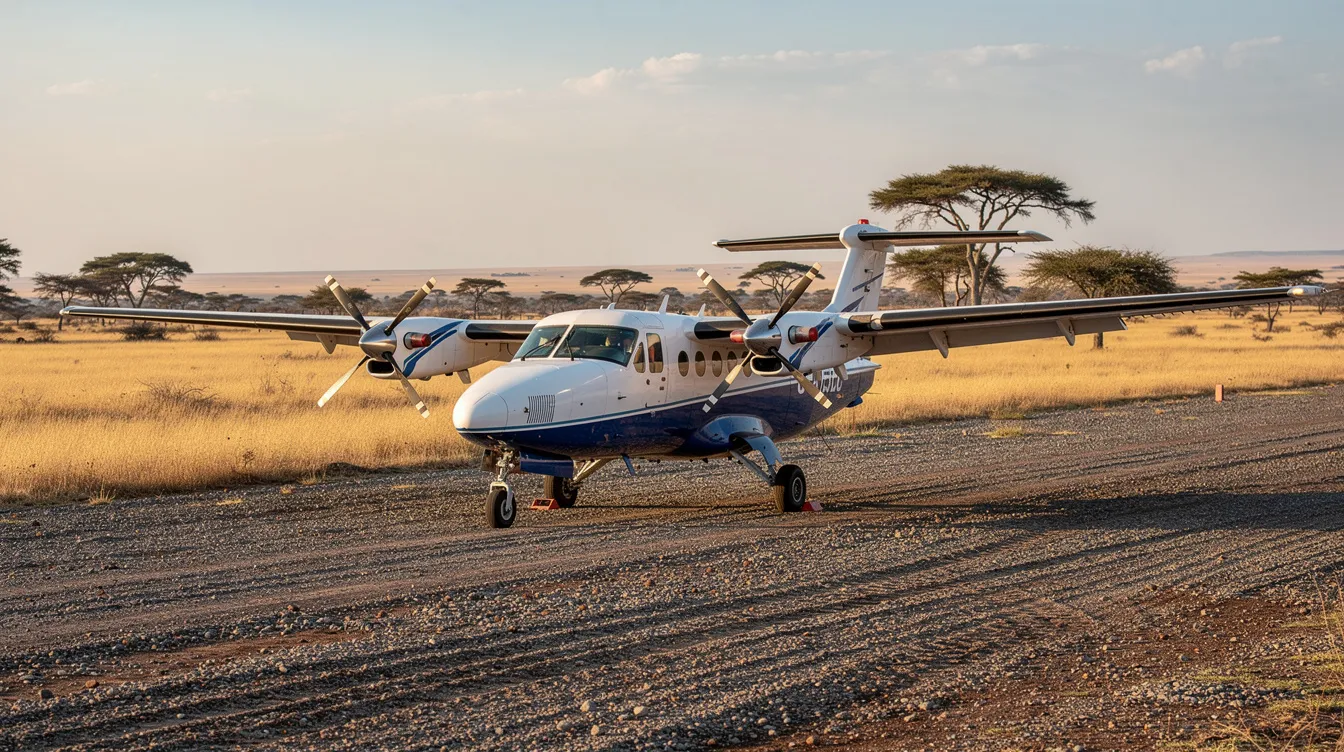
Not every secluded landing location suits every jet. Several technical and regulatory factors define what’s possible. Jettly’s network operators evaluate these factors before confirming aircraft options, maintaining safety and compliance with national aviation authorities like the FAA or EASA, drawing on deep experience with the broader private and charter airline landscape.
Runway length is often the first limiter:
|
Aircraft Category |
Typical Runway Need |
|---|---|
|
Turboprops (PC-12, King Air) |
800-1,200 meters |
|
Light jets (Citation CJ3+) |
1,200-1,500 meters |
|
Midsize jets |
1,500-2,000 meters |
|
Large cabin jets (G650) |
2,400+ meters |
Surface matters too—gravel suits rough-field aircraft like the Pilatus PC-12, but most jets prefer paved runways. High elevation reduces engine performance, increasing takeoff distance by 20-50% at airports like Telluride or Denver International Airport’s altitude.
Jettly’s platform filters aircraft automatically based on airport performance data, helping travelers interpret private jet flight cost factors for single trips alongside operational constraints.
Mountainous terrain, coastal winds, or short final approaches require specific procedures and experienced crews. Many remote airfields lack precision instrument landing systems, making operations dependent on visibility and daylight.
Seasonal factors affect access: snow and ice at alpine locations, tropical storms on islands. Reputable charter operators will decline or delay private flights when conditions don’t meet safety margins.
Many private airfields have minimal facilities: limited fuel availability, no hangars, and basic ground handling. For longer-range or larger aircraft, fuel availability can dictate routing, sometimes requiring tech stops.
Planning a return leg from a fuel-limited island might require careful load and range calculations, especially on international private jet flights where alternate airports and overflight permits add complexity. Many itineraries also benefit from strategies for booking the cheapest private jet flights without sacrificing safety or access to remote fields. Jettly’s partner operators manage these logistics—clients see a single confirmed itinerary with built-in stops where needed.

One of Jettly’s strengths is connecting users to appropriate aircraft and operators for remote airport missions via a digital, on-demand platform. The vast network includes 20,000+ aircraft globally—from turboprops to heavy jets and helicopters—many regularly operating into remote fields.
Clients enter their intended origin and destination. The system then suggests practical airport pairs, including secondary and remote options. Transparent pricing and tools like Jettly’s private jet charter cost estimator help travelers see cost differences between using a major international hub plus ground transportation versus landing closer at a remote airfield, aligning with broader guidance on how much it costs to rent a private jet.
Jettly considers runway length, elevation, and surface when proposing aircraft. A traveler flying from New York (perhaps from Teterboro Airport) to a short Caribbean strip might see a super-midsize jet to a nearby commercial airport, plus a turboprop connection for the final 20-30 minutes.
For frequent routes—New York to Telluride, London to alpine resorts, Toronto to northern Ontario—recommended aircraft types are standardized by past operations, and travelers can use a jet card flight cost estimator to anticipate pricing on these regular corridors while learning what a jet card is, its costs, and benefits. Safety ratings, operator audits, and crew experience with specific airports factor into selection, as do detailed comparisons of private jet card pricing structures.
Some private jet remote airports require prior permission (PPR), landing slots, or coordination with local authorities. International private flights into remote fields may require stopping at a designated port of entry first.
For example, travelers might clear customs at Nassau or Providenciales before continuing to a small island strip. Jettly’s partner operators arrange these permissions—travelers see a single itinerary without managing regulatory details themselves.
Different traveler profiles use remote airports for distinct reasons: time savings, privacy, mission access, or family convenience, and many compare options using guides on affordable private jet charter costs and broader explanations of how much a private jet can cost to own or charter before choosing their ideal route and airport. Private jet travel enables passengers to reach their next flight or destination more quickly and comfortably, emphasizing the convenience and efficiency that sets this mode of travel apart, especially when they understand hourly private jet rental price ranges.
A management team based in a major city needs to visit a manufacturing plant or energy site hours from the nearest airline hub. A private jet company can land at a small regional airport within a 15-30 minute drive of the site.
Sample routes include Houston to a Gulf Coast facility or Calgary to a northern Alberta strip. Companies value the ability to adjust timing mid-day—something remote airports and private charters make easier than fixed airline schedules.
Multi-generational families use remote airports to simplify travel with children to islands and mountain resorts, often exploring strategies for getting a seat on a private jet easily through memberships, empty legs, or shared flights, and comparing shared charter flights versus full private charters to balance cost and privacy. Many also look into how to buy a seat on a private jet through shared and semi-private options to make these trips more accessible. Flying from Toronto directly to a short-runway lake region avoids several hours of driving.
Direct access reduces transfers and long walks through commercial terminals. Baggage, sports gear, and pets travel in one cabin, going straight to the lodge vehicle at many private airports.
Private jet remote airports support trips to the Icelandic highlands, Greenland, Patagonia, or Arctic gateways. Many expedition cruises or heli-ski operations stage from villages with accessible runways for chartered aircraft.
Flying into Longyearbyen (LYR) for Svalbard or Chilean Patagonian airports provides flexibility for weather windows—critical for heli-skiing or wildlife viewing—and some travelers lower costs on these adventures by using crowdsourced and shared private jet flights and other tactics for finding the cheapest private jet flights. Operators pay close attention to weather, daylight hours, and alternate airports.
Private jet remote airports offer clear advantages but come with trade-offs in cost and environmental impact.
Flying into remote or shorter runways often favors turboprops and light jets, which can be more cost-efficient per hour than large cabin jets. Smaller airports often charge lower landing fees—sometimes 50-80% less than major hubs like London Heathrow or major cities’ commercial terminals.
|
Aircraft Type |
Approximate Hourly Range |
|---|---|
|
Turboprop |
$2,000-3,500 |
|
Light jet |
$3,500-5,000 |
|
Midsize jet |
$5,000-7,500 |
|
Large cabin |
$10,000+ |
Empty leg flights occasionally appear on routes to or from remote airports, offering lower-cost options through Jettly’s platform and complementing broader insights into one-off private jet flight pricing.
Private aviation has a higher per-passenger carbon footprint than most commercial flights. Many operators in Jettly’s network now offer Sustainable Aviation Fuel (SAF) options or carbon offsets, reflecting growing awareness of private jet emissions and cleaner ways to fly.
Efficient routing, right-sizing the aircraft, and consolidating itineraries reduce total emissions. Travelers can ask about environmental options when requesting a charter—this demand helps push the industry toward more sustainable operations.
These questions address practical concerns not fully covered above, from aircraft limitations to last-minute changes.
Many private jet remote airports have short or rough runways suitable only for turboprops, very light jets, or certain midsize jets. Large cabin jets like the Gulfstream G650 often cannot use the shortest strips. Instead, many private jets land at a nearby larger airport—perhaps a small regional field with longer runways—with a smaller connecting aircraft used for the final hop. Jettly evaluates each airport’s performance data before presenting aircraft options, ensuring travelers see only compatible choices. Sometimes choosing a regional airport slightly further away allows staying on a single, larger jet for the entire trip.
One advantage of private jet travel is shorter arrival times. At many private airports, private jet passengers typically arrive about 20-30 minutes before departure—a stark contrast to the long lines at a commercial airport. For international flights where customs is handled on-site, operators might request earlier arrival to complete formalities. Jettly’s confirmation documents specify recommended arrival times for each departure point, eliminating the guesswork that comes with military airports or busy commercial hubs, and travelers can further personalize their journeys with services such as in-flight catering for private jets.
Many private charters are pet-friendly, and pets regularly travel in the cabin on routes to remote airports like islands or rural homes. International flights still require compliance with veterinary and import regulations, which may be checked on arrival, even at smaller fields with immigration facilities. Jettly and partner operators advise on pet policies, crate requirements, and route-specific restrictions during booking, much as other leading private aviation providers like NetJets in the wider private aviation market guide their clients on specialized travel needs. Unlike commercial airlines with strict cargo holds, private lounges, and direct aircraft access make pet travel significantly less stressful.
Closures due to weather or runway conditions are handled via contingency plans—diverting to an alternate landing location and arranging ground or helicopter transfers. Operators monitor forecasts closely for remote strips and may propose adjusted departure times. In some cases, your next charter may need rescheduling if conditions don’t meet safety standards. Jettly’s team works with operators to communicate options quickly, giving travelers clear choices when travel plans need adjustment.
Remote airports operating within national airspace systems are subject to aviation authority oversight, though facilities may be simpler than at Van Nuys Airport, Santa Monica Airport, or major international airports. Safety depends on the charter operator’s standards, aircraft maintenance, and crew training—not just airport size. Airports regularly used for business aviation have published procedures and documented safety data. Jettly works only with licensed operators, and all private flights are conducted under relevant commercial regulations, whether accessing temporary airstrips in residential areas or established private airfields.
Private jet remote airports enable direct access to islands, mountains, wilderness areas, and remote business hubs that commercial airlines cannot efficiently serve. From Caribbean beaches to alpine slopes, these airfields unlock possibilities that would otherwise require complex multi-day itineraries through crowded commercial terminals.
Jettly’s digital platform and global aircraft inventory simplify planning such trips—from selecting compatible aircraft to handling permits and ground transfers. Private jet remote airports deliver the core benefits that define premium services in air travel: time saved, improved privacy, and increased flexibility.
The private jet travel experience through remote airports represents how private jets work to serve travelers who prioritize efficiency over convention. Whether visiting a private island, inspecting a remote location, or arriving at high-profile events in non-standard locations, the ability to land closer to your next flight’s purpose changes everything.
Ready to explore private travel on your terms? Whether through flexible private jet memberships, structured jet card programs, or even partnering via Jettly’s ULTRA high ticket affiliate program, Jettly offers options to match different flying profiles, and readers can also review the best jet card programs compared in detail before committing—request a quote at https://www.jettly.com.
Share this post:
Jay Franco Serevilla
Apr 22, 2026
|
5
min read
Discover tips and trends in the industry.
5
min read
Jet South Africa: Private Jet Charter, Routes & Pricing with Jettly
Jet travel in South Africa offers unparalleled convenience and flexibility, connecting major cities like Johannesburg, Cape Town, and Durban. Jettly's digital platform provides instant access to a vast network of private jets, catering to both business and luxury travel needs. With tailored itineraries and quick airport processing, flying private is an efficient alternative to commercial flights.
Read More
5
min read
Jet Method: Modern Approaches to Aircraft Management, Ownership, and Charter
Choosing the right jet method is crucial for optimizing private aviation travel. This guide explores various options, including on-demand charters, memberships, jet cards, fractional ownership, and full ownership, helping travelers find the best fit for their needs.
Read MoreStay updated with our latest insights and tips to elevate your journey with us.
MEMBERSHIPS AND ASSOCIATIONS



Disclaimer: Jettly operates as a charter broker, offering access to a global digital jet charter marketplace. Jettly is not a direct air carrier and does not own or operate aircraft. All advertised flights are conducted by third-party air carriers that are fully licensed and hold the appropriate Part 135 or Part 121 certifications issued by the Federal Aviation Administration (FAA) or equivalent regulatory authorities under U.S. or foreign law. Jettly complies fully with the U.S. Department of Transportation's Part 295 and Part 298 Charter Broker regulations. Jettly does not carry additional liability insurance. Passengers are covered by aircraft operator insurance. TICO: 50023770


