



Login
Get Instant Pricing On 23,000+ Aircraft

>
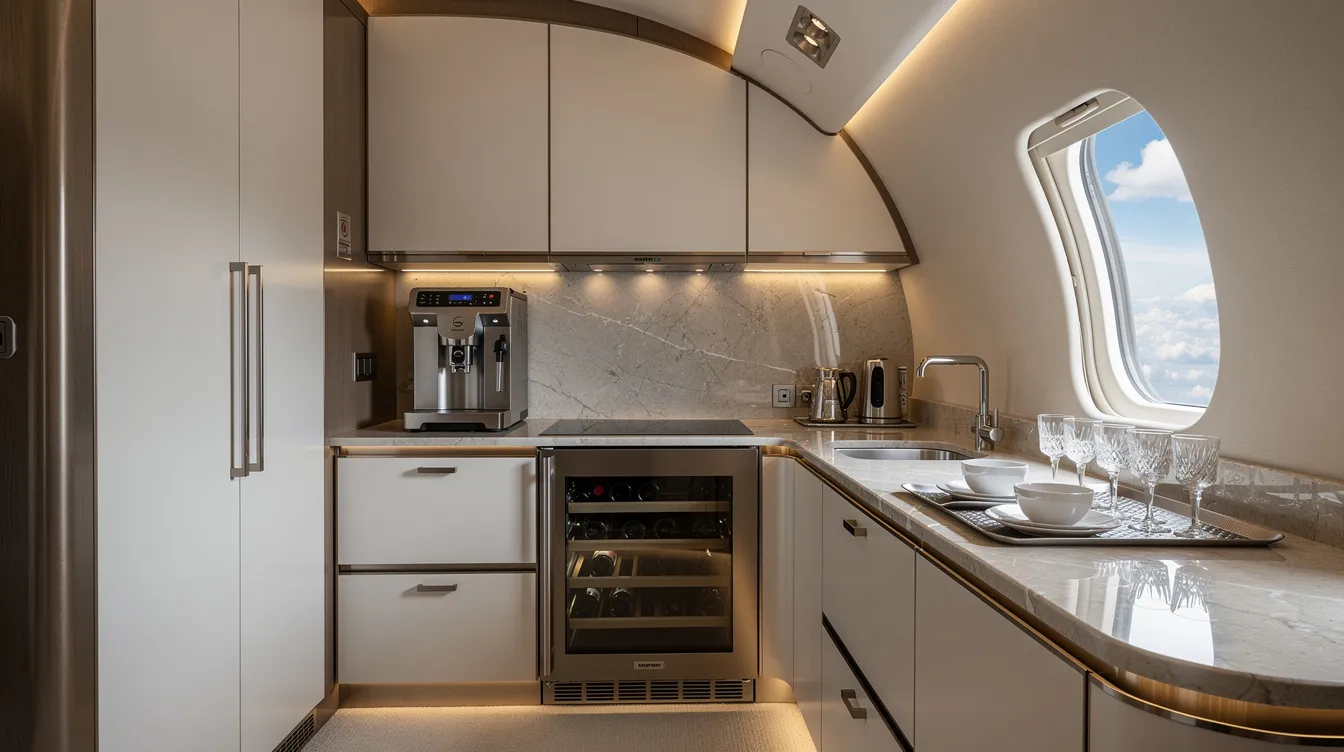
A private jet kitchen is a compact, purpose-built galley that transforms confined spaces into functional cooking and service stations at cruising altitude, with facilities ranging from simple refreshment centers on light jets to full setups with ovens, coffee systems, and multi-course meal service on heavy aircraft. Unlike the jet kitchen on commercial aircraft - which reheats standardized trays for hundreds of passengers - a galley on private jets is built for small groups, flexible timing, and personalized menus.
Private jet kitchens have evolved from basic snacks to gourmet meals over the past six decades. Today, the private jet experience can mean fresh fruit and gourmet sandwiches on a two-hour hop or multi-course dinners with filet mignon and curated wine pairings on overnight crossings. For corporate executives, high-net-worth individuals, families, and leisure travelers who book private aircraft for convenience and comfort, the difference comes down to galley space, equipment, catering logistics, and how well the aircraft supports the dining experience they want across a wide range of private charter aircraft.
This article walks through private jet kitchen design, essential appliances, food storage and hygiene, in-flight meal service and presentation, dietary accommodations, and how kitchen facilities differ across aircraft categories - so travelers can match meal expectations to galley capability before booking. It also explains how Jettly helps align aircraft options with onboard dining needs, reducing surprises and making it easier to plan a seamless private jet meal experience while keeping an eye on overall affordable private jet charter costs.
A modern private jet kitchen - called a galley - is designed to serve gourmet meals in a space often smaller than 20 square feet while complying with strict aviation regulations and fire safety standards.
Kitchen facilities vary widely by aircraft size: light jets usually offer refreshment centers for cold platters, light snacks, and soft drinks, while heavy jets and ultra-long-range jet models can support full multi-course fine dining.
Altitude, varying cabin pressures, and low humidity change how food tastes, so menus, essential appliances (fully functioning ovens, coffee machines, beverage centers), and finishing techniques are adapted differently from those on the ground.
Smart food storage, waste management, advanced planning for dietary restrictions, and daily cleaning tasks are just as important as the appliances themselves for a smooth in-flight dining experience.
Jettly's digital platform helps travelers match aircraft type and galley capability to their catering expectations, with more details and booking available at https://www.jettly.com. Frequent flyers can benefit from flexible private jet memberships, while travel professionals and content creators may also explore Jettly's high-ticket affiliate program for additional earning opportunities.

In the 1960s, jets had only insulated ice chests and thermos coffee. Crews managed with basic kitchens: coolers packed with sandwiches, bottled water, and maybe a plate of smoked salmon. There was no hot food capability to speak of.
By the 1990s, jets featured hot galleys with convection ovens. Aircraft like the Gulfstream IV introduced proper heating elements, hot water boilers, and improved cold storage, allowing flight crews to serve warm entrees on longer routes.
Today's jets support multi-course, chef-designed tasting menus. The Gulfstream G700 - certified in August 2023 - offers an "ultragalley" option with dual ovens, induction cooktops, and espresso systems. Private jet kitchens now include mini-fridges and fully functioning ovens as standard in larger private jets, while even midsize jets have seen meaningful upgrades.
This evolution parallels the rise of charter platforms like Jettly, which let travelers choose the right jet based partly on galley and catering capabilities, not just range or seat count, drawing on its extensive inventory of private charter aircraft.
Every inch, kilogram, and watt matters in a jet kitchen. Design considerations influence both safety and the quality of gourmet meals on board, and getting them wrong compromises passenger comfort or violates aviation regulations.
Private jet kitchens often use U-shaped or galley layouts, though L-shaped and straight-line configurations appear depending on fuselage width. Light jets allocate just 4-6 square feet for galley space, while large cabin jets dedicate 20-40 square feet for kitchens. Crew workflow, passenger privacy, and emergency egress all shape where the galley sits relative to the cabin. These spatial constraints require creative solutions - fold-down surfaces, nested drawers, and equipment that can save space when not in use.
Materials must be lightweight and fire-resistant in jet kitchens. Private jet kitchens must use fire-resistant materials for countertops, panels, and cabinetry, meeting standards set by the FAA, EASA, or Transport Canada. Cabinetry can feature dark wood or light veneers for aesthetic appeal, while countertops can be customized with various materials like stone - provided they meet durability requirements and weight limits.
Smoke detectors are required in private jet kitchens. All kitchen components must meet aviation authority standards, including secured latches, non-slip flooring, and fire-extinguishing systems positioned within reach. Appliances must be secured during flight to prevent accidents, and heating elements must withstand turbulence up to 3.8g forces. Lighting options can be adjusted for different flight phases, keeping the galley bright during prep while dimming for passenger sleep, and thoughtful planning around departure and arrival points using an airport locator tool helps ensure catering and galley support are available where you need them.
Most private jet kitchens focus on reheating and finishing professionally prepared meals, not raw cooking. Compact appliances are essential for efficient meal preparation, and private jet kitchens require compact, high-performing appliances that balance capability with weight and power draw.
Ovens in private jets can reach temperatures of 350-400°F. Heavy jets typically carry convection or combi ovens capable of finishing dishes like filet mignon, roast chicken, pasta dishes, or baked fish. Midsize jets often use combination microwave-convection units, while smaller aircraft may rely on warming drawers alone. Induction cooktops are preferred for their efficiency and safety - cool surfaces, instant heat control, and automatic shutoff during turbulence. Fold-down lids let cooktops save space between services.
Refrigeration is essential in galleys for storing beverages and food at safe temperatures. Under-counter fridges, refrigerated drawers, and small freezers handle everything from birthday cakes to fresh-squeezed juices. Refrigerated drawers keep food fresh during flights of 10-12 hours, maintaining temperatures between 0-4°C despite cabin pressure changes.
Coffee machines in jets often include plumbed espresso systems on heavy jets, while midsize jets typically feature capsule-based machines. High-end coffee machines are common in private jet galleys, alongside chilled beverage centers for soft drinks, wine storage, and fresh fruit juices. Appliances can be tailored to fit specific passenger needs - from a simple kettle to a dual-boiler espresso setup with hot water on demand.
Small essential appliances like hot water kettles, blenders, toasters, and ice makers round out the list. Power load management matters: long-range aircraft may draw up to 50 kW at peak galley usage, so equipment is staged rather than run simultaneously.
Smart food storage and waste management systems keep the jet kitchen organized, hygienic, and odor-free - especially on flights longer than three to four hours.
Cold storage strategies include labeling containers by course and passenger, maintaining separate zones for raw versus ready-to-eat items, and keeping high-risk foods like seafood and dairy at safe temperatures. Custom cabinetry is used in galleys for secure storage of dishes and glassware, with foam-lined compartments to prevent breakage.
Dry storage uses pull-out pantries, custom dividers, and non-rattling latches to keep food fresh, along with snacks, condiments, and coffee capsules secure through turbulence. Waste solutions include sealed bins with odor-control liners, segregation of recyclables from food waste, and compliance with international customs rules on disposal.
Weekly maintenance tasks and daily cleaning tasks - sanitizing work surfaces, checking fridge temperatures, rotating stock - keep the galley in working order between flights and contribute directly to food safety and passenger comfort.

A private jet kitchen supports a dining experience closer to fine dining than to airline service, even in a cabin built for travel. Flight attendants heat and plate meals from pre-prepared sources, turning a compact galley into a staging area for restaurant-quality presentation.
On larger jets, tableware includes porcelain plates, crystal glassware, silver cutlery, and tables dressed with elegant cloths. These are stored in felt-lined drawers to withstand turbulence without chipping. Smaller jets use trays and lighter serviceware but can still deliver a polished in-flight dining experience, especially when paired with coordinated in-flight catering for private jets.
Presentation adapts to altitude: tighter plating prevents spills, sturdy garnishes replace delicate ones, and sauce is placed precisely. Some operators feature fine china with personal branding on menu cards, and cabin lighting shifts to a warmer "dining mode" for special occasions.
Service on private jets can be tailored to passenger preferences for meal timing. A business traveler might want a quick main course service before landing in San Francisco, while a family on an overnight flight prefers a slower multi-course dinner. The best chefs design menus with this pacing in mind, and trained flight attendants manage timing from the limited space of the galley, mirroring the tailored service seen on celebrity private jets and their luxurious air travel.
Kitchen facilities scale with aircraft size, range, and mission profile. Here is how they compare:
|
Category |
Examples |
Galley Space |
Typical Capabilities |
Flight Duration |
|---|---|---|---|---|
|
Light jets |
Phenom 300, Citation CJ4 |
4-6 sq ft |
Refreshment center, chilled drawers, cold platters, light snacks |
1-2 hours |
|
Midsize jets |
Citation Latitude, Praetor 600 |
10-15 sq ft |
Combo ovens, fridge, coffee machines, hot entrees |
3-6 hours |
|
Heavy jets |
G650ER, Global 7500, Falcon 10X |
20-40 sq ft |
Dual ovens, induction cooktops, beverage centers, multi-course service |
8-14+ hours |
Smaller jets often have limited galley equipment and more basic snack offerings - perfect for short hops where cold platters and gourmet sandwiches suffice. Smaller aircraft on routes like Burbank to Las Vegas rarely need hot galleys.
Larger jets can offer multi-course meal service and expansive kitchen facilities. Larger private jets have full-service galleys for meal preparation, supporting more complex meals - from seared proteins to pasta dishes and desserts - over long-range missions carrying 10-16 private jet passengers.
When travelers book through Jettly, they can review the aircraft category and galley capabilities so catering expectations match what the onboard kitchen can deliver and use a private jet charter cost estimator to align those choices with their budget.
Because galley space is limited, most culinary work happens on the ground. Meals served on private jets are often pre-catered and reheated onboard. Private jet catering is typically sourced from premium providers near the departure airport, and meals on private jets are often designed by gourmet chefs who understand altitude's effect on taste buds, while overall trip budgets are shaped by the broader costs of private jet charter.
Catering orders for private jets must be placed 24-72 hours in advance. Standard private jet menus on common routes need 24-48 hours' notice, while special diets or remote airports may require 72+ hours of advance planning. Jettly Eats streamlines this process, and travelers can use a private jet charter cost estimator to understand how catering choices fit into the overall flight budget.
Menu options scale with galley strength:
Light jets: Cold platters, gourmet sandwiches, fresh fruit, smoked salmon
Midsize jets: Hot main courses, sushi, pasta dishes, curated wine pairings
Heavy jets: Full tasting menus with grilled proteins, made-to-order breakfasts, desserts
Private jet meals can accommodate dietary restrictions like gluten-free or kosher. Specialized caterers prepare vegan, halal, keto, or nut-free meals using separate labeling, sealed containers, and sometimes dedicated equipment. Private jet catering offers gourmet meals tailored to individual preferences, and premium jet card programs with inclusive catering benefits can simplify planning for frequent travelers.
Customs rules on international routes can require the disposal of leftover meat and dairy on landing, affecting how much food is loaded. Passengers flying internationally should factor this into their planning.
Commercial aircraft galleys serve 150-300 passengers per flight with standardized menus and trolley service. A private jet kitchen typically serves 4-16 guests, allowing a completely different approach to private jet catering, including options for crowdsourced private jet flights and shared empty seats that can reduce per-person costs.
Commercial flights focus on efficiency and volume. Commercial airlines reheat pre-packaged trays on rigid schedules. Private aviation favors flexible timing, bespoke private jet menus, and plating to restaurant standards, fitting within a broader landscape of private and charter airlines. The private chef or catering team designs each meal around the specific flight, not a generic cycle menu.
Equipment overlaps - both use convection ovens and trolleys - but private jets feature higher-end materials, custom cabinetry, and beverage centers configured to the owner's or charterer's preferences. Some modern business jets also maintain lower cabin altitudes and better humidity than many commercial aircraft, which reduces the impact of varying cabin pressures on how food and wine taste. Research shows that salt perception can drop 20-30% at altitude, so menus on private jets compensate with bolder seasoning and more aromatic herbs, especially when flying with a NetJets alternative like Jettly that emphasizes both comfort and culinary experience.
Travelers choosing Jettly gain a level of dining flexibility and privacy that commercial first class rarely matches, which is an important factor when comparing jet rentals vs first-class tickets for corporate travel.
Aligning expectations about gourmet meals with the actual jet kitchen on board starts with aircraft selection. A traveler who needs only soft drinks and light snacks for a short business hop can prioritize light jets with well-stocked refreshment centers.
Travelers planning working lunches, family dinners, or overnight flights with full breakfasts should look at midsize or heavy jets with hot galleys and larger storage space. Exploring private plane layouts helps visualize how galley placement affects the cabin, much like evaluating the best cross-country plane for your travel journey based on mission profile and comfort.
Jettly's global inventory of over 20,000 aircraft lets users filter by cabin size, range, and galley capabilities, then coordinate catering and dietary restrictions directly through the platform. For frequent flyers, flexible private jet memberships can make it easier to align aircraft choice and onboard kitchen facilities for each trip. The result: a private jet travel experience where the in-flight meal matches the kitchen that prepared and finished it.
Ready to experience private travel on your terms? Explore flight options or request a quote at https://www.jettly.com, and consider how different booking models, such as buying a seat on a private jet or leveraging strategies to get a seat on a private jet easily, can shape your onboard dining experience.
These questions cover practical details that private jet passengers commonly ask before their first charter or when upgrading to a larger aircraft.
Most light jets have a compact refreshment center rather than a full private jet kitchen. Expect a small refrigerator or cooled drawer, storage for snacks, a coffee and tea setup, and an ice drawer. Ovens or cooktops are rare in this category, so catering focuses on cold platters, sushi, sandwiches, and salads for flights under about two hours.
Yes. Specialized caterers prepare gluten-free, vegan, kosher, halal, or allergy-sensitive meals on the ground with clear labels and sealed packaging before loading. While the jet kitchen is small, careful organization, separate containers, and crew training allow safe service. Requests should be made at least 24-72 hours before departure for complex meals.
Rarely. Most private jet kitchens focus on reheating and finishing professionally prepared meals rather than cooking from raw, due to limited space, ventilation needs, and safety constraints at altitude. Chefs and caterers partially cook dishes on the ground so the onboard galley only needs to reheat, crisp, or finish sauces.
All galley equipment is secured with latches and restraints designed to withstand turbulence. Many induction cooktops and ovens include automatic shutoff features if conditions exceed safe thresholds. Flight attendants adjust service timing around expected bumps, pausing hot service or stowing loose items. Passengers may briefly wait for smoother air before complex meals or hot drinks are served.
Standard menu options on common routes typically need 24-48 hours' notice. For complex requests, rare ingredients, or strict dietary restrictions, 72 or more hours are recommended. When booking through Jettly, passengers can add catering preferences and dietary notes directly during the request process, allowing operators and caterers to coordinate with the capabilities of the specific jet kitchen on the chosen aircraft, especially when orders are managed via Jettly Eats in-flight catering.

Private jet kitchens have transformed the in-flight dining experience, offering tailored gourmet meals that match the convenience and luxury of private air travel. From compact refreshment centers on light jets to fully equipped galleys in heavy and ultra-long-range aircraft, the kitchen facilities onboard reflect the size and mission of the jet, catering to diverse traveler needs and preferences.
Choosing the right private jet with the appropriate galley capabilities is essential to ensure your culinary expectations are met. Jettly’s digital platform simplifies this process by providing access to a global inventory of over 20,000 aircraft, detailed information on onboard kitchen facilities, and seamless coordination with premium catering providers. Whether you’re booking a short business hop or an intercontinental journey, Jettly helps align aircraft selection, catering logistics, and dietary requirements to deliver a flawless dining experience at altitude.
Ready to experience private travel on your terms? Explore flight options or request a quote at https://www.jettly.com and discover how a well-equipped private jet kitchen can elevate your journey above the clouds.
Share this post:
Jay Franco Serevilla
Jul 11, 2026
|
5
min read
Discover tips and trends in the industry.

5
min read
Capacity of the Boeing 737-800: Seating, Layouts, and Comparisons
The Boeing 737-800 is a versatile aircraft with a seating capacity ranging from 162 to 189 passengers, depending on the airline's configuration. It is widely used for short- to medium-haul flights due to its fuel efficiency and reliability. Understanding its layout options helps travelers set expectations for comfort and plan their journeys effectively.
Read More
5
min read
Boeing 737 Models: Generations, Uses, and What They Mean for Modern Air Travel
The Boeing 737 is the best-selling commercial aircraft series, evolving through four generations since 1967. Each generation has enhanced fuel efficiency, passenger comfort, and operational range, making it a staple in both commercial and private aviation. This guide explores the various models, their uses, and their significance in modern air travel.
Read MoreStay updated with our latest insights and tips to elevate your journey with us.
MEMBERSHIPS AND ASSOCIATIONS



Disclaimer: Jettly operates as a charter broker, offering access to a global digital jet charter marketplace. Jettly is not a direct air carrier and does not own or operate aircraft. All advertised flights are conducted by third-party air carriers that are fully licensed and hold the appropriate Part 135 or Part 121 certifications issued by the Federal Aviation Administration (FAA) or equivalent regulatory authorities under U.S. or foreign law. Jettly complies fully with the U.S. Department of Transportation's Part 295 and Part 298 Charter Broker regulations. Jettly does not carry additional liability insurance. Passengers are covered by aircraft operator insurance. TICO: 50023770


