


Login
Get Instant Pricing On 23,000+ Aircraft

>

When planning intercontinental travel—whether for business, leisure, or specialized missions—the range of an aircraft is a critical factor that determines whether you can fly non-stop between distant city pairs or must schedule a refueling stop. This comprehensive guide covers both private business jets and commercial airliners, providing essential insights for private jet travelers, charter planners, and aviation enthusiasts. Understanding the capabilities and limitations of the world’s farthest-flying aircraft is crucial for effective trip planning, as it directly impacts route selection, travel time, and overall convenience.
The range of an aircraft is a crucial factor in intercontinental travel, determining whether nonstop flights are possible or if refueling stops are necessary. As of 2026, the Gulfstream G800 leads private business jets with a maximum range of 8,200 nautical miles, while commercial airliners like the Airbus A350-900ULR reach even farther for large passenger volumes.
– Aircraft range impacts route selection, travel time, and convenience for private jet travelers and charter planners.
– Published range figures are under optimal test conditions; real-world planning accounts for weather, payload, and fuel reserves.
– Ultra-long-range jets like the G800 and Global 8000 enable nonstop flights between distant city pairs such as New York–Hong Kong or London–Perth.
– Not all missions require maximum range—many trips are efficiently completed by jets with 4,000–6,000 nm range, offering potential cost savings.
– Platforms like Jettly help travelers compare aircraft by range, estimated flight time, and price for global missions.
This article is designed for private jet travelers and charter planners who need to make informed decisions about aircraft selection for global missions. By exploring both private and commercial jets, we help you understand how ultra-long-range models feature prominently among the best celebrity private jets and luxury aircraft, and how range considerations affect everything from seamless, nonstop journeys to budgeting and matching the right aircraft to each mission. Whether you are booking large-cabin flagships or the cheapest single-pilot jets for more economical missions, understanding aircraft range ensures you avoid unexpected fuel stops or diversions and optimize your travel experience.
Knowing the true operational range of different jets also complements broader decisions about choosing the best personal plane for your needs if you’re considering ownership. It allows for better budgeting, route selection, and matching the right aircraft to each mission—whether you’re flying a corporate team across continents, relocating a family internationally, or coordinating complex multi-leg itineraries, while understanding broader private jet operating costs and expense breakdowns.
As of 2026, the Gulfstream G800 leads the business jet category with an impressive 8,200 nautical miles of maximum range, while commercial airliners like the Airbus A350-900ULR push the boundaries even further for large passenger volumes. This article will compare the longest-range private and commercial jets, explain the factors that influence real-world range, and provide practical guidance for selecting the best aircraft for your global travel needs.
The Gulfstream G800 currently holds the record for the longest-range business aircraft at 8,200 nautical miles, followed closely by the Bombardier Global 8000 at 8,000 nm.
Ultra-long-range jets like the G800, Global 7500, and G650ER can connect city pairs such as New York–Hong Kong or London–Perth without refueling, up to their operational limit under favorable conditions.
Published range figures are determined under specific test conditions; professional charter planning typically uses 15–20% more conservative numbers to account for weather, payload, and regulatory fuel reserves.
Not every international trip requires maximum range—many transatlantic routes work comfortably on 4,000–6,000 nm aircraft, sometimes offering significant cost savings, especially when you factor in the broader picture of how much a private jet really costs to own and operate.
Jettly’s platform allows travelers to compare long-range aircraft options instantly, showing range capability, estimated flight time, and transparent pricing for global missions.
For travelers planning intercontinental private flights, understanding which aircraft can fly the farthest also ties into broader questions about whether private jets can fly internationally and what regulations, permits, and customs procedures apply.
As of 2026, the Gulfstream G800 holds the record for the longest range among business jets, offering 8,200 nautical miles (approximately 15,186 km) of maximum range without refueling. This figure represents performance under ideal test conditions: light payload, optimum cruise speed around Mach 0.85, and favorable winds. It is important to note that the range of a private jet is typically calculated under optimal conditions, meaning actual operational ranges may vary significantly based on real-world factors such as payload, weather, and routing.
For context, when comparing planes, commercial airliners like the Airbus A350-1000 and Boeing 777-8 achieve comparable ranges of 8,000–8,700 nm. Notably, the Airbus A350-900ULR (Ultra Long Range) is the longest-range commercial airliner currently in service, capable of flying over 9,700 nautical miles and operating flights lasting up to 19 hours. It connects extremely long-haul city pairs directly, such as New York to Singapore and Perth to London, without requiring refueling stops.
The A350-900ULR achieves this extended range through a combination of enhanced fuel capacity—thanks to a modified fuel system that increases fuel by 24,000 liters without additional tanks—lightweight carbon-fiber-reinforced plastic construction that significantly reduces fuel burn, and highly efficient Rolls-Royce Trent XWB engines optimized for long-haul cruise fuel efficiency. To maximize range, the aircraft often deactivates its forward cargo hold to prioritize fuel weight over commercial payload and typically features a low-density cabin layout, such as Singapore Airlines’ 161-seat configuration, to reduce total payload weight. Advanced aerodynamics, including extended specialized winglets, further improve lift-to-drag ratios, enhancing efficiency.
While commercial airliners like the A350-900ULR serve large passenger volumes, the G800 delivers similar non-stop capability tailored for 8–16 passengers in a fully private environment, offering unmatched range and comfort for business aviation. Jettly’s marketplace regularly sources G800-class and comparable ultra-long-range aircraft for corporate executives and families requiring direct global connections.
Beyond distance alone, private flyers and operators also need to budget for operating expenses, including fuel costs for different routes and aircraft sizes.
Aircraft range in private aviation refers to the maximum distance a jet can travel on a single tank of fuel under specified, pre-determined test conditions. For travelers planning intercontinental routes, the range is determined by these parameters and indicates whether a mission can be completed nonstop or requires intermediate fuel stops.
The distinction between maximum range and practical range is critical. The practical range is limited by operational factors. Marketing specifications represent ideal scenarios, while charter operators plan conservatively. A jet certified for 8,200 nm might realistically support 7,200–7,600 nm on a typical transatlantic mission when accounting for:
Fuel capacity and efficiency: Larger tanks and modern engines, along with advanced equipment such as fuel management systems, extend the capability
Payload weight: More passengers, baggage, and catering reduce the available fuel
Cruise speed selection: Flying at Mach 0.85 instead of Mach 0.90 can add hundreds of miles
Wind and weather: North Atlantic jet streams can add or subtract 200+ nm effective distance
Regulatory reserves: Contingency fuel, alternate airport fuel, and holding fuel are mandatory
Charter brokers like Jettly factor in weather forecasts, air traffic routing, relevant airspace regulations, and reserves when selecting aircraft, ensuring reliable scheduling without last-minute diversions. Conservative planning makes sense given real-world variables such as unpredictable weather, changing airspace restrictions, and fluctuating passenger loads, and many travelers also consider broader, affordable airplane rental costs and options, as well as budget-friendly aircraft ownership choices, including a range of the cheapest private aircraft options for different budgets, or even weekend plane rental costs and key considerations for short leisure trips, when deciding how to structure their private flying budget.
These engineering advances sit within a rapidly expanding market, with the global fleet of private jets and its key growth trends showing how demand for long-range capability has accelerated worldwide.
The ability of a jet to cover vast distances without refueling is rooted in its design. Long-range aircraft are meticulously engineered for maximum efficiency, with every element—from the curvature of the fuselage to the sweep of the wings—optimized to reduce drag and enhance lift. Jets such as the Gulfstream G650ER and Bombardier Global 7500 exemplify this approach, featuring slender profiles and advanced winglets that help them slice through the air with minimal drag.
Lightweight construction is another hallmark of these jets, with leading private-plane manufacturers such as Gulfstream, Bombardier, and Dassault investing heavily in composite structures and weight-saving technologies. By incorporating cutting-edge materials such as carbon fiber composites, manufacturers can reduce overall weight without sacrificing strength or safety. This weight savings directly translates to improved fuel efficiency and, ultimately, a greater flight range.
Engineers also pay close attention to the integration of fuel systems and aerodynamics, ensuring that every drop of fuel is used as efficiently as possible. The United States Air Force, a leader in long-range aircraft development, has pushed the boundaries with platforms like the B-21 Raider. This next-generation bomber combines stealth technology with a range exceeding 6,000 nautical miles, demonstrating how military innovation often sets the pace for the entire industry.
In business aviation, these design philosophies enable jets to maintain high speeds and comfort over intercontinental distances, delivering passengers to their destinations with fewer stops and greater reliability, characteristics shared by many of the world's best private jets for luxury and performance. Whether for private charter or military operations, the relentless pursuit of aerodynamic and structural efficiency enables today’s longest-range jets to connect the world, and a growing ecosystem of charter airlines and private flight providers now leverages these capabilities to offer flexible global access.
At the heart of every long-range jet is an engine designed for both power and efficiency. Modern jet engines, such as the Rolls-Royce Pearl 700, are marvels of engineering, delivering high thrust while consuming less fuel than previous generations. These engines leverage advanced materials—such as lightweight composites and heat-resistant alloys—and manufacturing techniques—such as 3D printing—to achieve optimal performance.
High-bypass turbofan engines are now standard on the longest range aircraft, providing the thrust needed for nonstop service between major global destinations while keeping fuel consumption in check. For example, the Boeing 777X, one of the world’s longest-range commercial jets, is equipped with engines that allow it to fly farther and faster, connecting cities like New York and Sydney without a stop.
The air force has also contributed to advancements in engine technology. The Pratt & Whitney F135, powering the F-35 Lightning II, is a prime example of an engine developed for both speed and efficiency, supporting extended missions with minimal refueling. These innovations have filtered into the business aviation sector, enabling jets to maintain top speeds of Mach 0.85 or higher while maximizing range.
Ultimately, the combination of high power, fuel efficiency, and reliability in modern jet engines enables today’s longest-range aircraft to deliver nonstop service to far-flung destinations, meeting the demands of both private travelers and the world’s most advanced air forces, but owners must also plan for ongoing private jet maintenance costs and long-term upkeep, as well as complementary options such as helicopter rental costs for short-range hops and last-mile connections.

Fuel capacity is a defining factor in how far an aircraft can fly, but it’s not just about having large tanks—it’s about managing that fuel with precision. Long-range jets are engineered with extensive fuel storage, allowing them to carry enough fuel for flights spanning continents and oceans. However, the real magic happens in how pilots and onboard systems manage this resource throughout the journey.
Pilots use sophisticated flight planning tools to determine the most efficient altitudes and speeds, adjusting their strategy in real time to account for weather, air traffic, and changing conditions. Advanced avionics, like the Gulfstream Symmetry Flight Deck, provide real-time data and automation to help crews optimize fuel burn and extend the aircraft’s ferry range—sometimes exceeding 7,000 nautical miles on a single flight.
Modern fuel management systems also allow fuel to be transferred between tanks to maintain balance and efficiency, ensuring every gallon is used to its fullest potential. The aircraft industry continues to develop jets with ever-greater capacity and efficiency, such as the Airbus A350 XWB, which boasts a range of over 9,000 nautical miles thanks to its innovative design and fuel systems.
For private jet travelers and operators, these advancements mean the ability to carry more passengers and cargo farther, with fewer stops and greater flexibility, while entry-level pilots and owners may instead focus on the cheapest planes suited to budget-conscious enthusiasts for shorter, personal missions. Efficient fuel management is essential for maximizing range, reducing costs, and delivering the nonstop service that defines the world’s most capable long-range jets, from ultra-long-range flagships down to efficient narrow-body workhorses like the Boeing 737-800 with its 3,195 nm range.
Navigating the globe requires more than just fuel and speed—it demands state-of-the-art avionics and navigation systems to keep aircraft on course and passengers safe. Today’s longest-range aircraft are equipped with advanced GPS, inertial navigation, and autopilot systems that allow pilots to precisely track their position and maintain optimal routes, even over remote oceans or polar regions.
Systems like the Honeywell Apex autopilot reduce pilot workload by automating routine tasks, allowing crews to focus on strategic decision-making and safety. Enhanced weather radar and terrain avoidance technologies provide real-time information, helping pilots steer clear of storms and obstacles, which is especially critical on ultra-long-haul flights.
The air force has pioneered many of these advancements, with systems like the Joint Precision Approach and Landing System (JPALS) offering pinpoint accuracy for landings in challenging conditions. These technologies have been adapted for use in commercial and business aviation, ensuring that the longest range aircraft—such as the Boeing 787 Dreamliner—can operate safely and efficiently across the world’s most demanding routes.
For private jet travelers, these avionics advancements translate into smoother flights, fewer delays, and the confidence that their aircraft can maintain course and performance over any distance. As technology continues to evolve, the ability to access more destinations with precision and reliability only grows, reinforcing the value of modern navigation systems in long-range aviation.
The ultra-long-range segment of business aviation features several aircraft capable of connecting distant global hubs. Here’s how the current leaders compare:
|
Aircraft |
Range (nm) |
Typical Cruise |
Passengers |
Status |
|---|---|---|---|---|
|
Gulfstream G800 |
8,200 |
Mach 0.85–0.90 |
8–16 |
In service |
|
Bombardier Global 8000 |
8,000 |
Mach 0.90–0.95 |
8–17 |
Mid-2020s delivery |
|
Gulfstream G700 |
7,750 |
Mach 0.90 |
13–19 |
In service |
|
Bombardier Global 7500 |
7,700 |
Mach 0.85–0.90 |
8–17 |
In service since 2018 |
|
Gulfstream G650ER |
7,500 |
Mach 0.85–0.90 |
11–18 |
In service |
|
Dassault Falcon 10X |
~7,500 |
Mach 0.85 |
12–16 |
Development phase |
|
Dassault Falcon 8X |
6,450 |
Mach 0.80–0.90 |
12–14 |
In service |
|
Jettly’s inventory includes many of these aircraft types worldwide. Users can filter by range, cabin size, and price to find the right match for their specific mission. |
The Gulfstream G800 currently holds the title for the longest-range aircraft in business aviation. Powered by twin Rolls-Royce Pearl 700 engines, it achieves maximum range at Mach 0.85 while offering high-speed cruise capability up to Mach 0.90 when faster transit takes priority. The G800 operates at the limit of current business jet range capabilities.
The G800 features Gulfstream’s Symmetry Flight Deck with advanced avionics and equipment that contribute to fuel efficiency and extended endurance. Its cabin can accommodate up to four living areas and offers flexible seat configurations, including a principal suite with a full-size bed, secondary suites, a crew rest area, and a large galley. Fresh air systems, low cabin altitude technology, and high-speed connectivity make 14–15-hour flights more manageable for passengers.
For charter applications, the G800 serves executives who need direct flights, such as Los Angeles–Singapore or London–Buenos Aires. Jettly can arrange access to G800-class aircraft on demand for these global missions.
An 8,200 nm range translates to approximately 14–15 hours of flight time under optimal conditions. However, payload choices directly affect usable distance. A typical charter with 8 passengers and standard luggage might have a practical range of 7,400–7,800 nm after accounting for reserves.
Real-world examples illustrate this:
New York to Tokyo (approximately 6,700 nm): Achievable non-stop with standard payload
London to Perth (approximately 4,750 nm): Well within capability, about 10–11 hours
Dubai to Los Angeles (approximately 8,000 nm): At performance limits; requires light payload and favorable winds
Brokers like Jettly model these variables to avoid last-minute fuel stops, using conservative planning distances rather than brochure maximums.
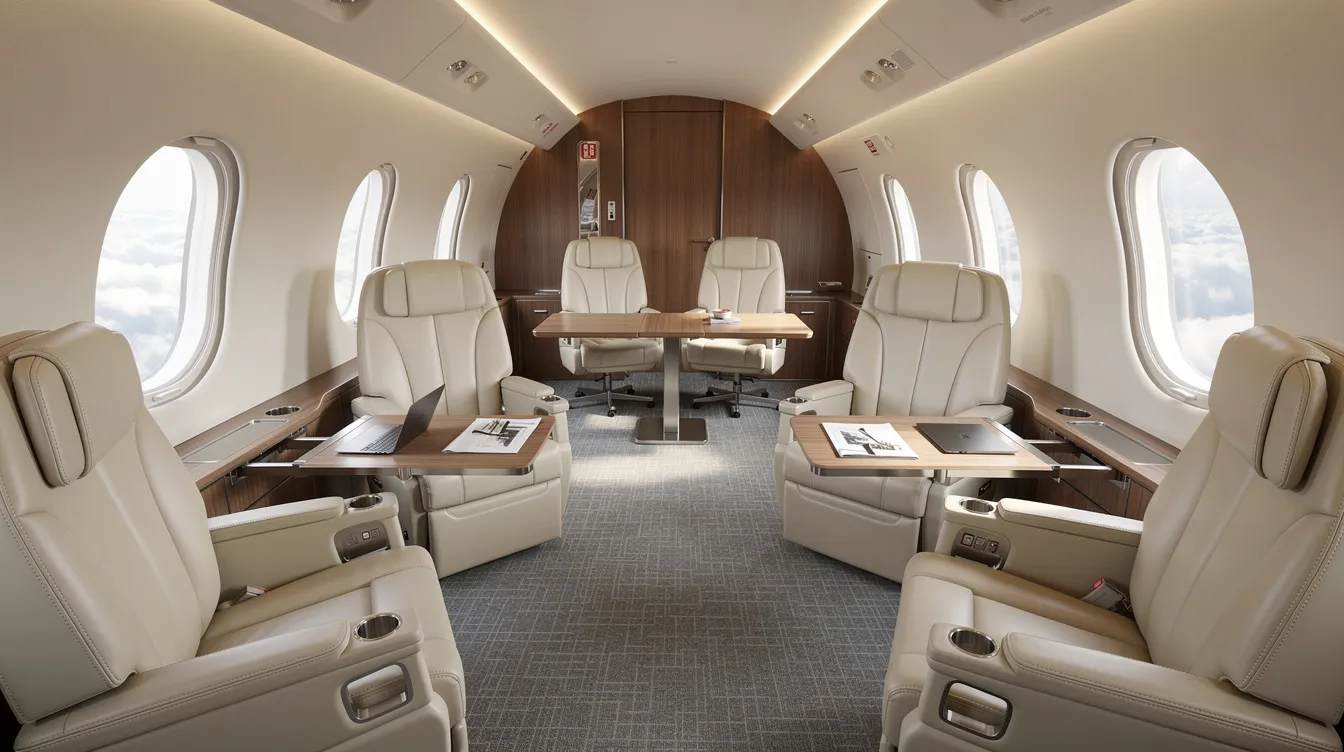
The Bombardier Global 8000 and Global 7500 are direct competitors in the discussion of the longest-range aircraft. The Global 8000 advertises an 8,000 nm range with a top speed of Mach 0.95, making it the fastest civil aircraft since Concorde and approaching supersonic speeds, while maintaining four true living spaces in the large-cabin design.
The in-service Global 7500, available since 2018, delivers a 7,700 nm range and distinctive features, including Smooth Flex Wing technology designed to reduce the impact of turbulence. Both models feature ultra-low cabin altitude (as low as 4,500 feet equivalent at 43,000 feet cruise altitude), which helps reduce jet lag on extended missions.
These aircraft can fly nonstop on routes such as New York–Hong Kong, Los Angeles–Sydney, and London–Singapore under typical conditions. Both are common in top-tier corporate and private fleets, where services like Jettly Eats in-flight catering for private jets help maintain restaurant-quality dining standards on 15-hour missions, and Jettly can often source them for complex, multi-leg global itineraries.
Global 8000 and 7500 cabins feature up to four distinct zones: a dedicated principal suite with a full-size bed, secondary rest areas, crew quarters, and a large galley capable of full-service catering throughout extended flights.
Low cabin altitude, advanced air filtration, and noise reduction technology help passengers arrive more rested. High-bandwidth connectivity via Ka-band or Starlink compatibility enables video conferences and streaming throughout 15+ hour missions.
Jettly typically configures charters on these jets with mixed work, dining, and sleep arrangements tailored to each client’s schedule and passenger needs.

Beyond the absolute leaders, several aircraft in the 6,000–7,500 nm bracket from major private plane manufacturers across multiple categories serve travelers who need extensive global capability without necessarily requiring the plane with the longest range available.
The Gulfstream G650ER delivers 7,500 nm range at Mach 0.925, representing proven ultra-long-range performance with extensive global fleets. The Gulfstream G700 offers approximately 7,750 nm of range and one of the most spacious cabins in private aviation.
Dassault Falcon 10X (projected approximately 7,500 nm) targets the European market with advanced avionics and efficiency. The Falcon 8X at 6,450 nm is notable for steep-approach capability, allowing access to shorter runways like London City Airport—a distinct advantage for passengers prioritizing proximity to urban centers.
These jets support routes like New York–Johannesburg, Paris–Buenos Aires, or Singapore–Zurich with minimal or no stops. Travelers planning missions to emerging business hubs—for example, using private jet charter services in Kolkata, West Bengal, in New Delhi, Delhi, or chartering private jets to Chennai, Tamil Nadu—also benefit from this range of capabilities. Through Jettly, travelers can balance cost and range by selecting slightly shorter-range jets, applying tips for booking the cheapest private jet flights and finding affordable luxury, comparing shared charter flights with full private charters, or even crowdsourcing private jet flights and sharing empty seats when a single technical fuel stop keeps overall travel time acceptable.
Many of these smaller jets are ideal for regional routes, including city pairs such as Mumbai–Hyderabad on dedicated private jet charter services, where range requirements are modest but schedule flexibility is critical.
Not every traveler needs the absolute longest-range aircraft, especially families who may prioritize comfort, safety, and cabin layout, and can benefit from guides to the best private planes for families across trip types. Many missions fall within 2,000–4,000 nm, where super-midsize and midsize jets excel at lower hourly rates, and some buyers instead look at cheaper plane options that keep ownership costs manageable, while others explore broader guides to the best private airplanes and luxury aircraft. [Travelers can approximate these rates](LINK 19) in advance using Jettly’s private jet charter cost estimator or by referencing guides to selecting the best cross-country aircraft for long-distance travel.
Typical range categories include, for example, regional missions around hubs like Lagos served by dedicated private jet charter services:
|
Category |
Range |
Typical Hourly Cost |
|---|---|---|
|
Light jets |
1,200–2,000 nm |
$3,000–$5,000 |
|
Midsize jets |
2,000–3,000 nm |
$4,000–$6,000 |
|
Super-midsize jets |
3,000–4,500 nm |
$5,000–$8,000 |
|
Ultra-long-range jets |
7,000+ nm |
$8,000–$12,000+ |
|
Long-legged, smaller jets like the Embraer Praetor 600 (approximately 4,000 nm), Cessna Citation X+ (approximately 3,400 nm), and Bombardier Challenger 3500 (approximately 3,400 nm) handle routes including New York–Los Angeles, Toronto–Vancouver, and some transatlantic routes with or without quick fuel stops. |
||
|
Jettly’s platform helps users compare whether upgrading to an ultra-long-range jet to avoid a refueling stop offers enough time savings to justify the higher cost. |
Chartering the plane with the longest range isn’t always the optimal choice. A smaller jet requiring one stop might save 30–40% on charter costs while adding only 3–4 hours to total travel time, and travelers can explore additional savings strategies through Jettly’s guide on affordable private jet charter costs.
Smaller jets often use shorter runways and secondary airports, delivering passengers closer to their final destinations with tools like Jettly’s airport locator platform. A family vacation from New York to the Caribbean on a super-midsize jet might prove more practical than booking an ultra-long-range aircraft intended for transpacific routes, and families can reference guides to the best plane options for a family of four when evaluating cabin comfort and baggage needs, while many travelers explore easy ways to get a seat on a private jet or dedicated guides on how to buy a seat on a private jet through shared and semi-private services through shared legs, memberships, or on-demand apps.
Jettly’s instant pricing displays multiple aircraft classes side by side, showing range, estimated flight time, and stop requirements, so travelers can make informed decisions. Complementary guides explain what determines the cost of a single private jet flight, helping travelers interpret those quotes more effectively.
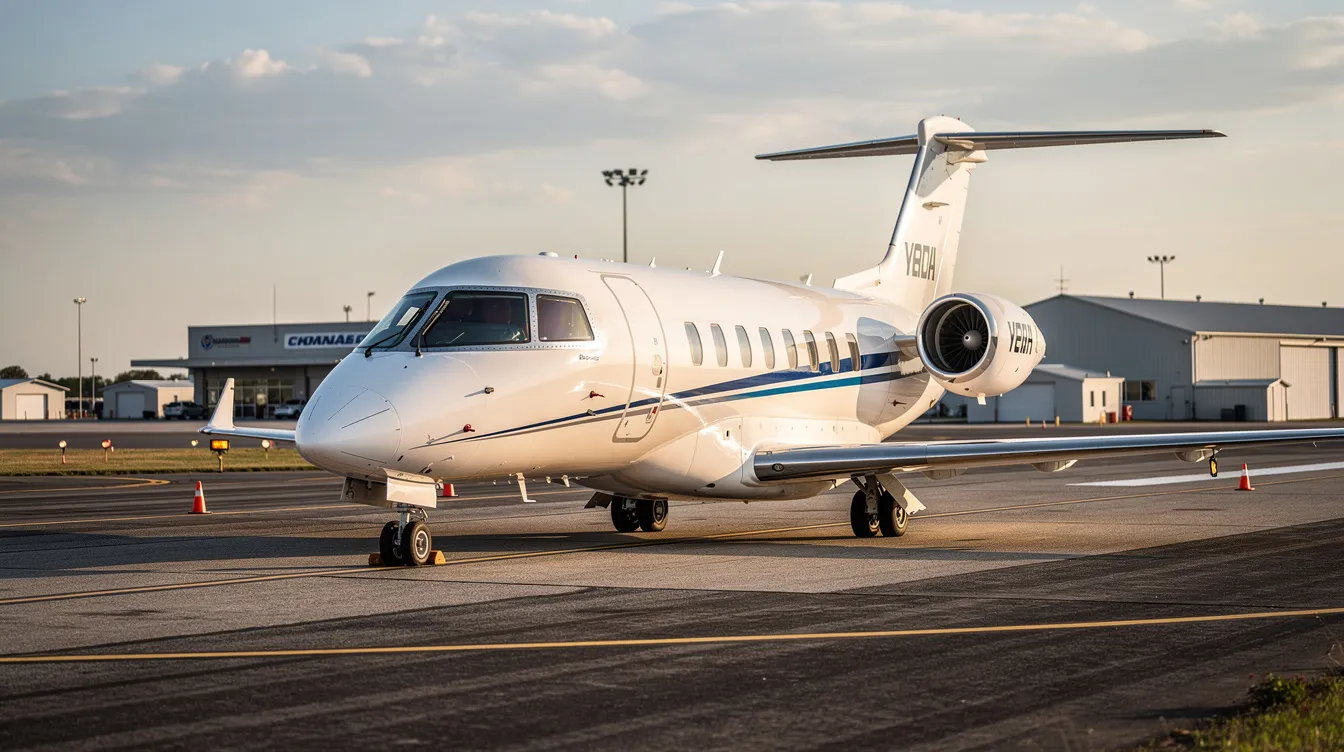
Even for the longest-range aircraft on paper, real flights rarely match brochure numbers exactly. Professional flight planners account for several variables:
|
Factor |
Impact on Range |
|---|---|
|
Winds |
North Atlantic polar routes experience 200+ knot jet streams; Pacific routes have seasonal patterns affecting both distance and fuel consumption |
|
Temperature |
Outside air temperature affects engine efficiency and fuel density |
|
Routing |
Air traffic control corridors can add 50–200 nm to the great-circle distance |
|
Payload |
Each additional passenger, bag, or cargo item reduces available fuel or increases burn rate |
|
Regulatory reserves |
Contingency fuel (typically 5% of trip fuel), alternate airport fuel, and holding fuel are non-negotiable requirements |
|
Professional operators and Jettly’s partners build in safety margins to maintain operational reliability and avoid unplanned diversions, often working under regulated frameworks as Part 135 charter operators focused on safety and compliance. |
Ultra-long-range capability connects to core benefits: time savings, reduced jet lag, privacy, and simplified logistics for multi-continent schedules, whether you fly with a dedicated fractional provider like NetJets, the industry leader in private aviation, or on-demand charter.
Non-stop missions like San Francisco–Bengaluru or London–Buenos Aires avoid border queues, security lines, and overnight layovers inherent in commercial transit. Productivity benefits include confidential meetings, uninterrupted sleep, and reliable connectivity throughout 12–15-hour flights.
Use cases span business scenarios (CEO touring multiple regions, investor roadshows across Asia), family needs (international relocation with pets, multi-generational vacations), and specialized requirements (medical evacuation, disaster response coordination), where some travelers may seek a NetJets alternative with more flexible private jet solutions or want deeper insight into NetJets jet card pricing and cost structures.
Jettly allows on-demand booking of long-range aircraft without jet card or fractional ownership commitments, while also offering structured jet card programs for travelers who prefer predictable hourly rates and priority access; understanding overall jet card costs and pricing structures and broader jet card benefits and how they work helps determine whether this model suits your flying profile. This keeps costs flexible for travelers who need global capability without permanent commitments, and some customers may also book through dedicated operator pages such as Dexter Air Taxi’s private jet services or ZENFLIGHT’s instant-book private jet charter platform.
Jettly operates as a digital private jet charter marketplace with access to over 20,000 private charter aircraft globally, from light jets to ultra-long-range flagships, and is frequently compared among the best private jet charter companies for luxury travel. The platform offers instant pricing and aircraft options tailored to route distance, passenger count, and luggage—not just the absolute longest range.
The typical booking workflow includes:
Enter route and dates
View aircraft with indicated range and estimated stops
Compare cabin layouts and hourly rates
Confirm charter online
Membership and on-demand options emphasize transparent pricing without long-term ownership or fractional contracts, while Jettly’s range of private jet membership plans, comparisons of the best jet card programs available today, and tools like Jettly’s jet card flight cost estimator help frequent flyers understand pricing across different card structures or evaluate XO charter flights, how they work, and potential smarter alternatives. Choosing right-sized, efficient aircraft for each mission also reduces unnecessary fuel burn while maintaining comfort and flexibility.
This FAQ addresses common questions about aircraft range, refueling, and jet selection for private charter travelers.
As of 2026, the Gulfstream G800 has the longest advertised range among business jets at 8,200 nautical miles, narrowly ahead of the Bombardier Global 8000 at 8,000 nautical miles. Actual usable range on any given day depends on payload weight, weather conditions, and required fuel reserves for alternate airports.
Top commercial airliners like the Airbus A350 and Boeing 777-8 have comparable or slightly greater maximum ranges than business jets, often reaching 8,000–8,700 nm. However, private jets offer similar non-stop city pairs with far smaller passenger loads, more flexible routing, departure from regional airports, and confidential operations that airlines cannot match.
Ultra-long-range jets such as the G800, Global 8000, and Global 7500 can typically fly about 14–15 hours non-stop under favorable conditions. This duration covers most intercontinental routes while still landing with the required fuel reserves for contingencies and alternate airport requirements.
Many transatlantic and even some transpacific routes can be flown comfortably on jets with 4,000–6,000 nm range, sometimes with one short fuel stop that adds only 60–90 minutes to total travel time. Choosing a slightly shorter-range aircraft can reduce charter costs by 30–40% while still completing the mission efficiently, and travelers can better understand the overall cost of private jet rentals when evaluating these trade-offs.
Jettly’s system and partner operators consider great-circle distance, typical seasonal winds, passenger and cargo payload, and regulatory fuel reserves when recommending aircraft. Users can request both non-stop and one-stop options to compare time versus price before booking, with detailed route planning available through Jettly’s platform at https://www.jettly.com.
What is the current longest-range private jet available?
As of 2026, the Gulfstream G800 offers the longest range among private jets at 8,200 nautical miles.
How does real-world range differ from advertised maximum range?
Advertised ranges are achieved under ideal conditions; actual operational range accounts for payload, weather, routing, and regulatory fuel reserves, typically resulting in 15–20% lower usable range.
Can private jets fly nonstop between any two cities in the world?
Ultra-long-range jets can connect most major city pairs like New York–Hong Kong or London–Perth, but some routes may require a technical fuel stop depending on conditions and payload.
Do smaller private jets have enough range for international travel?
Many midsize and super-midsize jets can handle transatlantic and some long-haul routes efficiently, but may require one stop for longer intercontinental flights.
What factors most impact a jet’s practical range?
Key factors include payload weight, winds, weather, air traffic routing, cruise speed, and required fuel reserves.
Is it more cost-effective to charter a jet with the maximum range?
Not always—smaller jets with a brief fuel stop can be significantly less expensive and suit many missions without greatly increasing travel time.
How does Jettly help travelers choose the right long-range jet?
Jettly’s platform lets users compare aircraft options by range, passenger capacity, estimated stops, flight time, and pricing to match the best jet to each mission.
The Gulfstream G800 currently leads with 8,200 nm range, closely followed by Bombardier’s Global 8000 and Global 7500, Gulfstream G700/G650ER, and Dassault’s Falcon 10X/8X. These aircraft can connect virtually any two major cities in the world without refueling under typical conditions.
However, maximum range is just one factor. Mission profile, passenger needs, airport access, and budget often determine the best jet for a specific trip. Sometimes, a 5,000 nm aircraft with one brief fuel stop proves more practical than booking the plane with the longest range available.
Jettly enables travelers to translate technical range specs into practical flight options with clear pricing and aircraft details. The platform makes comparing options straightforward, whether the mission requires a G800 for a direct flight between Singapore and New York or a super-midsize jet for a transcontinental hop.
In addition to chartering, some readers may be interested in Jettly’s ULTRA high-ticket affiliate program for private jet referrals, which allows partners to earn commissions by introducing new members and charter clients. Others may want to analyze private jet lease costs and how lease structures work as an alternative path to long-range access.
Ready to explore private travel options for your next global mission? Request a quote or explore flights at https://www.jettly.com.
Gulfstream G800 — Maximum range of 8,200 nautical miles, seats 8–16 passengers, cruises at Mach 0.85–0.90, and is currently in service.
Bombardier Global 8000 — Maximum range of 8,000 nautical miles, seats 8–17, cruises at Mach 0.90–0.95, with deliveries starting in the mid-2020s.
Gulfstream G700 — 7,750 nautical mile range, 13–19 passengers, cruise speed Mach 0.90, in service.
Bombardier Global 7500 — 7,700 nautical mile range, 8–17 passengers, cruises Mach 0.85–0.90, in service since 2018.
Gulfstream G650ER — 7,500 nautical mile range, 11–18 passengers, cruise speed Mach 0.85–0.90, in service.
Dassault Falcon 10X — Estimated 7,500 nautical mile range, 12–16 passengers, cruises Mach 0.85, in development.
Dassault Falcon 8X — 6,450 nautical mile range, 12–14 passengers, cruise Mach 0.80–0.90, in service.
Airbus A350-900ULR (Commercial) — 9,700 nautical mile range, 161–300+ passengers, cruises Mach 0.85, in commercial airline service.
Share this post:
Jay Franco Serevilla
Apr 13, 2026
|
5
min read
Discover tips and trends in the industry.

5
min read
Tiger Woods' Gulfstream G550: How elite athletes manage multicity travel
This article explores Tiger Woods' $53 million Gulfstream G550 and how high-performance private aviation serves as a crucial tool for top athletes. Beyond comfort and luxury, the jet's low cabin altitude pressurization, massive storage for specialized physio equipment, and direct long-range flight capabilities help Woods manage chronic injuries and travel fatigue while navigating a demanding global competition schedule.
Read More
5
min read
Helicopter Flying Time: How Long Your Flight Should Really Be
This guide provides insights into helicopter flying times, helping travelers understand what to expect when booking a flight. Factors such as distance, weather, and aircraft type influence the duration of flights, with typical airborne times ranging from 15 to 60 minutes. Knowing these details allows for better planning and a more enjoyable charter experience.
Read MoreStay updated with our latest insights and tips to elevate your journey with us.
MEMBERSHIPS AND ASSOCIATIONS



Disclaimer: Jettly operates as a charter broker, offering access to a global digital jet charter marketplace. Jettly is not a direct air carrier and does not own or operate aircraft. All advertised flights are conducted by third-party air carriers that are fully licensed and hold the appropriate Part 135 or Part 121 certifications issued by the Federal Aviation Administration (FAA) or equivalent regulatory authorities under U.S. or foreign law. Jettly complies fully with the U.S. Department of Transportation's Part 295 and Part 298 Charter Broker regulations. Jettly does not carry additional liability insurance. Passengers are covered by aircraft operator insurance. TICO: 50023770


