


Login
Get Instant Pricing On 23,000+ Aircraft

>
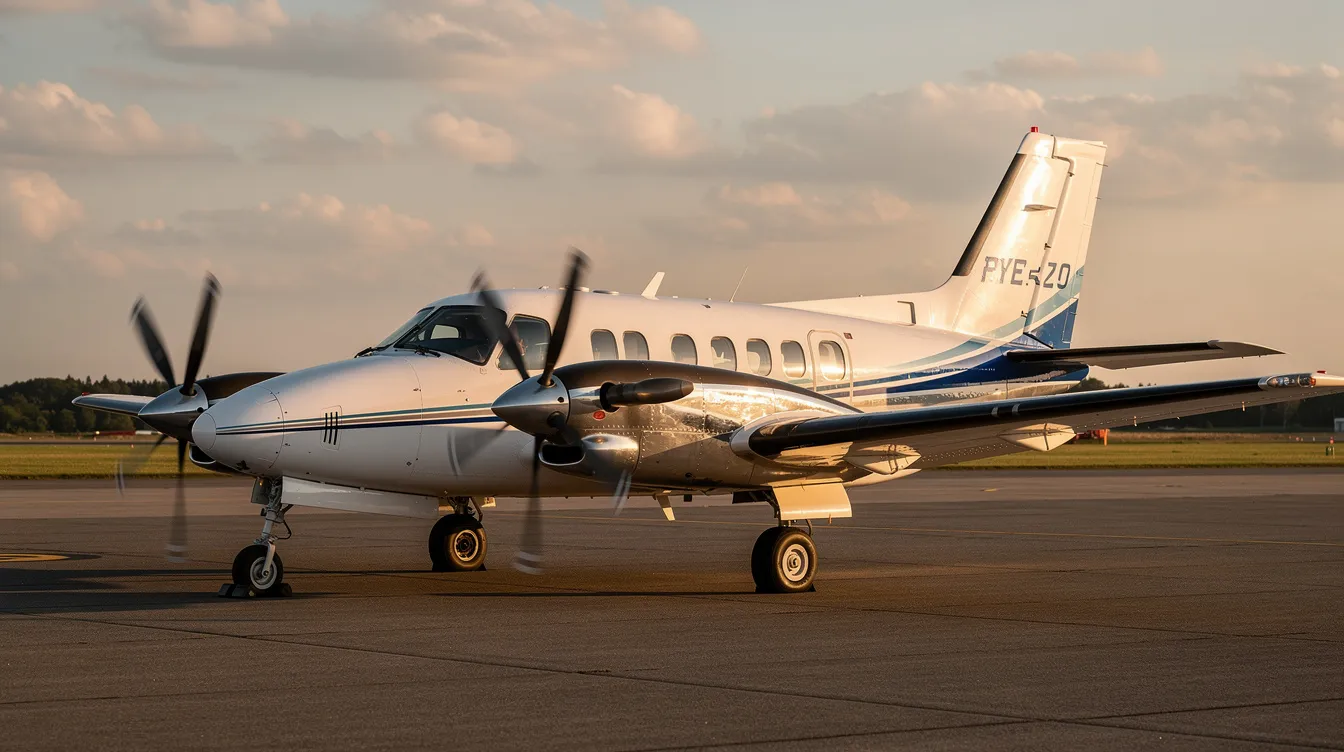
The Piper PA-31 Navajo is a family of cabin-class twin-engine piston aircraft that has served regional aviation for over five decades. Designed for charter, cargo, and utility operations, it remains one of the most recognizable general aviation aircraft in private flying. This guide is intended for private flyers, charter customers, and aviation enthusiasts interested in the Piper PA-31 Navajo family. Understanding the PA-31 Navajo's capabilities and variants helps travelers and operators make informed charter decisions. This guide breaks down each variant, covers real performance numbers, and explains how the PA-31 Navajo fits into modern charter travel through platforms like Jettly.
The Piper PA-31 Navajo family is a cabin-class, twin-engine aircraft series widely used for regional private and charter flights since the late 1960s. The Pa 31 Navajo, Navajo chieftain, and Pa 31p pressurized Navajo are popular options on Jettly for cost-efficient, short-haul private charters carrying 6 to 10 passengers.
Seating capacity typically ranges from 6 to 9 passengers, with variants such as the PA-31-350 Chieftain and PA-31-325 Navajo tailored to different payload and range requirements.
The Navajo family offers strong value: lower hourly rates than light jets, access to shorter runways, and solid performance for business hops, family trips, and remote-area missions. The aircraft consumes approximately 32 to 35 gallons of fuel per hour during cruise, keeping operating costs competitive.
Piper Navajo chieftain prices on the used market range from $119,500 to $375,000 depending on condition and avionics, while a used Piper PA-31-350 costs around $260,000.
Jettly is a digital marketplace where travelers can compare private jet options, see instant pricing, and book on demand without long-term commitments.
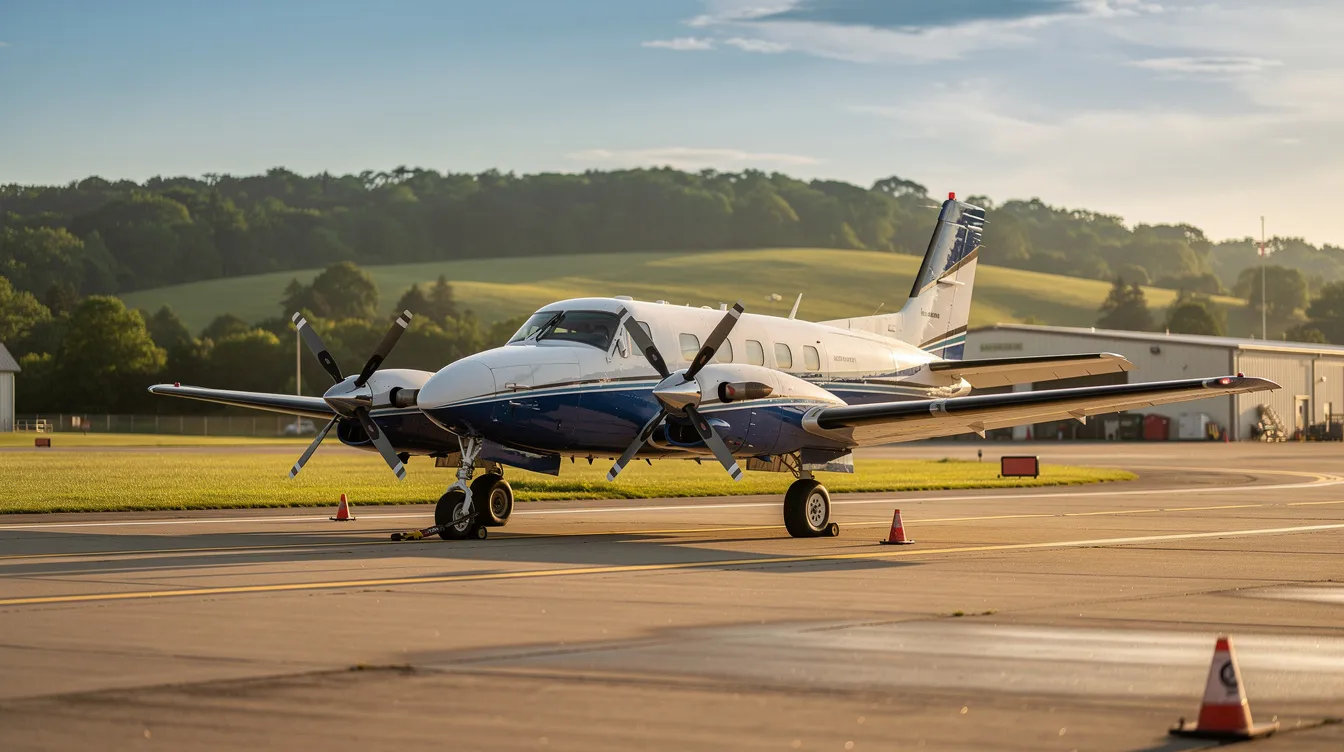
Development of the Piper PA-31 began in 1962 under the internal project name "Inca." Piper aircraft is intended to fill a gap in the market for a spacious cabin twin seating 6 to 8 passengers. The prototype first flew on September 30, 1964; certification came in February 1966, and deliveries started in 1967. The PA 31 series was produced from 1967 to 1984, with nearly 4,000 units built across all variants.
The term "Piper Navajo" or "31 Navajo" typically refers to the baseline PA-31 design. Later Navajo models - including the PA-31-310 Navajo, PA-31-325 Navajo, PA-31-350 Chieftain, pa 31p pressurized Navajo, and PA-31P-350 Mojave - evolved to deliver more powerful engines, greater payload, or pressurized comfort. The PA-31 family evolved into several variants during its production run, each targeting a different mission profile.
These versatile aircraft have served roles including regional air taxi, corporate transport, air ambulance, cargo hauling, and scheduled commuter services. West Coast Airlines, for example, used the Navajo aircraft as the "MiniLiner" in 1967 commuter airline market operations. Most PA-31 variants are piston-powered twins, though some derivatives and conversions use turboprop engines while still sharing the Navajo airframe. Many pa 31 aircraft remain in commercial service decades after production ended, often retrofitted with modern glass cockpit avionics, GPS, and advanced autopilots - keeping them relevant in 2020s charter fleets accessible through platforms like Jettly.
Here is a quick overview of the most common PA-31 types encountered in private and charter operations:
|
Variant |
Approx. Year |
Engine Power (each) |
Seating (excl. crew) |
MTOW |
|---|---|---|---|---|
|
PA-31 Navajo (early, NavaPiper PA-31jo B, Navajo C) |
1967–1970s |
300–310 hp |
6–8 |
~6,500–7,000 lb |
|
Piper PA 31 310 Navajo |
Early 1970s |
310 hp |
6–8 |
~6,500–7,000 lb |
|
pa 31 325 Navajo (piper navajo cr) |
1975 |
325 hp |
6–8 |
~7,000 lb |
|
Piper PA-31 350 / pa 31 350 Chieftain |
1973 |
350 hp |
Up to 9–10 |
7,000 lb |
|
Pa 31p pressurized Navajo |
1970 |
~425 hp |
6–8 |
~7,800 lb |
|
pa 31p 350 Mojave |
1983–84 |
~350 hp |
5–7 |
~7,200 lb |
PA-31 Navajo (early, B, C): Baseline model, 300–310 hp engines, 6–8 seats.
PA-31-310 Navajo: 310 hp engines, turbocharged, 6–8 seats.
PA-31-325 Navajo / Piper Navajo CR: 325 hp engines, counter-rotating propellers for improved handling and safety, 6–8 seats.
PA-31-350 Chieftain: 350 hp engines, stretched fuselage for more seating (up to 9–10), counter-rotating propellers for better handling.
PA-31P Pressurized Navajo: Pressurized, ~425 hp engines, higher service ceiling, 6–8 seats.
PA-31P-350 Mojave: Combines Navajo and Cheyenne features, ~350 hp engines, 5–7 seats, higher fuel capacity.
Each step up in designation reflects a clear change: more power for better climb and hot-and-high performance, a stretched fuselage for extra seats, or pressurization for comfort at higher cruise altitudes. In charter contexts on Jettly, travelers most often encounter the PA-31-310, PA-31-325, and PA-31-350 Navajo Chieftain due to their balance of seating capacity, operating cost, and runway performance.
The original PA-31 Navajo models (including B and C variants) feature 300–310 hp engines and typically seat 6–8 passengers. These early models established the PA-31's reputation for reliability and versatility.
The PA-31-310 Navajo is one of the most recognizable variants in the aviation industry - a reliable workhorse powered by two engines producing 310 hp each. The Navajo operates with two Lycoming TIO-540 six-cylinder piston engines, delivering turbocharged performance for regional missions. The original Navajo in this configuration typically seats a pilot plus 6 to 8 passengers.
Key performance figures for the PA-31-310:
Cruise speed: approximately 190–200 knots (impressive speed for a piston twin)
Range: roughly 800–1,000 nautical miles depending on weight and fuel capacity
MTOW: the PA-31-300 has a maximum takeoff weight of 6,500 lbs, while the 310 hp variant sits in the 6,500–7,000 lb bracket
Stall speed: around 63.5 knots
Service ceiling: approximately 18,000–20,000 ft
Rate of climb: 1,445 ft/min
The cabin features an aisle, club seating for four, additional forward-facing seats, and baggage compartments in the nose and rear part of the fuselage, plus storage lockers in engine nacelles. This gives it a "mini-airliner" feel compared to smaller prop planes. The PA-31 Navajo features a large cabin accommodating 6 to 10 passengers. The PA-31 Navajo features a robust chassis allowing operation from unprepared surfaces, a conventional tail, and two-bladed propellers on most baseline models. Pilots appreciate its straightforward handling, and private individuals chartering one through Jettly can expect a comfortable ride, flexible luggage capacity, and competitive hourly rates versus light jets.
Equipped with 325 hp engines and counter-rotating propellers (the "CR" designation), this variant offered improved handling and safety with similar cabin volume - typically seating 6–8 passengers. Counter-rotating engine variants improve control during an engine failure. It featured air conditioning as standard in later builds and served both commercial and corporate transport roles.
The Navajo chieftain - formally the pa 31 350 chieftain - is the stretched, more powerful evolution of the original Navajo. The Navajo Chieftain variant has a stretched fuselage, allowing for more seating. Many used-market examples also feature the Colemill Panther conversion, a notable STC upgrade. The PA-31-350 Chieftain was introduced in 1972, with deliveries beginning in 1973. The PA-31-350 was introduced in 1973 and produced until 1984. It features 350 hp engines and counter-rotating propellers, eliminating the critical-engine handling concern found in other Navajo models with a standard split pair of same-rotation props, while still sitting at the smaller end of the broader private charter aircraft spectrum. The PA-31-350 features counter-rotating propellers for better handling.
The Chieftain's longer fuselage and larger doors - including an optional separate door and sometimes a third door for cargo - allow layouts accommodating up to 10 passengers. The PA-31-350 Chieftain can accommodate up to 10 passengers in commuter aircraft configurations. The Chieftain has a maximum takeoff weight of 7,000 lbs.
Performance highlights:
Cruise speed of the PA-31-350 is 207 knots (238 mph)
Typical range: 700–900 nautical miles
Service ceiling: approximately 24,000 ft
Counter-rotating engine variants improve control during an engine failure, making the Chieftain safer and easier for pilots to manage in asymmetric thrust situations. The Navajo Chieftain variant has a stretched fuselage allowing for more seating, and the aircraft is often referred to as a "truck with wings" due to its heavy payload capacity. The Panther conversion is also widely recognized as a Chieftain upgrade. For Jettly users, this variant is ideal for groups needing more seats than a standard Piper Navajo but still looking for a cost-effective piston twin rather than upgrading to a turboprop or light jet, and a Colemill Panther is often valued for improved performance and upgraded capability.
The PA-31P Pressurized Navajo was certified in late 1969. This pressurized aircraft adds turbocharged engines producing approximately 425 hp each, a longer nose, fewer and smaller windows (with two cabin windows per side in some configurations versus the standard count), and a reinforced fuselage. It was designed for higher cruising altitudes - the service ceiling reaches approximately 24,000 ft - providing smoother flying above weather. The smaller windows reflect the structural demands of pressurization.
The PA-31P-350 Mojave was produced from 1983 to 1984 in small numbers (fewer than 100 units). It combined features from the Navajo and the Piper Cheyenne line, with more powerful engines, higher fuel capacity, and approximately 7,200 lb MTOW. It seats 5–7 passengers and targets owner-pilots and small corporate flight departments.
Some PA-31s were manufactured under license in Argentina (Chincul), Colombia (AICSA), and Brazil (Embraer's EMB 820C Navajo). Many of these aircraft still circulate in global charter and regional roles for small feeder airlines, potentially appearing in Jettly's worldwide inventory.
The typical PA-31 cabin offers aisle access, club seating for four, additional forward or aft seats, and a separate luggage area. The PA-31 Navajo features a large cabin accommodating 6 to 10 passengers, depending on variant and layout. There is enough space to sit upright comfortably, work on a laptop, or stow small bags within reach. Cabin windows are placed at each row, providing good natural light.
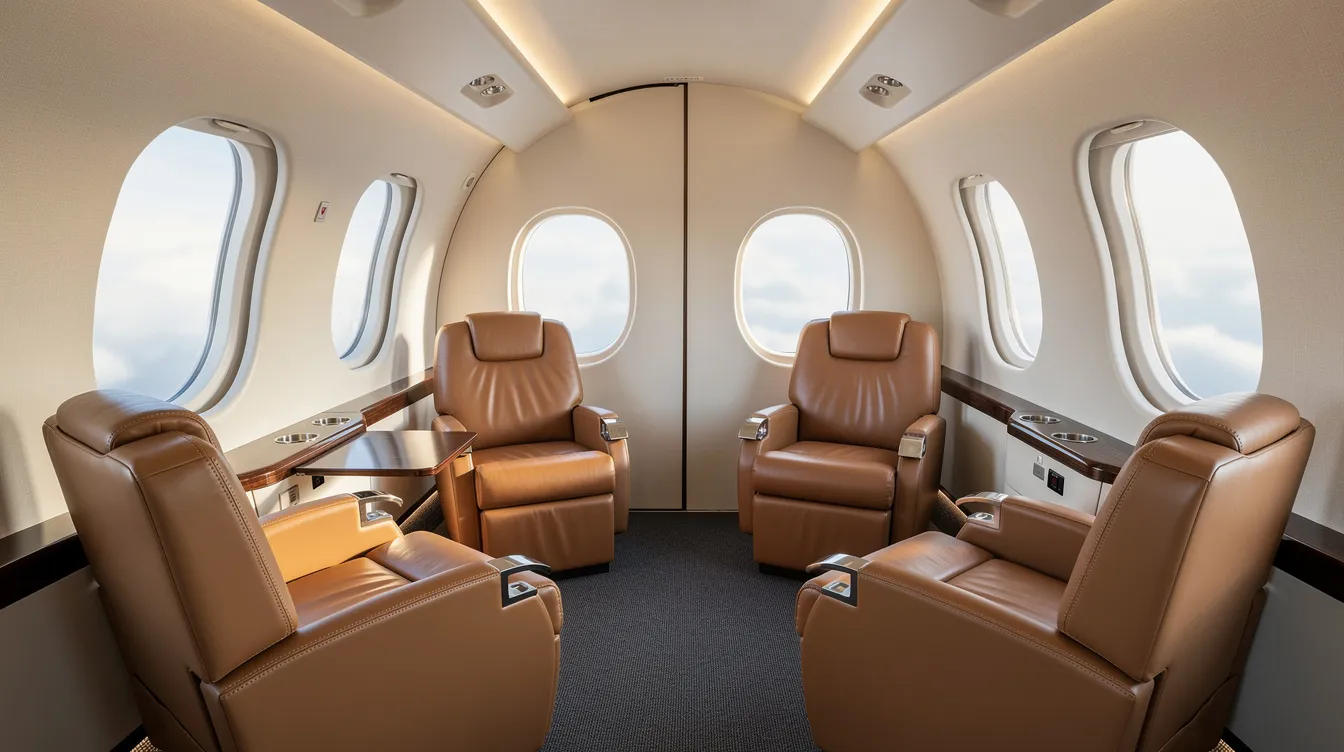
Navajo aircraft are used for cargo transport because of their substantial baggage capacity. Luggage goes into nose compartments, aft fuselage areas, and storage lockers in the engine nacelles. The spacious cabin and generous baggage capacity make the PA-31 practical for family trips with gear or business travelers with equipment, especially on flights that also take advantage of dedicated in-flight catering for private jets when available.
Modern refurbished PA-31 charters often include upgraded leather interiors, USB power ports, headset audio, basic refreshments, and improved soundproofing. Noise levels are typical of piston twins but noticeably reduced in well-maintained cabins. Actual interior specifications vary by operator, so Jettly users should review aircraft photos and seating diagrams for each listed option.
Across the Navajo family, performance is optimized for regional travel rather than long-haul missions - ideal for flights of 300–600 nautical miles with comfortable reserves and access to a wide range of smaller fields that can be identified using an airport locator tool.
|
Metric |
Baseline Navajo |
Chieftain |
Pressurized Navajo |
|---|---|---|---|
|
Cruise speed |
180–200 kts |
200–215 kts |
Similar at altitude |
|
Range |
600–800 NM |
700–900 NM |
Comparable |
|
Service ceiling |
18,000–20,000 ft |
~24,000 ft |
~24,000 ft |
|
Runway needed |
~2,500–3,000 ft |
Slightly longer |
~2,500–3,000 ft |
The Navajo is known for its strong short-field capability. Piper PA-31 Navajo aircraft can operate from unpaved and grass surfaces, giving charter customers access to islands, mining outposts, remote lodges, and smaller airports that jets simply cannot reach. These capabilities translate to closer airport options and reduced ground transfer time, which also influences results in any private jet charter cost estimator that factors in airport selection and stage length.
All operational planning is managed by licensed charter operators, but Jettly's platform helps users filter aircraft and airports to match route distance and runway requirements.
Many customers compare the PA-31 to turboprops like the King Air and light jets when choosing a charter for 4–9 passengers on short routes. The aircraft consumes approximately 32 to 35 gallons of fuel per hour during cruise, keeping fuel costs well below jet-powered alternatives. The PA-31 series is popular with air charter companies precisely because of this cost advantage, and travelers researching ways to keep private jet charter prices affordable will often find piston twins like the Navajo among the most economical options.
Charter rates depend on journey length and airports, but PA-31 piston twins consistently offer lower hourly rates than comparable turboprops and jets. For travelers looking for affordable private flights, the Navajo family delivers a cabin-class experience without jet-level pricing. Empty leg flights on PA-31 routes can reduce costs even further, especially when combined with platforms that allow you to crowdsource private jet flights and share empty seats.
Situations where the PA-31 makes strong sense:
Same-day business trips between secondary cities
Families travel to vacation properties with shorter runways
Group transfers to events or remote locations
Flights where flexibility and access matter more than speed
Jets offer higher speed and altitude but at significantly higher hourly cost and with longer runway needs. The PA-31 trades some speed for access and affordability - a practical trade-off for many regional missions, and an important consideration for anyone evaluating how much a private jet costs overall.
Jettly connects travelers to thousands of aircraft worldwide, including multiple Piper Navajo, Navajo Chieftain, and pressurized Navajo options. The aircraft is used by regional commuter airlines and air ambulance services, so availability across diverse regions is broad.
The booking flow is straightforward: enter origin, destination, and date. Jettly displays available aircraft - including PA-31 models - with instant quotes, estimated flight time, and aircraft specs. Users can filter by aircraft category or model, so anyone who specifically wants a PA-31-350 Chieftain or a pressurized PA-31P variant can prioritize those listings. Travelers who fly regularly may also benefit from Jettly's private jet memberships, which can streamline booking and access. Learn more about how to book a private jet through the platform.
Jettly's approach means no jet cards, no fractional ownership, and clear pricing. Compare multiple aircraft types for the same itinerary and choose based on speed, comfort, and cost, positioning the service as a flexible NetJets alternative for flying private without long-term commitments.
Ready to explore PA-31 Navajo charter options? Compare aircraft, get instant pricing, and request a quote at https://www.jettly.com, or dive deeper into the wider landscape of charter airlines and private flight options to see how the Navajo fits among them.
These questions address common concerns from prospective charter customers considering a PA-31 through Jettly. For travelers who also use prepaid jet solutions, a dedicated jet card flight cost estimator can help compare those options with on-demand Navajo charters.
The PA-31 series has a long operational history with nearly 4,000 aircraft built and extensive commercial use since the late 1960s. Safety in charter flying depends on maintenance quality, pilot training, and regulatory oversight. Jettly works with licensed operators who comply with national aviation authority regulations such as the FAA Part 135 in the United States, whether the trip is arranged directly or through branded operators like Dexter Air Taxi's private jet service. Many in-service PA-31 aircraft have been retrofitted with modern avionics, GPS navigation, terrain awareness systems, and updated safety equipment. Travelers should review operator information shown on the Jettly platform when selecting a flight.
Most PA-31 Navajo and Chieftain aircraft can handle several standard suitcases plus hand luggage for 6–8 passengers, though limits tighten on shorter runways or in hot-weather operations. Luggage is stored in the nose and aft baggage compartments, plus engine nacelle storage lockers. Oversized items should be discussed in advance. Jettly users should share approximate luggage weight and dimensions when requesting a quote so operators can confirm feasibility. Travelers comparing Navajo charters with large fractional providers may also find it helpful to review resources that explain NetJets and its private aviation model.
Most chartered PA-31 aircraft are equipped and certified for instrument flight rules (IFR), enabling operations in cloud and reduced visibility within regulatory limits. Night operations are common for professionally operated PA-31 flights. Severe weather such as strong thunderstorms or heavy icing is avoided or routed around, with safety always the priority. Customers can discuss departure flexibility and weather conditions with their operator through Jettly or, if they fly frequently, compare these trips with the benefits offered by structured jet card programs.
Turboprops such as the Beechcraft King Air generally offer higher cruise speeds, higher cruising altitudes, and smoother performance - but at higher charter rates. The PA-31 family has slightly lower cabin volume and range than many King Air models but remains competitive for short regional segments with 4–8 passengers. For price-sensitive journeys under roughly 500–600 nautical miles, a PA-31 Navajo or Navajo Chieftain can be a very cost-effective alternative. Jettly's platform allows side-by-side comparison so travelers can choose based on their priorities, similar to broader guides that highlight the best private jet charter companies and options.
Yes. The PA-31P Pressurized Navajo and pa 31p 350 Mojave are pressurized variants designed for higher-altitude cruising with improved comfort. These aircraft may be less common in charter fleets than standard Navajo and Chieftain models, but can appear in Jettly's inventory depending on the region. Customers seeking a pressurized piston twin should indicate this preference when searching on Jettly. If a pressurized PA-31 is unavailable on a given route, the platform may display comparable turboprop or light-jet alternatives offering similar high-altitude comfort.
The Piper PA-31 Navajo family continues to be a reliable and cost-effective choice for regional private and charter flights. Its variety of models—from the versatile PA-31-310 Navajo to the stretched PA-31-350 Chieftain and the pressurized PA-31P variants—offers options tailored to different passenger capacities, performance needs, and mission profiles. With its strong short-field capability, competitive operating costs, and flexible cabin layouts, the PA-31 remains relevant for business trips, family travel, and remote destinations.
For travelers seeking affordable, convenient private flights with transparent pricing and instant booking, Jettly provides access to a broad selection of Piper Navajo aircraft and other charter options worldwide. Explore current listings, compare aircraft, and request quotes easily at https://jettly.com/ to experience private aviation on your terms.
Share this post:
Jay Franco Serevilla
Jul 3, 2026
|
5
min read
Discover tips and trends in the industry.
5
min read
Arrow Jets: How Jettly Makes Private Jet Travel Simple, Fast, and Transparent
Jettly revolutionizes private jet travel by offering a digital platform that simplifies the booking process for over 20,000 aircraft worldwide. With instant pricing and transparent cost breakdowns, travelers can easily access fast, direct flights tailored to their needs. This on-demand model eliminates the complexities of traditional jet ownership, making private aviation more accessible and efficient.
Read More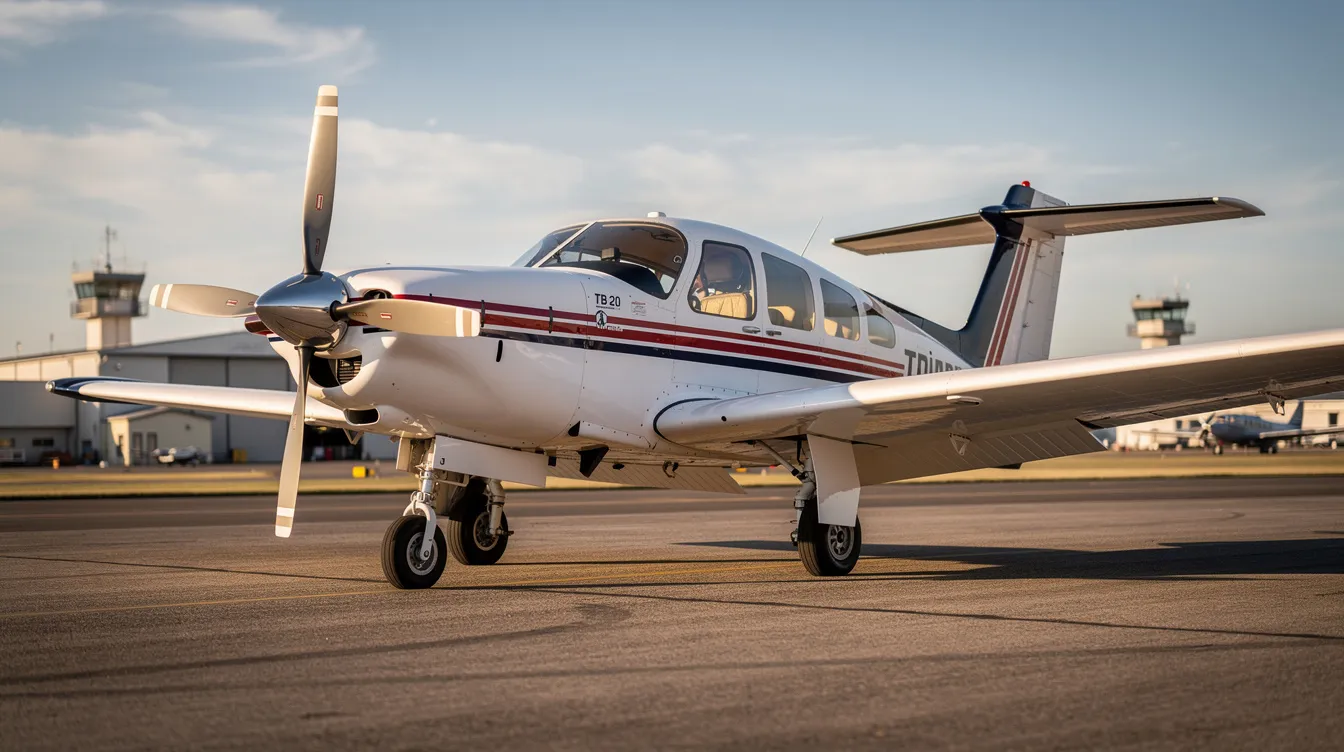
5
min read
Socata TB Series Guide: TB 20 Trinidad and Related Models
The Socata TB series, particularly the TB 20 Trinidad, is a renowned family of French single-engine aircraft designed for touring and training. With its spacious cabin and retractable landing gear, the TB 20 is favored by private pilots and flight schools for its performance and comfort. This guide explores the TB series' features, variants, and its relevance in modern private aviation.
Read MoreStay updated with our latest insights and tips to elevate your journey with us.
MEMBERSHIPS AND ASSOCIATIONS



Disclaimer: Jettly operates as a charter broker, offering access to a global digital jet charter marketplace. Jettly is not a direct air carrier and does not own or operate aircraft. All advertised flights are conducted by third-party air carriers that are fully licensed and hold the appropriate Part 135 or Part 121 certifications issued by the Federal Aviation Administration (FAA) or equivalent regulatory authorities under U.S. or foreign law. Jettly complies fully with the U.S. Department of Transportation's Part 295 and Part 298 Charter Broker regulations. Jettly does not carry additional liability insurance. Passengers are covered by aircraft operator insurance. TICO: 50023770


