


Login
Get Instant Pricing On 23,000+ Aircraft

>
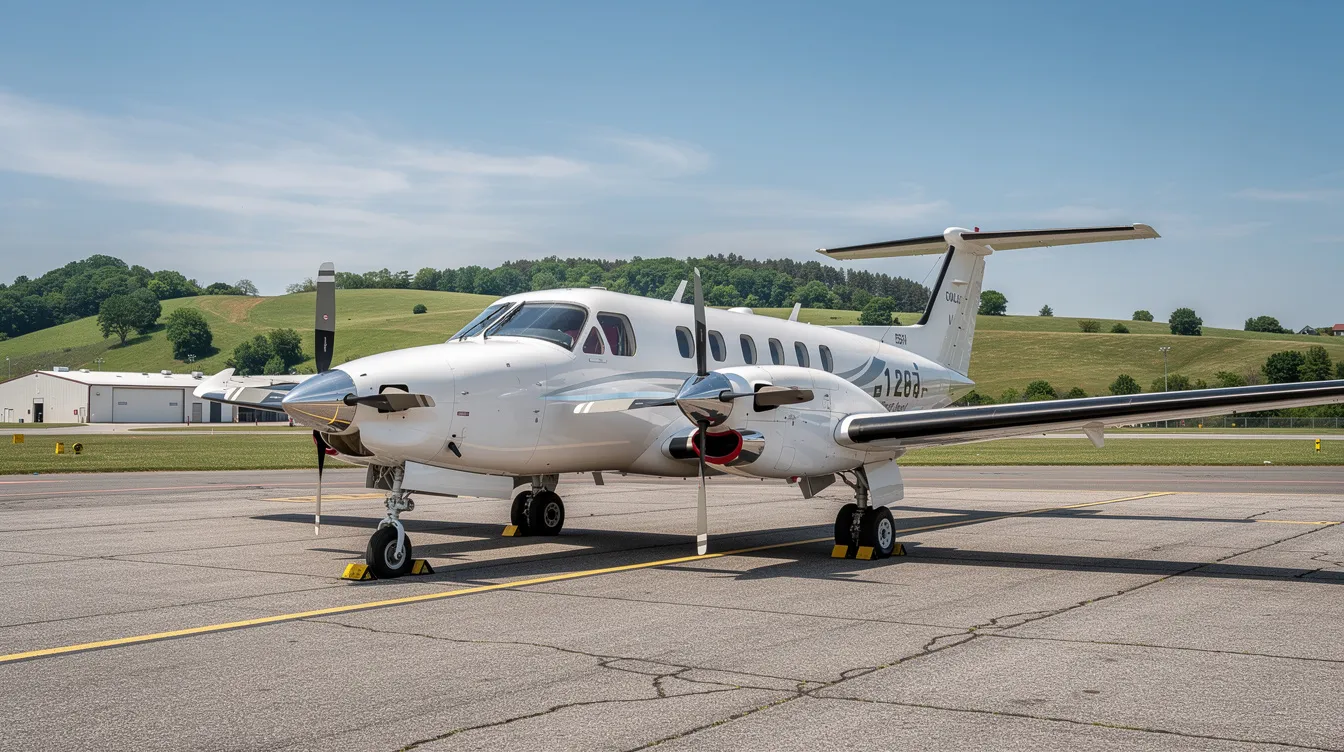
The Piper Meridian is one of the most practical single-engine turboprop options in private aviation, especially for private charter travelers seeking a cost-effective, efficient, and flexible solution for regional private flights. This guide is designed for private charter travelers considering the Piper Meridian for their next trip. It covers the aircraft's features, performance, and suitability for charter, highlighting why it is a popular and cost-effective choice for regional private aviation. Whether you are planning a business meeting or a weekend getaway, understanding the Piper Meridian’s capabilities will help you make an informed decision for your next charter flight.
Performance: The Meridian delivers a maximum cruise speed of 267 knots, a range of approximately 1,000 nm, a service ceiling of 30,000 ft, and an average fuel burn of roughly 30–40 gph, depending on power setting and cruise configuration.
Cabin: The cabin can seat up to six people, with club-style seating and a quiet pressurized cabin suited for business and family flights of two to three hours.
Avionics: Many Piper Meridian aircraft now feature Garmin G1000 or Garmin G1000 NXi upgrades, improving safety and situational awareness in charter operations. Weather radar, synthetic vision, and traffic alerts come standard on upgraded models.
Jettly access: The platform offers on-demand access to Piper Meridian and comparable private charter aircraft, transparent pricing, and instant quotes for regional routes.
The Piper Meridian is a single-engine turboprop aircraft. The Piper Meridian (PA-46-500TP) is the turboprop evolution of the PA-46 line. Piper Aircraft launched it in 2000 as the company's first factory-built single-engine turboprop, powered by a Pratt & Whitney PT6A-42A turbine engine rated at 500 horsepower. With a fleet size of 532 aircraft still active worldwide, the turboprop Meridian remains a fixture in both owner-flown and charter operations.
The Meridian sits within the broader PA-46 family, which includes the piston engine Malibu, the Mirage, and later M-class variants such as the M350, M500, M600, and M700. Among these, the Meridian occupies a sweet spot—more speed and reliability than the piston models, with lower operating costs than the larger turboprops.
Performance snapshot: max cruise around 267 knots, practical charter range of 600–900 nm, and operations typically between FL250 and FL300 at flight levels that keep passengers above most weather.
The Meridian is attractive for private charter because of relatively low direct operating costs, solid speed for a turboprop, and the efficiency of a single-engine design. It is commonly regarded as a good alternative to piston aircraft and is known for its combination of speed, comfort, and reliability.
As of Q2 2024, Piper Meridian's list price is $2,200,000, positioning it as an accessible entry point into turboprop ownership and charter availability. Travelers comparing purchase versus charter can reference a guide to affordable aeroplane rental costs and options. It is part of the Piper M-Class series and offers a blend of luxury, performance, and efficiency.
Piper introduced the turboprop-powered Malibu Meridian in the late 1990s development phase. The aircraft was certified in September 2000, with the first deliveries reaching customers for the 2001 model year. Production took place at Piper's facility in Vero Beach, Florida.
The transition from the piston-powered PA-46-350P Mirage to the PT6A-42A-powered Meridian reflected the broader rocket engineering challenge of adapting turbine power to an existing airframe, before Piper added a new wing with a strengthened wing spar, enlarged tail surfaces for improved stall characteristics, and a higher gross weight rating to handle the additional power. The wing span remained around 43 feet but was optimized for better aerodynamic load distribution. The retractable landing gear was reinforced to support the increased maximum takeoff weight of 5,092 pounds.
Early meridians used Meggitt Magic or Avidyne glass cockpit panels. Around 2009, Piper shifted to the Garmin G1000, and later production aircraft received the G1000 NXi as the M500 designation was introduced. This avionics evolution directly affects charter desirability—operators and aircraft owners prefer upgraded panels for reliability and pilot workload reduction.
Roughly 500+ units were built across the Meridian production run from the early 2000s through mid-2010s. The M500 was introduced as an upgrade to the Meridian in 2015, carrying the same airframe and Pratt Whitney PT6A engine family but with improved avionics and interior.
The Meridian connects to later Piper single-engine turboprops. The M600 features a new wing and increased fuel capacity. It received FAA certification on June 18, 2016, and Piper delivered 50 M600 aircraft between June 2016 and March 2018. Typical base pricing for a mid-year M500 is $2,325,000, while the M600's mid-year pricing is around $3,029,000. The M700 Fury was unveiled in 2024 as the latest model, featuring Garmin G3000 avionics and HALO autoland capability. The Meridian is favored by pilots upgrading from piston aircraft who want turbine engine reliability without jumping to a multi-engine airplane.
The PA-46 uses a low-wing, pressurized fuselage layout with a single pilot up front and a separate passenger cabin accessed via an aft airstair-style door on the left side. The aircraft features adjustable leather seats arranged in club and forward-facing configurations.
The cabin volume is approximately 106 cubic feet, with dimensions of roughly 3 ft 10 in height, 4 ft 2 in width, and about 12 ft 3 in usable length. For three to four passengers on legs of one to three hours, the space is comfortable and functional. The cabin can seat up to six people, including the pilot.
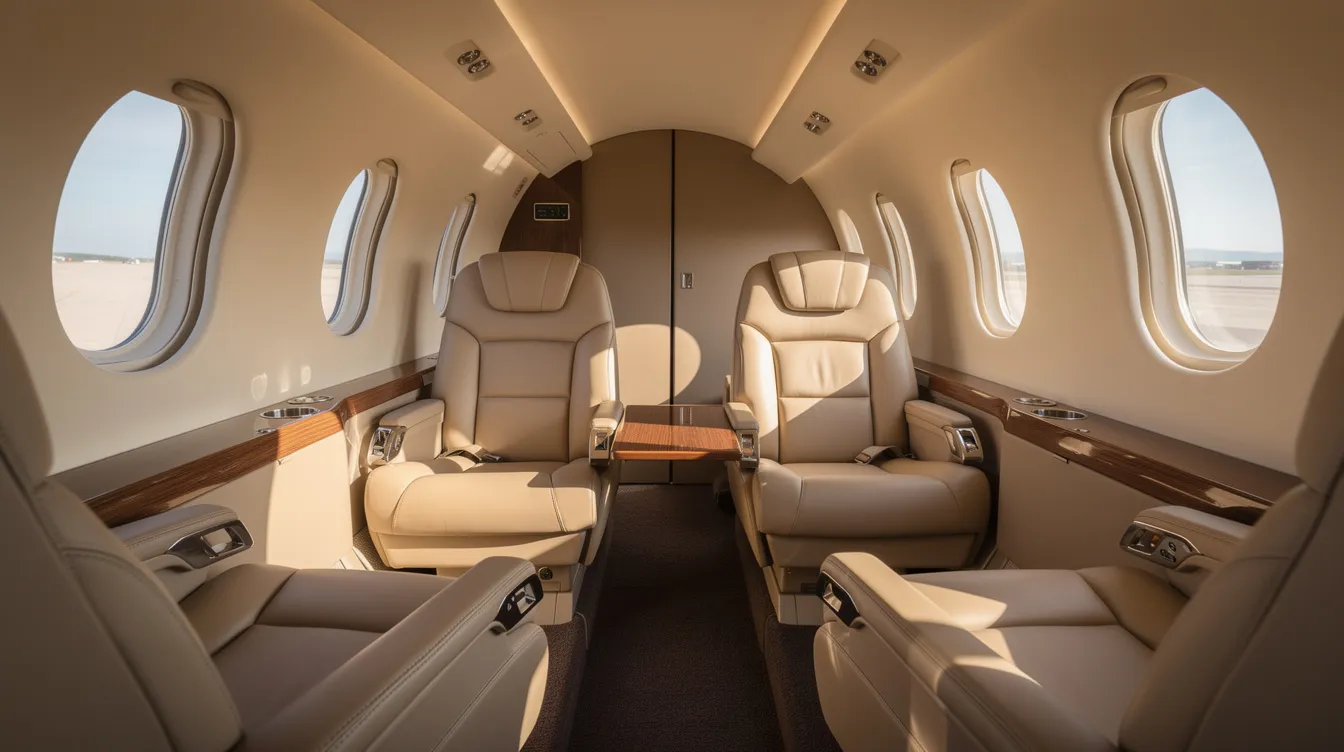
Later Meridians and M500s typically come equipped with leather seating, fold-out tables, lighting controls, USB charging ports, climate control, and large windows for natural light. The aircraft is designed for comfort with adjustable leather seats that can be repositioned for different mission needs.
The aircraft has a fully pressurized cabin, and its design prioritizes comfort at high altitudes. Pressurization benefits charter customers directly: smoother ride above weather, reduced fatigue, quieter cabin compared to non-pressurized turboprops, and the ability to cruise at 25,000–30,000 ft. This keeps passengers fresh on arrival.
Baggage space includes a rear compartment with capacity for roughly 200–300 lbs, depending on passenger count and fuel load. There is no forward baggage bay on most Meridian configurations. Charter operators typically allow a carry-on plus one small checked bag per person for groups of three to five travelers, with exact limits confirmed at booking.
Avionics configurations vary by production year, but many Meridians flying charter today are equipped with modern Garmin suites. The aircraft is equipped with advanced avionics systems, with most post-2009 airframes featuring either a Garmin G1000 glass cockpit or the newer G1000 NXi.
Key features relevant to charter passengers include synthetic vision, integrated GPS, traffic and terrain awareness, weather radar overlays, digital autopilot, and comprehensive engine monitoring. These systems support safer single-pilot operations and reduce workload during instrument flying conditions.
Some older aircraft may still carry Meggitt Magic or Avidyne Entegra panels. Charter operators generally favor aircraft that have been upgraded to Garmin glass for better system reliability, modern support networks, and enhanced situational awareness.
The PA-46-500TP includes envelope protection features and emergency descent modes that protect passengers in abnormal situations. The Pratt Whitney PT6A 42A engine carries a strong reliability record across the global fleet, which mitigates the single-engine concern. The aircraft also features de-icing capabilities for all-weather operation, expanding the range of conditions in which it can safely fly.
The aircraft is suited for single-pilot operations, and Jettly works exclusively with licensed, insured air carriers operating under FAA Part 135 or equivalent regulatory frameworks. Pilot experience standards, maintenance tracking, and avionics configuration all factor into the operators available through the platform.
The Meridian delivers a maximum cruise speed of 267 knots true airspeed, a service ceiling of 30,000 ft, and a range of approximately 1,000 nm with standard reserves. These figures position it among the most efficient operations in the single-engine turboprop class.
Takeoff and landing: The aircraft has a takeoff distance of approximately 1,650 feet and a landing distance of about 1,020 feet. For charter planning with safety margins, operators typically work with runways of 3,000–4,000 ft, but the Meridian's short-field capability opens access to smaller regional airports and even dirt strips—the aircraft is approved for operation on dirt strips. This gives passengers access to airfields closer to their final destination.
Climb and cruise: Initial climb rates run in the 1,200–1,500 fpm range at the maximum takeoff weight of 5,092 lbs, settling near 1,000 fpm by FL180. Real-world charter cruise altitudes typically sit between FL250 and FL270 for legs of 400–800 nm. The aircraft can climb to a maximum altitude of 30,000 feet, reaching high altitudes where the air is smoother and more speed is available.
Fuel burn: Fuel consumption averages 270 pounds per hour, which translates to roughly 37–40 gph at high-speed cruise versus approximately 30–32 gph in long-range cruise settings. The aircraft's fuel capacity supports missions up to 1,000 nm with reserves, though full fuel payload is limited to around 330 lbs, requiring trade-offs between passengers, luggage, and fuel load on longer legs. The useful load calculation is critical for every mission.
Mission examples: A 600 nm business trip—say Chicago to New York, Dallas to Denver, or Los Angeles to Boise—with three to four passengers takes about 2.5–3 hours at cruise speeds of 260–265 knots. Reserves remain comfortable within standard charter safety margins.

The Piper Meridian fills a niche between high-performance piston aircraft and larger turboprops or light jets. It delivers turbine reliability with a lower hour cost and acquisition price than multi-engine jets, making it a strong value proposition for efficient operations on regional routes.
Direct operating cost per hour is typically lower than that of comparable light jets. Savings come from single-engine fuel burn, simpler maintenance, and fewer parts. Travelers can use Jettly's private jet charter cost estimator to see how this translates into real-world pricing. Annual operating costs are approximately $495,264 based on 300 hours, covering fixed and variable expenses, including fuel, insurance, hangar, and maintenance reserves.
On the pre-owned market, early-2000s Meridians trade in the high six to low seven figures depending on avionics, engine time, and upgrades. The initial acquisition cost of a Meridian can be high, but it remains significantly below new turboprops and light jets; understanding one private flight cost and pricing factors helps buyers compare ownership versus charter.
Compared to other single-engine turboprops like the SOCATA TBM series or Pilatus PC-12, the Meridian usually has a smaller cabin and slightly higher fuel burn per knot of speed, but often comes at a lower charter price point. For price-sensitive travelers, Jettly offers affordable private jet charter guidance to identify the best-value option. It offers lower operating costs compared to larger turboprops while still delivering the system reliability of the PT6A engine family.
Operators and private owners choose the Meridian for its balance of fuel efficiency, turbine reliability, the capability to operate into smaller airports, and the proven airframe design. The airplane remains competitive in the charter fleet even as newer models push performance boundaries.
Jettly customers most often consider the Meridian for short to medium regional missions where efficiency and access to smaller airfields matter more than stand-up cabins or ultra-high speed.
Business travel: Executives commuting between regional hubs—Chicago to Cleveland, Houston to Nashville, or similar city pairs—benefit from day trips with morning outbound and evening return. The Meridian reaches secondary airports closer to client sites, cutting ground transport time, and fits neatly within the broader charter airlines and private flights landscape.
Leisure and family trips: Weekend ski getaways, beach destinations, or access to remote lodges with shorter runways. Flying three to four family members in a private, pressurized cabin removes the stress of commercial connections and security lines, and many families also compare the Meridian against the best private planes for families when planning their travel strategy.
Time-sensitive travel: Medical appointments, urgent site visits, or last-minute schedule changes where a same-day private charter on a single-engine turboprop saves hours. The Meridian's short-field performance and air access flexibility make it ideal for protect-the-schedule missions, particularly for smaller groups evaluating the best plane for a family of four.
Jettly's platform: Instant route pricing for Piper Meridian and comparable aircraft, visibility of multiple operator options, and the ability to compare the Meridian against light jets or larger turboprops for a given mission profile—all available through a single search, including options to crowdsource private jet flights and share empty seats where available.

Jettly is a digital private aviation marketplace with access to over 20,000 aircraft worldwide, including many PA-46-500TP and M500 aircraft operated under certified air carriers.
Booking process: A user inputs route, dates, and passenger count. The platform returns instant or rapid pricing options, clearly indicating aircraft type—including Piper Meridian, where available in the local fleet—and can complement this with a jet card flight cost estimator for those considering pre-paid hours.
Pricing transparency: Jettly emphasizes up-front charter quotes with no long-term jet card commitment. Travelers can book on-demand or use private jet memberships for frequent flying, with clear visibility into what each flight costs.
Operational standards: All flights are operated by licensed and insured air carriers. Aircraft such as the Piper Meridian are maintained under strict regulatory requirements, including FAA Part 135 or local equivalents. Maintenance tracking and pilot qualifications are verified, positioning Jettly as a strong NetJets alternative for flying private.
Travelers can compare a Piper Meridian quote against light jet and larger turboprop options on their preferred route to see potential cost and time savings. The platform makes it straightforward to weigh trade-offs between aircraft categories for any given mission.
The Meridian sits in the lower-middle of the performance and cost spectrum—above piston aircraft but below larger turboprops and jets commonly available through Jettly's marketplace.
|
Feature |
Piper Meridian |
Light Jet (e.g., Citation CJ2) |
Pilatus PC-12 |
|---|---|---|---|
|
Max cruise |
~267 KTAS |
~400+ KTAS |
~285 KTAS |
|
Range |
~1,000 nm |
~1,500 nm |
~1,800 nm |
|
Passengers |
5 |
6–7 |
8–9 |
|
Fuel burn |
~37–40 gph |
~120–160 gph |
~65–70 gph |
|
Cabin height |
3 ft 10 in |
~4 ft 8 in |
~4 ft 10 in |
|
Typical hourly charter cost |
Lower |
Slightly higher to significantly higher |
Moderate |
Vs light jets: The Meridian trades cruise speeds for substantially lower fuel burn and hourly cost. On routes under 800 nm, the time difference may be 30–60 minutes, while the cost savings can be meaningful.
Vs larger single-engine turboprops: The PC-12 and modern TBM models offer bigger cabins, more seats, and longer range. But the Meridian often comes at a lower charter price point for smaller groups who don't need the extra capacity.
Selection guidance: Smaller groups of two to four passengers on sub-800 nm routes with moderate luggage may find the Piper Meridian a strong value choice. For larger parties or longer legs, stepping up to a PC-12 or light jet through Jettly may make more sense.
A single-engine turboprop like the Piper Meridian is inherently more fuel-efficient per seat on many regional routes than larger jets, thanks to lower fuel burn and optimized cruise profiles.
At 30–40 gph, the Meridian burns roughly a quarter of what a light jet consumes on similar routes (120–160 gph). On a 600 nm leg, that translates to significantly lower CO₂ emissions per passenger.
Turboprops are generally less penalized by climb and descent cycles than jets, which prefer longer stage lengths to reach peak efficiency. For short hops of 200–500 nm, the Meridian's power-to-efficiency ratio works in its favor.
Jettly supports customers interested in carbon offsetting or more efficient aircraft selection. Choosing a fuel-efficient single-engine turboprop for appropriate trips is one practical step travelers can take to maintain a lower environmental impact while still enjoying the convenience of private air travel, and some travelers also enhance their trips with tailored in-flight catering for private jets.
Passengers conscious about environmental impact can prioritize aircraft such as the Piper Meridian when the mission profile allows, balancing comfort, speed, and fuel efficiency without compromise.
Below are common questions prospective charter customers ask about the Piper Meridian PA-46-500TP and its availability through Jettly.
The PT6A engine family has one of the strongest reliability records in aviation, with millions of flight hours logged across thousands of aircraft worldwide. The single-engine design is mitigated by this proven track record and by modern avionics like Garmin G1000 or G1000 NXi, which provide synthetic vision, terrain awareness, and traffic alerts to the pilot.
All Meridian charter flights arranged through Jettly are operated by licensed carriers under regulatory oversight, such as FAA Part 135. Jettly relies on audited, insured operators with documented maintenance histories and experienced pilots. While no aircraft can offer zero risk, the combination of turbine reliability, modern avionics, and regulatory compliance makes the Meridian a well-regarded charter platform in its class.
The rear baggage compartment accommodates approximately 200–300 lbs of luggage, depending on passenger count and fuel load. For a typical group of three to four passengers, each traveler can generally bring a carry-on bag plus one small checked bag.
Exact limits are confirmed at quote time because weight and balance calculations depend on the specific mission—route distance, fuel requirements, and passenger weight, all of which factor in. Jettly's booking process flags any load constraints, so travelers know what to expect before departure.
Expect comfortable leather seating, headset audio, USB power on many aircraft, and basic refreshments. Some operators offer light catering or can arrange specific food and beverage requests in advance. The Meridian does not carry a flight attendant—amenities are more "business efficient" than ultra-luxury.
Jettly can coordinate optional catering and ground transportation as part of the booking process, ensuring a seamless travel experience from door to door.
The Meridian is most commonly available on regional routes within North America in the 400–800 nm range. Think city pairs like Chicago to Nashville, Toronto to New York, or Denver to Boise. European availability depends on local operator fleets connected to the platform.
The aircraft's short-field capability makes it particularly well-suited for smaller airports and shorter runways that jets may not access. This brings travelers closer to their final destination and reduces ground travel time.
Enter your route and travel dates into Jettly's search tool. The platform returns side-by-side options organized by aircraft type, including price, estimated flight time, and aircraft category. This makes it simple to weigh the cost savings of a Meridian against the speed advantage of a light jet for the same route, and to see whether a jet card program could complement on-demand flying.
Ready to experience private travel on your terms? Explore flight options or request a quote at https://www.jettly.com. Frequent flyers can also review Jettly's ULTRA high ticket affiliate program, comprehensive jet card cost guides, NetJets card cost comparisons, and an overview of what a jet card is and how it works to decide which access model best suits their needs.
The Piper Meridian stands out as a versatile and efficient single-engine turboprop that meets the needs of private charter travelers seeking a balance of performance, comfort, and cost-effectiveness. With its reliable Pratt & Whitney PT6A engine, pressurized cabin, and modern avionics, the Meridian offers a compelling option for regional trips up to 1,000 nautical miles. Its ability to operate from shorter runways and smaller airports provides added flexibility and convenience, making it an excellent choice for business and leisure travel alike. Through Jettly’s platform, travelers gain transparent pricing and instant access to Piper Meridian charters, ensuring a seamless booking experience. For those looking to combine the benefits of turboprop efficiency with private aviation convenience, the Piper Meridian remains a strong contender.
Ready to experience private travel on your terms? Explore flight options or request a quote https://www.jettly.com.
Share this post:
Jay Franco Serevilla
Jun 15, 2026
|
5
min read
Discover tips and trends in the industry.

5
min read
MYEN (Norman's Cay Airport) Guide for Private Jet Travelers
Norman's Cay Airport (MYEN) in the Bahamas is a small, unattended airport catering primarily to private jet travelers and charter flights. With its single paved runway and limited infrastructure, MYEN offers a direct and private access point to the beautiful Exuma Islands, making it ideal for travelers seeking a seamless arrival experience. This guide provides essential information on operations, safety considerations, and how to charter the right aircraft through Jettly.
Read More
5
min read
Gulfstream GV: Ultra Long Range Business Jet Guide
The Gulfstream GV is an ultra long range business jet designed for nonstop intercontinental travel, featuring a spacious cabin for up to 18 passengers. With a maximum range of 6,500 nautical miles and advanced avionics, it offers unparalleled comfort and efficiency for corporate executives and families alike. Chartering through Jettly provides a flexible, cost-effective alternative to ownership.
Read MoreStay updated with our latest insights and tips to elevate your journey with us.
MEMBERSHIPS AND ASSOCIATIONS



Disclaimer: Jettly operates as a charter broker, offering access to a global digital jet charter marketplace. Jettly is not a direct air carrier and does not own or operate aircraft. All advertised flights are conducted by third-party air carriers that are fully licensed and hold the appropriate Part 135 or Part 121 certifications issued by the Federal Aviation Administration (FAA) or equivalent regulatory authorities under U.S. or foreign law. Jettly complies fully with the U.S. Department of Transportation's Part 295 and Part 298 Charter Broker regulations. Jettly does not carry additional liability insurance. Passengers are covered by aircraft operator insurance. TICO: 50023770


