


Login
Get Instant Pricing On 23,000+ Aircraft

>

The Pilatus PC-12/45 is a single-engine turboprop aircraft built by Pilatus Aircraft Ltd. from 1995 to 2005. It seats up to nine passengers, operates from short runways as short as 2,500 feet, and offers a range of approximately 1,742 nautical miles — making it a strong fit for both business and leisure charter through Jettly.
Jettly's digital marketplace offers on-demand access to Pilatus aircraft, including the PC 12 45, with instant pricing and global availability across thousands of operators.
The PC-12/45 combines a Pratt & Whitney PT6A-67B engine rated at 1,200 shp, a versatile pressurized cabin, and the ability to operate from grass, gravel, or short paved strips — giving it more flexibility than many light jets and even some twin-engine turboprops.
Typical charter pricing falls between $1,800 and $2,400 per flight hour. Jettly helps travelers compare PC-12/45 rates against light jets and other turboprops in real time.
The aircraft is best suited for small groups, regional business trips, golf weekends with bulky luggage like golf clubs, access to remote destinations, and travelers who prioritize value and airport access over pure speed.
The Pilatus PC-12 series is one of the most successful single-engine turboprop families ever built. The PC-12/45 sits within this lineage as an upgraded early-generation variant, certified to a maximum takeoff weight of 4,500 kg (9,921 lb). That "/45" designation directly references this weight increase over the earlier PC-12/41 models.
Pilatus Aircraft Ltd., headquartered in Stans, Switzerland, launched the PC-12 program in the late 1980s. The PC-12/45 entered service in the late 1990s, bringing a higher useful load, reinforced landing gear, and incremental cabin improvements while keeping the core strengths that made the PC-12 popular: a single Pratt & Whitney PT6 turboprop, a pressurized cabin for up to nine passengers, and the signature large cargo door.
By 2024, thousands of PC-12s were flying globally for corporate operators, charter companies, air ambulance providers, cargo haulers, and government agencies. That broad adoption underpins the type's reputation and consistent charter demand on platforms like Jettly.
Pilatus Aircraft is a Swiss manufacturer known for rugged, utility-focused designs. From the legendary PC-6 bush plane to the PC-7 and PC-21 military trainers and the PC-24 jet, the company has consistently built aircraft that operate reliably in challenging environments.
The PC-12 line evolved through several distinct models. The original PC-12/41 was certified in 1994. Pilatus developed the PC-12/45 by 1996, raising MTOW and broadening mission capability. Later came the PC-12/47 (4,740 kg MTOW), the PC-12 NG with a glass cockpit, and the current PC-12 NGX with a five-blade propeller and advanced cockpit environment.
The PC-12/45 played a key role in shifting the type from mainly utility operators toward corporate and charter use, thanks to its improved payload and avionics over early airframes. As of May 2023, over 2,000 PC-12s had been delivered, and the fleet had surpassed ten million flight hours. Tradewind Aviation, a notable launch customer for newer variants, ordered 20 new PC-12 NGX aircraft in 2022 — a sign of continuing market confidence in the platform. Jettly connects charter clients to this deep, mature fleet.
The PC-12/45 is powered by a single Pratt & Whitney Canada PT6A-67B engine, flat-rated at 1,200 shp for takeoff. It delivers a maximum cruise speed of 270 knots (KTAS) and can climb to a service ceiling of 30,000 feet.
The aircraft typically seats seven passengers in executive-style seats, though the certified maximum is nine. Most charter cabin configurations carry six to eight passengers in a comfortable club layout. Pilots fly from a cockpit certified for single-pilot IFR operations, though charter flights normally operate with professional crews.
Key performance numbers that matter for charter clients:
Range: approximately 1,742 nautical miles with IFR reserves
Takeoff distance: about 1,475 feet at typical weights
Landing distance: under 1,900 feet over a 50-foot obstacle
Maximum takeoff weight: 4,500 kg (9,921 lb)
The PC-12/45's average fuel burn is around 85 gallons per hour of Jet A. That figure gives it a clear cost-efficiency edge over many light jets of similar cabin size, where fuel burns can run 30–50% higher.
The PC-12/45's pressurized cabin offers around 330 cubic feet of total volume, a flat floor, generous headroom of about 4 feet 10 inches, and large oval windows that fill the space with natural light. The aircraft is known for its exceptional cabin volume relative to other aircraft in the turboprop and light jet categories.
Typical executive cabin configurations include six to eight leather seats arranged in a club layout with fold-out tables, power outlets, and optional divan seating. Some operators configure the cabin for nine-seat commuter-style passenger transport, maximizing capacity for group travel.
Common amenities on chartered PC-12/45 aircraft include:
Aft or forward lavatory
Refreshment center or mini galley
In-flight catering options (from light snacks to full meals)
In-flight Wi-Fi on select aircraft
The spacious cabin and internal baggage zone can easily accommodate golf clubs, skis, fishing gear, business cases, and family luggage. Because luggage stays in the pressurized, climate-controlled interior, items do not freeze at altitude — and passengers can access laptops or gear mid-flight.
The flat floor design is also pet-friendly, making the PC-12/45 appealing for families traveling with dogs or other pets via Jettly's charter marketplace.
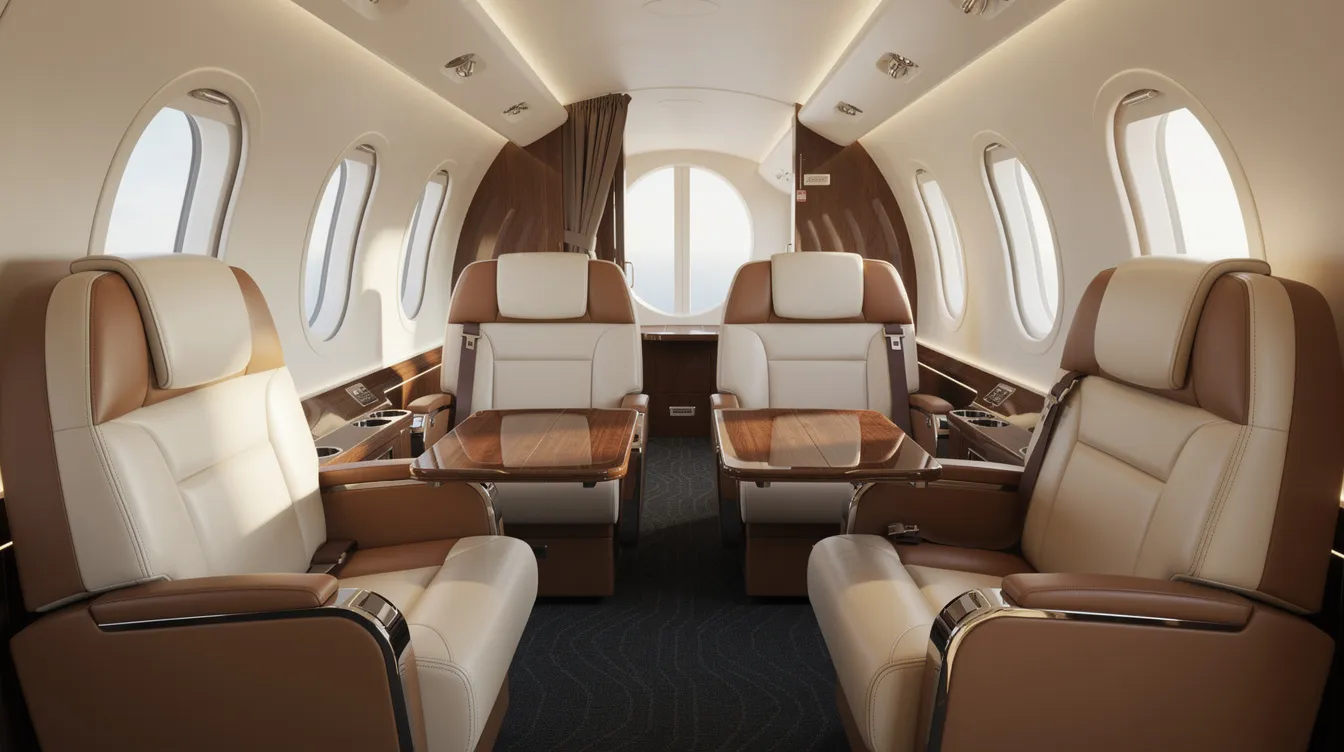
With a range of approximately 1,742 nautical miles under typical charter loads, the PC-12/45 supports nonstop legs like New York to Miami, Toronto to Orlando, Los Angeles to Aspen, or San Francisco to Denver. For flights under roughly three hours, its performance makes commercial airline connections feel unnecessary.
High-speed cruise sits around 260–270 KTAS. That is slightly below many light jets but comes with significantly lower fuel burn and far stronger short-runway capability. The PC-12/45 can access runways as short as 2,500 feet and can operate from unimproved airstrips — grass, gravel, compacted dirt, and prepared snow surfaces. This opens access to remote resorts, private ranches, island strips, and ski-area airports that business jets simply cannot reach.
The aircraft is equipped with modern IFR avionics (often Garmin or Honeywell systems) that enable reliable operations in varied weather conditions. While certified for single-pilot flight, charter trips booked via Jettly normally operate with professional crews under Part 135 regulations or local equivalents.
Consider two scenarios. A group of four flies from Dallas to a private ranch airstrip in South Dakota with gravel runways — the PC-12/45 handles it without issue. Or a business team charters directly into a regional airport 15 minutes from a manufacturing facility, skipping a two-hour drive from the nearest commercial hub. Both are everyday missions for this aircraft.
The Pilatus PC-12/45 was designed as a multi-role aircraft. It is versatile for various missions, including corporate transport and cargo, which benefits charter clients because operators can adapt cabin configurations to match specific trip needs.
For passenger transport, typical charter missions include executive shuttles between regional business centers, family holidays to remote vacation homes, and group trips for up to nine passengers where cost and airport access matter more than outright speed. Owner-operators account for 20–30% of PC-12 sales, a figure that speaks to the type's appeal for frequent private travel.
The large cargo door enables loading bulky items, spare parts, and oversized luggage with ease. Some operators use flexible seating arrangements where a portion of the cabin handles freight while still carrying passengers — a combi capability rare among other aircraft in this category.
On the special missions side, the PC-12 series has been utilized in government operations for surveillance by agencies including the US Air Force. The aircraft is also utilized for air ambulance and medical evacuation services — the Royal Flying Doctor Service in Australia being one of the most well-known operators. These demanding missions demonstrate the airframe's toughness, reliability, and operational efficiency, all of which benefit private flyers.
Jettly primarily connects clients to passenger transport and mixed passenger-plus-cargo missions, but the same underlying durability is what makes the PC-12/45 a dependable charter aircraft.
Chartering a PC-12 costs between $1,800 and $2,400 per hour in North America and Europe. The exact price depends on several factors affecting pricing, including route, season, and repositioning time, as well as the aircraft's year of manufacture and interior specification.
A typical quote includes aircraft time (both occupied and any repositioning legs), fuel, and crew costs. Basic in-flight refreshments are often bundled in. Hourly costs also include landing fees, crew costs, and taxes. Extra items like de-icing, overnight crew expenses, catering upgrades, and ground transportation may be billed separately.
Jettly's platform provides instant or near-instant pricing from multiple operators, allowing users to compare PC-12/45 charter rates against other Pilatus PC models, turboprops, and light jets on the same route. For sectors under about 1,000–1,200 nm with four to eight passengers, the PC-12/45 often delivers a lower cost per seat than light jets while dramatically cutting door-to-door travel time versus commercial flights.
Jettly may also surface empty-leg flights on PC-12 aircraft. Empty-leg flights can significantly reduce charter costs when clients are flexible on timing and routing.
For context on ownership economics: owning a PC-12 costs approximately $312,400 annually in fixed expenses. Pre-owned PC-12/45 prices range from $2.6 million to $3.4 million, and the PC-12/45 has strong residual value in the aircraft market — the PC-12 retains 80–85% of its value after 10 years. There are currently 108 PC-12/45 aircraft for sale on the pre-owned market.

The Pilatus PC-12/45 competes most directly with King Air models, TBM single-engine turboprops, and entry-level light jets. Each comes with different trade-offs.
The aircraft is often compared against twin turboprops like the Beechcraft King Air. King Air models offer twin-engine redundancy and may reach slightly higher speeds, but the PC-12/45 is known for low operating costs compared to twin-engine turboprops. It also wins on payload flexibility and large cargo door utility.
TBM turboprops are faster single-engine aircraft with smaller cabins. The PC-12/45 favors group comfort, luggage capacity, and rugged-strip access, while TBMs appeal more to owner-operators and pilots prioritizing speed over cabin space.
Light jets generally fly faster and higher but need longer, better-quality runways and have smaller baggage holds. Many light jets cannot match the PC-12/45's ability to land at remote strips with bulky items like golf clubs or skis.
When should a Jettly customer choose a PC-12/45 over a jet? When the trip involves a remote airport, when cost matters, or when cargo needs are significant. When might a jet be the better deal? On longer business hops where time is critical and both departure and arrival airports are major hubs with long runways.
Key performance numbers that matter for charter clients:
|
Specification |
Value |
|---|---|
|
Range |
Approximately 1,742 nautical miles |
|
Maximum Cruise Speed |
270 knots (KTAS) |
|
Service Ceiling |
30,000 feet |
|
Takeoff Distance |
About 1,475 feet |
|
Landing Distance |
Under 1,900 feet over a 50-foot obstacle |
|
Maximum Takeoff Weight |
4,500 kg (9,921 lb) |
|
Passenger Capacity |
7 typical, 9 max |
|
Engine |
Pratt & Whitney PT6A-67B, 1,200 shp |
|
Average Fuel Burn |
Around 85 gallons per hour |
The PC-12 family has built a strong safety and reliability record over millions of flight hours. The Pratt & Whitney PT6A engine line — with tens of thousands of units in service and hundreds of millions of hours logged globally — is one of the most trusted powerplants in aviation.
Industry data indicates PC-12 accident rates are competitive with or better than many turboprop peers, with most incidents tied to pilot decision-making rather than mechanical failure. Key safety features on the PC-12/45 include a robust airframe, terrain awareness and traffic alert systems on many charter aircraft, pressurization, de-icing and anti-icing equipment, and high levels of structural redundancy.
Jettly only works with licensed commercial operators — FAA Part 135 in the U.S. and equivalent approvals elsewhere. These operators must adhere to strict maintenance schedules, pilot training requirements, and safety oversight when flying Pilatus PC aircraft.
Clients can further enhance their confidence by asking about recent maintenance status, pilot experience on type, and operator safety ratings when requesting quotes through Jettly.
The PC-12/45 shines on regional routes under roughly three hours, where its speed, range, and short-field ability save significant door-to-door time versus airline schedules.
Here are four route examples that illustrate the aircraft's strengths:
New York (TEB) to Nantucket (ACK): A quick weekend escape to a short coastal strip. The PC-12/45 handles Nantucket's 6,300-foot runway easily, and passengers walk off with golf clubs in hand.
Dallas (DAL) to ranch airstrips in Texas or New Mexico: Many private ranches have gravel or grass runways under 3,000 feet — exactly where the PC-12/45 excels while business jets cannot operate.
Toronto (YTZ) to smaller Ontario lakeside strips: Family cottage trips to locations with no commercial service. The aircraft brings the vacation directly to the doorstep.
London (Biggin Hill) to Scottish Highlands: Short runways, unpredictable weather conditions, and a need to bring fishing or sporting gear make this a natural PC-12/45 mission.
Business users often charter PC-12/45 aircraft for same-day out-and-back trips to secondary cities. An executive can visit a manufacturing site, hold meetings, and fly home the same evening — a trip that would eat two full days on commercial airlines.
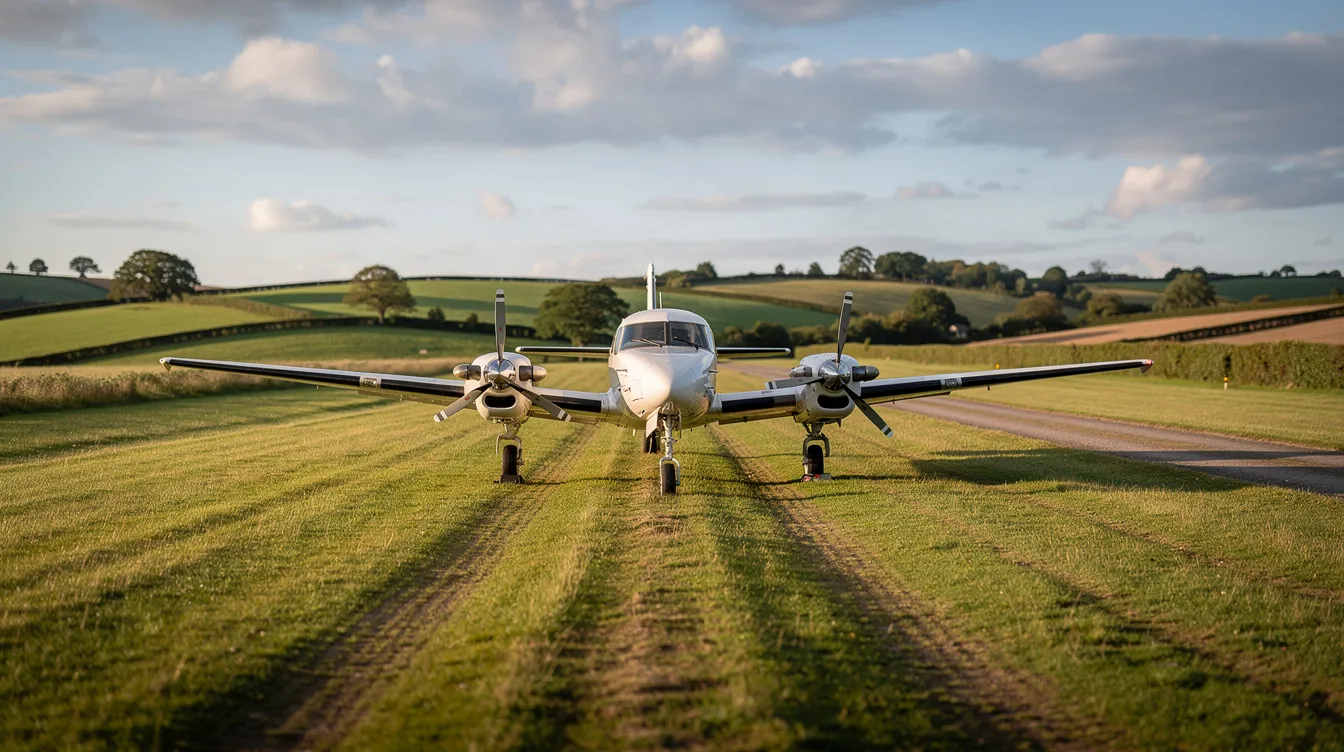
Finding and booking a Pilatus PC-12/45 on Jettly is straightforward. Enter your route and dates, filter for turboprop or specifically Pilatus PC 12, compare available aircraft — including the PC-12/45 when listed — then review pricing and operator details before confirming.
Jettly's global inventory includes thousands of turboprops and PC-12 variants. If a PC-12/45 is not available on a given route, similar Pilatus PC-12 models can often be offered with near-identical performance and cabin feel.
The platform supports both membership and on-demand options. Memberships suit frequent travelers seeking lower per-flight fees and added service. On-demand access works for occasional flyers who want a single charter without long-term commitments.
When booking, specify your passenger count, luggage volume (especially if carrying golf clubs, skis, or bulky equipment), catering preferences, Wi-Fi requirements, and pet travel needs. The more detail you provide, the better Jettly can match you with the right aircraft.
Ready to experience private travel on your terms? Explore flight options or request a quote at https://www.jettly.com.
Below are answers to common practical questions about chartering a PC-12/45, covering comfort, luggage, airport access, and booking details.
While the certified maximum is up to nine passengers, most charter-configured PC-12/45 aircraft are set up for six to eight passengers in an executive layout. This allows for generous legroom, workspace, and a more comfortable flight experience. When booking through Jettly, check the specific seat map and configuration for each aircraft listing, as layouts vary by operator and mission profile.
Yes. The PC-12/45 is well-suited for bulky luggage thanks to its large cargo door and internal baggage area. Golf clubs, skis, fishing gear, and similar items fit comfortably without sacrificing passenger seats. Mention oversized items when requesting a quote on Jettly so the operator can confirm capacity and suggest the best seating and baggage arrangement.
Short and unimproved runway performance is one of the PC-12/45's biggest advantages. It can access many small airports, private strips, and remote locations not served by jets. Final suitability depends on each airstrip's length, surface condition, and regulatory approvals. Jettly's partner operators will evaluate the intended airport and confirm whether a PC-12/45 can safely operate there.
While light jets are typically faster, the PC-12/45 offers a surprisingly spacious cabin for its category, with a flat floor, tall interior, and generous baggage space. Many passengers find the comfort comparable for flights under about three hours. Cabin noise is higher than in larger business jets but is well-managed with modern soundproofing, and passengers benefit from direct in-flight access to luggage and a more flexible interior layout.
Many, but not all, PC-12/45 aircraft in the charter market are equipped with in-flight Wi-Fi. Catering options range from light snacks to full meals, depending on the operator and route. Specify your Wi-Fi and catering needs when requesting quotes on Jettly so the platform can match you with a suitable Pilatus PC aircraft and clearly itemize any additional costs.
The Pilatus PC 12 45 remains a standout choice in the turboprop market, combining Swiss engineering excellence with versatile operational capabilities. Pilatus developed this model to meet the needs of both utility and corporate travelers, offering a spacious, pressurized cabin, strong short-field performance, and efficient fuel burn. Its type certificate ensures compliance with rigorous safety and performance standards.
For travelers seeking a balance of comfort, flexibility, and cost-effectiveness on regional routes, the PC-12/45 delivers exceptional value. Its ability to access remote and shorter airstrips opens up destinations unavailable to many jets, while its cabin volume and cargo capacity accommodate diverse mission needs, from business trips to leisure travel with bulky equipment.
Jettly’s platform simplifies the process of chartering the Pilatus PC 12 45 by providing instant pricing, transparent comparisons, and access to a global network of vetted operators. Whether booking for a family vacation, corporate shuttle, or special mission, the PC-12/45 offers a reliable, efficient, and comfortable private aviation experience.
Ready to experience private travel on your terms? Explore flight options or request a quote at https://www.jettly.com.
Share this post:
Jay Franco Serevilla
Sep 26, 2026
|
5
min read
Discover tips and trends in the industry.

5
min read
Jet Mgmt: What It Means Today in Aviation and the Music Industry
Jet management encompasses two distinct areas: private aviation and the music industry. In aviation, it refers to the comprehensive oversight of aircraft operations, while in music, it involves managing artist careers. Platforms like Jettly bridge these worlds by offering accessible private jet charter services, catering to the unique needs of both frequent travelers and touring musicians.
Read More
5
min read
Jet Inc: Bulk Commodity Transport Services in the Southeast
Jet Inc. is a family-owned bulk commodity transportation company based in Bolivia, North Carolina, serving the Southeast U.S. since 2007. Specializing in dry bulk and non-hazardous liquid transport, Jet Inc. prioritizes dependable service, safety, and efficient communication to meet the needs of industrial, agricultural, and commercial shippers.
Read MoreStay updated with our latest insights and tips to elevate your journey with us.
MEMBERSHIPS AND ASSOCIATIONS



Disclaimer: Jettly operates as a charter broker, offering access to a global digital jet charter marketplace. Jettly is not a direct air carrier and does not own or operate aircraft. All advertised flights are conducted by third-party air carriers that are fully licensed and hold the appropriate Part 135 or Part 121 certifications issued by the Federal Aviation Administration (FAA) or equivalent regulatory authorities under U.S. or foreign law. Jettly complies fully with the U.S. Department of Transportation's Part 295 and Part 298 Charter Broker regulations. Jettly does not carry additional liability insurance. Passengers are covered by aircraft operator insurance. TICO: 50023770


