


Login
Get Instant Pricing On 23,000+ Aircraft

>
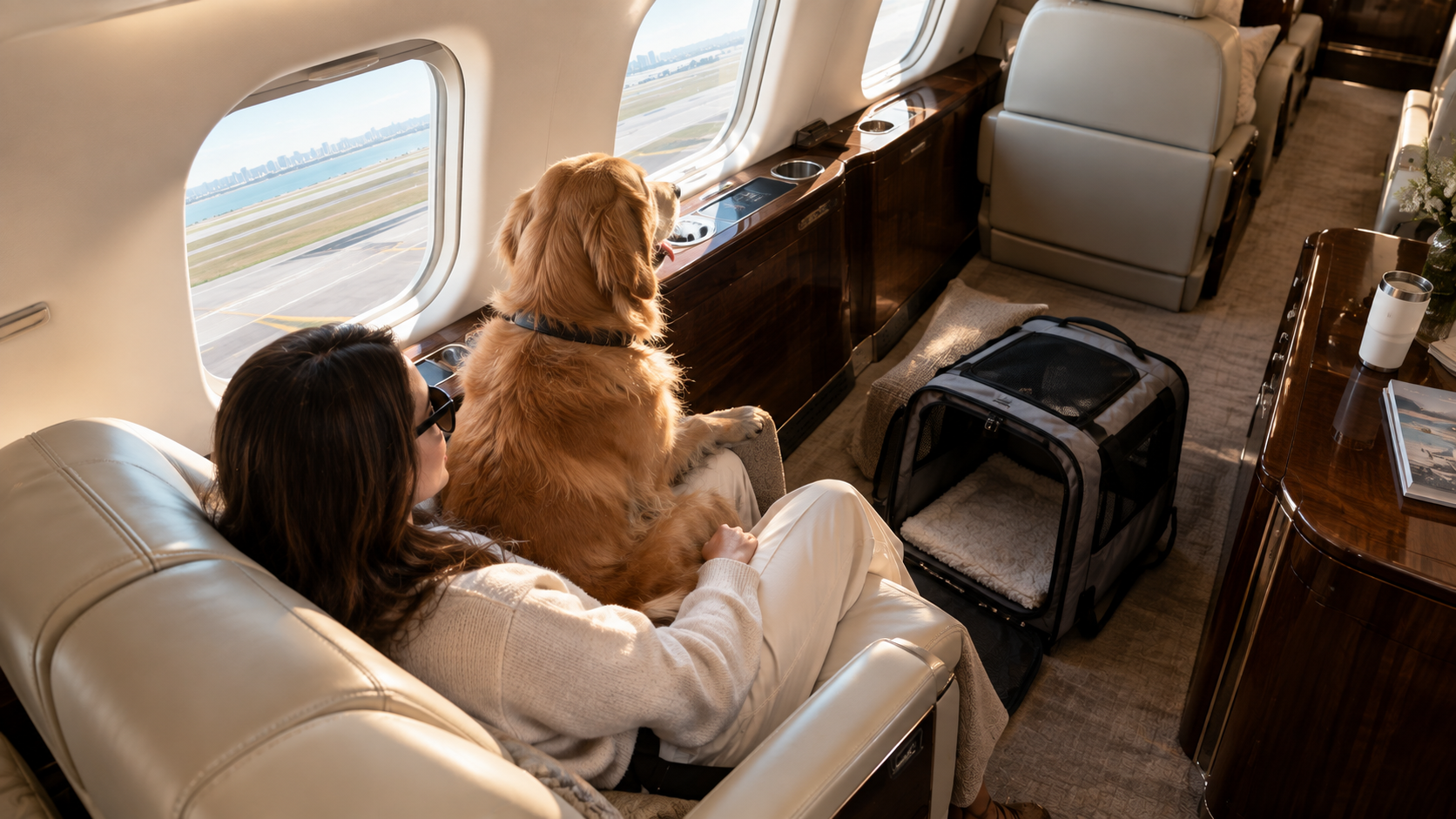
Whether you're a first-time flyer or a seasoned traveler, this guide is for pet owners who want to ensure a smooth, stress-free experience when flying with their animals on private jets. Understanding the rules and paperwork in advance helps you avoid last-minute surprises and keeps your pet comfortable throughout the journey.
This guide explains everything you need to know about bringing pets on private jets, including size limits, cabin vs. crate rules, and international paperwork. The scope covers:
The target audience is pet owners considering private jet travel, whether for the first time or as experienced travelers. This topic matters because knowing the rules and preparing the right paperwork in advance helps you avoid surprises at the terminal and ensures a smooth, comfortable journey for both you and your pet.
Most pets can fly on a private jet, but approval is operator-specific and depends on pet size, carrier/crate dimensions, and the aircraft's weight-and-balance limits for your exact route. That one sentence explains why vague "pets allowed" promises can let you down at the terminal. Flying with a dog or cat on a charter works best when you plan it like an aircraft-matching problem.
Share your pet's weight, the carrier or crate measurements, and every country on your route, then let the operator confirm before you book. This guide turns pets on private jets into a repeatable checklist, and it shows how a crate quietly eats into your baggage capacity and can push you toward a larger aircraft.
Pets can travel in the cabin on private jets. Unlike commercial flights, pets are not confined to the cargo hold in most cases. Pets travel in the cabin with owners on private jets, and in many cases, pets can roam the cabin freely without being confined to a crate, as long as they are under control and meet operator requirements.
To get a real yes or no, send the operator a short data set:
Baggage space on jets is measured in cubic feet and varies by model, which is why a pet setup that fits one jet may not fit another. New to charter? Our first-time private jet guide covers the basics before you add a pet to the plan, and understanding how charter companies operate gives helpful context for who sets and enforces pet policies.
FBO defined: An FBO (fixed-base operator) is the private terminal where charter passengers arrive, check in, and board, often just 15 to 30 minutes before departure.
Flying private removes ticket-style baggage rules, but it doesn't remove certified aircraft limits. Two layers control every pet decision. The first is operator policy. The second is aircraft physics.
Flights are operated by third-party carriers holding FAA Part 135 or Part 121 certification (or the foreign equivalent). The operator, not the broker, keeps operational control and makes the final call on your pet. In private aviation, baggage limits and pet policies are operational, not ticket-based, so the crew must confirm that passengers, fuel, baggage, and any pet carrier or crate fit within certified weight-and-balance limits.
The mission changes the limit. A jet flying a short hop can carry more weight than the same jet flying a long leg, since extra fuel for range eats into the payload available for passengers, bags, and a pet carrier. Add a hot day or a short mountain runway, and the usable payload shrinks further.
Door geometry is the second quiet trap. A carrier can fit "on paper" by cubic feet, yet fail to pass through an angled baggage door or stow safely once inside. On private jets, pet approval is a combination of operator policy and weight-and-balance feasibility for your exact route.
Weight and balance defined. Weight and balance is the pre-flight calculation that confirms passengers, fuel, baggage, and any pet carrier/crate keep the aircraft within certified limits for safe takeoff and landing.
Here is a simple decision rule: If your pet can comfortably remain in a carrier at your feet or on a protected seat, in-cabin travel is often feasible. If not, plan for a crate strategy and likely a larger aircraft category.
On private jets, pets can roam the cabin freely without being confined to a crate in most cases. Many operators allow dogs and cats in the cabin with their owners on private jets rather than in a cargo hold, which removes the need to place pets outside the passenger area.
On many approved flights, pets can move around the cabin in a controlled way instead of staying crated for the entire trip. Whether they stay loose in the cabin is often a personal decision, though keeping a carrier or crate available is still recommended in most cases.
Expect to keep the pet controlled during taxi, takeoff, landing, and turbulence, with a harness attached to an aircraft seat belt when the operator allows, and to cover cleaning if there is shedding or an accident. This is where a clear private jet pet policy from the operator saves you a scramble at the terminal.
A crate becomes the plan in a few common cases: larger dogs, multiple pets, certain cabin layouts, longer flights where turbulence is likely, and international trips where inspection or containment rules apply. Once you move to a crate, treat it like a large piece of luggage. It has volume, an awkward shape, and it must be secured, so it competes directly with your suitcases for space. If a crate is used in the cabin, it may also need to be secured to the airframe inside the cabin when the operator requires it so the pet stays protected for the entire flight.
That is usually simpler with one animal riding comfortably in-cabin than with more than one pet, which often pushes travelers toward a larger aircraft or stricter containment.
There is no single "private jet pet weight limit." Operators approve pets based on safe containment, cabin rules, and the aircraft's weight-and-balance limits for the mission. One operator might set a soft cap at a certain weight; another might clear a heavier dog on a bigger jet flying a short route. Booking early helps, and flexible options like empty leg dog flights can widen the pool of pet-friendly aircraft.
In-cabin pet defined. An in-cabin pet is a dog or cat that remains in the passenger cabin under control (carrier or harness plan) rather than traveling in an external baggage compartment.
Comparing pet containment options
In-cabin carrier
Rigid crate
Soft crate
Best for
Small dogs and cats
Medium to large pets, international travel
Medium pets on flexible layouts
Main risk
Size cap for comfort
Won't clear an angled door
Less protection, may not meet operator rules
What to measure
L x W x H and loaded weight
L x W x H plus largest diagonal
Packed L x W x H, compressed width
Tell the operator
Cabin placement plan
Whether the crate disassembles
Whether a rigid crate is required instead
Measurement tips and baggage guidance also shift by jet category, so a setup that works on a super-mid may not work on a very light jet.
Cubic feet is not the same as "it fits through the door." A crate can satisfy the compartment's volume and still refuse to load, since the opening may be narrow, angled, or shaped to block long rigid items.
Measure the crate at its widest points: length by width by height, including feet and door hardware. Add the largest diagonal, corner to opposite corner, if the crate must pivot through an angled opening. Common failure modes are rigid crate corners, narrow baggage doors, and internal compartment walls that taper toward the tail. Soft-sided carriers help when compressibility matters, but they don't help when the operator needs a hard shell for containment.
Door geometry defined: Door geometry is the practical shape constraint created by the baggage door opening and compartment angles, which can prevent long or rigid items from loading even when volume seems sufficient.
"Door geometry and weight and balance are the two things that actually decide a pet's spot on the aircraft," says Elena Ruiz, a flight operations lead who supports Jettly's coordinator team. "A crate can look fine by cubic feet, then meet an angled baggage door and stop. Send exact measurements and a few photos, and we sort it out before departure day."
To avoid a last-minute denial, confirm both baggage volume (cubic feet) and baggage-door geometry with the operator using your crate's exact dimensions.
Crate fit-check checklist
Measurement
How to measure
Why it matters
What to share
Length x width x height
Tape measure at widest points, feet and hardware included
Sets base volume against compartment space
All three numbers in inches or cm
Largest diagonal
Corner to opposite corner
Shows if the crate can pivot through an angled door
The diagonal figure plus a photo
Loaded weight
Weigh the crate with the pet, or add pet weight to the empty crate
Feeds weight and balance and payload
Total loaded weight
Disassembly
Note if the top separates or the door detaches
A crate that breaks down may still load
Yes/no and how far it reduces
Material
Rigid plastic, metal, or soft-sided
Affects safety approval and flexibility
Type and brand/model if known
A pet carrier or crate competes with luggage for payload and stowage space, most sharply on light jets and very light jets where every cubic foot counts, and large dogs or other pets over about 50 pounds, as well as many pets, can materially affect weight-and-balance and cabin logistics. Knowing private jet rental baggage limits by aircraft type is the quickest way to see whether your pet setup fits or forces an upgrade, and comparing private charter aircraft by category can help you picture the space your pet and luggage will actually have.
Baggage capacity defined. Baggage capacity is the volume of an aircraft's luggage compartments, usually stated in cubic feet, and it describes space, not a guaranteed number of bags.
Treat category ranges as planning guidance only; the operator confirms final acceptance for the tail and route. Light jets often carry roughly 30 to 80 cubic feet, midsize jets around 80 to 140, and large-cabin jets from about 140 to 350-plus, based on manufacturer spec sheets.
Model detail beats category every time. Two jets in the same category can seat the same number of passengers but have very different baggage capacity, so baggage limits by aircraft type must be confirmed by model, not just "light" or "midsize."
Some aircraft store luggage in an external compartment with no in-flight access, which means pet supplies belong in the cabin. Longer routes can also shrink your usable space, since more fuel reduces the payload left for bags and a crate.
Aircraft category
Typical baggage volume (cu ft)
Bags-per-passenger note
Pet in-cabin practicality
Crate practicality
Best practice to confirm
Very light / light jets
~30 to 80
About 1 soft bag per person
Small pets only
Tight, often external
Confirm door size by tail
Midsize / super-mid
~80 to 140
1 to 2 bags per person
Small to medium pets
Medium crate may fit
Verify model and route fuel
Heavy / large-cabin
~140 to 350+
2+ bags per person
Most pets comfortable
Large crate usually workable
Confirm stowage and access
For bigger dogs or multiple pets, heavy jet options simplify the logistics with larger holds and easier loading. Many travelers choose larger aircraft when transporting pets because the added space makes the cabin more relaxed.
Common pet setups and their planning impact
Pet setup
Rough space use
Planning impact
1 small in-cabin carrier
Fits at your feet or on a seat
Minimal, but still declare it
1 medium soft crate
Equal to a large suitcase
Reduces bag count on light jets
1 rigid crate
Bulky with a fixed shape
May force a size-up or external stow
A common operations planning rule treats a medium crate as roughly one passenger's luggage allowance for weight-and-balance purposes. Breed, size, and medical needs also affect aircraft matching and approval, and brachycephalic dogs may face extra operator scrutiny. Real impact depends on the aircraft and route, so treat these as starting points and confirm private jet charter baggage limits with the operator. Transport is often simpler on larger private aircraft when families are traveling with multiple animals.
If you share complete pet details early, you reduce last-minute aircraft changes and day-of-flight surprises. The fastest way to get a clear pet approval is to share your pet's weight plus the exact carrier or crate dimensions before the operator assigns the final aircraft. This is also the stage to flag age, medical needs, and any operator restrictions for very young pets.
Bring this to the booking table:
Then ask the operator, through your broker:
Good practice is to get a general check up with a licensed veterinarian shortly before travel, keep food and water to a limited amount, and offer only a small meal when appropriate to help avoid nausea or an upset stomach. Pets with special feeding needs, such as a diabetic dog, may need a different pre-flight routine from the veterinarian, and sedatives should be used only if that veterinarian advises it because they can create an increased risk of heart and respiratory problems and other respiratory problems as well as change how medication affects them at altitude.
Operator discretion is final, tied to safety and compliance. That is normal, and a good broker turns it into a predictable process rather than a gamble.
Charter agreement defined. A charter agreement is the document that confirms the aircraft, itinerary, price, and operational terms; the flight is confirmed only after it is signed and payment is secured.
Requirement
Why it matters
Pet weight
Feeds payload and weight and balance
Crate dimensions
Drives door geometry and stowage
Destination rules
Controls import and arrival clearance
Number of pets
Affects space, cleaning, and cabin plan
Quick answer: Documentation requirements vary by country and can include health certificates and vaccination records. Health certificates are required for pets traveling internationally. International travel with pets requires strict adherence to the destination country's import regulations. A health certificate is required within 30 days of travel.
Private jets don't bypass customs, and pets don't bypass import rules. A charter can shorten the ground time, but it cannot waive a country's entry requirements for animals, and the same holds for people as outlined in our guide on flying private jets internationally.
Commonly required documents include:
Preparations should also include confirming vaccinations are current before the paperwork window opens. Some countries add treatments or waiting periods. International travel may require additional health documentation beyond the standard certificate and vaccine record, depending on the destination. The IATA Live Animals Regulations (IATA LAR) are the widely referenced baseline for crate construction and labeling in aviation, and many operators expect a crate that meets IATA LAR standards, especially for international trips.
International pet paperwork defined. International pet paperwork is the set of veterinary records and government-required documents that allow a pet to legally enter (and sometimes exit) a country.
For international private jet travel with a pet, plan paperwork first and aircraft fit second. A perfect aircraft match doesn't help if import documents aren't accepted at arrival. Build a little buffer into your plan.
Follow this timeline:
International document checklist
Document
Who issues it
When to start
What to share
Health certificate
Licensed veterinarian (often government-endorsed)
Weeks ahead, inside the accepted window
Scan now, original on the day
Vaccination records
Your veterinarian
As early as possible
Copy of the full record
Microchip details
Vet or chip registry
Before the vet visit
Chip number and type
Import permit
Destination authority
As soon as the route is set
Permit reference
Most charter passengers arrive about 15 to 30 minutes before departure, but pets benefit from a little extra buffer. Private-terminal check-in is usually quicker, with fewer crowds and shorter waits that can help reduce stress. Using an airport locator tool for private terminals makes it easier to pick FBOs with good pet relief areas, and a short walk and a relief break before boarding pay off on a calm flight.
Private-terminal check-in is quick: ID and manifest verification, a fast luggage load, then boarding. Keep the pet leashed or harnessed in common areas, and coordinate relief breaks before you walk to the aircraft. On longer flights, pack training pads or a litter box plan if in-flight relief may be needed.
Liquids and pet medications are often handled differently at a private terminal than at a commercial security line, but rules can still apply, so confirm with the operator and keep pet meds in the cabin. If your aircraft uses an external baggage compartment, assume you won't access your pet's supplies mid-flight. Pack what your pet needs in the cabin, since baggage capacity in an external hold is off-limits once you take off.
External baggage compartment defined. An external baggage compartment is a luggage hold outside the cabin that usually can't be accessed during the flight.
Pet packing at a glance
Keep in the cabin
Okay in baggage
Leash and harness
Spare bedding
Wipes and training pads
Extra toys
Collapsible water bowl
Bulk food, sealed
Medications
Grooming supplies
One day of food
Backup crate parts
All document originals
Non-urgent gear
Familiar bedding, toys, or other stress eliminators can help pets stay calm before boarding and after takeoff, and arranging in-flight catering through Jettly Eats lets you focus on your pet instead of meal logistics.
Picture the moment: you arrive, and ops says the crate can't be safely loaded. Stay calm, because there is almost always a path forward that keeps the aircraft legal and your pet safe.
If a crate can't be loaded safely, the fix is usually a larger aircraft or a different carrier, not "squeezing it in." Weight-and-balance and stowage rules control the decision, and understanding how many passengers different private jet sizes carry can also give you a feel for which cabins have room to spare for a bulky crate. Work through the options in order:
The crew may still decline for one reason: safe stowage and weight and balance are not negotiable. Operator discretion means the air carrier has final authority to accept or refuse items (including pet crates) for safety and compliance on the day of departure.
The simplest way to fly with pets is to treat it like aircraft matching. Flights are operated by third-party carriers holding FAA Part 135 or Part 121 certification, or the foreign equivalent, and the operator keeps operational control.
Access to more than 23,000 aircraft through a global network on our private jet rental and charter platform lets a Personal Flight Coordinator compare categories fast and find a tail that fits your pet, your bags, and your route. Private aviation also offers more flexible scheduling for pet travel than fixed commercial timetables. With a shared charter versus a full charter, multiple passengers and pets may be on board and flights often run on fixed schedules, while a private charter provides exclusive use of the aircraft.
Travelers who want to fly private with pets often choose full-aircraft options for more control, especially with senior pets or when bringing more than one animal. Flexible private jet memberships can make it easier to book those full-aircraft trips consistently. That full-aircraft option also allows more customization of the onboard environment, creating a more personalized setup for pets and more comfort for both you and your animal companion as part of the family.
Flights work with certified operators that are ARGUS- or Wyvern-rated and monitors compliance, and frequent flyers can lean on a Jet Card program or membership for the same coordinator support, using tools like our jet card flight cost estimator to plan budgets in advance.
This helps prevent pet travel surprises by confirming pet acceptance with the operator and matching your pet and luggage needs to the right aircraft category before booking is finalized. While you plan, you can use a private jet charter cost estimator or our guide to affordable private jet charter pricing to understand how aircraft size, route, and pet-related cleaning fees affect the final quote. Pet fees vary by provider, and some don't charge for pets at all.
Ready to plan? Call +1-866-448-2358, email departures@jettly.com, or use the app or instant quote tool to start.
Share your pet's weight and carrier/crate dimensions, and operator approval will be confirmed and an aircraft recommended that fits your pet, your luggage, and your route on the right plane.
Many operators allow pets in the cabin on private jets, but you must get operator approval and follow containment and cleanliness rules. Plan on a carrier or a harness, keep the pet controlled during takeoff and turbulence, and know that some aircraft or layouts may require a crate strategy instead of in-cabin travel.
There isn't one universal pet weight limit on private jets; limits are operator-specific and also depend on aircraft payload and route fuel needs. Weight and balance is the reason the same aircraft can allow a different payload on a short hop versus a long, fuel-heavy leg, which is why heavier pets often point toward a larger cabin.
To confirm a crate will fit, you need both the aircraft's baggage compartment size and the baggage-door geometry, and you should verify using your crate's exact dimensions. Send length, width, height, and the largest diagonal, along with photos, and note whether the crate disassembles, since a crate that breaks down may still load when a fixed one won't.
Private jet charter baggage limits are set by aircraft baggage volume and weight-and-balance limits, not by a standard per-ticket allowance. Capacity is measured in cubic feet, and models vary widely within the same category, so a light jet and another light jet can carry very different loads.
Sometimes; many light jets use external baggage compartments you can't reach in flight, while some larger jets provide in-flight access to a cabin closet or aft baggage area. Keep pet essentials such as water, wipes, medications, and a day of food in the cabin so you are never dependent on baggage access.
International pet requirements vary, but they commonly include a health certificate and vaccination records, plus any destination-specific permits or endorsements. Verify the exact rules for every country on the itinerary, start early since some certificates have tight windows, and carry all originals on the day of travel.
Some operators charge pet or cleaning fees, while others simply require advance notice, so owners should confirm costs in writing before finalizing the charter. Fees are more likely when a pet sheds heavily, has an accident, or causes interior damage, as operators often base them on cleaning time and cabin protection rather than the pet itself.
If an operator denies a pet due to safety or fit constraints, the usual solutions are changing the carrier or crate, reducing baggage, or upgrading aircraft size. Sharing crate dimensions and photos in advance and getting written operator confirmation is the best way to avoid the denial in the first place.
Pets on private jets come down to a short, repeatable process: measure the pet and the crate, confirm the operator's private jet pet policy, check the crate against baggage-door geometry, and verify any international paperwork for every country on the route.
Do that early, and pet travel on a private jet becomes predictable instead of stressful. If you're still exploring how to access private flying, you can compare ways to get a seat on a private jet, look at options to crowdsource and share empty seats, or review our guide to charter airlines and private aviation platforms to see how different providers handle pets.
Share your pet's weight and carrier or crate dimensions, and a Personal Flight Coordinator will confirm operator approval and match you to an aircraft that fits your pet and your luggage.
Call +1-866-448-2358, email departures@jettly.com, or start an instant quote in the app.
Share this post:
Jeff Ryan Serevilla
Sep 25, 2026
|
5
min read
Discover tips and trends in the industry.
5
min read
US Fighter Jets: History, Technology, and Their Role in Global Security
US fighter jets have undergone significant evolution since 1945, transitioning from early subsonic models to advanced fifth-generation aircraft like the F-35. These jets play a crucial role in maintaining air superiority and global security, while also driving economic growth and technological advancements in civil aviation. The ongoing development of sixth-generation fighters promises to further enhance the capabilities of the US military and its allies.
Read More
5
min read
Private Jet Charters Miami: Ultimate Guide to Flying Private with Jettly
Miami private jet charters through Jettly provide travelers with on-demand access to fly privately, offering instant pricing and booking from key airports. With over 20,000 aircraft options and flexible scheduling, Jettly simplifies the private flying experience, making it ideal for both business and leisure travelers. Popular routes include Miami to New York and the Bahamas, ensuring quick and convenient travel.
Read MoreStay updated with our latest insights and tips to elevate your journey with us.
MEMBERSHIPS AND ASSOCIATIONS



Disclaimer: Jettly operates as a charter broker, offering access to a global digital jet charter marketplace. Jettly is not a direct air carrier and does not own or operate aircraft. All advertised flights are conducted by third-party air carriers that are fully licensed and hold the appropriate Part 135 or Part 121 certifications issued by the Federal Aviation Administration (FAA) or equivalent regulatory authorities under U.S. or foreign law. Jettly complies fully with the U.S. Department of Transportation's Part 295 and Part 298 Charter Broker regulations. Jettly does not carry additional liability insurance. Passengers are covered by aircraft operator insurance. TICO: 50023770


