


Login
Get Instant Pricing On 23,000+ Aircraft

>

The tail number N823KD is the FAA registration number for a Bombardier Challenger 604 business jet that became the focus of aviation safety discussions after a February 9, 2024, accident near Naples, Florida. This article is intended for travelers, aviation professionals, and anyone interested in private jet safety and charter options. Understanding the N823KD accident provides important lessons for safe private jet travel and maintenance best practices.
N823KD is the FAA registration number for a Bombardier Challenger 604 business jet. On February 9, 2024, Hop-A-Jet Flight 823 experienced a dual engine failure shortly before landing, leading to a crash on Interstate 75 in Naples, Florida. This article provides a comprehensive overview of the N823KD accident, the aircraft's background, and safe charter alternatives, directly addressing users searching for information about 'n823kd.'
The registration N823KD refers to a Bombardier Challenger 604 (N823KD) operated by Hopa Jet on a charter flight from Ohio State University Airport to Naples Airport when it experienced dual engine failure on final approach.
On February 9, 2024, Hop-A-Jet Flight 823 experienced a dual engine failure shortly before landing, leading to a crash on Interstate 75 in Naples, Florida.
The aircraft attempted an emergency landing on the southbound lane of Interstate 75, resulting in a plane crash that claimed the lives of two pilots while two passengers and one flight attendant survived.
The National Transportation Safety Board investigation identified corrosion in the CF34-3B engines’ variable guide vane (VGV) system and maintenance documentation gaps as contributing factors.
The incident has prompted enhanced safety practices, inspections, and discussions about aligning Part 135 business jet maintenance with commercial airline standards.
Jettly offers access to vetted charter operators with transparent pricing, connecting travelers to Challenger-class and other aircraft for business and leisure trips.
The tail number, also known as the FAA registration number, N823KD, is the FAA registration number for a Bombardier Challenger 604 business jet, a heavy aircraft built for medium- to long-range corporate and charter operations. This aircraft, model CL-600-2B16 with serial number 5584, was manufactured in 2004.
According to FAA registry data, the jet was registered to East Shore Aviation LLC in Fort Lauderdale, Florida. It was primarily used for on-demand private jet charter services and typically operated under Part 135 charter regulations by Ace Aviation Services, doing business as Hop a Jet Worldwide Jet Charter, serving corporate clients and high-net-worth travelers who might also consider established providers such as NetJets, the industry leader in private aviation.
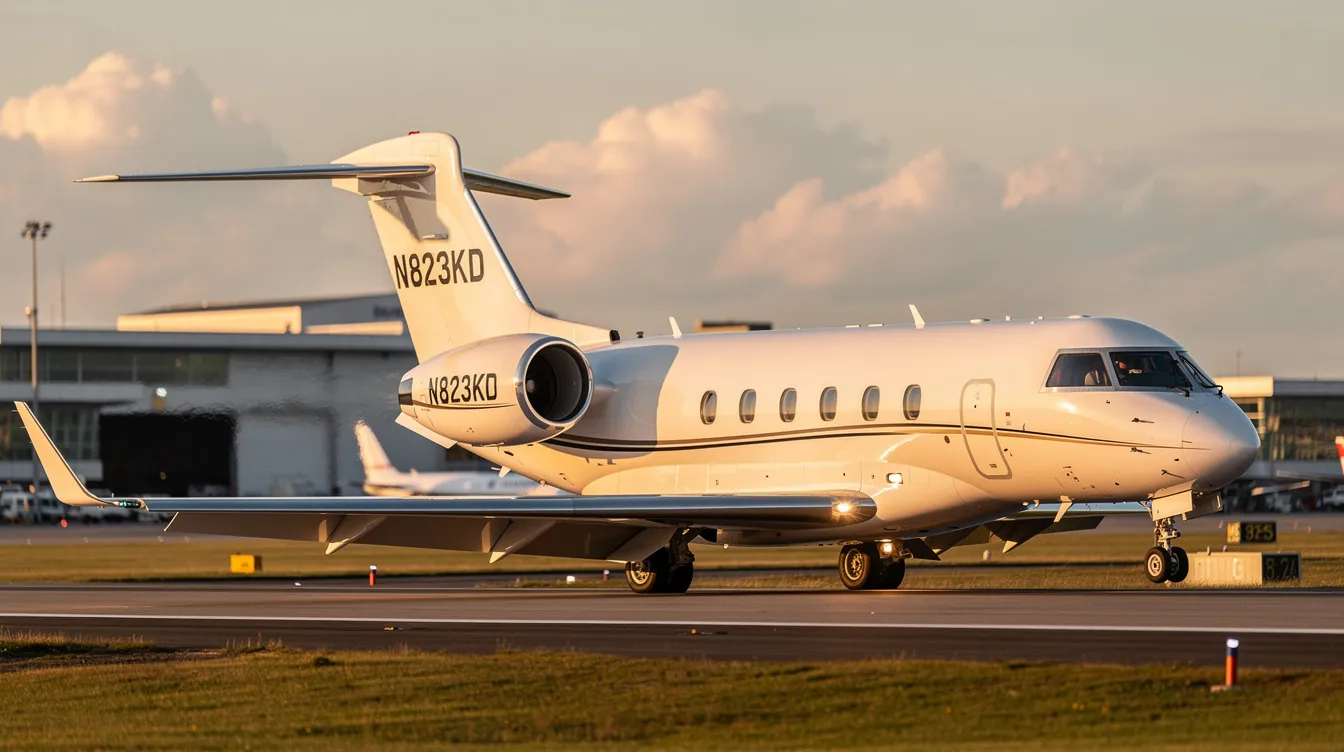
The Challenger 604 features twin GE CF34 turbofan engines and typically accommodates up to 12 passengers in a spacious cabin designed for comfort and productivity. Its wide-body cabin suits U.S. domestic routes and near-international flights. Its operation emphasized operational reliability and safety management, with common missions including Midwest to Florida runs, Northeast to Caribbean trips, and similar profiles to aircraft used for private jet charter in Lagos, Nigeria.
The tail number n823kd became widely known following a high-profile accident in February 2024, detailed in the sections below.
The Challenger 604 falls into the heavy jet category, designed for transcontinental missions. Corporations, charter operators, and private travelers favor this aircraft for its combination of range, cabin comfort, and operational efficiency, making it comparable to aircraft used on routes served by private jet charter in Kolkata, West Bengal.
The Bombardier Challenger 604 is powered by two General Electric CF34 turbofan engines, providing reliable performance for various flight conditions.
|
Attribute |
Details |
|---|---|
|
Manufacturer |
Bombardier |
|
Model |
Challenger 604 (CL-600-2B16) |
|
Serial Number |
5584 |
|
Cruise Speed |
Mach 0.80 (~460-470 knots) |
|
Service Ceiling |
41,000 feet |
|
Maximum Range |
~4,000 nautical miles |
|
Engines |
Two GE CF34-3B turbofans |
|
Seating Capacity |
Up to 12 passengers |
Stand-up headroom exceeding six feet
Executive club seating
Full galley
Enclosed lavatory
Optional high-speed Wi-Fi
Storage accommodates business equipment and luggage for extended trips
On February 9, 2024, while operating a flight from Ohio State University Airport (KOSU) in Columbus, Ohio, to Naples Municipal Airport (KAPF) in Southwest Florida, N823KD departed at approximately 1517 Eastern Standard Time. The charter flight, operated as Hop-A-Jet Flight 823, was carrying two pilots—Captain Edward Murphy (50) and First Officer Ian Hofmann (65)—along with two passengers and one flight attendant.
Shortly before landing, Hop-A-Jet Flight 823 experienced a dual engine failure during final approach to Naples Airport, around mid-afternoon. The crew configured the aircraft for landing with gear and flaps extended. At roughly 1,800 feet above ground level and approximately two miles from the runway, both engines lost thrust. The crew immediately declared an emergency to air traffic control.
Within approximately 60 seconds, the aircraft lost over 50 knots of airspeed
Altitude dropped more than 1,000 feet
High-drag configuration severely limited the glide distance
Pilots selected Interstate 75 southbound as the emergency landing site
The jet crashed on Interstate 75 in Naples, Florida, colliding with vehicles, breaking apart, and being consumed by post-crash fire. The incident resulted in the fatalities of both pilots, while one flight attendant and two passengers survived with minor injuries. No ground fatalities were reported.
The National Transportation Safety Board launched a full investigation immediately after the accident, supported by the FAA, GE Aerospace, Bombardier, and Transport Canada. The NTSB investigates aviation accidents to assess factors such as flight data, maintenance records, and crew qualifications, which are critical for understanding safety issues and the aircraft's operation. Establishing strong relationships with regulatory bodies like the FAA and NTSB is vital for effective crisis management, as it allows for better cooperation and support during investigations following an accident.
Investigators recovered the flight data recorder (FDR) and cockpit voice recorder (CVR) from the wreckage. The I-75 southbound lanes remained closed for documentation and debris recovery, reopening by February 11, 2024. Recorders were analyzed at NTSB headquarters in Washington, D.C.
The investigation determined that a non-recoverable dual-rotor compressor stall occurred in both CF34-3B engines. This failure was linked to severe internal corrosion and binding in the variable guide vane (VGV) system, which prevented proper adjustment during the power increase demanded on approach. The NTSB reported that the crew received oil pressure warnings shortly before the engine failures, highlighting the importance of monitoring operational data and adhering to safety procedures.
The data revealed that thrust loss happened precisely as pilots configured for landing. With gear and flaps deployed, the aircraft’s drag increased significantly while available power dropped to zero. Despite crew efforts, neither engine recovered thrust.
The report focused on technical facts rather than apportioning legal blame, emphasizing lessons for regulators and operators industry-wide.
The investigation examined N823KD’s maintenance records, uncovering gaps that obscured a progressive corrosion trend in the CF34-3B engines. Operational reliability and safety management are critical in ongoing maintenance and inspection routines, ensuring that every aspect of the aircraft's operation is thoroughly monitored to maintain safe and efficient performance.
Approximately two weeks before the accident, the aircraft experienced dual “hung-start” issues—incomplete engine spool-up during startup. Maintenance actions included:
Air filter replacements
Engine restarts with GE input
Return to service for multiple flights
However, technicians did not perform deeper borescope inspections, such as Maintenance Practice 68 Step 22.
|
Date |
Inspection Type |
Finding |
Documentation |
|---|---|---|---|
|
March 2019 |
3,200-hour borescope |
Corrosion near the VGV bushing bore holes |
Inadequately logged |
|
November 2020 |
192-month inspection |
Compressor case corrosion |
Not fully recorded |
These documentation deficiencies made it difficult for later technicians to determine the scope of corrosion progression. The gaps represent a systemic issue in tracking VGV-related risks on aging CF34-3B engines.
The CF34 engine family powers thousands of business jets and regional airliners. Prior incidents had already triggered regulatory action before the N823KD accident.
In 2021, GE Aerospace issued a Category 1 Service Bulletin addressing VGV and compressor issues on certain CF34 models following a regional jet incident. The FAA subsequently issued an Emergency Airworthiness Directive (AD) for CF34-8 variants on Part 121 airliners.
However, this directive did not apply to CF34-3B engines on Part 135 business jets like the Challenger 604—creating a regulatory gap.
After the N823KD crash:
Operators revisited inspection requirements for CF34-3B engines
Industry discussions intensified on aligning Part 135 maintenance with airliner standards
Legal actions filed in 2025 sought damages and pushed for updated service bulletins
The incident highlighted the difference between commercial airline oversight and business aviation maintenance requirements, which becomes apparent when reviewing the broader landscape of charter airlines and private flight options.
The flight crew demonstrated professional skill under catastrophic circumstances. Both pilots lost their lives while working to save their passengers and protect people on the ground. In the event of a dual engine failure, pilots face significant challenges, including increased drag from deployed flaps and landing gear, which complicates their ability to glide to a safe landing area.
Available data shows the crew:
Declared an emergency promptly and communicated clearly with air traffic control
Fought to maintain airspeed despite rapidly decaying thrust
Selected the I-75 highway landing to avoid populated areas
Prioritized survivable impact geometry over personal safety
The flight attendant played a critical role in evacuating survivors after the impact. Industry organizations, including the National Business Aviation Association, later recognized these life-saving actions.
Emergency preparedness in aviation involves routine training for scenarios that are unlikely to occur, ensuring crews are ready to respond effectively if emergencies do arise.
Enhanced simulator training for engine-out scenarios and consideration of crowdsourced private jet flights and shared empty seats to make safety-focused private travel more cost-effective
Updated emergency checklists for highway landing decisions
Improved operator-manufacturer communication on maintenance trends
Support systems to assist crew and families affected by aviation accidents
Training for emergency scenarios is essential, and companies must have a plan and regularly assess risks
Following an aviation accident, it is essential for companies to activate their emergency response plans (ERPs) to manage the situation effectively and assist those affected
The accident remains a case study in how crew training and decision-making can determine outcomes even in non-survivable situations.

While the N823KD accident highlighted specific maintenance issues, Challenger 600-series and similar heavy jets remain safely operated worldwide when properly maintained and crewed.
Jettly connects travelers to a vetted global fleet of over 20,000 aircraft, including heavy jets comparable to the Challenger 604, and provides tools like an airport locator to plan flights into thousands of destinations worldwide. Each user is paired with a dedicated flight advisor for a tailored and secure private travel experience. The platform serves routes like:
New York to Miami using flexible solutions such as Jettly’s jet card programs
Toronto to Vancouver
Los Angeles to Chicago
Request instant pricing across aircraft categories, or use tools like Jettly’s jet card flight cost estimator for frequent routes
Compare light, midsize, super-midsize, and heavy jets
Book on-demand flights without jet cards or fractional ownership
An executive team flying from Columbus to Naples for a board retreat can select a heavy jet with full catering and ground transport coordination. A family chartering from Fort Lauderdale to Aspen can compare pricing, cabin layouts, and luggage capacity before booking, or even explore options to buy a seat on a private jet when they don’t need the whole aircraft.
For more information or to request a quote, visit the relevant page on the Jettly website. For personalized assistance or inquiries about charter flights, contact Jettly today.

Safety remains foundational in private aviation. Digital platforms like Jettly reinforce this foundation through standardization and operator oversight.
Works only with certified operators (FAA Part 135 or international equivalents)
Verifies insurance and crew qualifications
Prioritizes operators following manufacturer-recommended inspection intervals
Reviews adherence to relevant service bulletins, including CF34-related guidance
Jettly provides instant quotations showing aircraft category, estimated flight time, positioning legs, and ancillary costs for catering, de-icing, and ground transport.
Browser and app-based searching with access to a private jet charter cost estimator
24/7 flight advisor support
Integration with Wi-Fi requests, catering options, and ground transportation at hubs like KOSU, KAPF, and KFXE
For travelers who followed the N823KD story, the lessons point toward choosing reputable brokers and operators, whether booking directly or via partners like Dexter Air Taxi’s private jet services. Learn more about Jettly’s charter options at https://www.jettly.com.
This article provides a comprehensive overview of the N823KD accident, the aircraft's background, and safe charter alternatives, directly addressing users searching for information about 'n823kd.'
Safety depends on strict maintenance, compliance with service bulletins, and experienced crews—not a single tail number. Thousands of Challenger 600-series flight hours are logged each year safely under FAA and international regulations.
After events like the N823KD accident, regulators and manufacturers tighten guidance. Reputable operators adopt enhanced inspection protocols around CF34 engine VGV systems and corrosion monitoring. Travelers should ask their broker about recent inspections when booking.
Both sectors operate under stringent rules but different regulatory frameworks. Airlines fly under FAA Part 121, while most U.S. charters operate under Part 135. Accident rates for well-run business aviation operators remain low when aircraft follow manufacturer standards and fly with trained two-pilot crews.
Commercial airlines benefit from scale and standardized fleets. Private charter offers flexibility. Travelers can compare the best private jet charter companies and top luxury options when deciding how to balance safety, service, and cost, and platforms like Jettly narrow any safety gap by connecting clients only with vetted, compliant operators.
Ask specific questions before booking:
Which operator holds the certificate?
Under which regulatory part do they fly?
How often is the aircraft inspected?
Does the operator participate in third-party audits (ARGUS, Wyvern, IS-BAO)?
Digital marketplaces like Jettly pre-screen operators for compliance. At the same time, travelers can explore different ways to get a seat on a private jet easily, depending on their budget and flexibility, and still request proof of insurance, crew experience summaries, and maintenance status for additional peace of mind.
Jettly provides access to heavy jets comparable to the Bombardier Challenger 604, including newer Challenger variants, Gulfstream, and Dassault Falcon models. These aircraft suit routes of 3,000-4,000+ nautical miles with 8-14 passengers, making them ideal for international private jet flights that cross oceans or reach secondary airports closer to final destinations.
Travelers can compare aircraft size, range, cabin layout, and pricing in real time while considering broader questions like how much a private jet really costs to own or charter. For those who have researched n823kd, explore safer, fully vetted alternatives and request an instant quote at https://www.jettly.com.
The tail number n823kd became widely referenced because it identifies the Challenger 604 involved in the February 9, 2024, dual-engine failure and emergency landing attempt on I-75 near Naples, Florida. Pilots, regulators, and enthusiasts analyze the case for technical, maintenance, and human-factor lessons.
While N823KD is no longer in service, insights from the investigation help inform safer private charter operations today—including those booked through data-driven platforms like Jettly.
The story of n823kd highlights the critical importance of rigorous maintenance, thorough inspections, and emergency preparedness in private aviation. Choosing a trusted platform like Jettly ensures access to vetted operators and aircraft that meet stringent safety standards. With transparent pricing, instant booking, and a wide selection of aircraft, Jettly is ready to assist travelers in making informed decisions that respect their time and safety.
Ready to experience private travel on your terms? Visit the Jettly page to explore flight options, request a quote, or contact our team for more information at https://jettly.com.
Share this post:
Jay Franco Serevilla
Apr 16, 2026
|
5
min read
Discover tips and trends in the industry.
5
min read
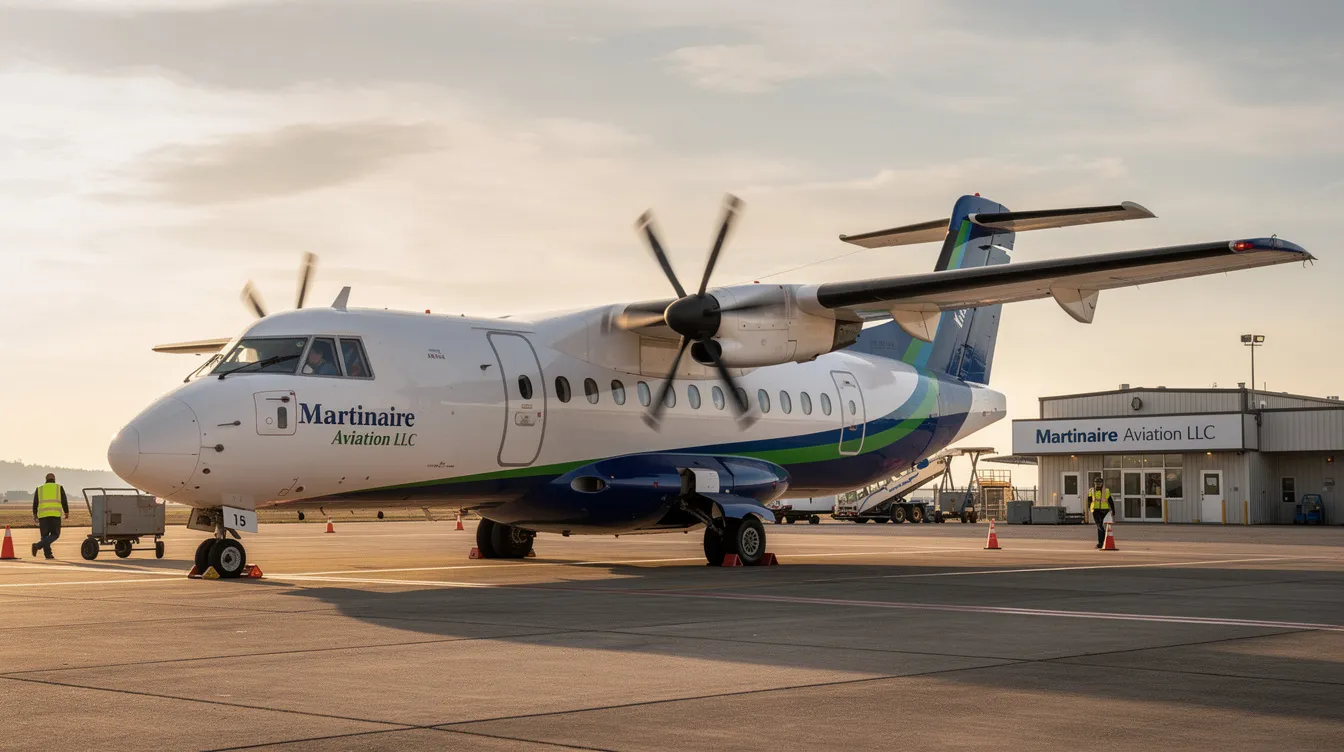
Martinaire Aviation LLC: Cargo Operations, Careers, and How It Compares to Private Charter
Martinaire Aviation LLC, founded in 1978, is a leading cargo feeder carrier in the U.S., specializing in overnight freight operations. With a fleet of turboprop aircraft, it connects regional airports to major sorting hubs, primarily serving integrators like UPS. This article explores Martinaire's operations, career opportunities, and how it contrasts with private charter services like Jettly.
Read More
5
min read
Alerion Aviation: Charter, Aircraft Management, and How Jettly Helps You Compare Options
Alerion Aviation is a premier boutique private aviation company specializing in aircraft management, on-demand charter, and in-house maintenance. With a strong safety record and a large fleet operating from key U.S. locations, Alerion offers personalized service for travelers and aircraft owners. Jettly enhances the experience by providing a digital marketplace for comparing charter options, ensuring travelers find the best fit for their needs.
Read MoreStay updated with our latest insights and tips to elevate your journey with us.
MEMBERSHIPS AND ASSOCIATIONS



Disclaimer: Jettly operates as a charter broker, offering access to a global digital jet charter marketplace. Jettly is not a direct air carrier and does not own or operate aircraft. All advertised flights are conducted by third-party air carriers that are fully licensed and hold the appropriate Part 135 or Part 121 certifications issued by the Federal Aviation Administration (FAA) or equivalent regulatory authorities under U.S. or foreign law. Jettly complies fully with the U.S. Department of Transportation's Part 295 and Part 298 Charter Broker regulations. Jettly does not carry additional liability insurance. Passengers are covered by aircraft operator insurance. TICO: 50023770


