


Login
Get Instant Pricing On 23,000+ Aircraft

>

Private jet leasing is increasingly popular among frequent flyers, corporate travel managers, and ultra-high-net-worth (UHNW) individuals seeking dedicated aircraft access without the capital burden of ownership. This guide is tailored for these audiences, providing a comprehensive overview of private jet leasing, key cost factors, comparisons with on-demand charter, and the unique role Jettly plays in offering flexible alternatives. Understanding private jet leasing is crucial for these groups because it enables informed decisions about travel efficiency, cost management, and operational flexibility—making it essential to carefully evaluate personal or business requirements, costs, and available options before deciding to lease or purchase a private jet.
Digital platforms now enhance the experience for clients by offering personalized management of bookings, itineraries, and real-time updates, making private jet leasing more client-centric than ever. Additionally, community and social networks play a growing role in helping individuals find private leasing opportunities through local contacts and community-based tools. Some free platforms allow private landlords to list rentals without additional costs, increasing visibility and attracting budget-conscious users. For business travelers logging 100 to 300 flight hours annually, a private jet lease can deliver predictable scheduling, consistent cabin configurations, and crew familiarity. But is it the right choice compared to on-demand charter or membership options? This guide breaks down how private jet lease agreements work, what they cost, and when platforms like Jettly offer a smarter alternative.
Leasing private means entering multi-month or multi-year contracts for exclusive aircraft access, typically requiring 50–100+ flight hours annually.
Lease duration significantly impacts costs: short-term leases generally have higher average hourly rates, while long-term leases can offer better cost efficiency.
Lease agreements may include restrictions or flexibility regarding destinations, which can impact your travel plans.
In 2026, annual lease costs start around USD 200,000–250,000 for light jets and can exceed USD 1 million for large-cabin aircraft like the Gulfstream G550.
Private leasing suits travelers flying 200–400 hours yearly on predictable routes, while those flying under 150 hours often benefit more from on-demand charter.
Jettly provides digital, on-demand charter and membership options as a flexible alternative to long-term leases, with access to 20,000+ aircraft and 5,000+ airports worldwide.
Compare leasing versus charter options and get instant quotes at jettly.com.
Leasing private refers to entering a multi-month or multi-year agreement to access a specific private jet or fleet without purchasing it outright. While the owner of an aircraft has full control over maintenance schedules, operational decisions, and interior configurations, a person leasing a jet does not have this level of autonomy. Owning a private jet provides full autonomy over operational decisions, including maintenance schedules and interior configurations, which are often limited in leasing agreements. Purchasing a private jet offers greater control and flexibility for the individual or person making the decision, but it comes with higher upfront costs, ongoing maintenance responsibilities, and exposure to depreciation. Leasing a private jet typically avoids the large upfront expenses, ongoing repairs, and depreciation costs associated with ownership, making it a more affordable choice for many travelers.
Typical lease terms run 24–60 months with minimum commitment requirements of 50–100+ hours per year. This structure suits corporations and ultra-high-net-worth individuals seeking predictable payments and guaranteed aircraft availability.
By contrast, on-demand charter through platforms like Jettly requires no long-term commitment. Travelers pay per trip, using tools such as Jettly’s private jet charter cost estimator to access the right aircraft for each mission without being locked into a contract. For a European pharmaceutical firm flying London–Zurich weekly (a 1.5-hour flight), a midsize lease might cost $400,000–$600,000 annually. A similar schedule via charter offers flexibility to adjust routes or aircraft as travel needs change.
Private jet lease programs are available in various formats to suit different preferences and needs, including options for short-term leases, long-term leases, and wet and dry leases. The lease process is finalized when both parties sign the lease agreement, making the terms legally binding.
Wet Lease vs. Dry Lease: In a wet lease, the leasing company supplies the aircraft along with the crew, maintenance, and insurance, while a dry lease includes only the aircraft, with the lessee responsible for hiring the crew and maintaining the jet.
Needs analysis: Brokers and clients should be carefully evaluating annual hours, core routes, and passenger needs to recommend suitable aircraft.
Aircraft selection: Choose from fleets ranging from turboprops to large-cabin jets based on mission profiles.
Wet vs. dry lease decision: Wet leases (90% of deals) include aircraft, crew, maintenance, and insurance. Dry leases provide only the airframe—meaning you are responsible for hiring the crew, maintaining the aircraft, and managing all operational duties.
Term negotiation: Standard lease agreements span 30–60 months with hourly allotments of 50–400 blocks. Overage charges typically run 1.5x the base rate.
Early termination penalties: Be aware that ending a lease early often incurs significant penalties, sometimes equal to the remaining lease balance.
Down payments: Leased aircraft generally require lower initial down payments compared to the 10–20% typically recommended for purchasing a vehicle or aircraft.
Delivery: The aircraft positions to your base with an entry-into-service inspection.
Always review contract details carefully to avoid unexpected costs or privacy issues.
Usage rules commonly require 24–72 hours' notice (longer during peak periods), minimum daily flight hours of 1.0–2.0 billable hours, and restrictions on non-revenue ferrying without lessor approval.
Choosing the right lease type matters as much as selecting the right jet. Here’s how options compare:
Short-term leases (3–11 months) suit seasonal needs—a sports team chartering for an NBA season might spend $300,000–$500,000 total. Long-term leases (24–60 months) provide stability for corporations needing consistent access.
Wet leases keep operations hands-off: the lessor handles crew training, safety oversight, and mechanicals. Dry leases transfer these responsibilities to the lessee, requiring Part 135 certification and exposing you to 20–30% higher insurance premiums.
|
Option |
Commitment |
Minimum Hours |
Cost Predictability |
Flexibility |
|---|---|---|---|---|
|
Private lease |
2–5 years |
50–400/year |
High (fixed payments) |
Low |
|
Jettly on-demand |
None |
None |
Variable (pay per trip) |
High |
|
12–24 months |
25–100 hours |
Moderate |
Moderate |
|
|
Fractional |
3–5 years |
50+ hours |
Moderate |
Low |
Understanding the main cost drivers is essential for anyone considering leasing private. Below is a summary table addressing the most common questions about private jet leasing:
|
Factor |
Details |
|---|---|
|
Lease Types |
Short-term leases (3–11 months), long-term leases (24–60 months), wet leases (aircraft + crew/maintenance/insurance), dry leases (aircraft only, lessee manages crew/maintenance) |
|
Typical Costs |
Annual: $500,000–$1,000,000+ depending on jet type and terms; Monthly: Light jets $75,000–$150,000, Midsize $200,000–$400,000, Large cabin $500,000–$700,000+. For a deeper context on the overall private jet lease cost, see how these ranges compare across contract structures and providers. |
|
Lease Duration & Flight Hours |
Short-term leases have higher hourly rates; long-term leases offer better cost efficiency. Exceeding annual hour limits incurs overage charges; underutilizing hours means paying for unused time. |
|
Advantages Over Ownership |
Avoids substantial upfront costs, ongoing maintenance, and depreciation. Predictable payments and no exposure to asset value fluctuations. Monthly lease payments are generally lower than loan payments for the same vehicle or aircraft model, but leasing results in continuous payments without building equity. Ownership allows for full control without restrictions on mileage or customization. |
|
Trade-Offs |
No equity is built; recurring payments do not contribute to ownership. At lease end, lessees own no asset and have no trade-in value. Early termination often incurs heavy penalties. Ownership requires higher initial costs, including larger down payments and higher monthly loan payments, but once a loan is fully repaid, the owner can use the vehicle or aircraft without further payments. Leasing limits customization and mileage, unlike ownership. |
Aircraft category impacts:
Light jets (Citation CJ3+): $75,000–$150,000/month
Midsize (Hawker 800XP): $200,000–$400,000/month
Large cabin (Gulfstream G550): $500,000–$700,000+/month
Contracted hours:
The number of hours contracted determines your effective hourly rate.
A 200-hour contract yields $2,500–$5,000/hour all-in, but overages add $4,000–$10,000/hour penalties.
Underusing your hours wastes 20–40% on fixed minimums.
Geographical factors:
Slot fees at major airports (e.g., Teterboro: $2,000–$5,000 per turn; Heathrow: £3,000+).
Remote operations can add $10,000+ in support costs.
Additional expenses:
Fuel surcharges (10–20% volatility)
De-icing ($1,000–$5,000/event)
Wi-Fi ($3–$5/mile)
Hangarage ($5,000–$20,000/month)
Crew overnight costs ($500–$1,000/night)
The following ranges reflect 2025–2026 market data. Actual quotes vary by operator and region.
|
Category |
Seats |
Range |
Monthly Lease |
Example Route |
|---|---|---|---|---|
|
Turboprop (PC-12) |
6–9 |
1,800 nm |
$12,500–$21,000 |
LA–Vegas (45 min) |
|
Light jet (CJ3+) |
6–8 |
1,500–2,000 nm |
$17,000–$33,000 |
NY–Miami (2.5 hrs)<br>Light jets are typically more economical, accommodating 6 to 8 passengers with a range of approximately 1,500 to 2,000 miles. They are ideal for short to mid-range flights and a great choice for those looking to save money or bank on affordability without sacrificing comfort or efficiency. |
|
Midsize (Hawker 800XP) |
7–9 |
2,000–2,800 nm |
$42,000–$67,000 |
Toronto–Vancouver (4.5 hrs)<br>Midsize jets, such as the Hawker 800XP, provide more space and range than light jets, seating 7 to 9 passengers and offering flight ranges of about 2,000 to 2,800 miles. |
|
Super-midsize (Challenger 350) |
10 |
3,200 nm |
$58,000–$83,000 |
NY–London (6.5 hrs) |
|
Large cabin (G550) |
12–16 |
6,750 nm |
$83,000–$125,000+ |
Transatlantic |
Certain models dominate private leasing due to reliability and efficiency.
Hawker Beechcraft 800XP: This midsize workhorse seats 8, flies 2,700 nm, and handles short-field operations (2,000-ft runways). Ideal for NY–Dallas in 3 hours.
Bombardier Challenger 605: Super-midsize with 9–12 seats, 4,000 nm range, and dispatch reliability above 99%. Lessees value the stand-up cabin height for NY–LA nonstops.
Pilatus PC-12: This turboprop carries 6–9 passengers 1,800 nm on single-pilot operations. Perfect for accessing remote airfields inaccessible to jets and illustrative of the variety of aircraft available in Jettly’s private charter aircraft fleet.
Dassault Falcon 7X: Large-cabin tri-jet with 5,950 nm range and fly-by-wire efficiency. Favored for transcontinental missions requiring short-field ability.
All these aircraft types are available through Jettly’s on-demand marketplace, allowing travelers to access similar cabins without lease agreements.
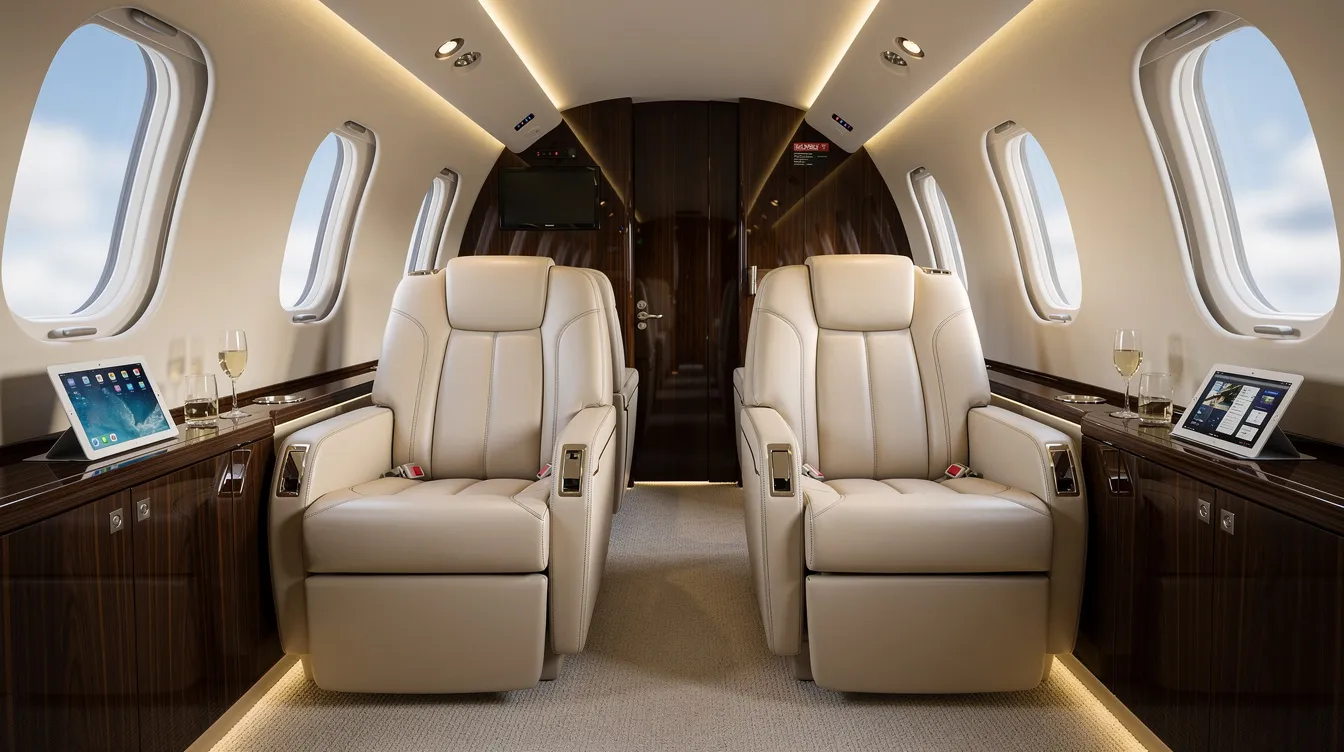
Many travelers considering leasing private can achieve similar benefits using an on-demand charter through Jettly. The key difference lies in commitment level, financial implications, and the quality and range of services provided by private jet operators, which are crucial for enhancing the customer experience.
Leases lock you into 2–5 year contracts with fixed annual hours. Jettly allows booking trips by trip, including one-way flights and empty-leg and shared-seat deals at 30–75% savings.
Practical example: A business traveler flying 60–80 hours annually on routes like New York–Miami may spend $300,000–$500,000 via Jettly charter. A comparable lease with minimum hour requirements could cost $500,000+ before accounting for unused capacity.
Jettly offers access to 20,000+ aircraft worldwide with instant price estimates and transparent digital booking. Travelers gain the ability to match aircraft to each mission rather than flying one jet for every trip. Trips can be customized for short-term needs, spontaneous travel, or longer journeys, maximizing value and efficiency. After you land at your destination, private jet companies like Jettly often arrange ground transportation—such as car rentals or limousine hire—to ensure a seamless transition from air travel to land travel. For frequent flyers who want flexibility without long commitments, Jettly’s private jet memberships can complement or replace a lease. For those who value the personal touch of familiar crew, leasing wins—but for flexibility, Jettly delivers.
Leasing private fits specific usage profiles rather than casual travel needs.
Ideal candidates include:
Companies and corporations flying 200–400 hours yearly on repeat routes, benefiting from leasing options tailored to their corporate travel needs and tools like Jettly’s airport locator platform to streamline route planning
Governments and sports teams with predictable schedules
UHNW families wanting consistent cabin configurations and crew
Example scenario: A European corporation commuting weekly between Frankfurt and Dubai (a 6-hour flight) benefits from lease predictability. A North American medical group needing rapid access to remote communities values guaranteed short-notice availability.
Decision thresholds: Consider leasing if you fly 200+ hours annually, want branded livery, and prefer keeping aircraft off your balance sheet versus owning outright.
Travelers flying under 150 hours yearly typically gain more flexibility and lower risk using Jettly’s charter or rent options for private jets, allowing for flexible, short-term usage. Those evaluating renting versus leasing can review a broader guide to affordable airplane rental options before committing. Consult a tax professional to understand how lease terms affect your business deductions.
Once committed to a lease, structuring the agreement correctly saves money and should be informed by benchmarks on how much it costs to rent a private jet.
Negotiate inclusive hourly rates ($3,000–$8,000 all-in) covering fuel, crew, and landing fees
Match contracted hours precisely to expected usage—220 versus 200 hours could save $50,000, especially when you understand the full picture of how much a private jet really costs
Build seasonal flexibility for peak periods with extra hour blocks
Clarify repositioning charges, daily minimums, and fuel surcharges upfront
Consider combining a lease with occasional Jettly charter for overflow missions. This hybrid approach optimizes fleet use without overpaying for capacity. Some providers also offer premium account options that provide access to market rates, set hours, or price guarantees, delivering flexibility and personalized service for clients seeking more tailored solutions. Tax and accounting advice matters—U.S. Section 168(k) depreciation may apply to improvements, while EU operators can reclaim VAT on business use.
Business leaders comparing multiple providers may benefit from a broader look at the best private jet charter companies before finalizing a lease strategy.
For personalized consultation or assistance with leasing private jets, contact our team today.
Sustainability concerns are reshaping private aviation in 2026. Modern aircraft like the Pilatus PC-12 (150 gph fuel burn) offer significant efficiency advantages over older large-cabin jets consuming 250+ gph.
Sustainable Aviation Fuel (SAF) adoption is growing, with 5–20% blends cutting CO2 emissions by up to 80% at a $1–$2/gallon premium, and even in-flight services such as private jet catering through Jettly Eats are evolving to support more efficient, globally coordinated operations. Carbon offset programs through standards like Gold Standard provide additional options, and leading operators such as NetJets and similar private aviation leaders increasingly highlight sustainability initiatives alongside traditional service benefits.
Platforms like Jettly enable travelers to choose efficient aircraft and routes on a trip-by-trip basis. This flexibility often proves more environmentally responsible than flying an oversized leased jet on every mission and aligns with strategies for affordable private jet charter that reduce waste and unnecessary repositioning.

No. Leasing becomes cost-effective at 200–300 hours annually ($2,500/hour effective vs. $5,000 charter). Below 150 hours, Jettly typically wins. A 250-hour annual lease might cost $600,000 fixed, while a pay-per-trip charter totals $400,000 for the same missions. Always analyze real trip data before signing a contract.
Most lease programs require 24–72 hours' notice, with 48+ hours on peak days. Some guarantee 4–6 hour notice except on 10 designated peak days. Jettly often accommodates same-day bookings when aircraft and crew are available.
Subleasing is heavily regulated. Wet leases typically prohibit third-party charter; dry leases require operator certification. For some flyers, understanding how renting a plane works can clarify when short-term rental or charter is preferable to subleasing. Using Jettly for demand overflow is simpler than trying to offset lease costs through ad-hoc rental income. Seek legal advice before planning revenue generation from a leased vehicle.
Wet leases place safety responsibility on the operating carrier, which manages crew training and regulatory compliance. Dry leases require the lessee to partner with or become an approved operator. Prioritize ARGUS or Is-BAO certified operators and consult broader overviews of private charter airlines and operators when benchmarking providers. Jettly works exclusively with licensed, vetted operators, removing this burden from travelers.
Estimate annual flight hours and list core routes (e.g., NY–Miami, LA–Vegas). If travel is irregular, multi-city, and often one-way, Jettly’s on-demand access and empty-leg deals likely deliver better value, particularly as a NetJets alternative for those comparing against fractional ownership. Frequent flyers with 200+ hours and stable patterns should model both options, including all fixed and variable expenses. Search live charter pricing at jettly.com before committing.
Leasing private offers predictable access and cost structure for high-usage travelers, but it requires a multi-year commitment and careful contract review. Many business and leisure travelers achieve similar convenience through Jettly’s global on-demand charter marketplace and extensive private charter aircraft selection without long-term obligations.
Align your choice with actual travel patterns, budget constraints, and appetite for operational responsibility. For many, exploring charter and membership options is the smarter way to experience the benefits of leasing private, with the flexibility to adapt as travel needs evolve.
Ready to fly on your terms? Explore flight options or request a personalized quote at jettly.com.
Share this post:
Jay Franco Serevilla
Apr 22, 2026
|
5
min read
Discover tips and trends in the industry.

5
min read
AA1526: American Airlines Flight Number Guide & Private Charter Alternatives
AA1526 is an American Airlines flight number that has served various domestic routes, including Charlotte to Nashville and Charleston to Philadelphia. This guide provides insights into the flight's history, current operations, and compares commercial travel with private charter options through Jettly, highlighting the benefits of flexibility and convenience for travelers.
Read More
5
min read
Selling Aircraft: A Practical Guide to Smooth, Successful Transactions
Selling an aircraft in 2026 requires careful preparation, accurate pricing, and thorough documentation. This guide outlines the entire process from valuation to closing, helping sellers maximize their sale price while minimizing delays and risks. Understanding the modern aviation sales landscape and leveraging digital platforms can significantly enhance the selling experience.
Read MoreStay updated with our latest insights and tips to elevate your journey with us.
MEMBERSHIPS AND ASSOCIATIONS



Disclaimer: Jettly operates as a charter broker, offering access to a global digital jet charter marketplace. Jettly is not a direct air carrier and does not own or operate aircraft. All advertised flights are conducted by third-party air carriers that are fully licensed and hold the appropriate Part 135 or Part 121 certifications issued by the Federal Aviation Administration (FAA) or equivalent regulatory authorities under U.S. or foreign law. Jettly complies fully with the U.S. Department of Transportation's Part 295 and Part 298 Charter Broker regulations. Jettly does not carry additional liability insurance. Passengers are covered by aircraft operator insurance. TICO: 50023770


