


Login
Get Instant Pricing On 23,000+ Aircraft

>
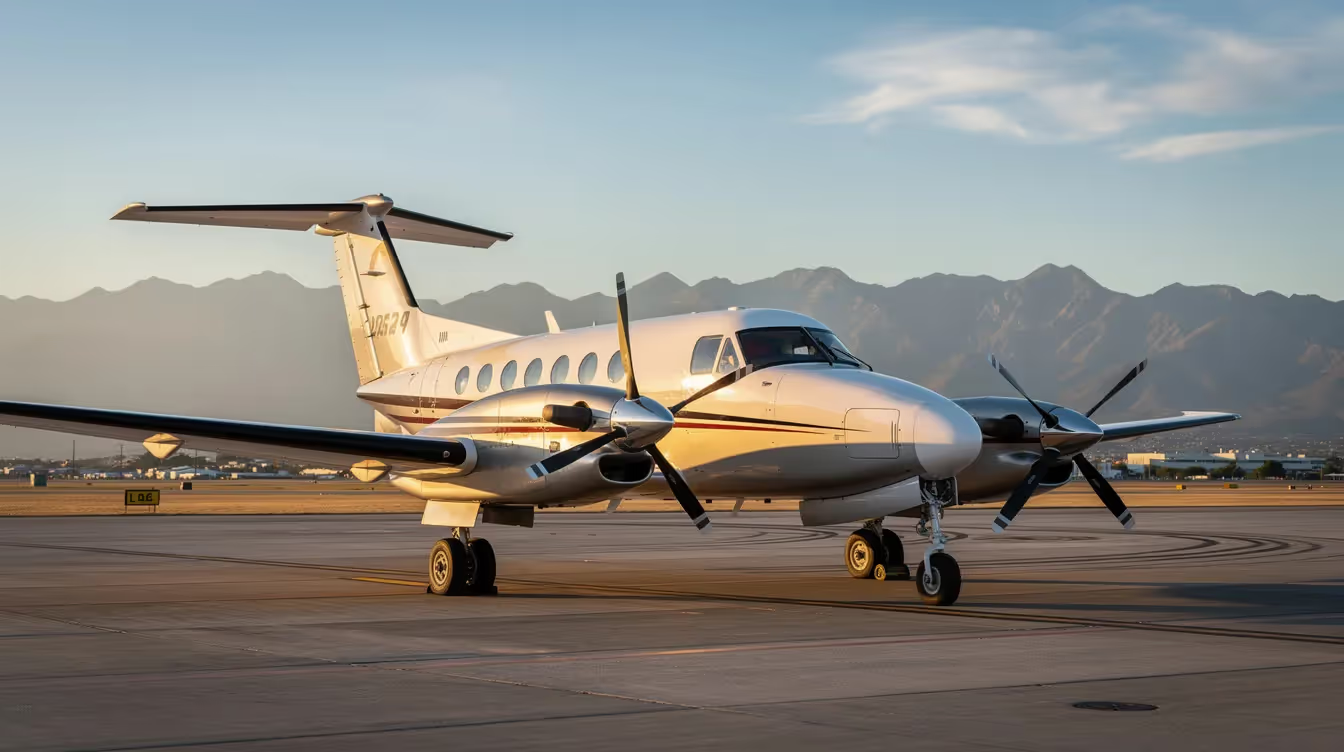
Are you a prospective King Air buyer, a charter client considering your next trip, or an aviation enthusiast interested in the world’s most popular turboprop? This guide is designed specifically for you. Understanding the nuances of King Air sales, current pricing, and available alternatives is crucial—whether you’re evaluating a purchase, comparing ownership to charter, or simply following the latest trends in private aviation. With dozens of active listings spanning models from the 1960s to today’s factory-new aircraft, knowing what drives value, how to assess listings, and when to consider charter access can save you significant time and money. Many listings also offer buyers’ choice in features such as paint schemes or interior finishes, allowing for customization to suit your preferences.
Beechcraft King Air models from 1968 to 2026—including the C90, King Air 200, King Air B200, King Air 250, King Air 300, King Air 350, and King Air 360—are actively trading on the secondary market, with dozens of listings available globally as of May 2026.
Pre-owned King Air prices in 2026 typically range from about $630,000 for older C90/E90 models to $7,100,000+ for late-model King Air 350i/360 aircraft, depending on year, total time, avionics, and maintenance programs.
Many travelers do not need to buy a King Air at all. Jettly’s charter platform provides on-demand access to King Air fleets worldwide with transparent pricing and no long-term ownership commitments.
The most searched variants are the King Air 200/B200, King Air 250, King Air 300, and King Air 350/350i, covering use cases from regional business trips to special mission and medevac operations.
This article walks through current market examples, pricing benchmarks, and how to decide between purchasing and chartering a Beechcraft King Air via Jettly.
The Beechcraft King Air line represents the world’s longest continuously produced turboprop aircraft, with initial deliveries beginning in 1964. The Beechcraft King Air family has maintained turboprop market leadership for over six decades, known for its reliability and operational flexibility across various missions, including corporate transport and air ambulance services. Today, Textron Aviation continues production with the King Air 260 and King Air 360 at its Wichita facility.
As of May 2026, you can find pre-owned and new Beechcraft King Air turboprop aircraft for sale across several specialized aviation networks. Listings span everything from 1970s C90/B90 and 1980s F90/King Air 200 models to nearly new 2020–2026 King Air 250, King Air 350i, and King Air 360 aircraft. The Beechcraft King Air line comprises several models that fall into two families: King Air (Model 90 Series and Model 100 Series) and Super King Air (Model 200 Series and Model 300 Series). The King Air line is divided into three primary series (90, 200, and 300/350), each offering distinct performance profiles. One-owner King Airs are particularly sought after for their well-documented maintenance history and ownership stability, often commanding a premium in the market.
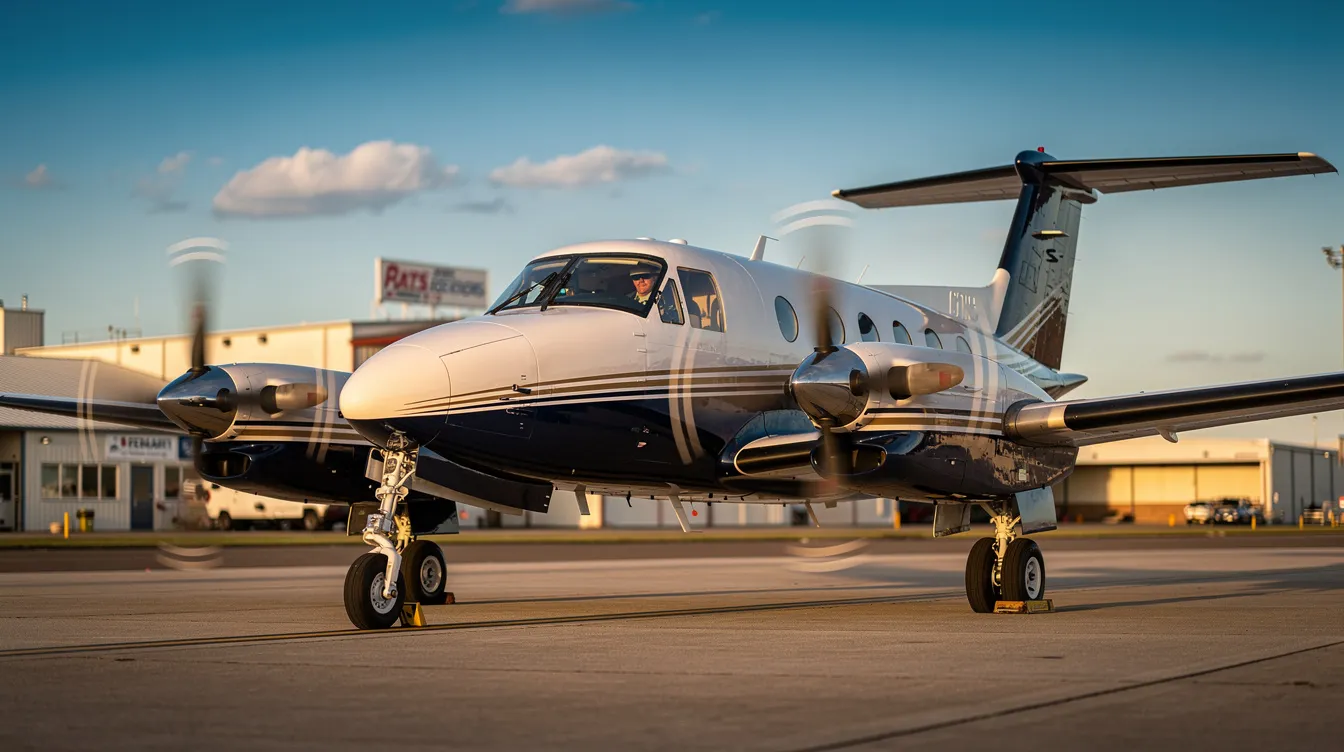
These aircraft serve diverse missions in 2026: executive charter, corporate shuttles, air ambulance, cargo, and special mission roles, including ISR and survey work, and they compete with other cross-country planes for long-distance travel in the broader private aviation market. King Air aircraft are recognized for their strong residual value retention, typically maintaining 40-50% of their original value after 15 years, reflecting their proven utility and sustained market demand. Jettly gives charter clients access to many of these same models on demand through its global private charter aircraft network, with King Airs operating in North America, South America, Europe, Africa, and Australia, alongside other providers highlighted among the best private jet charter companies.
Current listings for Beechcraft King Air aircraft range from approximately $630,000 to $7,100,000, depending on the model and specifications. The average pricing for King Air aircraft is around $2,354,322, reflecting strong market liquidity and residual values. Here’s what buyers can expect across the major segments, and how King Air pricing fits within broader private jet cost benchmarks:
|
Model Segment |
Typical Price Range (2026) |
Key Features & Notes |
|---|---|---|
|
C90/E90/B90 |
$630,000 – $3,700,000 |
Older models with Garmin upgrades, fresh inspections |
|
King Air 200/B200 |
$1,350,000 – $3,400,000 |
Blackhawk engine upgrades, Garmin G1000, Raisbeck kits |
|
King Air 250 |
$3,500,000 – $4,000,000 (approx.) |
BLR winglets, Pro Line 21 avionics, dual aft strakes |
|
King Air 300 |
$1,795,000 – $1,950,000 |
Limited production, PT6A-60A engines, larger cabin |
|
King Air 350/350i |
$2,700,000 – $7,100,000+ |
Versatile, high-performance, extended-range options |
|
King Air 360 |
$8,000,000+ (new) |
Flagship model, Pro Line Fusion avionics, autothrottles |
Each price reflects value drivers: total time, engine programs (ESP pro parts, JSSI engine program, MORE), avionics (Garmin G1000NXi, GTN 750Xi, Collins Pro Line Fusion with auto throttle engines enrolled), interior refurbishment dates, and mission-specific modifications like wing lockers or hi-flotation gear, all of which also appear in many affordable private aircraft options beyond the King Air family.
Understanding the most commonly searched models helps buyers narrow their search efficiently.
The Beechcraft Super King Air 200 has a maximum takeoff weight of 12,500 lb (5,670 kg) and an empty weight of 7,755 lb (3,520 kg). The King Air 200 features a cruise speed of 289 knots (333 mph, 536 km/h) and a maximum speed of 294 knots (339 mph, 545 km/h). It is powered by Pratt & Whitney Canada PT6A-41 engines rated at 1,015 shp, providing a strong rate of climb of 2,450 ft/min (12.5 m/s). One of the King Air’s greatest strengths is its ability to access shorter, unimproved runways that light jets cannot use. Many 1980–2001 B200 listings and modern King Air 200 charter options show Garmin G1000, Blackhawk PT6A upgrades, and Raisbeck swept blade props.
An evolution of the B200GT with BLR winglets, composite scimitar props, and improved hot-and-high performance. Examples from 2014–2019 typically feature Collins Pro Line 21 or Fusion avionics, dual aft body strakes, and ADS-B out compliance. Prices cluster in the high-$3M range for well-equipped aircraft with excellent pedigree.
A higher-power stretch of the 200 series with more cabin volume and speed, featuring PT6A-60A engines. Real listings show late-1980s King Air 300 examples around $1,795,000–$1,950,000, though limited production (63 built) can make parts sourcing challenging.
The King Air 350 model is known for its versatility, high performance, and spacious cabin, making it suitable for various missions, including corporate transport and air ambulance services. Executive interiors accommodate 8–11 passenger configurations, with extended range versions reaching 2,000+ nm. The largest and fastest models in the King Air series, the 360 and 350i, have an 11-seat capacity and modern features. Examples from 1999–2019 range from roughly $2,700,000 to over $7,000,000.
The current-production flagship features Pro Line Fusion touchscreen avionics, digital pressurization, IS&S ThrustSense autothrottles, and ESP Pro engine programs. Aircraft from 2021–2026 appearing on the market tend to be low-time corporate machines sold “price on request,” with Canadian ownership examples and charter-operated history available.

Key features to consider when purchasing a Beechcraft King Air include its renowned reliability, versatile payload, and ability to use short runways on paved runways worldwide. Here are the critical evaluation points:
Airframe and engine time: Listings show wide variation—8,024 hours on a 1999 King Air B200 versus 955 hours on a 2019 King Air 350i. Total time, cycles, and hours since overhaul or hot-section inspection materially affect value. Engines can represent up to 80% of an aircraft’s value, making engine condition paramount.
Maintenance status and programs: Look for CAMP tracking, MORE and ESP programs, or JSSI engine program enrollment. Phase 1 through Phase 4 inspections (Beech’s 600-hour/12-month checks), 6-year landing gear overhauls, and prop overhauls reduce near-term expenses. Aircraft with landing gear inspection completed and a recent phase inspection are more attractive.
Avionics and compliance: Upgrades such as Garmin G1000 SVS, G600TXi, GTN 750Xi, Collins Pro Line 21/Fusion, ADS-B out, WAAS LPV approaches, TCAS II, and synthetic vision add hundreds of thousands in market value. When planning typical routes and field limitations, a dedicated airport locator tool is helpful. Landing lights, entry door condition, and air conditioning systems should also be inspected.
Modifications and performance kits: Raisbeck dual aft body strakes, wing lockers, BLR ultimate performance package winglets, Blackhawk engine upgrades, Hartzell 4-blade or five-blade MT props, and flotation gear enhance performance. These appear frequently on 1978–1981 C90 and 200 series aircraft.
Interior, paint, and mission fit: Fresh interior refurbishment (2022–2025) with leather and LED lighting adds $100,000–$200,000 in value. Many listings offer the buyer's choice for features such as paint schemes, interior materials, or equipment, allowing customization to individual preferences. Medical interiors, cargo doors (B200C/350), and special-mission wiring can be advantageous or limiting depending on the buyer’s choice. Verify known damage history and damage history disclosures.
Pre-buy inspection: The King Air brand benefits from a comprehensive global support infrastructure provided by Textron Aviation, which includes over 400 authorized service centers worldwide, ensuring unmatched maintenance accessibility for operators. Corrosion inspection is critical as the fleet ages and should be done before engine borescopes. Commission inspections at centers like Stevens Aviation or Elliott Aviation ($15,000–$25,000), reviewing complete logbooks and AD/SB compliance, and considering how Textron compares with other leading private plane manufacturers, if you are still deciding on a brand.
Operating costs for the King Air 200 and 250 models typically range from $1,600 to $2,000 per flight hour. These costs include fuel, crew, maintenance reserves, insurance, and hangar fees. The larger King Air 350i and 360 models have higher operating costs, estimated between $2,000 and $2,500 per hour, reflecting their increased size and capabilities.
Annual fixed costs for owning a King Air can vary widely, typically ranging from $700,000 to $1.5 million depending on the model. These fixed expenses cover crew salaries, hangar space, insurance, training, and other non-flight-hour-related costs. Engines alone can represent up to 80% of an aircraft's value, emphasizing the importance of maintenance and overhaul status in the total cost of ownership.
Deciding between outright purchase and on-demand charter access requires an honest assessment of your travel patterns and a clear view of typical private jet charter pricing.
Ownership case: Acquisition budgets range from under $1,000,000 for older C90/E90 models to $7,000,000+ for modern King Air 350i/360 aircraft. Annual fixed costs for owning a King Air can range from $700,000 to $1.5 million, depending on the model, before any flight hours are logged. This includes crew salaries, hangar, insurance, and training.
Utilization thresholds: Operating costs for the King Air 200/250 typically range from $1,600 to $2,000 per flight hour, which includes fuel, crew, maintenance reserves, insurance, and hangar costs. The King Air 350i/360 has higher operating costs, estimated between $2,000 and $2,500 per hour, reflecting its larger size and capabilities. A dedicated private jet charter cost estimator can help translate these ownership numbers into equivalent charter budgets. Full ownership begins to make economic sense at 200–300+ flight hours per year—many private travelers and families fly far less.
Jettly’s charter value: Global access to thousands of turboprops and jets, including King Air 200, King Air 250, and King Air 350 models. Instant online quoting, transparent per-trip pricing, and optional private jet memberships with no requirement for traditional jet cards or long-term contracts.
Superior charter use cases: Ad-hoc business trips like New York–Toronto, Los Angeles–Las Vegas, or Toronto–Vancouver; seasonal family holidays; medical or last-minute travel where speed matters more than asset ownership.
Fleet flexibility: With Jettly, travelers can choose a King Air for short regional legs but switch to a light or midsize jet for longer missions, rather than being tied to a single owned aircraft—an approach that fits within the broader charter airlines and private aviation landscape.
Benchmarking tool: Readers interested in King Airs for sale can use Jettly to model real charter costs, including via its jet card flight cost estimator, helping determine whether a King Air 200, King Air 250, or King Air 350 purchase is financially justified versus on-demand access.
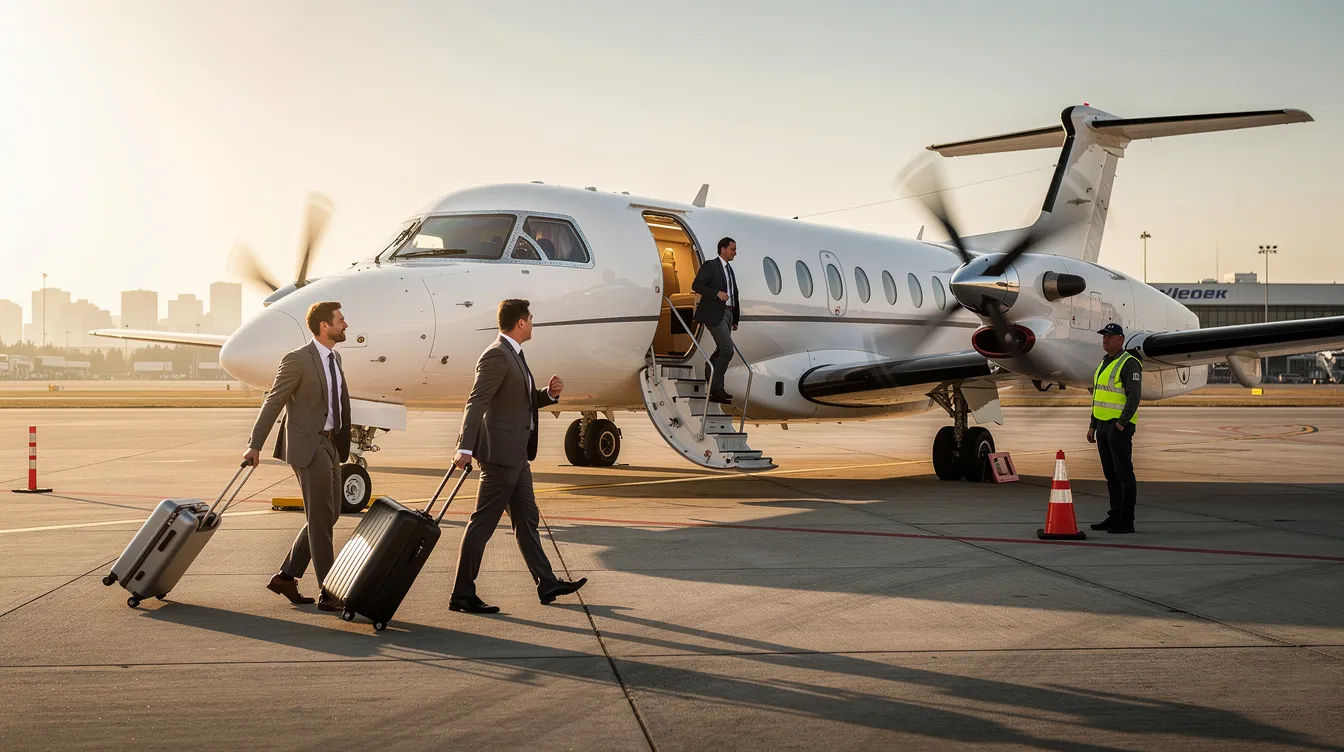
Jettly operates as a digital private jet charter marketplace—not an aircraft dealer—with access to 20,000+ aircraft worldwide, including numerous Beechcraft King Air turboprops.
Search and instant pricing: Users input routes (Dallas–Miami, London–Geneva, Johannesburg–Cape Town), dates, and passenger counts, then filter for turboprops or King Air equivalents to view live or near-live estimates.
Membership and on-demand options: Travelers can use the platform on a pay-per-flight basis or select membership tiers that reduce per-trip fees while maintaining transparency and avoiding traditional jet card program lock-ins, making it easier to compare these options with a more detailed overview of how jet cards work and what they cost.
Safety and operator standards: King Air flights sourced through Jettly are operated by licensed air carriers, such as featured partners like Dexter Air Taxi, under regulations comparable to FAA Part 135 or EASA AIR OPS, with audits, pilot minimums, and current maintenance records.
Trip extras: Coordinate catering, ground transportation, and special configurations (cargo, medevac-style layouts, extra baggage for sports and film crews, crew accommodation) or even explore crowdsourced and shared private flights on applicable King Air aircraft with appropriate cabin capacity and range, while dedicated services like Jettly Eats in-flight catering can further enhance the onboard experience.
Ready to explore King Air 200, King Air 250, or King Air 350 charter options? Learn more or request pricing at https://www.jettly.com.
Many 1970s–1980s King Airs legitimately show 9,000–12,000+ hours (for example, a 1979 C90 with 12,585 hours) and can still be airworthy if maintained properly, especially when combined with smart strategies for booking the cheapest private jet flights if charter is part of your overall travel mix. Buyers should focus on recent overhauls, engine programs, and corrosion inspections rather than total time alone.
For those prioritizing resale value, targeting aircraft with moderate time and strong maintenance records—sub-10,000-hour airframes with engines mid-cycle and up-to-date inspections—offers a good balance, while others may opt to buy just a seat on a private jet instead of committing to full aircraft ownership. Always commission a pre-buy inspection at a Beechcraft/King Air specialist facility to interpret time and cycles in context.
Both King Air 200/B200 and King Air 250 excel on 300–800 nm regional legs, and either can be suitable for international private jet flights when configured and crewed appropriately. However, the King Air 250’s BLR winglets, composite props, and performance kits improve climb rate, runway performance, and fuel efficiency.
Buyers with frequent hot-and-high operations or short runways may prefer the King Air 250, while budget-conscious operators find strong value in well-upgraded B200 or B200GT models. Jettly users can test both types via charter on real routes (Denver–Santa Fe or Milan–Geneva) before committing to purchase, using many of the same strategies described for getting a seat on a private jet easily.
Many King Air 200, King Air B200, and King Air 350 aircraft have been converted for air ambulance or special mission roles. Features include cargo doors (B200C/350), stretcher systems, oxygen, vacuum, and dedicated power supplies.
Some listings show existing medevac or ISR-ready platforms (such as 1979 King Air 200 special mission aircraft), saving substantial conversion time and cost. Prospective operators should work with certification firms familiar with King Air STCs and local regulations. Jettly can often provide charter access to mission-equipped King Airs while permanent solutions are planned, giving operators a flexible alternative to large fractional providers such as NetJets and similar industry leaders, especially for those evaluating detailed NetJets card costs and pricing structures against on-demand charter.
Charter clients pay only for flight hours and selected services, avoiding capital outlay and annual fixed costs like hangar, crew salaries, insurance, and training that can collectively reach $700,000 to $1.5 million per year for an owned King Air, whether they choose shared charter flights or full charters for their trips.
For travelers flying fewer than roughly 150–200 hours per year, charter through a platform like Jettly is usually more economical—especially when factoring in depreciation and unexpected maintenance events on older King Airs. Request sample King Air 200 or King Air 350 charter quotes from Jettly on your most common routes to build a direct comparison against projected ownership budgets.
Well-maintained King Air C90, C90A/C90B, and E90 aircraft remain popular entry-level turboprops, with 1970s–1990s examples often priced between $585,000 and $1,800,000 depending on upgrades and condition.
Many have received modern avionics (Garmin G600TXi, GTN 750Xi), Raisbeck performance modifications, and fresh Phase 1–4 inspections, significantly enhancing capability despite aircraft age. Pay close attention to corrosion history, spar inspections, and retrofit quality. Chartering a newer King Air 250 or 350 via Jettly can be a lower-risk alternative for those uncertain about committing to an older airframe in the USA market or internationally, especially when viewed as a NetJets alternative for flying private at lower cost or compared with other cheapest private aircraft options that might suit different budgets.
The market for King Airs for sale spans everything from sub-$1,000,000 C90/B90S to multi-million-dollar King Air 350i and 360 aircraft with modern avionics and low airframe time.
Key evaluation factors when shopping: year of manufacture, airframe and engine time, avionics suite (Garmin G1000 or Pro Line Fusion), maintenance status, and mission-specific equipment such as cargo doors, medevac interiors, or international aircraft marketing history.
Compare the full cost of ownership—including service, paint, fuel burn, and depreciation—against realistic annual flight hours. Many travelers are ultimately better served by flexible King Air charter access through a platform like Jettly, whether they’re flying regional sectors in India, such as private jet charter in Kolkata, or city pairs like private jet charter in Houston, or similar routes elsewhere.
Jettly offers transparent pricing, digital booking, and broad King Air availability across other aircraft categories, from private jet charter in Chennai to transcontinental and international missions, as well as dedicated services like private jet charter in Bangalore. Whether you need to fly short regional hops or search for sell-side market data, charter quotes help validate ownership assumptions.
Ready to experience private travel on your terms? Whether you’re planning routes like a private jet charter to New Delhi or regional hops closer to home, including private jet charter in Islamabad, explore flight options or request a quote at https://www.jettly.com.
Share this post:
Jay Franco Serevilla
May 12, 2026
|
5
min read
Discover tips and trends in the industry.
5
min read
Hawker Beechcraft: Aircraft Family, History, and Charter Insights
Hawker Beechcraft, a prominent name in private aviation, combined the legacies of Beechcraft and Hawker to produce a diverse fleet of business jets and turboprops. Although the company no longer exists, its aircraft continue to operate globally, supported by Textron Aviation. This guide explores the history, aircraft families, and charter options available through platforms like Jettly.
Read More
5
min read
British Aerospace BAe 146: Overview and Charter Guide
The British Aerospace BAe 146, known as the 'Whisperjet,' is a versatile regional jet designed for short runways and noise-sensitive airports. With a capacity ranging from 70 to 112 passengers, it serves various roles including passenger transport, cargo, and specialized missions. This guide provides insights into the BAe 146's history, design, operational capabilities, and charter options for travelers seeking access to challenging airports.
Read MoreStay updated with our latest insights and tips to elevate your journey with us.
MEMBERSHIPS AND ASSOCIATIONS



Disclaimer: Jettly operates as a charter broker, offering access to a global digital jet charter marketplace. Jettly is not a direct air carrier and does not own or operate aircraft. All advertised flights are conducted by third-party air carriers that are fully licensed and hold the appropriate Part 135 or Part 121 certifications issued by the Federal Aviation Administration (FAA) or equivalent regulatory authorities under U.S. or foreign law. Jettly complies fully with the U.S. Department of Transportation's Part 295 and Part 298 Charter Broker regulations. Jettly does not carry additional liability insurance. Passengers are covered by aircraft operator insurance. TICO: 50023770


