


Login
Get Instant Pricing On 23,000+ Aircraft

>
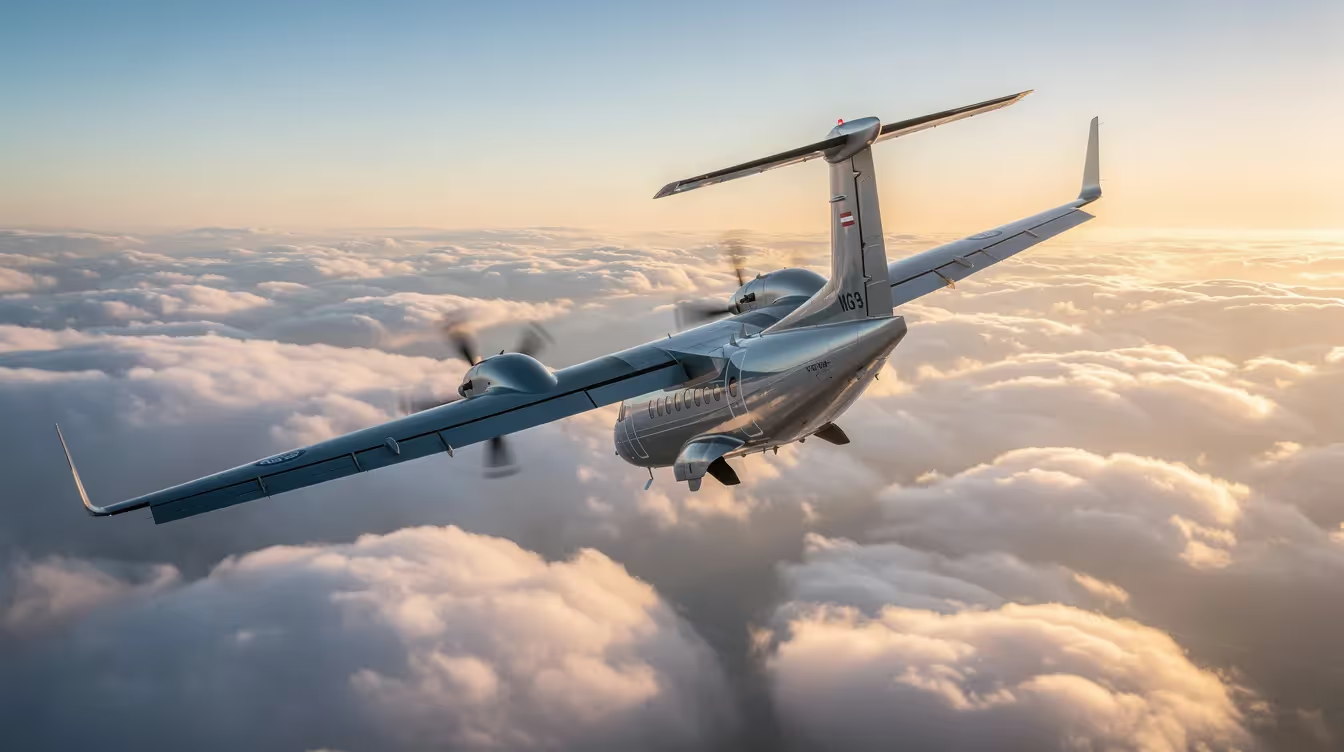
The King Air C90GTx represents one of the most practical choices in private aviation for regional charter travel. This twin-engine turboprop combines proven reliability with modern avionics, offering access to smaller airports that many jets simply cannot reach. For travelers seeking cost-effective private flights through platforms like Jettly, the C90GTx delivers a compelling balance of capability and economy within a market that includes many of the best private jet charter companies, and those referring clients to these services can benefit from Jettly’s ULTRA high ticket affiliate program.
Range: The Beechcraft King Air C90GTx is a twin-engine turboprop ideal for regional charter trips of 800–1,100 nm, comfortably seating 4–6 passengers in typical executive configurations.
Cruise Speed: Core performance figures include a normal range around 1,152 nm, a typical cruise of approximately 272 knots, a service ceiling of 30,000 ft, and a fuel capacity of about 384 gallons.
Avionics & Engines: The aircraft features Collins Pro Line Fusion avionics and PT6A-135A turboprop engines, each delivering an average power output of 550 shp, combining modern cockpit technology with time-tested powerplants, and is certified for single pilot operation.
Useful Load: With a maximum takeoff weight of 10,485 lb and an empty weight of around 7,265 lb, the C90GTx provides an average useful load of over 3,200 lb, though payload is reduced when carrying full fuel.
Short-Field Performance: Short-field performance—takeoff from runways as short as 1,984 feet and landing distance of approximately 2,100 feet—enables access to airports unavailable to light jets.
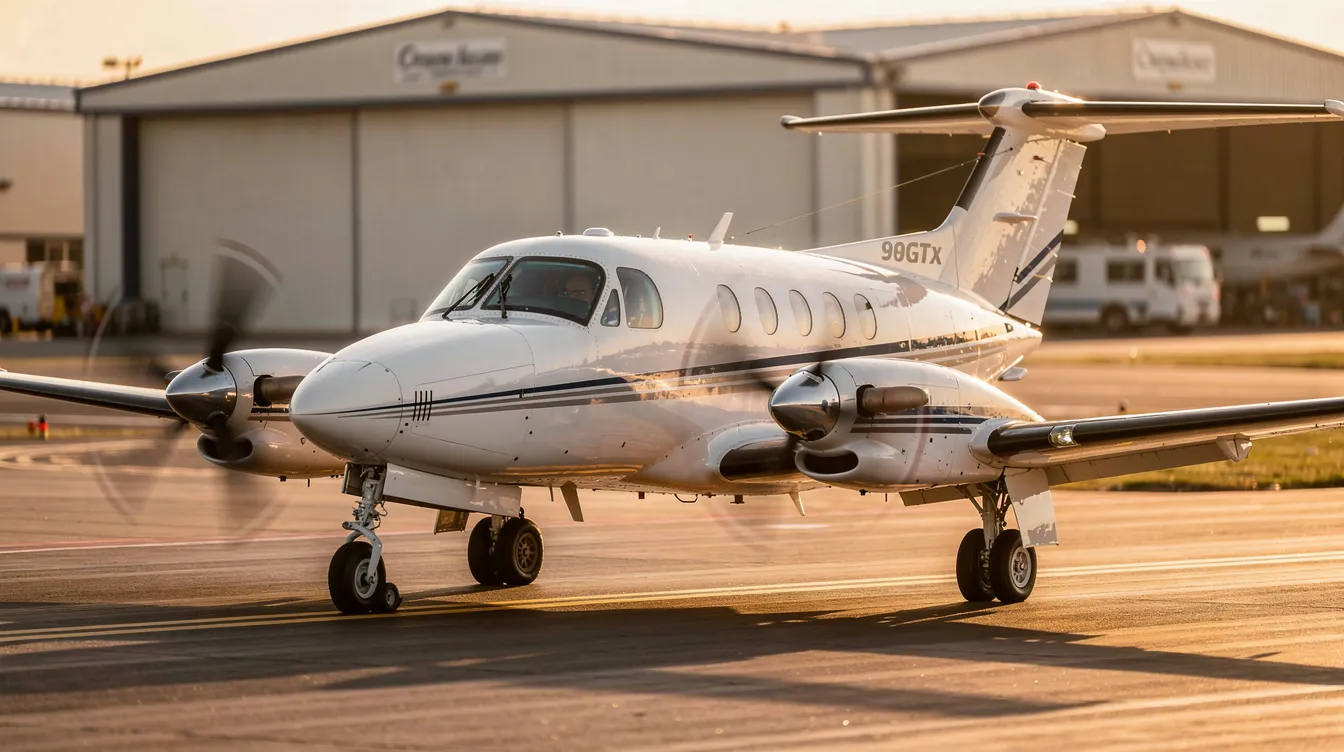
The Beechcraft King Air family has been in continuous production since 1964, making it the longest continually produced civilian aircraft in its class and a notable presence alongside some of the best private jets in the world. The C90GTx, introduced in 2010 as a direct development of the C90GTi, brought factory-installed winglets, increased MTOW, and improved payload flexibility to the proven 90-series platform.
As part of the broader Beechcraft King Air line, which has seen more than 3,100 aircraft delivered since the mid-1960s, the C90GTx benefits from decades of operational refinement. Textron Aviation, the parent company of Beechcraft, provides manufacturer support and technical data for the King Air series, and features prominently among the best private plane manufacturers for every budget and need. This King Air aircraft serves as an entry-level twin-turboprop frequently deployed by on-demand charter operators, air taxi services, and small corporate flight departments, many of which operate under Part 135 charter company regulations, and is especially popular in business aviation. Production continued through the 2010s, with model years from 2010 to 2020 commonly available on the market. The aircraft is designed for comfort and multi-mission versatility rather than raw speed, making it ideal for regional, multi-mission travel due to its ruggedness, short-runway performance, and lower operating costs compared to light business jets, characteristics often highlighted among top affordable private aircraft options.
The King Air platform has also served military operators worldwide. The Japan Maritime Self-Defense Force has operated a total of 40 C90 and C90A King Airs since 1973, including 34 TC-90 trainers and five LC-90 transports. The U.S. military has employed King Air 90s in multiple capacities, including VIP and liaison transport, under designations such as VC-6A, T-44 Pegasus, and U-21 Ute. The T-44A Pegasus, a trainer version, was used by the U.S. Navy to train pilots from 1977 to 1980, with a total of 61 delivered.
The air C90GTx features an all-metal, low-wing, pressurized design with a T-tail and factory-installed winglets that distinguish it from previous models in the 90-series. As a twin-turboprop aircraft type, the King Air C90GTx's fuselage incorporates a square-oval design that provides more head and shoulder room than typical light jets.
|
Specification |
Measurement |
|---|---|
|
Length |
35 ft 6–7 in |
|
Height |
14 ft 3 in |
|
Wing span |
53 ft 8–9 in |
|
Wing Area |
~295 sq ft |
The empty weight sits around 7,265 lb with a maximum gross weight of 10,485 lb, yielding a useful load exceeding 3,200 lb. This higher useful load capacity compared to many light jets allows the aircraft to carry more payload with a full fuel load. Baggage capacity reaches approximately 350 lb across roughly 48 cubic feet of internal baggage space that is pressurized, heated, and accessible during flight—enough for several medium suitcases across a typical four to six passenger charter.
The cabin of the King Air C90GTx measures 12 ft 6 in in length, 4 ft 6 in in width, and 4 ft 9 in in height. The pressurized cabin can accommodate up to seven passengers and includes a private aft lavatory. Most charter operators configure seats for four to six passengers to maximize comfort on regional flights, often referred to as an executive configuration.
Typical Cabin Features:
Club-style seating for four passengers
Optional side-facing fifth or sixth seat
Fold-out work tables
Rear lavatory, depending on configuration
LED lighting and leather upholstery on most charter aircraft
While propeller-driven aircraft like the C90GTx are typically noisier inside the cabin compared to jets, modern installations include tuned vibration absorbers that reduce cabin noise significantly. The pressurization system maintains comfort at the 30,000 ft service ceiling. Notably, the cabin offers a more spacious feel than many light jets in a similar price bracket, particularly for two families traveling together or small business groups on shorter legs, even if it lacks the ultra-luxury finishes seen on the best celebrity private jets.
The King Air C90GTx is powered by two Pratt & Whitney Canada PT6A-135A turboprop engines, each providing 550 shp, sharing a design philosophy with larger turboprops such as the King Air 200 charter aircraft. These powerplants deliver reliable performance with global support networks and straightforward maintenance requirements that charter operators value.
The propellers are four-blade, constant-speed, auto-feathering Hartzell aluminum units. This auto-feathering capability enhances safety during engine-out scenarios by automatically reducing drag from a failed engine.
The cockpit and flight deck of the King Air C90GTx feature an advanced panel with integrated glass displays and touchscreen controls, facilitating easier navigation and single-pilot operation. It is equipped with Collins Aerospace Pro Line Fusion avionics, which enhances single-pilot operation and includes advanced features like touchscreen flight planning and GPS capabilities. Earlier aircraft used the Collins Pro Line 21 system, but many have been upgraded to the Fusion package. This modern avionics suite provides:
Large glass displays with synthetic vision
Integrated weather radar and terrain awareness
LPV approach capability for smaller airports
ADS-B compliance for modern airspace requirements
For charter customers booking via Jettly, aircraft with Pro Line Fusion often demonstrate better dispatch reliability thanks to advanced navigation tools and autopilot integration.
|
Metric |
Value |
|---|---|
|
Normal Cruise |
270–274 KTAS (average cruise speed) |
|
Long-Range Cruise |
204–208 KTAS |
|
Service Ceiling |
30,000 ft |
|
Normal Range |
1,152 nm (average range) |
|
Seats-Full Range |
850–903 nm |
|
Maximum Range |
1,260 nm |
|
Initial Climb Rate |
1,800–1,900 ft/min at sea level |
The maximum cruise speed of the C90GTx is approximately 272 knots (313 mph), placing it firmly in the fast turboprop category. At cruise altitudes between 20,000 and 30,000 ft, pilots can fly efficiently above most weather while maintaining predictable fuel consumption. For endurance calculations, operators typically use an average cruise power setting, balancing speed and fuel efficiency.
The King Air C90GTx has a service ceiling of 30,000 feet, providing access to smooth air and favorable winds. However, the C90GTx is less suitable for long-distance, time-critical travel because it is significantly slower than light jets. For missions under 700 nm, this speed difference becomes negligible when accounting for total trip time, including ground transportation, especially when leveraging shared-flight options such as crowdsourced private jet flights and empty seats, shared charter flights vs. full charters, or discounted empty leg flights to reduce per-passenger costs.
One primary advantage of the King Air C90GTx for charter is its short-field performance, which differentiates it from regional jets such as the Canadair CRJ-200 that typically require longer runways. The aircraft excels on short, unpaved, or unimproved runways, with outstanding short runway capability, allowing access to airports that many light jets cannot use.
|
Performance Metric |
Value |
|---|---|
|
Takeoff ground roll |
~1,500 ft |
|
Takeoff over 50-ft obstacle |
1,984 ft |
|
Landing distance ground roll |
1,050–1,100 ft |
|
Landing distance over 50-ft obstacle |
2,100–2,400 ft |
The C90GTx can operate from runways as short as 1,984 feet for takeoff and 2,100 feet for landing under optimal conditions. This capability opens access to closer-in business airports, island strips, and regional airfields that jets must bypass. For Jettly users, more airport choices translate directly into reduced ground travel time and proximity to final destinations across Europe and North America, especially when booking through operators like Dexter Air Taxi’s private jet services or instant-book partners such as Zenflight’s private jet marketplace available on the platform.

Understanding the relationship between empty weight, fuel capacity, and payload is crucial for charter mission planning. The useful load exceeding 3,200 lb sounds generous, but full fuel payload flexibility requires careful calculation. This higher useful load capacity compared to many light jets allows the aircraft to carry more payload with a full fuel load, with a payload capacity of approximately 700 lb when tanks are full.
|
Parameter |
Value |
|---|---|
|
Empty Weight |
~7,265 lb |
|
Maximum Gross Weight |
10,485 lb |
|
Useful Load |
~3,220 lb |
|
Fuel Capacity |
384 US gallons (2,573 lb) |
|
Payload with Full Fuel |
~700 lb |
At full tanks, the aircraft carries several passengers plus luggage but may require fuel trade-offs for maximum occupancy on longer flights. A practical example: four passengers with business luggage on a 900 nm sector can fly with full fuel, while six to seven people on an 800 nm route might require adjusted fuel loads. Charter brokers like Jettly optimize these calculations during trip planning, and tools such as Jettly’s private jet charter cost estimator help travelers understand how weight and distance impact pricing.
While pre-owned C90GTx aircraft often sell in the USD 2.8–4.0 million range, on average, about 5–7% of the fleet is available for sale at any given time, with average monthly sales activity reflecting steady market demand for this model. For travelers comparing ownership versus on-demand flying, understanding how renting a plane works and reviewing a broader guide to affordable aeroplane rent and the cheapest private aircraft options by category can clarify which option best fits their usage. Charter clients focus more on average hourly costs than ownership economics, and broader analyses of private jet operating costs and comprehensive private jet rental pricing guides highlight how turboprops fit into the lower end of the cost spectrum. Typical average hourly operating costs for turboprops are estimated at $1,500 to $2,500, making them attractive for budget-conscious private travelers who want to understand how much it costs to rent a private jet in detail. The direct operating cost per hour for the King Air C90GTx is approximately $1,200, depending on utilization and fuel prices, and understanding how much it costs to fuel a private jet alongside broader guides to affordable private jet charter costs can provide additional context when comparing aircraft categories.
The annual operating cost for the Beechcraft King Air C90GTx is approximately $948,366, with total variable costs estimated at $911,826 annually based on 450 flight hours and a fuel cost of $9 per gallon. Total fixed costs sit around $365,568 per year, contributing to a total annual budget of approximately $1,277,394 for owner-operators. These are average figures based on industry benchmarks.
Primary Charter Roles:
Regional business shuttles between financial centers
Family travel to vacation homes or resorts
Point-to-point flights where airline service is limited
The C90GTx often has lower average operational costs compared to similar-sized jets, making it particularly economical for missions under 600–700 nm, especially for travelers applying tips for booking the cheapest private jet flights. Jettly’s platform allows customers to compare the King Air C90GTx with other turboprops and light jets, viewing estimated flight time, cost, and aircraft specifications before booking; broader overviews like an ultimate list of charter airlines can also help travelers understand how the C90GTx fits into the wider private aviation landscape, while its catalog of private charter aircraft spans everything from light turboprops to ultra long-range jets.
Within the full Beechcraft King Air lineup, the C90GTx occupies the entry-level position. The King Air 260 and King Air 360 variants offer longer maximum range (around 1,700–1,800+ nm) and higher passenger capacity at correspondingly higher purchase and operating costs.
Many corporate flight departments and fleet operators choose the C90GTx for shorter missions and lower fuel burn while deploying larger King Air variants when capacity and range become critical. The shared design philosophy across the king air line—rugged construction, redundant systems, and PT6 powerplants—simplifies crew training and maintenance, benefiting charter reliability.
For Jettly users comparing aircraft, the C90GTx sits between smaller single-engine turboprops and more expensive light jets, and using aircraft comparison tools or considering key features can help determine if it represents a practical choice for regional missions where the world of private aviation meets cost efficiency; broader guides to finding the best cross-country plane and the best private plane manufacturers for every budget can also inform these decisions.
Travelers can use Jettly’s digital platform to source King Air C90GTx aircraft globally, viewing instant or near-instant pricing for specific routes and dates, and a dedicated jet card flight cost estimator can help frequent flyers evaluate fixed-rate program options alongside Jettly’s broader jet card programs and best jet card programs compared in depth, while resources outlining jet card costs and pricing structures support more detailed budgeting. The platform acts as a charter broker marketplace, connecting customers to a vetted network of operators flying aircraft like the C90GTx rather than operating aircraft directly.
The booking flow is straightforward:
Enter route and travel dates
Filter or select turboprops including the King Air C90GTx
Review aircraft photos, specifications, and interior details
Request or confirm a quote
Customers can choose between on-demand bookings and private jet memberships that reduce commissions across multiple flights, or follow strategies on how to get a seat on a private jet easily when they prefer flexible, trip-by-trip arrangements. Jettly’s tools help match mission profiles—distance, passengers, luggage, runway requirements—to appropriate aircraft, often proposing the C90GTx as a cost-effective solution for regional transport. Travelers planning region-specific trips, for example those using private jet charter in Chennai, Tamil Nadu, or booking private jet charter in Atlanta, Georgia, Bangalore, Karnataka, Houston, Texas, Kolkata, West Bengal, Mumbai, Maharashtra, or New Delhi, Delhi, can also benefit from Jettly’s broader charter airline coverage, and its airport locator tool makes it easy to identify suitable departure and destination airfields.

On shorter regional hops, the C90GTx is significantly more fuel-efficient than light jets. This efficiency advantage stems from optimized turboprop propulsion at speeds below 300 knots, resulting in lower fuel burn compared to jets.
Efficient cruise settings combined with modern navigation via Pro Line Fusion or similar Collins Pro Line suites help pilots minimize unnecessary route deviations and fuel consumption. Some operators partnering with Jettly participate in carbon offset programs, which customers can explore when booking, and services like Jettly Eats in-flight catering allow travelers to tailor onboard dining without adding logistical complexity.
Operational best practices—optimized climb and descent profiles, careful load management—support both cost control and reduced emissions for each adventure in the sky.
While the C90GTx can accommodate up to seven people including a belted lavatory seat, most charter operators configure cabins for four to six passengers to maximize comfort. Seating layouts vary by operator, so Jettly’s aircraft profiles or advisors can confirm exact arrangements before booking.
Sample block times include approximately one hour for 250–300 nm routes (Los Angeles to Las Vegas), around two hours for 500–550 nm sectors (London to Geneva), and roughly three hours for 800–900 nm missions (Toronto to New York), with similar regional timings on routes served by private jet charter in Hyderabad, Telangana. Actual times depend on winds and air traffic, but the aircraft’s 270+ knot cruise provides predictable regional timings.
Light jets typically fly faster and higher but at higher hourly costs with longer runway requirements. For sectors under 600–700 nm, the time difference between a C90GTx and light jet is often modest, while the turboprop may offer better access to short runways and lower charter pricing through Jettly.
The C90GTx is capable of operating from many shorter paved runways that jets cannot use. Access to grass or gravel strips depends on operator approvals, local regulations, and runway conditions. Customers interested in remote airports should provide the exact airfield in their Jettly quote request so operators can confirm suitability.
Typical baggage allowance is around 350 lb and roughly 48 cubic feet—enough for several medium suitcases plus smaller bags for four to six passengers. Oversized items such as golf bags or skis should be flagged during booking so the operator can confirm fit and weight limits for the specific flight.
The King Air C90GTx delivers a blend of speed, short-field capability, and efficient operating economics that makes it a strong candidate for regional business and leisure charters. With cruise speeds around 272 knots, normal range of approximately 1,152 nm, 30,000 ft ceiling, and strong runway performance, this produced turboprop handles diverse mission profiles effectively.
For many Jettly customers, the C90GTx offers a comfortable cabin for four to six passengers, access to smaller airports, and lower costs compared with light jets—without sacrificing safety, modern avionics, or the benefit of lower ownership cost, especially when viewed as a flexible NetJets alternative with Jettly for travelers familiar with NetJets as the industry leader in private aviation. The sleek winglet-equipped airframe and proven PT6A engines create a complete package for regional travel.
Ready to experience private travel on your terms? Compare the Beechcraft King Air C90GTx against other turboprops and jets using Jettly’s online tools to see real-time pricing for your specific route. Explore flight options or request a quote at Jettly.
Share this post:
Jay Franco Serevilla
May 13, 2026
|
5
min read
Discover tips and trends in the industry.

5
min read
How Far Is Las Vegas to Arizona? Distance, Driving Times, and Scenic Private Jet Options
Traveling from Las Vegas to Arizona varies significantly based on your destination, with distances ranging from 35 miles to over 420 miles. Popular spots like the Grand Canyon and Hoover Dam are easily accessible, making for memorable day trips. Whether you choose to drive, take a guided tour, or fly privately, each option offers unique experiences and scenic views along the way.
Read More
5
min read
Jet It: What Happened, What It Means for Private Aviation, and Smarter Alternatives
Jet It, a fractional jet ownership company, ceased operations in mid-2023 due to financial and operational challenges, highlighting the risks of low-cost models in private aviation. Its collapse serves as a cautionary tale for potential buyers, emphasizing the importance of understanding costs and flexibility in private flight options. As a result, many customers are now turning to platforms like Jettly for more reliable and adaptable private aviation solutions.
Read MoreStay updated with our latest insights and tips to elevate your journey with us.
MEMBERSHIPS AND ASSOCIATIONS



Disclaimer: Jettly operates as a charter broker, offering access to a global digital jet charter marketplace. Jettly is not a direct air carrier and does not own or operate aircraft. All advertised flights are conducted by third-party air carriers that are fully licensed and hold the appropriate Part 135 or Part 121 certifications issued by the Federal Aviation Administration (FAA) or equivalent regulatory authorities under U.S. or foreign law. Jettly complies fully with the U.S. Department of Transportation's Part 295 and Part 298 Charter Broker regulations. Jettly does not carry additional liability insurance. Passengers are covered by aircraft operator insurance. TICO: 50023770


