


Login
Get Instant Pricing On 23,000+ Aircraft

>
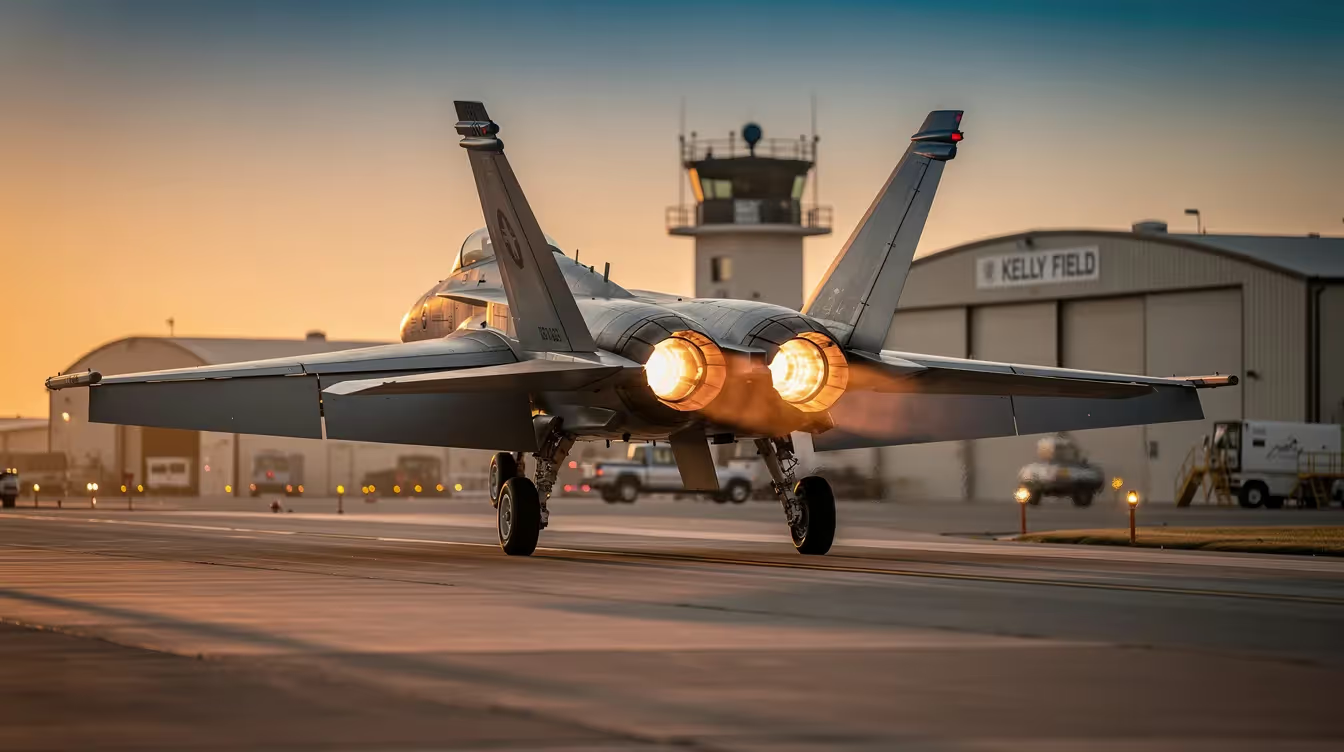
This article provides a comprehensive overview of Kelly Field in San Antonio, Texas. It covers the airfield's historical significance, military legacy, and its current role in private and commercial aviation. The content is intended for travelers, aviation enthusiasts, and anyone interested in the history and modern operations of Kelly Field.
Kelly Field is located on the southwest side of San Antonio, Texas, and has operated continuously since 1917, making it one of the oldest active airfields in the United States.
The airfield played critical roles during World War I, World War II, the Korean War, the Vietnam War, and the Cold War operations as a pilot training center and major air logistics hub.
Kelly Field served as a primary training site and aviation airfield for the nation’s air arm, supporting corps aerial equipment and additional flying operations during two world wars.
Today, Kelly Field functions as part of Joint Base San Antonio and Port San Antonio, supporting military readiness, aerospace manufacturing, MRO operations, and air cargo movements.
The facility features an 11,500-foot runway with 24/7 access, capable of handling heavy cargo planes, military transports, and large-cabin private jets.
Private travelers can access Kelly Field through charter platforms like Jettly, offering a strategic alternative to San Antonio International Airport for business or government-related travel.
Kelly Field (ICAO: KSKF) is a historic and active military-civilian joint-use airfield located in San Antonio, Texas. Situated approximately seven miles southwest of downtown, the facility dates back to 1917 and now operates within Port San Antonio and Joint Base San Antonio–Lackland.
Established on January 11, 1917, when the War Department authorized a one-year lease of 677 acres of land, Kelly Field is one of the oldest continuously operating aviation airfields in the United States. The location was chosen by Brigadier General Scriven and Captain Benjamin Foulois for its easy access and most importantly, strategic position away from large structures and population centers to minimize accident risks.
The airfield operates under a joint-use agreement between the U.S. military and the city of San Antonio, known as Joint Base San Antonio. It is designated as a military facility supporting the Air Force Reserve Command’s 433d Airlift Wing and the Texas Air National Guard’s 149th Fighter Wing.
The physical layout includes a primary runway (15R/33L) spanning 11,500 feet—the longest in the region—providing 24/7 access for heavy cargo planes and commercial transport. Large apron areas, multiple hangars, and air logistics facilities support MRO operations, cargo flights, and aerospace manufacturing activities.
Compared to San Antonio International Airport (KSAT), Kelly Field serves a specialized market. The facility continues to support military readiness while also housing a booming commercial aerospace industry. Private jet movements can be coordinated through charter platforms such as Jettly, offering travelers an efficient gateway to southwest San Antonio.
When the United States entered World War I in April 1917, the Army Signal Corps faced an urgent need for pilot training facilities. Kelly Field was established as a primary training site and aviation airfield for the nation's air arm, supporting corps aerial equipment and additional flying operations. Captain Benjamin Foulois selected the site southwest of San Antonio to reduce the risk of aircraft accidents over populated areas near Fort Sam Houston.
Flying operations officially began on April 5, 1917—one day before Congress declared war on Germany—when four aircraft arrived to begin flying activities. Early infrastructure included steel hangars, wooden barracks, tent encampments near Frio City Road, crude airstrips carved from open fields, and mess halls to support the growing number of enlisted men and trainees living in tents and barracks.
By the end of May 1917, the population at Kelly Field had grown to over 4,000 men, necessitating additional land acquisition due to inadequate space. Expansion into Kelly Number One (later renamed Duncan Field) and Kelly Number Two quickly became apparent to accommodate the influx of recruits and additional flying operations.
During World War I, Kelly Field trained over 1,500 pilots and was the first reception and classification center for testing thousands of recruits before assigning them to specific jobs. The Air Service Mechanics School formed hundreds of aero squadrons and trained thousands of mechanics. Notable figures, including Charles Lindbergh, passed through Kelly Field as part of flight training programs.
Kelly Field was the primary filming location for the silent film Wings, which won the first Academy Award for Best Picture in 1926—a testament to the airfield’s prominence in American aviation culture.
After World War I, Kelly Field transitioned into an Air Corps Training Center and military aeronautical center, serving as both an aviation general supply depot and an aviation repair depot. It provided critical logistics, maintenance, and repair services for military aviation operations. Following the war, Kelly Field absorbed other installations, including smaller aviation repair depots and small flying fields, and remained open while many similar facilities were shuttered, solidifying its role as a central aviation hub.
In the late 1930s, Congress approved $300 million in expenditures for the Air Corps, which significantly increased personnel and aircraft at Kelly Field, leading to the expansion of facilities and sustained Air Force presence through the interwar period. Kelly Field continued to evolve as a major military aviation training center, supporting U.S. military preparedness and training legendary pilots throughout the 1920s and 1930s.
World War II transformed Kelly Field into a massive logistics and maintenance hub within the Army Air Forces network. The base served as a major overhaul and supply depot, handling aircraft engines and airframes supporting operations in both European and Pacific theaters.
Key World War II contributions included:
Aircraft engine repair and airframe reconditioning
Supply storage and distribution for global operations
Integration of the “Kelly Katies”—female employees who joined the workforce in significant numbers for maintenance and administrative roles
After the war, the installation was redesignated Kelly Air Force Base on January 29, 1948. During the Berlin Airlift in 1948, Kelly Field was the only depot in the U.S. repairing and overhauling Pratt and Whitney R2000 engines for the C-54 Skymaster cargo aircraft, shipping 1,317 engines worth $1.7 million by the end of the operation.
In response to the Korean War, Kelly Field’s maintenance line reconditioned Boeing B-29 Superfortresses, earning the nickname “Great White Way” due to the outdoor lighting used for night work.
Kelly Field played a significant role during the Vietnam War, sending 89 personnel on temporary duty to establish supply centers throughout the western Pacific, including South Vietnam, by the end of 1965. The C-5A Galaxy, the Air Force’s largest aircraft, entered the inventory in June 1970, with Kelly Field managing both the aircraft and its TF39 engine repair responsibilities.
During Operation Just Cause in 1989, Kelly Field served as a transit point for over 8,200 troops deploying to Panama and processed vital war material for Operation Desert Storm in 1991.
The 1990s Base Realignment and Closure (BRAC) actions fundamentally reshaped Kelly Air Force Base. The facility was designated as Kelly Field Annex in 2001 following the BRAC action, which transferred control to Lackland Air Force Base within Joint Base San Antonio.
Kelly Field Annex is currently operated under the jurisdiction of the 802d Mission Support Group, Air Education and Training Command (AETC). While the runway and immediate operational areas remained under military control, the surrounding property—including additional land west of the former runways—was transferred or repurposed as part of the base realignment process, transitioning into Port San Antonio—a civilian-managed industrial and technology campus.
Port San Antonio focuses on:
Aerospace manufacturing and testing
Defense contractor operations
Logistics and cybersecurity
Advanced manufacturing
Kelly Field Annex serves as a logistics center and is part of the larger Joint Base San Antonio, which integrates multiple military operations and support functions. Kelly Field’s transformation post-closure into a civilian-military aerospace industrial park is regarded as a national model for successful military base conversion.
The 2017 reversion to the simplified “Kelly Field” name coincided with the 100-year anniversary of the San Antonio Chamber of Commerce granting the airfield to the U.S. Government, honoring Lieutenant George E. Kelly, the first American military aviator killed in a powered aircraft accident.
Today, Kelly Field functions as an integrated aerospace and air logistics platform within Port San Antonio. The area surrounding Kelly Field, known as Port San Antonio, houses over 80 tenant companies focusing on aerospace, cybersecurity, and advanced manufacturing.
Fixed-Base Operator (FBO) Services available include:
Aircraft fueling and ground handling
Maintenance and storage facilities
Crew support for visiting aircraft
Coordination with military authorities for access
U.S. Customs and Border Protection maintains a Federal Inspection Station adjacent to Kelly Field, enabling the processing of certain international arrivals when pre-arranged. Port San Antonio is located within Foreign-Trade Zone #80-10, offering duty deferral and reduction benefits for companies importing aircraft parts and equipment.
Major aerospace and defense tenants provide:
|
Service Type |
Description |
|---|---|
|
Engine Overhaul |
Military and commercial powerplant repairs |
|
Airframe Maintenance |
Heavy checks and structural repairs |
|
Avionics Upgrades |
Cockpit modernization and systems integration |
|
Logistics Operations |
Global fleet support and supply chain management |
Kelly Field has a significant economic impact on San Antonio, creating jobs in the aerospace and defense sectors. The long runway and ample ramp space make it suitable for large cargo aircraft, military transports, and heavy jets—relevant for charter clients moving oversized loads or large groups.
Port San Antonio has positioned Kelly Field as more than an aviation asset—it serves as a hub for education and workforce development aligned with the region’s aerospace needs.
St. Philip’s College Southwest Campus operates at Port San Antonio, offering specialized training programs:
Aircraft maintenance certification
Avionics technology
Welding for aerospace applications
Logistics and supply chain management
These programs supply technicians, mechanics, and support staff directly to employers on and around Kelly Field. Many families in San Antonio have multiple generations of employment history at Kelly Field, creating deep institutional knowledge and workforce stability.
Additional STEM and technology initiatives include innovation centers focusing on cybersecurity and robotics, connecting students to real-world aerospace applications. This integrated approach—combining an operational airfield, aerospace industry tenants, and training providers—creates a 21st-century workforce ecosystem in San Antonio.
Private flyers can use Kelly Field as a practical alternative to San Antonio International Airport for specific mission profiles. The airfield offers distinct advantages for travelers with business at Port San Antonio, Lackland Air Force Base, or southwest San Antonio industrial districts.
Scenarios where Kelly Field is advantageous:
Corporate site visits to aerospace tenants
Government or defense-related travel requiring proximity to military operations
Cargo or group movements needing a large ramp space
Flights coordinated with industrial or military partners
Jettly’s digital platform allows travelers to search for and book on-demand private flights to or from Kelly Field using its airport locator tool, with instant pricing across light jets, midsize jets, heavy jets, and turboprops. The 11,500-foot runway accommodates large-cabin jets with ease.
Operational details for charter clients:
|
Feature |
Kelly Field Capability |
|---|---|
|
Runway length |
11,500 feet |
|
FBO support |
Fueling, handling, crew services |
|
Customs |
Available via Federal Inspection Station |
|
Ground transportation |
Coordinated through operators |
Jettly connects users to a global network of over 20,000 aircraft, enabling point-to-point flights between Kelly Field and other U.S. or international destinations through its airport locator and charter booking platform. Membership and on-demand access options offer transparent pricing without long-term ownership commitments, with private jet memberships providing additional benefits for frequent travelers.
Learn more about Jettly’s charter options at https://www.jettly.com and explore pricing for routes involving Kelly Field and other Texas airports, or use Jettly’s private jet charter cost estimator to model different itineraries.
Kelly Field operates under FAA regulations with published instrument approach and departure procedures updated on scheduled cycles. Pilots must always consult current, official FAA charts for navigation, approach minima, and airport data.
Airport capabilities for instrument operations include:
Precision and non-precision approach options
Runway lighting suitable for night operations
11,500-foot runway length for large aircraft
Weather considerations in San Antonio include typical afternoon convective activity during summer months and occasional early morning fog conditions.
Charter operators using Jettly must meet strict safety and certification standards, holding appropriate FAA Part 135 or equivalent approvals. Aircraft used in commercial charter operations undergo regular inspections and maintenance programs, with crews vetted for regulatory compliance.
Jettly emphasizes safety by working only with regulated operators and coordinating with FBOs and airport operations for smooth arrivals and departures at Kelly Field.
When planning private travel to San Antonio, both Kelly Field (SKF) and San Antonio International Airport (SAT) offer viable arrival points depending on final destination and mission requirements, and some travelers may combine a visit here with flights arranged through Jettly’s private jet charter services in Houston, Texas.
Comparison factors:
|
Factor |
Kelly Field (SKF) |
San Antonio International (SAT) |
|---|---|---|
|
Location |
Southwest San Antonio |
North-central San Antonio |
|
Best for |
Port San Antonio, Lackland AFB, industrial districts |
Downtown, River Walk, hotels |
|
Runway |
11,500 feet |
8,505 feet (longest) |
|
Traffic |
Lower congestion |
Higher commercial traffic |
|
Customs |
Pre-arranged via FIS |
Full CBP facilities |
Jettly’s platform displays multiple options for the San Antonio area, showing pricing differences, aircraft types, and estimated travel times from each airport to final destinations, helping travelers understand how private jet charter pricing works in practice.
Typical private charter use cases for Kelly Field:
Corporate executives visiting aerospace manufacturing facilities
Government personnel coordinating with Air Force units
Cargo charters requiring large ramp space and heavy-lift capability
Defense contractors with business at Port San Antonio tenants, including those exploring Jettly’s high-ticket affiliate program
Growing attention to environmental impact and fuel efficiency affects aviation operations at facilities like Kelly Field. Consolidated maintenance and logistics operations can reduce unnecessary repositioning flights and improve overall fleet efficiency for military and commercial operators.
Some private charter operators accessible through Jettly implement carbon offset programs or operate newer, more fuel-efficient aircraft, and may offer shared and crowdsourced private jet flights to make efficient use of available seats. Environmentally conscious travelers can request these options when booking.
Operational best practices at Kelly Field include accommodating enhanced services such as dedicated in-flight catering for private jets and other premium amenities, and also include:
Optimized ground handling procedures
Reduced taxi times compared with busier commercial hubs
Coordinated slot management, minimizing delays
These factors contribute to both operational efficiency and reduced environmental impact for private aviation operations.
The following questions address practical concerns not fully covered in the main article.
Kelly Field primarily supports military and industrial operations but can accommodate certain civilian, charter, and corporate flights when coordinated in advance through approved operators and FBO services. Private travelers typically arrange access via charter brokers or platforms like Jettly, which work with operators familiar with the field’s procedures and security requirements.
San Antonio International Airport is the region’s main commercial hub with extensive airline service, while Kelly Field is an industrial and military airfield focused on logistics, maintenance, and defense missions. Kelly Field may offer advantages for passengers heading to Port San Antonio or Lackland AFB, whereas SAT is often more convenient for downtown hotels, tourism sites, and general business districts.
International arrivals depend on current customs availability and operator permissions. U.S. Customs facilities adjacent to Kelly Field can handle certain flights when pre-arranged. Travelers should confirm customs and immigration options with their charter operator or through Jettly before planning an international itinerary into Kelly Field.
The airfield routinely handles large military transports, cargo aircraft, and heavy jets associated with MRO and logistics work, taking advantage of its long runway and spacious ramps. Private charters may involve turboprops, light jets, midsize jets, or large-cabin jets, depending on passenger count, range requirements, and operator availability.
Travelers specify Kelly Field as origin or destination on Jettly’s platform, compare available aircraft and pricing, and confirm a flight with an operator authorized to use the airfield, following the same basic steps outlined in Jettly’s guide on how renting a plane works. Visit https://www.jettly.com to explore live options, discuss any special access or security requirements, and coordinate ground transportation or connecting flights as needed, or use the jet card flight cost estimator if you prefer flying via prepaid hours.
Kelly Field evolved from a World War I training ground into a major Air Force logistics and maintenance center supporting multiple world conflicts—from World War II through the Cold War, Korea, Vietnam, and beyond. Today, it serves San Antonio as a versatile industrial and military airfield integral to Port San Antonio’s aerospace cluster and ongoing Air Force missions.
For travelers whose business or government engagements center on Port San Antonio or southwest San Antonio, Kelly Field offers a practical gateway with minimal congestion and direct access to the region’s aerospace hub.
Ready to experience private travel on your terms? Explore charter options, compare aircraft, and request instant quotes for flights involving Kelly Field and other destinations at https://www.jettly.com, review jet card programs for frequent flyers, or plan connected itineraries via private jet charter in Atlanta, Georgia.
Share this post:
Jay Franco Serevilla
May 15, 2026
|
5
min read
Discover tips and trends in the industry.

5
min read
Planet 9 Aviation: Ultra Long Range Private Air Travel & How Jettly Helps You Charter It
Planet 9 Aviation specializes in ultra-long-range private jet travel, offering a managed fleet for intercontinental charters. Through Jettly, travelers can easily access these services without the need for ownership or jet cards, ensuring flexibility and convenience in booking private flights.
Read More
5
min read
Guide to Aviation Blogs: From Student Pilots to Private Jet Travelers
Aviation blogs have evolved into essential resources for student pilots, aviation businesses, and private jet travelers. They provide valuable insights on flight training, market trends, and charter options, helping readers make informed decisions. With contributions from industry professionals, these blogs serve as a bridge between education and practical application in aviation.
Read MoreStay updated with our latest insights and tips to elevate your journey with us.
MEMBERSHIPS AND ASSOCIATIONS



Disclaimer: Jettly operates as a charter broker, offering access to a global digital jet charter marketplace. Jettly is not a direct air carrier and does not own or operate aircraft. All advertised flights are conducted by third-party air carriers that are fully licensed and hold the appropriate Part 135 or Part 121 certifications issued by the Federal Aviation Administration (FAA) or equivalent regulatory authorities under U.S. or foreign law. Jettly complies fully with the U.S. Department of Transportation's Part 295 and Part 298 Charter Broker regulations. Jettly does not carry additional liability insurance. Passengers are covered by aircraft operator insurance. TICO: 50023770


