


Login
Get Instant Pricing On 23,000+ Aircraft

>
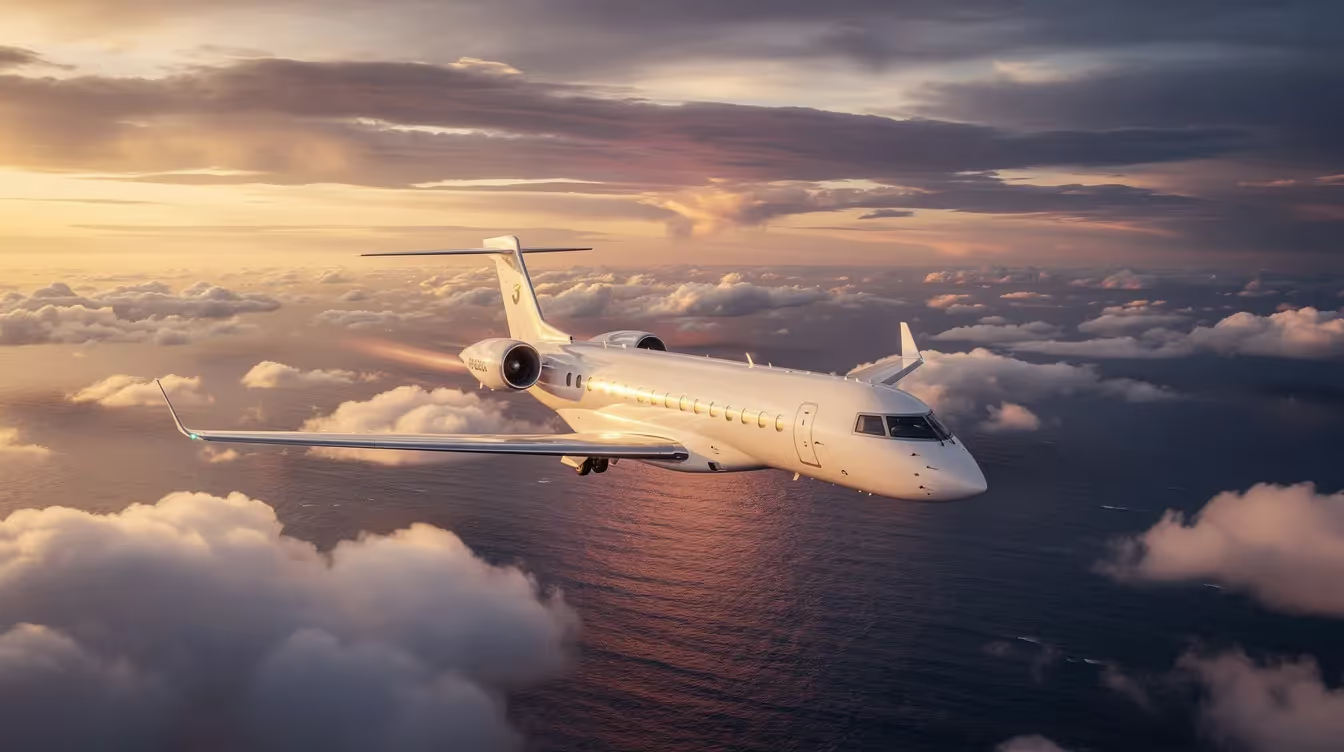
Intercontinental private jets enable nonstop routes like New York to Tokyo or London to Singapore, transforming how executives and families approach global travel. Jettly’s digital platform makes accessing these aircraft simple and transparent, connecting travelers to a network of over 20,000 aircraft worldwide.
This guide covers the essentials of intercontinental private jets, including aircraft capabilities, cabin experience, cost considerations, and how to book through Jettly. It is designed for executives, families, and discerning travelers seeking efficient, comfortable, and flexible global travel solutions. As demand for private long-haul flights grows, understanding these options is more important than ever for those prioritizing time savings, privacy, and convenience.
These ultra-long-range business jets typically offer 6,000 to 8,000+ nautical miles of range, supporting 12 to 17-hour nonstop flights across continents. Jettly provides on-demand access to flagship long-range aircraft, including the Bombardier Global 7500, Gulfstream G700 and G800, and Dassault Falcon 8X. Whether for business meetings spanning multiple time zones or extended family vacations, chartering via Jettly often beats ownership or jet cards: no long-term commitment, instant digital pricing, and the ability to choose the right aircraft for each trip.
Intercontinental private jets fly 5,500 to 8,000+ nautical miles nonstop, covering routes like Los Angeles to Sydney or Dubai to Melbourne without refueling.
Flagship models available through Jettly include the Bombardier Global 7500/8000, Gulfstream G700/G800, Dassault Falcon 8X/10X, and Boeing Business Jets.
Charter pricing for ultra-long-range jets ranges from $5,000 to $25,000 per flight hour, and up to $50,000 for ultra-long-range jets, with round-trip intercontinental missions typically costing $160,000 to $400,000.
Jettly’s platform allows travelers to compare aircraft, view transparent pricing, and book without membership requirements or long-term commitments.
Modern intercontinental jets feature low cabin altitude, multi-zone layouts, and high-speed connectivity to reduce fatigue and maintain productivity on flights lasting 10 to 15 hours.
Intercontinental private jets are heavy or ultra-long-range business jets specifically designed for extensive travel without refueling, capable of nonstop flights between major continents. Routes like New York to Dubai, London to Johannesburg, or Los Angeles to Sydney become single-segment journeys rather than multi-stop ordeals.
These aircraft feature exceptional range, typically between 5,500 and 8,000 nautical miles, and increasingly near 7,500 nautical miles for nonstop travel. Cruise speeds range from Mach 0.85 to Mach 0.94, with top-tier models approaching Mach 0.95. Flight durations can reach 15 to 17 hours before refueling becomes necessary. However, full passenger loads and heavy luggage can significantly reduce maximum range, potentially necessitating unplanned refueling stops, so ensuring the aircraft’s range matches the route and load is crucial for nonstop capability.
Within the private aviation spectrum, intercontinental jets sit above the super midsize category and standard long-range jets. They deliver greater endurance, larger cabin size, and enhanced passenger capacity for global missions.
Concrete route examples feasible with ultra-long range models include:
|
Route |
Approximate Distance |
|---|---|
|
Los Angeles–Sydney |
6,500 nm |
|
London–Singapore |
5,900 nm |
|
Dubai–Melbourne |
7,100 nm |
|
New York–Hong Kong |
7,000 nm |
|
Jettly’s platform lets users filter for these aircraft types and ranges when searching for flights, matching mission requirements to the appropriate fleet options. |
|
The strategic advantages over commercial first class extend beyond seat comfort. Unlike commercial airlines, private jets offer direct access to over 5,000 airports in the U.S. and many more globally—far exceeding the approximately 500 served by commercial carriers. This includes smaller airports often closer to final destinations, which commercial airlines cannot access, saving ground travel time.
Private jets allow passengers to skip long security lines and crowded terminals, minimizing travel time. Utilizing Fixed-Base Operators (FBOs) can save travelers an average of two to five hours per leg by bypassing standard TSA lines. Private terminals also provide a secure environment, reducing exposure to public crowds.
Key reasons travelers choose intercontinental private jets include:
Nonstop global reach that eliminates connection fatigue
Privacy for board-level meetings conducted at 45,000 feet
Flexible departure times that match tight business schedules rather than airline timetables
Real-world use cases illustrate the value:
A CEO flying from New York to Tokyo for a 36-hour deal negotiation, working en route and landing ready for meetings
A family chartering from London to Cape Town for a two-week holiday, avoiding multiple connections and airport crowds
Medical or emergency repatriation flights between Europe and North America, where time is critical
Door-to-door travel time comparisons favor private aviation significantly. When factoring in private terminals, no security lines, and shorter check-in times, intercontinental flights can save 3 to 6 hours compared to commercial options on the same route.
Jettly adds value by allowing travelers to compare private charter aircraft and operators in a single interface, with transparent pricing rather than opaque phone-based quotes.
Choosing the right aircraft depends on measurable factors: flight range, speed, passenger capacity, and operating ceiling all influence which jet fits a specific mission.
Maximum range determines route capability. A 7,700 nautical mile range covers New York to Hong Kong or Paris to Buenos Aires without refueling. Aircraft approaching 8,000 nautical miles enable virtually any global city pair to fly nonstop under ISA conditions.
Cruise speeds vary across the category:
|
Aircraft Class |
Typical Cruise Speed |
|---|---|
|
Standard Ultra Long Range |
Mach 0.85–0.90 |
|
Top Speed Models (G800, Global 8000) |
Mach 0.90–0.95 |
|
Cabin altitude matters for long flights. Modern jets like the Gulfstream G700 and Bombardier Global series maintain a cabin altitude of 4,000 to 4,850 feet when cruising at 41,000 feet. This reduces fatigue and jet lag compared to commercial cabins typically pressurized to 6,000 to 8,000 feet equivalent. Jets with lie-flat seating, separate divans, or dedicated master suites are prioritized for long-haul flights to ensure proper rest. Modern jets also feature hospital-grade air filtration systems and advanced avionics and weather radar systems that help pilots navigate around adverse conditions, significantly improving flight safety. |
|
|
Jettly’s aircraft details pages clearly display these specifications, allowing charter clients to quickly compare models by performance and cabin comfort. |
Jettly provides on-demand charter access to many of the same flagship intercontinental jets owned by corporations and ultra-high-net-worth individuals. The following represents popular private jets available through the platform.
The Bombardier Global 7500 offers a range of up to 7,700 nautical miles and typically seats up to 19 passengers. Its four-zone cabin layout includes a lounge, conference and dining area, a private suite, and a crew rest space. The aircraft is a popular choice for routes such as New York to Johannesburg or Los Angeles to Shanghai, offering ample room for work, rest, and dining on extended flights.
The Global 8000 targets approximately 8,000 nautical miles of range with a top speed approaching Mach 0.95. Four equal-sized living spaces provide spacious accommodation for intercontinental flights. Ideal missions include Dubai to Los Angeles or Singapore to San Francisco nonstop.
The Gulfstream G700 features the widest cabin in its class with approximately 7,500 nautical miles of range. The G800 extends its range to around 8,000 nautical miles, with advanced technology for efficiency and passenger comfort. Both aircraft feature a low cabin altitude and cruise at near-Mach 0.90, designed for nonstop flights such as London to Perth or New York to Bangkok.
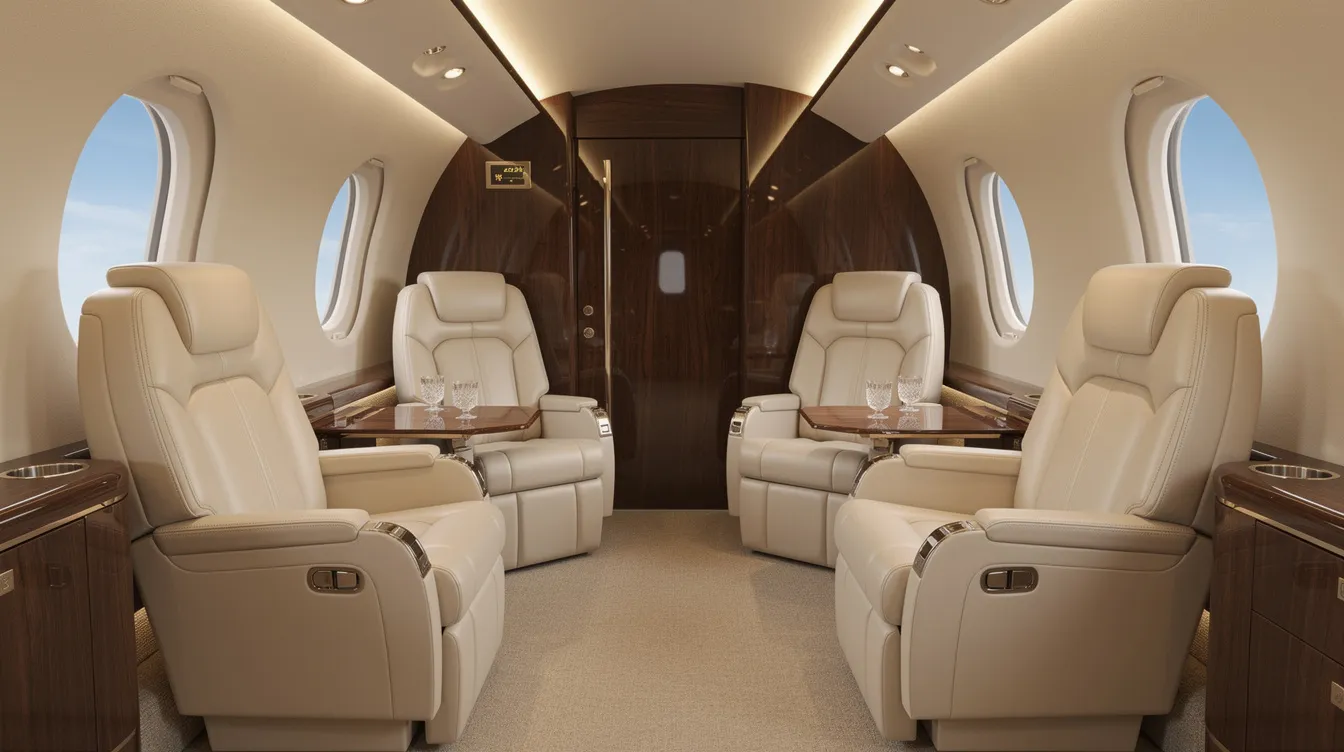
The Dassault Falcon 8X delivers approximately 6,450 nautical miles of range with a three-zone cabin and strong short-runway performance. The Falcon 10X, expected around 2026, targets 7,500 nautical miles with an advanced wing design and a very wide cabin, competing directly with the G700 and Global 8000.
Boeing Business Jets (BBJ 787) and Airbus ACJ319neo/ACJ320neo represent “flying residence” options. These larger aircraft feature enormous cabin volumes, ranges of 6,000 to 8,000+ nautical miles, and are typically used by heads of state or large corporate teams. Jettly’s marketplace can source these on request for group and VIP itineraries.
Jettly’s search tools help users filter by manufacturer and mission profile, simplifying the selection of the ideal jet for intercontinental travel.
Long flights of 10 to 15 hours make cabin design and wellness features crucial. The aircraft serves as both a functional workspace and a living space, and the cabin experience directly impacts arrival readiness.
Many intercontinental jets feature three or four distinct zones: a lounge area for relaxation, a conference and dining space for business meetings and meals, a private suite or bedroom for sleep, and separate crew rest areas. Passengers move between work, dining, and rest throughout the flying experience.
Wellness features reduce jet lag and fatigue:
Low cabin altitude (4,000–4,850 ft equivalent)
Higher humidity levels
Advanced air filtration systems
Smooth-wing or active turbulence-damping technology
Connectivity infrastructure supports productivity across oceans. Multi-band high-speed internet via Ku/Ka-band satellite systems enables VPN support and secure video conferencing. Pilots and passengers remain connected throughout the flight.
Dining service mirrors luxury hotel standards. Full galleys prepare multi-course meals, with catering customizable based on dietary requirements. Jettly coordinates catering through its service network.
Customization options include different seating layouts, convertible divans that transform into lie-flat beds, optional shower suites in larger models, and interior styles ranging from minimalist business-focused to residential comfort aesthetics—all offering unmatched comfort for extended travel.
Intercontinental missions are the highest-spending category in business aviation, but chartering remains more flexible than ownership or long-term jet cards.
Charter rate ranges for 2024–2026 can be modeled using Jettly’s private jet charter cost estimator:
|
Aircraft Type |
Hourly Rate (USD) |
|---|---|
|
Ultra Long Range Jets |
$5,000–$25,000 |
|
VIP Airliners (BBJ, ACJ) |
$20,000–$50,000+ |
|
Sample trip estimates provide realistic planning data: |
|
|
Route |
Aircraft |
|
------------------------------------------------------------------------------------------------------------------------------------------------------------------------------------------------------------------------------------------------------- |
--------------------- |
|
New York–London |
Global 7500 or G700 |
|
Los Angeles–Sydney |
G800 or Global 8000 |
|
Factors that drive pricing include aircraft type and age, route length, runway performance requirements at departure and arrival airports, crew duty limits, overnight and de-icing fees, and whether empty legs can be optimized during positioning. |
|
|
Empty-leg flights, also known as deadhead flights, occur when a private jet returns to its base or travels to pick up another passenger. Travelers can save up to 75% on private jet travel by booking these empty leg flights at a reduced rate, making them an attractive option for those seeking luxury travel at a lower cost. |
|
|
Jettly’s platform displays instant or near-instant pricing from multiple operators, giving customers clearer visibility into total trip cost before committing. Private jet memberships can reduce booking fees or provide additional perks for frequent intercontinental travelers without locking them into a specific aircraft or hours package. |
Not every flight requires an ultra-long-range jet. Jettly also offers light jets, midsize, and super midsize aircraft for regional and transcontinental missions, with guidance on affordable private jet charter options for different budgets.
|
Category |
Example Aircraft |
Typical Range |
Best For |
|---|---|---|---|
|
Light Jets |
Embraer Phenom 300E, Cessna Citation CJ series |
1,200–2,000 nm |
New York–Miami, London–Rome |
|
Super Midsize |
Cessna Citation Longitude, Gulfstream G280 |
3,000–3,500 nm |
Toronto–Vancouver, Dubai–London |
|
Long Range |
Gulfstream G550, Embraer Lineage 1000E |
5,000–6,750 nm |
Most transatlantic routes |
|
Intercontinental |
Global 7500, G800, Falcon 10X |
6,500–8,000 nm |
Longest global routes |
|
Light jets carry small groups with lower hourly costs. Super midsize jets serve as workhorses for 3 to 7-hour flights carrying 8 to 10 passengers. Standard long-range private jets handle most transatlantic city pairs. |
|||
|
Truly intercontinental jets work best when travelers need nonstop performance on the very longest routes or maximum cabin space for larger groups. For complex international private jet flights, Jettly’s support team can match mission profile—distance, passenger count, luggage, budget—with the most efficient category. |
|||
 |
The digital booking flow follows a straightforward process: search, compare, select, and confirm private charter aircraft, all via Jettly’s website or app.
Users enter origin and destination (New York JFK to Tokyo Haneda, for example), dates, and passenger count. Filters narrow results by aircraft size, range, or manufacturer.
Jettly aggregates offers from a vetted global fleet of operators flying aircraft like Global 7500s, G700S, Falcon 8Xs, and VIP airliners, positioning itself as a flexible NetJets alternative for flying private. Pricing and aircraft features are displayed side by side for direct comparison.
Safety is handled through operator accreditation and regulatory checks, including FAA Part 135 certification in the US, EASA-compliant operators in Europe, and equivalent oversight in other regions. Many operators maintain Wyvern Pass or ARG/US Platinum safety ratings. Advanced avionics and weather radar systems onboard modern jets enhance flight safety by helping pilots navigate adverse weather and turbulence.
Added services include bespoke catering, ground transportation coordination at both ends of the route, meeting rooms at FBOs, security arrangements, and medical support when needed. Integrating ground transportation with private jet services enhances the overall travel experience by providing seamless transitions between air and land travel, allowing passengers to arrive at their destination without delays. This integration is increasingly important for business travelers to minimize travel time, and some choose to crowdsource private jet flights and share empty seats to further optimize costs.
Payment options include card and bank transfer, with contract and cancellation terms typical for long-haul charters clearly presented during booking.
Intercontinental private jets carry a significant environmental footprint, but modern technology and operational strategies reduce impact compared to earlier generations.
Improvements in current aircraft include more efficient high-bypass turbofan engines, advanced aerodynamics, and lighter composite materials, collectively lowering fuel burn per nautical mile.
Sustainable aviation fuel (SAF) adoption is expanding on long-haul routes. Some operators in Jettly’s network offer SAF blends where available, reducing lifecycle CO₂ emissions compared to conventional jet fuel.
Operational efficiency measures further reduce consumption:
Optimized flight planning with favorable routing
Step climbs to optimal cruise altitude
Weight management for fuel efficiency, including careful consideration of passenger and luggage loads, which can affect maximum range and necessitate refueling stops
Jettly customers can explore carbon offset or climate contribution programs to balance unavoidable emissions for intercontinental missions, while tools like the jet card flight cost estimator and Jettly’s jet card programs help frequent flyers budget and plan long-range travel more efficiently.
Demand for intercontinental flights via private jet has grown substantially since 2020, especially among executives and families seeking control, flexibility, and health security.
Common city pairs flown via private charter include:
New York–London
Los Angeles–Tokyo
London–Dubai
Paris–São Paulo
Singapore–Zurich
Toronto–Hong Kong
Ultra-long-range jets reduce or eliminate fuel stops on routes like New York to Johannesburg or Dubai to Melbourne, converting multi-leg trips into single overnight flights with passengers arriving rested.
Seasonal patterns emerge in the market: winter traffic flows between North America and the Caribbean or South America, while summer sees increased movement between Europe and the US or the Middle East.
Jettly’s global coverage allows passengers to depart from secondary airports near home rather than major hubs, enhancing practical access to intercontinental missions.
These questions address common issues not fully covered in the main sections above.
Most intercontinental private jets fly between 5,500 and 8,000 nautical miles nonstop, depending on model, passenger load, and weather conditions. Aircraft such as the Bombardier Global 7500 and Gulfstream G800 sit near the top of this range, enabling missions like New York to Hong Kong or London to Perth without refueling. Operators may still choose to make a technical stop for operational reasons, such as strong headwinds, runway conditions, or payload limits. Full passenger loads and heavy luggage can reduce maximum range and necessitate unplanned refueling stops. Jettly’s flight planning accounts for these factors when proposing aircraft for a given route.
Luggage capacity varies by jet, but ultra-long-range models typically support substantial baggage for 10 to 14 passengers, often in the 1,500 to 2,500-pound range. Space accommodates checked bags, carry-ons, and specialized items such as ski equipment, golf bags, or professional gear. Share details about bulky or heavy items with Jettly when requesting quotes so the aircraft can be matched appropriately. VIP airliner configurations offer even more space, ideal for extended relocations or large groups.
Jettly supports both on-demand booking and membership options. Travelers do not need to join a program to charter an intercontinental flight. Memberships can offer benefits such as lower service fees, additional concierge support, and preferential access during peak periods. Those who fly multiple intercontinental trips per year may find value in reviewing Jettly’s membership tiers to manage costs and simplify future bookings. Visit the main website for the latest membership details.
Booking at least 1 to 3 weeks in advance for complex intercontinental itineraries helps secure optimal aircraft and pricing. Last-minute charters within 24 to 72 hours are sometimes possible through Jettly’s network, though choice may be limited and repositioning costs higher. Peak seasons—late December transatlantic travel, major global events—require even more lead time. Travelers with fixed meeting dates or tight connections should confirm aircraft as soon as schedules are set.
Most intercontinental private jets feature lie-flat sleeping options, including seats that convert to beds and dedicated suites with full-size beds on larger aircraft. Cabin crew typically prepare sleeping areas with bedding, pillows, and adjusted lighting for overnight sectors. Low cabin altitude and quiet cabin environments support better rest compared to many commercial cabins. Communicate the preferred rest times and cabin temperature to the crew in advance for the best on-board experience.
Intercontinental private jets offer nonstop global reach, large and comfortable cabins, and high-speed connectivity for both business and leisure travelers. They represent the pinnacle of private aviation capability.
Those who benefit most include executives managing cross-continental operations, families combining multiple destinations in one long trip, and travelers who value time savings and privacy over commercial ticket price.
For travelers who need to fly around the world on their own schedule, intercontinental private jets deliver what commercial alternatives cannot match. Jettly makes accessing these aircraft straightforward, from instant pricing to end-to-end trip coordination.
Ready to explore intercontinental travel on your terms? Review aircraft options, compare routes, or request a tailored quote at https://www.jettly.com.
Share this post:
Jay Franco Serevilla
Apr 11, 2026
|
5
min read
Discover tips and trends in the industry.
5
min read
Private Plane NYC to Miami: Route Guide, Costs, and How to Book with Jettly
Flying private from NYC to Miami offers a seamless travel experience, cutting down on time and avoiding commercial airport chaos. With flight times of 2.5 to 3 hours and various aircraft options, travelers can enjoy flexibility and comfort tailored to their needs. Jettly's platform simplifies the booking process, providing instant quotes and access to over 20,000 private jets.
Read More
5
min read
Cessna 210 Operating Cost: Complete Owner's Breakdown
Understanding the operating costs of a Cessna 210 is vital for potential owners. With costs ranging from $200 to $300 per flight hour and annual expenses between $25,000 and $45,000, ownership can be a significant commitment. For those flying less frequently, chartering through platforms like Jettly may offer a more flexible and cost-effective alternative.
Read MoreStay updated with our latest insights and tips to elevate your journey with us.
MEMBERSHIPS AND ASSOCIATIONS



Disclaimer: Jettly operates as a charter broker, offering access to a global digital jet charter marketplace. Jettly is not a direct air carrier and does not own or operate aircraft. All advertised flights are conducted by third-party air carriers that are fully licensed and hold the appropriate Part 135 or Part 121 certifications issued by the Federal Aviation Administration (FAA) or equivalent regulatory authorities under U.S. or foreign law. Jettly complies fully with the U.S. Department of Transportation's Part 295 and Part 298 Charter Broker regulations. Jettly does not carry additional liability insurance. Passengers are covered by aircraft operator insurance. TICO: 50023770


