


Login
Get Instant Pricing On 23,000+ Aircraft

>
Updated July 8, 2026
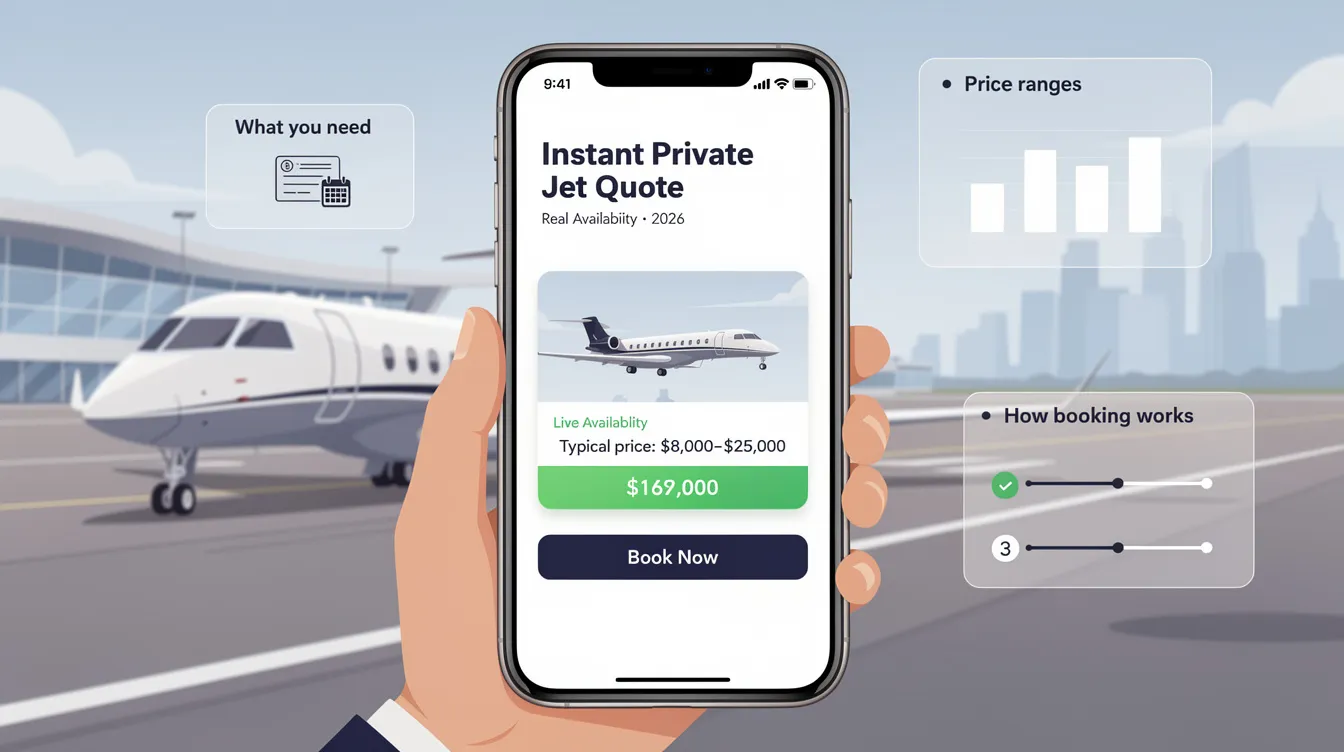
An instant private jet quote can land on your screen in seconds, but the aircraft behind that number takes a few more steps to lock in. Pricing is fast. Real availability is dynamic. Knowing the difference between the two is what separates a confident booking from a frustrating one, and it is the part most charter websites quietly skip.
An instant private jet quote is a fast, route-specific price estimate or set of aircraft options based on your airports, date/time, and passenger count, but the flight is only confirmed after an operator accepts the trip, you sign the charter agreement, and payment is secured. That one distinction turns a number on a screen into a seat you can actually fly.
Pricing moves quickly in private aviation. Availability moves too. Aircraft can appear or vanish within hours based on positioning, crew duty limits, and operator acceptance. Real aircraft availability means an operator has an aircraft and crew that can legally fly your itinerary in your requested time window, subject to final contract and payment confirmation.
Jettly works as a charter broker, not a direct air carrier. Every flight is operated by a properly licensed third-party carrier holding FAA Part 135 or Part 121 certification, or the foreign equivalent. You get marketplace pricing and live aircraft options drawn from a global fleet, and the operator and aircraft details appear in your charter agreement. Departures run from a private terminal called an FBO, and flexible travelers can often trim costs with empty legs.
Plan on 24 to 72 hours of lead time for the widest aircraft selection. Same-day trips are sometimes possible in roughly 3 to 6 hours, depending on where aircraft sit and whether crews are ready. In private aviation, pricing can be instant, but a flight is only confirmed when the operator accepts the trip and the charter agreement is signed and paid. New to charter? Our first-time private jet guide covers the basics before you request a quote.
How much does a private jet charter cost? Hourly rates run from about $1,800 for turboprops to $15,000 and up for ultra-long-range jets, plus taxes and trip-specific fees.
How do I get an instant private jet quote? Enter your exact airports, date and time, and passenger count into Jettly's quote tool, or speak with a coordinator who can source live options.
What is an empty leg flight? A discounted repositioning flight where you charter the entire aircraft on a fixed route and time window.
The fastest way to get accurate private jet pricing is to provide the details that affect aircraft choice and positioning. To get accurate private jet pricing, you need (1) departure and arrival airports, not just cities, (2) date and local time, (3) passenger count and ages if traveling with infants, (4) luggage count and oversized items, (5) one-way vs round trip vs multi-city, and (6) flexibility windows that allow better aircraft positioning and pricing.
A flexibility window is the range of acceptable departure times, for example "any time Friday afternoon through Sunday morning," that lets brokers match you with better-positioned aircraft. Airport choice and flexibility windows are two of the biggest levers that change both private jet pricing and real aircraft availability.
"The fastest way to receive accurate private jet pricing is to provide specific airports, flexible travel windows, passenger details, and baggage requirements. Small itinerary changes can significantly influence both price and aircraft availability."
Justin Crabbe, CEO of Jettly
|
Input |
Why it matters for price and availability |
|---|---|
|
Exact airport codes (TEB vs JFK vs HPN) |
Fees and aircraft positioning differ sharply between neighboring airports. |
|
Date and local departure time |
Time of day affects crew legality and whether the airport is open. |
|
Trip type (one-way, round trip, multi-city) |
Round trips can reduce repositioning uncertainty; multi-city charter adds legs. |
|
Passenger count and ages |
Sets cabin size; infant or child seats are operator-dependent. |
|
Luggage and oversized items |
Skis, golf clubs, and strollers can push you into a larger aircraft category. |
|
Pets |
Many operators allow pets on board; rules vary by operator. |
|
Flexibility window |
Wider windows unlock better-positioned aircraft and lower rates. |
|
Ground and special needs |
Car service, catering, and accessibility requests are operator-dependent. |
Jettly advertises access to more than 23,000 aircraft across over 190 countries, so detail in your request helps match the right tail to your trip faster. Want a head start on the math? Run a quick estimate with the private flight cost calculator before you request a live quote.
Three pricing layers exist in private aviation, and lumping them together causes most of the confusion travelers feel.
|
Layer |
What you get |
Best for |
What can change |
When it's binding |
|---|---|---|---|---|
|
Cost estimator |
A route-based price range |
Budgeting and early planning |
Almost everything until sourced |
Never; it is not a quote |
|
Instant quote with live options |
Aircraft options and indicative pricing |
Comparing aircraft fast |
Availability as schedules shift |
Not yet; subject to acceptance |
|
Exact quote with real availability |
A sourced aircraft and firm price |
Locking in a confirmed flight |
Little once held |
After signed agreement and payment |
A cost estimator is built for budgeting and is not binding. Jettly's charter cost calculator outputs route-specific estimates and factors in flight distance, billable hours, the U.S. 7.5% federal excise tax, and per-passenger segment fees, and the results are estimates rather than binding quotes. An instant quote with options goes a step further by showing aircraft tied to your requested details, though availability can still change before you confirm.
An exact quote with real availability requires live sourcing with operators. The aircraft is held and confirmed only after the paperwork and payment steps are complete. Availability changes for predictable reasons: aircraft repositioning, crew duty limits, scheduled maintenance, and delays on a prior trip.
A charter agreement is the contract that lists the operator, aircraft details, itinerary, price, and operating terms, and it is what makes a private jet booking official. If a platform cannot tell you when a quote becomes a confirmed charter agreement, it is not real availability, it is just an estimate. For a deeper walkthrough of the full process, see our guide to renting a private jet.
Private jet charter pricing is typically quoted per aircraft per billable flight hour, not per passenger. In 2026, typical on-demand private jet charter hourly rates are roughly: turboprops $1,800–$2,800/hr, very light jets $2,000–$3,500/hr, light jets $2,800–$4,500/hr, midsize/super-midsize $4,000–$8,000/hr, and heavy/ultra-long-range jets $8,000–$15,000+/hr, before taxes and trip-specific fees.
|
Category |
Typical seats |
Typical hourly range (2026) |
Best for |
Notes |
|---|---|---|---|---|
|
Turboprop (King Air, PC-12) |
5–9 |
$1,800–$2,800 |
Short regional hops, small runways |
Strong value; cabin comfort varies |
|
Very light jet (Phenom 100, Mustang) |
4–6 |
$2,000–$3,500 |
Quick 1–2 hour trips |
Limited luggage and range |
|
Light jet (Phenom 300, CJ3) |
6–8 |
$2,800–$4,500 |
Two to three hour trips, small groups |
Popular fit for four adults plus two kids |
|
Midsize / super-midsize (Citation XLS, Challenger 350) |
7–10 |
$4,000–$8,000 |
Transcontinental comfort, stand-up cabin |
Super-mid can skip many fuel stops |
|
Heavy / large-cabin (Falcon 2000, G450) |
10–16 |
$8,000–$15,000+ |
Long-range trips, larger groups |
More baggage; bedrooms on some models |
|
Ultra-long-range (G650, Global 7500) |
12–19 |
$8,000–$15,000+ |
Intercontinental nonstop |
Top-tier range and speed |
A billable flight hour is the time used to price the aircraft portion of a charter, and operators bill using flight-time conventions defined in their terms and your charter agreement. Total trip cost works out as the hourly rate multiplied by billable hours, plus taxes and trip-specific fees. For most one-off trips, the aircraft category you choose is the single biggest driver of private jet pricing.
Membership programs can price differently. Jettly's programs use fixed hourly rates with point-to-point billing, no fuel surcharges, and no positioning fees, but the ranges above describe typical on-demand charter. A VIP airliner sits above these bands for very large groups. Readers who want the deeper breakdown can study private jet hourly rates in detail.
How we built these ranges. The hourly bands reflect Jettly's published on-demand rates, cross-checked against marketplace benchmarks from industry references such as Paramount Business Jets and Air Charter Service. All figures are illustrative estimates, not binding quotes.
Below are illustrative examples for budgeting, not binding quotes, because final pricing depends on the specific aircraft sourced and operator terms. Each scenario lists its assumptions so you can see how one change moves the number.
|
Trip type |
Passengers |
Likely aircraft |
Assumed flight time |
Example total range (USD) |
What can move the price |
|---|---|---|---|---|---|
|
One-way regional (Scenario A) |
6 (4 adults + 2 kids) |
Light or midsize jet |
2.0–2.5 hrs |
$9,000–$22,000 |
Aircraft class, positioning, airport fees |
|
Short hop (Scenario B) |
4–6 |
Turboprop or light jet |
~1.0 hr |
$6,500–$12,000 |
Daily minimums and FBO fees outweigh flight time |
|
Long domestic (Scenario C) |
6–8 |
Super-midsize |
4.5–5.5 hrs |
$30,000–$55,000 |
Avoiding a fuel stop, winds, demand |
|
International (Scenario D) |
6–12 |
Heavy / ultra-long-range |
7+ hrs |
$80,000–$130,000+ |
Permits, handling, customs, crew overnights |
Scenario A is the classic family-of-six request. A light jet at roughly $3,500 per hour for a 2.25-hour leg puts the aircraft near $7,900, and an all-in total tends to land between $9,000 and $15,000 once taxes and fees are added. Step up to a midsize cabin and the range climbs to roughly $14,000–$22,000. Divide the light jet total by six travelers and you sit near $1,500–$2,500 per person.
Scenario B shows why a one-hour flight rarely costs one hour of money. Daily minimum billable hours and airport handling fees dominate short hops, so the total can resemble a longer trip. Scenario C rewards range: a super-midsize jet can often cross the country nonstop, and skipping a fuel stop saves both time and billable hours. Scenario D adds international handling, permits, customs, and possible crew overnights, all kept in USD here but variable by country and airport.
For a group of six, private jet cost is often easiest to evaluate as a per-person number, even though charter is priced per aircraft. Positioning is when an aircraft has to fly empty to reach your departure airport or move to its next assignment, and it can affect the total price on one-way trips. Change only the departure airport, swapping a major commercial field for a nearby reliever, and both fees and positioning can shift. Charter quotes commonly include the U.S. 7.5% federal excise tax and a per-passenger segment fee in the $4.50 to $5.20 range on domestic trips, and empty legs remain a strong cost-cutter when your dates are open.
Private jet quotes usually include the aircraft, crew, and fuel, but taxes and trip-specific operational fees can still apply. The cleanest way to read a quote is to ask for an itemized total rather than a single headline number.
"Travelers should evaluate private jet quotes based on the total trip cost, not just the advertised hourly rate. Airport fees, repositioning, taxes, and operational factors all contribute to the final price."
Justin Crabbe, CEO of Jettly
|
Fee |
When it applies |
Typical range or description |
How to minimize it |
|---|---|---|---|
|
Federal Excise Tax (FET) |
U.S. domestic charter |
7.5% of applicable charter cost |
Built into the quote; unavoidable on domestic flights |
|
Per-passenger segment fee |
Per person, per leg (U.S. domestic) |
~$4.50–$5.20 per passenger per segment |
Fewer legs means fewer charges |
|
Airport and FBO fees |
Landing, ramp, handling |
Varies widely by airport |
Choose a reliever over a major hub |
|
Crew overnights |
Multi-day trips |
Operator-dependent |
Same-day round trips avoid them |
|
De-icing |
Cold-weather departures |
Variable; can be material |
Jettly memberships include complimentary de-icing coverage |
|
International handling, permits, customs |
Cross-border trips |
Varies by country and airport |
Plan early and request an itemized estimate |
A segment, or leg, is one takeoff-to-landing portion of a trip, and on domestic U.S. charters the per-passenger segment fee is charged per person, per leg. FET applies on top of the aircraft cost for domestic flying. Fuel pricing also drives some of the variability you see between quotes, which is why understanding jet fuel basics helps explain seasonal swings.
When comparing private jet quotes, compare the all-in total, not just the hourly rate, because taxes and airport/handling fees can change the final number. One more point worth checking up front: many charters become non-refundable once confirmed, especially within 72 hours of departure, and the cancellation terms are set by the operator.
Eight levers shape almost every quote. Each one comes with a simple action you can take.
Aircraft category and cabin size. Match the aircraft to your group rather than overbuying space you will not use.
Trip type. A round trip can reduce repositioning uncertainty compared with a single one-way leg.
Aircraft positioning and routing. Ask whether a well-positioned aircraft is nearby, and scan empty legs first.
Airport fees. Pick a reliever airport over a busy commercial hub when one is close.
Peak demand. Shift dates away from holidays and major events where you can.
Crew duty-time constraints. Widen your departure window so more crews qualify to fly your trip.
Weather and de-icing risk. Build a buffer in winter and confirm how de-icing is handled.
Special requests. Bundle catering, pets, and ground transport into the request early.
Peak demand is any period when many travelers compete for the same aircraft, such as holidays or major events, which tightens availability and pushes pricing upward. Flexibility is the easiest way to improve both private jet pricing and real availability, because it increases the number of aircraft that can legally and efficiently operate your trip.
"Flexibility is one of the most effective ways to reduce private aviation costs. Broader departure windows and alternate airports increase the number of available aircraft and can improve both pricing and scheduling options."
Justin Crabbe, CEO of Jettly
Bigger cabins cost more for real reasons, and our breakdown of private jet operating costs shows how fuel, crew, and maintenance feed into the hourly rate you are quoted.
A charter broker arranges flights operated by licensed air carriers, and the broker does not own or operate the aircraft. Jettly follows a six-step flow, and the confirmation moment is clearly marked so you always know where you stand.
Search or request a flight. Choose one-way, round trip, or multi-city, and add legs as needed.
Receive aircraft options. Available options depend on aircraft positioning and operator acceptance across the marketplace fleet.
Select your aircraft. Weigh cabin size, baggage space, and runway limits at your chosen airports.
Confirm with a signed charter agreement and secured payment. This is the confirmation gate.
Pre-flight coordination. Share the passenger manifest, catering, and ground transfers through the app or with your coordinator. Our flight planning guide explains how the details come together.
FBO departure. Arrive at the private terminal roughly 15 to 30 minutes before departure, with ID requirements varying by operator and route.
With Jettly, a private jet is confirmed only after you choose an aircraft, sign the charter agreement, and payment is secured. The platform runs on web plus iOS and Android apps, backed by a 24/7 support team, and members are assigned a Personal Flight Coordinator. As a broker, Jettly complies with the U.S. Department of Transportation's Part 295 and Part 298 charter broker regulations, and every flight is operated by an FAA Part 135 or Part 121 certified carrier or its foreign equivalent.
Typical timeline. Best availability with 24 to 72 hours of notice; same-day charter possible in about 3 to 6 hours when aircraft and crew line up.
Speed guide:
Same day: sometimes arranged in about 3 to 6 hours with a well-positioned aircraft.
Best practice: book 24 to 72 hours ahead for the widest selection and pricing.
Members: Jettly membership programs carry a 10-hour minimum callout, so members can book with as little as 10 hours' notice.
A callout is the minimum notice required to reliably arrange an aircraft and crew, and shorter callouts can be possible but depend on positioning and operational constraints. Real availability tends to be stronger near major hubs where more aircraft sit, yet nothing is guaranteed until the confirmation steps are complete. You can sometimes charter same-day, but the fastest way to improve availability is to book 24 to 72 hours in advance and stay flexible on departure time and airport.
|
Notice time |
What's realistic |
Common constraints |
|---|---|---|
|
Same day (3–6 hrs) |
Possible with a nearby aircraft |
Crew duty limits, aircraft location |
|
10+ hours (members) |
Membership minimum callout |
Still needs operator acceptance |
|
24–72 hours |
Best selection and pricing |
Peak dates can tighten supply |
|
1+ week |
Widest choice, time to compare |
Few; ideal for holiday travel |
If time is tight, have passenger names and IDs ready to speed confirmation. For genuinely time-critical travel, read our guide to urgent charter situations.
Six levers reliably cut the price of a private jet rental when you know how to use them.
|
Strategy |
Best for |
Trade-offs |
What to provide in your request |
|---|---|---|---|
|
Empty leg flights |
Flexible dates on popular routes |
Fixed route and time; can change or cancel |
Preferred airports and a date range |
|
Flexible departure window |
Travelers with open schedules |
Less control over the exact time |
A 72-hour window to unlock discounts |
|
Shared or shuttle seats |
Solo or small groups on busy routes |
Set schedule; shared cabin |
Route and number of seats |
|
Cost splitting |
Groups traveling together |
Each person invoiced separately |
Passenger contacts for billing |
|
Turboprops for short hops |
Six to eight people, regional routes |
Slower and lower than jets |
Airports and group size |
|
Membership or Jet Card |
Frequent flyers |
Upfront or monthly commitment |
Expected trips per year |
An empty leg is a discounted repositioning flight sold on a fixed route and departure window, and you still charter the entire aircraft. Jettly lists thousands of empty legs on-site, advertised from as little as $99 and with savings often running 30% to 75% versus standard charter pricing, though times and routes follow the aircraft's schedule and can change. If your schedule is flexible, empty leg flights are often the single biggest source of legitimate charter savings.
Jettly's Flexible Departure Discount rewards a 72-hour window with lower rates. Shared Flights and per-seat Shuttle Flights let you buy a single seat on select routes instead of the whole cabin, and the Cost Splitting feature lets passengers divide a flight's cost with separate invoices each. Compare access models honestly: one-off charter suits occasional trips, while flight-based memberships and Jet Card hours suit frequent flyers, and Jettly's paid memberships carry no contract and can be cancelled online anytime. Our empty leg flights explainer breaks down how repositioning deals work in practice.
You do not need a pilot's license to confirm a charter is legitimate. Run through this checklist before you pay.
|
What to verify |
Where you'll see it |
Why it matters |
|---|---|---|
|
Operator certification (Part 135 or 121) |
Charter agreement and operator profile |
Confirms legal authority to fly passengers for hire |
|
ARGUS or Wyvern rating |
Operator documentation |
Shows the operator passed third-party safety audits |
|
Aircraft tail number |
Charter agreement, when available |
Lets you confirm the specific aircraft |
|
Broker compliance (DOT Part 295/298) |
Broker disclosures |
Confirms the broker follows federal rules |
|
Insurance coverage |
Operator's policy |
Passengers are covered by the aircraft operator's insurance |
|
Signed agreement before payment |
Your booking confirmation |
No signed agreement means no confirmed flight |
FAA Part 135 is the U.S. certification framework for on-demand charter operators authorized to carry passengers for hire, and Part 121 covers scheduled airline-style operations. A legitimate private jet charter is flown by a Part 135 or Part 121 certified operator, and the operator's details should be disclosed in your charter agreement. Jettly works exclusively with ARGUS- or Wyvern-rated operators that meet or exceed FAA, Transport Canada, and EASA standards, with some also holding IS-BAO certification, and it states that it vets every operator and works with independent safety auditors. Passengers are covered by the aircraft operator's insurance.
"Transparency builds confidence in private aviation. Understanding when a quote becomes a confirmed booking, what factors affect availability, and which costs are included allows travelers to make more informed decisions with fewer surprises."
Justin Crabbe, CEO of Jettly
For cautious first-time flyers, our deeper look at private jet safety answers the questions that come up most.
Most one-off private jet charters price out as an hourly aircraft rate multiplied by billable flight time, plus taxes and trip-specific fees, so totals commonly range from the low five figures for short hops to six figures for long-range trips. The hourly rate table and scenario examples above show how aircraft category sets the baseline, while positioning and airport fees move the final number.
Private jet charter is typically priced per aircraft, not per person, so the total charter price stays the same even if you don't fill every seat. Many travelers gauge value by dividing the total by the number of people flying together, which makes a six-passenger trip far more reasonable per head than it first appears.
With the right routing and a well-positioned aircraft, same-day private jet charters can sometimes be arranged in about 3 to 6 hours, but booking 24 to 72 hours ahead typically improves availability and pricing. Aircraft positioning and crew readiness are the two gating factors that decide how quickly a trip comes together.
Accurate instant private jet pricing starts with exact airports, departure date and time, passenger count, luggage details, and whether the trip is one-way, round trip, or multi-city. Adding a flexibility window, pet details, and any special requests up front speeds sourcing and often improves the price.
Real availability means an operator has an aircraft and crew that can legally fly your itinerary in your requested time window, and can confirm it in your charter agreement once accepted and paid. Options shown before that point can change as schedules, crews, and aircraft positioning move.
An empty leg is a discounted repositioning flight sold on a fixed route and time window where you still charter the entire aircraft. The trade-off is flexibility: times and routes follow the aircraft's schedule, so empty legs can shift or cancel if the operator's plans change.
There shouldn't be hidden fees, but there can be variable fees like taxes, airport handling, de-icing, and crew overnights, so the safest approach is to review an itemized quote before you sign. Comparing the all-in total rather than the hourly rate alone keeps two quotes honest against each other.
Jettly is a charter broker, which means it arranges flights operated by properly licensed third-party air carriers under FAA Part 135 or Part 121, or foreign equivalents. Jettly complies with U.S. DOT Part 295/298 broker rules, vets every operator, and discloses operator and aircraft details in your charter agreement.
An instant private jet quote gives you speed; the confirmation steps give you certainty. Provide exact airports, dates, passenger details, and a flexibility window, read the all-in total rather than the hourly rate alone, and confirm only when the charter agreement is signed and payment is secured. That sequence is how you turn a fast estimate into a real, bookable aircraft.
Ready to see live options? Use Jettly's Get Instant Quote tool to compare aircraft for your route, or talk to a Flight Coordinator 24/7 at +1-866-448-2358 or departures@jettly.com. Manage everything on the go with the Jettly Private Jet Charter app for iOS and Android.
FAA, Aircraft Capacity and Utilization - context for why aircraft availability can be constrained and dynamic.
Jettly Private Jet Cost Calculator - estimate logic including the 7.5% federal excise tax and per-passenger segment fees, with results presented as estimates rather than binding quotes.
Share this post:
Jay Franco Serevilla
Jul 9, 2026
|
5
min read
Discover tips and trends in the industry.
5
min read
Private Flight Club Membership Cost: What You Really Pay For
Private flight club memberships offer a range of costs influenced by initiation fees, monthly dues, and hourly rates. Understanding these components helps travelers make informed decisions between membership and on-demand charter options. With costs varying significantly based on aircraft type and usage, it's essential to evaluate personal travel needs and frequency before committing.
Read More
5
min read
Taneja Aerospace Share Price: Live Updates, Fundamentals & Investor Guide
Taneja Aerospace & Aviation Ltd's current share price is ₹344.20, reflecting a 1.7% decrease. With a P/E ratio of approximately 47, the stock indicates strong growth expectations in the aerospace sector, making it an intriguing option for investors. This guide provides essential trading data, valuation metrics, and insights into the company's fundamentals and market trends.
Read MoreStay updated with our latest insights and tips to elevate your journey with us.
MEMBERSHIPS AND ASSOCIATIONS



Disclaimer: Jettly operates as a charter broker, offering access to a global digital jet charter marketplace. Jettly is not a direct air carrier and does not own or operate aircraft. All advertised flights are conducted by third-party air carriers that are fully licensed and hold the appropriate Part 135 or Part 121 certifications issued by the Federal Aviation Administration (FAA) or equivalent regulatory authorities under U.S. or foreign law. Jettly complies fully with the U.S. Department of Transportation's Part 295 and Part 298 Charter Broker regulations. Jettly does not carry additional liability insurance. Passengers are covered by aircraft operator insurance. TICO: 50023770


