



Login
Get Instant Pricing On 23,000+ Aircraft

>
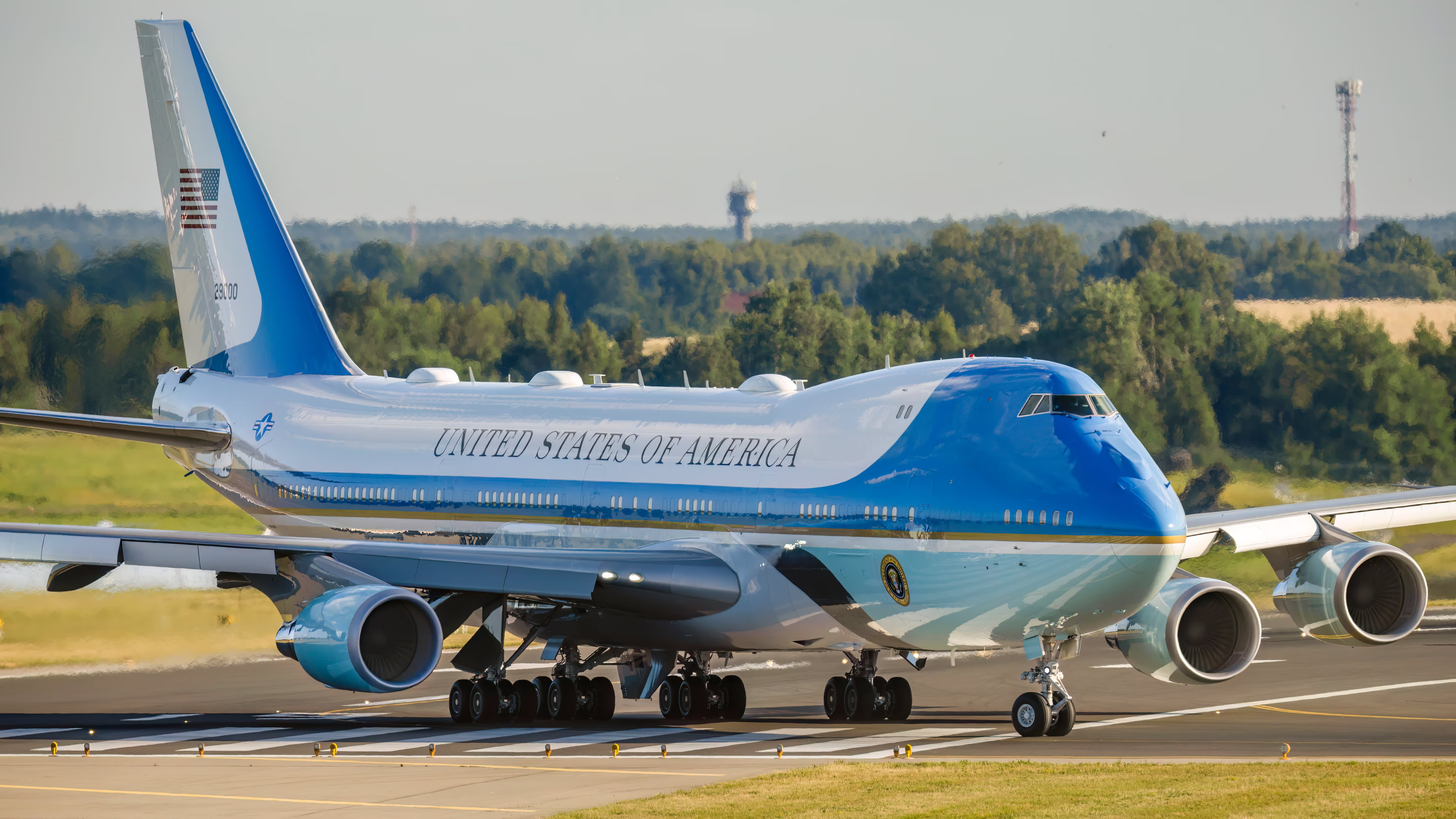
The U.S. leads the world in private aviation, with the largest and fastest-growing market, projected to reach $40.05 billion by 2029. With that in mind, it’s no surprise that Air Force One, America’s most famous non-commercial jet, ranks among the most advanced and secure non-combat aircraft ever built.
While one might assume that America’s fascination with private aviation began with the presidential plane, history tells a different story. Long before Air Force One became a symbol of power in the sky, oil tycoons and major news organizations were already embracing private aircraft as a practical way to cross the country faster than trains.
So how did Air Force One evolve into a three-story, nuclear-hardened flying fortress? And how much did the private aviation industry shape what the president flies today? In this article, jet rental platform Jettly examines the history of Air Force One.
By the late 1930s, business executives were crisscrossing the nation in the Twin Beech (the first American airplane designed specifically for business travel) while the President was still relying on trains and ships to get around.
Unlike today, those early private aviation customers weren’t chasing luxury or status. They were corporations and industrial titans looking for a competitive edge. Before Air Force One, with all its bells and whistles, was a concept, airplanes were practical business tools that moved people and information faster than any steam engine ever could.
The landscape began to change between 1945 and 1960, when the U.S. government found itself with a massive surplus of military transport aircraft (such as the C-47). This helped start the first air charter companies. For the first time, a group of people could pool their money to rent a plane for a specific trip, rather than owning the entire aircraft and hangar.
Technically, “Air Force One” isn't a single plane; it is the radio call sign for any U.S. Air Force aircraft carrying the president. However, the lineage of the “Flying White House” spans over 80 years of aviation history, evolving from basic military transports to today’s airborne command centers reportedly “hardened” to withstand the electromagnetic pulse from a nuclear detonation.
The first sitting president to fly privately was Franklin D. Roosevelt, who took a Boeing 314 Clipper flying boat (the Dixie Clipper) to the Casablanca Conference in 1943.
Several planes later, the presidential flight got the Air Force One moniker during Dwight D. Eisenhower’s term. The reason? A simple confusion: His plane (Columbine II) and a commercial Eastern Airlines flight had the same tail number (8610), and they needed a way to tell them apart.
Once the Boeing 707 was introduced in 1959, both private aviation and presidential flying began to focus more on passenger comfort and experience. Suddenly, it wasn’t just about how fast passengers can get to the other corner of the world, but also how well-rested they would be at landing.
The cyan, silver, and white paint scheme with “United States of America” emblazoned on the fuselage was introduced by JFK and First Lady Jacqueline Kennedy. Also, the most famous 707, SAM 26000, which entered service under John F. Kennedy in 1962, carried eight presidents, and brought home JFK’s body.
In the present day, two highly modified Boeing 747-200B aircraft play the role of Air Force One. These are designated as VC-25A (tail numbers 28000 and 29000) and have been serving since 1990.
These planes are flying fortresses, capable of acting as a mobile command center in the event of a nuclear strike. They include a medical suite (with an operating table), two galleys that can feed 100 people, and a private suite for the president.
At first glance, the evolution of private aviation and Air Force One can seem completely unrelated, as if they simply developed side by side and happened to share the same timeline.
In reality, their stories are tightly intertwined.
As the ultimate symbol of government aviation, the president’s aircraft has always set the bar, pushing manufacturers to raise standards for safety, comfort, and onboard productivity. In many ways, the drive to enhance Air Force One’s capabilities helped lay the groundwork for the private jets flown by today’s CEOs and celebrities.
When President Kennedy began flying aboard a Boeing 707 in 1962, it became a flying endorsement for jet travel itself. That presidential “seal of approval” reassured corporate America that jets were safe and necessary, fueling the demand for the first dedicated private business jets like the Lockheed JetStar and Learjet.
The pattern repeated with technology. The president’s need for secure, high-speed communications at 40,000 feet accelerated the development of satellite systems and onboard connectivity, features that are now standard in modern Gulfstreams and Bombardiers.
But the relationship works the other way around, too. The long-range Gulfstream jet, which is one of the planes that serves as Air Force One for smaller missions, was developed entirely by the private sector.
In short, these two worlds function as a feedback loop: the government funds high-risk, doomsday-level technology, while private industry refines it, makes it more efficient, and eventually brings the cost down so private aviation clients can use it.
Share this post:
Jay Franco Serevilla
Dec 27, 2025
|
5
min read
Discover tips and trends in the industry.
5
min read
Latitude Airlines & Private Aviation: How Jettly Makes Booking Simple
Many travelers seeking private flights often search for 'latitude airlines,' a term that encompasses various private aviation options. Jettly simplifies the booking process by connecting users to over 20,000 aircraft worldwide, offering flexible scheduling and transparent pricing. This guide explains how Jettly serves as a digital marketplace for private jet charters, catering to both business and leisure travelers.
Read More
5
min read
Lunken Airport Private Charter: Jet Charters at Cincinnati Municipal Lunken Airport (LUK)
Cincinnati Municipal Lunken Airport (LUK) offers a convenient private charter service for travelers seeking quick access to downtown Cincinnati. Jettly connects clients to a wide range of aircraft options, ensuring a seamless booking experience with transparent pricing. With amenities designed for comfort and efficiency, Lunken Airport is the ideal choice for both business and leisure flights.
Read MoreStay updated with our latest insights and tips to elevate your journey with us.
MEMBERSHIPS AND ASSOCIATIONS



Disclaimer: Jettly operates as a charter broker, offering access to a global digital jet charter marketplace. Jettly is not a direct air carrier and does not own or operate aircraft. All advertised flights are conducted by third-party air carriers that are fully licensed and hold the appropriate Part 135 or Part 121 certifications issued by the Federal Aviation Administration (FAA) or equivalent regulatory authorities under U.S. or foreign law. Jettly complies fully with the U.S. Department of Transportation's Part 295 and Part 298 Charter Broker regulations. Jettly does not carry additional liability insurance. Passengers are covered by aircraft operator insurance. TICO: 50023770


