



Login
Get Instant Pricing On 23,000+ Aircraft

>
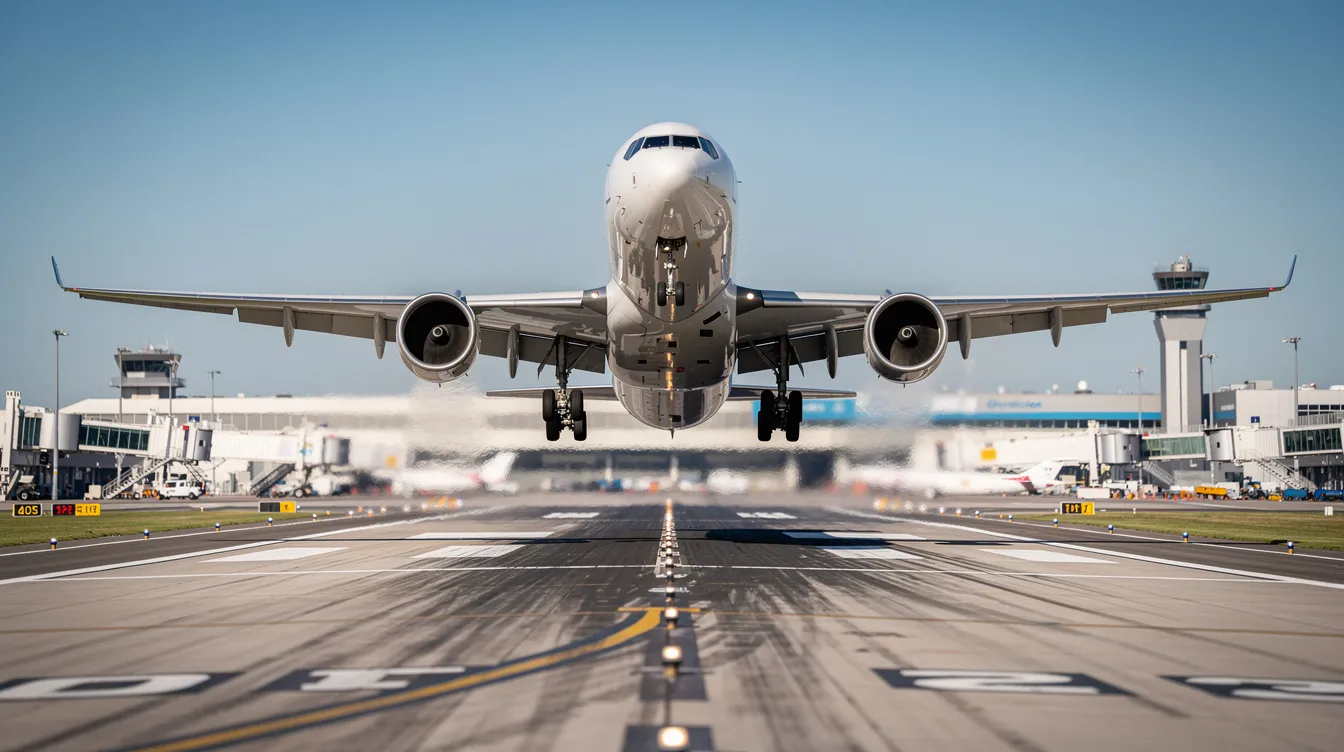
The Boeing 777 is one of the most widely operated long-range wide-body aircraft in commercial aviation. Airlines fly it on routes spanning 14+ hours, carrying 300 to 400 passengers across oceans and continents. But how long of a runway does a 777 need to get airborne, and how much pavement does it require to land safely?
This guide breaks down the runway length requirements for every major 777 variant, explains the technical factors that shift those numbers, and puts them in context for travelers comparing commercial airline operations with private jet charter.
A Boeing 777-300ER typically needs about 10,000 to 11,000 feet (3,050 to 3,350 m) of runway for takeoff at or near maximum takeoff weight at sea level under standard conditions. The Boeing 777-200 needs about 9,900 feet, and the Boeing 777-300 requires approximately 10,200 feet.
Aircraft weight is the single biggest factor influencing runway length requirements. Many 777 flights depart below maximum weight, allowing safe operations from 8,500 to 9,500 ft runways on shorter routes with fewer passengers or less cargo.
Landing distance for a 777 is much shorter than takeoff distance: around 5,500 to 7,000 feet depending on weight, runway surface, and weather.
Runway requirements depend on temperature, airport elevation, runway surface condition, wind, and one-engine-failure performance margins. A wet runway can increase required length by 15 percent.
While Jettly focuses on private jet charter, understanding 777 runway requirements helps travelers see why private jets, with their lower runway needs, can access hundreds more airports than commercial wide-bodies.
Under standard conditions at sea level on a dry runway, a Boeing 777 needs roughly 9,000 to 11,000 feet of runway for takeoff at or near maximum weight. The exact figure depends on the variant. A heavier aircraft requires more runway for takeoff and landing, so longer-range variants with higher maximum takeoff weight sit at the upper end of that range.
Here are planning-level figures for key variants:
777-200ER (~656,000 lb MTOW): roughly 9,500 to 10,500 ft
777-300ER (~775,000 lb MTOW): about 10,000 to 11,000 ft
777-200LR / 777F (~766,000 lb MTOW): approximately 10,000 to 10,500 ft
777-8 / 777-9 (preliminary, ~775,000 to 805,000 lb MTOW): comparable to or slightly above the 777-300ER
These numbers assume operations at or near maximum takeoff weight. Lighter departures (shorter routes, less fuel, fewer passengers, less cargo) can reduce required runway length by 10 to 30 percent. Specific operational limits always come from the aircraft flight manual and the airport's declared distances, not simple rules of thumb.
Major intercontinental hubs like London Heathrow (12,008 ft), Dubai International (13,123 ft), and New York JFK (14,511 ft on its longest runway) offer 11,000 to 14,500 ft runways specifically to support fully loaded long-range 777 and similar wide-body operations.
Different 777 versions have different runway needs due to differences in maximum weight, engines, wing design, and range capability. For a deeper look at how Boeing sizes its aircraft family, see Jettly's guide to the size of Boeing planes.
The table below summarizes indicative balanced field length at sea level, ISA conditions for each major variant at or near maximum takeoff weight. These are planning figures, not operational guarantees.
|
Variant |
Approx. MTOW |
Takeoff Distance (dry, sea level, ISA) |
Landing Distance (at MLW, dry) |
|---|---|---|---|
|
777-200 (Classic) |
~545,000 lb (247 t) |
~8,500–9,900 ft (2,600–3,020 m) |
~5,500–6,500 ft |
|
777-200ER |
~656,000 lb (298 t) |
~9,500–10,500 ft (2,900–3,200 m) |
~6,500–7,500 ft |
|
777-300 |
~660,000 lb (299 t) |
~10,200 ft (3,109 m) |
~6,000–7,000 ft |
|
777-300ER |
~775,000 lb (352 t) |
~10,000–11,000 ft (3,050–3,350 m) |
~6,000–7,000 ft |
|
777-200LR |
~766,000 lb (347 t) |
~9,200–10,500 ft (2,800–3,200 m) |
~5,200–6,000 ft |
|
777F (Freighter) |
~766,000 lb (347 t) |
~10,000–10,500 ft (3,050–3,200 m) |
~5,500–6,500 ft |
|
777-8 / 777-9 (prelim.) |
~775,000–805,000 lb |
Comparable to 777-300ER or slightly higher |
Data pending final certification |
Airlines often depart at less than maximum takeoff weight, so many commercial 777 flights can safely use runways slightly shorter than the worst-case planning distances listed above.
For a Boeing 777, takeoff is almost always more runway-critical than landing, especially on long-range flights where the airplane is loaded with fuel close to its maximum weight.
Consider the 777-300ER: takeoff distance at maximum takeoff weight runs about 10,000 to 11,000 feet on a dry runway at sea level. Landing distance at maximum landing weight on the same dry runway surface is about 6,000 to 7,000 feet. The difference is roughly 3,000 to 4,000 feet.
The aircraft usually lands much lighter than it departed because it burns fuel throughout the flight. A 777-300ER carrying fuel for a 14-hour flight might burn 200,000+ lb of fuel, meaning the airplane arrives well below its maximum landing weight. This reduces the runway needed for landing distance even further.
Regulatory landing distance calculations include safety margins, so a 777 can often land at airports where it could not depart at maximum weight and range.
Sample takeoff vs. landing distances (777-300ER, sea level, ISA):
|
Condition |
Takeoff Distance |
Landing Distance |
|---|---|---|
|
Dry runway, near max weight |
~10,000–11,000 ft |
~6,000–7,000 ft |
|
Wet runway, near max weight |
~11,000–12,000+ ft |
~7,000–8,000 ft |
When people ask how much runway a 777 needs, they are usually referring to the balanced field length rather than just physical pavement length.
Balanced field length is the runway length at which the accelerate-stop distance equals the accelerate-go distance for a critical engine failure at decision speed (V1). Two scenarios define it:
Accelerate-stop distance: the airplane accelerates to V1, the crew detects an engine failure, rejects the takeoff, and brings the airplane to a full stop on the remaining runway.
Accelerate-go distance: the airplane accelerates to V1, loses one engine, continues the takeoff on one engine, rotates, and climbs to 35 feet above the runway.
For the Boeing 777, this one-engine failure case largely sets minimum runway requirements for takeoff performance and airport planning. Published runway requirements in Boeing's airport planning manuals are conservative design figures. Day-of-flight performance calculations can yield shorter or longer usable distances depending on current conditions.
The Boeing 777 is a twin-engine long-range wide-body. It must demonstrate safe takeoff performance with one engine inoperative (OEI). This requirement shapes how much runway the airplane needs.
With two engines, losing one at V1 removes roughly 50% of the airplane’s total thrust. Compare that to a four-engine aircraft like the Boeing 747-400, which loses only about 25% when one engine fails. For reference, a 747-400 needs about 11,000 feet at maximum weight, despite having four engines, because of its higher overall mass.
To compensate for this thrust asymmetry, the 777's engines produce very high thrust. The GE90-115B on the 777-300ER is rated at roughly 115,000 lb of thrust per engine. Engine types and thrust ratings directly affect takeoff performance and distance needed; more thrust and better wings can reduce the necessary balanced field length, even for a heavy aircraft.
This OEI performance requirement is the reason the 777 needs long runways at high weights. The airplane must not only accelerate to flying speed; it must do so with enough margin that losing one engine at the worst possible moment still results in a safe outcome.
Airlines operating the 777 rely on a set of standard performance speeds and distances computed for every departure and arrival.
Key speeds:
V1 (decision speed): the speed below which the crew must reject the takeoff if a critical failure occurs, and above which they must continue.
VR (rotation speed): the speed at which the pilot pulls back on the controls to lift the nose.
V2 (takeoff safety speed): the minimum speed the airplane must reach by 35 feet above the runway with one engine inoperative.
VREF (approach reference speed): the target speed crossing the runway threshold during landing.
These speeds interact with runway length, weight, and flap setting to determine whether a given runway meets safety margins. Aircraft configuration affects runway performance, including flaps and engine thrust ratings in the takeoff configuration; a higher flap setting increases lift but also drag, creating trade-offs in required distance.
Modern airline dispatch systems and electronic flight bags (EFBs) generate precise runway requirements for each flight using current weight, wind, density altitude, and runway condition. While enthusiasts may quote generic 777 runway length numbers, certified crews must always use actual performance data from the 777's AFM and company-approved software.
Density altitude is an equivalent altitude that reflects the combined effect of pressure altitude and temperature on air density. A runway at sea level on a 40°C day can have a density altitude equivalent to a runway several thousand feet above sea level.
Higher density altitude means thinner air. Thinner air reduces both engine thrust and wing lift, increasing the runway length needed for safe takeoff. High elevation reduces engine thrust, and high temperature affects air density; both effects compound at airports that are both hot and high. The Boeing 777 typically requires longer runways at higher altitudes.
Concrete example: a 777-300ER departing close to maximum takeoff weight from a cool sea-level airport might use about 10,000 feet of runway. That same airplane at Mexico City (elevation ~7,343 ft) on a 30°C afternoon could need well over 12,000 feet, or more likely, would need to reduce weight by carrying less fuel or fewer passengers.
At extreme hot-and-high locations, long-haul 777 flights may require:
Payload restrictions (fewer passengers, less cargo)
Fuel stops en route
Departures scheduled for cooler morning or nighttime hours
Dispatch planners for 777 long-range flights treat density altitude as one of the most important inputs in their performance calculations.
A Boeing 777 is certified for operations on strong paved surfaces only. Runway surface quality and friction are critical at weights exceeding 500,000 lb and speeds above 150 knots.
A dry runway provides optimal traction and braking performance for aircraft during takeoff and landing. A grooved concrete or asphalt surface in good condition delivers the shortest stopping distances and the most predictable acceleration.
Wet or contaminated runways reduce braking effectiveness and increase landing distance. Wet runways increase required runway length by 15 percent under standard regulatory calculations. Standing water, slush, compacted snow, or ice push those increases even higher. Boeing's operational data manuals document specific increases for each contamination type.
Runway slope also matters. Runway slope can influence acceleration during takeoff and deceleration during landing. An uphill slope increases takeoff roll and may demand more runway, while a downhill slope can reduce ground roll on departure but increases landing rollout.
For 777 operations, airport data such as runway friction coefficients, braking action reports, and slope gradients are essential inputs into performance calculations.
Runway requirements for a Boeing 777 extend beyond length. Width, pavement strength, and obstacle clearance all factor in.
Typical minimums for 777 operations:
|
Requirement |
Minimum Value |
|---|---|
|
Runway width |
45 m (150 ft), ICAO Code 4E |
|
Pavement strength |
PCN sufficient for ~250-tonne class aircraft |
|
Wingspan clearance |
~200 ft (60+ m) for the 777; 777X folding tips extend to ~235 ft |
|
Taxiway width |
Must accommodate 777 turning radius |
A runway might appear long enough on paper, but if pavement strength cannot support the 777's wheel loads, or if taxiway geometry prevents safe maneuvering, the airport is not 777-capable.
For context, many regional airports that serve private jets at smaller fields lack the pavement strength or width for heavy commercial widebodies, even though they are prime examples of airports commonly used by private jets.
Temperature, wind, and weather can change a 777's required runway length by thousands of feet compared with cool, calm, dry conditions.
Temperature: runway length increases with temperature and aircraft weight. A 777 needing 10,000 ft at 15°C (ISA standard) might need well over 11,000 ft at 35 to 40°C at the same weight and elevation. On a hot day, the airplane needs more runway because the air is thinner.
Wind: Wind conditions influence required runway length for takeoff and landing. Headwinds decrease the distance needed for takeoff while tailwinds increase it. Even a 10-knot tailwind component can add hundreds of feet to the required takeoff distance and may trigger weight restrictions.
Adverse weather: rain, snow, or ice reduce braking friction, increasing landing distance and changing takeoff calculations. Crosswinds combined with marginal runway length or wet runway surface can lead airlines to choose longer runways or delay operations.
Real-world example: Emirates operates 777-300ERs from Dubai International on hot summer afternoons when temperatures exceed 45°C. On those days, the airline may restrict payload on the longest routes to ensure the airplane can meet takeoff performance requirements on Dubai's 13,123 ft runways.
Boeing 777s routinely operate on routes like London to Dubai, New York to Hong Kong, and Los Angeles to Tokyo. The airports serving these routes provide generous runway lengths to support fully loaded long-range departures.
Runway lengths at major 777 hubs:
London Heathrow (LHR): 12,008 ft (3,658 m) on Runway 09L/27R
Dubai International (DXB): 13,123 ft (4,000 m)
Hong Kong (HKG): 12,467 ft (3,800 m)
New York JFK (JFK): 14,511 ft (4,423 m) on Runway 13L/31R
Los Angeles (LAX): 12,091 ft (3,685 m) on Runway 25L/07R
These runways support fully loaded intercontinental departures where the 777 is near maximum takeoff weight with fuel for 14+ hour flights.
At airports with medium-length runways (around 9,000 to 10,000 ft), 777 operations may be weight-restricted during hot afternoons or require performance-focused planning. Mexico City (elevation ~7,343 ft, runway ~13,000 ft) has a long runway, but the high elevation means the effective density altitude can still impose payload limits on long-range 777 departures.
While the 777 is designed for large international airports, it can operate from some shorter runways under the right conditions and with weight limits, especially in configurations like the Boeing 777-200LR long-range variant.
A 777 arriving relatively light after a medium-haul leg can land on a runway of about 7,000 to 8,000 feet with appropriate safety margins. Departures at reduced weight (shorter routes, less fuel, fewer passengers) can use runways shorter than the maximum-weight planning distances.
Runway width, taxiway geometry, and pavement strength often rule out many secondary airports even if the runway length appears adequate on paper. There are documented occasions of 777s diverting into smaller airports during contingencies, demonstrating the airplane's flexibility when managed with proper performance calculations.
These operations are planned and authorized by regulators and airline performance engineers; they are not ad hoc improvisations.
A 777-capable runway would need:
At least ~9,000 to 11,000 ft of straight, reasonably level ground
A width of about 150 ft (45 m) or more
Pavement strong enough for 250+ tonne aircraft
Adequate safety areas and obstacle-free zones at each end
Building such a strip requires heavy construction equipment, thousands of tonnes of concrete or asphalt, and months of work. The ground would need to be surveyed, graded, compacted, and paved to aerospace-grade standards.
Construction activities, ground clearing over several kilometers, and the required runway surface would be visible in satellite imagery. Intelligence agencies routinely monitor construction of new runway-grade infrastructure. In practice, the logistical, technical, and detection challenges make constructing a covert 777 runway highly impractical.
The Boeing 777 sits at the upper end of runway requirements for commercial aircraft. Private jets commonly booked through platforms like Jettly need far less pavement.
Large-cabin and ultra-long-range business jets like the Gulfstream G650, Bombardier Global 7500, and Dassault Falcon 8X typically need about 5,500 to 7,000 ft of runway at or near maximum weight. That difference of 3,000 to 5,000 feet opens up hundreds of additional airports. For details on how heavy jets compare across models, Jettly maintains a dedicated guide.
Travelers who do not need 300+ seats can choose smaller aircraft with lower runway requirements and far greater airport flexibility, or even explore more affordable aircraft options if they are considering ownership instead of charter. For a broader comparison, see Jettly's private jets comparison guide, which also explains how many passengers different private jet types can carry.
Runway requirements influence route planning, fuel planning, payload limits, and even pricing for both airline and charter operations.
If an airport's runway length, surface, or declared distances are marginal for a 777, the operator may need to:
Limit payload (fewer passengers or cargo)
Carry less fuel and schedule a fuel stop
Use an alternative, longer runway airport nearby
This same logic applies at a smaller scale to private jet flights, including innovative options that crowdsource private jet flights and share empty seats. Runway length can determine whether a client uses a convenient regional airport or must reposition to a major hub. For travelers considering charter or complex long-range itineraries, reviewing runway data early is practical, particularly for remote or hot-and-high destinations, and can help in choosing the most suitable aircraft from the broader private jet charter fleet.
Learn more about Jettly's charter options at jettly.com or explore a detailed guide on affordable private jet charter pricing.
Jettly's digital platform and partner operators routinely evaluate runway requirements for each proposed charter. While Jettly does not operate 777s as standard private charter equipment, the performance evaluation process applies to every aircraft type available through its private charter aircraft network.
Simple checklist for charter travelers:
Identify departure and arrival airports
Note runway length, width, surface, and runway elevation
Consider season, temperature, and time of day
Share passenger count and baggage estimates with the charter team
Jettly's network of operators uses certified performance data to match each trip to aircraft with suitable runway performance, often selecting light, midsize, or large-cabin jets instead of airline-sized wide-bodies, depending on where private jets can land and the facilities available. This process helps ensure safe operations, reduces the risk of last-minute payload cuts, and can open up airports closer to a traveler's final destination by leveraging insights into where private jets typically land.
Use Jettly's airport locator and airport locator tool to identify airports that match your route and aircraft type.
The Boeing 777's runway needs sit at the top of the commercial aviation spectrum. Here is how it compares across aircraft categories:
Turboprops: ~2,000–4,000 ft
Very light and light jets: ~3,000–4,500 ft
Midsize and super-mid jets: ~3,500–6,000 ft
Large-cabin private jets: ~5,500–7,000 ft
Narrow-body airliners (A320, 737): ~6,000–8,200 ft (see Jettly's guide to minimum runway length for 737)
Wide-body airliners (777, A350, 787): ~8,000–11,000 ft
Standard takeoff distances for large aircraft typically range from 6,000 to over 10,000 feet. These are planning ranges at sea level, near maximum weight, on dry paved runways. Real operations vary with load and conditions.
The Boeing 777 sits at the upper end because it is a long-range, high-capacity airliner designed to carry 300+ passengers with fuel for 16-hour flights. Jettly's platform can propose alternatives across these categories for travelers whose origin or destination airports have limited runway length. A smaller aircraft can often fly into airports that a larger aircraft cannot reach, and those evaluating long-term solutions may look into the cheapest private aircraft options that still meet their range and runway needs.
Regulatory bodies like the FAA and EASA require conservative safety margins for both takeoff and landing distances for heavy aircraft like the 777. Regulations require certified safety buffers in runway length calculations for takeoff.
Key regulatory concepts:
Factored landing distance: in some jurisdictions, commercial operators must use the "60% rule," meaning the airplane must be able to stop within 60% of the available landing distance under normal conditions.
Wet runway factors: regulators apply a factor (typically 115% of the dry figure) when a wet runway is reported or forecast.
Declared distances: TORA (Takeoff Run Available), TODA (Takeoff Distance Available), ASDA (Accelerate-Stop Distance Available), and LDA (Landing Distance Available) may be less than physical runway length due to displaced thresholds, slopes, or obstacles.
Even if a 777's basic landing distance from 50 feet might be around 4,500 to 5,000 feet under ideal conditions, operators must ensure it fits into a longer runway after applying regulatory factors. The dry requirement is only the starting point; actual planning distances are always higher.
These rules also affect chartered aircraft, and reputable platforms like Jettly only work with operators who adhere to these regulated performance margins.
Ultra-long-range flights push the 777 to high takeoff weights, making runway length a critical constraint. A 777-300ER flying Dubai to Los Angeles (roughly 16 hours) may depart at or near its maximum takeoff weight of ~775,000 lb, carrying close to 300,000 lb of fuel.
Such flights may:
Require the longest available runway at the departure airport
Impose payload limits when ambient conditions are unfavorable (hot, high, wet)
Be rescheduled to cooler times of day to gain performance margin
How much fuel the airplane carries directly determines how much runway it needs. More fuel means higher weight, which means more distance needed for the takeoff roll. On a hot day at an airport like Dubai, the airline may limit passenger count or cargo to keep the airplane within performance limits for the available runway.
Private ultra-long-range jets like the Bombardier Global 7500 or Gulfstream G700 can fly similar stage lengths but from shorter runways due to their smaller size and lower weight, reflecting the capabilities of leading private jet manufacturers. This trade-off between capacity and runway flexibility is fundamental to understanding why different airplane types exist and helps inform travelers who may eventually consider choosing the best personal plane for private use.
The decision about whether a runway meets the 777's needs follows a systematic workflow between airline dispatchers and flight crews.
Key data inputs:
Aircraft weight at a given time for the departure
Flap setting selected for takeoff
Anti-ice system status
Runway length, slope, and declared distances
Surface condition (dry, wet, contaminated)
Density altitude (combining airport elevation and temperature)
Wind speed and direction
Obstacle environment in the departure path
Performance software calculates the maximum allowable takeoff weight for a given runway. It also outputs the required takeoff and landing distances, along with any limitations such as tailwind limits, use of reduced thrust, or intersection departure restrictions.
If the required distance exceeds declared runway length, dispatch must reduce weight, change the runway, or adjust routing until performance margins are met. The pilot has final authority to reject a takeoff if conditions on the ground do not match what was planned.
This systematic approach is mirrored in business aviation, where Jettly's partner operators perform similar calculations for every private flight, just with different aircraft types, from light jets to larger airliners such as the Boeing 737-800.
Runway length limitations influence route options, schedules, and airport choices in ways that directly affect the passenger experience.
Airlines flying 777s are confined to major airports with long, strong runways. That often means longer ground transfers, congested terminals, and less schedule flexibility. A 777 cannot fly into a 5,000 ft regional strip, no matter how close it is to the traveler's destination.
Private jet charter via platforms like Jettly puts travelers on aircraft with lower runway requirements and can also serve as a cost-effective alternative to NetJets and similar fractional ownership programs. A midsize jet can use a 5,000 ft runway at a regional airport 20 minutes from a resort town. A large-cabin jet can land at a business hub where the longest runway is 6,500 feet. That airport might not appear on any commercial airline's route map.
For complex trips, understanding runway requirements helps high-frequency travelers select the most efficient combination of airline and private jet segments. Fly the 777 for the transoceanic leg, then connect to a private charter for the final hop, using tools like a private jet charter cost estimator to understand pricing across different aircraft sizes.
A Boeing 777 needs roughly 9,000 to 11,000 feet of runway for takeoff at or near maximum weight under standard conditions at sea level. Different Boeing 777 variants can have different runway requirements based on maximum takeoff weight, with the 777-300ER at the upper end. Landing distances are shorter, generally in the 5,500 to 7,000 ft range depending on conditions.
The core variables are weight, density altitude, runway surface and slope, wind, and one-engine-out performance requirements. Runway length increases with aircraft weight and temperature, and higher altitude airports push those numbers higher still. A dry runway at sea level is the best case; a wet runway at high elevation on a hot day is among the worst.
Runway length for a 777 is about meeting conservative safety margins under the worst credible scenarios, not just how quickly the airplane can lift off on a good day. For travelers who want aircraft that can use shorter runways than a Boeing 777, private jet charter opens up far more airports and destinations.
Ready to explore your options? Explore flight options or request a quote at jettly.com.
Below are answers to common questions about Boeing 777 runway operations that are not fully covered in the main article.
In an emergency at relatively low landing weight, a 777 can stop within about 5,000 to 6,000 ft on a dry runway. A 7,000 ft runway may be usable if conditions are favorable. In genuine emergencies, captains may opt for any runway that offers the best overall chance of landing the airplane safely, even if it does not meet normal planning margins.
This is not a normal planning scenario. Airline operations typically require longer runways with full safety factors applied. A wet runway surface, tailwind, high density altitude, or obstacles near the runway could make 7,000 ft marginal or unacceptable even in an emergency.
The 777 is designed to carry 300 to 400+ passengers long distances and requires long, strong runways. That makes it impractical for most on-demand charter missions with small groups.
Private jets focus on flexibility, lower runway requirements, and access to a much larger network of airports, supported by a global fleet of private jets numbering in the tens of thousands worldwide. Typical charter group sizes of 4 to 15 passengers are far better served by light, midsize, or large-cabin business jets. Jettly's marketplace offers access to over 20,000 aircraft across these categories, all of which can operate from shorter runways than a 777, positioning it among the leading private charter airlines and platforms.
No. The Boeing 777 is not certified for unpaved surfaces like grass or gravel. Its weight, landing gear design, and engine placement create risks of pavement damage, foreign object ingestion, and gear failure on soft or unimproved surfaces.
Some turboprops and specialized military or bush aircraft are designed and certified for unpaved or rough fields. For remote or unpaved locations, private charter with suitable turboprops or helicopters is a more realistic option. Jettly can connect travelers with operators who specialize in these types of operations.
Modern 777s meet stringent international noise standards (ICAO Chapter 14), but many airports still impose night curfews, departure procedures, or runway use restrictions to limit noise over residential areas. These rules may force 777s to use specific runway directions or procedures, which can affect usable runway length if obstacles or crosswinds are present.
Private jets are subject to similar noise rules, but their smaller engines and lower thrust often give them more flexibility in noise-sensitive environments.
Density altitude affects both takeoff and landing performance, but its impact is usually more critical for takeoff. At takeoff, the airplane is heavier and must meet one-engine-out climb requirements, which are the binding constraint.
At high density altitude, landing distances do increase due to higher true approach speeds and reduced braking effectiveness. Crews must check landing distance calculations carefully, especially on a shorter runway at a higher altitude airport. Airlines and business jet operators alike use performance tools that account for density altitude at both departure and destination before dispatching a flight.
The Boeing 777 requires approximately 9,000 to 11,000 feet of runway for takeoff at or near maximum weight under standard conditions at sea level. Variations among 777 models, environmental factors like temperature and elevation, runway surface conditions, and safety regulations all influence the exact runway length needed. Landing distances are significantly shorter, typically between 5,500 and 7,000 feet.
Understanding these requirements highlights why the 777 operates primarily from major airports with long, strong runways, while private jets, with their lower runway needs, can access a wider range of airports. For travelers seeking flexibility and convenience, private jet charter platforms like Jettly offer access to aircraft that can use shorter runways, expanding travel options beyond those available to large commercial airliners.
Ready to experience private travel on your terms? Explore flight options or request a quote at https://www.jettly.com.
Share this post:
Jay Franco Serevilla
Nov 2, 2026
|
5
min read
Discover tips and trends in the industry.
5
min read
How Long of a Runway Does a 777 Need? (Runway Length, Takeoff and Landing Explained)
The Boeing 777 requires approximately 9,000 to 11,000 feet of runway for takeoff at maximum weight under standard conditions. Landing distances are shorter, typically ranging from 5,500 to 7,000 feet. Factors such as aircraft weight, temperature, and runway conditions significantly influence these requirements.
Read More
5
min read
Plane Charter Prices in 2026: How Much Does It Cost to Charter a Private Jet?
In 2026, private jet charter prices vary significantly based on aircraft type, with costs ranging from $1,800 to over $20,000 per flight hour. Additional expenses such as taxes, fees, and crew costs can increase the total trip price by 20-40%. This guide provides insights into the factors influencing these prices and offers strategies to reduce costs while maintaining comfort.
Read MoreStay updated with our latest insights and tips to elevate your journey with us.
MEMBERSHIPS AND ASSOCIATIONS



Disclaimer: Jettly operates as a charter broker, offering access to a global digital jet charter marketplace. Jettly is not a direct air carrier and does not own or operate aircraft. All advertised flights are conducted by third-party air carriers that are fully licensed and hold the appropriate Part 135 or Part 121 certifications issued by the Federal Aviation Administration (FAA) or equivalent regulatory authorities under U.S. or foreign law. Jettly complies fully with the U.S. Department of Transportation's Part 295 and Part 298 Charter Broker regulations. Jettly does not carry additional liability insurance. Passengers are covered by aircraft operator insurance. TICO: 50023770


