


Login
Get Instant Pricing On 23,000+ Aircraft

>
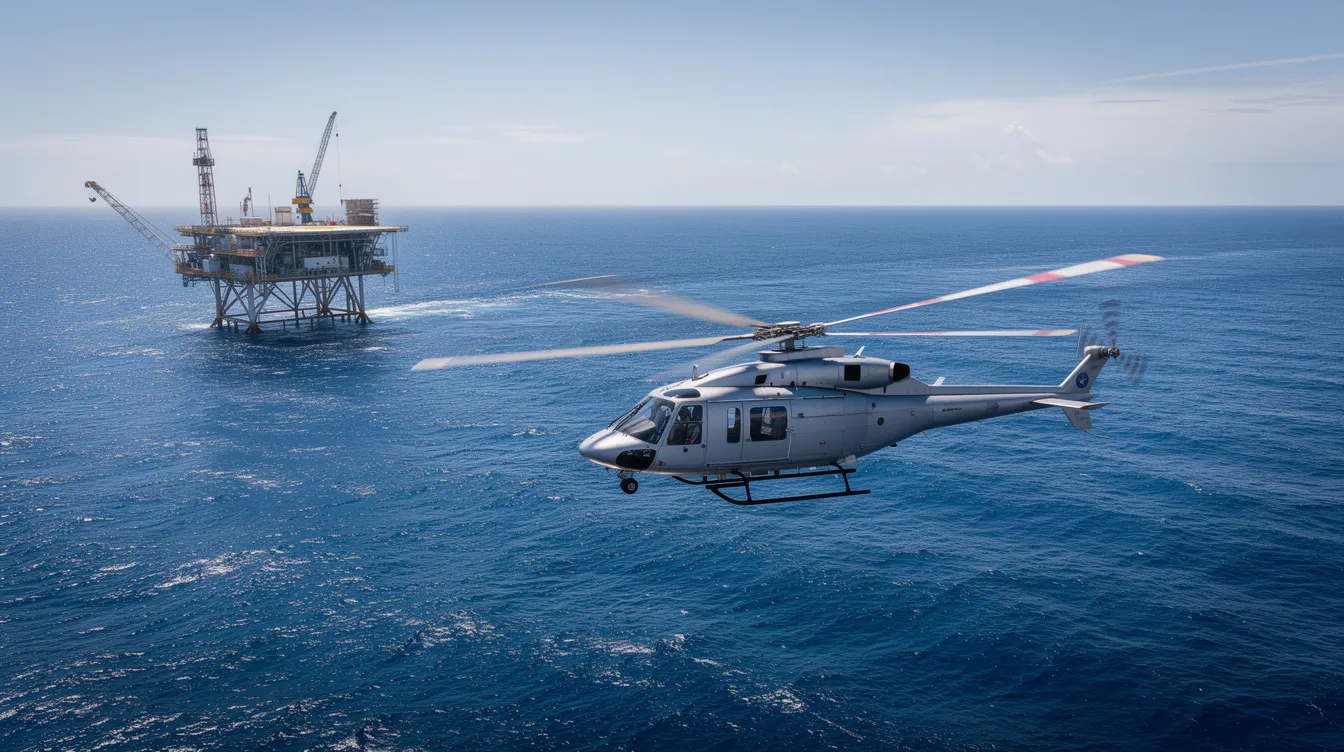
A typical light helicopter can usually stay airborne for about 2 to 4 hours. Piston engine helicopters like the Robinson R44 average around 2 to 2.5 hours of usable flight time. Light turbine singles like the Airbus H125 stretch closer to 3.5 to 4.5 hours. Large twin-engine helicopters used for offshore transport, such as the Sikorsky S-92, can remain aloft for roughly 5 hours before reserves kick in.
Typical helicopter endurance ranges from 2 to 6 hours, depending on the class. The average range of helicopters is 250 to 500 miles, though that figure can vary significantly with cruise speed, wind, and weight. A helicopter cruising at 130 knots for 3 hours covers about 390 nautical miles (roughly 450 statute miles). Fly slower, and you stay up longer but cover less ground. Fly faster and fuel consumption climbs, cutting total time aloft.
Fuel capacity, payload weight, weather conditions, and mission profile are the main limits on endurance. Pilots must maintain legal fuel reserves during flights; most regulations require 20 to 30 minutes of reserve fuel for daytime VFR operations. That reserve always reduces usable time in the air compared to published maximums. The table below reflects the average capacity across common helicopter classes.
Summary of Main Endurance and Range Figures by Helicopter Class:
Light Piston: 2–2.5 hours endurance, 200–350 miles range
Light Turbine: 3–4.5 hours endurance, 300–450 miles range
Medium Twin: 3.5–4.5 hours endurance, 350–500 miles range
Heavy Twin: 4–5+ hours endurance, 450–600+ miles range
|
Metric |
Light Piston |
Light Turbine |
Medium Twin |
Heavy Twin |
|---|---|---|---|---|
|
Average endurance |
2–2.5 hrs |
3–4.5 hrs |
3.5–4.5 hrs |
4–5+ hrs |
|
Average range |
200–350 mi |
300–450 mi |
350–500 mi |
450–600+ mi |
|
Common models |
Robinson R44 |
Airbus H125 |
Bell 429 |
Sikorsky S-92 |
Endurance is the total time a helicopter can stay in the air on one fuel load under standard conditions, including a required safety reserve. A helicopter's flight endurance depends on fuel capacity and consumption rate. Range is the maximum distance helicopters fly on a single tank of fuel at cruising speed in still air. Understanding helicopter range matters for flight plans because it determines whether a route is feasible without a refueling stop.
The same helicopter can show different endurance and range numbers depending on the speed a helicopter pilot selects. A slower cruise setting uses less fuel per hour, stretching endurance, but covers fewer miles. Higher speeds consume more fuel, impacting range. Legal fuel reserves often reduce practical flight time by 10% to 25% below published maximums; an aircraft with a published 4.5-hour endurance may only be planned for 3.5 to 4 hours of actual mission flying.
Endurance example: 3 hours at 130 knots = ~390 NM of range
Reserve impact: Adding 30 minutes of reserve fuel drops usable time to ~2.5 hours, reducing range to ~325 NM
Most helicopters fall into distinct endurance bands based on engine type and size. Below are realistic figures, not theoretical maximums.
|
Category |
Example Model |
Typical Endurance (with reserves) |
Approximate Range |
|---|---|---|---|
|
Light piston |
Robinson R44 Raven II |
1.8–2.2 hrs |
200–300 mi |
|
Light turbine (single) |
3.5–4 hrs |
300–400 mi |
|
|
Light twin |
3.5–4 hrs |
350–450 mi |
|
|
Medium twin |
Leonardo AW139 |
3.5–4.5 hrs |
400–500 mi |
|
Heavy twin / offshore |
Sikorsky S-92 |
4.5–5 hrs |
480–550 mi |
|
Specialized long-range |
Military with aux tanks |
4–6+ hrs |
500–1,200 mi |
Civilian helicopters typically fall between 2 and 4.5 hours. Advanced models with auxiliary fuel tanks can push beyond 5 hours, particularly specialized models built for offshore energy support and long overwater flights.
Several factors can significantly influence helicopter range and endurance, which in turn control how long any helicopter stays airborne:
More fuel and lower consumption per hour equal longer flights.
Turboshaft-powered helicopters cruise faster and handle altitude better than piston-engine helicopters but burn more fuel per hour.
Heavier loads force engines to work harder, increasing fuel usage.
High density altitude reduces helicopter rotor and engine performance, raising fuel burn for the same output.
Headwinds cut effective range, and adverse conditions can increase fuel usage; turbulence and icing require extra contingency fuel.
Hovering consumes far more fuel than forward cruise; stop-start patterns (construction, filming, search and rescue) drain tanks faster.
Power setting choices, altitude selection, and in-flight adjustments all influence how long a helicopter can stay in the air.
Endurance planning for both military and civilian helicopters always starts with fuel capacity and forecast fuel burn per hour. Later sections cover how air ambulance services, border patrol units, and charter operators apply these factors to real missions.
Fuel capacity directly influences a helicopter's flight range. The math is straightforward: divide usable fuel by hourly burn rate. A helicopter carrying 140 gallons that burns 50 gallons per hour stays airborne roughly 2.8 hours before reserves. Add a 30-minute reserve requirement and usable mission time drops to about 2.3 hours.
The Robinson R44 Raven II carries approximately 46.5 US gallons of usable fuel (standard plus auxiliary tanks). At a typical cruise burn of around 18 to 20 gallons per hour, that yields about 2.3 to 2.5 hours. Piston-engine helicopters typically range from 200 to 350 miles on a full load.
The Airbus H125 is a light turbine single with a published endurance of 4 hours 27 minutes at maximum takeoff weight, fast cruise, no reserves. With reserves factored in, usable time drops to about 3.5 to 4 hours. Gas-turbine helicopters can fly approximately 300 to 450 miles, thanks to higher cruise speeds and better power-to-weight ratios.
The Sikorsky S-92 burns roughly 1,270 pounds of fuel per hour at long-range cruise, delivering an endurance of about 5.2 hours without reserves. With a 30-minute reserve, usable time is roughly 4.6 to 4.8 hours.
Additional fuel tanks or extended range fuel tanks are common options for helicopters operating offshore or reaching remote locations. The trade-off: extra fuel tanks reduce cabin payload capacity and luggage space. The Bell 429, for instance, offers an optional 39-gallon auxiliary tank on top of its standard 217 gallons; the extra fuel stretches range but limits passenger or cargo weight, much like other light utility types such as the Eurocopter EC30 that balance payload against fuel capacity.
|
Model |
Usable Fuel |
Approx. Burn Rate |
Endurance (no reserve) |
|---|---|---|---|
|
Robinson R44 |
~46.5 gal |
~18–20 gal/hr |
~2.3–2.5 hrs |
|
Airbus H125 |
~143 gal |
~32 gal/hr |
~4.5 hrs |
|
Sikorsky S-92 |
~760 gal |
~190 gal/hr |
~5.2 hrs |
Weight affects helicopter performance and fuel burn in direct proportion. Every additional pound of passengers, baggage, or specialized equipment forces the rotor system to generate more lift, which demands more power from the engine, which burns more fuel per hour.
How Payload Weight Affects Helicopter Range:
A rescue helicopter carrying medical gear, a stretcher, and a flight paramedic crew operates closer to maximum takeoff weight, reducing both endurance and effective range.
A heavy-lift helicopter performing construction sling loads burns fuel at hover-level rates for extended periods, sometimes double the cruise-flight burn.
News and aerial cinematography helicopters loaded with camera rigs and satellite communication systems add hundreds of pounds of specialized equipment.
Hovering vs. Forward Flight:
Hovering consumes significantly more fuel than forward flight. In cruise, a helicopter's rotor system benefits from translational lift, reducing the power needed to stay airborne. In a hover, the rotor must generate all lift from engine power alone. Helicopters require significant power to maintain altitude during hover, and missions involving frequent climb/descend cycles (sightseeing flights, construction lifting) shorten effective time in the air.
Consider a worked scenario: an Airbus H125 flying light (pilot plus one passenger, partial fuel) might sustain about 4 hours of cruise. Load that same helicopter to near maximum takeoff weight with full passengers, baggage, and camera equipment, and usable endurance drops to roughly 3.2 hours; a 20% reduction driven entirely by weight.
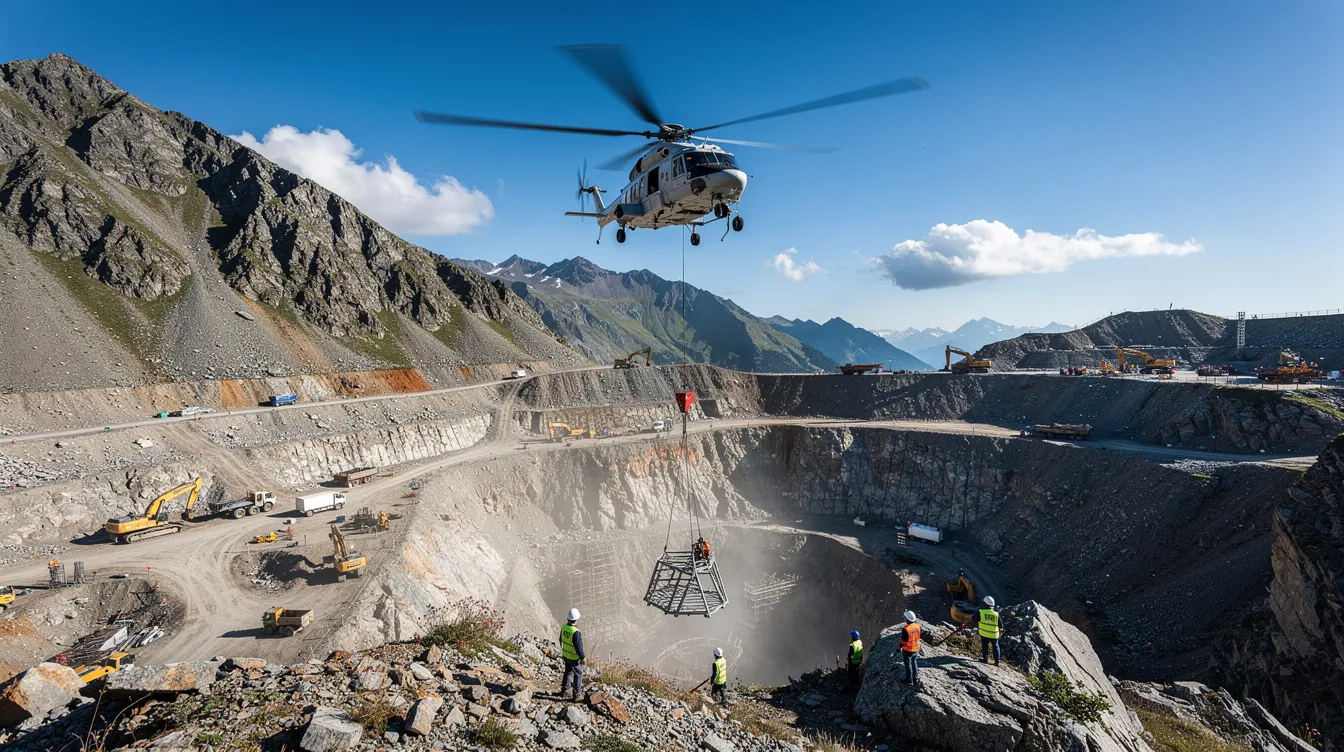
Civilian helicopters typically operate between 1,000 and 5,000 feet above ground level. As altitude increases, air density drops. High density altitude reduces helicopter rotor and engine performance; engines must work harder to produce the same power, and rotor blades generate less lift per revolution. The result: fuel burn per hour rises for the same flight profile, and endurance shrinks. This effect is pronounced in hot-and-high conditions (mountainous terrain, summer temperatures), where larger helicopters carrying full loads feel the squeeze most.
Weather conditions can reduce a helicopter's effective range in several ways. Headwinds cut groundspeed; a 20-knot headwind on a helicopter cruising at 120 knots reduces effective ground distance by roughly 17% for the same fuel burn. Tailwinds help, extending the distance covered without changing fuel consumption. Weather conditions affect helicopter range and endurance when pilots must carry extra contingency fuel for diversions, holding patterns, or icing avoidance.
Two brief comparisons illustrate the gap:
Mountain rescue at 8,000 ft in summer: The helicopter operates in thin, hot air. Fuel burn per hour can rise 15% to 20% compared to sea-level cruise. Reserve fuel requirements are stricter because alternate landing sites are sparse. Effective mission time may drop from 3 hours to 2.3 hours.
Coastal patrol at 500 ft, mild weather: Dense, cool air allows the engine to operate at peak efficiency. Endurance approaches published maximums. Reserves are easier to manage with multiple landing options nearby.
How long modern helicopters stay aloft depends heavily on their intended role. Here is a practical breakdown for aviation enthusiasts and charter travelers alike.
Models like the Bell 429, Airbus Helicopters H145, and Leonardo AW109 typically deliver 3 to 4 hours of endurance with reserves. These helicopters balance cabin comfort with range capabilities, carrying 6 to 8 passengers on legs of 150 to 350 miles, and their operating economics reflect the typical helicopter rental costs and pricing factors that charter customers should understand.
Emergency medical service helicopters typically have a range of 300 to 400 miles. Aircraft like the EC135 (H135) and H145 usually fly missions of 30 to 90 minutes each way, reserving enough fuel for diversions. Total endurance between refuelings: 2 to 3 hours. For more on helicopter ambulance operations, Jettly's guide covers costs and logistics, while a broader look at affordable aeroplane rental options helps compare helicopters with other aircraft types for medical and utility missions.
The Sikorsky S-92 and Leonardo AW189 carry crews to platforms 200+ miles from shore, with endurance of 4 to 5+ hours. These larger helicopters need that margin for overwater safety regulations requiring alternate fuel planning.
Robinson R44 and R66 helicopters technically sustain 2+ hours, but most sightseeing flights run 30 to 90 minutes for passenger comfort and scheduling efficiency, similar to how fixed-wing travelers weigh cross-country plane choices for longer journeys.
Search and rescue helicopters can cover distances of 300 to 500 miles, giving rescue operations enough radius to reach remote destinations and return safely, and their practical helicopter range capabilities depend heavily on fuel planning, payload, and weather.
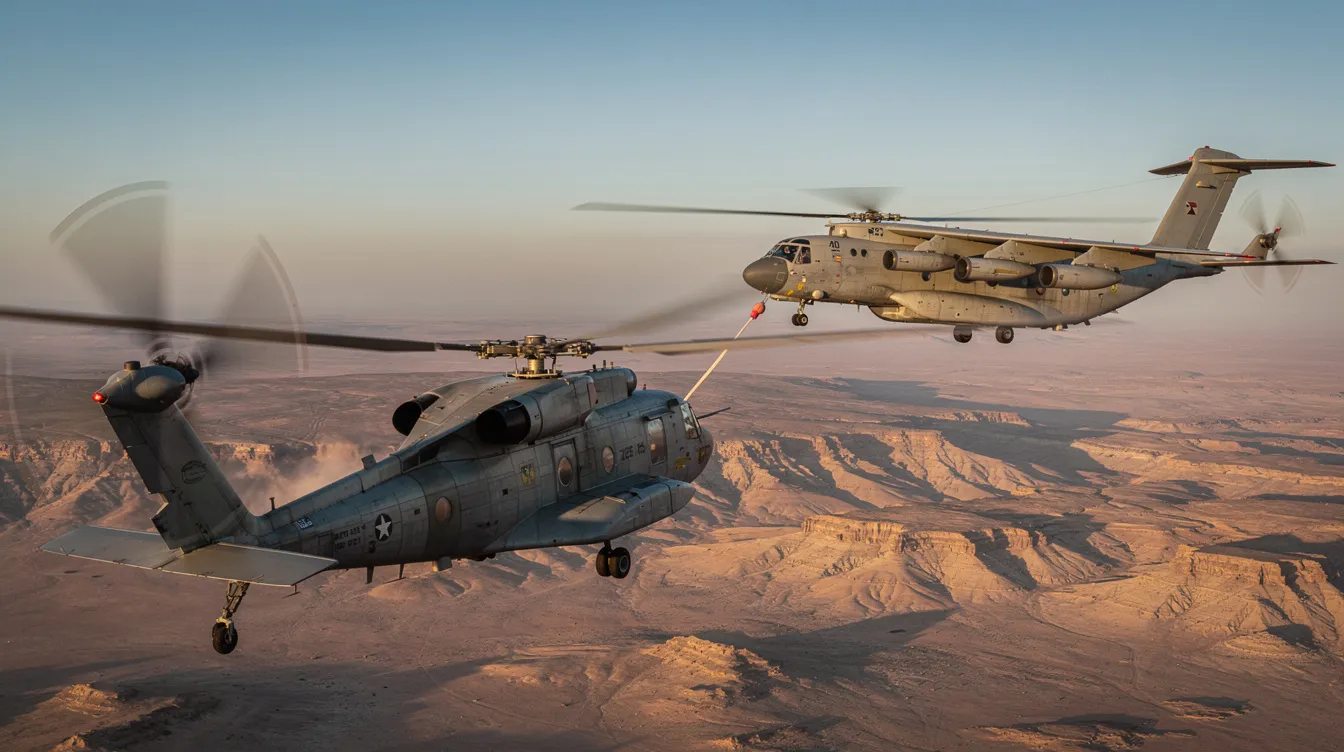
Many military helicopters carry external fuel tanks and, in some configurations, aerial refueling probes that allow them to stay airborne far beyond standard endurance. Military helicopters can achieve ranges up to 1,200 miles when configured for ferry or extended operations.
Specific military models and their endurance:
The UH-60 Black Hawk has a normal mission endurance of four hours. It can carry 11 soldiers with a range of 400 miles. With external tanks, that figure extends further depending on payload and profile.
The AH-64 Apache can stay airborne for two and a half hours on internal fuel. Attack helicopters like the Apache prioritize weapons load over fuel, so endurance, range, and maximum speed all factor into suitability for demanding missions, while extended range comes from external tanks on ferry missions.
The AH-1Z Viper has a flight endurance of three hours and thirty minutes, giving it longer loiter time for close air support than many comparable military models.
The Sikorsky CH-53K King Stallion has a range of 530 miles and can fly for four and a half hours. As a heavy-lift helicopter, the CH-53K King Stallion's endurance supports transporting troops and heavy cargo over long distances.
Special operations platforms like the MH-47G Chinook routinely use in-flight refueling to stay airborne for rescue missions and long-range insertions well beyond normal endurance. While some military helicopters could theoretically remain on station 6 to 8 hours with multiple aerial refuelings, crew fatigue and maintenance cycles limit real-world durations.
Endurance shapes mission planning for border patrol, maritime surveillance, and combat search and rescue operations, where loiter time on station determines mission success. The United States Army structures its rotary-wing patrol blocks around 2- to 3-hour segments with return-to-base for refueling and crew changes.
The longest helicopter flight on record belongs to the Bell 412 helicopter, which holds the record for the longest non-stop flight at 2,213 miles. That 1966 demonstration (flown as the Hughes YOH-6A) proved what helicopter technology could achieve with minimal payload and optimized fuel management.
A more extreme demonstration of endurance came in 1956, when a modified YH-13H nicknamed "Hamblin Annie" stayed airborne for 57 hours and 50 minutes using hover refueling and rotating seven pilots. The aircraft consumed roughly 731 gallons of fuel during that run.
Modern long-range helicopter expeditions, including around-the-world flights, rely on multiple legs, careful fuel management, and frequent refueling stops rather than single marathon segments. These flights prove the high performance helicopters can deliver under controlled conditions, but they are exceptions. Most operational missions, commercial or military, limit continuous time in the air to manageable blocks for crew rest and safety considerations.
A helicopter pilot's approach to fuel management starts before the engine turns. Choosing optimal cruise power settings, climbing efficiently to planned altitude, and avoiding unnecessary maneuvering all reduce fuel consumption. Maximum endurance airspeed minimizes fuel consumption per hour aloft; this speed is typically lower than maximum cruise and varies by aircraft type and weight.
Advanced avionics and flight management systems track real-time fuel burn, fuel remaining, and estimated time to reserve. These tools let pilots adjust speed, altitude, or routing mid-flight to stretch endurance when conditions change. Optimizing fuel efficiency is a practical skill, not a theoretical exercise.
Operational practices vary by mission. Some operators depart with full tanks; others carry partial fuel when payload capacity demands it, planning a refueling stop en route. Professional operators in air ambulance, law enforcement, and offshore support roles build standardized fuel policies that guarantee safe reserve fuel while maximizing usable time in the air. Advanced fuel systems on newer helicopters automate fuel transfer between tanks and provide warnings well before reserves are reached.
Platforms like Jettly work only with certified operators whose fuel management and safety procedures meet strict regulatory standards, giving charter customers confidence that every flight is planned with proper margins, particularly when selecting compliant Part 135 charter companies.
Typical endurance dictates how operators design their daily schedules:
Air ambulance: Flights average 30 to 90 minutes each way. The helicopter carries enough fuel to divert to another hospital or return to base if the primary landing zone is unavailable. Search and rescue operations follow a similar pattern, with sortie lengths driven by the distance to the incident and the need for reserve fuel.
Border patrol and law enforcement: Patrol blocks run 2 to 3 hours with return-to-base for refueling and crew rotation. Even when a helicopter technically can fly 3 to 4 hours, operators schedule missions in shorter blocks to manage fatigue and maintenance cycles.
Utility, construction, and firefighting: Shorter but intensive sorties with frequent landings and hovering. These helicopters may refuel multiple times per day, burning through fuel rapidly due to hover-heavy profiles.
Island/resort transport: Civilian helicopters used for transporting passengers between cities, islands, or ski resorts typically fly sectors of 30 to 200 miles, well below maximum helicopter range. This preserves flexibility for return legs and contingencies and complements Jettly's broader private charter aircraft options for travelers who may mix helicopters with jets on multi-leg itineraries.
|
Mission Type |
Typical Sortie Length |
Refueling Frequency |
Key Constraint |
|---|---|---|---|
|
Air ambulance |
30–90 min each way |
Every 2–3 hrs |
Diversion fuel |
|
Border patrol |
2–3 hr blocks |
After each block |
Crew fatigue |
|
Construction/utility |
20–60 min sorties |
Multiple times/day |
Hover fuel burn |
|
Island/resort transport |
30–90 min each way |
After round trip |
Passenger comfort |
For charter travelers, helicopter range and endurance determine which routes are feasible without a refueling stop. Most city-to-resort or city-to-island flights cover 30 to 250 miles, well within the impressive range of common charter models like the Bell 429, Airbus H145, or Leonardo AW109.
Charter brokers and operators select aircraft whose range comfortably exceeds the planned routing plus reserves. Balancing range, cabin size, and payload capacity matters; for many private charter passengers, comfort and baggage space are as important as the helicopter's flight range. Endurance figures help planners decide whether a refueling stop is needed, not something guests typically worry about, especially when using flexible private jet membership programs that also include access to helicopters.
Jettly's platform gives access to a wide inventory of civilian helicopters with different endurance profiles. Whether the trip is a short hop to a helipad or a multi-stop regional itinerary, travelers can match the aircraft to their needs using tools like Jettly's airport locator and booking platform. Learn more about Jettly's helicopter charter options.
Several lines of helicopter technology development are pushing endurance and range upward:
Newer turboshaft engines with FADEC (Full Authority Digital Engine Control) deliver lower specific fuel consumption. These more efficient engines reduce fuel burn per hour without sacrificing power, letting helicopters fly longer on the same fuel load.
Composite rotors, carbon-fiber fuselage panels, and improved rotor hub designs reduce empty weight, which means less fuel burned for the same mission. Lift efficiency improves when the aircraft weighs less.
Current electric helicopters manage under 60 minutes of endurance. Hybrid systems (turbine plus battery) are targeting 2 to 3 hours, and battery energy density continues to improve. These concepts may reshape short-range urban air mobility within the next decade.
These designs blur the line between helicopters and fixed-wing aircraft, combining rotor lift with wing-borne cruise. The result is higher cruising speed and extended range. Tiltrotors like the V-22 Osprey already achieve range and endurance figures closer to turboprop aircraft than traditional helicopters.
Operators are using flight data to optimize power settings, weight loading, and routing to squeeze more time from every gallon.
These innovations will give operators and platforms like Jettly more options for longer, more efficient, and potentially lower-emission vertical-lift missions in the years ahead, especially as shared models such as crowdsourced private flights and empty-seat sharing make rotorcraft access more affordable.
How long can a helicopter stay in the air on average? Most helicopters average 2 to 4 hours of usable flight time. Light piston helicopters land around the 2-hour mark; light turbine models reach 3 to 4.5 hours; and heavy offshore twins like the S-92 approach 5 hours. Typical helicopter endurance ranges from 2 to 6 hours across all classes when including specialized and military models.
Which helicopters can stay up the longest without refueling? Among civilian helicopters, the Sikorsky S-92 leads with roughly 5.2 hours (no reserve) and a maximum range of about 547 nautical miles. Among military models, the CH-53K King Stallion can fly for four and a half hours and covers 530 miles. With aerial refueling, some military helicopters extend well beyond those numbers.
Can helicopters fly as far as private jets? No. Most helicopters average a range of 250 to 500 miles. Even high-performance helicopters with extra fuel tanks top out around 600 miles. Private jets routinely cover 2,000+ nautical miles at faster cruising speeds, making fixed-wing aircraft the better choice for long-distance travel.
How does fuel reserve planning limit actual time in the air? Published endurance figures typically exclude reserves. Once a pilot adds the required 20 to 30 minutes of reserve fuel (or more for IFR and overwater operations), usable flight time drops by 10% to 25%. A helicopter with 4 hours of published endurance may only plan 3 to 3.5 hours of actual mission flying.
Can a helicopter stay in the air indefinitely with in-flight refueling? In theory, yes. In practice, crew fatigue, maintenance intervals, rotor component life, and flight duty regulations set hard limits. Even with refueling, continuous flights rarely exceed 8 to 12 hours in operational use.
How do charter companies plan fuel and refueling stops for helicopter flights? Charter operators verify that the selected aircraft's range exceeds the planned route plus reserves and alternate landing options. They adjust payload or add auxiliary fuel tanks if needed, factor in forecast winds and weather, and follow strict safety SOPs. Platforms like Jettly ensure every operator in their network meets these standards before a flight is offered.
Most civilian helicopters remain in the air between 2 and 4 hours per fuel load, with helicopter range typically falling between 250 and 500 miles. Military models push further with auxiliary fuel tanks and aerial refueling, reaching ranges up to 1,200 miles. Specialized models like the S-92 and CH-53K sit at the upper end of endurance; lighter aircraft like the R44 define the lower bound.
How long a helicopter can stay in the air depends on fuel capacity, engine efficiency, payload, weather, and smart fuel management; not just the published maximum endurance number. Helicopters stick to tighter operational windows than their theoretical limits suggest, because safety considerations, crew rest, and reserve fuel requirements always come first.
Understanding helicopter range and endurance helps match the right aircraft to any route, whether that is a 30-minute island hop or a 3-hour cross-country flight. Jettly's platform connects travelers with certified operators flying a wide range of helicopters suited to every mission profile and remote destination.
Ready to experience private travel on your terms? Explore flight options, consider joining Jettly's high-ticket affiliate program to earn from referrals, or request a quote at https://www.jettly.com.
Share this post:
Jeff Ryan Serevilla
Oct 6, 2026
|
5
min read
Discover tips and trends in the industry.
5
min read
Do Travel Agents Get Discounts on Flights? (And How That Compares to Private Jet Booking)
Travel agents do receive discounts on flights, but these are not as significant or universal as many believe. The landscape has changed, with most agents relying on service fees and negotiated rates rather than deep discounts. Private jet booking platforms like Jettly offer transparent pricing and alternatives for travelers seeking flexibility and convenience.
Read More
5
min read
How Long Is a Flight to London, England? (Private & Commercial Travel Times Explained)
Flight times to London vary significantly based on the departure city, ranging from 1 hour for nearby European cities to 14 hours for long-haul flights from Asia. Private jet travel can greatly reduce overall journey time by minimizing airport waiting and offering flexible routing. This guide provides insights into flight durations, airport choices, and the benefits of private versus commercial travel.
Read MoreStay updated with our latest insights and tips to elevate your journey with us.
MEMBERSHIPS AND ASSOCIATIONS



Disclaimer: Jettly operates as a charter broker, offering access to a global digital jet charter marketplace. Jettly is not a direct air carrier and does not own or operate aircraft. All advertised flights are conducted by third-party air carriers that are fully licensed and hold the appropriate Part 135 or Part 121 certifications issued by the Federal Aviation Administration (FAA) or equivalent regulatory authorities under U.S. or foreign law. Jettly complies fully with the U.S. Department of Transportation's Part 295 and Part 298 Charter Broker regulations. Jettly does not carry additional liability insurance. Passengers are covered by aircraft operator insurance. TICO: 50023770


