


Login
Get Instant Pricing On 23,000+ Aircraft

>

Travelers and corporate flight departments face a critical choice: dynamic pricing for opportunistic cost savings, or guaranteed availability for operational certainty. Each model carries distinct financial and schedule implications.
These systems help match travelers with the right aircraft at the right time, offering more flexibility and predictability than traditional booking models. Jettly broke down how these options work, the advantages they bring, and how to maximize value from each option.
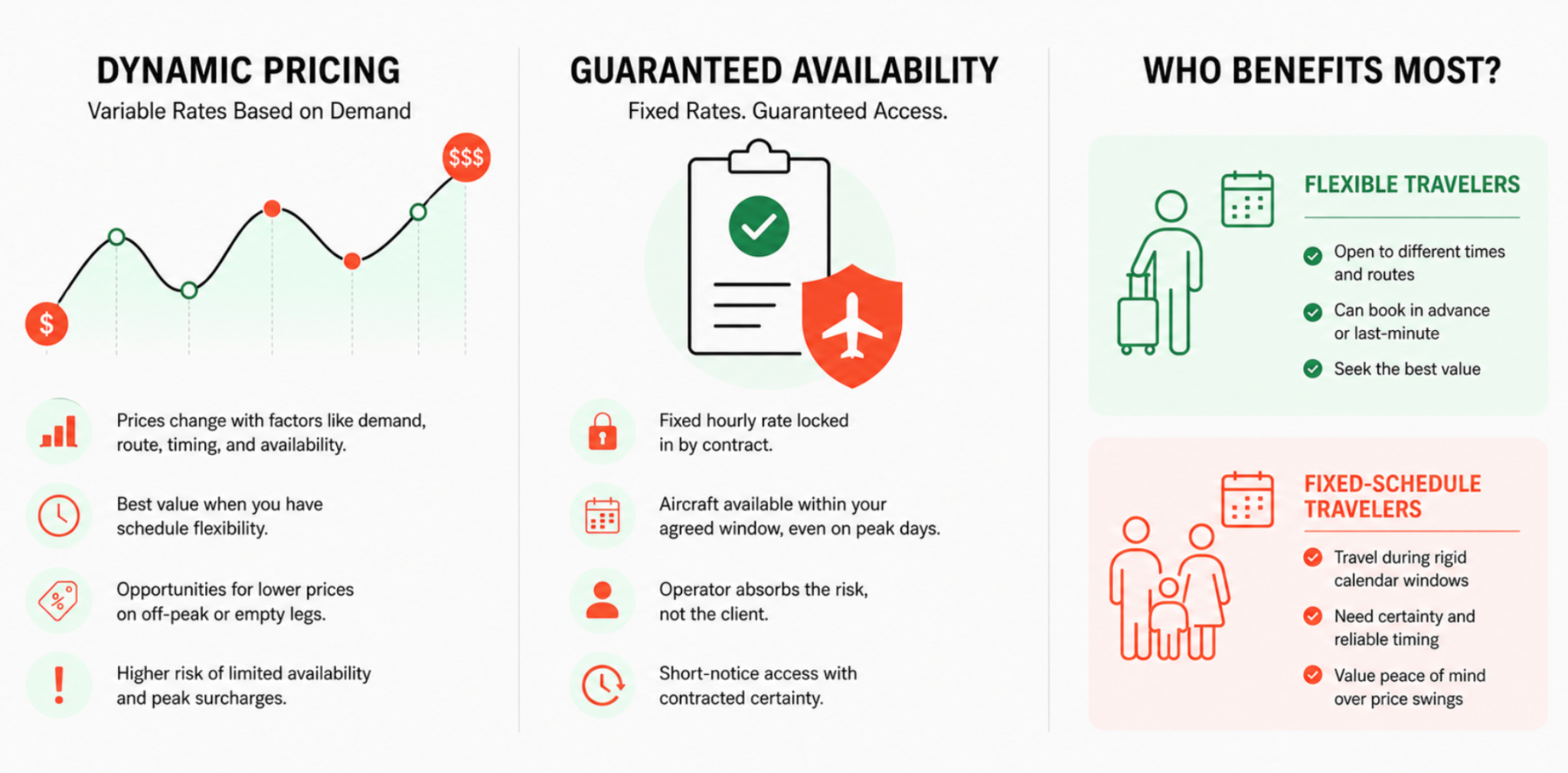
Nowadays, dynamic pricing is the norm, and not just in commercial and private aviation. Dynamic pricing appears in hospitality, ride-sharing, utilities, energy, and other sectors. This is a pricing strategy where the final cost is influenced by a series of factors.
In private aviation, some of the factors that weigh the heaviest are aircraft size and class, demand, availability, route, environmental factors, and/or fuel surcharges. Flights from New York to Miami on Thursday afternoons in October carry lower prices than that same route on the day after Thanksgiving.
Charter companies use dynamic pricing for yield optimization. Their main goal is to make sure an aircraft never flies empty or underpriced, while also attracting a more varied customer base. On the other hand, holiday travelers who enjoy the luxury of private flying also stand to gain from this arrangement.
The model aligns operator and customer incentives.
Guaranteed availability is the alternative model. This is a contractual promise that, in exchange for an upfront premium, a private operator will have an aircraft available within a specific window (usually 10 to 72 hours' notice), no matter how busy the market is.
The price is almost always tied to a fixed hourly rate determined when the contract is signed. Whether flights occur in October at 5 a.m. or Christmas Eve at 2 p.m., an aircraft remains available. The fixed hourly rate applies regardless of timing. The offer is usually included in financial instruments like fractional ownership, leases, and traditional membership jet cards.
Contracts require careful review of fine print. Most contracts designate 15 to 45 days a year (major holidays, Super Bowl weekend, Thanksgiving) as peak days. On these specific dates, the rules of the guarantee change slightly to give the operator breathing room.
Clients might face longer notice requirements, from the usual 24-hour to 72 or 96 hours. Also, the operator may reserve the right to adjust requested departure times by ±3 hours to help stagger the fleet's schedule.
When deciding between options, the following comparison illustrates key differences between models:
Holiday demand drives pricing volatility. In recent years, inflation, global geopolitical conflicts, and disruptions in the supply chain have made travel of any kind a lot more expensive.
In fact, according to the Deloitte 2025 Holiday Travel Survey, only 1 in 4 surveyed travelers would book a first-class flight. In the same survey, 57% of travelers said they prefer driving instead of flying because of the costs.
Still, demand for private aviation remains at an all-time high, and holiday travelers are an important segment of the clientele. That is due, in part, to dynamic pricing.
When schedules are flexible (such as during holidays), dynamic pricing is a gold mine. Flexible travelers can scan marketplace platforms and find discounted flights from operators eager to avoid flying an empty aircraft.
Travelers who frequently fly contrarian routes (e.g., flying out of Florida at the beginning of winter, or flying midweek) also benefit because the algorithm lowers prices to stimulate demand on empty legs.
On the other hand, families who only travel during rigid calendar windows (e.g., Christmas, spring break, or to Aspen, Colorado in January) heavily benefit from a guarantee.
Share this post:
Jay Franco Serevilla
Jun 18, 2026
|
5
min read
Discover tips and trends in the industry.
.avif)
5 minutes
min read
Pricing and Availability Insights: How Short-Term and Long-Term Private Jet Leases Compare
Private jet leasing has become a popular alternative to ownership or on-demand charter, offering travelers flexibility, cost savings, and consistent access to premium aircraft. Short-term leases (1–6 months) are ideal for seasonal or project-based travel, while long-term leases (12+ months) offer better value and perks for frequent flyers. With Jettly, both options include transparent pricing, access to a modern fleet, and the ability to add hours or switch aircraft as needed. Whether you're seeking short-term flexibility or long-term consistency, Jettly makes leasing private jets simple, customizable, and cost-effective.
Read More.avif)
5 minutes
min read
Are Private Jets Safe? Everything You Need to Know About Private Aviation Safety
Private jets are statistically among the safest modes of travel, with rigorous pilot training, frequent maintenance, and compliance with strict FAA regulations—particularly under Part 135 charter rules. Modern private jets are equipped with advanced safety features like terrain awareness systems, enhanced vision systems, and real-time weather monitoring, and are flown by highly experienced pilots, often with military or commercial backgrounds. Private aviation also offers added safety through reduced exposure to crowds, customizable security measures, and better hygiene. With proper due diligence—such as checking ARGUS/Wyvern ratings and maintenance standards—flying private is both secure and luxurious.
Read MoreStay updated with our latest insights and tips to elevate your journey with us.
MEMBERSHIPS AND ASSOCIATIONS



Disclaimer: Jettly operates as a charter broker, offering access to a global digital jet charter marketplace. Jettly is not a direct air carrier and does not own or operate aircraft. All advertised flights are conducted by third-party air carriers that are fully licensed and hold the appropriate Part 135 or Part 121 certifications issued by the Federal Aviation Administration (FAA) or equivalent regulatory authorities under U.S. or foreign law. Jettly complies fully with the U.S. Department of Transportation's Part 295 and Part 298 Charter Broker regulations. Jettly does not carry additional liability insurance. Passengers are covered by aircraft operator insurance. TICO: 50023770


