


Login
Get Instant Pricing On 23,000+ Aircraft

>
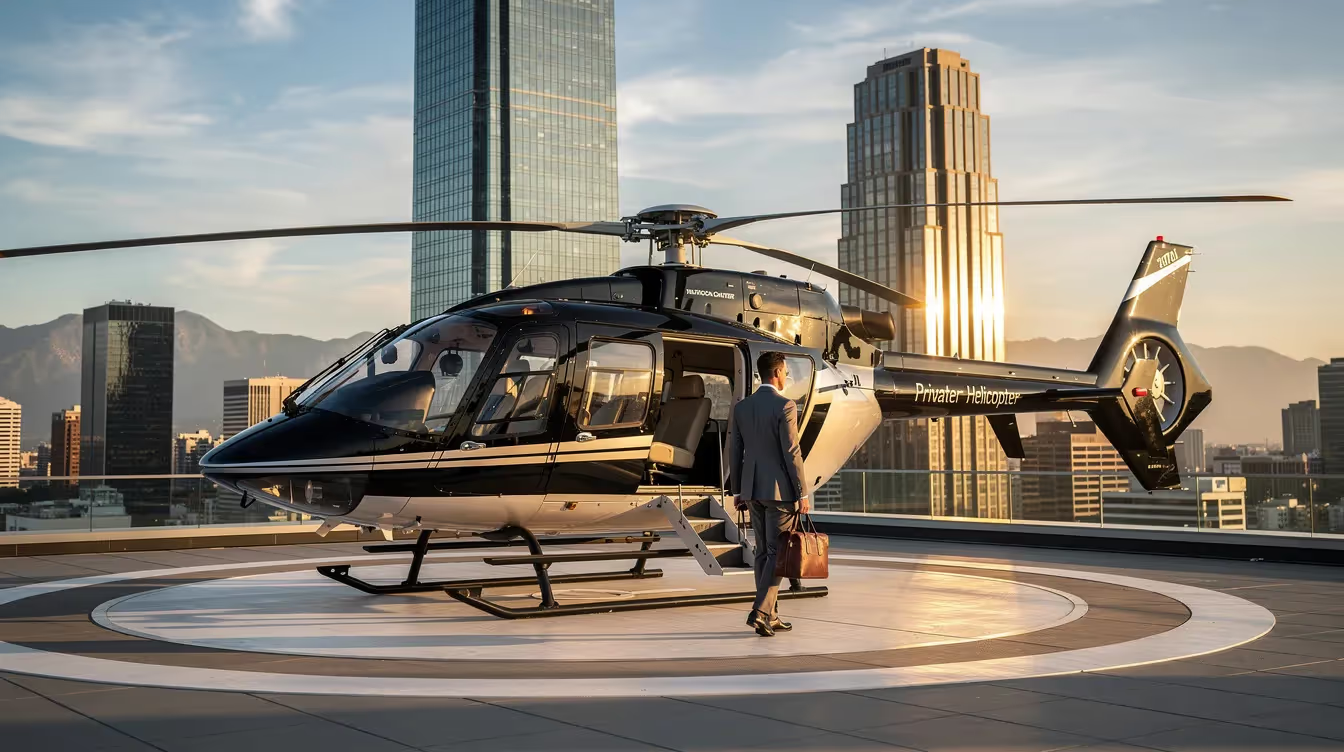
Helicopters occupy a distinct position in aviation. Unlike fixed-wing aircraft that need runways, helicopters can lift off from a rooftop, touch down on a yacht, or hover above a mountain rescue site. For private travelers seeking direct access to constrained destinations, these vertical flight aircraft offer something jets and turboprops cannot provide: the ability to skip airports entirely and land where the journey actually ends.
This guide covers the principles behind vertical flight, traces helicopter development from ancient concepts to modern machines, and explains how helicopter charter fits into Jettly’s broader private aviation platform.
Helicopters are vertical flight aircraft that generate lift through powered rotors, enabling vertical takeoff, landing, hover, and low-speed maneuvering—capabilities that fixed-wing aircraft lack entirely.
The journey from early vertical flight concepts (Chinese bamboo-copter toys around 400 CE) to the first helicopter free flight in 1907 and practical designs in the 1940s took centuries of engineering progress.
Modern helicopters serve diverse missions including medical evacuation, search and rescue, offshore transport, firefighting, and VIP charter—tasks that require hover capability or access to locations without runways.
Helicopter charter through Jettly works for point-to-point transfers like New York to the Hamptons, Monaco to Nice, or ski-resort connections, with transparent pricing and digital booking.
Choosing between helicopters and jets depends on route distance, landing options, and access needs—Jettly’s platform allows customers to compare both aircraft categories for any itinerary.
A helicopter is a rotorcraft that uses one or more powered horizontal rotors to generate lift and thrust. This design enables true vertical flight: vertical takeoff and landing, sustained hover, and low-speed maneuvering in any direction. Helicopters can take off and land vertically, allowing them to access remote locations and perform missions that fixed-wing aircraft cannot.
The fundamental difference between helicopters and airplanes lies in how each generates lift. Fixed-wing aircraft require forward speed to push air over their wings. Helicopters push air downward with spinning rotor blades, creating lift from a standstill. This means helicopters can operate from rooftops, helipads, confined fields, and offshore platforms where runway-dependent aircraft cannot land.
Helicopters are part of a broader family of vertical flight aircraft that includes autogyros, tiltrotors like the V-22 Osprey, and emerging eVTOL concepts. Rotorcraft are categorized by rotor design, engine type, and mission, and they are generally capable of vertical takeoff, landing, and hovering. Helicopters can be classified into various categories, including civil helicopters, military helicopters, and unmanned aerial systems (UAS), each serving different operational needs and missions.
The main visible components include:
Main rotor (generates vertical lift)
Tail rotor or alternative anti-torque system (counteracts torque)
Fuselage (passenger and cargo cabin)
Landing gear (skids or wheels)
Cockpit with flight controls
Modern helicopters serve civil missions—air ambulance, tourism, charter, offshore energy support, utility work—and military helicopters handle transport, attack, and reconnaissance operations.
Every helicopter flight moves through three basic conditions: hover, transition to forward flight, and sustained forward flight. Helicopters can operate in a variety of flight conditions, including hover, forward flight, and the transition between these states, which allows for versatile mission profiles. Pilots constantly manage power and control inputs throughout each phase.
During hovering, the rotor pushes air downward to create lift equal to the aircraft’s weight. The ability of helicopters to hover in place is a unique capability that enables them to perform tasks such as aerial firefighting and medical evacuations effectively. Pilots use cyclic, collective, and pedals to remain stationary over a point, making constant small corrections because helicopters are inherently unstable in hover.
Transition from hover to forward flight introduces translational lift, which appears around 16–24 knots (30–45 km/h). As the helicopter moves forward, air flows more efficiently through the rotor disc, reducing power required and making controls feel more stable. The way a helicopter generates lift determines its stability, speed, and lifting capacity during each flight phase.
In forward flight, controls become more similar to fixed-wing aircraft. However, the advancing rotor blade (moving forward) develops higher airspeed than the retreating blade, creating asymmetrical lift. Modern helicopters limit forward speed to avoid retreating blade stall, typically cruising between 120–150 knots.
Autorotation provides a critical safety mode. If engine power fails, the main rotor continues rotating from upward airflow, allowing pilots to guide a controlled descent and landing. High-inertia rotor systems facilitate safer autorotation in case of engine failure, while multi-bladed designs offer better stability.
Key flight controls:
Cyclic (lateral/directional control stick)
Collective (vertical lever adjusting blade pitch)
Pedals (anti-torque/yaw control)
Throttle (engine power management)
This section provides a high-level tour of the mechanical systems that make vertical flight possible.
The rotor system consists of a mast (central shaft), hub, and rotor blades. There are several basic types of helicopter rotor systems, including hingeless, fully articulated, and teetering designs, which determine how the rotor blades are attached and move relative to the hub. Common configurations include two-blade teetering rotors (like the Bell 206) and multi-blade articulated designs (like the Airbus H145). Three or more-bladed rotor systems generally provide better stability and safety compared to two-bladed systems. Blade pitch changes through a swashplate mechanism to generate and direct lift.
Torque from the main rotor would spin the fuselage in the opposite direction without compensation. The single-rotor design is the most prevalent configuration, featuring one large rotor for lift and a smaller tail rotor to counteract torque. The tail rotor provides horizontal thrust controlled by foot pedals. Alternatives include Fenestron ducted fans and NOTAR systems, which reduce noise and eliminate exposed blade hazards.
Engine type impacts helicopter suitability, with single-engine models typically more affordable and twin-engine models providing better safety for certain operations. Early helicopters like the Sikorsky R-4 used piston engines. Turbine-powered engines are standard in modern commercial and military helicopters due to their power-to-weight ratio. The Sud Aviation Alouette II became the first production turbine helicopter around 1955–1956, transforming capability and reliability.
The gearbox reduces engine RPM (thousands per minute) to rotor RPM (hundreds per minute), delivering power to both main and tail rotors through shafts and couplings. Time Between Overhaul (TBO) and Life-Limited Parts (LLPs) are crucial factors to consider for helicopter maintenance status. Transmissions are heavily inspected and maintained because failures can be catastrophic.
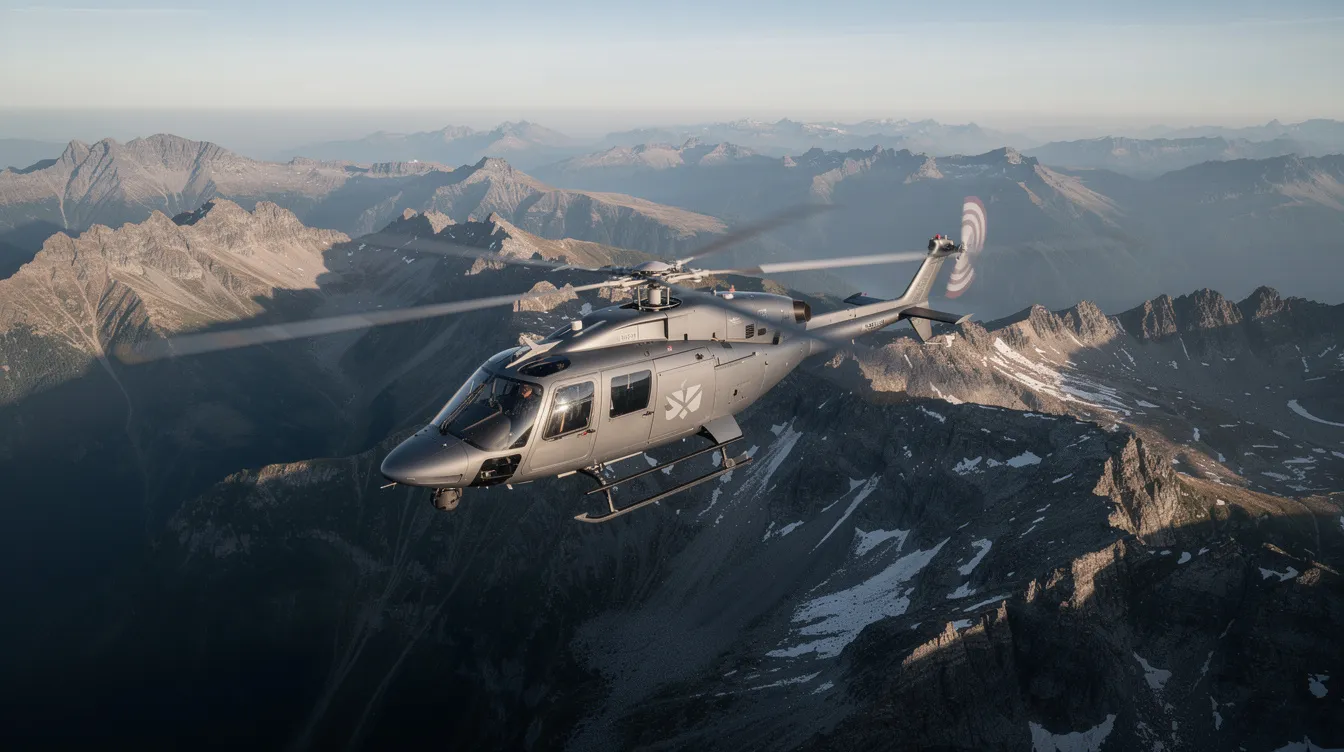
Major subsystems summary:
Rotor system: generates lift through blade pitch control
Anti-torque: prevents fuselage spin, enables yaw control
Engine: provides power (turboshaft standard on commercial/military)
Transmission: converts high-RPM engine output to low-RPM rotor speed
Vertical flight ideas emerged over 1,500 years ago, but practical helicopters only arrived in the 20th century once engines and materials became light yet powerful enough to lift themselves and a pilot.
The Chinese bamboo-copter toy around 400 CE demonstrated rotary lift principles—children would twist and release them to spin briefly upward. Leonardo da Vinci sketched the “aerial screw” around 1480, a conceptual rotor design. Neither led to practical aircraft, but both proved the concept. The term “helicopter” was introduced by Gustave de Ponton d’Amécourt in 1861, originating from the Ancient Greek words helix, meaning “spiral,” and pteron, meaning “wing.”
In 1907, the Breguet brothers achieved a short flight with their Gyroplane No. 1, which is considered one of the earliest examples of a helicopter, although it was tethered and not fully controlled. French aviator Paul Cornu completed a brief free flight the same year. Both machines were extremely unstable and never progressed to practical operations, but they proved powered vertical flight was possible.
Argentine inventor Raúl Pateras Pescara tested coaxial rotor designs in the 1920s and introduced cyclic pitch control. The Danish inventor Jacob Ellehammer built a helicopter in 1912 that made several free take-offs before tipping over in 1916. The Focke-Achgelis Fa 61 became the first truly successful helicopter in 1936, setting distance and altitude records. Test pilot Hanna Reitsch famously flew it indoors in 1938, demonstrating remarkable stability.
Igor Sikorsky’s VS-300 first flew on September 14, 1939, in Connecticut. This became the first practical single-rotor helicopter with a tail rotor, establishing the configuration still used today. The first large-scale mass-produced helicopter was the Sikorsky R-4, developed in 1942, which was primarily used for search and rescue during World War II.
The Bell 47 received US civilian certification in 1946, becoming the first helicopter widely available for private and commercial use. Roles expanded into air ambulance and offshore support. The Kaman K-225 achieved turbine-powered flight in 1951, and the Alouette II’s success from 1957 cemented turboshaft engines as the standard.
By the late 20th century, tens of thousands of helicopters were in service worldwide. Popular civil models include the Robinson R44, Airbus H125, and Bell 206. Sikorsky helicopters like the S-76 serve VIP and offshore roles. Helicopter development continues with quieter rotors, advanced avionics, and automation systems.
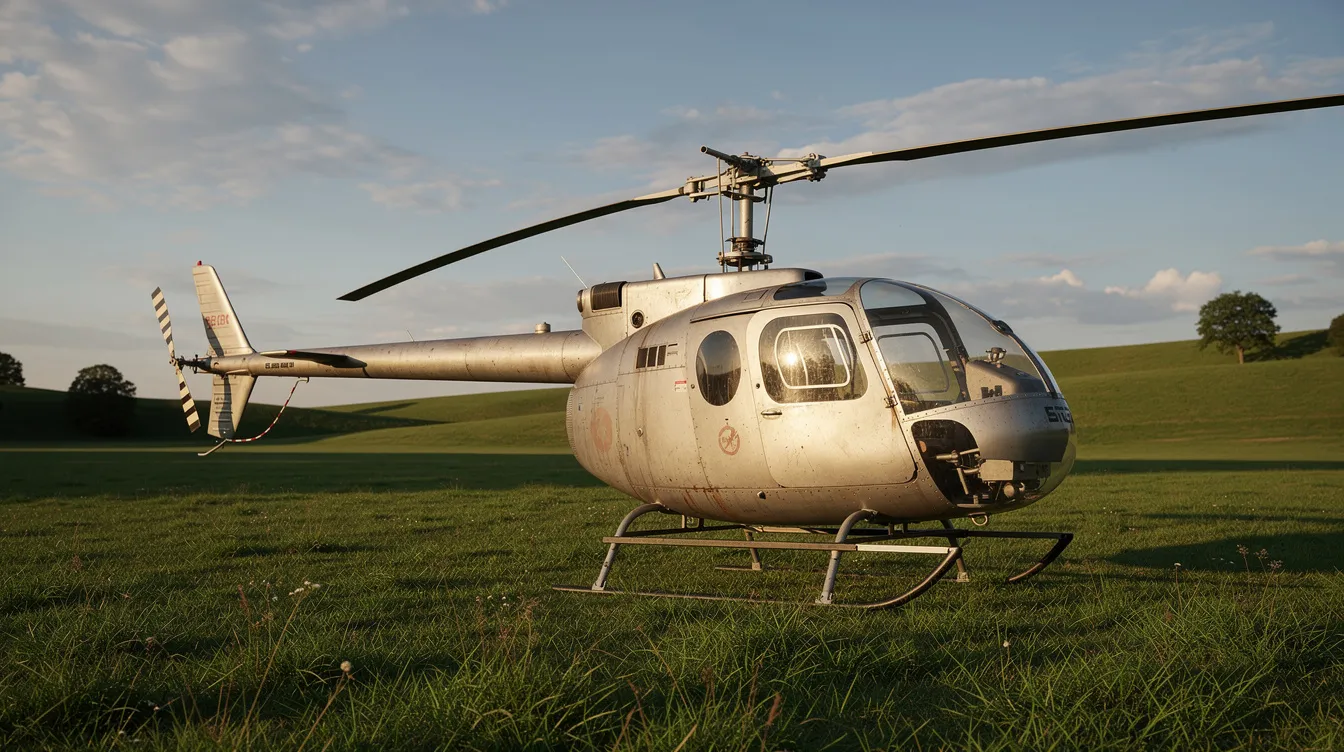
Helicopters’ unique capabilities stem from vertical flight and hover. They can reach tight, improvised, or constrained locations where fixed-wing aircraft cannot land vertically or even approach safely.
Core advantages:
Vertical takeoff and landing (no runway required)
Hover and low-speed maneuvering
Sideways and backward flight
Operations close to terrain and obstacles
Point-to-point routing over short distances
Helicopters perform a wide range of tasks including transporting people and cargo, supporting military operations, construction work, firefighting, search and rescue missions, tourism, medical transport, law enforcement, agriculture, news reporting, and aerial observation.
Mission types dependent on these capabilities include mountain and maritime search and rescue (hovering to lower personnel via winch), offshore oil and gas crew transport to platforms in the North Sea and Gulf of Mexico, powerline and pipeline inspection, construction lifts in dense cities (hoisting HVAC units or steel sections), aerial firefighting with water drops, and medical evacuation from accident scenes.
While airplanes are more efficient at speed and over long range, they cannot land on rooftops, city-center helipads, or ships at sea. This keeps helicopters essential for operations requiring direct access. A helicopter can fly to a private estate, ski chalet, island resort, or yacht—often eliminating 30–60 minutes of ground transfer that would follow a jet landing at a regional airport.
Military helicopters represent a distinct category of vertical flight aircraft, central to logistics, close support, and rapid mobility since World War II. Helicopters serve various roles such as emergency services, frontline combat, troop transport, and Medical Evacuation (MEDEVAC), with versatile models like the Eurocopter EC30 light utility helicopter tailored to demanding missions.
Main mission types include:
Troop transport and air assault
Close air support and attack
Reconnaissance and surveillance
Special operations insertion and extraction
Heavy-lift cargo (artillery, vehicles, supplies)
Specific examples by country and role: the Sikorsky UH-60 Black Hawk serves US Army utility and medevac needs. The Boeing CH-47 Chinook handles tandem-rotor heavy lift. Bell AH-1 Cobra and Boeing AH-64 Apache function as attack helicopters with advanced sensors and weapons. Russian-designed Mil Mi-8/17 and Mi-26 variants perform transport and heavy-lift missions in several countries. The NH90 serves as a European multirole helicopter.
Vertical flight is critical in modern combat and humanitarian operations because helicopters can deliver troops to areas with no runways, evacuate casualties under time pressure, and resupply remote bases in terrain where other aircraft cannot operate. Many safety, maintenance, and training standards used in civil operations were influenced by decades of military helicopter experience.
Beyond military use, most helicopters spend their lives in civil roles that directly support communities and economies, often operating alongside affordable aircraft rental options that make specialized aerial services more accessible.
In firefighting, helicopters are employed for aerial firefighting missions, often outfitted with tanks or helibuckets to drop water on wildfires, as well as to transport firefighters to hard-to-reach locations. Type 1, Type 2, and Type 3 helicopters serve on wildland fires in North America and elsewhere. Type 1 helicopters carry up to ~700 gallons (2,650 L) of water or retardant, while smaller types handle rapid initial attack and crew transport.
Helicopters function as air ambulances, delivering urgent medical care and transporting patients swiftly when ground ambulances cannot reach the location promptly. Services like “Life Flight” and “Air Ambulance” in the US, Canada, and Europe move patients from accident scenes or smaller hospitals to major trauma centers. Twin-engine models like the Sikorsky S-76 or Airbus H145 carry advanced medical equipment and trained flight paramedics.
Mountain rescue teams in the Alps and Rockies depend on helicopter hover and winch systems. Coastal SAR operations through the UK’s HM Coastguard and US Coast Guard perform hoists from ships, cliffs, and glaciers where boat recovery would be impossible.
Roles include powerline inspection, pipeline patrol, forestry surveys, geophysical surveys, and aerial crane work. In dense cities, it’s often faster to lift equipment by helicopter than by road crane.
Sightseeing flights over landmarks like the Grand Canyon, New York City, and Rio de Janeiro generate significant revenue, paralleling the premium experiences offered by top private jet charter companies. Media helicopters provide live aerial coverage of traffic and events.
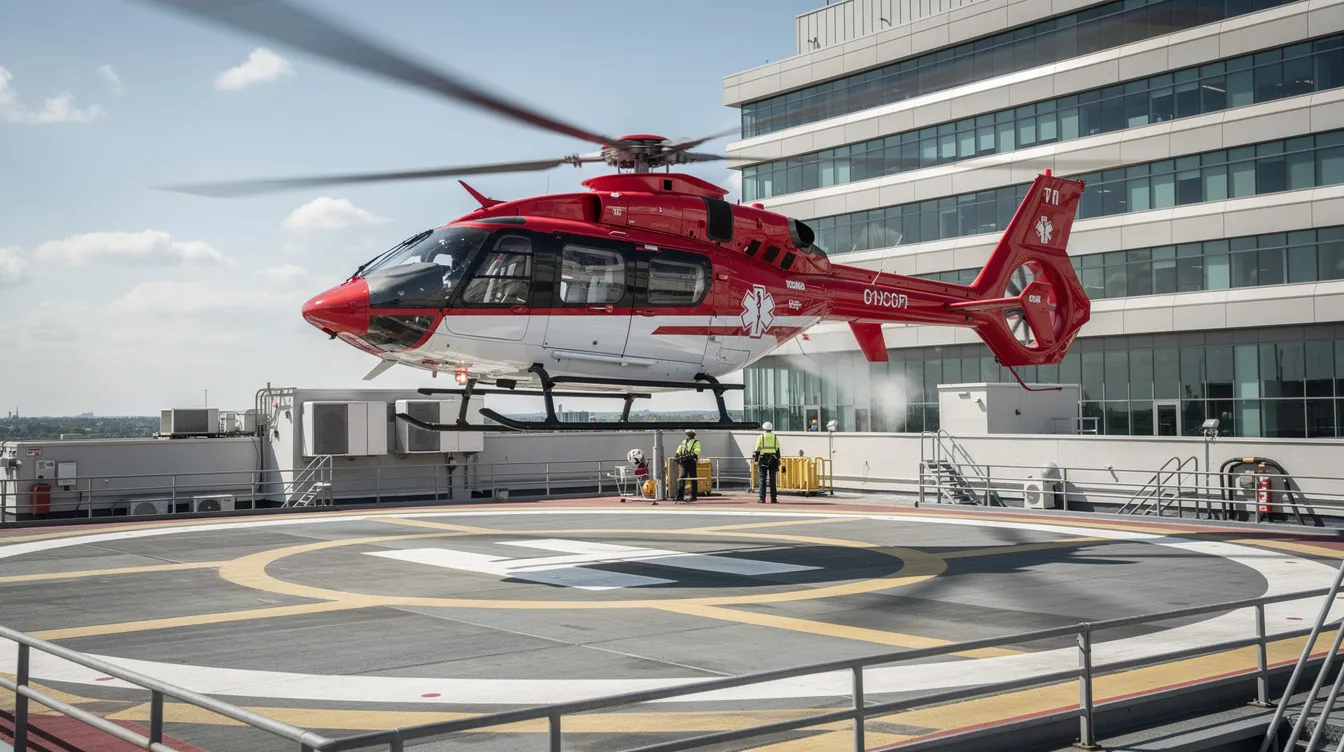
Civil mission categories:
Firefighting (water drops, crew transport)
Emergency medical services (air ambulance, trauma transfer)
Search and rescue (mountain, maritime, disaster response)
Utility (inspection, surveys, aerial crane)
Tourism (sightseeing, charter)
Media (news coverage, aerial observation)
Helicopter charter offers a flexible option within Jettly’s wider private aviation marketplace, complementing its range of private jet membership plans. Helicopters complement jets and turboprops for short, point-to-point routes and last-mile connections where vertical flight provides direct access.
Defining a “mission profile” is crucial to choosing the appropriate helicopter. Common Jettly customer scenarios include:
City-center to resort transfers (New York to the Hamptons, Los Angeles to Palm Springs, Monaco to Courchevel)
Connecting from private jet arrival to a yacht or remote villa
Urgent same-day business site visits where roads are congested
Ski-resort transfers from regional airports to slope-side chalets
Island hopping where ferry or small aircraft options are limited
The booking experience on Jettly involves customers entering departure and arrival locations—which may include heliports, rooftops, or private estates with approved landing areas—similar to how its airport locator tool for private flights streamlines airport selection. Operators should be chosen based on reputation and safety record, and Jettly pre-screens partners for regulatory compliance. Customers receive instant pricing where available, view aircraft options (Robinson R44, Airbus H125, Sikorsky S-76), and confirm charter digitally.
Renting a helicopter can be more economical for low usage, while buying is practical for high usage or customization needs, and understanding helicopter rental costs and pricing factors helps set realistic budgets. For most private travelers, charter provides access without ownership burdens. Choosing the right helicopter involves balancing mission requirements with operational realities—passenger count, luggage, and landing zone specifications all factor into aircraft selection.
Helicopter charter integrates with Jettly’s jet services for multi-leg itineraries. A customer might fly via midsize jet from New York to a regional airport, then transfer via helicopter directly to a mountain chalet—both legs booked and coordinated through a single platform, leveraging Jettly’s broad private charter aircraft selection. Learn more about Jettly’s charter options.
Helicopters on Jettly are operated by licensed, regulated air carriers (FAA Part 135 in the US, Transport Canada, EASA operators in Europe) with strict maintenance and pilot experience standards.
Helicopters and fixed wing aircraft serve different needs. Helicopters excel at access and flexibility over short-to-medium distances, while jets and turboprops offer speed and efficiency over longer range.
When to choose helicopters:
Origin or destination lacks a suitable runway
Destination sits in a congested metro area
Offshore or mountainous terrain
Stage lengths under about 150–250 miles (240–400 km)
Direct access to private property, yacht, or helipad
When to choose private jets or turboprops:
City-pair routes between established airports (Toronto–Vancouver, New York–Miami, London–Nice)
Distances over 250 miles where cruise speed matters
Passenger comfort is the priority
Larger groups with significant luggage
Helicopters often have smaller cabins and more vibration compared to midsize or heavy jets. However, expensive helicopters like VIP-configured Sikorsky S-76 or Airbus H155 models feature club seating, noise reduction, and business amenities for 6–12 passengers.
Maximum Takeoff Weight (MTOW) dictates how much payload a helicopter can carry, limiting luggage capacity compared to jets. Soft-sided bags are typically recommended.
Jettly’s platform allows users to compare aircraft types side by side—light jet, midsize jet, heavy jet, turboprop, helicopter—with indicative pricing, supported by tools like its private jet charter cost estimator. Travelers can match aircraft to trip length, group size, and landing options. A 50-mile transfer from Manhattan to the Hamptons might take 30 minutes by helicopter versus 2+ hours by jet plus ground transit.
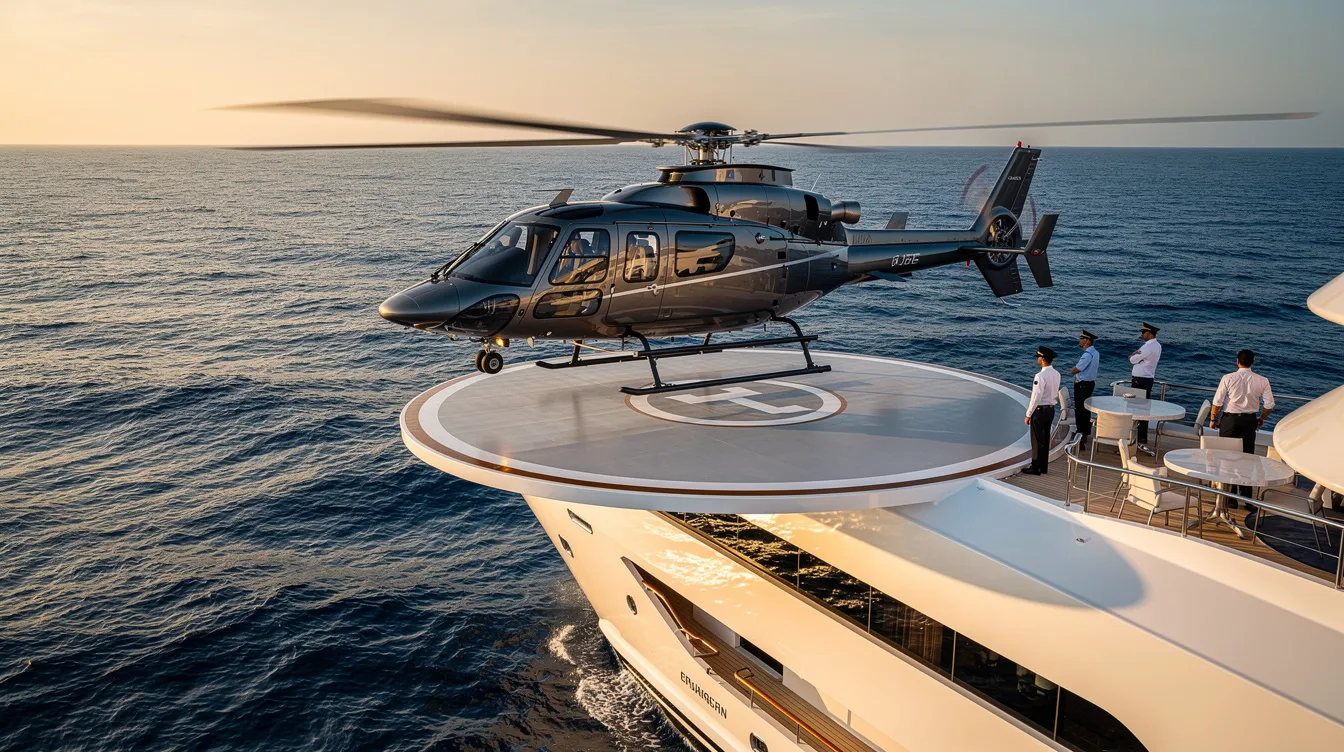
Helicopter technology continues evolving, with new forms of vertical flight aircraft emerging for urban and regional mobility.
Traditional helicopter improvements include quieter rotor designs that reduce community noise near helipads, advanced avionics with synthetic vision and terrain awareness, and automation systems that reduce pilot workload. Modern safety features significantly reduce pilot workload and improve survivability across the industry.
The industry is shifting toward Electric Vertical Take-off and Landing (eVTOL) aircraft, targeting short-range urban transport and pilot training. Compound helicopters represent a specialized category featuring additional propulsion systems, often including small fixed wings. These enhancements enable higher speeds by reducing the rotor's workload during cruising flight. However, conventional helicopters will remain essential for heavy-lift, long-range, and complex missions for decades.
Sustainability efforts focus on efficient routing, lighter composite materials, and sustainable aviation fuels (SAF). Charter customers can ask about carbon offsetting and greener options when booking through platforms like Jettly, which are increasingly highlighted in broader guides to private and charter airlines.
Innovation themes to watch, including new business models like crowdsourced private charter seat sharing:
Noise reduction for urban operations
Automation and reduced pilot workload
Sustainable aviation fuel adoption
eVTOL integration for short urban routes
Enhanced safety culture and training standards
Charter helicopters operated through Jettly’s partner network fly under national commercial regulations (FAA Part 135, Transport Canada, EASA), with strict maintenance, pilot training, and duty-time requirements, mirroring the standards it promotes as a NetJets alternative for private flying. Common safety features include twin engines on VIP and offshore models, advanced avionics, and regular inspections.
Safety records depend heavily on operator standards and weather decisions. Platforms like Jettly pre-screen operators for compliance, but travelers should still ask about operator certification, pilot hours, and recent maintenance when booking—best practices echoed in many private aviation charter guides.
Light single-engine helicopters often start in the low thousands of US dollars per flight hour. Twin-engine VIP helicopters run higher, potentially $4,000–$8,000+ per hour depending on market and operator, similar in structure to affordable private jet charter pricing where aircraft type and distance drive cost. The purchase price of a helicopter is often only a small fraction of its total long-term cost, which is why charter makes sense for occasional users, much like opting for charter instead of ownership when choosing the best cross-country plane for long trips.
Variable costs for helicopter operation include fuel, oil, and crew wages, while fixed costs encompass insurance and hangar fees. Total Cost of Ownership (TCO) includes direct operating costs and fixed costs—considerations that Jettly handles for charter customers. The platform provides instant or rapid pricing estimates, allowing comparison against jets or turboprops for a given itinerary.
Helicopters can land at airports, licensed heliports, hospital pads, and certain private properties that meet local regulations, landowner consent, and safety criteria (adequate size, obstacle clearance, noise limits), whether you’re flying into a major metro like Houston for private charter services or a remote estate.
Using a private estate or yacht for landings typically requires prior assessment and approvals. Charter operators through Jettly help coordinate these checks. Customers should share precise destination details early in planning so the operator can confirm a safe, legal landing zone exists.
Many modern helicopters are equipped and certified for instrument flight rules (IFR) and night operations. Actual go/no-go decisions depend on weather, terrain, aircraft equipment, and regulatory limits.
Low clouds, fog, strong winds, icing, or thunderstorms may delay or cancel flights—especially for visual flight rules (VFR) operations requiring clear visibility. Travelers should build flexibility into itineraries during winter or stormy seasons and trust operator judgment. Reviewing maintenance history, including compliance with Airworthiness Directives (ADs) and Service Bulletins (SBs), is essential before aircraft purchase or charter engagement.
Small helicopters like the Robinson R44 typically carry 3 passengers plus pilot. Larger twin-engine models like the Sikorsky S-76 or Airbus H155 accommodate 6–12 passengers in VIP layouts. A thorough Pre-Purchase Inspection (PPI) by a mechanic is critical when purchasing a used helicopter, a principle shared across aircraft rental and ownership guides, but for charter customers, Jettly’s operator vetting handles these concerns.
Luggage capacity is more limited than on private jets, with strict weight and balance constraints. Soft-sided bags are usually recommended. Customers should provide passenger counts, estimated weights, and luggage details when requesting a quote so the platform can match a suitable aircraft.
Helicopters remain indispensable because of capabilities no other aircraft can match: vertical takeoff and landing, sustained hover, and access to locations without runways. These vertical flight aircraft complement fixed-wing aircraft rather than compete with them—each serves different operational needs.
From early concepts in the 1400s to the first helicopter free flight in 1907 and mass adoption after the 1940s, rotorcraft have continually expanded what aviation can accomplish. Today, helicopters perform rescue missions in the Alps, transport crews to offshore platforms, and deliver executives directly to mountain resorts or city-center helipads.
Jettly integrates helicopter charter into a broader private aviation solution. Customers can combine helicopters with jets or turboprops under transparent, on-demand pricing—matching aircraft to each leg of a journey rather than forcing compromises. For short hops requiring direct access, helicopters deliver what conventional aircraft cannot.
Ready to experience private travel on your terms? Explore flight options or request a quote at https://www.jettly.com, compare full and shared charter options, or even crowdsource private flights by sharing empty seats. Travelers booking regularly can use tools like Jettly’s private jet jet card cost estimator, explore its world-class jet card programs, or consider ongoing private jet memberships for predictable pricing. Content creators and travel advisors can also join Jettly’s ultra high ticket affiliate program to earn commissions on referred trips. For catering, passengers can arrange bespoke menus via Jettly Eats in-flight catering, while those comparing providers can review leading private jet charter companies. Jettly also partners with operators like DEXTER Air Taxi to expand global coverage.
Share this post:
Jay Franco Serevilla
May 9, 2026
|
5
min read
Discover tips and trends in the industry.
5
min read
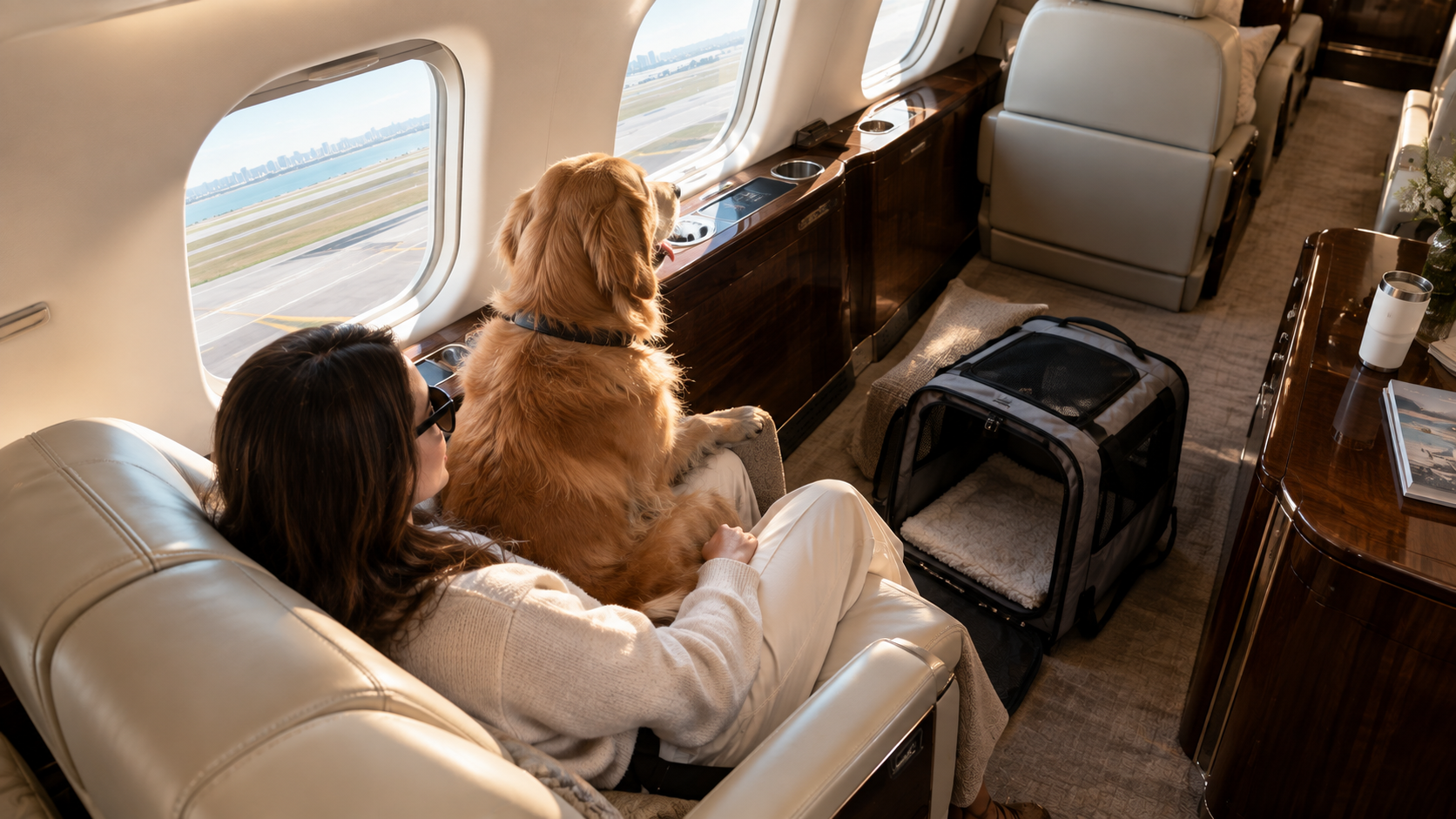
Pets on Private Jets in 2026: Size Limits, Crate vs. Cabin Rules, and International Paperwork
This comprehensive guide for pet owners covers everything you need to know about flying with pets on private jets in 2026. It details size limits, cabin versus crate rules, and essential international paperwork to ensure a smooth travel experience. Understanding these guidelines helps avoid surprises and keeps your pet comfortable during the journey.
Read More
5
min read
DC9 Private Jet Charters: History, Cabin Experience, and Modern Alternatives
The Douglas DC-9 revolutionized regional air travel with its efficient design and quick turnaround capabilities, serving as a vital link for short-haul routes. Although most DC-9s are retired, their legacy continues in modern private jet charters, which offer enhanced comfort and flexibility for travelers. Jettly connects clients with a diverse fleet of aircraft that embody the DC-9's mission of fast, point-to-point flying.
Read MoreStay updated with our latest insights and tips to elevate your journey with us.
MEMBERSHIPS AND ASSOCIATIONS



Disclaimer: Jettly operates as a charter broker, offering access to a global digital jet charter marketplace. Jettly is not a direct air carrier and does not own or operate aircraft. All advertised flights are conducted by third-party air carriers that are fully licensed and hold the appropriate Part 135 or Part 121 certifications issued by the Federal Aviation Administration (FAA) or equivalent regulatory authorities under U.S. or foreign law. Jettly complies fully with the U.S. Department of Transportation's Part 295 and Part 298 Charter Broker regulations. Jettly does not carry additional liability insurance. Passengers are covered by aircraft operator insurance. TICO: 50023770


