



Login
Get Instant Pricing On 23,000+ Aircraft

>
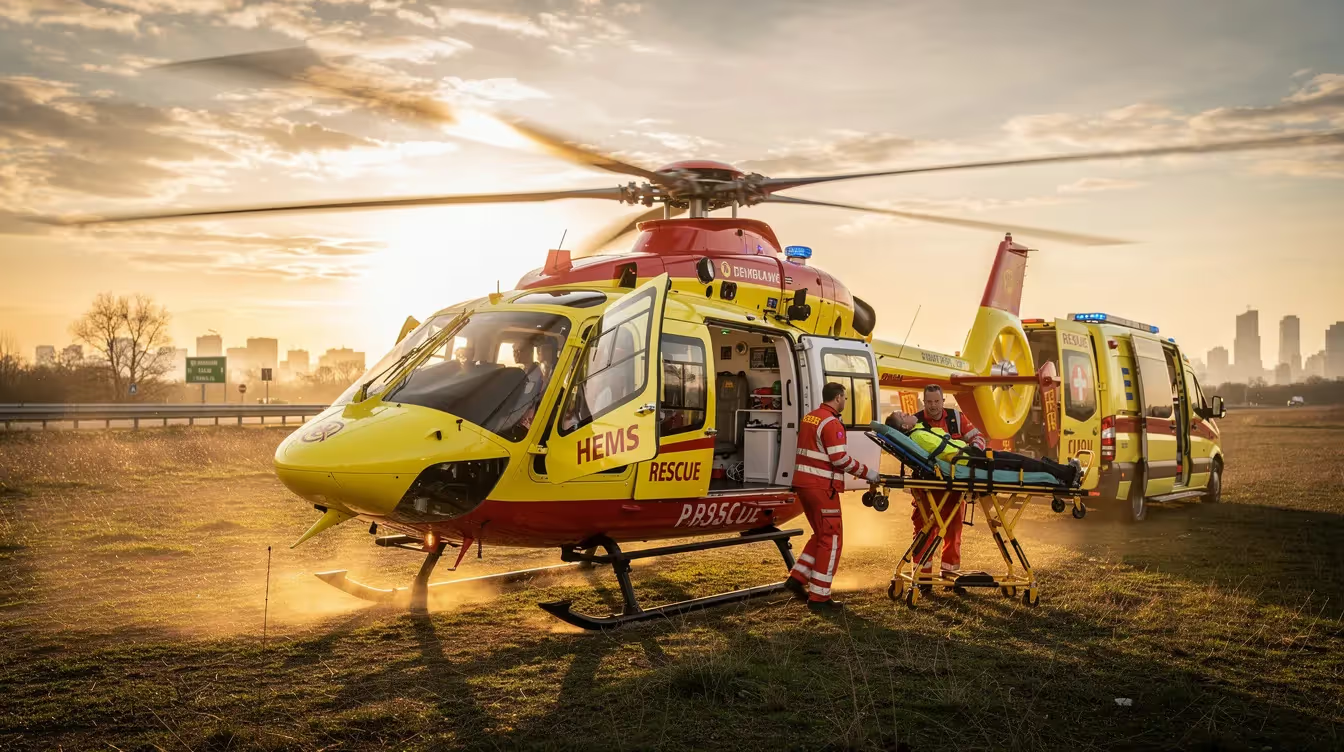
Helicopter ambulances are rotorcraft equipped for rapid emergency medical transport—dispatched from accident scenes, remote areas, or between hospitals when ground ambulance services cannot move fast enough. Understanding helicopter ambulance cost before an emergency matters because these bills often arrive weeks later, surprising families with five-figure charges they never anticipated.
Consider a real example: a 75-mile medical emergency flight in the Midwest in 2025 billed at $40,000–$45,000, with the patient ultimately responsible for $12,000 after insurance processed. Prices vary dramatically by distance, region, medical complexity, and health insurance coverage.
Jettly operates as a tech-driven charter platform arranging non-emergency private flights and helicopter charters across a global private charter aircraft network—useful for time-sensitive medical or family travel when 911-style medevac services are not required.
A typical helicopter ambulance cost in the U.S. ranges from $25,000 to $60,000, with extremes from about $15,000 to over $100,000 in 2026.
Bills combine a base fee (often $12,000–$20,000), mileage ($150–$300 per mile), and medical services.
Network status (in-network vs out-of-network) and insurance details can shift a patient’s bill by $20,000–$40,000.
Jettly focuses on private air charter and helicopter charters, not emergency medevac, but understanding medevac pricing helps travelers plan for urgent medical travel needs.

A typical U.S. helicopter ambulance costs $25,000–$60,000 per trip in 2026, with many urban flights clustered around $30,000–$40,000. However, extremes exist on both ends.
Concrete examples:
A 50-mile trauma transport in Texas (2024) charged $28,000, combining base activation, mileage, and medical staff fees.
A 120-mile night flight in Montana (2025) was billed at $58,000 due to distance, rural operations, and overtime staffing.
These air ambulance costs typically combine three components: base activation fee, per-mile rotor flight charge, and medical/operational add-ons. For non-emergency travel, understanding helicopter rental costs and pricing factors can help set expectations before booking. Federal data consistently shows that air ambulance companies' billed amounts far exceed what insurers consider “allowed,” resulting in large balance bills for patients.
Typical 2026 cost ranges by flight type:
Short urban flight (30–50 miles): $25,000–$35,000
Regional flight (50–120 miles): $35,000–$55,000
Remote/rural or mountain flight (80–150 miles): $50,000–$90,000
Air ambulance transport uses a hybrid pricing model: a flat base fee plus per-mile charges, similar to how private helicopter charters price flights.
Typical 2026 base fees for medical helicopters range from $12,000–$20,000 before covering a single mile. This covers aircraft readiness, crew mobilization, and operating costs. Per-mile rates typically range from $150 to $300 per statute mile.
Worked example:
Base fee: $15,000
Distance: 60 miles × $200/mile = $12,000
Medical equipment and staff: $4,000
Total: $31,000
Very short flights appear expensive per mile because the base fee dominates. A 20-mile flight with a $14,000 base effectively costs $700+ per mile, while a 100-mile flight dilutes that base to roughly $140 per mile plus the mileage charge.
Two patients on similar routes can receive bills that differ by $15,000–$30,000 because multiple cost drivers are operating simultaneously.
Distance and flight time add costs through loaded mileage. Holding patterns for congested airspace or landing zone preparation can add 10–20 extra billable miles. Medical complexity matters significantly—basic life support runs $1,000–$3,000 in added charges, while advanced life support with intubation or IV medications adds $3,000–$7,000. Specialty care transport with neonatal or cardiac teams can add $7,000–$15,000.
Staffing and shift type increase costs when flights require night crews, overtime pay, or dual-physician teams. Medical equipment such as ventilators, blood products, and advanced monitoring systems adds $500–$5,000. Weather conditions requiring night-vision operations or icing diversions extend flight time and expense by $2,000–$4,000.
Aircraft type affects base fees—newer EC-145 or AW109 helicopters cost $1,800–$2,500/hour to operate, compared with $1,200–$1,800 for older models. Geographic location in rural states like Wyoming, Montana, or Alaska runs 20–50% higher than urban corridors due to lower flight volume and higher fuel costs.
A 2024 Colorado comparison: daytime basic care 80-mile flight billed $32,000, while a nighttime cardiac specialty transport with weather diversion on the same route hit $48,000–$52,000.
The biggest factor in what patients actually pay is whether the air ambulance provider is in-network with their health insurance plan.
In-network scenario: The insurance company and provider have contracted rates well below sticker price. Patients pay only their deductible, copay, and coinsurance. Example: $38,000 billed, $20,000 allowed rate, patient owes $2,000–$4,000.
Out-of-network scenario: Providers can bill the full charges, and balance-bill patients for amounts insurance does not cover. Example: $45,000 billed, insurer pays $15,000 as “reasonable,” leaving a $30,000 patient balance.
The No Surprises Act, effective since 2022, aims to prevent surprise billing for patients using out-of-network air ambulance services. This federal law protects many privately insured patients from certain surprise bills, though disputes between insurers and operators can delay final amounts. Self-funded employer plans may have different coverage rules.
The Biden-Harris Administration has proposed additional rules to promote transparency in air ambulance costs and protect consumers further from surprise medical bills. Under these proposed rules, air ambulance providers must submit detailed data regarding their services, enabling the Centers for Medicare & Medicaid Services (CMS) to enforce consumer protections in states that do not adequately enforce these requirements. This is especially important because the air ambulance industry is highly consolidated, which often leads to surprise bills for patients.
More than 50 percent of air ambulance trips are out-of-network, contributing to these surprise bills. The median cost for air ambulance transportation ranges from over $36,000 to $40,000, with many patients facing high out-of-pocket costs if their provider is out-of-network.
Medicare and Medicaid Coverage: Medicare Part B may cover air ambulance transportation if a person has a medical emergency requiring transport where a ground ambulance is insufficient. Medicare Part B pays for 80% of eligible costs once the deductible ($257 in 2025) is met, leaving patients responsible for the remaining 20% coinsurance. Medicare Advantage plans follow the same coverage rules as Original Medicare. Additionally, Medicare may sometimes cover nonemergency transportation if deemed medically necessary by a healthcare professional.
People with Original Medicare can sign up for a Medicare supplement plan (Medigap) to help cover some of Part B's out-of-pocket costs. A basic Life Flight Network air ambulance membership costs about $85 per month and may assist with remaining expenses after Medicare coverage.
Many health insurance policies cover air ambulance services only if deemed medically necessary. Patients should consider supplemental air ambulance coverage if their existing insurance does not provide adequate protection.
Real-world out-of-pocket costs vary dramatically:
Well-insured, in-network: $300–$4,000
Out-of-network with average coverage: $5,000–$30,000
Minimal insurance: $30,000–$60,000+
A typical invoice shows: activation/base charge (40%), mileage (30%), medical staff fees (15%), medications and medical equipment (5–10%), ground transportation segments, and administrative fees.
Immediate emergency deployments may incur a 25% to 50% premium over scheduled medical transfers, reflecting the urgency and complexity of the mission.
Steps to manage a large bill:
Request an itemized statement and verify flight distance, dates, and procedures.
Check that insurance processed correctly; appeal denials with records showing medical necessity.
Ask for prompt-pay discounts (often 20–40% for lump-sum or structured payments).
Negotiate based on hardship, referencing Medicare fee schedules as leverage.
Many air ambulance companies offer payment plans and charity care for households at 200–300% of the federal poverty level.
Anecdotal example: A $52,000 2024 helicopter bill was negotiated to $31,000 through dispute resolution and Medicare benchmarking, then placed on a 48-month plan at under $650/month.
Emergency helicopter ambulances are medical aircraft dispatched via 911 or hospital protocols, staffed with flight nurses and paramedics who provide medical care during transport. Private helicopter charters booked through platforms like Jettly serve non-emergency transportation with transparent pricing quoted before departure.
Cost structure comparison:
Medevac flight: Base medical activation + per-mile + medical team + facility fees, often unknown until after transport.
Private charter: Hourly or route-based rate disclosed upfront; a same-day 100-mile private helicopter charter typically ranges $4,000–$9,000.
Jettly’s helicopter and fixed-wing charters, supported by tools like an airport locator for convenient routing and trip planning, support time-sensitive medical travel scenarios:
Non-emergency hospital transfers where speed matters but intensive care is not required.
Family members are traveling quickly to a distant hospital after a relative’s medical evacuation.
Specialist appointments in another city require rapid ground transportation alternatives.
Jettly offers transparent upfront pricing, access to aircraft globally, and private jet memberships that lower per-flight costs. Travelers and content creators can also earn referral income through Jettly’s high-ticket affiliate program. Learn more about Jettly’s charter options at https://www.jettly.com.

Helicopter ambulance cost can vary by 200–300% across regions due to competition, terrain, weather, and insurer mix within the air ambulance industry.
Highest-cost regions: Alaska, Wyoming, Montana, the rural Rockies, and remote Southwest areas see bills of $50,000–$90,000 for complex missions. Example: a 2025 80-mile trauma flight in rural Alaska billed at $72,000.
Moderate-cost regions: Rural Midwest and Deep South typically fall in the $30,000–$55,000 range. Example: a 2024 60-mile stroke transport in Ohio billed at $34,000.
Lower-cost regions: Dense urban corridors such as the Northeast, Southern California, and South Florida see charges of $25,000–$40,000 due to higher call volume and competition. Example: a 2023 40-mile urban flight in Los Angeles billed at $27,000.
Other developed countries, such as Canada, Germany, and Australia, often see much lower patient costs due to government subsidies. The U.S. relies heavily on private operators and facilities, which drives higher charges, which is why many travelers research the best private jet charter companies and providers, or look into how to buy a seat on a private jet when planning alternative air transport.
In a true emergency, medical necessity should always outweigh cost concerns. Air ambulance transport is clearly justified for severe trauma far from a Level I trauma center, suspected stroke or heart attack, where minutes matter, and remote terrains where ground vehicles cannot reach quickly.
Gray areas exist: stable conditions where ground transport is possible but slower, transfers between similar hospitals, or marginal weather situations. Patients who remain stable and conscious usually have the right to refuse helicopter transport, though this carries medical risk and should be weighed against the attending physician's recommendation.
Understanding potential helicopter ambulance cost in advance—plus knowing your air ambulance insurance coverage—helps families make informed decisions when rare opportunities to choose arise, much like using a private jet charter cost estimator for non-emergency flights or learning what a jet card is and how it works to avoid financial surprises.
Acquisition costs for a medical helicopter can reach $6 million, with rigorous, frequent maintenance. Fixed costs, including 24/7 readiness and staffing, can account for up to 93% of total expenses, contributing to the high base fees charged by air ambulance companies. Similar economic pressures influence the pricing and structures of affordable private jet charters and broader private jet card costs.
Typical helicopter ambulance costs range from $25,000 to $60,000 in 2026, driven by distance, medical complexity, aircraft type, and regional factors. Insurance network status creates the largest swing in what patients actually pay—potentially a $20,000–$40,000 difference on the same bill —whereas predictable options like jet card and corporate jet card programs offer fixed hourly rates for private travel, and detailed guides to NetJets card costs and pricing tiers help travelers benchmark alternatives.
Review health care, travel, and supplemental insurance now. Ask insurers specific questions about emergency services and air ambulance coverage. Consider medevac memberships if living in rural areas or if frequently traveling to distant cities, where private jet charter in Mumbai, Maharashtra, or similar services could be involved in medical travel. Keep records and negotiate if you ever receive a large helicopter bill.
Ready to make urgent or complex trips easier to manage? Explore private jet and helicopter charter options, compare with industry leaders like NetJets, or request a quote at https://www.jettly.com.
These FAQs address common questions not fully covered above.
In 2026, a 50-mile emergency helicopter flight in the U.S. often totals $25,000–$40,000. This includes a base fee around $15,000, mileage charges of $7,500–$10,000, and medical staff and equipment fees of $3,000–$8,000, depending on care level.
Many standard travel policies only pay for transport to the nearest appropriate medical facility, not full repatriation. Travelers should look specifically for policies that mention “medical evacuation and repatriation,” with coverage limits of $250,000–$1,000,000 for adequate protection, especially if visiting destinations where private jet charter services in Chennai, Tamil Nadu, or similar hubs may be part of an evacuation plan.
In most 911-level emergencies, dispatch centers and hospital protocols determine which helicopter flies. Patients rarely select a provider or verify network status in real time. Planned inter-facility transfers may offer more choice if time permits.
For emergencies requiring on-board medical teams, charter is not a substitute. However, for non-emergency, time-sensitive trips, a pre-quoted private helicopter charter through Jettly can cost significantly less than a surprise medical helicopter bill—often $4,000–$9,000 versus $30,000+—with full upfront price transparency.
Review health insurance air ambulance provisions and ask about in-network air medical partners. Consider medevac memberships if you live in a remote area. Build a small emergency fund. Keep copies of insurance cards and emergency contacts accessible when traveling, particularly if your trips include international hubs where private jet charter in New Delhi, Delhi, might be part of contingency planning.
Helicopter ambulance costs can be unexpectedly high, but understanding how pricing works and knowing your insurance coverage can protect you from financial shock. By proactively reviewing your health insurance air ambulance provisions, exploring medevac memberships, and preparing emergency funds, you can reduce the risk of overwhelming out-of-pocket expenses.
For travelers and those seeking non-emergency medical transport, platforms like Jettly offer transparent private air charter and helicopter charter services with upfront pricing, comprehensive in-flight catering options through Jettly Eats, and a flexible NetJets alternative for flying private, providing an option to costly emergency medevac flights. Whether you need urgent medical travel or want to plan ahead for possible medical transport, Jettly’s tech-driven platform connects you with private aircraft worldwide, ensuring peace of mind and cost predictability.
Stay informed, plan ahead, and choose the right options to safeguard your health and finances when air ambulance transportation becomes necessary.
Learn more about private helicopter charters and medical transport options at Jettly.
Share this post:
Jay Franco Serevilla
Mar 30, 2026
|
5
min read
Discover tips and trends in the industry.

5
min read
Air X: Private Aviation, Diversified Fleets, and Jet Support Explained
Air X represents a category of private jet charter operators known for their diversified fleets and integrated jet support, ensuring flexibility and safety. With over 7,050 flights in 2023, AirX Charter exemplifies excellence in private aviation, catering to corporate executives and high-net-worth individuals. Digital platforms like Jettly enhance access to these services, allowing travelers to book tailored flights effortlessly.
Read More
5
min read
Helidosa Aviation Group: Private Jet Charter, Safety Insights, and Alternatives
Helidosa Aviation Group is a leading private aviation operator in the Dominican Republic, offering a range of services including private jet charters and helicopter tours. Established in 1992, the company has expanded its fleet and services to cater to leisure and business travelers across the Caribbean and Americas. While Helidosa boasts a strong safety record, it has faced incidents that travelers should consider when booking.
Read MoreStay updated with our latest insights and tips to elevate your journey with us.
MEMBERSHIPS AND ASSOCIATIONS



Disclaimer: Jettly operates as a charter broker, offering access to a global digital jet charter marketplace. Jettly is not a direct air carrier and does not own or operate aircraft. All advertised flights are conducted by third-party air carriers that are fully licensed and hold the appropriate Part 135 or Part 121 certifications issued by the Federal Aviation Administration (FAA) or equivalent regulatory authorities under U.S. or foreign law. Jettly complies fully with the U.S. Department of Transportation's Part 295 and Part 298 Charter Broker regulations. Jettly does not carry additional liability insurance. Passengers are covered by aircraft operator insurance. TICO: 50023770


