



Login
Get Instant Pricing On 23,000+ Aircraft

>
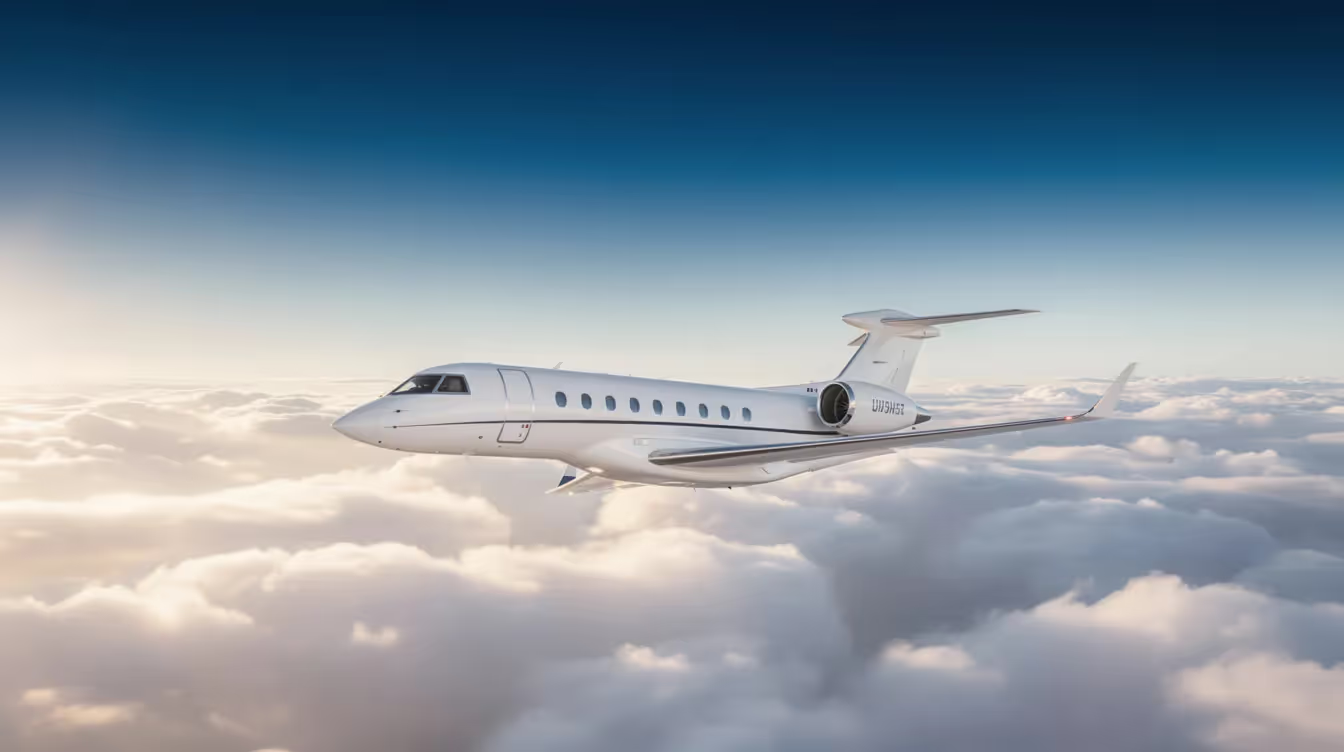
The Hawker 1000 is a notable super-midsize business jet that combines range, comfort, and efficiency for private jet travelers. Known for its spacious cabin and intercontinental capabilities, it serves as an evolution of the popular Hawker 800 series with upgraded engines and avionics. Ideal for both business and leisure travel, the Hawker 1000 offers a balance of performance and operating economy that appeals to those seeking flexible, non-stop flights across medium to long distances. This article explores the aircraft’s design, technical features, cabin experience, and how travelers can conveniently charter a Hawker 1000 through Jettly’s digital platform.
The Hawker 1000 is a super-midsize business jet offering a maximum range of approximately 3,100–3,150 nautical miles, making it well-suited for non-stop routes like New York–Los Angeles or Toronto–Vancouver. With a passenger cabin configured for eight to nine passengers and a stretched fuselage measuring 24.4 feet long, this aircraft evolved from the British Aerospace 125/Hawker 800 family with new engines and extended fuel capacity.
The Hawker 1000 bridges midsize and large-cabin jets, delivering transcontinental range at operating costs lower than many larger aircraft
Powered by two Pratt & Whitney Canada PW305 turbofan engines, each producing 5,255 pounds of thrust at takeoff, with economical fuel burn
The Hawker 1000A became the primary intercontinental version, with approximately 52 units that entered production during the 1990s
Jettly’s digital platform allows travelers to compare the Hawker 1000 with similar super-midsize jets, offering instant pricing and on-demand booking
This article covers the aircraft’s design, performance, cabin experience, operating economics, and how to charter a Hawker 1000 through Jettly.
The Hawker 1000, also known as the BAe 125-1000 or Beechcraft Hawker variant, launched in the early 1990s as a super-midsize business jet derived from the Hawker 800 line. The Hawker 1000 is a super-midsize business jet manufactured between 1993 and 1998. Manufactured by Hawker Aerospace between 1993 and 1998, the Hawker 1000 is part of a broader business jet product line that includes the renowned Hawker 125 series. Its first flight occurred around 1990, with deliveries beginning shortly after. Production continued through most of the decade, resulting in a relatively small fleet of approximately 52 aircraft, making it a sought-after option in today’s charter market.
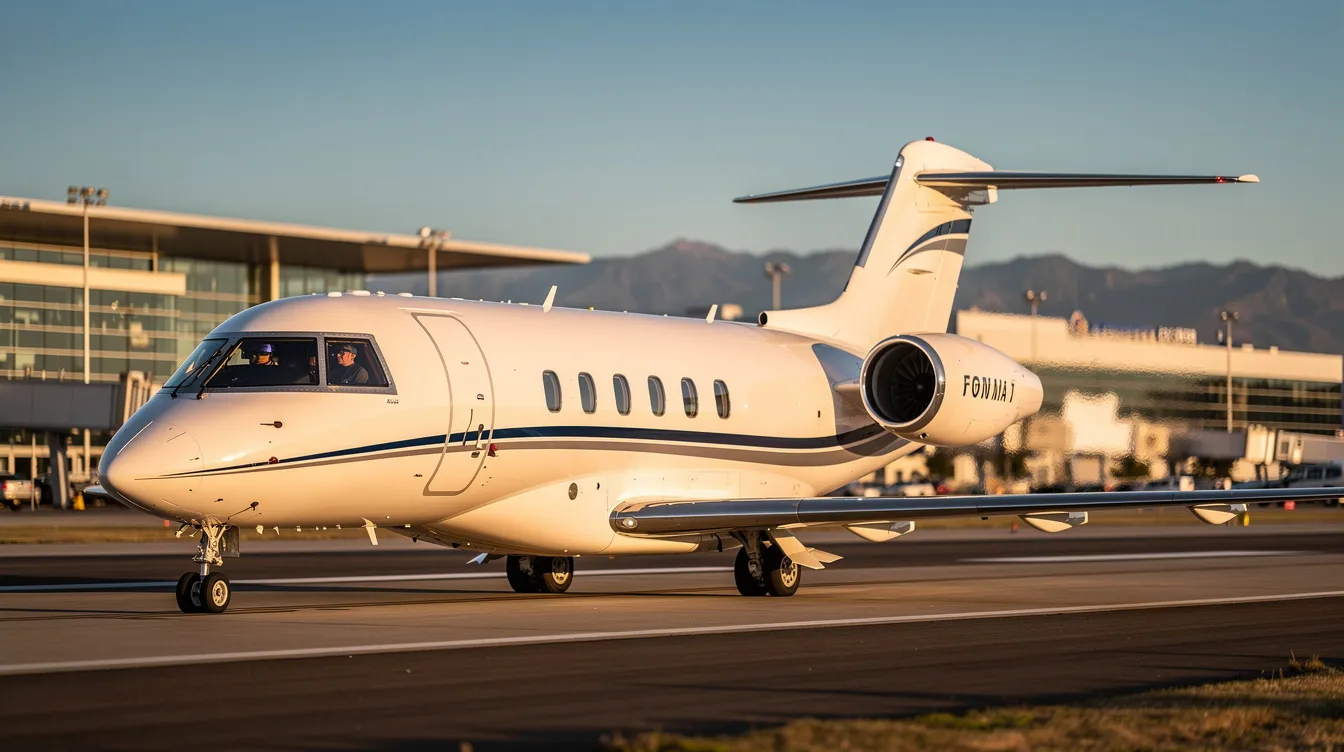
The Hawker 1000 was produced for six years, with a total of 52 units built. This relatively low market performance contrasts with its predecessor, the Hawker 800, which outsold the 1000 by better than two to one. This difference in sales reflects the market’s preference for the more economical Hawker 800 despite the 1000’s advanced features and extended range.
This aircraft sits between midsize and large-cabin jets, offering a good balance of transcontinental range and manageable operating costs. Among its in-production variants, the Hawker 1000 evolved from earlier models such as the 125-800, now known as the Hawker 800, with each version introducing major updates and improvements. Most passengers can stand upright in the cabin, and the jet performs efficiently on routes that would require connections on commercial flights.
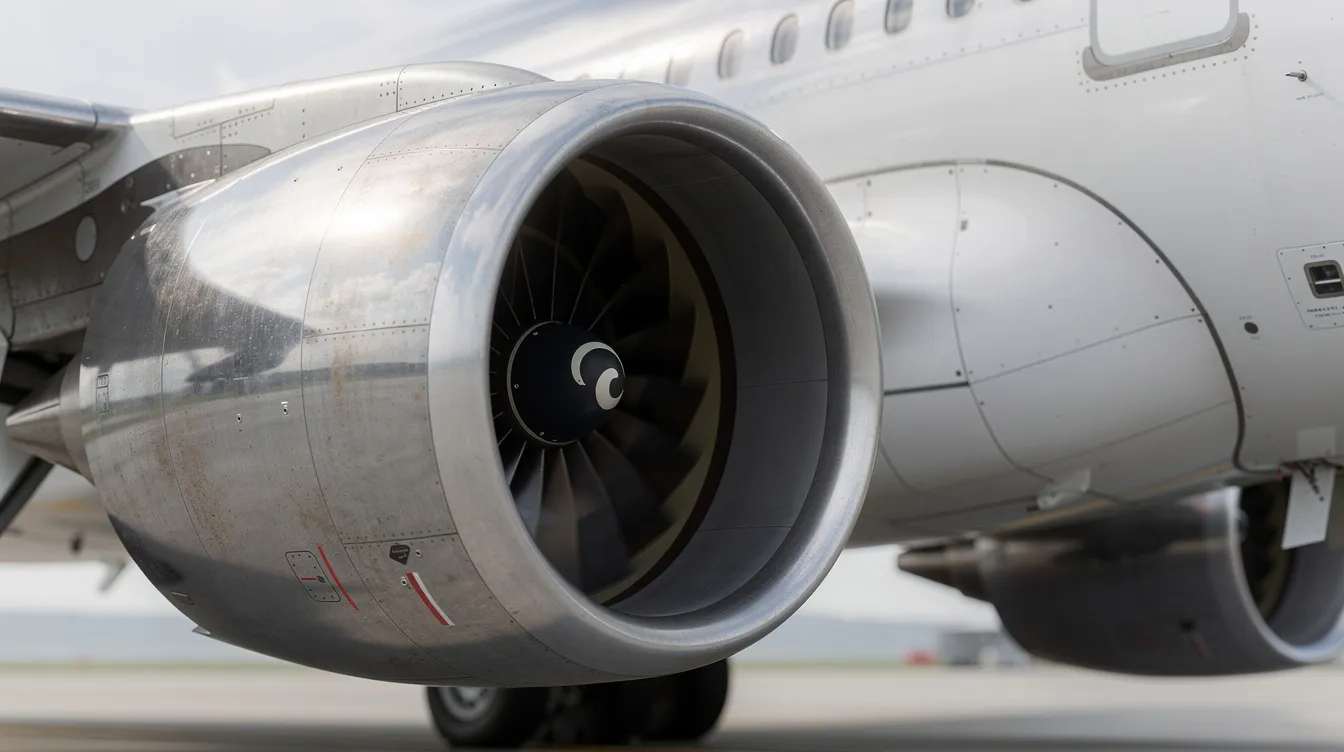
The Hawker 1000 is powered by two rear-fuselage-mounted Pratt & Whitney Canada PW305 turbofan engines. These engines marked a significant upgrade from earlier Garrett powerplants used on some Hawker 800 variants, delivering improved efficiency and range for long-haul private flight operations.
The Hawker 1000’s roots trace back to the de Havilland DH.125, which first flew in the 1960s. The aircraft progressed through the Hawker Siddeley HS.125 designation, then became the British Aerospace 125 in the 1980s before evolving into the Hawker 800 series. This lineage represents decades of continuous refinement in business aviation, with the Hawker 1000 introducing a new design that reduced engine noise and improved passenger comfort by blending biomorphic and traditional elements.
British Aerospace, later partnering with Raytheon Hawker and eventually Hawker Beechcraft, targeted the super-midsize segment through several changes to the Hawker 800 platform. The two main variants, the 125-800 and the 125-1000, were developed, with the 125-800 becoming the Hawker 800 and the 125-1000 evolving into the Hawker 1000. Engineers created a stretched fuselage, increased fuel capacity by nearly 200 gallons through a ventral tank, and fitted the more efficient PW305 turbofans.
Following Raytheon's purchase of British Aerospace's business jet division, the main variants were re-designated as the Hawker 800 and Hawker 1000, with the Hawker 1000A and Hawker 800A/800XP emerging as the main variants after Raytheon's purchase. The Hawker 1000A was marketed as an intercontinental business jet with reported intercontinental range capabilities exceeding the Hawker 800XP. However, higher acquisition costs—originally approximately $12.695 million, nearly $3 million more than the Hawker 800XP—limited production to just 52 deliveries before the manufacturer shifted focus to successor models in the Hawker series.
Production of the Hawker 1000 ceased in 2013 following the bankruptcy of Hawker Beechcraft, a consequence of a prolonged slump in business jet demand after the Great Recession.
This section examines the Hawker 1000’s airframe, engines, and avionics for readers, comparing technical characteristics for charter selection within Jettly’s broader private charter aircraft marketplace.
The aircraft features a low-wing design with a T-tail arrangement. The cabin stretches approximately 24.4 feet in length with a maximum width of 6.0 feet and a height of 5.8 feet. This cabin volume provides useful space for work and relaxation during extended flights. The pressurized environment supports high altitude operations where the aircraft performs most efficiently.
Two Pratt & Whitney Canada PW305B turbofan engines are mounted on the rear fuselage, each delivering approximately 5,255 pounds of thrust at takeoff. These powerplants feature Full Authority Digital Engine Control (FADEC) and Automatic Performance Reserve, reducing pilot workload while optimizing performance. When one engine requires additional thrust during takeoff, the system automatically compensates.
The cockpit is equipped with the Honeywell SPX-8000 dual-channel fail-operational digital flight system, representing advanced avionics technology for the early 1990s. It includes five flat-panel EFIS screens, Primus 870 Doppler turbulence detection, and WX-970 weather radar, supporting efficient and safe operations.
The Hawker 1000 can cruise at speeds up to 453 knots (0.68 Mach) at an altitude of 37,000 feet, with a long-range cruise speed of 400 knots (0.60 Mach) at 41,000 feet. It has a maximum range of approximately 3,530 miles (3,098 nautical miles), enabling non-stop flights on transcontinental routes.
Fuel consumption averages around 1,400 pounds (232 gallons) per hour at maximum speed or range parameters, supported by a total fuel capacity of 11,300 pounds. These efficient engines and fuel management systems contribute to the aircraft’s competitive operating economics.
Takeoff performance includes a distance of 5,950 feet at sea level and 8,075 feet at an altitude of 5,000 feet, demonstrating the aircraft’s capability to operate from a variety of airports and runway lengths.
The Hawker 1000 incorporated a slower velocity exhaust design to reduce engine noise, effectively lowering exhaust velocity and minimizing the noise footprint around the aircraft. This design places the Hawker 1000 among the quieter jets in its class, achieving a compact noise footprint of just 1.6 square miles—significantly smaller than typical twin-turboprops—making the aircraft more acceptable at noise-sensitive airports.
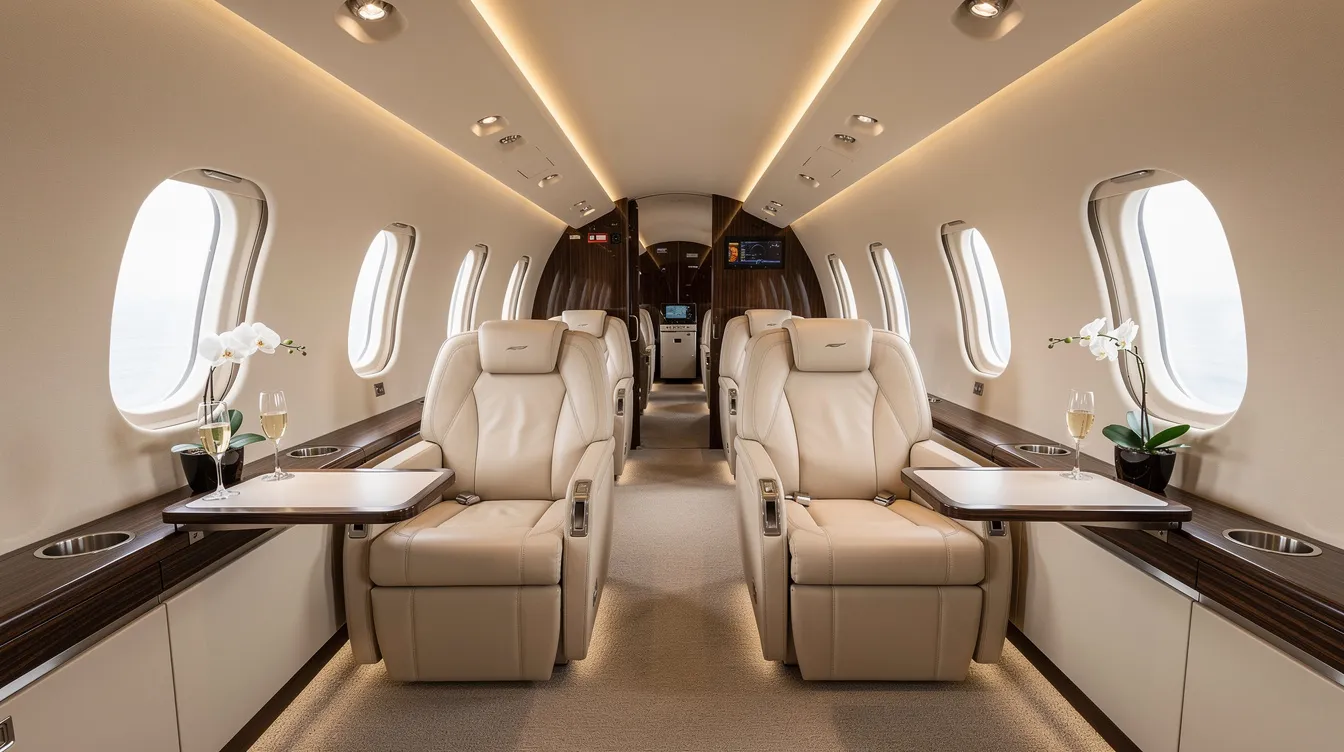
The Hawker 1000 typically accommodates eight passengers in a spacious cabin configured with a club seating arrangement and a three-seat divan. This layout provides a comfortable environment for business or leisure travelers.
The cabin measures 24.4 feet long, 6 feet wide, and 5.8 feet high, offering more space compared to many other jets in the super-midsize category. These dimensions contribute to a more open and comfortable feel during flights.
Standard seating includes a forward club section with four seats facing each other, plus an aft three-seat divan and two single seats, allowing for social interaction or productive meetings onboard. This versatile layout supports a range of travel needs.
The Hawker 1000 provides approximately 72 cubic feet of baggage space in internal and external compartments, sufficient for multi-day trips and bulky items such as golf clubs or ski equipment.
The aircraft includes an enclosed lavatory and refreshment galley. Many operators offer in-flight Wi-Fi, power outlets, and catering options. Jettly coordinates these services to enhance passenger comfort.
The Hawker 1000 occupies an economical niche in the super-midsize segment, delivering transcontinental range at operating costs typically lower than large-cabin jets, which is important when understanding one private jet flight cost in the context of different aircraft categories.
The aircraft achieves economical fuel burn averaging 232 gallons per hour due to efficient PW305 engines and aerodynamic refinements. Engine inspection intervals of 5,000 hours contribute to reasonable maintenance economics, all of which factor into quotes generated by Jettly’s private jet charter cost estimator.
Despite its advanced features and capabilities, the Hawker 1000's average price of approximately $12.695 million was nearly $3 million more than the Hawker 800XP, which contributed to its lower sales figures. The Hawker 1000 was produced for six years, with only 52 units built, indicating relatively low market performance compared to the Hawker 800, which outsold it by more than two to one. Current acquisition costs range from approximately $1.27 to $3.25 million on the pre-owned market, making the aircraft attractive for charter operators.
Compared with similar super-midsize jets, the Hawker 1000 offers a blend of range, cabin comfort, and mid-length runway access. While newer aircraft may offer higher maximum speeds or updated avionics, the Hawker 1000 delivers value through proven reliability and competitive hourly rates, fitting well within Jettly’s positioning as a NetJets alternative for private flyers.
Jettly’s transparent pricing and large aircraft inventory make comparing the Hawker 1000 with other options straightforward, helping travelers find the best balance of cost and capability, particularly when evaluating affordable airplane rental options across categories.
The Hawker 1000 serves executives, families, and small groups needing non-stop flights over medium to long distances.
Multi-city North American itineraries in a single day
Board meetings requiring schedule control
Site visits with productive cabin time during flight
Executive travel where avoiding commercial connections saves hours through dedicated private jet operator services
Family vacations to coastal destinations
Ski trips requiring transport of bulky equipment, which can be made more economical by sharing private jet seats on select routes
Group travel to weddings, sporting events, or reunions
Getaways where flexibility and convenience matter
Jettly’s digital booking tools allow travelers to enter desired routes and compare whether a Hawker 1000 or another super-midsize jet offers the best combination of price, flight time, and comfort for specific itineraries, including options for those who prefer simply buying a seat on a private jet rather than chartering the entire aircraft.
Jettly operates as a global private jet charter marketplace offering on-demand access to aircraft like the Hawker 1000 through a streamlined, tech-driven platform that makes it easier to get a seat on a private jet without long-term commitments.
Users select origin, destination, and travel dates. The platform searches a global network of over 20,000 aircraft, displaying Hawker 1000 options alongside comparable jets with instant pricing estimates. Travelers can filter by aircraft category, compare cabin layouts, and review operator safety credentials before confirming.
Jettly offers membership models that reduce per-flight costs compared with traditional jet cards or fractional ownership—particularly valuable for frequent travelers seeking flexibility without long-term commitments, especially when compared with conventional jet card programs.
The platform provides 24/7 trip support, helping travelers arrange catering, ground transportation, and specific onboard services, and even use a dedicated jet card flight cost estimator when planning frequent or recurring trips.
Ready to experience private travel on your terms? Explore flight options or request a quote at https://www.jettly.com, compare top jet card programs, or even join Jettly’s high-ticket affiliate program if you regularly refer new private flyers.
|
Category |
Specification |
|---|---|
|
Passenger Capacity |
8–9 passengers (typical configuration) |
|
Crew |
2 pilots |
|
Cabin Length |
Approximately 24.4 feet |
|
Cabin Height |
5.8 feet (stand-up for most adults) |
|
Cabin Width |
6.0 feet maximum |
|
Baggage Volume |
Approximately 72 cubic feet |
|
Maximum Range |
~3,530 miles (3,098 nautical miles) |
|
Normal Cruise Speed |
Up to 453 knots (0.68 Mach) |
|
Service Ceiling |
Up to 43,000 feet |
|
Engines |
Two Pratt & Whitney Canada PW305B turbofans |
|
Thrust |
~5,255 lbf per engine |
|
Fuel Capacity |
11,300 pounds (1,707 US gallons) |
|
Fuel Burn |
Approximately 1,400 pounds (232 gallons) per hour |
Actual performance varies by operator, configuration, and flight conditions. For precise mission planning, request tailored estimates through Jettly’s support team.
Production numbers remain relatively low compared with mainstream midsize jets. Most sources cite approximately 52 Hawker 1000A aircraft delivered during the 1990s, based on serial number records from 259003 to 259052. This limited production run makes the type relatively rare but sought-after on the charter market.
The Hawker 1000’s range of approximately 3,100–3,150 nautical miles allows selected transatlantic sectors under favorable wind conditions—for example, some eastern North America to western Europe city pairs. However, most operators and charter clients position this aircraft primarily for long North American or intra-regional routes. Check specific mission feasibility with Jettly for each trip.
The Hawker 1000 offers a longer cabin, greater fuel capacity, and extended range compared with the Hawker 800. Both aircraft typically carry around eight passengers, but the Hawker 1000 provides more legroom and non-stop capability on routes exceeding four hours—making it more attractive for transcontinental travel.
The Hawker 1000 generally accommodates approximately 72 cubic feet of baggage space, including internal and external compartments for larger items. This supports luggage needs for multi-day trips and specialty equipment. Jettly confirms specific baggage allowances for each aircraft before booking.
Many Hawker 1000 operators offer in-flight Wi-Fi, power outlets, and catering options ranging from light snacks to full meals. Equipment and services vary by operator and aircraft configuration. Jettly’s team arranges tailored onboard services and confirms connectivity details during the quotation process.
The Hawker 1000 remains a compelling choice for travelers seeking a super-midsize jet with transcontinental range, comfortable cabin space, and efficient performance. With its advanced digital avionics, reduced engine noise, and reliable Pratt & Whitney Canada PW305 engines, it offers a balanced blend of comfort and capability. Whether for business or leisure, chartering a Hawker 1000 through Jettly’s digital platform provides transparent pricing, instant booking, and access to a global network of aircraft. Ready to experience private travel on your terms? Explore flight options or request a quote athttps://jettly.com.
Share this post:
Jay Franco Serevilla
Apr 18, 2026
|
5
min read
Discover tips and trends in the industry.

5
min read
Delta Boarding Zones: How Delta Air Lines Boarding Works (and What It Means for Private Flyers)
Delta Air Lines utilizes a structured boarding system with eight numbered zones plus pre-boarding, determining the order in which passengers board based on cabin class, fare type, and loyalty status. Understanding this system is crucial for travelers considering commercial flights versus private jet charters, as it impacts overhead bin space and wait times. For those seeking a more streamlined experience, private jet options like Jettly eliminate the complexities of boarding zones altogether.
Read More
5
min read
Delta Basic Economy: What Changed, What It Includes, and When to Avoid It
Delta Air Lines has rebranded its Basic Economy fare to Delta Main Basic as of October 1, 2025, maintaining its core restrictions while altering the booking experience. This fare class is the most restrictive in Delta's lineup, making it suitable primarily for solo travelers on short flights who prioritize low prices over flexibility. For most travelers, considering higher fare options like Delta Main Classic or private jet charters may provide better value.
Read MoreStay updated with our latest insights and tips to elevate your journey with us.
MEMBERSHIPS AND ASSOCIATIONS



Disclaimer: Jettly operates as a charter broker, offering access to a global digital jet charter marketplace. Jettly is not a direct air carrier and does not own or operate aircraft. All advertised flights are conducted by third-party air carriers that are fully licensed and hold the appropriate Part 135 or Part 121 certifications issued by the Federal Aviation Administration (FAA) or equivalent regulatory authorities under U.S. or foreign law. Jettly complies fully with the U.S. Department of Transportation's Part 295 and Part 298 Charter Broker regulations. Jettly does not carry additional liability insurance. Passengers are covered by aircraft operator insurance. TICO: 50023770


