


Login
Get Instant Pricing On 23,000+ Aircraft

>

When business demands your presence in Tokyo tomorrow but you’re in New York today, a global airplane makes the impossible routine. These ultra-long-range business jets represent the pinnacle of private aviation, engineered to connect continents without refueling stops. Through platforms like Jettly, travelers can access aircraft such as the Bombardier Global Express and Global 7500 on-demand, bypassing the complexity of ownership while gaining instant intercontinental reach.
A global airplane in business aviation refers to ultra-long-range jets capable of nonstop flights exceeding 6,000 nautical miles, such as the Bombardier Global series and comparable aircraft.
These jets combine intercontinental range (6,000–8,000 NM), low cabin altitude around 2,691–5,000 ft, and advanced systems like the Bombardier Vision flight deck to maximize comfort and safety on 10–16 hour missions.
Digital charter platforms like Jettly provide access to a global aircraft inventory of over 20,000 aircraft with instant pricing and transparent costs—no jet cards or fractional ownership required.
Compared with commercial aviation, global airplanes offer direct routing between city pairs (New York–Tokyo, London–Singapore), flexible departure times, and access to thousands more airports worldwide.
The sections below cover aircraft types, cabin experience, flight deck technology, and how to book through Jettly.
A global airplane is an ultra-long-range business jet designed for nonstop intercontinental flights typically exceeding 6,000 nautical miles. These aircraft sit at the top of the business jet hierarchy, above light, midsize, and standard large-cabin jets, purpose-built for missions like New York–Hong Kong, Los Angeles–Sydney, or London–Singapore.
The term “global” extends beyond range. It encompasses worldwide operability: high cruise speeds around Mach 0.85–0.95, robust field performance for challenging runways, and regulatory compliance across FAA, EASA, and other jurisdictions. Global airplanes are often registered and based in various countries, including France, to optimize operational flexibility and comply with local regulations. The global airplane industry is valued at over $226 billion in 2026 and is projected to reach approximately $274 billion by 2030, with a compound annual growth rate of 4.3%.
Iconic examples include:
Bombardier Global Express (6,500 NM; maximum range figures are typically calculated under ISA conditions)
Bombardier Global 6000 (6,000 NM; maximum range figures are typically calculated under ISA conditions)
Global 7500 (7,700 NM; maximum range figures are typically calculated under ISA conditions)
Global 8000 (8,000 NM; maximum range figures are typically calculated under ISA conditions)
Travelers can charter these aircraft through Jettly’s digital platform without needing jet cards or fractional ownership.
The Bombardier Global Express was unveiled at the National Business Aviation Association convention in October 1991, with the program officially launched in December 1993. The first prototype performed its maiden flight on October 13, 1996, lasting 2 hours and 46 minutes, reaching an altitude of 11,000 ft and a speed of 210 knots. Extensive flight testing and ground testing were critical in verifying the aircraft's performance and functionality, leading to Canadian type certification in July 1998. The Global Express entered service in July 1999.
The program cost approximately $800 million to develop, with a backlog of over 40 aircraft by June 1995. Since 2023, the Global Express has been assembled at Toronto Pearson International Airport, with components produced by manufacturers including Mitsubishi Heavy Industries.
The original aircraft, building on its predecessors, offered:
Range of 6,500 nautical miles at Mach 0.80
Cabin altitude of approximately 4,500 ft at FL450
Large cabin optimized for work and rest
Evolution brought the Global 5000, 6000 (with 6,000 NM range competitive in its class), and later the Global 7500 and 8000. The Global 7500 and 8000 have transformed the business jet market with their advanced features and technology. The Bombardier Global 8000 features a range of 8,000 nautical miles, accessing 30% more airports than its closest competitor. The global market for large mainline commercial airliners remains a duopoly, with specialized manufacturers dominating regional, defense, and business jet sectors. The Asia-Pacific region accounts for over 45% of global aircraft demand, with India emerging as the world’s fastest-growing aviation market.
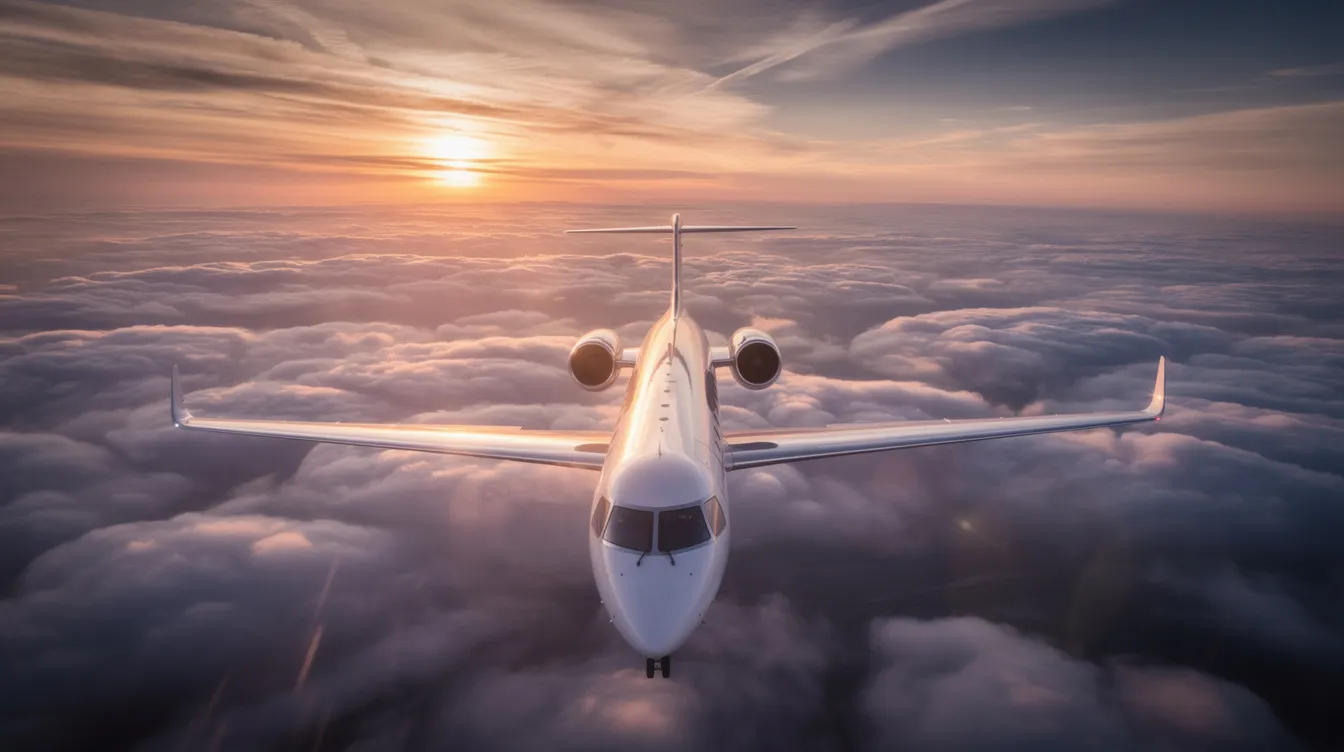
Range, speed, and field performance determine whether a business jet can connect distant city pairs without layovers. For executives managing operations across continents, these specifications translate directly into time saved.
|
Aircraft Model |
Maximum Range (NM) |
Top Speed (Mach) |
Cabin Altitude (ft) |
Passenger Capacity |
Notable Features |
|---|---|---|---|---|---|
|
Bombardier Global Express |
6,500 |
0.80 |
~4,500 |
12–14 |
Large cabin, first in series |
|
Bombardier Global 6000 |
6,000 |
0.85 |
~4,500 |
12–16 |
Updated avionics, competitive range |
|
Bombardier Global 7500 |
7,700 |
0.90 |
2,900 |
14–19 |
Four living spaces, low cabin altitude |
|
Bombardier Global 8000 |
8,000 |
0.95 |
2,691 |
14–19 |
Fastest business jet, access to more airports |
The Bombardier Global 8000 reaches a top speed of Mach 0.95, making it the fastest business jet and the quickest civil aircraft since the Concorde. Its powerful engines deliver exceptional thrust, contributing to impressive speed and takeoff performance. Normal cruise sits around Mach 0.85–0.90, with high-speed cruise reaching Mach 0.92–0.95.
Real-world route examples:
New York to Tokyo (approximately 6,000 NM)
Los Angeles to Sydney (7,200 NM)
Dubai to São Paulo (5,780 NM)
London to Singapore (5,800 NM)
Field performance matters for itinerary flexibility. Advanced wings with leading-edge slats and carbon brakes allow some global airplanes to operate from runways under 5,000–6,000 ft, including steep-approach airports like London City. These leading-edge slats enhance airport accessibility and short-runway performance, and tools like Jettly’s airport locator help travelers identify suitable airfields for these operations. This opens access to over 14,000 airports worldwide versus roughly 500 major hubs served by commercial widebodies.
The cabin of a global airplane functions as both office and residence during 10–15 hour flights, with the spacious size of the cabin allowing for exceptional comfort and productivity. Multiple zones accommodate work, dining, and rest, transforming transit into productive or restorative hours.
The aircraft is designed with four spacious living areas and boasts the industry’s lowest cabin altitude of 2,691 ft, enhancing passenger comfort during long flights. For comparison, many commercial airliners maintain cabin altitudes of 6,000–8,000 ft. Lower altitude means higher oxygen saturation, reducing fatigue and jet lag by up to 50% according to NASA studies on hypoxia.
Cabin features in aircraft like the Global 7500:
Club Suite: Four single seats with 180° recline
Conference Suite: Dynamic table seating 10 with swivel seats
Principal Suite: Queen bed, 75” lie-flat, optional stand-up shower
Lounge area: Sofa and entertainment system
Lavatory: Located at the rear and forward sections, offering privacy and ample space for passenger convenience
Additional wellness details include the Nuage seat with zero-gravity positioning, circadian LED lighting synced to destination time zones, and air renewal every 90–100 seconds via HEPA filtration. Windows are 80% larger than predecessors, admitting 20% more natural light. Noise levels hover around 50–55 dB—far quieter than commercial cabins at 75–85 dB. The cabin interior can also be customized to create a luxurious and tailored flight experience, ensuring every journey meets the highest standards of comfort.
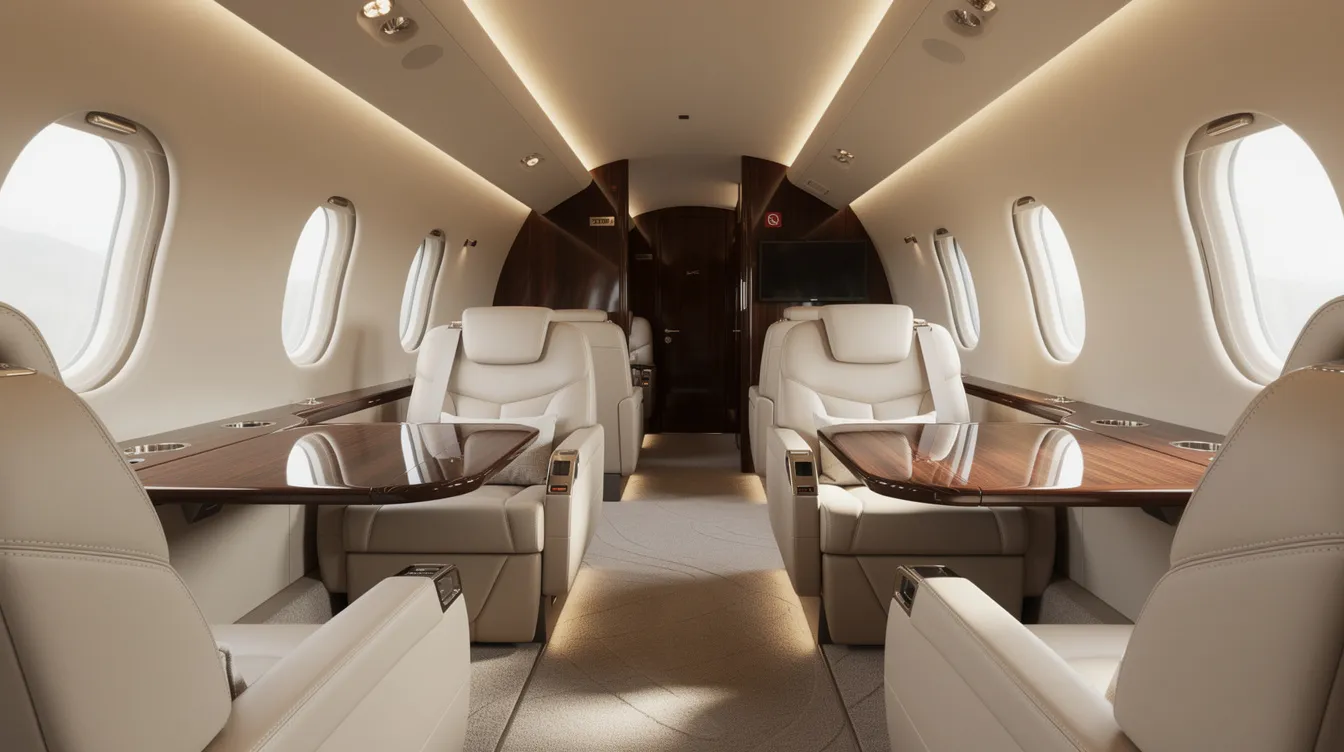
Onboard, life is centered around making the most of the moments between milestones, thanks to the cabin’s comfort and flexibility.
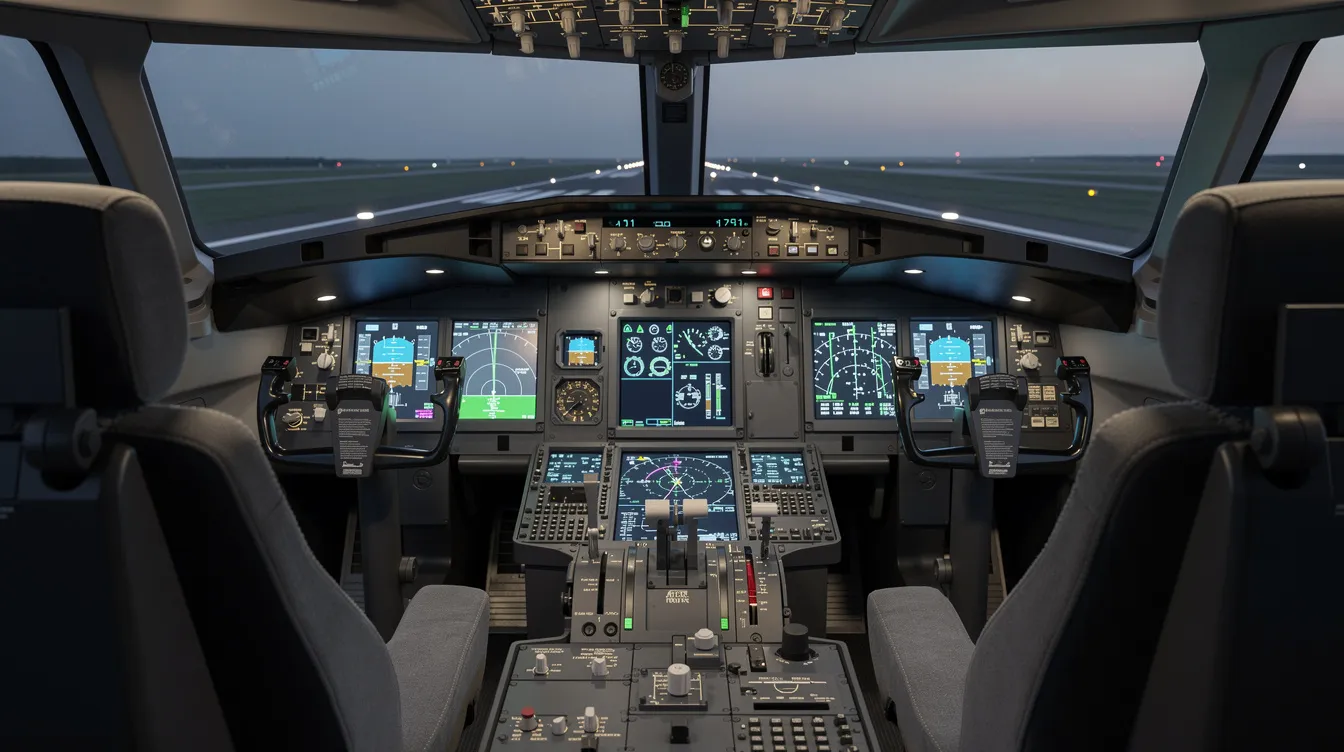
Long-range missions across unfamiliar international routes demand advanced avionics and automation. The Bombardier Vision flight deck represents a flagship example, featuring fully integrated systems, fly-by-wire controls, and four 15.1-inch landscape displays. In this cockpit, advanced avionics are paired with flight intelligence features to enhance both safety and the pilot experience.
Key technologies include:
Head-up display (HUD)
Enhanced vision system with infrared cameras
Synthetic vision rendering terrain in zero visibility
Active control sidesticks with envelope protection
Fly-by-wire systems contribute to smoother rides by attenuating turbulence up to 40% via load alleviation. Modern engines like the GE Passport monitor health in real-time, predicting potential failures 100+ hours in advance.
Crews operating through charter platforms like Jettly’s network must meet strict regulatory standards. Pilots typically hold thousands of flight hours on type, with operators meeting Part 135 or equivalent certification and audits from organizations like ARGUS Platinum or Wyvern Wingman. Business jets maintain an accident rate of 0.23 per 100,000 hours versus 1.2 for Part 121 airliners, according to NTSB data from 2023.
Global passenger traffic is projected to reach 5.2 billion travelers, generating over $1 trillion in total revenue for commercial aviation. Yet for executives and high-net-worth travelers, total door-to-door time often matters more than ticket price.
Time advantages:
Use smaller airports closer to city centers, cutting ground transfer time
Depart on your schedule—no queues, security lines, or boarding waits
Connect city pairs requiring multiple commercial connections in one flight
Avoid layover risks and disruption from delays
Airlines face margin compressions due to multi-year labor agreements, wage adjustments, and elevated interest rates. Budget carriers are expanding market share, posing challenges to traditional legacy airlines through lower pricing. Geopolitical tensions are impacting air traffic by causing flight route changes and airspace closures.
Productivity benefits:
Along with quieter cabins and inflight connectivity, services such as Jettly Eats in-flight catering further enhance productivity and comfort by ensuring tailored meals are ready on board for long work-focused sectors.
Private charters offer quiet cabins configured with conference tables, fast inflight connectivity, and privacy. Meetings or focused work during cruise segments turn travel time into billable hours. Studies indicate 80% of executives report higher productivity on private flights. In addition, private jet charters provide peace of mind, allowing travelers to focus on business with confidence, knowing that reliable service and support are designed to ensure their satisfaction and peace throughout the journey, particularly when using providers positioned as a NetJets alternative with flexible on-demand access.
Jettly operates as a digital private aviation platform aggregating a global inventory of more than 20,000 aircraft, including many ultra-long-range jets commonly described as global airplanes, giving travelers on-demand access to an extensive private charter aircraft fleet.
How the platform works:
In addition to on-demand access, Jettly offers private jet memberships that can lower effective hourly rates for frequent users.
Search routes (New York–Tokyo, London–Dubai)
Compare aircraft like Bombardier Global Express, Global 6000, or similar jets
View estimated pricing and flight times instantly
Book on-demand without jet cards or fractional ownership
Jettly focuses on transparent pricing models, supported by resources that explain affordable private jet charter and the factors that influence total trip cost. Customers see hourly rates (typically $10,000–$18,000 for Global-series aircraft), estimated total trip costs, and additional fees in advance, and they can use a private jet charter cost estimator to understand how route length and aircraft size affect pricing. Both membership and on-demand access options exist, with memberships potentially reducing per-flight costs and adding services like catering coordination and ground transportation, while structured jet card programs appeal to flyers seeking fixed hourly rates and predictable budgeting.
Partner operators must hold proper certification under Part 135 or equivalent, with aircraft maintained under approved maintenance programs, and travelers can review how Part 135 charter companies operate to better understand these safety and compliance standards. Learn more about charter options at Jettly.
Not every long flight requires the largest possible business jet. For some trips, especially when you only need a seat rather than the whole aircraft, strategies for getting a seat on a private jet easily can offer a more efficient match between aircraft size and traveler needs. Mission planning should consider distance, passenger count, luggage, and budget, and frequent travelers may also weigh whether jet card costs make sense versus ad hoc charter on a trip-by-trip basis.
General guidance:
Transcontinental routes (NY–LA, Toronto–Vancouver): Super-midsize or smaller large-cabin jet
True intercontinental legs (NY–Tokyo, Paris–Johannesburg): Ultra-long-range aircraft like Global Express or Global 7500
Key decision factors:
Required range with NBAA IFR reserves
Need for sleeping accommodations or principal suite
Number of separate cabin zones
Access to short or challenging runways
Example scenarios:
For travelers who do not need to charter an entire aircraft, learning how to buy a seat on a private jet can unlock similar route options at a fraction of full aircraft cost.
Executive roadshows across Asia: Global 6000 for multi-leg flexibility
Family holidays between North America and Europe: G650ER with bedroom configuration
Fast-turnaround site visits in multiple regions: Pair a global airplane with super-midsize for feeder segments
Jettly’s tools help match customers to suitable aircraft types across all categories, similar to how broader guides to finding the best cross-country plane compare performance, comfort, and operating costs for different mission profiles.
Global airplanes consume more fuel than smaller aircraft, but modern designs focus on higher efficiency per mile than earlier generations. High passenger numbers have driven record aircraft orders, but manufacturers face engine delays, quality oversight, and component shortages, resulting in decade-long delivery wait times. Global backlogs for commercial aircraft have topped 15,000 units, providing more than 10 years of production coverage for Airbus and Boeing.
The global fleet is expected to nearly double over the next 20 years to meet demand and replace older, less efficient aircraft. Shortages of specialized alloys and titanium contribute to production bottlenecks. Aircraft manufacturers are increasing investments in automation and 3D printing to combat supply chain vulnerabilities.
Sustainability efforts:
The aviation industry is pushing toward a Net Zero 2050 goal, prioritizing Sustainable Aviation Fuel blending and fuel-efficient propulsion technologies
The availability of SAF remains low and incurs extreme costs, making the push toward net-zero challenging
Some operators in Jettly’s network offer carbon offsetting where available
Chartering a single nonstop global flight can sometimes prove more efficient than multiple shorter legs with positioning flights, especially on international private jet routes that cross oceans or connect secondary cities not well served by commercial networks.
The term applies to ultra-long-range business jets with ranges around 6,000–8,000 NM, multiple cabin zones, and systems optimized for nonstop intercontinental missions. Examples include aircraft families like the Bombardier Global series, designed from the outset to link major business centers without refueling.
Most Bombardier Global Express and similar aircraft are configured for approximately 12–14 passengers, though layouts vary between operators. Seating and sleeping capacity should be confirmed at the quote stage on Jettly, with floor plans available where provided.
Many modern global airplanes maintain cabin altitudes around 2,691–5,000 ft at cruise, compared with 6,000–8,000 ft on commercial airliners. Lower altitude reduces fatigue, headaches, and dehydration on flights longer than 8–10 hours, improving alertness upon arrival.
One-way charters on global airplanes are often possible, especially on busy corridors like North America–Europe. Pricing may factor in repositioning if no return leg exists. Check Jettly for empty leg opportunities, which can provide cost advantages with flexible schedules.
Book at least 7–14 days in advance for complex intercontinental itineraries to secure the right aircraft, crew rest planning, and airport slots during peak seasons. Urgent trips can often be arranged in shorter timeframes through Jettly, though aircraft choice may be more limited.
A global airplane in business aviation offers the range, speed, and cabin comfort to connect distant markets in a single overnight flight. Aircraft like the Bombardier Global Express and its successors combine advanced flight deck technology, low cabin altitude, and flexible layouts supporting both productivity and rest on flights exceeding 10 hours.
Jettly’s digital platform makes access simple and transparent—global aircraft inventory, instant pricing, and on-demand booking without long-term commitments. Whether planning an intercontinental business trip or complex multi-city itinerary, these aircraft transform how executives and families move across continents.
Experience private travel tailored to your needs. Discover flight options or request a personalized quote at https://www.jettly.com.
Share this post:
Jay Franco Serevilla
May 13, 2026
|
5
min read
Discover tips and trends in the industry.
5
min read
White Cloud Aviation & Private Charter Around Lake Havasu
White Cloud Aviation in Lake Havasu City offers specialized flight training and private jet charter services, making it an ideal destination for pilots and leisure travelers. With year-round flying conditions and a focus on cloud aviation skills, students can enhance their training while enjoying seamless travel through platforms like Jettly.
Read More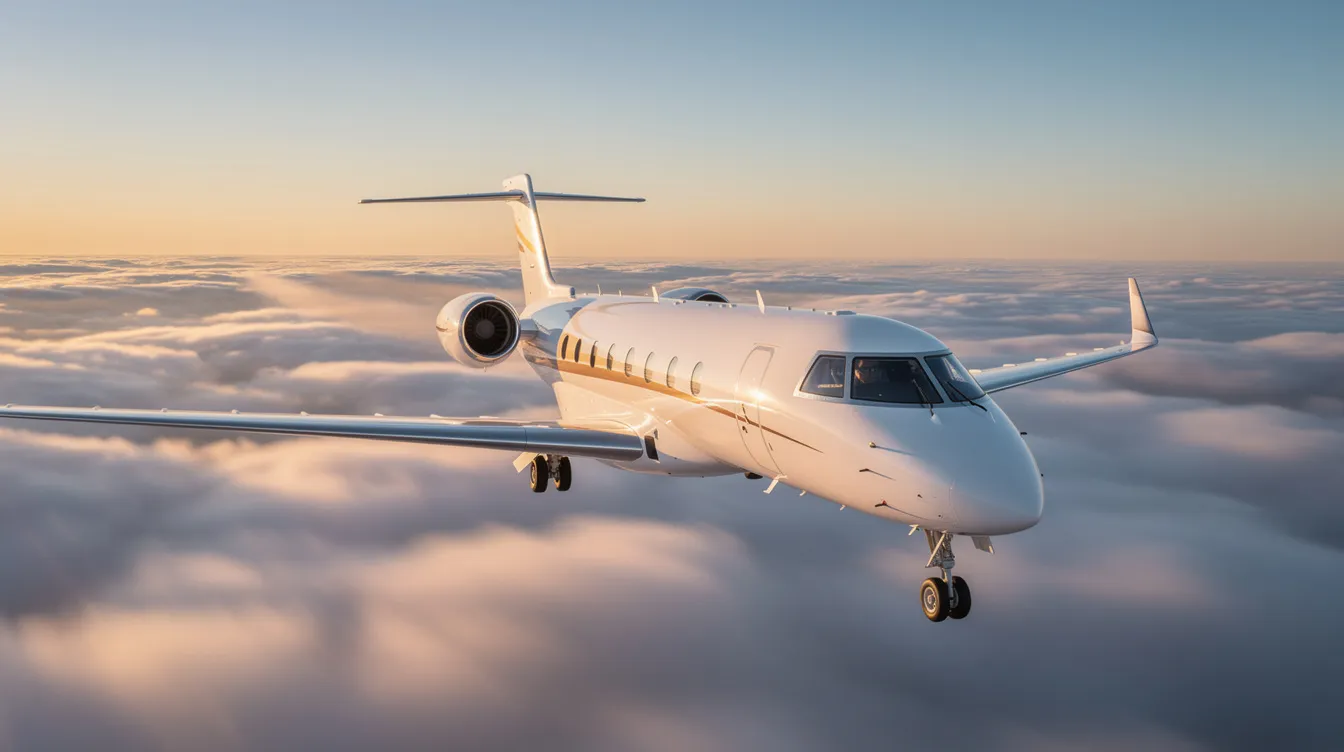
5
min read
BAJ Jets: How Digital Platforms Like Jettly Are Changing Private Jet Travel
BAJ jets, or Book-A-Jet platforms, are revolutionizing private aviation by providing digital access to over 20,000 aircraft worldwide. Platforms like Jettly offer live pricing, transparent quotes, and flexible booking options, making private jet travel more accessible than ever. This article explores how these platforms work, their pricing models, and the overall booking experience.
Read MoreStay updated with our latest insights and tips to elevate your journey with us.
MEMBERSHIPS AND ASSOCIATIONS



Disclaimer: Jettly operates as a charter broker, offering access to a global digital jet charter marketplace. Jettly is not a direct air carrier and does not own or operate aircraft. All advertised flights are conducted by third-party air carriers that are fully licensed and hold the appropriate Part 135 or Part 121 certifications issued by the Federal Aviation Administration (FAA) or equivalent regulatory authorities under U.S. or foreign law. Jettly complies fully with the U.S. Department of Transportation's Part 295 and Part 298 Charter Broker regulations. Jettly does not carry additional liability insurance. Passengers are covered by aircraft operator insurance. TICO: 50023770


