



Login
Get Instant Pricing On 23,000+ Aircraft

>
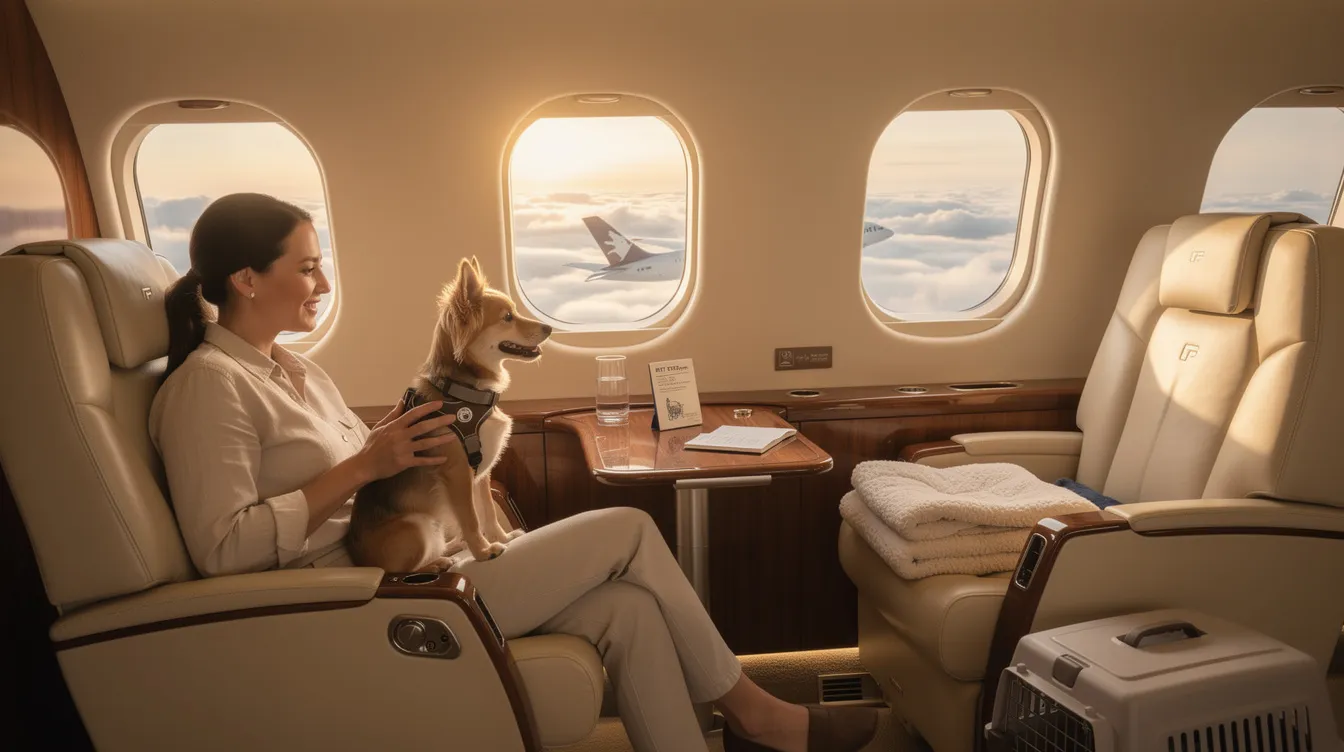
Flying with pets on a private jet skips nearly everything that makes commercial pet travel stressful. Your dog or cat rides in the cabin with you; there is no cargo hold, and you check in at a quiet private terminal instead of a crowded airport. Approval is never a given, though. The operating air carrier that supplies the aircraft decides what rides onboard, and your destination's entry rules can reshape the whole plan. This 2026 guide covers pet policies, paperwork, cabin and baggage limits, real costs, and the international steps that trip up most travelers.
Yes. Pets can usually travel in the cabin on a private jet charter, but approval depends on the operating air carrier, the specific aircraft, and your destination's entry rules, so you must disclose your pet's details before the flight is confirmed.
That is the quick version of "can I bring pets on a private jet charter flight?" Three factors decide what actually happens on your trip:
Operator approval. The company that operates the aircraft has the final say on whether your pet flies and under what conditions.
In-cabin travel is typical. On most private charters, your pet stays in the cabin with you rather than riding in a hold.
Destination rules. Domestic trips are simpler. International routes add paperwork and lead time that can change the plan.
Planning a private jet charter with pets starts with one habit: tell the broker about your animal before anything is booked. Give these details to Jettly at quote time, not after you sign the contract: species, breed, weight, and crate dimensions in inches. Early disclosure lets the operator confirm the right aircraft the first time and avoids a last-minute swap or refusal. Pets can often fly in the cabin on private jet charters, but the operating carrier and destination rules decide what is permitted on your specific flight.
A definition worth bookmarking: the operating air carrier is the certified company that provides the aircraft and crew and has operational control of the flight. It sets and enforces the final onboard pet policy. In the United States, that carrier typically operates under FAA Part 135 or Part 121 rules.
One note for the day itself. Many travelers arrive at the private terminal, the FBO, about 15 to 30 minutes before departure. If this is your first time flying private, that short, calm check-in is one of the biggest differences from the commercial airport routine.
Pet approval follows a predictable path from quote to wheels-up:
Quote. You request a flight and disclose your pet's details.
Operator review. The carrier checks whether the aircraft and crew can accept your pet.
Aircraft assignment. A specific tail number gets matched to your trip.
Document check. The operator verifies vaccination records, health certificates, and any permits.
Final go or no-go. Approval is confirmed, and your flight is locked in.
Jettly sits at the front of that chain as a charter broker and global digital charter marketplace. Jettly arranges the flight; it does not own or fly the aircraft. Every advertised flight is operated by a third-party air carrier holding FAA Part 135 or Part 121 certification, or the equivalent foreign authority. Jettly arranges the charter, but the operating carrier retains operational control and makes the final decision on pet acceptance and onboard rules.
Pet policies differ from one operator to the next for practical reasons. Owner and management preferences, cabin layout, crew discretion, destination entry rules, and each operator's risk posture all feed the decision. A private jet pet policy on one aircraft may welcome a 90-pound dog loose in the cabin; another may require a crate for the same animal.
Disclose pet details at the quote or request stage, never after signing. Bringing pets on a private jet charter flight into the conversation early prevents aircraft swaps, repriced quotes, or an outright refusal once money has changed hands.
An FBO, or Fixed-Base Operator, is the private aviation terminal where charter passengers check in and depart without using the main commercial terminal. For timing, Jettly recommends booking 24 to 72 hours ahead for the best availability, though same-day charters are sometimes possible in roughly 3 to 6 hours depending on aircraft positioning and crew readiness. Pet paperwork, especially for international trips, usually needs far more runway than the flight itself.
|
Step |
What Jettly needs from you (pet + trip info) |
|---|---|
|
Quote request |
Departure and arrival cities, dates, passenger count, pet species, breed, and weight |
|
Operator review |
Crate dimensions (L×W×H in inches), behavior notes, and number of pets |
|
Aircraft assignment |
A luggage estimate so weight and balance can be checked alongside the crate |
|
Document check |
Vaccination records, health certificate, microchip, and permit details for international trips |
|
Final go or no-go |
Your acceptance of any restraint, crate, or handling conditions the operator sets |
|
FBO departure |
Arrival time at the private terminal and any special pickup needs |
There is no single universal private-jet pet policy. Each operator writes its own rules, so confirm them for the exact aircraft assigned to your trip.
Start every booking by telling the operator, through Jettly, exactly what is traveling: the number of pets, species, breed, weight, any reactive or anxious behavior, crate needs, and medical issues such as medications or recent surgery. Complete information up front keeps a small dog from becoming a reason to re-quote the whole trip.
Policy areas worth confirming every time include cabin access, leash rules on the ramp, restraint during takeoff and landing, whether cats need a crate for the full flight, and any cleaning or deep-clean contingencies. Keeping aisles clear and following crew instructions is a core part of the safety standards that apply on any charter, and pets are held to the same logic.
Special cases carry their own questions. Service animals follow different expectations than pets. Exotic animals, young puppies and kittens, and heat- or cold-sensitive breeds often need extra review and sometimes prior approval. Carrier and crate practices referenced in the IATA Live Animals Regulations are a useful planning benchmark, though your operator's own rules are what govern your flight.
A pet-friendly aircraft is one whose operator permits pets onboard and whose cabin and baggage configuration can safely accommodate the animal plus any carrier or crate required. Treat pet acceptance like a flight-safety item: disclose pet details early and confirm the exact rules for the specific aircraft assigned to your itinerary.
|
Question to ask the operator |
Why it matters |
What you may need to bring |
|---|---|---|
|
Can my pet ride loose, or is a carrier required? |
Sets comfort expectations and what you pack |
Soft carrier or crate on standby |
|
Is a restraint needed for takeoff and landing? |
Covers the highest-risk phases of flight |
Harness with a seatbelt attachment |
|
Do cats need a crate for the whole flight? |
Many operators treat cats differently from dogs |
Hard-sided carrier |
|
Are there cleaning fees after an accident? |
Prevents a surprise charge post-flight |
Pee pads, waste bags, blanket |
|
Can my pet be on the ramp off-leash? |
Ramp areas near running aircraft are hazardous |
Leash and a secure collar, every time |
|
Is carpet or upholstery protection required? |
Protects the cabin and your deposit |
Washable mat or blanket |
|
How many pets can this aircraft take? |
Cabin space and weight limits apply |
Accurate count and individual weights |
|
Where can the pet settle during the flight? |
Aisles and exits must stay clear |
Designated bed or mat away from the aisle |
Most pets ride in the cabin on private charters. Cargo-hold transport is uncommon for standard companion-animal trips and depends on the route and aircraft.
In the cabin, safety expectations still apply. Your pet may need a carrier, harness, or other restraint during taxi, takeoff, landing, and turbulence, and the aisle has to stay clear the entire flight. A calm pet on a familiar bed beside your seat is the usual picture for pet travel on a private jet.
Searches for private jet charter baggage limits and pet policies often expect a single number. There isn't one. A charter's "baggage limit" comes from the aircraft's baggage compartment volume and its weight-and-balance math, not a published airline-style allowance. Weight and balance is the aircraft loading calculation that keeps the plane within safe limits for takeoff, flight, and landing; heavy crates and luggage can change what the crew can accept onboard.
Private-jet baggage limits aren't one universal number. The aircraft's baggage compartment size, weight-and-balance limits, and whether you're bringing a crate all affect what can go, so confirm the exact limits for your assigned aircraft, not just the jet category.
Crates add a wrinkle. A large crate might travel in the baggage area on one aircraft and inside the cabin on another, and a bulky crate can push a traveler up into a bigger aircraft category. When the crate drives the decision, moving to a larger cabin often solves crate space and luggage room in one step. Our guide to large-cabin jets explains where that extra room comes from.
|
Aircraft category |
Typical best for (pet profile) |
Cabin space notes |
Crate practicality |
Baggage planning notes (confirm) |
|---|---|---|---|---|
|
Turboprop |
One small-to-medium pet, short regional hops |
Modest headroom, narrow aisle |
Soft carrier fits; a big crate is tight |
Smaller hold, confirm total weight early |
|
Very light / light jet |
One or two small-to-medium pets, short to medium trips |
Lower ceiling, usable floor for a bed |
Small to medium carrier works well |
Limited compartment, confirm crate plus bags together |
|
Midsize / super-midsize |
A large dog or two pets with more luggage, 3 to 5 hour trips |
Near stand-up cabin, flat floor space |
Medium to large crate usually manageable |
Larger hold, still confirm weight and balance |
|
Heavy / large-cabin |
Large dog, multiple pets, long-haul, big crates |
Full stand-up cabin with distinct zones |
Large crates and several carriers fit |
Biggest compartment, confirm securing points |
Restrictions are operator-specific, and most reviews focus on safety, containment, and the ability to follow crew instructions. On private jet charters, "breed restrictions" usually mean the operator needs more details and may require containment, not that a pet is automatically banned.
Size. A large dog with long legs, a big crate, and several bags is often the clearest case for stepping up a category. The extra cabin and baggage room removes the guesswork.
Short-nosed breeds. Brachycephalic breeds are short-nosed dogs and cats, such as bulldogs, pugs, and Persian cats, that can have more difficulty breathing under stress or heat. Review travel plans with a veterinarian and plan conservatively, with temperature control and calm handling in mind.
Behavior. Disclosure matters most here. Barking, bite risk, and resource guarding are the kinds of details an operator wants in advance. Common mitigations include a leash and harness, a muzzle kept on hand, familiar bedding, and a good walk before the flight. Operator guidance from the charter sector, such as the four pet rules published by Stratos Jets, shows how prior approval, restraints, and muzzles come up as standard conversations rather than hard bans. Crew discretion and operator approval still finalize the plan.
If you are weighing a private jet charter with pets against different providers, start by matching the aircraft to the animal, then compare service. Our overview of private jet charter options helps frame that, and Jettly's network keeps a wide range of pet-friendly aircraft in reach.
|
Review factor |
What to confirm or what to do |
|---|---|
|
Size and weight |
Give exact weight and crate size; step up a category if space is tight |
|
Temperament |
Disclose anxiety, barking, or bite history so the crew can plan |
|
Crate requirement |
Ask whether a crate is required and bring one that is airline-grade |
|
Shedding |
Pack a washable blanket; ask about any cleaning fee policy |
|
Allergies among passengers |
Confirm no other travelers are affected on shared cabins |
|
Route length |
Plan potty breaks and water for longer flights |
|
International entry |
Match paperwork to the destination before booking |
|
Other passengers and pets |
Confirm introductions and seating if more than one animal flies |
Domestic flights are usually simpler. International trips are documentation-driven, and the paperwork timeline often decides how early you must start.
For domestic travel, pet travel paperwork is light in most cases. Carry current vaccine records, ID tags, and a leash or harness, plus any medications with written instructions. Some operators may still ask for a health letter depending on the pet or the route, so confirm before departure.
International trips are a different animal. An international charter with a pet usually needs a microchip where required, a current rabies vaccination record, a health certificate issued within the destination's time window, parasite or tapeworm treatment where required, and an import permit or quarantine steps where applicable. International pet travel usually requires those documents in sequence, and the operator then verifies them before departure.
A pet health certificate is a veterinarian-issued document stating the animal is healthy enough to travel and meets destination requirements; its validity depends on the destination's rules. Time windows are where travelers slip. Some documents must be issued within a set number of days before entry, so a certificate signed too early can expire mid-trip. Verify the exact window for your destination, and expect international planning to take weeks or longer depending on the tests and permits required.
In the United States, USDA APHIS handles pet export endorsements and publishes country-by-country requirements. For the United Kingdom, DEFRA administers the rules many people still call the UK Pet Travel Scheme. Jettly coordinates the booking and confirms what the operating carrier needs to see, though your veterinarian and the destination authority remain the source of truth for pet travel paperwork.
|
Document |
Who provides it |
Common timing rule (verify) |
Where travelers get stuck |
|---|---|---|---|
|
Microchip (ISO 15-digit) |
Veterinarian |
Implanted before the rabies shot |
Chip unreadable or wrong standard |
|
Rabies vaccination record |
Veterinarian |
Often 21+ days before travel, within validity |
Shot given before the microchip, so it does not count |
|
Health certificate |
Accredited vet, sometimes USDA-endorsed |
Issued within days of departure (varies) |
Signed too early, expires before arrival |
|
Import permit |
Destination authority |
Applied for weeks ahead |
Not realizing one is required |
|
Tapeworm treatment |
Veterinarian |
Set hours before entry for some countries |
Window missed on arrival day |
|
Rabies antibody titer test |
Approved laboratory |
Months ahead for certain countries |
Underestimating lab turnaround |
|
Export endorsement |
USDA APHIS (U.S. departures) |
After the vet signs, before departure |
Appointment or mailing delays |
|
ID tag and leash/harness |
Owner |
Day of travel |
Forgetting a backup leash |
Rules change. Verify with destination authorities and your veterinarian. This guide is planning help, not legal clearance.
International pet travel is set by the destination and any transit countries, not by the private jet alone, so routing can change what paperwork you need. Build your document plan around the place you are landing first, then check every stop along the way.
United States arrival and re-entry. Import rules can differ by species and country of origin, and dog-entry requirements have tightened in recent years. Verify current USDA APHIS and CDC guidance well before departure.
Great Britain. DEFRA runs the rules known as the UK Pet Travel Scheme. Expect a microchip, a valid rabies vaccination, and, for dogs, a tapeworm treatment inside a specific window before arrival. Some routes and entry points have their own handling arrangements, so confirm them early.
European Union. EU member states share a common framework, yet each country can still add its own conditions. Verify the exact country you are entering rather than assuming "EU rules" cover it.
Canada. Requirements vary by species and the pet's age. Confirm current entry rules and plan for document checks by the operator and border officials.
Transit and tech stops. An import permit is a destination-issued authorization that allows an animal to enter under specific conditions, and some countries require one before travel. A refueling stop in another country can trigger its own transit rules, so confirm routing before you lock anything in. Europe trips in particular tend to need longer paperwork lead times and different handling fees, which our guide to private to Europe cost breaks down alongside the flight pricing.
|
Destination |
Common requirements (verify) |
Lead time risk |
Common gotchas |
Confirm with operator/FBO |
|---|---|---|---|---|
|
United States |
Microchip, rabies record, species-specific entry forms |
Medium to high for dogs |
Rules differ by origin country |
Entry airport and document review |
|
Great Britain (UK) |
Microchip, rabies, tapeworm treatment for dogs |
High |
Treatment window missed on arrival day |
Approved entry point and handling |
|
European Union |
Microchip, rabies, EU health certificate |
Medium |
Country-specific add-ons |
Exact member state rules |
|
Canada |
Rabies proof, age and species conditions |
Medium |
Puppy age limits |
Border document checks |
|
Middle East (varies by country) |
Import permit, rabies titer, health certificate |
High |
Permits and breed limits vary widely |
Permit status before booking |
A private jet with pets cost is built around the aircraft, not the animal. There is usually no per-pet ticket. You charter the whole plane, so the price is driven by aircraft category, flight time, repositioning, airport and FBO fees, and international handling. Cleaning fees apply only if your pet leaves a mess. One calm Labrador and an empty cabin cost the same to fly.
The main drivers behind a private jet with pets cost are straightforward:
Aircraft and time. The category you fly and the billable flight hours set the base.
Repositioning. If the aircraft has to fly to reach you, that can add to the total.
Airport and FBO fees. Landing, handling, and ramp charges vary by airport.
International handling and permits. Cross-border trips add customs, handling, and document costs.
There's usually no separate "pet fee" on a private jet. Your pet is part of the charter, so the real price drivers are aircraft category, flight time, and operational fees that depend on the route. Industry pricing guides, including the pet cost breakdown from Fly Elite Jets, frame private pet travel the same way: you pay for the plane.
Before the table, one planning habit helps. Thinking in terms of an hourly charter rate makes it easy to estimate a trip from flight time alone. The ranges below reflect Jettly's published on-demand bands and vary by market and availability. Some editorial planning guides cite higher figures for premium markets, so treat all of these as estimates rather than quotes.
|
Aircraft category |
Indicative hourly range |
Best for (pet + trip) |
Cost variables to watch |
|---|---|---|---|
|
Turboprop |
$1,800 to $2,800 / hr |
One small pet, short regional hops |
Short-leg minimums, repositioning |
|
Very light / light jet |
$2,000 to $4,500 / hr |
One or two pets, short to medium trips |
Crate space, overnight crew costs |
|
Midsize / super-midsize |
$4,000 to $8,000 / hr |
Large dog or two pets with luggage |
Handling, catering, landing fees |
|
Heavy / ultra-long-range |
$8,000 to $15,000+ / hr |
Multiple pets, long-haul, big crates |
International permits, overflight, handling |
Several items can move the final number: repositioning, crew duty limits and overnights, landing and handling, de-icing in winter, catering, and special international handling. Jettly's own programs soften some of these. The route-specific estimates in Jettly's calculator already factor the U.S. 7.5% federal excise tax and per-passenger segment fees of roughly $4.50 to $5.20, shown as estimates rather than binding quotes. Membership programs advertise no positioning fees, complimentary de-icing coverage, and point-to-point billing where the clock starts at takeoff and stops at landing.
An empty leg flight is a discounted repositioning trip where the aircraft would otherwise fly without passengers; it can save money but offers less schedule flexibility. Pets are often welcome on them, though approval still rests with the operator and assigned aircraft. Our guide to empty leg flights for dogs covers how to match a discounted repositioning trip to your route and paperwork timing.
|
Sample route (planning example) |
Likely aircraft fit |
Approx. nonstop time (verify) |
Estimated charter range |
What could change it |
|---|---|---|---|---|
|
New York to Miami |
Midsize jet |
~3 hours |
~$14,000 to $24,000 |
Repositioning, peak-season demand |
|
Los Angeles to Aspen |
Light to midsize jet |
~2.5 hours |
~$12,000 to $22,000 |
Aspen aircraft limits, winter de-icing |
|
New York to London |
Heavy / ultra-long-range jet |
~7 hours |
~$55,000 to $110,000 |
Overnight crew, handling, pet permits |
These examples are planning illustrations, not offers. For savings, it helps to compare a full charter against an empty leg and against per-seat options, keeping in mind that pet acceptance varies for each one.
|
Option |
Pet-friendliness |
Schedule control |
Paperwork risk |
|---|---|---|---|
|
Full charter |
Highest, confirm with the operator |
Highest, you set the schedule |
Lowest, you control timing |
|
Empty leg |
Possible, confirm per aircraft |
Low, fixed route and window |
Higher for international document timing |
|
Per-seat shuttle or shared |
Often limited, confirm first |
Low, shared cabin and set schedule |
Higher, shared cabin adds approvals |
Pick the cabin for the animal, not only for the people. A few rules of thumb:
One small pet and light bags fit a turboprop or light jet comfortably.
A medium dog and a few suitcases suit a midsize cabin.
A large dog, multiple pets, or a long-haul trip points to heavy or large-cabin aircraft.
A big crate plus lots of luggage is the clearest reason to size up.
For a large dog or multiple pets, choosing a larger cabin is often the simplest way to solve crate space and baggage limits at the same time. Comfort variables matter to animals, too: flat-floor space for a bed, lower cabin noise, steady temperature control, and lavatory access on longer trips. Cabin altitude is the effective altitude inside the pressurized cabin, and a lower cabin altitude can improve comfort on longer flights, which is one reason many owners prefer a bigger jet for international routes. Our look at intercontinental private jets covers the long-range cabins built for those trips.
The best pet-friendly aircraft always depends on the exact cabin layout and baggage compartment of the assigned tail, not just the category name. Two midsize jets can differ in usable floor space. When you request a quote for a private jet charter with pets, send crate dimensions in inches (L×W×H) so the operator can match a genuinely pet-friendly aircraft to your animal the first time.
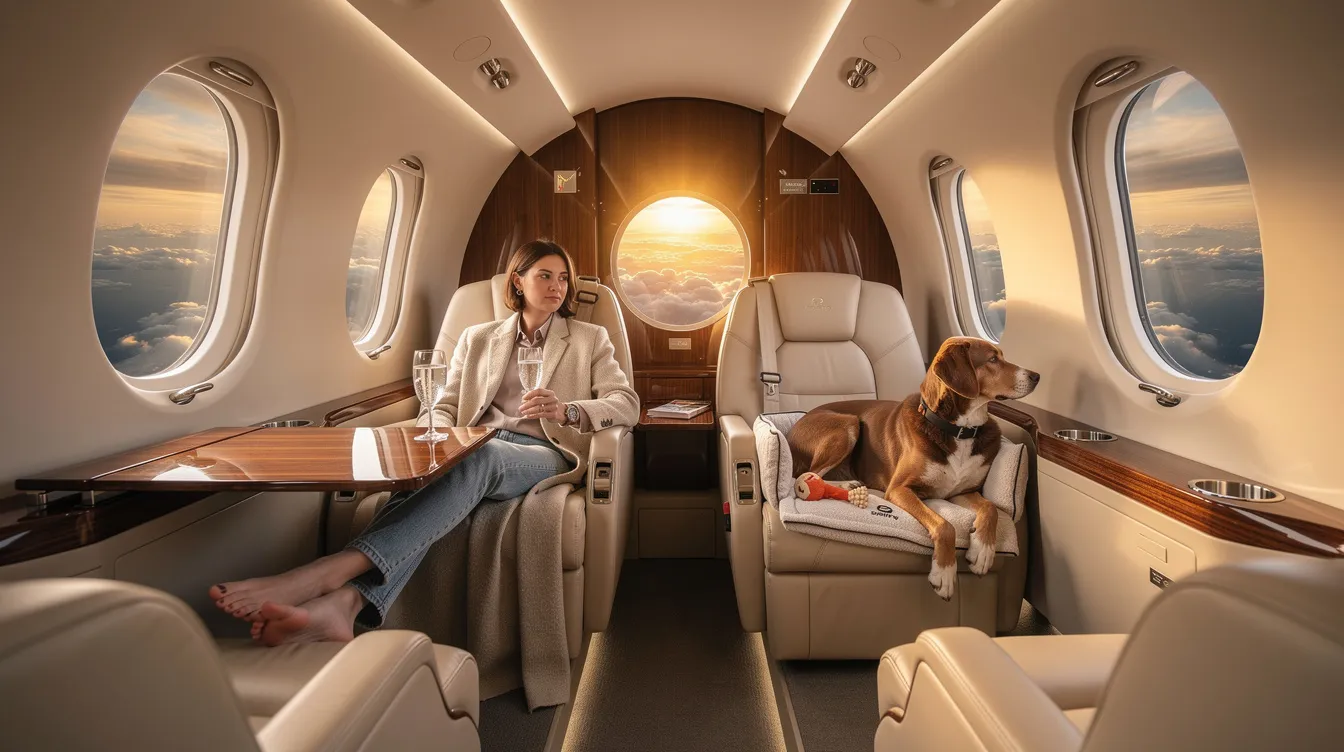
A calm, well-prepared pet is the goal, and a simple timeline gets you there. This is the kind of pet travel checklist that reduces last-minute cancellations, especially on international routes.
30+ days out. Book a vet consult for a fit-to-fly check, review chronic conditions and anxiety, confirm destination rules, and start any import permits or titer tests.
21 to 14 days out. Complete vaccinations in the right order, begin a titer test if your destination needs one, and start crate acclimation at home.
14 days out. Confirm the aircraft and the operator's pet policy, and finalize the route.
7 days out. Check the health-certificate window, book the signing appointment, and organize documents in one folder.
1 to 2 days out. Complete any tapeworm treatment inside its window, pack the comfort items, and plan a light exercise session.
Flight day. Feed a small meal early, manage water, take a potty break, and arrive at the FBO about 15 to 30 minutes before departure.
On the vet consult, raise one point directly. Never give your pet sedatives for air travel unless a veterinarian specifically prescribes them for your animal and itinerary. Sedation can affect breathing and balance at altitude, so it is a medical decision, not a default. For crate training, go gradually: short car rides, calm rewards, and familiar bedding build positive associations. Feed a light meal rather than a full one, and manage water so your pet is hydrated without discomfort.
A pet travel checklist is a pre-flight list of documents, restraints, food and water supplies, and comfort items you prepare so your pet can travel safely and calmly in the cabin. Here is a printable version for flying with pets on a private jet:
Documents. Vaccination records, health certificate, microchip number, import permit, and copies of each.
Comfort. Familiar blanket or bed, a favorite toy, and a worn T-shirt that smells like home.
Feeding. Measured food, collapsible bowls, treats, and bottled water.
Hygiene. Waste bags, pee pads, wipes, and a small towel.
Restraint. Leash, harness, carrier or crate, and a muzzle if requested.
Emergency. Medications with written instructions and your vet's contact details.
For multi-leg trips, map potty breaks and document timing against your itinerary with a flight planning tool so nothing expires between legs.
Fast approvals come from complete pet details. The more an operator knows up front, the quicker a pet-friendly private jet gets confirmed without a re-quote. To book a pet-friendly private charter quickly, provide your pet's species, breed, weight, and crate dimensions at the quote stage so the operator can approve the aircraft before confirmation.
Send this with your request:
Number of pets and species for each
Breed and approximate age
Weight of each animal
Crate dimensions in inches (L×W×H)
Whether the pet travels loose, in a carrier, or in a crate
Behavior notes, such as anxiety or reactivity
Any medications or medical conditions
Departure and arrival airports and dates
Passenger count and luggage estimate
Destination country for international document planning
Jettly then confirms the operational details with the operator:
Whether the assigned aircraft accepts your pet
Restraint, carrier, or crate requirements
Cabin access and ramp leash rules
Cleaning or protection policies
Weight-and-balance fit for crate plus luggage
Document requirements for the route
Handling and FBO arrangements
Final pet approval before the contract is signed
Jettly's booking flow is a short, clear path: request a flight, receive aircraft options, select the aircraft, sign the charter agreement with secured payment, complete pre-flight coordination, and depart from the FBO. A charter agreement is the contract that confirms aircraft, itinerary, price, and operational terms; your flight is confirmed after it is signed and payment is secured. Jettly works with certified operators that are ARGUS- or Wyvern-rated and meet FAA, Transport Canada, and EASA standards, and the operating carrier always retains operational control, including the final call on pets.
Practical benefits make a private jet charter with a pet easier to arrange: a global network of over 23,000 aircraft across more than 190 countries, 24/7 support, app-based booking and trip management, and the ability to source last-minute flights depending on positioning. Jettly recommends booking 24 to 72 hours in advance for the best availability, with same-day charters possible in roughly 3 to 6 hours. An empty leg flight can be a smart way to cut the private jet charter price, and pets are often possible, though they must be confirmed for the operator and aircraft. To price a trip first, run the numbers through the Jettly cost calculator, then confirm pet approval before you book the private jet charter.
Pets usually fly in the cabin on private jet charters, but the operator may require a carrier or restraint for safety, especially during takeoff and landing. Baggage constraints are aircraft-specific, and a large crate can take up seat or luggage room, so confirm the exact rule for the specific aircraft assigned to your trip.
Typically no. Private charters price the aircraft, not a per-pet ticket, although cleaning or damage fees can apply if needed. Your total cost is driven mostly by aircraft category, flight time, repositioning, airport and FBO fees, and any international handling.
Most international trips require a current rabies vaccination record, a destination-valid health certificate, and any microchip or permit required by the country you are entering. Parasite or tapeworm treatments apply for some destinations, and timing windows plus transit stops can change the list, so verify requirements before the charter is finalized.
Restrictions are operator-specific; most decisions are based on safety, containment, and the ability to keep the cabin and aisles clear. Large dogs and short-nosed breeds often need prior approval or a crate, and choosing a larger cabin usually solves space concerns.
Many operators require a carrier or harness restraint during takeoff and landing, and some may require a muzzle or crate depending on the pet's size or behavior. Bring the restraint equipment even if it is not usually required, since crew instructions vary by operator and bringing it prevents delays.
Yes, empty legs can cost less, but they are tied to fixed routes and time windows, and pet approval still depends on the operator and aircraft. For international trips, paperwork timing can make an empty leg impractical unless your schedule is very flexible.
Often yes, but service-animal handling and documentation expectations can vary by operator and route, so confirm requirements before signing your charter agreement. Raise it at the quote stage so the operator can plan seating and any paperwork in advance.
Sometimes, but it depends on the operator's rules, destination import requirements, and who is responsible for custody and paperwork during the trip. Coordinate early with Jettly and the operator so the custody chain and document responsibility are clear before departure.
Flying with pets on a private jet is usually a cabin experience, priced as a charter rather than a per-pet ticket, and shaped by two things you control: early disclosure and correct paperwork. Match the aircraft to your animal, confirm the private jet pet policy for the exact tail, and start international documents weeks ahead. Jettly handles the rest as a broker, matching you with certified operators who make the final pet call. Request a pet-friendly private jet quote with Jettly: tell us your pet's details and route, and Jettly will match you with a certified operator and confirm the aircraft's pet policy before your flight is finalized. Reach the team through the app, the online platform, by phone at +1-866-448-2358, or by email at departures@jettly.com.
Private Jet With Pets Cost: A Complete Pricing Guide (Fly Elite Jets) - charter-based pricing framing and indicative hourly ranges used as planning figures.
Four Rules for Flying on Private Jets With Pets (Stratos Jets) - operator-specific requirements, disclosure at booking, and possible restraint or muzzle expectations.
VistaPet: Pet-Friendly Private Jet Charter (VistaJet) - example of a structured pet travel program with crew training and documentation guidance.
How to Travel With Pets on Your Private Aircraft Charter (Priester Aviation) - practical pre-trip and in-flight comfort suggestions.
Share this post:
Jay Franco Serevilla
Nov 2, 2026
|
5
min read
Discover tips and trends in the industry.
5
min read
Private Jet Types and Sizes (2026): Light vs Midsize vs Super-Midsize vs Heavy Jets
Choosing the right private jet involves understanding the differences between very light, light, midsize, super-midsize, and heavy jets. Each category offers unique benefits in terms of passenger capacity, range, baggage space, and onboard amenities. This guide helps you match your travel needs with the appropriate jet type for a seamless flying experience.
Read More
5
min read
Delta Ticket Classes: How Delta Fare Classes, Brands, and Experiences Really Work
Delta ticket classes are defined by single-letter booking codes that determine fare, perks, and upgrade eligibility. Understanding these classes is crucial for frequent flyers and corporate travel planners, as they impact mileage earning and overall travel experience. For those seeking more flexibility and transparency, private jet charters like Jettly offer a compelling alternative to navigating Delta's complex fare structure.
Read MoreStay updated with our latest insights and tips to elevate your journey with us.
MEMBERSHIPS AND ASSOCIATIONS



Disclaimer: Jettly operates as a charter broker, offering access to a global digital jet charter marketplace. Jettly is not a direct air carrier and does not own or operate aircraft. All advertised flights are conducted by third-party air carriers that are fully licensed and hold the appropriate Part 135 or Part 121 certifications issued by the Federal Aviation Administration (FAA) or equivalent regulatory authorities under U.S. or foreign law. Jettly complies fully with the U.S. Department of Transportation's Part 295 and Part 298 Charter Broker regulations. Jettly does not carry additional liability insurance. Passengers are covered by aircraft operator insurance. TICO: 50023770


