


Login
Get Instant Pricing On 23,000+ Aircraft

>
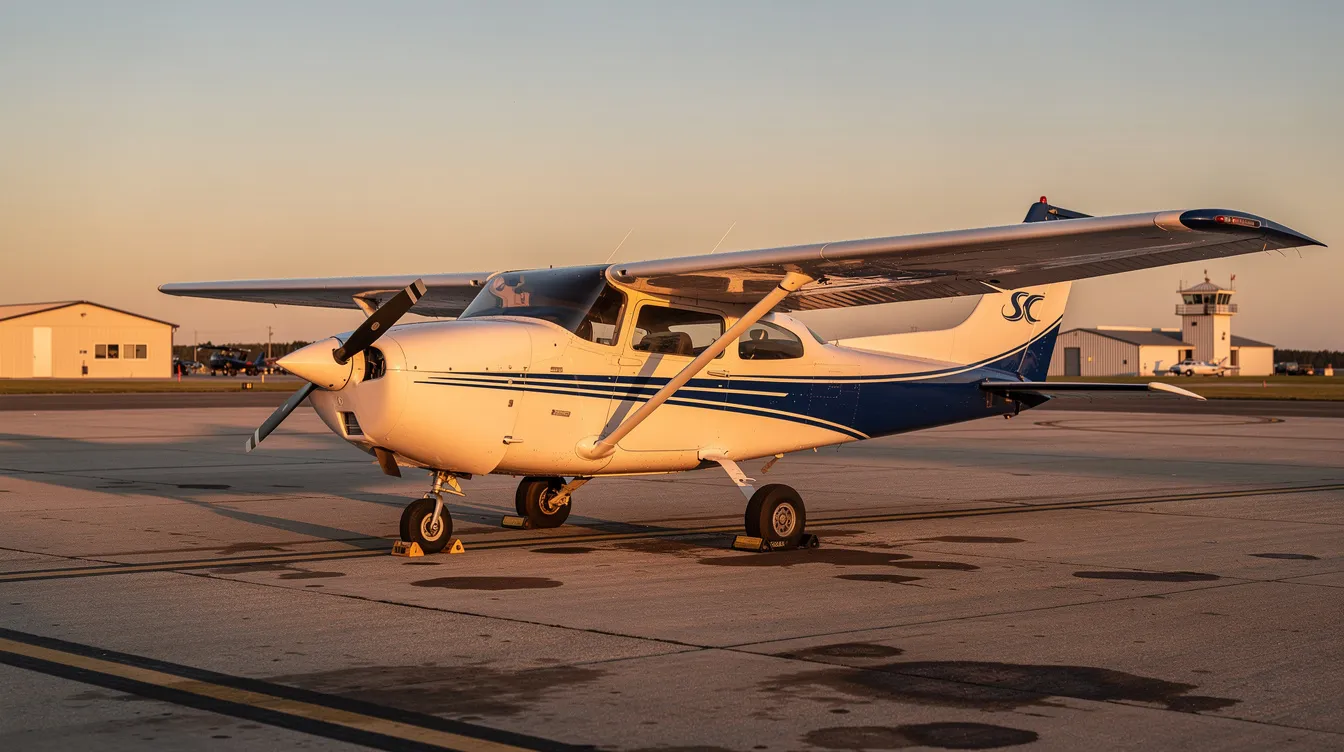
Flying a Cessna is one of the most accessible ways to enter the aviation world. The Cessna 172 Skyhawk sits on nearly every flight school ramp across the globe, and for good reason. It is forgiving, reliable, and purpose-built for the journey from first lesson to private pilot certificate and beyond. This guide walks through every phase of that journey, from medical certificates and pre flight checklist discipline to solo flight milestones and cross-country adventures.
The Cessna 172 Skyhawk is the most produced aircraft in history, with over 44,000 built since 1956, and remains the global standard for flight training and earning a private pilot's license.
Flying a Cessna combines structured flight training at flight schools with real-world practice, progressing from dual instruction with a certified flight instructor to solo flight and cross-country trips.
Every flight starts with a disciplined pre flight checklist and walk-around inspection to verify fuel levels, controls, weight and balance, and safety equipment.
Student pilots learn core skills in the Cessna 172—takeoff, climb, cruise, navigation, approach, and landing—that transfer easily to many other aircraft and other planes.
While the 172 is a training workhorse, private flyers often transition to faster, more capable aircraft (including private jets via platforms like Jettly) once they hold a private pilot license.
The Cessna 172 Skyhawk, introduced in 1956 and still in production, has earned its place as the most produced aircraft in aviation history. With over 44,000 airframes built, it is the default choice at Cessna pilot centers and independent flight schools worldwide as a dependable training plane. Its high wing design provides strong stability and excellent downward visibility, while the tricycle landing gear with a nose wheel simplifies ground handling for beginners. The airplane also features forgiving stall characteristics, letting student pilots safely explore slow flight and stall recovery without abrupt surprises.
The Cessna 172 has a maximum cruise speed of 124 knots and can fly at a maximum altitude of 15,000 feet. It holds 56 gallons of fuel, giving it a range of approximately 600–800 nautical miles, making it suitable for both local pattern work and realistic cross-country training flights. Compared to the Piper PA-28 family, the 172's high wing gives better downward visibility and simpler fuel management—many models let pilots select "BOTH" tanks, removing the need for frequent switching. Low-wing trainers like the Piper Warrior have their own advantages, but most aircraft used in primary training remain Cessna 172s.
Skills learned in the Skyhawk form the foundation for pilots who later move on to complex singles, twins, turboprops, and jet aircraft. That progression can eventually include different aircraft categories and classifications available through charter platforms like Jettly.
The basic pathway to flying a Cessna 172 in the U.S. under FAA requirements follows a clear sequence: obtain a medical certificate, apply for a student pilot certificate, enroll in a flight school, complete training hours, pass the FAA written exam, and take the practical checkride. Pilots must have proper training, certification, and experience to operate a Cessna.
Student pilots must pass a medical examination. A Third-Class medical certificate from an Aviation Medical Examiner is the minimum for private pilot privileges.
For pilots under age 40, the certificate is valid for 60 calendar months. For those 40 or older, it is valid for 24 months.
Apply through the FAA's IACRA portal with proof of identity and citizenship or legal status. TSA verification applies.
A student pilot certificate is required to fly solo.
|
Factor |
Part 61 |
Part 141 |
|---|---|---|
|
Structure |
Flexible, instructor-driven pace |
FAA-approved syllabus with stage checks |
|
Minimum PPL hours |
40 hours |
35 hours |
|
Typical real-world hours |
60–75 |
55–70 |
|
Best for |
Self-paced learners, part-time students |
Career-track or structured learners |
Flight training typically requires 40 to 60 hours of flight time, though many students log closer to 60–75 hours before checkride readiness.
When evaluating a flight school, focus on aircraft condition and maintenance standards, instructor experience and scheduling flexibility, availability of Cessna 172s versus other planes, cost transparency, and the school's safety record, as well as how they handle renting a plane for training and personal travel.
Learning to fly a Cessna 172 costs between $7,000 and $12,000, including flight hours and instruction. Rental fees average $150 per hour, while instructor fees range from $50 to $100 per hour. Additional expenses such as ground school materials, written exam fees (~$175), and checkride fees (~$500–$800) can add $1,000 to $2,000 to the total. For pilots flying regularly post-certification, the total annual cost for 100 flight hours is approximately $22,530, increasing to about $32,430 for 300 hours.
A modern 172S features a Lycoming IO-360-L2A engine producing 180 hp. It is a four-seat airplane with a useful load of roughly 878 lb and a fuel capacity of 56 gallons (53 usable). With full fuel, payload for passengers and baggage is about 560 lb. Pilots use the Pilot's Operating Handbook to understand performance limitations and procedures for every phase of flight.
Pilot sits in the left seat; instructor or passenger on the right side.
Center console houses the throttle, mixture lever, and fuel selector.
The instrument panel features either a traditional "six-pack" of analog gauges or a Garmin G1000 glass cockpit in newer models.
Airspeed Indicator – monitors climb, cruise, and approach speed
Attitude Indicator – orientation relative to the horizon
Altimeter – altitude above mean sea level
Heading Indicator – current heading, supplemented by magnetic compass
Vertical Speed Indicator – rate of climb or descent
Turn Coordinator – roll rate and yaw, essential for coordinated turns
Fuel system: two wing tanks with a selector (LEFT, RIGHT, BOTH, OFF); fuel drains at lowest points for contamination checks.
Electrical system: 28-volt DC with alternator, battery, avionics master switch, and circuit breakers.
Pitot-static system: pitot tube for airspeed data, static ports feeding the altimeter, VSI, and airspeed indicator.
Calculating the aircraft's weight and center of gravity is crucial for safe operations, and pilots should verify weight and balance before every flight.
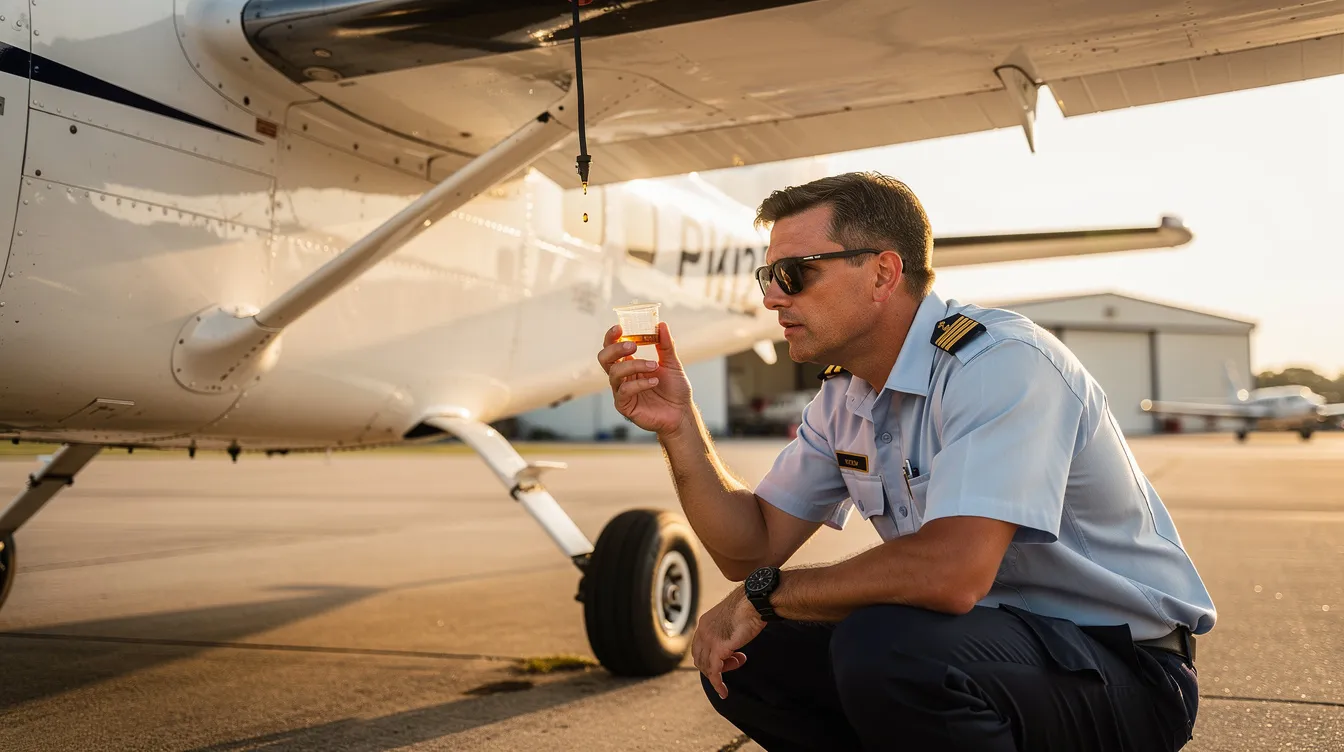
Every Cessna 172 flight—training, solo flight, or recreational—begins with the manufacturer's pre flight checklist, not memory alone. Cessna 172 pilots must perform a thorough pre-flight checklist for safety, and pre-flight checklists ensure safety and aircraft functionality.
Inspect fuel levels and oil quantity before flight. Check fuel quantity and caps on each wing.
Drain fuel sumps and the fuel strainer to check for water or contamination. Fuel quality must be checked for contamination before takeoff.
Verify engine oil is within the acceptable range.
Examine the propeller for nicks, cracks, or damage; check the spinner.
Inspect landing gear, tires for proper inflation, and brake components.
Confirm control surfaces (ailerons, elevator, rudder) move freely with secure hinges.
Check pitot tube and static ports are clear and unobstructed.
The pre-flight inspection verifies that no structural damage exists. Conduct a thorough external inspection of the aircraft.
Review aircraft documents: airworthiness certificate, registration, weight and balance records, and logbook entries confirming current inspections.
Note any due inspections, discrepancies, or operating limitations before engine start.
Set fuel selector (typically BOTH for start), mixture to rich, throttle to idle.
Remove control locks, chocks, and tie-downs.
Test all instruments and systems inside the cockpit, including navigation lights, beacon, and strobes.
Confirm avionics off before engine start; then follow POH startup procedure.
A pilot must manage weight and balance limits for the aircraft before departure.
Common student-pilot mistakes:
Skipping fuel drain checks
Leaving control locks engaged
Overlooking tie-downs or chocks
Rushing through the walk-around due to eagerness or fatigue
Instructors will insist on checklist discipline from day one.
Ground handling in a tricycle-gear Cessna is straightforward, but it still demands careful rudder and brake technique, especially in crosswinds. The nose wheel steers through the rudder pedals, and differential braking helps with tight turns on the ground.
Steer with rudder pedals; apply light braking as needed.
Watch compass and turn coordinator for correct directional behavior during turns.
Avoid heavy braking on downhill slopes to prevent nose-over risk.
Park into the wind. Set RPM to approximately 1,700–2,000 RPM per the POH.
Perform magneto check to verify both ignition systems.
Check carb heat (carbureted models) or alternate air (fuel-injected 172S).
Confirm engine gauges (oil pressure, oil temperature, cylinder head temp) are in the green.
Flight control check: move yoke left and right, full forward and back, full rudder deflection—verify "full and free" movement.
Cessna 172 requires a strong understanding of throttle management during takeoff. Apply power smoothly to full throttle.
Track the runway centerline with rudder pedals.
Monitor engine instruments throughout the roll.
Rotate at approximately 55 KIAS for a 172S at typical training weight.
After liftoff, pitch for Vy (best rate of climb, ~74 KIAS) unless obstacle clearance requires Vx.
A pilot must maintain proper airspeeds during takeoff, climb, and final approach to avoid stalling.
Takeoffs and landings must be conservative to avoid accidents.
Most early flight training in the Cessna 172 focuses on pitch-and-power control and the coordinated use of ailerons and rudder. Flying a Cessna aircraft involves a structured process broken down into phases of flight.
Climbing in a Cessna 172 requires balancing power and pitch attitude. Use full power and pitch for Vy (~74 KIAS) for best rate of climb.
Trim the yoke to relieve control pressure so the airplane holds pitch without constant input.
Monitor cylinder head temperatures and oil temperature to avoid engine overheating during prolonged climbs.
Set power to 65–75% of maximum continuous per the POH. Cruise speed settles around 122–125 KTAS depending on altitude, weight, and weather conditions.
Lean the mixture above 3,000–5,000 ft to optimize fuel burn and engine performance.
Maintain heading and altitude using outside horizon references, correcting with instruments.
Coordinated turns in a Cessna 172 typically involve a 30-degree bank angle for standard-rate turns. Use coordinated rudder to prevent slipping or skidding.
Maintain altitude throughout the turn by adjusting back pressure.
Steep turns (~45° bank) are introduced later in training as a confidence and skill builder.
Continuous scanning for other airplanes is crucial during flight—always clear the area before entering a turn.
Reduce power, adjust mixture, and set a manageable descent rate using the vertical speed indicator.
Monitor airspeed to avoid exceeding Vne or flap extension speeds.
Understanding stall recognition and recovery is important for safety, especially during slow-speed transitions in descent.
Landing is often the most challenging phase for student pilots, but the Cessna 172's stable handling helps them learn to land consistently with practice. Landing techniques in a Cessna 172 require managing descent rate and alignment throughout the approach.
Fly the standard pattern at approximately 1,000 ft AGL: upwind, crosswind, downwind, base, and final.
Make radio calls at each key point. Effective communication with air traffic control is necessary during flights in controlled airspace, while self-announce procedures apply at non-towered fields.
Downwind: maintain 80–90 KIAS, flaps up. When abeam the landing point, reduce power and begin descent.
Add first stage of flaps (10°). Slow to approximately 75 KIAS.
Base: add second stage of flaps (25°), slow to about 70 KIAS, and begin the turn to final.
Set full flaps (30°) or as directed by the POH.
Aim for a point on the runway threshold; adjust glide path with small power corrections.
Begin the flare approximately 20–30 ft above the runway, raising the nose gently.
Let the main wheels touch first, then lower the nose wheel. Reduce power to idle and maintain directional control with rudder.
Small aircraft are sensitive to strong crosswinds, turbulence, and icing conditions. Use the crab method on approach (nose angled into the wind) or the sideslip method (yoke left or right into the wind with opposite rudder to keep the nose aligned with the runway).
Touch down with the windward wheel slightly first in a sideslip, maintaining alignment through rollout.
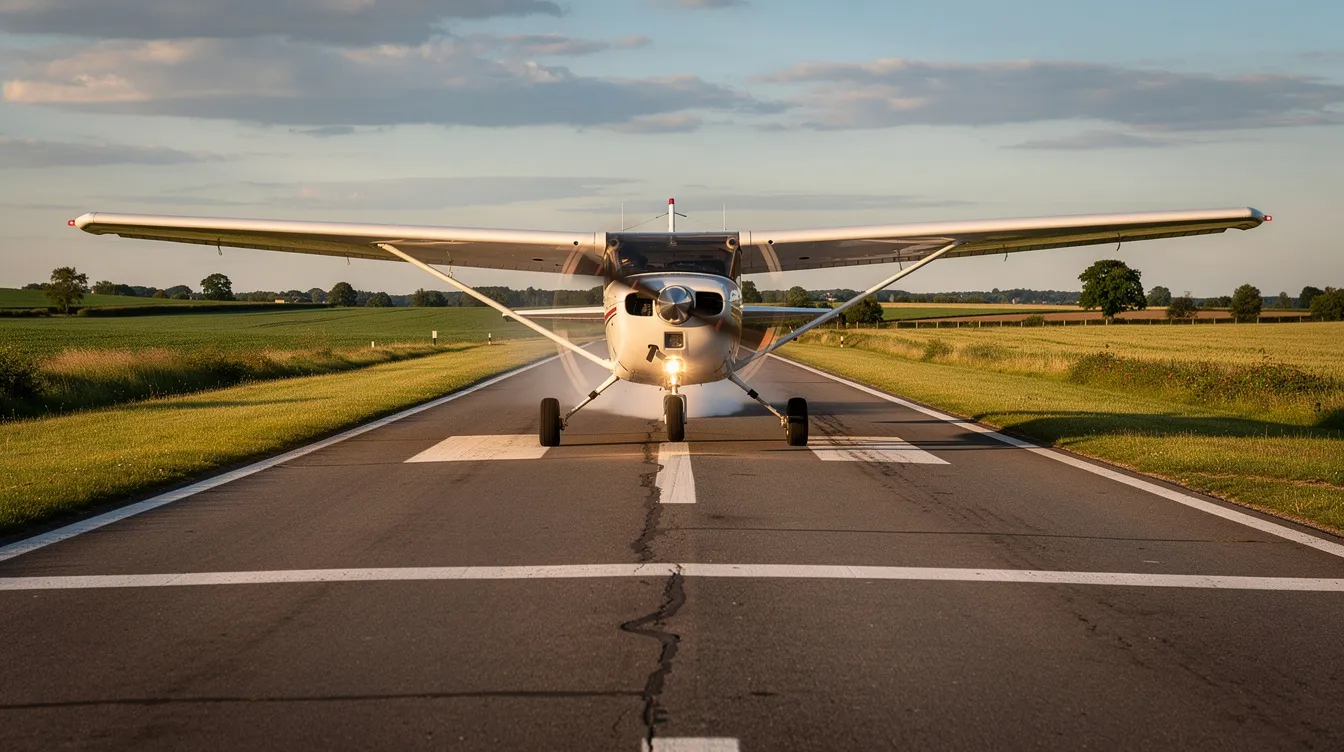
A student pilot typically progresses in a Cessna 172 from a discovery flight to supervised solo between 10 and 25 hours of instruction, depending on aptitude, training frequency, weather, and the bigger challenges of handling the flight alone.
Consistent takeoffs and landings without instructor input
Basic maneuvers: climbs, turns, descents, slow flight
Normal and crosswind pattern work
Emergency procedures must be practiced to ensure readiness (engine failure, forced landing scenarios)
Reliable radio communication at the home airport
An endorsement from a certified flight instructor is necessary before solo. The instructor must endorse both the student's logbook and the student pilot certificate for a specific make and model (e.g., Cessna 172) and specific airports, per FAR 61.87.
Review the pre flight checklist, rehearse the pattern mentally, and make sure you are mentally ready for a first time solo.
Double-check weather: wind limits, ceilings, visibility. Set personal minimums.
Confirm fuel margins and aircraft readiness.
Completing a first solo in a Cessna Skyhawk is a milestone many pilots remember for life, especially flying alone for the first time. It marks the shift from "student" to "emerging pilot" and fuels the motivation to continue the journey toward a private pilot's license.
Cross-country flights in the Cessna 172 teach navigation, fuel planning, and real-world decision-making. These legs often cover 50–150 NM between small airports, pushing students beyond the comfort of the home field, and benefit from tools like an airport locator for small and regional fields.
Plot routes on current VFR sectional charts. Navigation logs should be set up before a flight.
File VFR flight plans and check NOTAMs and TFRs for the route.
Confirm fuel availability at destination and alternate airports. Identify each fuel stop along the way.
Note whether the destination offers ramp parking, tie-downs, or a hangar if weather or overnight storage is a concern.
Current and forecasted weather must be reviewed before a flight. Weather checks are essential before every flight.
The semi-circular rule helps maintain safe altitude separation when flying VFR, ensuring proper cruising altitudes based on magnetic course.
Typical burn rate: 8–10 gallons per hour at cruise power.
With the Cessna 172's 56-gallon capacity and legal reserves (45-minute VFR reserve), expect roughly 4–5 hours of endurance.
Follow the POH for tank-switching guidance.
For longer distances where a Cessna cannot reasonably travel farther in a practical timeframe, platforms like Jettly complement a pilot's personal flying by offering on-demand private jet charter for time-critical trips and handy tools such as a private jet charter cost estimator. Compare turboprop charter rates and options for regional missions or light jet charters for routes spanning several hundred miles.
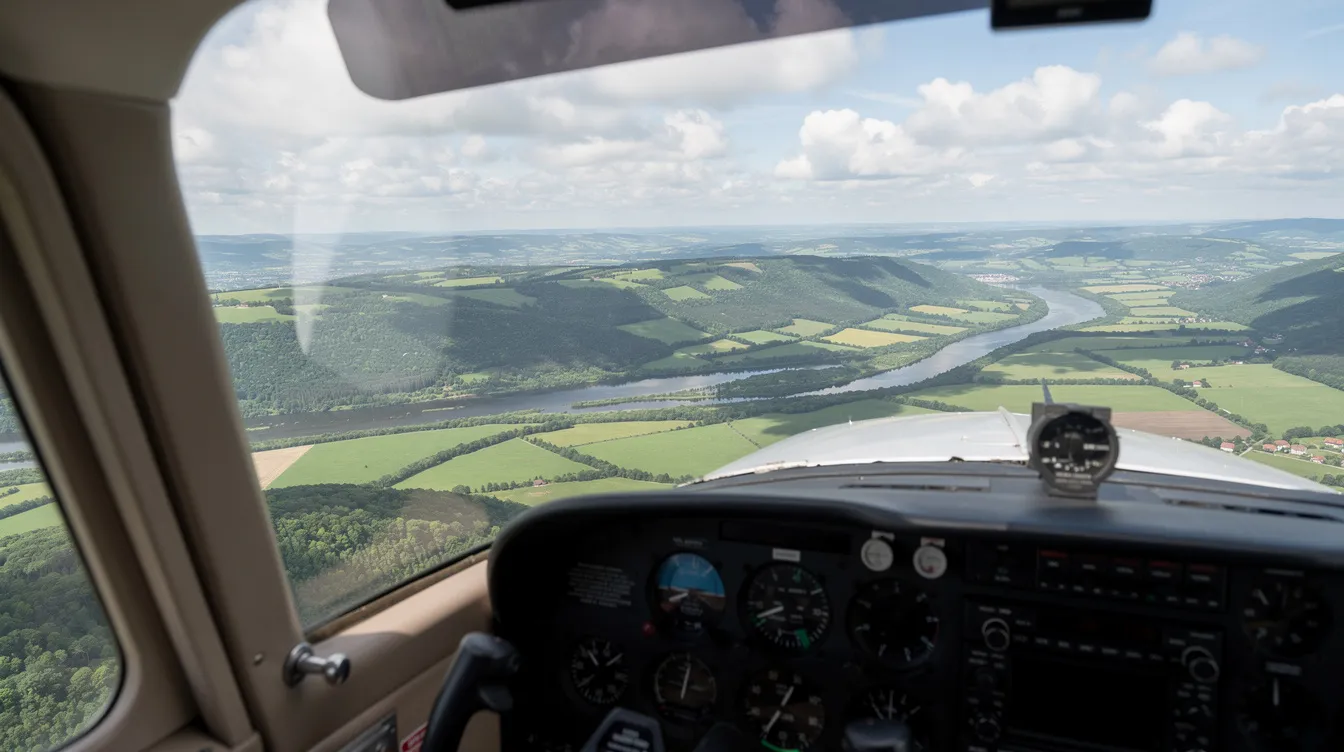
The Cessna 172's strong safety record among small GA aircraft depends on conservative decisions by pilots, especially regarding weather and weight and balance. The airplane is a reliable aircraft when maintained properly, but safety ultimately rests with the person in the cockpit.
No flying near thunderstorms or in icing conditions.
Crosswind limits set by instructors (often under 10–15 knots).
Minimum visibility of 3–5 statute miles and adequate cloud ceilings for VFR.
Wind gusts within manageable spreads.
After earning a private pilot certificate, many pilots pursue an instrument rating, commercial certificate, and multi-engine rating.
Each new rating adds experience, required flight hours, and knowledge tests.
The disciplined habits learned flying the Skyhawk—checklists, briefings, and respect for weather—carry over to other planes and to professionally crewed private jets.
Many pilots continue to rent or share a Cessna 172 for proficiency and local trips, while booking turboprop or jet charters or other private charter aircraft across multiple categories when the mission requires higher speed, more seats, or better weather capability. Regardless of the airplane, the foundation built in a 172 keeps pilots grounded in good judgment.
Many licensed private pilots enjoy flying Cessna 172s for local or regional trips while using private jet charter for longer, time-sensitive, or multi-city itineraries. The two approaches serve different missions.
|
Factor |
Cessna 172 |
Private Jet (via Jettly) |
|---|---|---|
|
Cruise speed |
~120–125 KTAS |
400–500+ knots |
|
Range |
600–800 NM |
1,500–3,000+ NM |
|
Passengers |
Pilot + 3 |
4–16+ depending on category |
|
Weather capability |
VFR (IFR with rating) |
IFR, de-icing, pressurized |
|
In-flight experience |
Hands-on piloting |
Work, relax, or hold meetings |
Jettly's platform offers instant pricing, access to over 20,000 aircraft—from light jets to long-range heavy jets—and digital booking that complements personal GA flying, with options to enroll in flexible private jet memberships with wholesale charter access. Explore how to book a private jet through the platform for a sense of how simple the process is.
Example use case: A pilot trains and flies locally in a Skyhawk on weekends, covering 100–200 NM trips to nearby airfields. When a Toronto–Vancouver business trip or a New York–Miami family flight comes up, they book a midsize jet through Jettly. The Cessna handles the fun; the charter handles the mission that demands speed and range. Check private jet charter pricing or use a private jet charter cost estimator for current rate ranges.
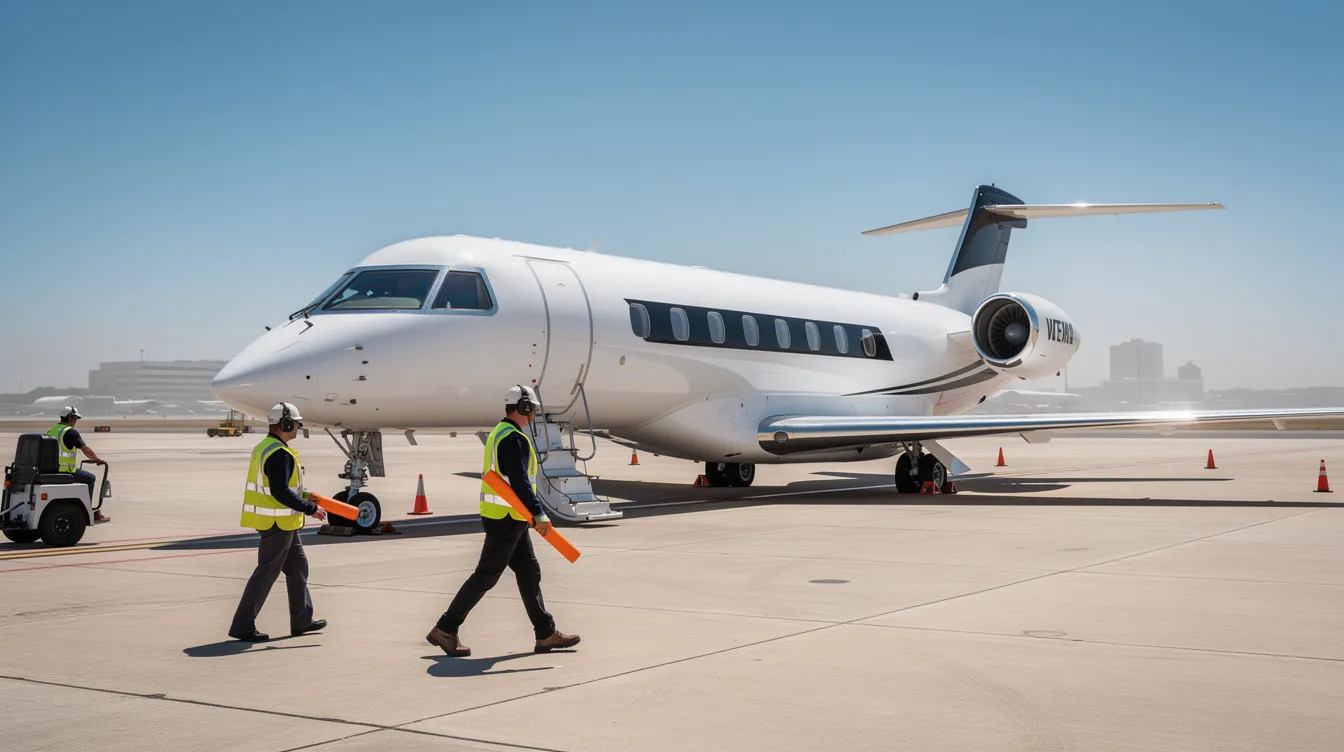
This section answers common questions about costs, training timelines, and how Cessna flying fits alongside private jet travel, complementing broader guides on the cheapest private aircraft and budget-friendly options.
Most student pilots finish in 3–9 months depending on schedule and consistency. The FAA minimum under Part 61 is 40 hours, but real-world training often requires 55–75 hours. Flying 2–3 lessons per week with regular ground study keeps momentum. Weather delays, aircraft availability, and study habits are the biggest variables.
Learning to fly a Cessna 172 costs $7,000 to $12,000 at many schools, though total spend depends on how many hours a student needs. Cessna 172 rental fees average $150 per hour (wet rate). Instructor fees range from $50 to $100 per hour. Additional training expenses—ground school materials, written exam fees (~$175), and checkride fees (~$500–$800)—can add $1,000 to $2,000.
For those who continue flying after certification, the total annual cost for flying 100 hours is around $22,530, while the total annual cost for flying 300 hours is about $32,430, factoring in rental, fuel, insurance, and currency requirements.
Yes. Common post-licence options include renting from the same flight school, joining a flying club for lower hourly rates, or entering cost-sharing arrangements that comply with FAA non-commercial rules. Many pilots keep flying the 172 for proficiency, short country trips, and recreation—even after moving up to more advanced aircraft, using private jet charter for business travel, or exploring crowdsourced and shared private jet flights to reduce charter costs.
The 172 has one of the strongest safety records in general aviation. Its high-wing stability, benign stall behavior, and massive support infrastructure (parts, maintenance expertise, type familiarity) work in its favor. That said, safety depends heavily on pilot training quality, maintenance standards, disciplined checklist use, and sound weather decision-making. Well-maintained training fleets with strict checklist culture are key risk reducers.
Private jet charter via platforms like Jettly becomes the practical choice for distances of several hundred to thousands of miles, tight schedules, groups of five or more, and routes with poor airline connectivity. A pilot might fly a Cessna 172 for a weekend hop to a nearby airfield, then book a same-day out-and-back multi-city business itinerary on a light or midsize jet through Jettly. Learn more about small aircraft and jet options and compare top private jet charter companies and providers to find the right fit for each mission.
Flying a Cessna 172—through structured flight training, disciplined use of checklists, and gradual progression from dual instruction to solo flight—provides a solid, transferable foundation for any path in aviation. The skills learned in the most produced aircraft in history apply whether a pilot continues with small piston aircraft, upgrades to other planes, or travels as a passenger on private jets across the skies, perhaps leveraging structured programs like jet cards for frequent corporate travel.
Combining hands-on piloting in Cessnas with the flexibility of digital private aviation platforms creates a complete, modern flying lifestyle. Whether the next step is an instrument rating, a cross-country adventure, or a coast-to-coast business trip at 40,000 ft with a NetJets alternative that emphasizes on-demand charter, the journey starts in the cockpit of a Skyhawk.
Ready to experience private travel on your terms? Explore flight options, compare leaders like NetJets and other premium operators, or request a quote at https://www.jettly.com.
Share this post:
Jay Franco Serevilla
Aug 13, 2026
|
5
min read
Discover tips and trends in the industry.
5
min read
Safest Passenger Planes in 2026: Models, Statistics, and How They Impact Your Flight
In 2026, the safest passenger planes include models like the Embraer ERJ family, Boeing 717, Airbus A340, and Airbus A380, all boasting zero fatal accidents. Understanding aircraft safety data helps travelers make informed decisions, as modern jets like the Airbus A350 and Boeing 787 also maintain exceptional safety records. With rigorous engineering and advanced technology, commercial aviation remains the safest mode of transportation.
Read More
5
min read
Topflightfares: How to Spot Real Deals and When to Choose Private Jets Instead
Travelers today face numerous options when booking flights, from premium commercial fares to private jet charters. This guide helps you evaluate deals, identify risks, and determine when private jets may offer better value, especially for groups or last-minute trips. With insights on pricing, hidden fees, and safety, you can make informed travel decisions.
Read MoreStay updated with our latest insights and tips to elevate your journey with us.
MEMBERSHIPS AND ASSOCIATIONS



Disclaimer: Jettly operates as a charter broker, offering access to a global digital jet charter marketplace. Jettly is not a direct air carrier and does not own or operate aircraft. All advertised flights are conducted by third-party air carriers that are fully licensed and hold the appropriate Part 135 or Part 121 certifications issued by the Federal Aviation Administration (FAA) or equivalent regulatory authorities under U.S. or foreign law. Jettly complies fully with the U.S. Department of Transportation's Part 295 and Part 298 Charter Broker regulations. Jettly does not carry additional liability insurance. Passengers are covered by aircraft operator insurance. TICO: 50023770


