


Login
Get Instant Pricing On 23,000+ Aircraft

>
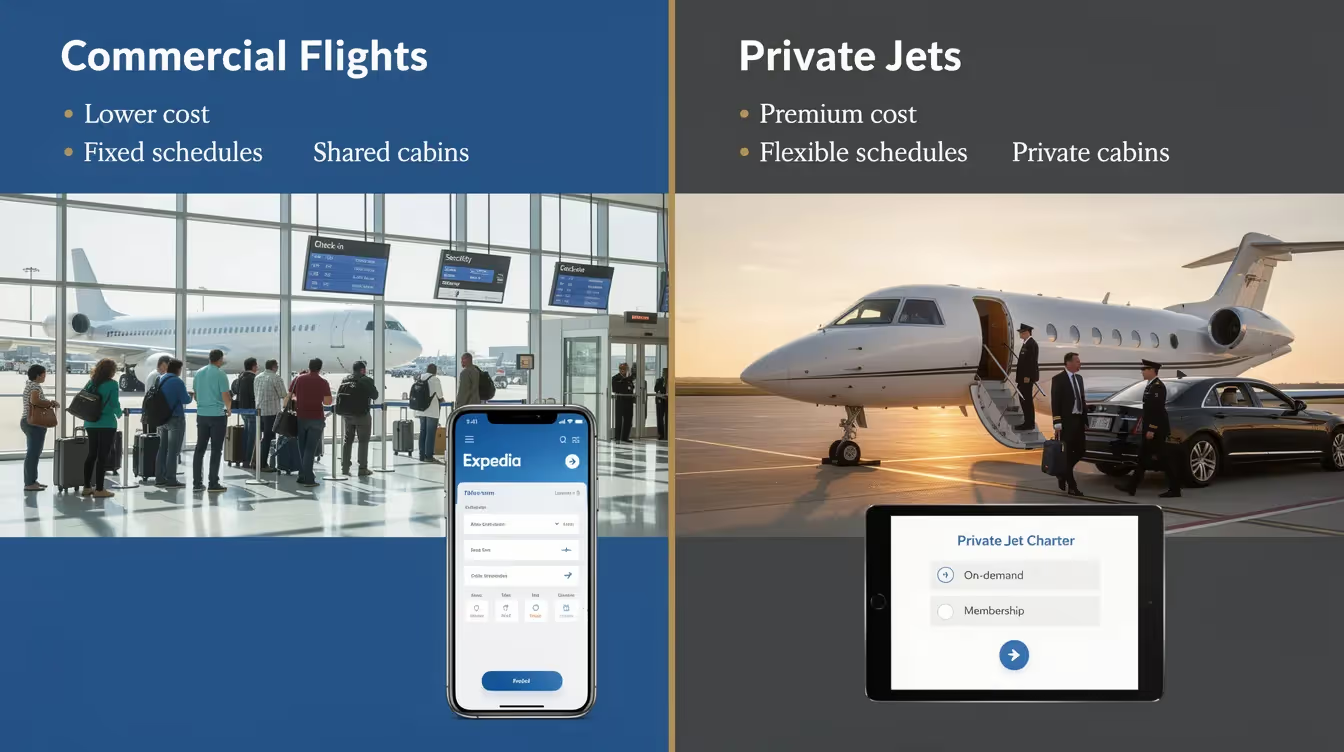
When planning air travel, many people immediately think of Expedia plane tickets—commercial airline tickets booked through the Expedia platform, which involves searching by destination and dates, filtering results, and completing the purchase. Expedia offers a vast inventory of airline partners, providing travelers with a wide range of flight options for both domestic and international travel. However, as travel needs evolve, more business travelers and families are considering private jet charters as an alternative.
This article is designed for travelers weighing the pros and cons of Expedia plane tickets versus private jet charters. We’ll compare these two options in detail, helping you determine which is best for your specific needs—whether you’re seeking the best deals, flexibility, time savings, or a tailored travel experience.
Expedia plane tickets refer to commercial airline tickets booked through the Expedia platform, which involves searching by destination and dates, filtering results, and completing the purchase. In contrast, private jet charter means booking the entire aircraft for your trip, rather than individual seats, allowing for a fully customized schedule and route—fundamentally different from commercial ticketing.
Understanding the differences between these travel solutions is crucial for making informed decisions, maximizing value, and ensuring your journey aligns with your priorities, whether that’s cost, convenience, or flexibility.
Expedia plane tickets work best for solo travelers, couples, and those collecting airline miles on non-urgent trips
Private jet charters through Jettly become cost-competitive for groups of 4–10 on routes like New York–Miami or Los Angeles–Las Vegas
Time savings of 3–4 hours per leg make private aviation practical for executives and families with tight schedules
Empty leg flights offer 40–60% discounts on repositioning charters, creating affordable entry points to private travel
Combining both options—commercial for leisure, private for critical trips—delivers the best overall travel value
Booking plane tickets on Expedia is a straightforward process that offers flexibility, rewards, and opportunities for savings. Here’s how you can make the most of Expedia’s platform:
Searching and Filtering: Start by entering your destination and travel dates. Expedia’s user-friendly search filters allow you to sort results by price, duration, airline quality, and amenities. You can also filter tickets by policies such as “No change fees” to find flexible options.
Wide Range of Options: Expedia partners with a vast inventory of airlines, giving you access to both domestic and international flights. Comparing prices for different airports at your destination can help you find better deals, especially if multiple airports are available.
Bundled Savings: Save more by bundling your flight with hotel stays or car rentals. Expedia often offers package discounts that reduce your overall trip costs.
Rewards Program: Join Expedia’s One Key rewards program to earn OneKeyCash on eligible flights, hotel stays, and car rentals, enhancing the value of your bookings.
Flexible Payment Options: Expedia provides flexible payment methods, including “buy now, pay later” through partners like Affirm or Klarna.
Flexible Booking and Cancellations:
Many airlines offer free cancellations on eligible flights if canceled within 24 hours of booking.
After the initial 24-hour period, cancellation fees may apply for flights booked through online travel agencies.
Some flights may be non-refundable, but you might receive airline credit for future travel instead of a cash refund.
Some round-trip flights are actually two one-way tickets, requiring separate management for changes or cancellations.
Flexible flight tickets that allow changes without incurring fees can be selected during the booking process.
Tips for Finding Deals:
Be flexible with your travel dates, airports, and times to score the cheapest flight deals.
Last-minute flight deals and exclusive promotional fares are common, especially if you browse offers from multiple carriers.
Check-In: Typically, check-in is completed directly on the airline’s website or app 24–48 hours before departure using your confirmation code.
By leveraging these features, travelers can find the best deals, maximize rewards, and enjoy a seamless booking experience on Expedia.
Booking plane tickets on Expedia involves searching by destination and dates, filtering results, and completing the purchase. The platform’s vast inventory of airline partners ensures a wide range of flight options for both domestic and international travel. Travelers can filter tickets by policies such as “No change fees” when searching for flights, and many airlines offer flexible flight tickets that allow changes without incurring fees.
Expedia provides several options for managing changes and cancellations:
Many airlines offer free cancellations on eligible flights if canceled within 24 hours of booking.
After this period, cancellation fees may apply.
Some flights may be non-refundable, but travelers might receive airline credit for future travel instead of a cash refund.
Some round-trip flights are actually two one-way tickets, requiring separate management for changes or cancellations.
Changes and cancellations are often subject to different policies depending on whether Expedia or the airline handles them.
Flexible payment options, such as “buy now, pay later,” are available through partners like Affirm or Klarna. Check-in is typically done directly on the airline’s website or app 24–48 hours before departure using a confirmation code.
Last-minute deals are common, with frequent sales and exclusive promotional fares available for quick trips. Comparing prices of flying into various airports can lead to better airfare deals for commercial travel, especially if your destination has multiple airports. By bundling flights with hotel stays, travelers can save even more on their overall trip costs. Expedia’s One Key rewards program allows users to earn OneKeyCash on eligible flights, stays, and car rentals.
While commercial flights offer convenience for many, private jet charters provide a different set of advantages, which we explore next.
Private jet charter operates on a different model: travelers book the entire aircraft rather than individual seats. Schedules are built around passenger needs, not airline timetables.
Jettly’s marketplace provides access to turboprops, light jets, midsize jets, heavy jets, and helicopters. The booking flow is straightforward: enter a route like Toronto–Vancouver, select a date and passenger count, receive instant pricing, choose an aircraft, and confirm online. All operators on the platform comply with FAA, Transport Canada, or EASA regulations with professionally crewed aircraft.
The value equation shifts from price-per-seat to time saved, privacy, and productivity for business or family travel.
With a clear understanding of private jet charter basics, let’s compare when each travel option makes the most sense.
The choice between commercial and private depends on trip profile, group size, and time sensitivity.
Commercial tickets work best when:
Traveling solo or as a couple on non-urgent trips
Flying long-haul international routes where premium cabins may cost less than chartering
Collecting airline miles through loyalty programs
Being flexible with travel dates, arrival/departure airports, and times to score the cheapest flight deals
Expedia acts as a one-stop shop for all travel things, offering deals, flight searches, and comprehensive travel services.
Private jets make sense when:
Groups of 4–10 need to reach destinations like New York–Miami or Los Angeles–Las Vegas quickly
Multi-city itineraries would require complex commercial connections
Accessing remote ski resorts or islands not served by commercial airlines
Same-day round trips eliminate hotel stays
Comparing prices of flying into various airports can lead to better airfare deals for commercial travel, especially if your destination has multiple airports. For private aviation, smaller regional airports often provide faster access to final destinations.
As you weigh these options, consider how time, convenience, and flexibility factor into your travel priorities.
The primary difference between commercial and private aviation extends beyond seat comfort to time saved at every step.
Commercial journeys require arriving 2–3 hours early at large hub airports, clearing security lines, boarding queues, and potential delays. A Toronto executive flying to Boston commercially faces a full travel day with possible overnight stay.
Private aviation changes this equation. Travelers arrive 15–30 minutes before departure at an FBO (fixed-base operator), board directly, and skip standard TSA lines. Private jets can use smaller regional airports closer to city centers—Teterboro instead of JFK, Van Nuys instead of LAX.
For that Toronto–Boston trip, a private charter allows a full working day with same-day return, saving both time and hotel costs.

Understanding these time and convenience factors can help you decide which travel mode best fits your schedule and needs.
Commercial tickets are priced per seat and offer value through cheap economy fares during sales, airline miles accumulation, and loyalty status upgrades. Some round-trip flights are actually two one-way tickets, requiring separate management for changes or cancellations.
Private jet charters are priced per aircraft and flight time. The value comes from time savings, direct routes, and productivity while flying, as outlined in Jettly’s overview of affordable private jet charter costs. Frequent travelers often combine both: use miles and Expedia-style platforms for personal leisure trips, and Jettly charters for critical business itineraries.
Rough cost ranges by aircraft type can be further refined using Jettly’s private jet charter cost estimator:
Turboprops: $1,500–$3,000/hour (ideal for routes under 1,000 miles)
Light jets: $3,000–$4,500/hour (New York–Miami range)
Midsize jets: $4,500–$6,000/hour (transcontinental routes)
Heavy jets: $6,000–$10,000+/hour (international travel)
Changes and cancellations are often subject to different policies depending on if the airline or a third-party service handles them.
Some flights may be non-refundable, but travelers might receive airline credit for future travel instead of a cash refund.
Many airlines offer free cancellations on eligible flights if canceled within 24 hours of booking.
After the initial 24-hour period, cancellation fees may apply for flights booked through online travel agencies.
By understanding these value propositions, you can better assess which travel solution aligns with your budget and flexibility needs.
Jettly operates as a tech-driven private charter aircraft marketplace designed for fast, transparent booking rather than traditional phone-only brokers.
The booking journey is straightforward: create an account, enter route and date, review instant quotes, filter by aircraft size, age, and cabin amenities, then book online. This approach provides transparent pricing without long-term jet card commitments.
Membership options offer lower commissions and added support for frequent flyers, with tiered private jet memberships that match different travel frequencies and service expectations. Service integrations include arranging in-flight catering, ground transportation, and special requests like Wi-Fi for remote work or pet-friendly flights.
With booking made easy, the next step is choosing the right aircraft for your route and group size.
|
Aircraft Type |
Passenger Capacity |
Range (miles) |
Typical Routes |
Features |
|---|---|---|---|---|
|
Turboprops |
6–9 |
<1,000 |
New York–Boston, Toronto–Quebec |
Efficient for short hops, cost-effective |
|
Light jets |
4–6 |
1,000–1,500 |
New York–Miami, LA–Las Vegas |
Fast, comfortable, ideal for small groups |
|
Midsize jets |
6–8 |
1,500–3,000 |
Chicago–Denver, Toronto–Vancouver |
Spacious, meeting-friendly, jet card eligible |
|
Heavy jets |
8–14 |
3,000+ |
New York–London, corporate tours |
Intercontinental, luxury, large luggage space |
Cabin features that matter include Wi-Fi, meeting-friendly seating, quiet cabins, and luggage capacity for golf clubs or skis.

Selecting the right aircraft ensures your private charter matches your comfort and productivity needs.
Empty leg flights occur when aircraft reposition without passengers after completing a charter. These flights are offered at 40–60% below standard charter rates, and Jettly maintains a live marketplace of empty leg flights with deep discounts.
Travelers can use empty legs for spontaneous trips or to test private jet travel at lower cost, or leverage Jettly’s platform to crowdsource flights and share empty seats to reduce charter costs even further. Last-minute flight deals can often be found by browsing offers from multiple carriers, especially with flexible travel plans—empty legs work similarly for private aviation.
A family could take an empty leg to a resort destination, then return commercially using traditional tickets. Empty leg availability is highly dynamic and best suited to flexible travelers who can adapt dates or airports.
By considering empty leg flights, you can access private aviation at a fraction of the usual cost.
Private aviation has a higher emissions profile per passenger than full commercial flights when seats are occupied—roughly 400–500 grams CO2 per passenger-kilometer versus 90–100 grams for commercial.
Efficient trip planning, direct routings, and matching aircraft size to passenger count reduce unnecessary fuel burn. Some operators on Jettly’s network offer carbon offsetting programs or newer, more efficient aircraft types.
Environmentally conscious travelers might balance trips: taking commercial plane tickets for long-haul routes and using private jets when they truly add value through time savings and reduced overnight stays, often comparing options such as traditional fractional ownership with Jettly as a NetJets alternative.
With environmental impact in mind, let’s address some frequently asked questions about both travel options.
Traditional airline miles are earned on commercial plane tickets sold by airlines, not on private jet charters. Many travelers combine both approaches: collecting airline miles on commercial flights while using Jettly when time sensitivity or complex routing makes private aviation more practical, sometimes opting to buy a single seat on a private jet through shared or semi-private options rather than chartering the whole aircraft.
Commercial tickets often reward early booking with lower fares, especially 30–90 days ahead. Private jets can be booked on much shorter notice—sometimes within hours—depending on aircraft availability and crew schedules, and there are multiple ways to get a seat on a private jet easily through memberships, empty legs, and shared flights.
For solo travelers, first or business class is usually cheaper than chartering an entire aircraft. For groups of 4–10 passengers on short- to mid-haul routes, the total cost divided among travelers can approach multiple premium commercial tickets. The return on investment often comes from time saved and reduced hotel nights.
Jettly supports multi-leg and multi-city routes, such as a three-day corporate tour. Unlike commercial tickets with fixed connections, private itineraries can be tailored to exact meeting times and preferred airports.
Private aviation offers flexibility: departure times can often be adjusted same-day, subject to aircraft and crew availability. Significant changes may impact costs due to crew duty limits or airport slots—communicate changes promptly through Jettly’s platform.
Expedia plane tickets and similar commercial booking tools remain valuable for many journeys, particularly where airline miles and low fares matter most. Booking options can vary significantly, with some airlines providing free cancellations on eligible flights within a specific timeframe.
Jettly’s private jet marketplace serves trips where time, privacy, flexible schedules, and direct access to smaller airports outweigh per-seat price considerations. The decision comes down to total trip value: time saved, productivity in the air, reduced hotel nights, and tailored itineraries for teams and families.
Ready to experience private travel on your terms? Explore flight options or request a quote at https://www.jettly.com.
Share this post:
Jay Franco Serevilla
May 6, 2026
|
5
min read
Discover tips and trends in the industry.

5
min read
Cleveland Jet Charter: Private Flights to and from Cleveland, Ohio
Cleveland Jet Charter offers travelers the flexibility and convenience of private flights to and from Cleveland, Ohio. With access to over 20,000 aircraft globally, Jettly simplifies the booking process, allowing clients to choose their departure times and aircraft without long-term commitments. Ideal for business or leisure travel, private jet charters provide enhanced privacy and productivity.
Read More
5
min read
What's a Transatlantic Flight? (History, Routes, Private Jets & Planning)
A transatlantic flight is any air journey that crosses the Atlantic Ocean, connecting continents like North America and Europe. This guide explores the history, modern routes, and private jet options for transatlantic travel, highlighting the evolution from early flights to today's efficient services. Jettly offers insights into planning and booking private transatlantic flights, ensuring flexibility and comfort for travelers.
Read MoreStay updated with our latest insights and tips to elevate your journey with us.
MEMBERSHIPS AND ASSOCIATIONS



Disclaimer: Jettly operates as a charter broker, offering access to a global digital jet charter marketplace. Jettly is not a direct air carrier and does not own or operate aircraft. All advertised flights are conducted by third-party air carriers that are fully licensed and hold the appropriate Part 135 or Part 121 certifications issued by the Federal Aviation Administration (FAA) or equivalent regulatory authorities under U.S. or foreign law. Jettly complies fully with the U.S. Department of Transportation's Part 295 and Part 298 Charter Broker regulations. Jettly does not carry additional liability insurance. Passengers are covered by aircraft operator insurance. TICO: 50023770


