


Login
Get Instant Pricing On 23,000+ Aircraft

>
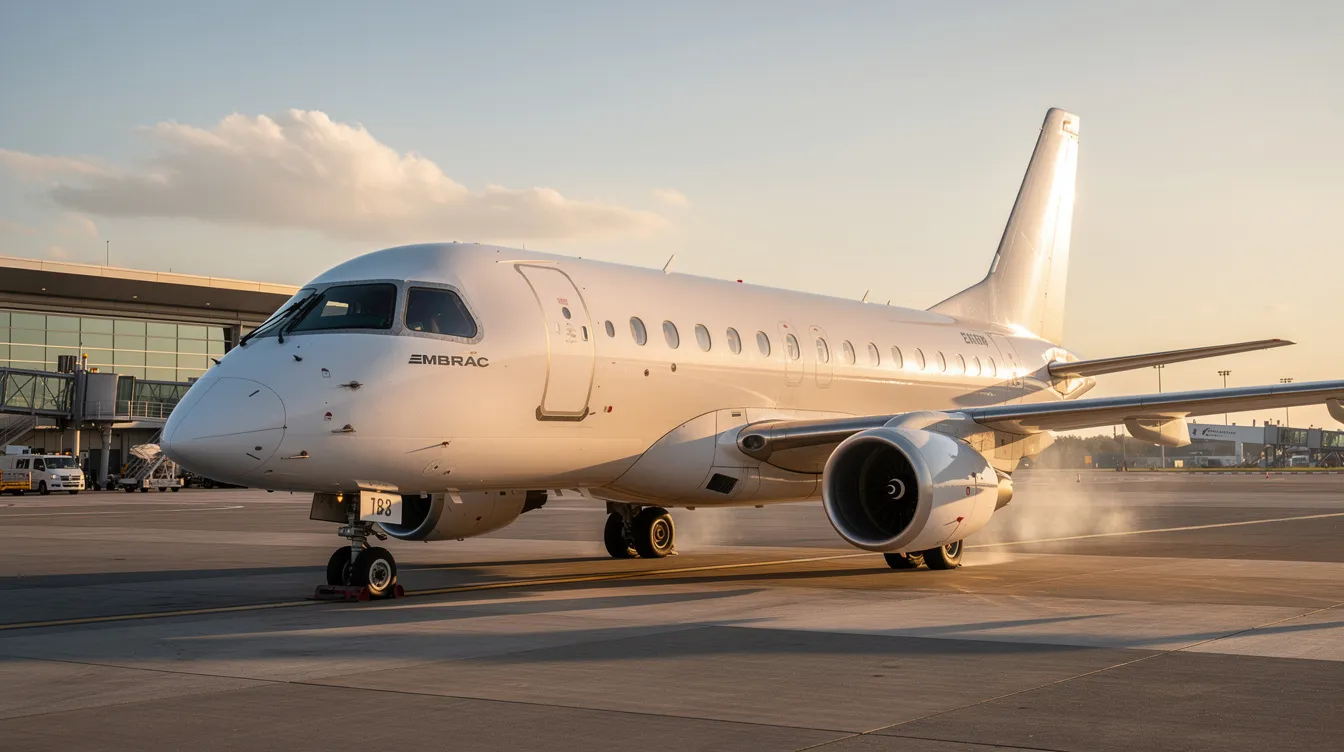
The Embraer 175 jet is one of the most widely flown regional aircraft in North America, carrying millions of passengers each year on routes that connect secondary cities to major hubs. With a flexible cabin, proven engines, and a safety record that stands out across the industry, the E175 has earned its place as a cornerstone of regional aviation. This guide breaks down everything travelers and charter customers need to know about this airplane — from technical specs and cabin layout to real-world charter use.
The Embraer 175 is a twin-engine narrow-body regional jet that typically seats 76 to 88 passengers. It is part of Embraer's E-Jet family, powered by two General Electric CF34-8E engines, and widely flown by carriers such as Republic Airways and SkyWest Airlines. Jettly can arrange on-demand charters on this aircraft type where available.
The E175 features a 2+2 cabin layout with no middle seats, modern aircraft features including advanced avionics, and a clear seat map that appeals to both business and leisure travelers. Adjustable headrests, power outlets, and Wi-Fi capability are common across many operator configurations.
The airplane has an exceptional safety and operational history. The Embraer E175 has zero hull loss accidents and no fatal accidents involving passengers. The broader E-Jet family has logged millions of flight hours with a statistically negligible accident rate.
The E175 balances passenger comfort with operational economics for regional flights, making it a cost-effective alternative to chartering multiple smaller jets or booking premium commercial tickets for groups of 60–80 people through Jettly.
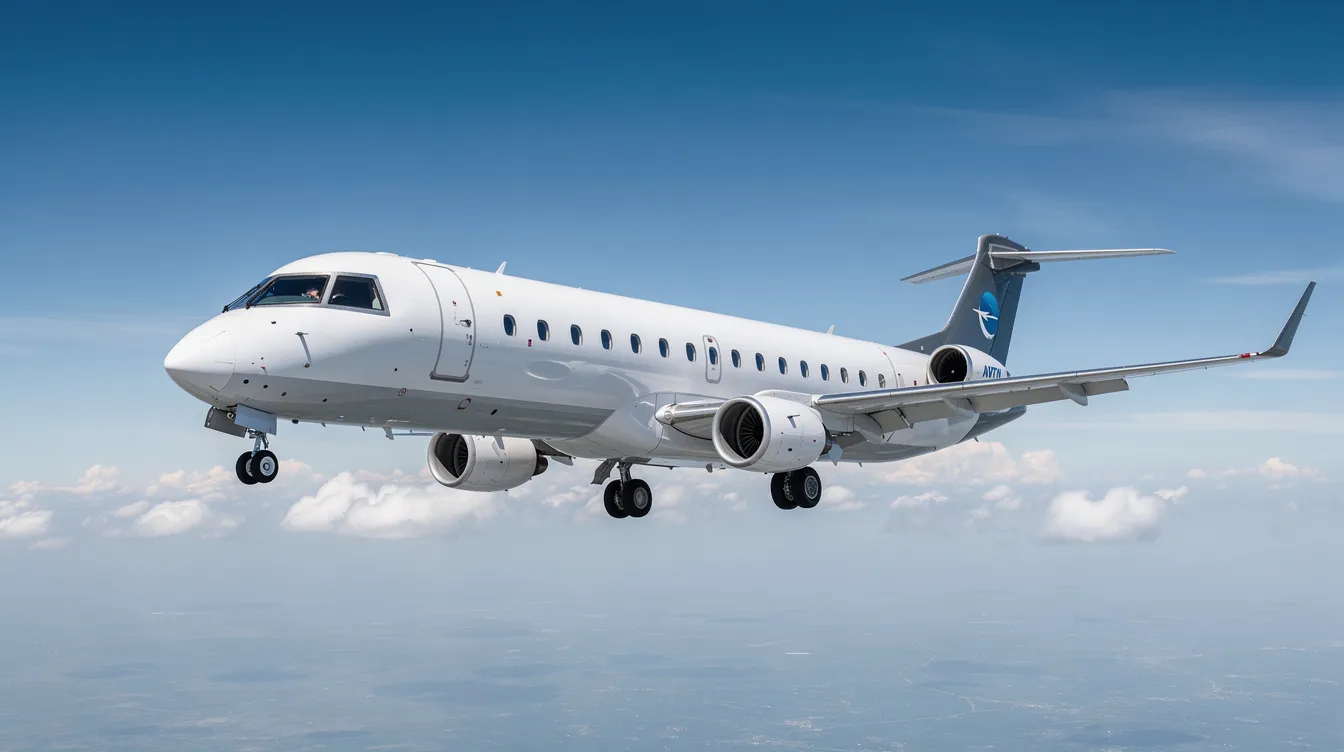
The Embraer 175 — also referenced as ERJ-175 or E175 — is a short- to mid-range regional jet in Embraer's first-generation E-Jet family; Embraer is the manufacturer of the E170, E175, E190, and E195. It is a twin-engine narrow-body regional jet with an overall length of approximately 31.68 meters (103.9 feet) and typical seating for 76 to 88 passengers depending on configuration.
The E175 sits between the E170, the smallest aircraft in the E-Jet family, and the larger E190, sharing cockpit design, fly-by-wire flight controls, and common systems across variants. This commonality simplifies flight crew training and supports mixed fleet operations for airlines.
Its primary mission profile involves frequent takeoff and landing cycles on routes of 300–1,500 miles, feeding major airline hubs and connecting secondary cities. The Embraer 175 has become a dominant aircraft in the North American regional market, and major airlines use the E175 for regional and feed operations to connect smaller airports to hubs. The aircraft's design allows it to serve routes where larger jets would be economically unfeasible.
While primarily operated by airlines, the Embraer 175 platform can also be accessed for tailored charter solutions via digital marketplaces like Jettly.
Embraer launched the E-Jet program in the late 1990s to fill the gap between turboprops and larger narrow-body jets from manufacturers like Airbus and Boeing. The E170 completed its first flight in 2002, and the E175 followed as a stretched variant designed to carry more passengers on the same airframe architecture.
Key milestones in the E175's development:
First flight: The E175 prototype first flew on 14 June 2003.
FAA certification: FAA type certification for the E175 was granted on 31 August 2005. Type certificates were also issued by ANAC (Brazil) in December 2004 and EASA in January 2005.
Commercial service: The E175 began commercial operations in July 2005, with Air Canada as its launch customer.
Production milestone: Embraer celebrated the delivery of the 1,000th E-Jet by September 2013.
The E175 was specifically designed to meet U.S. regional scope clause restrictions. In the U.S., pilot union scope clauses limit regional aircraft to a maximum of 76 seats and a maximum takeoff weight near 86,000 lbs—constraints the E175 was engineered to satisfy while offering mainline-style comfort.
Adoption expanded quickly. U.S. regional partners flying for United Airlines, American Airlines, Delta, and Alaska added E175s to their fleets throughout the 2010s. The plane also found operators in Europe, South America, and Asia. By the mid-2020s, hundreds of production aircraft were in service with a strong order backlog. By July 2020, 25 million passengers had flown on E175S. The E-Jet family has accumulated millions of flight hours, establishing the E175 as a reliable workhorse for daily high-frequency operations.
The E-Jet family breaks down into two size groups: the E170/E175 as smaller variants and the E190/E195 as larger models. All share fly-by-wire controls, similar avionics suites, and a common cockpit philosophy. Embraer also offered long-range and advanced-range variants within the first-generation family.
The E175 was designed as a stretched derivative of the E170. The E175's fuselage was extended by 1.78 meters (5.8 ft), increasing seat count while retaining the same wing design, while the E175LR served as the long-range version developed from the baseline model and kept the CF34-8E engine family and cockpit layout.
Embraer announced the second-generation E-Jet E2 program in 2011. The E175-E2 was intended as the successor, featuring a new wing, advanced avionics, and Pratt & Whitney PW1700G geared turbofan engines promising better fuel efficiency. However, the E175-E2's higher maximum takeoff weight (roughly 98,000 lbs) and increased seating capacity push it beyond current U.S. scope clause restrictions. Embraer has paused E175-E2 development until at least 2029 as a result, with no firm U.S. orders placed.
For now, the first-generation Embraer 175 remains in active production and is the dominant variant in regional fleets worldwide — the only scope-clause-compatible regional jet brand still rolling off the assembly line.
This section summarizes the Embraer 175's key technical data, focusing on what matters most to travelers and charter customers.
Dimensions and weights:
|
Specification |
Value |
|---|---|
|
Wingspan |
~26 m (85.3 ft), with winglets |
|
Overall length |
~31.68 m (103.9 ft) |
|
Maximum takeoff weight |
86,000 lbs (~39,000 kg) for scope-compliant LR variant |
|
Maximum payload |
~10,000 kg (22,000 lb) |
|
Fuel capacity |
~9,335 kg (~3,071 US gallons) |
Performance:
|
Metric |
Value |
|---|---|
|
Maximum cruise speed |
Mach 0.82 |
|
Service ceiling |
41,000 feet |
|
Maximum range (LR) |
Approximately 2,150 nautical miles |
|
Maximum range (AR) |
Approximately 2,200 nautical miles |
|
Takeoff field length (500 nm, full pax) |
~4,150 ft |
All first-generation E-Jets share similar cruise speed and altitude characteristics, which simplifies pilot training across mixed fleet operations. Aircraft features that directly impact passenger experience include large overhead bins sized for standard carry-on luggage, modern LED lighting, and climate-controlled cabin zones. For charter purposes, operators can tailor interior layouts — more business-style seating, extra legroom, or VIP configurations — using the same base airframe.
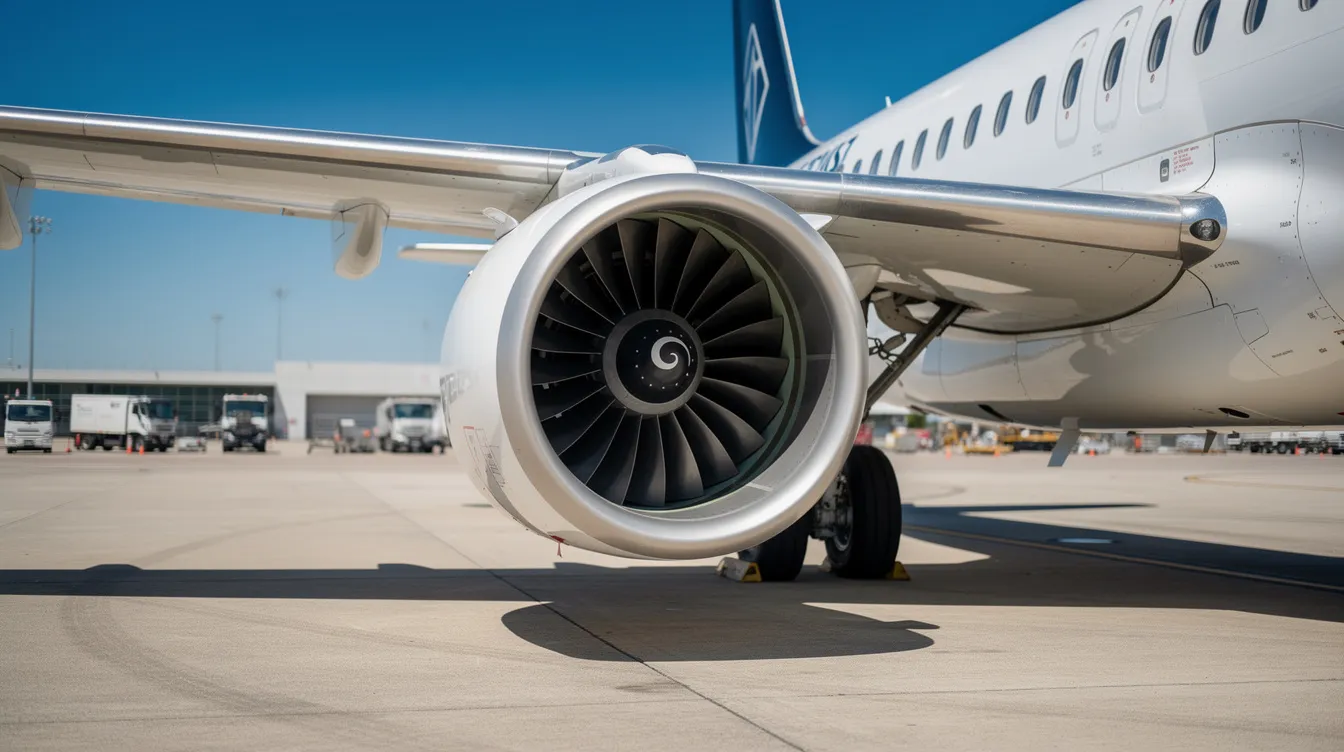
The General Electric CF34-8E is the sole powerplant for the Embraer 175, part of the proven CF34 engine family. The E175 is powered by two General Electric CF34-8E engines, and each engine produces 14,500 lbf (64.5 kN) of thrust. The high-bypass turbofan design targets fuel efficiency and low noise, meeting ICAO Chapter 4 noise standards and CAEP/6 emissions requirements.
The engines are managed by dual-channel full authority digital engine control (FADEC) systems. This technology optimizes fuel burn across all flight phases, reduces flight crew workload, and protects against exceedances during takeoff and climb. The E175 employs a fly-by-wire flight control system with multiple redundant control modules and envelope-protection logic that helps prevent unsafe attitudes — a meaningful safety layer for high-frequency regional operations.
Landing and braking systems include:
Carbon brakes with anti-skid protection
Automatic ground spoilers for shorter landing rolls
Robust landing gear designed for frequent regional cycles
For Jettly customers, these systems translate into smoother rides, efficient climbs to cruise altitude, and reliable performance from shorter regional runways, especially when flying with Part 135 charter companies that meet strict regulatory standards.
The Embraer 175 is consistently praised for its cabin. The E175 features a 2+2 seating layout with no middle seats — a detail that sets it apart from many comparable regional jets and narrow-body aircraft.
Typical seat map configurations:
Dual-class (76 seats): Forward premium cabin plus main cabin economy. U.S. operators typically configure the E175 with 70 to 76 seats to comply with scope clause limits.
High-density (88 seats): The E175 can be configured in a high-density layout for 88 seats, used in some international markets with tighter pitch.
Delta Connection example: The Delta Connection E175S has 12 first-class seats in a 1+2 layout, with remaining seats split between premium economy and standard economy.
Seat pitch in standard economy typically runs 31–32 inches, with greater legroom in premium sections (up to 36 inches). Seat width is competitive for a regional jet given the four-abreast layout, and many travelers prefer this arrangement over the three-abreast middle-seat configurations found on other operators.
Key cabin comfort features include relatively wide seats, large windows, low cabin noise thanks to sound-absorbing materials, and generous overhead bin space. The cabin also features four main exits, forward and aft lavatories, and galley positions suitable for full passenger service.
For private or corporate shuttle charter via Jettly, an Embraer 175 can be configured with more business-oriented seating, branded interiors, or special-purpose layouts for sports teams, event groups, or executive delegations.
Amenities on the Embraer 175 depend heavily on the operating airline or charter operator, but the aircraft supports a full range of modern in-flight systems. Common features across many fleet configurations include:
Wi-Fi capability (increasingly standard on newer builds)
In-seat power outlets and USB ports, especially in first class and premium cabins
Streaming entertainment via passenger devices
Optional mood lighting and LED cabin systems
Unlike long-haul wide-body jets, the E175 does not typically offer flat bed seats. Premium seats are usually recliner-style with extra pitch and better recline — comfortable for mid-range flights of two to three hours but not designed for overnight transatlantic legs.
Catering options can be fully tailored for private charter. Operators partnering with Jettly can arrange anything from simple snacks and beverages to bespoke meal service, depending on the mission. When booking through a digital charter platform, customers can request specific amenities — including power at every seat, specific catering preferences, or branding inside the cabin — on compatible Embraer 175 aircraft, often fulfilled through Jettly's dedicated in-flight catering service, Jettly Eats.
The E175's performance profile — range, speed, and short-field capability — aligns with the kinds of routes it commonly serves. Typical mission lengths fall between 300 and 1,000 nautical miles, though longer sectors are possible.
Example routes and approximate flight times:
|
Route |
Distance |
Flight Time |
|---|---|---|
|
New York–Chicago |
~710 nm |
~2 hrs |
|
Los Angeles–Seattle |
~830 nm |
~2.5 hrs |
|
Toronto–Halifax |
~760 nm |
~2 hrs |
|
London–Berlin |
~480 nm |
~1.5 hrs |
The E175 can typically complete 4–6 legs per day in scheduled commercial service, thanks to quick turnarounds and efficient fuel burn. Its ability to operate from many secondary airports and regional fields with runways around 4,100–4,500 ft gives airlines and charter customers access to more convenient, less congested airports closer to final destinations, which can be planned efficiently using Jettly's airport locator and charter booking platform.
Charter-oriented use cases through Jettly:
Corporate shuttles between company sites (60–80 staff)
Sports team travel with equipment and cargo
Government and VIP delegations needing schedule control
Large family or event groups traveling to domestic destinations together
Compared with chartering multiple light or midsize jets for the same group, an Embraer 175 offers superior per-seat economics and keeps everyone on board together. A light jet carrying 6–8 passengers would require 8–10 aircraft to move 70 people — making the E175 far more practical and cost-effective for large groups, especially when combined with crowdsourced and seat-sharing charter options that fill otherwise empty seats.

The Embraer 175 is most visible in North America, where it serves as the backbone of regional airline operations. The largest E-Jet operators include SkyWest Airlines, Republic Airways, Envoy Air, and Mesa Airlines, flying under brands such as United Express, American Eagle, Delta Connection, and Alaska Airlines, often alongside smaller regional types like the Embraer ERJ 145 for lower-capacity routes.
Republic Airways operates approximately 189 E175s, serving around 88 U.S. airports and carrying roughly 21 million passengers over a trailing 12-month period. SkyWest Airlines fields approximately 270 E175 aircraft, having grown its fleet by 36% between 2021 and 2024. The E175 is primarily operated under capacity purchase agreements (CPAs), where regional carriers fly on behalf of major airlines.
Beyond North America, the E175 has a presence in Europe — with other operators including LOT Polish Airlines and several regional carriers — as well as in Latin America and selected markets in Africa and Asia. For charter customers, this broad operator base means that many charter-eligible aircraft are maintained to the same regulatory standards as airline fleets, often by the same MRO networks that support large E-Jet operators, similar to the diverse private and charter airlines profiled across the private aviation industry.
The Embraer 175 has one of the strongest safety records among modern regional jets. The E175 has accumulated millions of flight hours since 2005, and the E175's accident rate is statistically negligible.
A hull loss refers to a situation where an aircraft is damaged beyond economic repair. The Embraer E175 has zero hull loss accidents across its entire service life. The E175 has recorded no fatal accidents involving passengers — a remarkable track record given the volume of daily flights operated worldwide.
The few serious incidents involving the broader E-Jet family have generally involved other variants or were survivable events. Typical probable cause findings in rare E-Jet incidents include runway overruns in poor weather, windshear encounters on takeoff, or maintenance-related control issues. In each case, regulatory findings led to procedure and training improvements across the fleet.
The E175's modern advanced avionics, fly-by-wire protections, and full compliance with FAA and EASA certification standards all contribute to this strong safety reputation. For Jettly's charter model, this matters directly: charter operations use operators that comply with national regulations — such as FAA Part 135 in the U.S. — and safety history is a key factor when selecting aircraft types like the Embraer 175.
Although the Embraer 175 is primarily known as an airline regional jet, it can also be deployed for ad-hoc charter, corporate shuttle programs, and large-group missions. Availability can be limited since many E175S are tied to airline schedules, but operators with charter authorization do offer them through platforms like Jettly.
Typical charter scenarios:
Companies moving 60–80 staff to a conference or training site
Sports teams traveling with bulky equipment
Music or entertainment tours requiring consistent scheduling
Multi-family holiday trips needing more capacity than a traditional private jet
The cost and value angle is straightforward: per-seat economics of an E175 charter can be competitive with booking multiple business jets or purchasing premium-cabin commercial tickets when the aircraft is near full capacity.
Jettly's digital platform helps customers access instant charter cost estimates for regional jet categories, search a global inventory of over 20,000 aircraft, and request Embraer 175 or similar E-Jets when available. Additional services can include custom catering, branding on cabin materials, coordinated ground transportation, and flexible departure times.
To explore whether an Embraer 175 or comparable aircraft fits your next regional group trip, visit Jettly's charter options.
Regional jets like the Embraer 175 play a specific role in aviation sustainability. By enabling direct point-to-point routes, they can reduce total travel time and emissions compared with multi-segment itineraries through congested hubs, especially when chartered through a curated private charter aircraft marketplace with global fleet access.
The E175's aerodynamic design and winglets deliver meaningful fuel efficiency improvements over older regional jets. SkyWest Airlines reports that replacing older CRJ200s with E175S has contributed to a roughly 3% reduction in CO₂ per available seat-mile since 2021. Newer wingtip designs and incremental upgrades continue to refine fuel burn, keeping the E175 competitive even as second-generation designs are developed.
E-Jet operators increasingly blend sustainable aviation fuel (SAF) into their fuel mix where available. Jettly can help charter clients explore lower-impact options, including efficient aircraft selection and carbon offsetting programs.
The E175 also supports regional development by allowing airlines and charter customers to serve thinner routes and smaller airports efficiently — improving connectivity without always needing larger, less fuel-efficient aircraft.
Aircraft choice should be based on passenger count, route distance, airport constraints, budget, and onboard comfort expectations, and understanding the overall cost of private jet charter across aircraft types can help set realistic budgets. Here is how the Embraer 175 compares:
|
Factor |
Embraer 175 |
Light/Midsize Jet |
Turboprop |
|---|---|---|---|
|
Best for |
60–80 passengers |
4–16 passengers |
Short hops, small groups |
|
Range |
Up to ~2,000 nm |
1,500–3,500 nm |
500–1,200 nm |
|
Cabin class options |
Multiple (first class, economy) |
Single premium cabin |
Usually single class |
|
Runway requirement |
~4,100+ ft |
3,000–5,000 ft |
2,500–4,000 ft |
|
Cruise speed |
Mach 0.82 |
Mach 0.70–0.85 |
250–350 ktas |
|
Per-seat cost (group) |
Lower when near capacity |
Higher per seat |
Lowest hourly rate |
The E175 is a strong fit when moving 60–80 passengers on routes of up to roughly 2,000 nautical miles, when multiple cabin classes are needed, or when using secondary airports compatible with regional jets. For smaller groups (4–16 passengers), a light or midsize jet offers more flexibility and bespoke interiors. Turboprops can fly from shorter runways at lower hourly rates but sacrifice speed and cabin comfort; for these missions, Jettly's guidance on choosing the best cross-country aircraft for your trip can help align aircraft type with route and comfort needs.
Jettly's platform helps clients weigh these trade-offs with side-by-side pricing, aircraft class filters, and access to flight advisors who can recommend whether a regional jet like the Embraer 175 is the right choice, especially when paired with flexible private jet membership plans for frequent flyers.
Ready to explore group travel options? Get a quote at https://www.jettly.com, or consider joining Jettly's high-ticket affiliate program to earn by referring new charter clients.
Below are answers to common practical questions about the Embraer 175 and its use in private charter that were not fully covered above.
Many business travelers find the E175 more comfortable than typical narrow-body aircraft. The 2-by-2 seating eliminates middle seats entirely, and the relatively quiet cabin makes it easier to work or rest during mid-range flights. Premium cabins on airline-configured E175S often include extra legroom, in-seat power, and priority boarding. Charter configurations can further upgrade seating for corporate groups, adding wider spacing and dedicated service areas, or be paired with jet card programs that offer predictable hourly rates and benefits.
In practice, most Embraer 175 missions fall between 300 and 1,500 nautical miles, even though the maximum range reaches roughly 2,150–2,200 nautical miles depending on variant and payload. Actual range on a charter flight will depend on passenger count, baggage weight, weather, and air traffic constraints. Jettly can provide route-specific estimates when quoting a trip through the cost estimator or its dedicated jet card flight cost calculator.
The E175 is designed for regional operations and can use many secondary airports, typically requiring runway lengths just over 4,000 ft under standard conditions. Some very short or high-altitude runways may not be suitable, and airport compatibility is checked automatically during the charter planning process on platforms like Jettly, which also outlines multiple ways to secure a private jet seat easily and affordably.
The Embraer 175's safety record is comparable to — and in some metrics better than — many other modern regional jets. It has no recorded fatal passenger accidents and zero hull losses as of the mid-2020s, which reassures travelers comparing options for buying a single seat on a private jet flight. Adherence to maintenance requirements, crew training, and regulatory oversight from the FAA, EASA, and local authorities are the key determinants of safety for any particular flight, whether flying with legacy fractional programs or cost-effective NetJets alternatives like Jettly.
Visit https://www.jettly.com, enter your route and dates, select your passenger count, and review instant pricing across applicable aircraft categories — including regional jets when available. You can request an Embraer 175 specifically or ask Jettly flight advisors to recommend comparable options if an E175 is not available for the requested route or date. For groups that need a tailored solution, explore flights or request a customized quote through the platform.
The Embraer 175 jet remains a leading choice for regional air travel and private charter services, combining efficient performance, passenger comfort, and a strong safety record. Its versatile cabin configurations and operational flexibility make it ideal for business groups, sports teams, and large families traveling between secondary airports and major hubs. With a maximum range suitable for most short- to mid-range routes and a 2+2 seating layout that eliminates middle seats, the E175 offers a superior experience compared to many regional aircraft.
For travelers and organizations seeking on-demand access to Embraer 175 charters, Jettly provides a seamless digital platform to explore availability, receive instant pricing, and book flights with ease. Jettly’s global network of aircraft and transparent pricing model simplify the process of securing this popular regional jet for private or group travel.
Ready to experience private travel on your terms? Explore Embraer 175 flight options or request a quote at https://jettly.com. Learn more about Jettly’s private jet charter services, discover how to buy a seat on a private jet, check out our jet card programs for frequent flyers, explore group private jet charters, or find the best cross-country aircraft for your trip.
Share this post:
Jay Franco Serevilla
Sep 18, 2026
|
5
min read
Discover tips and trends in the industry.

5
min read
Best Executive Jet: How to Choose the Right Aircraft for High-Level Travel
Choosing the best executive jet depends on specific travel needs such as distance, passenger count, and budget. This guide compares various aircraft categories, from light jets to ultra-long-range models, helping executives select the right jet for their missions. Jettly's platform simplifies the booking process, offering access to over 20,000 aircraft tailored to each trip's requirements.
Read More
5
min read
Private Jet from Dallas to Las Vegas: 2026 Guide to Flight Time, Costs, and Best Jets
Chartering a private jet from Dallas to Las Vegas offers a swift and luxurious travel experience, averaging 2 hours and 10 minutes for the journey. With costs ranging from $13,000 to over $34,000 depending on the aircraft type, travelers can choose from a variety of jets to suit their needs. This guide provides insights into flight times, costs, and tips for optimizing your private jet experience.
Read MoreStay updated with our latest insights and tips to elevate your journey with us.
MEMBERSHIPS AND ASSOCIATIONS



Disclaimer: Jettly operates as a charter broker, offering access to a global digital jet charter marketplace. Jettly is not a direct air carrier and does not own or operate aircraft. All advertised flights are conducted by third-party air carriers that are fully licensed and hold the appropriate Part 135 or Part 121 certifications issued by the Federal Aviation Administration (FAA) or equivalent regulatory authorities under U.S. or foreign law. Jettly complies fully with the U.S. Department of Transportation's Part 295 and Part 298 Charter Broker regulations. Jettly does not carry additional liability insurance. Passengers are covered by aircraft operator insurance. TICO: 50023770


