


Login
Get Instant Pricing On 23,000+ Aircraft

>
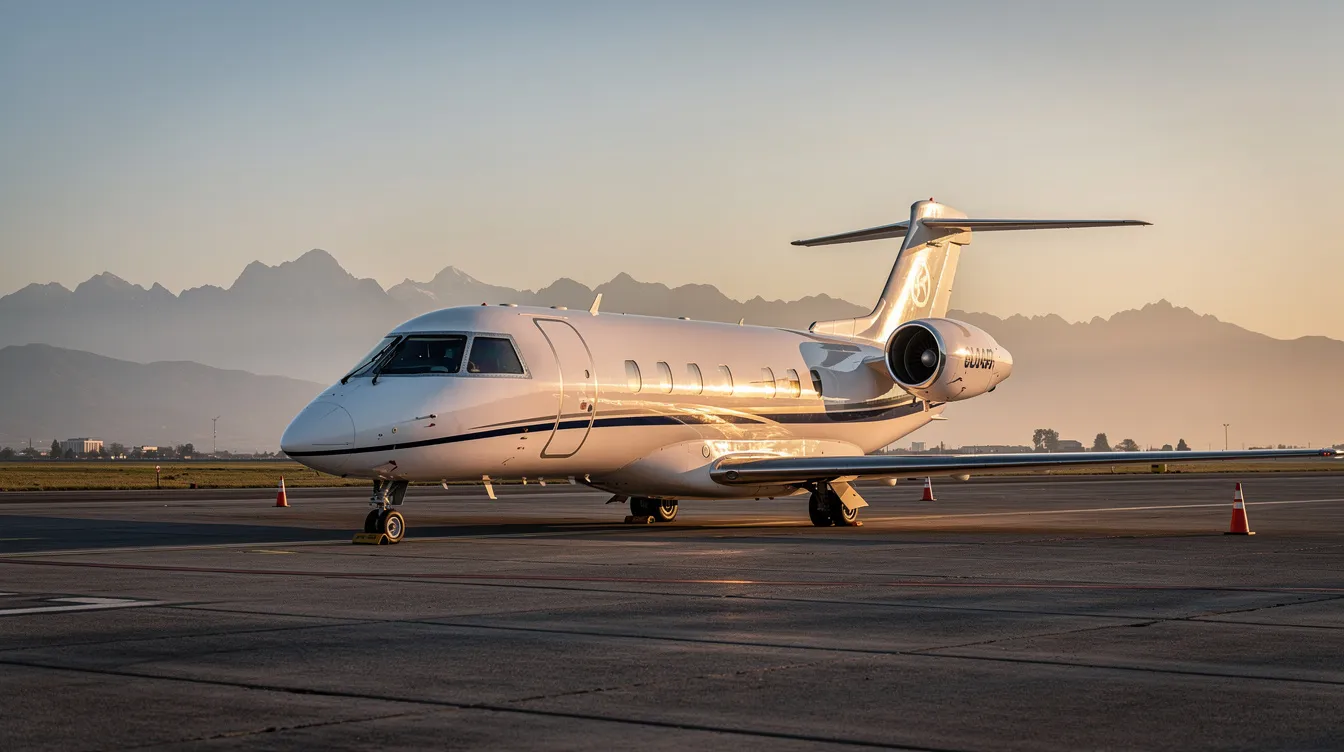
The Dassault Falcon 20F is a twin-engine midsize business jet produced from 1970 to 1988, known for improved weight, payload, and aerodynamic performance over earlier Falcon 20 variants and for helping define the midsize charter category. This overview is aimed at frequent flyers, private charter clients, and aviation enthusiasts who want to understand the Falcon 20F’s history, design, performance, operating role, passenger experience, noise and regulatory limits, and how it compares with modern midsize jets available through platforms like Jettly. Knowing where the Falcon 20F fits in business aviation makes it easier to judge why today’s charter aircraft often deliver better efficiency, comfort, and onboard technology for current private travel needs.
The Dassault Falcon 20F is a fan jet Falcon variant that emerged during the 1970s and 1980s as a refined mid-production model in the Falcon 20 family. The designation Falcon 20F refers to a specific variant of the Falcon 20 series, built to improve on earlier models in weight, payload, and aerodynamic performance.
The Falcon 20 line traces its first flight heritage to May 4, 1963, when the Mystère 20 prototype took to the skies over France. The 20F arrived as an improved version, and over 500 Falcon 20s were sold by 1988.
The aircraft can typically accommodate 8 to 14 passengers depending on cabin configuration, though most executive layouts seat 8 to 10.
The Falcon 20F is a development of the original Dassault Falcon 20, created with higher maximum takeoff weight, better range margins, and refined aerodynamics for improved field performance.
The Falcon 20 family has served various roles, including corporate transport, cargo, and military applications, helping establish Dassault Aviation as a serious business jet competitor among corporations worldwide.
Compared with the modern midsize jets typically featured for charter, the Falcon 20F's classic design lags in fuel economy, cabin connectivity, and noise compliance.
The Dassault Falcon 20 is a French twin-engine business jet that completed its maiden flight on May 4, 1963. Originally named the Mystère 20, it was marketed as the fan jet Falcon and renamed for the North American market in 1965 when Pan Am became its distributor.
The Falcon 20 family features a low-wing layout, rear-mounted engines, a pressurized cabin, and a T-tail - a silhouette that defined early business aviation.
The Falcon 20F is one of the later CF700-powered variants (following 20C and 20D models), configured with increased maximum takeoff weight and aerodynamic refinements.
The Falcon 20 typically seats 8 to 10 passengers and its range exceeds 2,000 kilometers, making it ideal for medium-range corporate routes of about 1.5 to 3 hours - think Paris to Berlin or New York to Chicago.
Production of all Falcon 20 variants ran from the mid-1960s until 1988, with production peaking at seven aircraft per month and hundreds delivered worldwide. Many airframes were later converted to cargo or special-mission roles.
The Falcon 20F kept the recognizable aft fan engine appearance, contributing to the aircraft's distinctive look and a noise profile that now trails modern turbofans by a wide margin.
Dassault's foundation in military fighter design - swept wings, hydraulic controls, robust structures - directly shaped the Falcon 20 program. The structural design of the Falcon 20F incorporates engineering adapted from military applications, a point of advantage that gave the airframe durability few civil jets of its decade could match.
The French government's export ambitions, especially targeting the U.S. airline and corporate market, motivated the company to build an 8- to 10-seat executive jet with range above 2,000 km. Marcel Dassault approved production in December 1961, and a June program review preceded the Mystère 20 prototype's first flight in May 1963, an early step in building Dassault's business-jet presence.
Early operator feedback drove several incremental variants. The Falcon 20F emerged as a heavier-gross-weight model planned to offer better payload and flexibility, with upgraded CF700-2D-2 engines and full high-lift devices.
While external changes were subtle, the Falcon 20F included structural strengthening, improved systems, and - in many cases later in life - avionics upgrades tailored to corporate and government customers.
By the late 1970s, attention shifted toward more efficient engines. Some aircraft were re-engined with Garrett TFE731 turbofans under the Falcon 20-5 program, offering better range and noise compliance. The Falcon 20F remained an important bridge between the early fleet and these upgraded models.
The Falcon 20F's purpose-built airframe reflects its fan jet Falcon identity. Here are the key design features:
Low-mounted swept wings with full-span leading-edge slats enhancing low-speed performance, a T-tail, and rear-fuselage engine installation. Tricycle landing gear with dual main wheels supports operations from paved runways and relatively short fields.
The Falcon 20F is noted for its excellent short-field performance due to these aerodynamic enhancements, giving operators access to a wider number of regional airports.
Hydraulically powered primary flight controls, derived from Dassault's fighter experience, deliver stable handling and good cruise performance around Mach 0.8.
Structural robustness: an unlimited-life airframe design with no fixed retirement age and a strengthened floor, which later made many aircraft attractive for cargo conversions.
The cockpit uses a two-crew configuration. Originally fitted with analog steam-gauge instrumentation, many Falcon 20Fs have been retrofitted with modern avionics packages such as Collins ProLine or partial glass display suites.
These design choices were advanced for their era but now lag behind modern private jet makes in aerodynamics, fuel efficiency, and noise insulation.
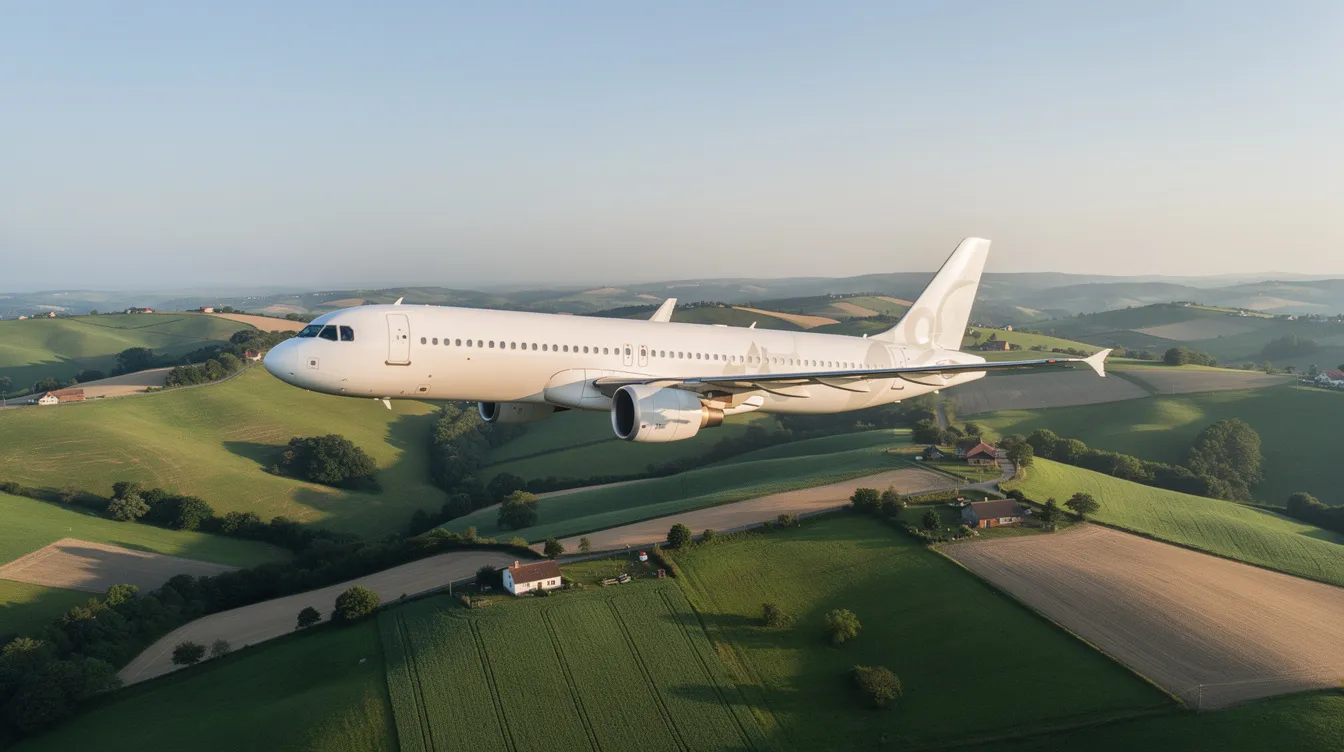
The Falcon 20F was originally powered by two General Electric CF700 turbofan engines, a distinctive choice that set the Dassault Falcon 20 family apart from many contemporary jets.
The CF700 layout places the turbine at the front and a fan at the rear with a visible bypass duct, making the fan jet Falcon nickname technically accurate and visually obvious.
The maximum speed of the Falcon 20F is approximately 480 knots. The maximum cruise speed reaches Mach 0.82 (roughly 536 to 538 mph). The service ceiling extends up to 42,000 feet, with some sources citing 13,725 meters (45,000 feet) for the broader Falcon 20 family.
The maximum range of the Falcon 20F varies between roughly 1,340 and 2,200 nautical miles depending on configuration and load. This range matches well with 1.5 to 3-hour corporate flights.
It can operate on short runways, needing about 4,500 ft for takeoff - suitable for many regional and secondary airports where business travelers fly, especially when paired with an airport locator tool that highlights suitable fields.
The CF700's main drawback: high noise levels compared with newer turbofans. This triggered widespread installation of hush kits to meet Stage 3 noise regulations, a milestone many operators had to reach or face airport restrictions.
Some Falcon 20 airframes were re-engined to Garrett TFE731 under the Falcon 20-5 program to reduce fuel burn and meet tighter standards. Non-upgraded CF700-powered Falcon 20Fs face restrictions at many modern airports.
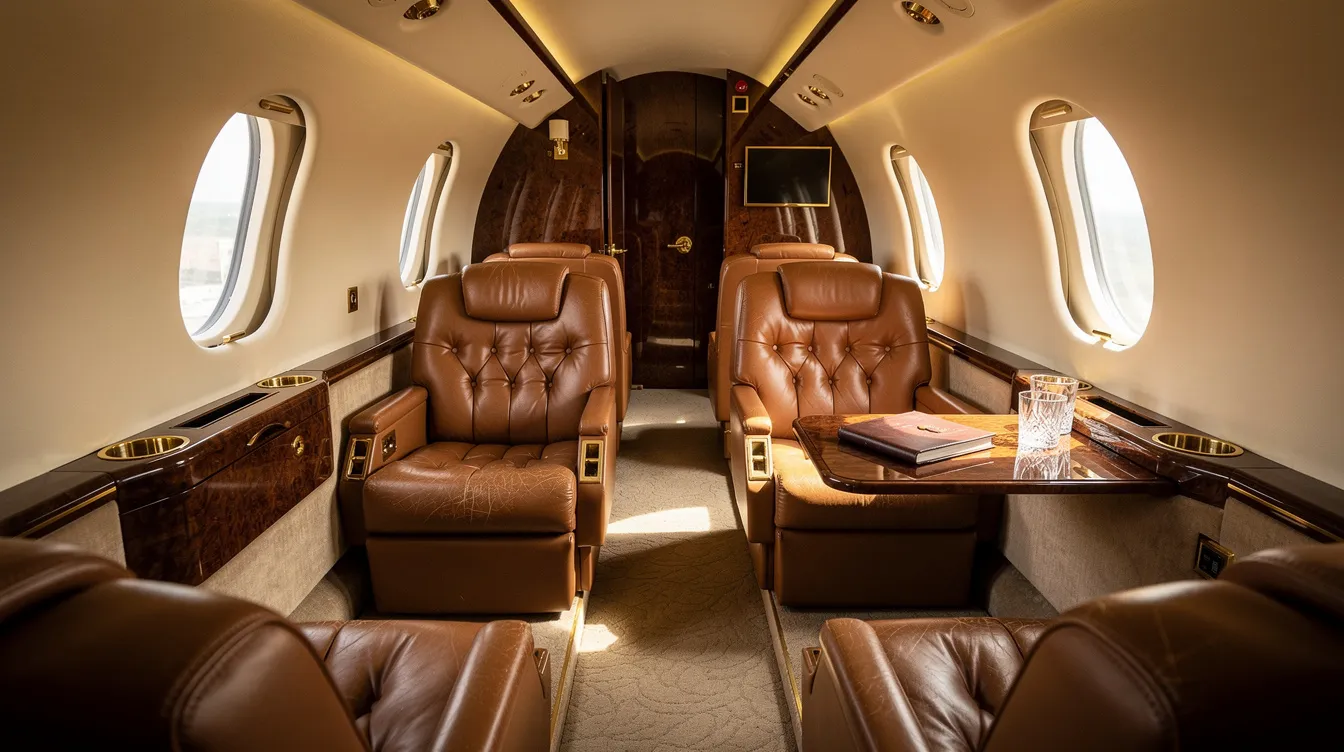
The Falcon 20F helped define expectations for later Dassault Falcon interiors. Its cabin volume of around 587 to 726 cubic feet provided a working environment that was generous for its era.
Typical seating: 8 to 14 passengers depending on configuration, though most executive layouts use a double-club arrangement (four seats facing four) with an additional divan or extra individual seats for flexibility.
Stand-up or near stand-up height for many passengers, with a width that was relatively spacious compared to other jets of the same decade - well-suited for work sessions, meetings, or family travel.
Amenities include a forward galley for light catering, a rear enclosed lavatory, fold-out work tables, and overhead or side-fuselage storage for laptops, documents, and smaller bags.
Baggage capacity varies by configuration and weight limits, but operators have carried business equipment, skis, and golf bags in the external or internal compartments.
The cabin remains functional but generally lacks modern expectations: high-speed Wi-Fi, advanced noise insulation, and fully refreshed styling are absent unless an operator has invested in major refurbishments, which many family-friendly private planes now offer as standard.
The Falcon 20F and its variants proved remarkably versatile across corporate, cargo, and government service.
During the 1960s through the 1980s, corporations operated the Falcon 20 family as executive shuttles across Europe and North America, covering routes similar to those served by today's midsize jets and other cross-country planes for long journeys.
FedEx began cargo operations with the Falcon 20 in April 1973, using modified airframes with strengthened floors and cargo doors to launch its early overnight shipping network. While many of these were not Falcon 20F specifically, the type's robust build made it ideal for freight.
The U.S. Coast Guard adopted Falcon 20 derivatives as the HU-25 Guardian for maritime patrol, surveillance, and search and rescue - a service that ran for decades.
Other special uses included flight-test platforms for avionics trials, calibration aircraft for air traffic systems, and training aircraft for electronic warfare exercises.
Today, surviving Falcon 20F and related models are more often found in niche roles - cargo operators, government contracts, or training fleets - rather than mainstream premium charter service, where they have largely been replaced by more affordable private aircraft options.
This section compares the Falcon 20F variant with the baseline Falcon 20 to help readers understand the progression within the Dassault Falcon 20 family.
The Falcon 20F has an approximate length of about 17 m, a wingspan of about 19 m, and a maximum takeoff weight of 13,860 kg (30,550 lb). Standard passenger capacity is 8 to 10 in executive layout.
The Falcon 20F offers increased payload and maximum takeoff weight versus early Falcon 20 versions, with similar cruise speed but slightly improved operational flexibility.
Both use CF700 aft-fan engines in their original configuration, but many aircraft across the family have undergone avionics and noise-reduction upgrades over decades of operation.
From a charter customer's point of view, the interior experience between a well-kept Falcon 20 and Falcon 20F is broadly similar. The bigger differences are in behind-the-scenes operating weights, fuel planning, and certification details.
Despite this evolution, both are outperformed in fuel efficiency, range, and connectivity by modern midsize jets that platforms like Jettly commonly feature from leading private plane manufacturers. For a detailed private jets comparison, newer options consistently deliver more value per flight hour.
Some Falcon 20 and Falcon 20F aircraft still operate, but they form a small share of today's charter market. Newer midsize jets are preferred for charter across nearly every route and mission profile.
Tighter noise regulations, higher fuel burn, and aging airframes have pushed many operators to retire or convert these jets to non-passenger roles. The Federal Aviation Administration has set strict inspection directives for older Falcon 20 fleets, and regulatory agencies continue to oversee airworthiness and safety directives relevant to aircraft like the Falcon 20F. Some upgraded Falcon 20s are still available for charter, but charter rates vary based on journey length and airports.
A few upgraded Falcon 20F jets, equipped with modern avionics, refurbished cabins, and hush-kitted powerplants, may still appear in specific markets where demand permits, but most travelers now compare how much it costs to rent a private jet of a newer design instead.
Jettly's digital platform helps travelers looking for an aircraft similar in size and mission to the Falcon 20F by offering access to modern midsize jets such as the Citation XLS, Hawker 800XP, Learjet 60, and Challenger 300 through its extensive private charter aircraft inventory. For midsize jet cost transparency, the platform provides instant pricing.
Jettly features a searchable global inventory of 20,000+ aircraft, instant pricing tools, including a private jet charter cost estimator, filters for cabin category, passenger count, range, and aircraft age - all without long-term ownership commitments.
Visitors interested in aircraft with a similar role to the classic Dassault Falcon 20F can explore and compare options on Jettly or consider private jet memberships that suit their flying frequency. The platform also addresses questions about sustainable aviation fuel, carbon offsetting, and route planning for 2- to 3-hour business trips.
Is the Dassault Falcon 20F still used for passenger charter today? Some upgraded examples remain in service, but they are rare compared with newer Dassault Falcon models and other midsize business jets. Most surviving airframes now serve in cargo, training, or government roles rather than front-line charter.
How does the Falcon 20F compare to contemporary midsize jets? In terms of speed, the Falcon 20F remains respectable at roughly 480 knots maximum. However, newer designs win on fuel burn, noise, avionics, and in-flight connectivity. Modern midsize jets also offer better range - often 3,000 to 4,000 nm - and taller, wider cabins with reliable Wi-Fi, though these advantages come with the higher ownership and operating expenses outlined in guides to how much a private jet costs.
What about noise and airport access? Hush kits and re-engining programs helped some Falcon 20s meet Stage 3 noise rules, but many airports and operators now prefer quieter, later-generation aircraft. Unmodified CF700-powered jets face growing restrictions.
Does the Falcon 20F support sustainable aviation fuel? The Falcon 20 completed a 100% biofuel flight in 2012, making it the first civil jet to fly on biofuel. The fuel was derived from hydroprocessed esters and fatty acids, and biofuel use can reduce lifecycle CO2 emissions by up to 80%. Modern jets can operate on approved sustainable aviation fuel blends, and Jettly can help travelers explore greener flying options.
How can I book an aircraft similar to the Falcon 20F through Jettly? Visit Jettly to filter by midsize cabin category, choose 8 to 10 passengers, set your preferred range, and receive instant quotes, keeping in mind the factors that determine how much to rent a private jet. Learn more about how to charter a private jet through the platform.
The Dassault Falcon 20F holds a special place in the Falcon 20 family, helping establish the Dassault Falcon reputation and demonstrating the potential of midsize business jets from the 1960s through the 1980s. Its classic fan jet Falcon design, versatile roles in business and government operations, and solid performance for its era - in addition to milestones like early cargo deliveries and a pioneering biofuel flight - mark it as a genuine milestone in civil aviation.
While the Falcon 20F retains historical and technical interest, most charter customers today benefit more from newer midsize jets that deliver better range, quieter cabins, modern avionics, and reliable connectivity.
Jettly's private jet charter marketplace allows travelers to quickly compare aircraft that match or exceed the Falcon 20F's capabilities - without the costs and complexity of ownership, jet cards, or fractional programs, unless they choose to explore dedicated jet card programs for frequent flying.
Ready to experience private travel on your terms? Explore flight options or request a quote at https://www.jettly.com. You can even reduce your per-seat price by using Jettly's tools to crowdsource private jet flights and share empty seats. Search for midsize jets suited to 2- to 3-hour regional business or family trips and find the right aircraft for your next flight.
Share this post:
Jeff Ryan Serevilla
Oct 8, 2026
|
5
min read
Discover tips and trends in the industry.

5
min read
Cheap Time to Fly to Europe: How to Find Cheap Flights, Routes, and Travel Windows
Finding the cheapest time to fly to Europe involves understanding seasonal patterns and booking strategies. January through early March offers the best deals, with midweek flights being more affordable. Utilizing flexible dates and comparing commercial flights with private jet options can significantly reduce travel costs.
Read More
5
min read
Costco Travel: How Vacation Packages Work (and When Private Jets Make Sense)
Costco Travel offers exclusive vacation packages for members, bundling hotels, cruises, and rental cars at competitive prices. While it simplifies trip planning, it lacks stand-alone flight options, making private jet charters a viable alternative for those seeking flexibility and time savings. This article explores how to effectively combine Costco Travel packages with private jet services for an optimized travel experience.
Read MoreStay updated with our latest insights and tips to elevate your journey with us.
MEMBERSHIPS AND ASSOCIATIONS



Disclaimer: Jettly operates as a charter broker, offering access to a global digital jet charter marketplace. Jettly is not a direct air carrier and does not own or operate aircraft. All advertised flights are conducted by third-party air carriers that are fully licensed and hold the appropriate Part 135 or Part 121 certifications issued by the Federal Aviation Administration (FAA) or equivalent regulatory authorities under U.S. or foreign law. Jettly complies fully with the U.S. Department of Transportation's Part 295 and Part 298 Charter Broker regulations. Jettly does not carry additional liability insurance. Passengers are covered by aircraft operator insurance. TICO: 50023770


