


Login
Get Instant Pricing On 23,000+ Aircraft

>
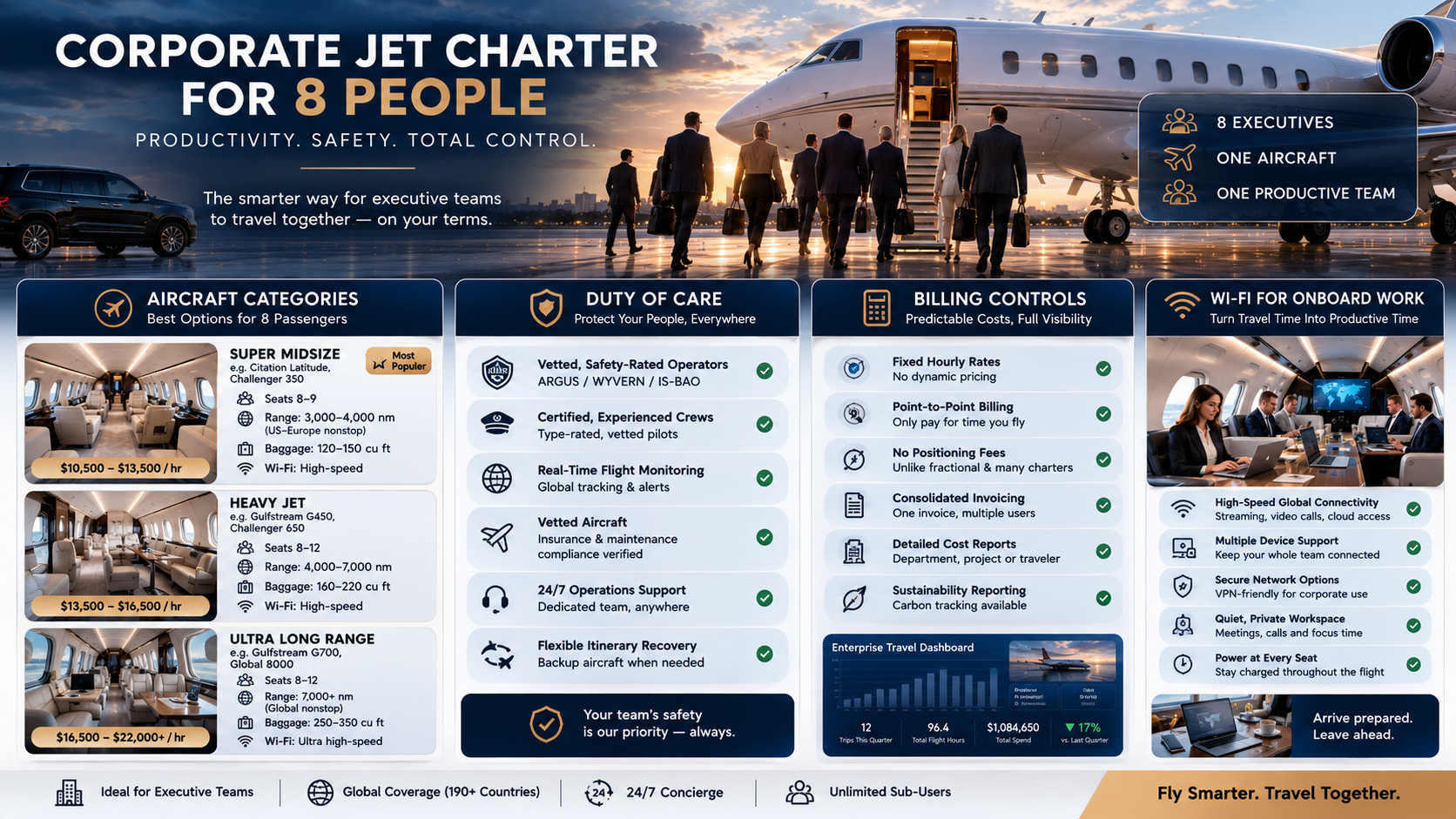
A leadership team of eight that flies often has different needs than a single executive booking a weekend hop. You want room to work, reliable inflight wi‑fi, billing your accounting team can audit line by line, and a duty of care process that holds up when weather or a mechanical issue disrupts the plan. This guide matches the right private jet categories to a corporate mission of eight, then walks through how to compare quotes, govern spend, plan multi‑city travel, and write connectivity requirements that actually get met. For a leadership team of 8, the most common fit is a midsize or super‑midsize private jet. Light jets can work when luggage is light and legs are shorter, and heavy jets are usually chosen when range, cabin zones, or onboard staffing matters more than price.
Short answer first. Short legs with minimal bags point you toward a light jet. Transcontinental or work‑heavy days point toward midsize or super‑midsize. Long‑range international flying or a two‑zone cabin pushes you into heavy jets.
An aircraft category is a standardized way to group private aircraft by cabin size, typical seating capacity, range (nmi), and onboard amenities so you can match a mission to the right level of capability. When you send a request, spell out passenger count, baggage, meeting needs, your inflight wi‑fi requirement, departure flexibility, and any security or IT constraints. Predictable billing follows from fixed‑rate options where possible, standardized invoice fields, and clear approval rules.
For 8 passengers, a midsize or super‑midsize jet is usually the best balance of workspace, baggage room, and range without paying heavy‑jet pricing. Typical market rates run roughly $2,800 to $4,500 an hour for light jets and $4,000 to $8,000 for midsize and super‑midsize, route and aircraft dependent. Before you book, sanity‑check what "eight seats" really means by reviewing private jet passenger capacity, since eight seats on a spec sheet is not the same as eight comfortable working seats.
Eight seats on paper can feel tight for eight adults with laptops, especially in light jets. The goal is to pick the smallest category that safely handles your people, your bags, and your mission, then optimize price inside that constraint. A quick look at this corporate aircraft guide helps frame how business travelers actually use each class.
Range (in nautical miles, or nmi) is the maximum distance an aircraft can fly without refueling under specified conditions. Real‑world range shifts with passengers, baggage, winds, and routing, so treat published figures as a starting point and confirm by tail number before a final quote.
Here is how the main private jet categories map to a corporate team of eight.
VLJ (very light jet): four to six seats, short legs, minimal baggage space. Too small for eight working adults in most cases.
Light jet: six to eight seats, regional range, a narrow cabin that often lacks full stand‑up height. Workable for short hops with carry‑ons.
Midsize jet: seven to nine seats, stand‑up cabin, club seating with tables, and enough baggage space for a working team.
Super‑midsize jet: eight to ten seats, wider cabin, coast‑to‑coast range, and the room that makes onboard meetings feel practical.
Heavy jet: ten or more seats, multiple cabin zones, a flight attendant, and the range for international travel.
|
Table 1. Best Aircraft Categories for 8 People |
|||||
|
Category |
Typical seating for corporate comfort |
Typical range band (nmi) |
Cabin and work notes |
Baggage notes |
Best for |
|---|---|---|---|---|---|
|
Light jet |
4 to 6 comfortable, 8 max |
~1,500 to 2,000 |
Narrow cabin, limited stand‑up height, tight for laptops |
Modest; plan carry‑ons |
Short regional legs, light bags |
|
Midsize jet |
7 to 8 |
~2,000 to 3,000 |
Stand‑up cabin, club‑four layout, work tables |
Good; external hold on most models |
Transcontinental days with work |
|
Super‑midsize jet |
8 to 10 |
~3,000 to 3,600 |
Wider cabin, more space per seat, meeting‑friendly |
Large external baggage |
Coast‑to‑coast, onboard meetings |
|
Heavy jet |
10 to 16 |
~4,000 to 7,500+ |
Two cabin zones, flight attendant, full galley |
Largest; suits long trips |
International, overnight, staffed cabin |
Actual specs and interiors vary by aircraft and operator; confirm in the charter agreement.
Representative aircraft for corporate missions of eight include the Embraer Phenom 300 and Cessna Citation CJ4 in the light class; the Citation XLS/XLS+ and Hawker 800XP in the midsize class; the Bombardier Challenger 300/350 family, Embraer Praetor 600, and Gulfstream G280 in the super‑midsize class; and larger‑cabin options like the Challenger 650 or Gulfstream G450 when you want a two‑zone cabin. Configuration and amenities differ by operator, so verify each aircraft rather than assuming the class standard. Jettly advertises access to more than 23,000 aircraft across 190‑plus countries, spanning piston, turboprop, light, midsize, super‑midsize, and heavy classes, with availability that varies by market and time.
For an 8‑person corporate mission with laptops and carry‑ons, a light jet is often the minimum category, but midsize and super‑midsize jets are where onboard work feels truly practical.
"For most executive teams of eight, the decision isn't simply about fitting eight seats on an aircraft. It's about giving eight people the space to work effectively. Once laptops, luggage, privacy, and productivity become priorities, midsize and super‑midsize aircraft typically deliver the strongest balance of capability and cost."
- Justin Crabbe, CEO
Duty of care in corporate aviation is the organization's responsibility to vet suppliers, reduce foreseeable travel risks, and have a documented plan to locate and support travelers during disruptions or emergencies. Private aviation adds variables that scheduled airlines abstract away: the specific operator, aircraft, crew, routing, weather, and alternates all change trip by trip. That variability is exactly why a corporate private aviation program needs written procedures rather than ad‑hoc trust.
Understand the split in responsibility. The operator holds operational control and flies the aircraft. Jettly is a charter broker, not a direct air carrier, and every advertised flight is conducted by a third‑party operator holding FAA Part 135 or Part 121 certification, or the foreign equivalent. The broker sources aircraft, coordinates the trip, and helps you document the controls your policy demands. Reviewing the fundamentals of private jet safety gives your travel and security owners a shared baseline before they sign off on vendors.
A corporate duty‑of‑care program for private aviation should cover three things: operator vetting, traveler tracking, and disruption response. The checklist below turns that into something a company can adopt today, even without an in‑house aviation department.
|
Table 2. Duty of Care Checklist (Copy and Paste) |
|||
|
Requirement |
Why it matters |
Evidence to request and retain |
Owner |
|---|---|---|---|
|
Operator certification |
Confirms a licensed air carrier flies the trip |
Part 135/121 certificate number |
Broker / Operator |
|
Safety ratings |
Independent audit of operator quality |
ARGUS, Wyvern, or IS‑BAO status |
Security |
|
Operator insurance confirmation |
Passengers are covered under the operator's policy |
Certificate of insurance from the operator |
Operator |
|
Crew duty and rest compliance |
Fatigue is a real safety factor on multi‑leg days |
Confirmation of legal duty limits |
Operator |
|
Passenger manifest accuracy |
Needed for tracking and emergencies |
Signed manifest per leg |
Travel |
|
Emergency contacts |
Fast reach‑back if plans change |
24/7 contact list |
HR / Travel |
|
Medical contingencies |
Plan for onboard or ground medical needs |
Allergy and medical notes on file |
HR |
|
Traveler tracking and comms |
Know where leaders are at all times |
Itinerary and check‑in protocol |
Security |
|
Disruption and recovery plan |
Sourcing a replacement aircraft fast |
Written recovery procedure |
Broker |
|
Secure ground transport |
Door‑to‑aircraft risk is often overlooked |
Vetted car service details |
Travel / Security |
|
Documentation retention |
Audit trail and compliance |
Charter agreement and invoices |
Finance |
Companies that want a formal layer can look at Jettly's Corporate Safety and Duty of Care membership, which provides risk assessments, compliance and legal‑standard adherence, and managed travel for corporate teams. Passengers are covered by the aircraft operator's insurance, so your policy should request that certificate from the operator on every trip rather than assuming a broker adds its own coverage.
"Corporate aviation should operate under the same governance standards as any other critical business function. Clear duty‑of‑care procedures, standardized billing, documented operator verification, and well‑defined travel requirements transform private jet charter from an occasional convenience into a reliable executive mobility program."
- Justin Crabbe, CEO
Most billing surprises trace back to a handful of failure modes: scope mismatch between quote and invoice, repositioning and overnight charges, de‑icing fees, catering, airport and facility fees, taxes, and cancellation penalties. Strong billing controls close each gap before the flight, not after the invoice lands.
Start with the pricing model. On‑demand charter quotes float with market and aircraft position. Jet cards lock an hourly rate. Membership and subscription options change the fee structure. An occupied hourly rate means you pay for the time you're actually flying passengers (takeoff to landing), not for the aircraft's repositioning time. Jettly's programs use point‑to‑point billing where the clock starts at takeoff and stops at landing, with no fuel surcharges and no positioning fees on membership flights. Jettly also offers jet cards in 25, 50, 100, and 200‑hour tiers with a one‑time enrollment fee, and hours on the card do not expire.
Some costs still vary: airport and facility fees, taxes, international charges, operator‑specific cancellation terms, and any extras you request. Jettly's estimate logic, for instance, factors the U.S. 7.5% federal excise tax and per‑passenger segment fees on qualifying itineraries. Tax applicability varies by trip structure, so confirm with your advisor. Predictable private jet billing comes from standardizing what's in‑scope in every quote and requiring invoices that tie line‑by‑line back to the signed charter agreement. Run ballpark numbers with a charter cost calculator before you request formal quotes.
Use this repeatable audit process every time an invoice arrives.
Match the charter agreement. Confirm the invoice references the same signed agreement and trip ID.
Verify routing and airports. Check every departure and arrival airport against the plan.
Verify occupied time versus billed time. Compare actual flight hours to what was charged.
Reconcile taxes and fees. Validate excise tax, segment fees, and facility charges.
Validate extras. Confirm catering, ground transport, and any add‑ons match what was ordered.
Exception review and approval. Route anything outside scope to a named approver.
Retain documents and trend KPIs. File the agreement and invoice, then track cost per route over time.
Every invoice should carry these fields: aircraft tail and model, operator name and certificate, legs with block and flight times, passenger count, itemized tax lines, and a unique trip ID for general‑ledger mapping. Jettly membership flights include complimentary catering and executive car service, and the platform's Cost Splitting feature lets passengers split a flight's cost with each receiving a separate invoice, which helps when multiple business units share a trip. Confirm which inclusions apply to your booking type, since on‑demand charters differ from membership flights.
|
Table 3. Quote and Invoice Field Checklist |
|||
|
Field or item |
Must‑have? |
Where to find |
Common issues |
|---|---|---|---|
|
Aircraft details (tail, model) |
Yes |
Charter agreement |
Generic "or similar" language |
|
Operator name and certificate |
Yes |
Charter agreement |
Missing certificate number |
|
Legs and block/flight times |
Yes |
Invoice |
Block time billed as flight time |
|
Occupied time |
Yes |
Invoice |
Repositioning slipped into total |
|
Taxes and fees |
Yes |
Invoice |
Unitemized lump sums |
|
De‑icing policy |
Yes (winter) |
Quote |
Surprise seasonal charge |
|
Catering |
Confirm |
Quote |
Assumed included when it is not |
|
Ground transport |
Confirm |
Quote |
Scope unclear |
|
Cancellation terms |
Yes |
Charter agreement |
Non‑refundable window missed |
|
Payment terms |
Yes |
Charter agreement |
Deposit handling unclear |
|
Documentation and trip ID |
Yes |
Both |
No GL mapping reference |
Picture three meetings in three cities in one day. That itinerary lives or dies on details: runway and airport access at each stop, realistic turn times, crew duty limits, and a backup aircraft if leg one slips. Multi‑city travel rewards planning and punishes assumptions.
Each leg has its own turn time, catering refresh, and ground transfer, and a delay early in the day compounds across every stop that follows. An FBO (fixed‑base operator) is the private terminal where charter flights depart and arrive, typically letting travelers show up about 15 to 30 minutes before departure, which is part of why private beats connecting commercial itineraries on a packed schedule. Cost drivers to understand include repositioning, when an aircraft flies empty to reach you, and overnight charges when crew and aircraft stay out. Jettly membership programs advertise no positioning fees and point‑to‑point billing, though on‑demand charter may include repositioning depending on where the aircraft sits.
Constraints shape what is possible: crew duty and rest limits, airport curfews, runway length for a given aircraft, de‑icing season delays, and international permits. A tight day may need a larger cabin and longer range to absorb schedule risk. Our flight planning guide covers how these pieces fit together for complex routing.
Jettly supports complex trips through its Multi‑City instant‑quote tool, multi‑leg booking, Simultaneous Departures for teams leaving from different cities at once, and a Recovery Aircraft guarantee that sources a replacement aircraft or alternate luxury transport if the booked aircraft becomes unavailable. Booking 24 to 72 hours ahead improves availability, and same‑day trips can be possible in as little as 3 to 6 hours depending on aircraft positioning and crew readiness.
For multi‑city leadership travel, the best aircraft category is the one that absorbs schedule risk: enough range, enough baggage space, and a cabin layout that lets eight people work without feeling cramped.
Same‑day, three legs: A super‑midsize jet keeps eight travelers working between meetings, with range to skip a fuel stop. A midsize can work if legs are short and bags are light. Block roughly 60 to 90 minutes on the ground per stop for turns and transfers.
Two‑day, four to five legs: An overnight adds luggage, so a larger cabin reduces fatigue and improves onboard work between cities. Confirm crew rest and hotel logistics so day two starts on time.
Itinerary planning checklist: airport operating hours, runway length, turn time per stop, catering refresh, ground transport, crew rest limits, weather alternates, recovery plan, invoice scope, and your inflight wi‑fi requirement.
"Wi‑Fi available" is not the same as "Wi‑Fi good enough for eight people working." Connectivity is the single most over‑assumed feature in private aviation, and the fix is to treat it as a written requirement rather than a hope.
Three connectivity types cover most aircraft. Air‑to‑ground works regionally over land and can slow down over water or remote terrain. Ku‑band satellite offers wider coverage with variable performance. Ka‑band satellite generally delivers the strongest performance for video calls, though coverage and onboard usage still affect the experience. What matters for your team is coverage on your route, expected performance, and latency for live calls. An overview of aviation technology helps set expectations for what modern cabins support.
An inflight Wi‑Fi requirement is a written performance need (coverage plus use case) that you include in the charter request so the aircraft offered is compatible with how you plan to work onboard. Use this checklist to build that requirement.
Required apps confirmed to work (VPN, Teams, Zoom)
Video call expectation stated as yes or no
Device count for the full team
Cellular hotspot backup identified
Power outlets and USB ports per seat
Table space for laptops
Seat layout preference (club versus conference)
Noise expectations for calls
Printing or scanning need (usually none)
Data handling and device encryption policy
Multi‑factor authentication readiness offline
Preflight IT go/no‑go connectivity test
Keep security simple and broadly applicable: run a VPN, hold sensitive calls only when connectivity is confirmed, use cellular tethering as failover, and encrypt devices. Request Wi‑Fi confirmation per tail number where possible, and get it written into the charter agreement or preflight confirmation. If Wi‑Fi is mission‑critical, treat it like any other safety or compliance requirement: specify it in the request, confirm it for the assigned aircraft, and have a backup plan. Jettly's Personal Flight Coordinator and 24/7 support act as the execution layer that confirms these requirements with operators before departure.
|
Connectivity Options at a Glance |
|||
|
Option |
Typical best for |
Common limitations |
What to ask the broker or operator |
|---|---|---|---|
|
Air‑to‑ground |
Domestic legs over land |
Weak over water and remote areas |
Does coverage hold on my exact route? |
|
Ku‑band |
Wider regional and ocean coverage |
Performance varies by satellite load |
What throughput should eight users expect? |
|
Ka‑band |
Video calls and heavy data |
Coverage gaps in some regions |
Is this tail Ka‑equipped and active? |
Different aircraft categories and different scopes can make prices look misleading. A cheaper quote on a smaller jet with fewer inclusions is not actually cheaper once you add what got left out. Compare on an apples‑to‑apples basis before you compare on price.
The broker arranges the trip and sources aircraft options; the operator is the licensed air carrier that flies the aircraft and holds operational control. Jettly is a charter broker that complies with the U.S. Department of Transportation's Part 295 and Part 298 charter broker regulations, and flights are operated by licensed third‑party carriers. Seeing exactly how aircraft charter works clarifies where each party's responsibility begins and ends.
To compare corporate jet charter quotes fairly, normalize every quote to the same scope: aircraft category, occupied flight time, taxes and fees, de‑icing policy, catering and ground transport, cancellation terms, and whether repositioning or overnight costs are included. On service levels, weigh response time, ability to handle multi‑city travel, documentation quality, 24/7 support, disruption recovery options, and how each provider confirms your Wi‑Fi and work needs. A charter agreement is the contract that confirms the operator, aircraft, itinerary, price, and operational terms; a trip is confirmed only after it is signed and payment is secured. Many charters are non‑refundable within 72 hours of departure, with terms set by the operator, so read the cancellation clause closely.
Jettly's Recovery Aircraft guarantee and its Safety and Compliance Monitoring (vetting operators, monitoring aircraft, and working with independent safety auditors) address what happens when a trip goes sideways. The best quote is the one that's complete: correct aircraft category, confirmed operator, documented inclusions, and clear disruption and cancellation terms.
|
Quote Comparison Scorecard (score each 1 to 5) |
|||
|
Criterion |
Vendor A |
Vendor B |
Vendor C |
|---|---|---|---|
|
Aircraft fit |
|||
|
Duty of care |
|||
|
Wi‑Fi confirmation |
|||
|
Billing transparency |
|||
|
Flexibility |
|||
|
Recovery plan |
|||
|
Total cost clarity |
"The organizations that manage private aviation most successfully don't evaluate charter providers solely on hourly price. They compare the entire program: operator quality, billing transparency, connectivity, disruption planning, and whether every quote is built on the same assumptions. That's what creates predictable travel budgets and fewer operational surprises."
- Justin Crabbe, CEO
If you fly often, the biggest lever isn't the aircraft model, it's the program structure and billing rules. Four structures cover most corporate needs, and the right one depends on frequency and how much predictability your finance team wants.
On‑demand charter suits occasional travel, with pricing that moves by market and aircraft position. Jettly's paid memberships use dynamic pricing with no booking fee; the Free tier adds a 10% booking fee, paid tiers remove it, and every tier carries no contract and cancels online. Jettly's Jet Card runs in 25, 50, 100, and 200‑hour tiers with a one‑time enrollment fee, hours that do not expire, a minimum callout of 10 hours' notice, and member deposits held in an insured escrow account kept separate from operating funds. Confirm exact contract terms at purchase. Jettly's Cloud Fraction program licenses access to an entire aircraft class (Light, Midsize, or Super‑Mid) at fixed hourly rates plus a monthly management fee on a 36‑month term, with no aircraft title and no tail‑number restrictions. Our roundup of jet card programs helps match a structure to your travel pattern.
Point‑to‑point billing means the flight clock starts at takeoff and stops at landing, so you're billed for the trip you took rather than aircraft positioning time. Fixed rates help accounting forecast repeated routes, though trip‑specific fees like taxes and facility charges can still apply. For frequent executive travel, predictable billing usually comes from a program with published rates and clear in‑scope inclusions, not from negotiating each trip from scratch.
|
Which Program Fits? |
||||
|
Factor |
On‑demand |
Membership |
Jet Card |
Class Licensing |
|---|---|---|---|---|
|
Best for |
Occasional trips |
Regular flyers |
Frequent, fixed rate |
Heavy, predictable use |
|
Billing predictability |
Lower |
Medium |
High |
High |
|
Flexibility |
High |
High |
Medium |
Medium |
|
Governance overhead |
Per trip |
Low |
Low |
Contract managed |
Below are two common corporate patterns for teams of eight; use them as templates for your own travel policy.
Scenario A, regional multi‑city day (three legs). Eight leaders visit three sites in one day and need to prep between stops. A super‑midsize jet gives them table space and quiet for calls, and the range to skip a fuel stop. A midsize jet still works if legs stay short and everyone travels with carry‑ons. A light jet becomes the fallback only when schedule and bags are minimal.
Scenario B, transcontinental leg with onboard work. When the whole point is a working flight, super‑midsize usually wins because inflight wi‑fi and workspace carry the day. A heavy jet earns its premium when you want a two‑zone cabin, an onboard flight attendant, and fatigue reduction on longer or international routes. Understanding the underlying operating costs keeps these comparisons honest rather than oversimplified.
Service recovery is the documented plan for sourcing a replacement aircraft or alternate transport if the original aircraft becomes unavailable, and it belongs in both scenarios. Before you book either pattern, ask for Wi‑Fi confirmation, seat layout, baggage volume, catering expectations, invoice scope, and the recovery plan in writing. The "right" aircraft for eight leaders is the one that meets the work requirement and the schedule requirement, then you optimize price inside that constraint.
|
Decision Drivers |
|
|
Driver |
Pushes you toward |
|---|---|
|
Heavy baggage |
Super‑midsize or heavy |
|
Long range or international |
Heavy |
|
Onboard meetings and calls |
Super‑midsize |
|
Overnight, staffed cabin |
Heavy |
|
Budget priority, short legs |
Light or midsize |
|
Coast‑to‑coast with work |
Midsize or super‑midsize |
Jettly works exclusively with certified operators that are ARGUS‑ or Wyvern‑rated and meet or exceed FAA, Transport Canada, and EASA safety standards, with some operators also holding IS‑BAO certification. The platform vets every operator, monitors aircraft for compliance, and works with independent safety auditors. Jettly is operated by Jettly Inc., a charter broker that does not own or operate aircraft; operators hold operational control, and passengers are covered by the aircraft operator's insurance.
For 8 people, a midsize or super‑midsize private jet is usually the best fit because it offers more workspace, baggage capacity, and range than most light jets. Light jets can still work for short legs with light luggage. Heavy jets make sense when you need a two‑zone cabin, longer range, or onboard staffing.
Luggage capacity depends more on the specific aircraft and cabin configuration than on the seat count. Traveling with eight people, ask for baggage volume in cubic feet and confirm whether bulky items fit in the external compartment or must ride in the cabin. Midsize and super‑midsize jets generally offer more baggage space than light jets.
Most private jet charter pricing is for the aircraft, not per person, so you're generally paying for the whole plane and splitting the cost across travelers if you choose. Taxes and segment fees can apply per passenger, and some platforms, Jettly included, offer cost splitting with separate invoices. Read more on per person pricing to see how it works.
The most reliable way to get inflight wi‑fi for work is to make connectivity a written requirement in your charter request and confirm it for the specific aircraft assigned. Confirm the system type and route coverage, confirm power outlets and seating or table layout, and plan a cellular tethering backup. Set the expectation that performance can shift by route and onboard usage.
A corporate duty‑of‑care checklist should include operator certification and safety vetting, traveler tracking and communications, and a disruption or emergency response plan. Add safety ratings such as ARGUS or Wyvern, documentation retention for charter agreements and invoices, and a recovery plan for sourcing a replacement aircraft.
Compare private jet charter quotes by normalizing the scope, aircraft category, occupied flight time, included fees, and contract terms, before you compare price. Check cancellation terms, de‑icing policy, catering and ground transport inclusions, and recovery options so two quotes reflect the same trip.
For best availability, book 24 to 72 hours in advance, although some same‑day trips may be possible depending on aircraft positioning and crew readiness. Multi‑city travel and peak demand periods increase lead‑time needs, so complex itineraries benefit from more notice.
A corporate private aviation program for a team of eight succeeds on four fronts: the right aircraft category, a written duty of care process, billing controls your accounting team can audit, and connectivity you specified instead of assumed. Midsize and super‑midsize jets fit most eight‑person missions, heavy jets step in for range and staffed cabins, and the program structure you choose drives how predictable your budget becomes. Get an instant multi‑city quote for eight travelers through Jettly's Multi‑City tool, or request a corporate duty‑of‑care and billing controls consult to build the governance layer around it. Reach the Jettly team at +1‑866‑448‑2358 or departures@jettly.com, and ask for the Corporate Private Aviation Program Pack, which bundles the duty‑of‑care checklist, quote comparison scorecard, and invoice field template.
Jettly program terms and marketplace disclosures, covering the broker and operator distinction, FAA Part 135/121 operator requirements, and DOT Part 295/298 compliance.
Operator safety vetting standards (ARGUS, Wyvern, IS‑BAO) as described in Jettly safety positioning and operator documentation.
Connectivity definitions (Ka‑band, Ku‑band, air‑to‑ground) from verified satcom provider documentation.
Last updated: Jul 25, 2026.
Share this post:
Jay Franco Serevilla
Jul 25, 2026
|
5
min read
Discover tips and trends in the industry.

5
min read
Flight Charter: How Jettly Makes Private Charter Flights Simple, Flexible, and Transparent
Jettly revolutionizes private charter flights by offering travelers the flexibility to choose their schedule, aircraft, and route. With access to over 20,000 certified aircraft worldwide, Jettly ensures transparent pricing and no long-term commitments. This guide explores the benefits of charter flights, including cost-saving options like empty leg flights and the convenience of booking through a digital platform.
Read More
5
min read
Charter Company: How Jettly Connects Travelers with Private Jets Worldwide
Jettly is a digital charter marketplace that connects travelers with over 20,000 private jets worldwide, offering flexibility and convenience without ownership commitments. This guide explores how charter companies operate, the benefits of private jet travel, and how Jettly reshapes the industry with instant pricing and transparent services.
Read MoreStay updated with our latest insights and tips to elevate your journey with us.
MEMBERSHIPS AND ASSOCIATIONS



Disclaimer: Jettly operates as a charter broker, offering access to a global digital jet charter marketplace. Jettly is not a direct air carrier and does not own or operate aircraft. All advertised flights are conducted by third-party air carriers that are fully licensed and hold the appropriate Part 135 or Part 121 certifications issued by the Federal Aviation Administration (FAA) or equivalent regulatory authorities under U.S. or foreign law. Jettly complies fully with the U.S. Department of Transportation's Part 295 and Part 298 Charter Broker regulations. Jettly does not carry additional liability insurance. Passengers are covered by aircraft operator insurance. TICO: 50023770


