


Login
Get Instant Pricing On 23,000+ Aircraft

>
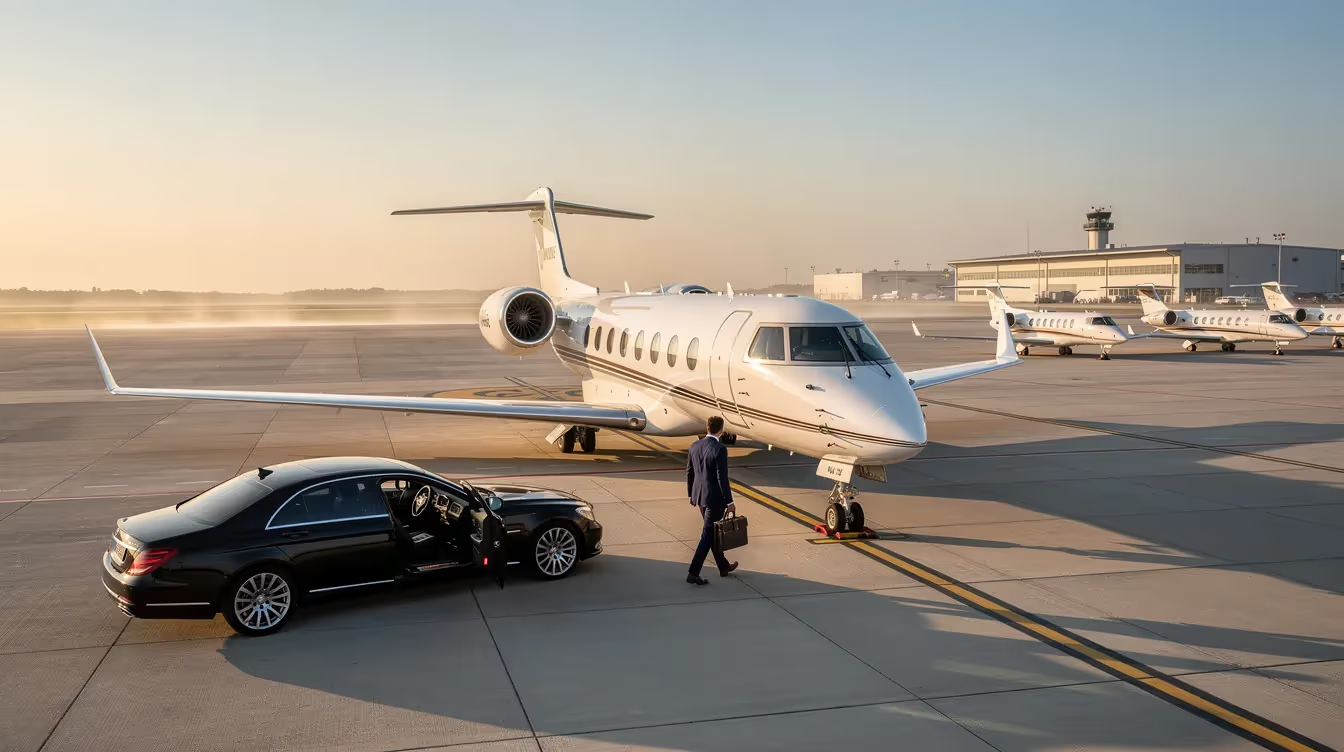
Choosing between commercial and private flights depends on your priorities for cost, convenience, privacy, and time savings. Commercial flights offer affordability and accessibility, while private flights provide flexibility, comfort, and a tailored travel experience.
– Commercial flights are typically more cost-effective for solo travelers and those on a budget.
– Private flights save time by minimizing airport wait times and allowing direct routing to more airports.
– Private aviation offers enhanced privacy, comfort, and the ability to customize the journey.
– Group travelers may find private flights competitively priced compared to business class fares.
– Technology platforms like Jettly make booking private jets easier and more transparent.
Travelers today frequently weigh commercial flights vs. private flights when planning business trips, family vacations, or urgent last-minute travel. The differences extend far beyond ticket price. Commercial air travel is generally more efficient and cost-effective, designed for higher passenger capacity, while private air travel offers enhanced comfort, flexibility, privacy, and luxury amenities.
Commercial flights operate as scheduled services, flown by large airlines such as Delta, Air Canada, and American Airlines, departing from major hubs such as JFK, LAX, or Heathrow. Commercial airline flights remain the standard option for most travelers due to their accessibility and affordability. Private flights, by contrast, are on-demand charters using smaller jets and turboprops, often departing from quieter airports and tailored entirely to passenger schedules.
Since 2020, demand for private aviation has surged. Industry data shows private jet activity surpassed 2019 levels by 2022–2024, entering 2026 with continued momentum. Platforms like Jettly connect travelers to a global network of private aircraft with transparent pricing and instant search, making charter booking as straightforward as searching for commercial tickets online.
This article provides a private jet vs commercial flight comparison, focusing on cost, comfort, privacy, convenience, and other key factors to help you decide which mode of air travel best suits your needs.
Commercial and private flights differ in time, flexibility, privacy, and cost, each serving different travel needs.
Private flights can save several hours on routes by eliminating airport queues, enabling direct routing, and offering flexible departure times.
Private flights avoid layovers, saving time and reducing travel stress.
Commercial flights are cheaper per seat, but private charters can be cost-effective for groups of 4–8, especially for urgent travel.
Jettly is a tech-driven private jet charter platform offering transparent pricing and instant search.
This is where the difference between commercial and private flights becomes immediately obvious: time spent on the ground before takeoff.
Commercial flights operate on fixed schedules to accommodate more passengers, often using large aircraft. Commercial passengers typically arrive 2–3 hours before domestic departures and 3–4 hours before international departures, such as London–New York. This accounts for check-in, bag drop, security lines, and zone-based boarding at crowded gates.
Commercial aircraft are designed to serve large groups, while private flights typically carry fewer passengers. Private aviation flips this entirely. Travelers arrive 15–30 minutes before departure at a Fixed Base Operator (FBO) or private terminal, often with curbside access and direct escort to the aircraft.
Comparison of Boarding and Airport Experience
Comparison of Boarding and Airport Experience
Arrival Time: Commercial flights require passengers to arrive 2–4 hours early, while private flights allow arrival just 15–30 minutes before departure.
Security Process: Commercial flights involve TSA and airport screening with long lines; private flights feature quick ID checks, minimal formalities, discreet security, and control over the passenger list.
Terminal: Commercial flights operate from large public hubs, whereas private flights use private Fixed Base Operators (FBOs) or terminals.
Boarding: Commercial boarding involves zone-based boarding, competition for overhead bin space, and long lines and security checks; private flights provide direct, streamlined access to the aircraft, bypassing these lines and checks.
A typical commercial flight day involves arriving early, standing in multiple queues, and waiting at the gate. Boarding a commercial plane means managing more passengers and adhering to fixed schedules, which can lead to delays and inconvenience during security checks, boarding, and cancellations. Check-in may be online or at the counter, but checked-bag fees, weight limits, and potential waits at major hubs add friction.
Security procedures require removing laptops and liquids, passing through body scanners, and navigating peak travel periods. Commercial airline flights use large aircraft to accommodate the high volume of travelers, with air hostesses or stewards assisting passengers and providing safety information during the flight. Boarding narrow-body jets like the Boeing 737 or Airbus A320 means competing for overhead bin space. The entire process can consume 45–90 minutes of a traveler’s day, not counting travel to and from the airport.
Private flights match the passenger’s schedule, not the other way around. With private jet charters, departure is tailored to your needs, allowing you to choose the exact takeoff time that best fits your itinerary. Arrival at an FBO involves a small reception area, a quick ID check, minimal paperwork, and direct access to the aircraft, with the departure time set according to your preference rather than a fixed airline schedule.
There are no standard queues for check-in, security, or boarding. Luggage is loaded by ground staff with more flexible baggage rules depending on aircraft size. The curb-to-takeoff process can take as little as 15–20 minutes in many North American and European cities.
Private flights often use secondary airports—Teterboro instead of JFK, Van Nuys instead of LAX, Toronto Buttonville instead of Pearson—reducing both airport congestion and ground transfer time. Jettly’s platform can arrange flights from these convenient local airports, simplifying the departure experience.
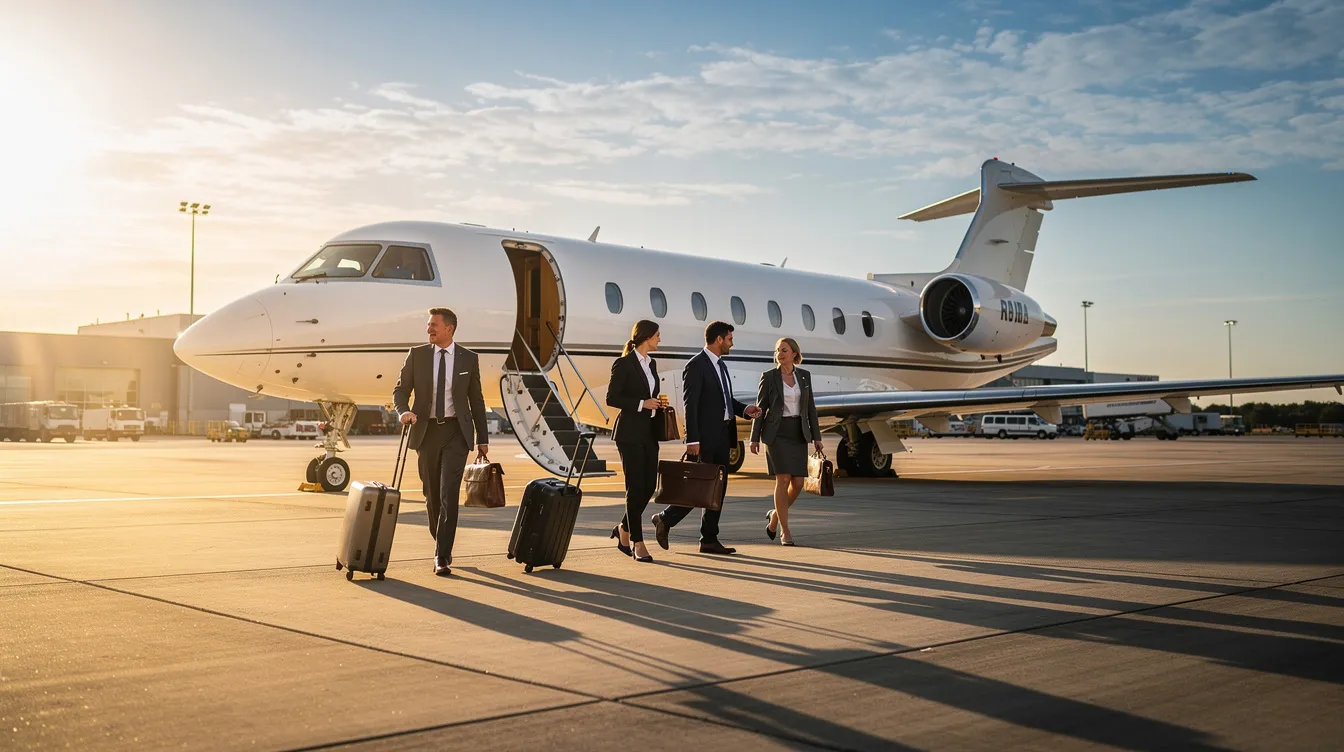
Once airborne, commercial and private flights differ most clearly in space, privacy, and customization. Private jets provide more space for passengers to relax or work, offering a level of comfort and freedom not typically found on commercial flights.
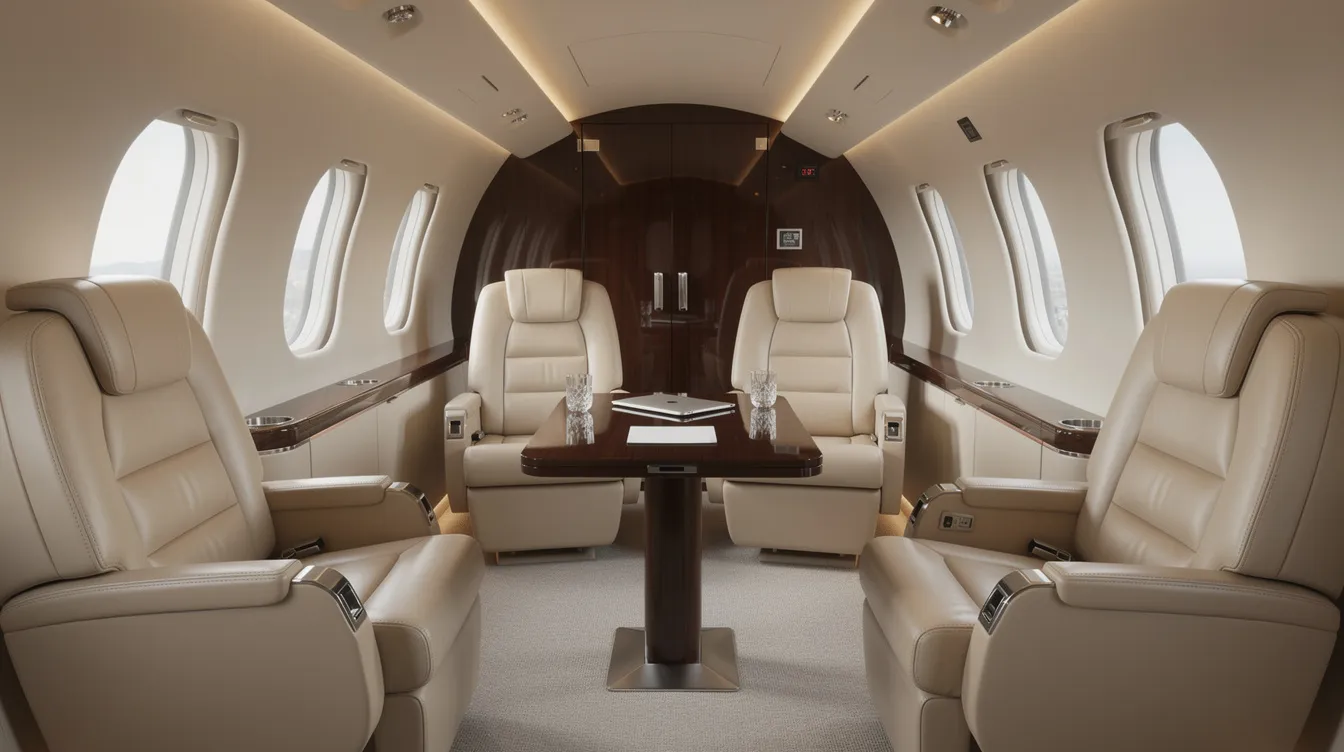
Private jets hold fewer passengers than commercial flights, providing more space and comfort for each individual. They often feature plush leather seats, custom interiors, and layouts designed for passenger comfort, including office areas and sleeping quarters, to maximize productivity and rest.
Commercial cabins are designed around seat density and standardized service, with differentiated cabins from economy through first class. Commercial airlines typically offer limited amenities, especially in economy class, where meals and refreshments may not be provided. By contrast, private flights offer luxurious amenities including gourmet meals and high-quality entertainment systems tailored to passenger preferences.
In commercial cabins, even business class and first class involve proximity to other passengers, public announcements, and general cabin noise. Private flights limit the cabin to the traveler’s invited group, enabling confidential meetings, family relaxation, or focused work.
A company leadership team could conduct a strategy session between New York and Chicago without concern about being overheard—a scenario impossible in commercial travel.
Commercial economy seating typically offers 30–32 inches of pitch. Private jets like the Citation XLS or Hawker 800XP feature spacious cabins with fully reclining seats, tables for laptops and meals, and swiveling chairs for face-to-face conversation, reflecting broader trends in the global private jet fleet toward comfort and productivity-focused design.
Large-cabin aircraft such as the Gulfstream G550 or Bombardier Global 6000 include lie-flat beds and separate sleeping areas for long-haul routes. Onboard catering for private flights can be tailored in advance to meet specific dietary requirements, children’s meals, or preferred beverages, and services like Jettly Eats in-flight catering for private jets further expand menu and provisioning options. Jettly charters can arrange bespoke catering, ground transportation, and cabin setup aligned with client preferences.
On commercial flights, productivity is constrained by noise, lack of privacy, and variable Wi-Fi quality. Many private aircraft offer high-speed connectivity where available, enabling email, video calls, and real-time collaboration.
Small teams can use flight time for presentations, board meetings, or deal reviews. A legal team might prepare for court en route, or executives could finalize a cross-border transaction while flying between Toronto and New York.
When comparing commercial flight vs private flight speeds, the real advantage lies in total journey time, not just raw cruising numbers. Private jets can travel faster than commercial airliners due to their lighter weight and ability to fly at higher altitudes, often achieving faster cruising speeds than commercial aircraft. This contributes to shorter overall travel times.
Many private jets cruise at Mach 0.78–0.90, comparable to commercial airliners such as the Boeing 777, which cruise at Mach 0.84–0.86.
However, private jets allow you to reach your final destination more directly, often bypassing major hubs. The time savings come from direct routing and streamlined ground processes. Private jets often fly at higher altitudes—up to 45,000 feet—above crowded airways, reducing delays.
Light and midsize jets like the Learjet 75 or Citation X can match or exceed typical airline cruise speeds. Private pilots select optimal paths where air traffic control permits, minimizing weather rerouting.
Combined with minimal pre-flight waiting and faster disembarkation, private flights often cut door-to-door travel by 1–3 hours on common business routes.
Private jets can access over 5,000 airports across the U.S., whereas commercial airlines are limited to about 500. This enables point-to-point routing to smaller fields near final destinations—New York to Nantucket, LA to Aspen, or Toronto to remote Ontario communities—and tools like Jettly’s airport locator help identify the most convenient airfields for each trip, complementing broader insights on where private jets typically land and airport access.
Travelers can use London Biggin Hill instead of Heathrow, or regional airports near industrial sites and vacation properties. Jettly’s platform lets users filter and select departure and arrival airports based on aircraft performance and runway requirements.
Commercial flights are generally much cheaper per seat, particularly for single travelers or long-haul flights. This affordability stems from commercial airlines prioritizing economy over luxury, spreading costs across many passengers, and allowing lower ticket prices. Commercial airlines also offer consistent, reliable service for major city-to-city travel.
Private flights typically cost thousands of dollars per hour, reflecting their exclusivity and personalized service. Private jets tend to be more expensive than commercial flights because travel expenses are not shared among hundreds of passengers. The price of flying private versus commercial can vary significantly depending on factors such as the type of aircraft, distance, and additional costs like crew salaries and maintenance.
When groups of 4–8 share a private jet, the per-person cost can approach or sometimes be lower than business class fares on commercial airlines, especially for time-sensitive or remote-location travel. Private flights are often more cost-effective for groups or when flying to remote locations with limited commercial routes, and options like buying a seat on a private jet via shared and semi-private services or crowdsourcing private jet flights and sharing empty seats can make this even more accessible.
Empty-leg flights and special one-way deals can significantly reduce private jet costs, and using a private jet charter cost estimator or a dedicated jet card flight cost estimator can help you understand how factors like distance and aircraft size affect pricing.
Key drivers include aircraft category (turboprop, light jet, midsize, heavy jet), distance, overnight crew costs, de-icing, and peak holiday demand.
Jettly’s platform enables users to compare options across aircraft categories and see transparent pricing before confirming a charter, and its private jet memberships provide additional benefits and wholesale rates for frequent travelers, while its ULTRA high ticket affiliate program allows partners to earn by referring new clients. Learn more about Jettly’s charter options.
Both commercial airlines and reputable private charter operators must adhere to the Federal Aviation Administration's (FAA's) safety and maintenance requirements. Air travel remains statistically among the safest transportation modes, with the injury rate for airline passengers in the United States close to 0 per 100 million passenger miles.
Private jets are bound by the same safety regulations as commercial flights. Both private and commercial pilots must be licensed, undergo rigorous training, and accumulate significant flight experience before carrying passengers. Reputable operators explain how Jettly offers affordable private jet charter while maintaining strict safety and regulatory standards.
Commercial airlines keep passengers safe through standard TSA screening processes, while private flights offer discreet security with fewer passengers and controlled access.
Private jets might be safer than commercial flights because they are smaller and carry fewer passengers, reducing exposure to risk.
Private flights offer flexible scheduling, allowing passengers to arrive at the airport just 15–30 minutes before departure. This contrasts sharply with commercial flights, where long security lines, crowded terminals, and fixed schedules can consume valuable business time.
Private travel allows personalized schedules, access to smaller airports, minimal security, and maximum privacy. Passengers enjoy a hassle-free experience that often starts before they leave home, with transport and ground arrangements handled seamlessly, whether they’re flying with major providers like NetJets, the industry leader in private aviation, or on-demand charter platforms.
Private flights often allow same-day return trips, reducing downtime and hotel costs. Private passengers use Fixed-Base Operators (FBOs), allowing them to bypass TSA lines and board in minutes.
Commercial flights make sense for:
Solo travelers or couples on flexible schedules
Budget-sensitive trips
Routes with frequent service and competitive fares
Private flights make sense for:
Business executives with tight schedules
Families seeking direct access to vacation destinations
Groups traveling together for events
Travelers heading to remote locations
Flying commercially offers lower costs and more frequent routes, but comes with less privacy, less flexibility, and longer boarding procedures compared to private options.
Flying private vs commercial means enjoying greater flexibility, privacy, and the ability to use smaller airports, but at a higher cost. Private and commercial flights each have unique advantages depending on the traveler's needs.
Private flights support roadshows, site visits, and multi-city meetings in a single day—Boston to Chicago to Dallas and back. Saved hotel nights, fewer missed meetings, and higher productivity can offset higher flight costs, especially when working with top private jet charter companies and providers that specialize in business travel.
Privacy for sensitive discussions matters in finance, law, tech, and government sectors. Jettly’s platform allows travel coordinators to arrange complex multi-leg itineraries quickly and also serves as a flexible NetJets alternative for companies that prefer on-demand charters over fractional ownership.
Families benefit from flexible departure times tailored to their schedules, easier handling of strollers and special items, and direct access to smaller vacation airports, and guides to the best private planes for families can help match aircraft types to specific trip needs.
When 6–10 travelers share a private jet to destinations like Las Vegas or Caribbean resorts, per-person costs can approach premium commercial fares. Jettly matches group sizes with suitable aircraft categories, from turboprops for short hops to heavy jets for transcontinental trips, whether you’re flying popular routes in North America or booking private jet charter services in Kolkata, West Bengal, and other global hubs.
Jettly is a digital platform that modernizes how travelers search, compare, and book private flights worldwide. Users enter route, dates, and passenger count to see real aircraft options, indicative pricing, and flight times.
Key features include transparent pricing, access to multiple aircraft categories, jet card programs for frequent flyers, membership options for frequent flyers, and support from aviation specialists. Jettly’s technology helps optimize routes and aircraft choices, potentially reducing empty legs and improving cost-efficiency.
Ready to enjoy private travel tailored to your preferences? Discover available flight options or request a personalized quote at https://www.jettly.com.
| Feature | Commercial Flight | Private Flight |
|---|---|---|
| Cost per Seat | Lower, especially for solo travelers | Higher, but can be competitive for groups |
| Scheduling | Fixed airline schedules | Flexible, tailored to passenger needs |
| Airport Arrival Time | 2–4 hours before departure | 15–30 minutes before departure |
| Privacy | Shared cabin with other passengers | Exclusive cabin for your group |
| Airport Access | Major airports and hubs | Thousands of smaller airports and FBOs |
| In-Flight Comfort | Basic to premium (economy to first class) | High: spacious seats, custom amenities |
| Luggage Policy | Strict per-bag and weight limits | More flexible, limited by aircraft size |
| Security | Standard TSA screening and lines | Quick ID check, minimal lines |
These FAQs address common questions about practical details, especially for first-time private flyers considering their options.
Private flights are governed by total weight and cargo hold size rather than strict per-bag rules. However, light jets have limited baggage capacity, and hard suitcases may be restricted on short runways even with empty seats. Share luggage details with the charter provider in advance so an appropriate aircraft can be selected.
Many private charters allow pets in the cabin, subject to operator policies and destination regulations. This is typically more comfortable for animals than commercial cargo holds. Ensure vaccination records, pet carriers, and any import/export rules are prepared for international routes.
Private flights can often be arranged within hours for urgent trips, but 24–72 hours’ notice generally offers more aircraft choices and better pricing. During peak seasons or major events like Formula 1 weekends, booking earlier helps secure preferred aircraft and slots.
Per passenger, private flights can have a higher carbon footprint because fewer people are on board. Many providers, including those working with Jettly, offer carbon offset programs and efficient aircraft options. Ask about offsetting, aircraft choice, and route optimization if environmental impact is a key concern.
For flying internationally, passengers need valid passports and visas, just as on commercial flights. Aircraft and operational insurance are handled by the charter operator. Check entry requirements for destinations and confirm documentation for minors or pets in advance.
The contrast between commercial and private flights spans airport experience, in-flight comfort, time savings, cost structures, and operational flexibility. Commercial flying suits cost-conscious, flexible travelers. Private flying serves those who prioritize time, privacy, and tailored itineraries.
Private flights unlock access to thousands of smaller airports and enable complex multi-stop routes that commercial schedules cannot match. For business travelers facing tight timelines or families seeking convenience, private aviation delivers measurable value beyond simple luxury, especially on long-haul and cross-border itineraries where private jets flying internationally can combine direct routing with streamlined customs procedures. Travelers comparing providers can also review the ultimate list of charter airlines and private flight options to better understand how Jettly fits into the broader market.
Share this post:
Jay Franco Serevilla
Apr 12, 2026
|
5
min read
Discover tips and trends in the industry.
5
min read
Boeing 737 Seat Capacity: How Many Passengers Can Each Variant Carry?
The Boeing 737 is the most-produced commercial jetliner, with a seating capacity ranging from 85 to 230 passengers depending on the variant and configuration. This guide explores the seating capacities of various 737 models, highlighting how cabin layouts and airline choices impact passenger comfort and efficiency. Understanding these factors is crucial for travelers and airline planners alike.
Read More
5
min read
Empty Leg Flights Phoenix: How to Save on Private Jets from the Valley
Empty leg flights from Phoenix provide an excellent opportunity for travelers to save significantly on private jet charters. These one-way repositioning flights often offer discounts of 25-75%, making them a cost-effective choice for both business and leisure travelers. With multiple airports and a variety of aircraft available, flexible travelers can take advantage of these deals for spontaneous trips.
Read MoreStay updated with our latest insights and tips to elevate your journey with us.
MEMBERSHIPS AND ASSOCIATIONS



Disclaimer: Jettly operates as a charter broker, offering access to a global digital jet charter marketplace. Jettly is not a direct air carrier and does not own or operate aircraft. All advertised flights are conducted by third-party air carriers that are fully licensed and hold the appropriate Part 135 or Part 121 certifications issued by the Federal Aviation Administration (FAA) or equivalent regulatory authorities under U.S. or foreign law. Jettly complies fully with the U.S. Department of Transportation's Part 295 and Part 298 Charter Broker regulations. Jettly does not carry additional liability insurance. Passengers are covered by aircraft operator insurance. TICO: 50023770


