



Login
Get Instant Pricing On 23,000+ Aircraft

>
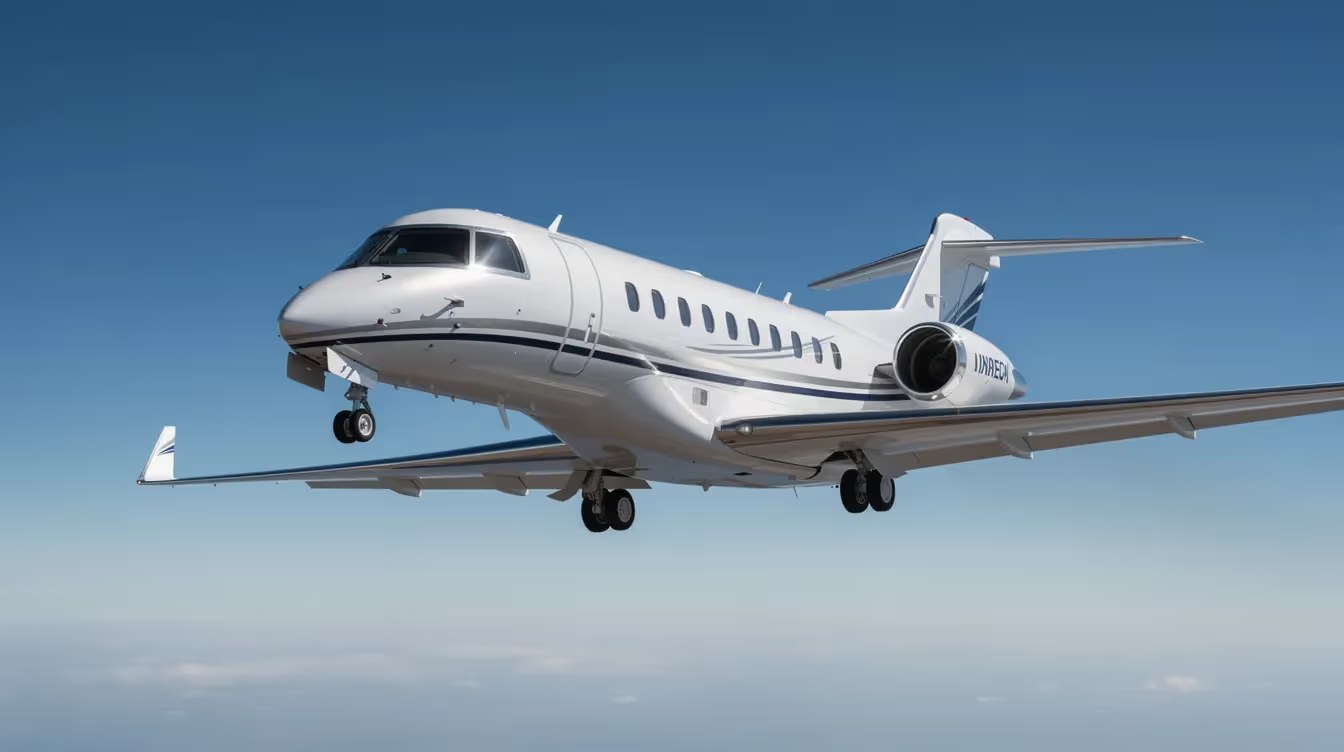
The Cessna 550 Citation Bravo, developed by the company Cessna—a leading business jet manufacturer—remains one of the most recognized light business jet options in private aviation. Developed as a cost-effective, high-performance upgrade to the Citation II, the Citation Bravo was produced from 1997 to 2006, with a total of 336 units delivered. This aircraft continues to serve charter operators and private owners worldwide. For travelers seeking a balance of speed, range, and operating economics, the Citation Bravo offers a proven platform for short to medium-range missions.
The Cessna 550 Citation Bravo is an upgraded variant of the Cessna Citation II family, manufactured between 1997 and 2006, with approximately 330+ aircraft delivered during its production run.
The aircraft typically seats 7 to 9 passengers and 2 crew members, with a comfortable cabin volume of about 278 cubic feet and baggage capacity of around 74-76 cubic feet.
It cruises around 400 knots, offers a maximum range of up to 2,000 nautical miles, and can operate from runways as short as 3,600 feet thanks to its short-field capabilities.
Two Pratt & Whitney Canada PW530A engines power the Citation Bravo, delivering improved thrust and approximately 25% better fuel efficiency compared to earlier Citations equipped with JT15D powerplants.
The aircraft features trailing-link landing gear for smoother landings and a Honeywell Primus 1000 glass cockpit for advanced avionics.
Certified for single-pilot operations, the Citation Bravo can provide cost savings for operators with appropriate training and regulatory approval.
Pre-owned Citation Bravo aircraft are available in the USD 1.25 million to USD 3 million range, supported by a strong resale market due to the aircraft’s reliability, comfort, and efficiency.
The estimated total cost of operation for a Citation Bravo, based on 300 flight hours per year, is approximately $1,328,768, including fixed and variable costs. Fuel consumption is about 170 gallons per hour, translating to roughly $1,068 per hour at a fuel price of $6.28 per gallon.
The aircraft has a service ceiling of 45,000 feet and a rate of climb of 3,190 feet per minute.
The cabin design includes bagged insulation and an isolated interior shell to minimize low-frequency engine noise, with increased headroom by 5 inches over its predecessor for enhanced passenger comfort.
Travelers can charter a Cessna Citation Bravo through Jettly for business trips, family travel, and point-to-point regional flights with transparent pricing and instant booking.
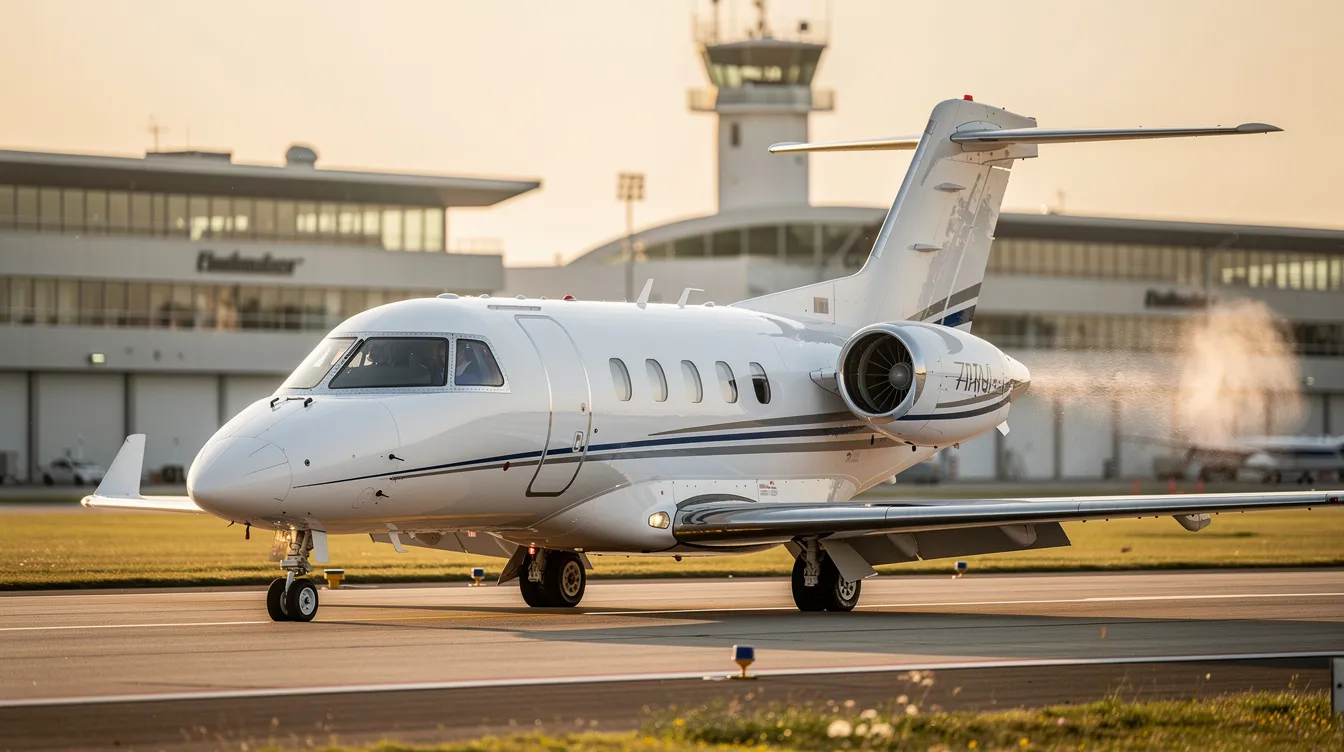
The Cessna 550 Citation Bravo, a stretched version of the Citation S/II, first flew on April 25, 1995, was certified in August 1996, and entered service in February 1997 as a modernization of the Citation II and S/II airframes. Production ended in 2006 after Cessna delivered over 330 aircraft to operators worldwide. The model retains the proven Model 550 fuselage and supercritical wing design while incorporating more powerful engines, updated flight deck equipment, and cabin refinements.
Central to the upgrade, the Bravo replaced the JT15D engines with new Pratt & Whitney Canada PW530A turbofans, which provided 15% more thrust at takeoff and 23% more at altitude compared to its predecessors. The aircraft also received modern avionics, commonly the Honeywell Primus 1000 EFIS system, improving situational awareness for pilots. These changes positioned the Bravo as a cost-effective light jet suited for routes like New York to Miami, Los Angeles to Las Vegas, or London to Madrid.
Earlier in the Citation family, the Citation ISP was introduced in 1977, produced until 1985, and later developed into the Citation II, illustrating the evolution and replacement of older models with more advanced versions.
The Citation Bravo is based on the Cessna Model 550 airframe, maintaining the straight wing and T-tail configuration that defined earlier Citation models. This design delivers forgiving handling characteristics and short field capability, making it well-suited for operation at smaller regional airports with shorter runway lengths.
Major design changes from the Citation S/II include:
Replacement of JT15D engines with PW530A turbofans, delivering approximately 15% more thrust at takeoff
Modernized flight deck with Honeywell Primus EFIS displays for better communications and navigation
Revised cabin insulation with bagged materials and an isolated interior shell to reduce low-frequency engine noise
A secondary seal on the cabin door to minimize wind noise at cruise altitude
Trailing-link landing gear for smoother landings
The aircraft is certified for two-pilot operation but is also approved for single-pilot operations under specific regulatory exemptions, providing potential cost savings for operators with trained pilots. For frequent travelers, private jet memberships can similarly optimize costs across multiple missions. Pilots require type-specific training covering systems, performance, and emergency procedures before they can fly this model.
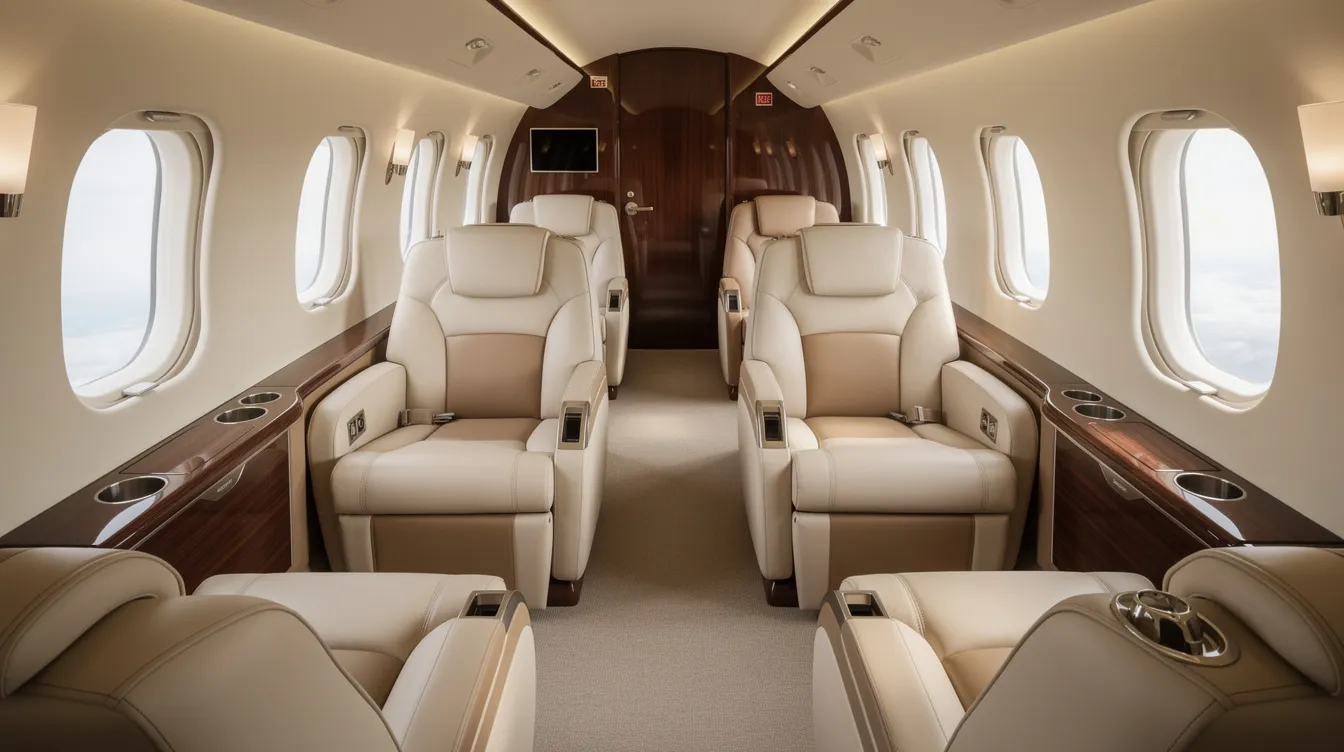
The Citation Bravo cabin offers approximately 278 cubic feet of volume, with dimensions roughly 15.8 feet long, 4.8 feet wide, and 4.8 feet high. It typically accommodates 7 to 9 passengers plus 2 crew members in most layouts. The typical arrangement features a four-seat club configuration in the aft cabin, two forward-facing seats near the galley, and an optional belted seat near the lavatory entrance.
Comfort features include:
Bagged insulation and an isolated interior shell reduce engine fan noise
Increased headroom by 5 inches compared to its predecessor
Generous window placement provides natural light throughout the fuselage
An enclosed rear lavatory with basic facilities
A small refreshment center or cabinet for drinks and snacks during the flight
Baggage capacity totals approximately 74-76 cubic feet in external compartments, suitable for one medium suitcase and one carry-on per passenger for a group of five to seven travelers. For charter customers using Jettly, the cabin proves quiet enough for in-flight work and comfortable for family groups, with catering options available upon request, and tools like Jettly’s airport locator platform help match the Bravo’s capabilities to convenient regional airfields.
The Citation Bravo balances cruise speed, range, and operating cost in a package efficient for regional and light transcontinental routes under 2,000 nautical miles.
Key performance figures include a long-range cruise of approximately 335 knots and a high-speed maximum speed of 400 to 402 knots. The maximum range reaches nearly 2,000 nm in long-range configuration, while typical operations with a full passenger load yield approximately 1,290 nm. Takeoff distance is around 3,600 feet, with landing distance approximately 3,180 feet at standard conditions.
The propulsion system consists of two Pratt Whitney Canada PW530A turbofan engines, each producing roughly 2,887 pounds of thrust. This represents a significant upgrade over earlier JT15D-powered models, delivering better climb rates (approximately 3,190 feet per minute) and improved hot-and-high performance.
Dimensions and weights place the aircraft firmly in the light business jet category:
|
Specification |
Value |
|---|---|
|
Length |
47 ft 3 in |
|
Wingspan |
51 ft 8 in |
|
Max takeoff weight |
14,800 lb |
|
Gross weight (max ramp) |
15,000 lb |
|
Fuel capacity |
4,860 lb |
|
Service ceiling |
45,000 ft |
For charter customers, these figures translate to nonstop routes like Toronto to Miami, Paris to Athens, or Chicago to Denver, with the ability to access smaller business airports closer to final destinations, and Jettly’s private jet charter cost estimator can help approximate pricing for such missions.
The Citation Bravo maintains popularity on the pre-owned market due to its blend of reasonable acquisition cost, manageable fuel burn, established maintenance infrastructure, and a strong resale market driven by its reliability, comfort, and efficiency. As of 2021, the typical resale price for a Cessna Citation Bravo ranges from $1.25 million to $3 million, depending on the aircraft's age and condition, with a number of units available for sale at any given time. Production of the Citation Bravo ceased in late 2006 after a total of 336 units had been delivered, further supporting its value retention in the resale market.
Used Citation Bravo prices commonly fall between USD 1.25 million and USD 3 million. Aircraft from early production years (1997-2000) trend toward the lower end, while later models with modern avionics and recent interior refurbishment command higher values, and broader market trends among top private plane manufacturers also influence long-term value.
The estimated total cost of operation for a Citation Bravo, based on 300 flight hours per year, is approximately $1,328,768, which includes both fixed and variable costs. Direct operating costs average in the low-to-mid USD 2,000s per flight hour. Published analyses cite approximately USD 2,400 per hour, including fuel and routine maintenance. Fuel consumption is about 170 gallons per hour, translating to a fuel cost of $1,068 per hour at a fuel price of $6.28 per gallon. Maintenance costs for the Citation Bravo average around $810 per flight hour, including routine maintenance and engine program costs. Annual fixed costs for ownership—covering pilots, hangar, insurance, and training—typically reach USD 400,000 or more at around 300 flight hours annually.
For charter customers using Jettly, these ownership costs are already factored into hourly charter rates. Travelers pay only for hours flown without long-term ownership commitments or capital outlay, and can reference Jettly’s guide on affordable private jet charter pricing to understand how those rates are structured.
Jettly includes the Cessna 550 Citation Bravo in its global on-demand fleet as a core light jet option for four to seven passengers seeking efficient regional travel.
Common use cases include:
Same-day business travel: A morning departure from New York to Chicago (approximately 790 nm, 2-hour flight), conduct meetings, and return the same evening
Family holiday flights: London to Palma de Mallorca (approximately 760 nm) with direct access to executive airports, saving time versus commercial hub connections
Time-sensitive travel: Medical transport or emergency business trips where schedule control and airport proximity matter most
The platform offers instant pricing and real-time availability for Citation Bravo and comparable aircraft. Customers can compare options across very light jet, midsize, and turboprop categories based on route, passenger count, and budget. Membership options can reduce per-hour costs for frequent users without requiring fractional ownership or traditional jet card programs.
Learn more about Jettly’s charter options at https://www.jettly.com.

Travelers often compare the Cessna 550 Citation Bravo to other popular light jets when selecting the best aircraft for a mission.
Against earlier Cessna Citation II and S/II models, the Bravo offers improved engines (PW530A versus JT15D), a quieter cabin, and more modern avionics. The first flight of the upgraded variant in 1995 marked a significant step forward, and production ceased in 2006 after establishing the model’s reputation.
Compared to the Learjet 31/31A or Hawker 400XP, the Citation Bravo trades some speed for better fuel efficiency and stronger short-runway performance. The Learjet offers faster cruise (up to 511 knots) but higher operating costs and a smaller cabin. The Hawker 400 series provides excellent altitude capability but similar trade-offs in cabin size.
The Bravo is often chosen for:
Balanced fuel efficiency and range for regional routes
Strong field performance at airports with 3,500 to 4,000-foot runways
Widely available maintenance support and parts improve dispatch reliability
When customers request quotes via Jettly, the platform surfaces Citation Bravo options alongside similar jets from its global private charter aircraft network, allowing customers to compare hourly rates, flight times, and airport options before booking.
The Citation Bravo’s light jet size and efficient PW530A engines make it relatively fuel-efficient for missions of 500 to 1,500 nautical miles compared with larger cabin jets.
Selecting an appropriately sized aircraft—such as a Citation Bravo instead of a midsize or heavy jet for four passengers—can reduce total fuel burn and operating impact per passenger by 20 to 30 percent. Some charter operators participate in carbon offset or sustainability initiatives, and Jettly customers can explore options to offset emissions when booking or even use shared-flight tools that crowdsource private jet flights and empty seats to improve overall aircraft utilization.
Operational efficiencies include the ability to use secondary airports closer to final destinations, reducing total surface travel time. Direct routings often prove faster than commercial connections on regional city pairs, lowering overall trip duration, and many of the same factors discussed when choosing the best cross-country aircraft apply when deciding if a Citation Bravo is the right fit.
This section addresses common questions about chartering and operating the Cessna 550 Citation Bravo that are not fully covered in the main text.
A Citation Bravo usually accommodates luggage for five to seven passengers, such as one medium suitcase and one small carry-on per person, within overall weight and balance constraints. Bulky items like golf bags or skis may be possible, but should be confirmed when booking through Jettly so the operator can verify dimensions and capacity. Share approximate luggage details when requesting a quote to ensure the aircraft is suitable.
Not every Citation Bravo is equipped with in-flight Wi-Fi, as connectivity depends on the specific aircraft’s installation and operator service plan. Request Wi-Fi as a requirement when using Jettly so the platform can prioritize aircraft with onboard connectivity. Where installed, Wi-Fi is usually adequate for email, messaging, and light browsing, though streaming may be restricted.
The Bravo’s takeoff and landing performance make it well-suited for many regional and executive airports with runways in the 3,500 to 4,000-foot range, subject to weight, altitude, and weather conditions. Jettly can help identify convenient airports closer to city centers than major commercial hubs. Local noise restrictions and operating hours may apply and should be checked during trip planning.
The Citation Bravo is type-certified for two-pilot operation, and most commercial charter flights use a captain and first officer for redundancy and safety. Any single pilot operation depends on regulatory approval, operator procedures, and specific training. Charter customers booking through Jettly can be assured that flights use properly certified operators meeting applicable crew requirements.
While the platform can often accommodate short-notice requests, booking several days to a week in advance typically provides more aircraft choice and better pricing. Peak periods, such as major holidays or events, may require earlier booking for popular routes served by light jets. Use Jettly’s instant pricing and quote tools as soon as travel dates are confirmed to secure availability.
The Cessna 550 Citation Bravo remains a strong light jet option for passengers who value reliable performance, reasonable operating economics, and access to smaller airports. With FAA certification maintained across its global fleet and established service infrastructure, the aircraft continues to serve charter and corporate operations effectively.
Key strengths include seating for up to eight passengers, cruise speed near 400 knots, maximum range approaching 2,000 nm under optimal conditions, and a quiet, comfortable cabin for business or leisure travel. The model’s proven track record since its first flight in the mid-1990s and widespread availability make it a practical choice within the light business jet category.
Ready to experience private travel on your terms? Explore flight options or request a quote at https://www.jettly.com.
Share this post:
Jay Franco Serevilla
Apr 18, 2026
|
5
min read
Discover tips and trends in the industry.

5
min read
Dallas Helicopter Ride and Dinner: How to Plan an Unforgettable Night in the Sky
Experience the magic of Dallas from above with a helicopter ride followed by a delightful dinner. This unique package offers breathtaking views of the city skyline, making it perfect for romantic evenings or special celebrations. With options for custom routes and dining experiences, planning an unforgettable night in the sky has never been easier.
Read More
5
min read
Zimex Aviation: Specialist Missions, Fleet, and Career Opportunities
Zimex Aviation, established in 1969, specializes in flying to remote and challenging environments where conventional airlines often cannot operate. With a diverse fleet of turboprop aircraft, Zimex provides essential services such as oil and gas logistics, humanitarian airlift, and express cargo. The company emphasizes safety and operational excellence, making it a key player in the global logistics and humanitarian support sectors.
Read MoreStay updated with our latest insights and tips to elevate your journey with us.
MEMBERSHIPS AND ASSOCIATIONS



Disclaimer: Jettly operates as a charter broker, offering access to a global digital jet charter marketplace. Jettly is not a direct air carrier and does not own or operate aircraft. All advertised flights are conducted by third-party air carriers that are fully licensed and hold the appropriate Part 135 or Part 121 certifications issued by the Federal Aviation Administration (FAA) or equivalent regulatory authorities under U.S. or foreign law. Jettly complies fully with the U.S. Department of Transportation's Part 295 and Part 298 Charter Broker regulations. Jettly does not carry additional liability insurance. Passengers are covered by aircraft operator insurance. TICO: 50023770


