



Login
Get Instant Pricing On 23,000+ Aircraft

>
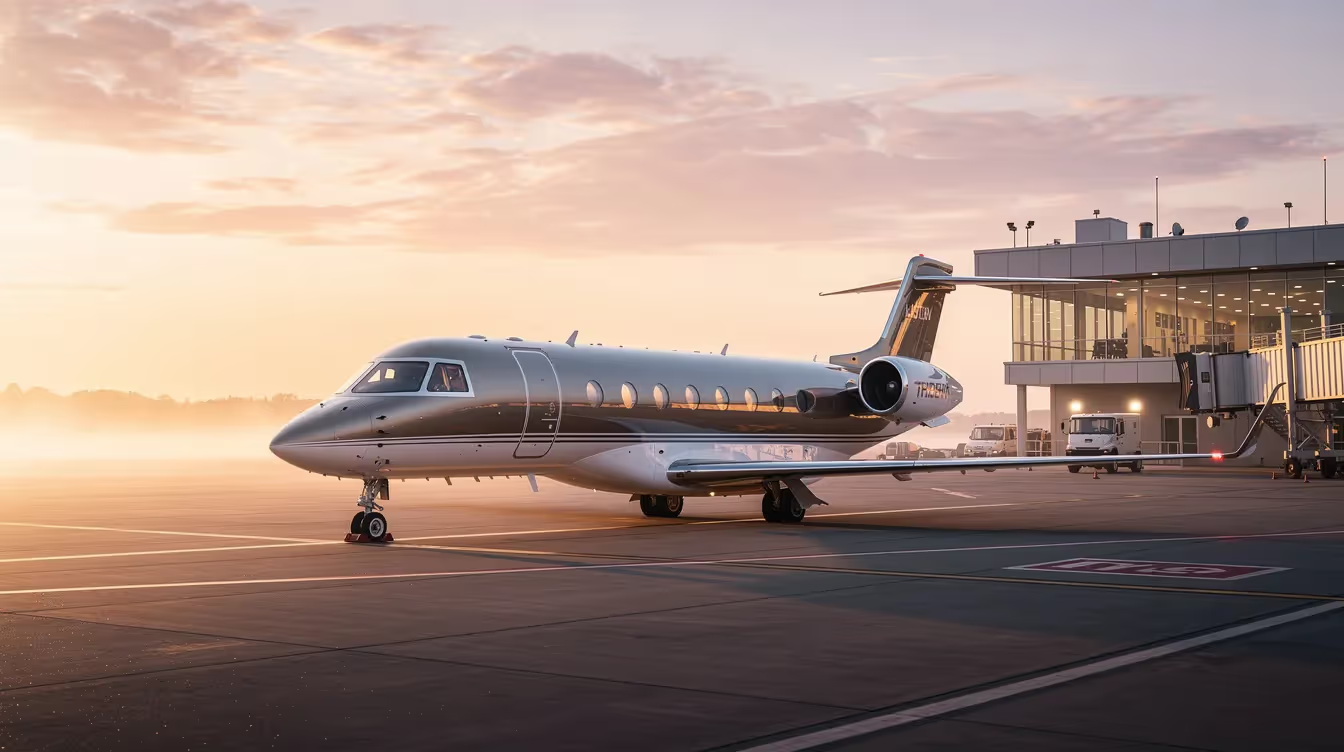
Business jets play a vital role in modern corporate and private travel, offering unmatched flexibility, convenience, and efficiency. Unlike commercial flights, business jets provide direct access to thousands of airports worldwide, enabling travelers to save time by avoiding busy terminals and lengthy security lines. These aircraft are powered by advanced technology and designed to serve diverse travel needs, from short regional hops to intercontinental journeys.
Over the next decade, the business jet market is expected to evolve with innovations in sustainability, connectivity, and aircraft design, enhancing the ability of companies and individuals to travel smarter. Whether for urgent business meetings, family vacations, or emergency travel, business jets offer a tailored experience that prioritizes privacy, comfort, and productivity.
Jettly’s platform simplifies access to this world by connecting travelers with a wide range of business jets, transparent pricing, and instant booking options. This guide explores the key aspects of business jets, helping users understand their benefits, categories, and how to choose the right aircraft for their needs.
A business jet is central to business aviation because it saves time, protects privacy, and turns travel into productive work time.
Business jets range from turboprop aircraft and light jets to ultra-long-range flagships and bizliners like Boeing Business Jets.
The world’s fastest business jet class today cruises near Mach 0.95, helping executives fly faster on nonstop intercontinental routes.
Jettly gives on-demand access to over 20,000 business aircraft without full ownership, fractional commitments, or rigid airline schedules.
Travelers can compare aircraft types, pricing models, routing options, catering, and ground transport, then request instant quotes online.
A business jet is an aircraft used mainly for corporate, government, and high-net-worth travel. It helps business teams avoid airlines, access regional airports, and control their schedule.
Business aviation matters because time matters. A CEO can fly from New York to Chicago in a light jet, attend a board meeting, and return the same day. A team can shuttle London–Zurich in a midsize aircraft without waiting through commercial connections.
Private aviation also supports confidential work. Cabins provide high-speed connectivity, privacy, and space for teams to work without interruption, allowing them to hold meetings en route. Flights offer a controlled environment that allows executives to handle sensitive intellectual property and negotiate mergers.
Executives arrive at private terminals minutes before departure, eliminating hours of waiting at security lines. Business jets eliminate long security lines, rigid airline schedules, and layovers, using regional airports closer to the final destination.
Jettly connects customers with vetted operators worldwide. Learn more about Jettly’s charter options at https://www.jettly.com.
A typical charter journey is simple: search, quote, choose aircraft, book, then coordinate flight-day logistics. With Jettly, users enter a route such as Los Angeles–Las Vegas, travel dates, and passenger count to see real-time options.
Jettly’s platform gives access to a global fleet of 20,000+ jets and other aircraft. It supports on-demand charter, private jet membership plans, and trip management without long-term contracts.
Companies must decide if full ownership makes financial sense, with fractional ownership or on-demand charter services being more cost-effective for less frequent flights. Many executives compare leading programs using resources on the best fractional jet ownership companies. Fractional ownership of aircraft involves an individual or corporation that pays an upfront equity share for the cost of an aircraft, allowing them to become an equity owner and access flight time on that aircraft or others in the fleet.
Under fractional ownership arrangements, overhead costs such as flight crew, hangarage, and maintenance are split among the users, making it a cost-effective option for accessing business aviation. Readers evaluating these programs can benefit from a detailed breakdown of fractional jet ownership costs. In the United States, fractional-ownership operations may be regulated by either FAA part 91 or part 135, which govern different operational standards and requirements for aircraft operations.
Jettly also coordinates support services, such as in-flight catering through Jettly Eats, ground transportation, and 24/7 trip support.
Business aircraft can be grouped by size, range, cabin, speed, and cost. Business jets can be categorized according to their size, including very light jets (VLJs), light jets, midsize jets, super-midsize jets, large jets, and heavy jets.
Decision-makers must consider route distances, passenger headcounts, budget limits, and amenities when choosing the right aircraft. Passenger capacity and cabin configuration should be considered to ensure adequate workspace and amenities during flights.
Very light jets (VLJs) typically accommodate 6–7 passengers over an average range of 1,174 nautical miles and have a mean price of around $4.4 million. Super mid-size jets usually accommodate 10–11 passengers with an average range of 3,420 nautical miles and a mean price of approximately $22.2 million.
Large cabin jets typically accommodate 9 passengers over a range of 2,540 nautical miles, with a mean price of about $15.7 million. Heavy jets can accommodate 12–19 passengers and have an average range of 6,500 nautical miles, with a mean price of around $61.2 million.
Hourly charter rates often range from about USD 2,500 for turboprops to USD 12,000+ for larger long-range jets, and travelers can use a private jet charter cost estimator to model trip-specific pricing.
Turboprop aircraft such as the Beechcraft King Air 350i and Pilatus PC-12 are practical for short runways, regional airports, and 1,500–1,800 nmi missions. They suit routes like Toronto–Montreal or Dallas–Houston.
Light Jets are excellent for short-haul trips of 2-3 hours, offering speed and efficiency for smaller teams. A light jet such as the Embraer Phenom 300E, Cessna Citation CJ4 Gen2, HondaJet Elite II, or Embraer Phenom 100EX often carries 4–7 passengers and cruises near Mach 0.70–0.76.
This class works well for New York–Miami, London–Geneva, and similar routes. Companies flying into shorter runways or smaller regional airports require jets with superior short-field performance, often starting their planning with an airport locator tool for private jets.
Midsize and super midsize jets balance range, cabin space, and cost. Examples include the Praetor 500 and 600, Cessna Citation Latitude and Longitude, Gulfstream G280, and Bombardier Challenger 3500.
Midsize Jets offer more comfort and range (approx. 2,000–3,000 miles) for larger teams of 8-10 passengers, suited for mid-range flights. Super midsize aircraft can stretch toward 3,500–4,000 nmi.
Many corporate users choose this class for North American roadshows, multi-city European trips, and shorter transatlantic missions, reflecting demand patterns across the global fleet of private jets. Cabins serve as secure, quiet boardrooms with high-speed Wi-Fi for confidential meetings.
Large cabin and ultra-long range models include the Gulfstream G700 and G800, Bombardier Global 7500 and Global 8000, and Dassault Falcon 8X. These aircraft can carry 12–19 passengers and fly routes such as New York–Hong Kong.
The Global 8000 is one of the world’s fastest business jets, with near-Mach-0.95 performance and an advertised 8,000 nmi range. The Global 8000 business jet features the industry’s lowest cabin altitude of just 2,691 feet, which helps reduce jet lag for passengers.
Bizliners include Airbus Corporate Jets and Boeing business jets based on commercial airframes. Boeing Business Jets may use 737 MAX or 787 platforms for VIP delegations, sports teams, and government travel, sitting at the top end of the spectrum of private and charter airlines.
The major business jet manufacturers include Airbus Corporate Jets, Boeing Business Jets, Bombardier, Dassault, Embraer Executive Jets, Gulfstream, HondaJet, and Textron.
These manufacturers define the market through different models, cabin designs, wing technology, avionics, thrust levels, and performance targets. Jettly aggregates aircraft from these companies, helping customers choose by age, configuration, service quality, and budget.
Bombardier is recognized as the world’s third-largest aircraft manufacturer, with a diverse range of business jets including the Global and Challenger series. Bombardier inc launched the Global 7500, which entered service in 2018, and positioned the Global 8000 as the world’s fastest business jet contender.
The Global family is built for long-range, passenger comfort, and productivity. It is capable of missions such as Los Angeles–Singapore or London–Perth, depending on payload and weather.
Bombardier and other OEMs use advanced systems; Honeywell’s Primus Elite Synthetic Vision enhances cockpit safety and sophistication in business jets. The LASEREF IV is a digital gyro-based inertial reference system that improves navigation and communication in business jets.
Gulfstream Aerospace specializes exclusively in corporate aircraft and is known for producing long-range, large-cabin business jets, including the G800, which has the longest range of any business jet at 8,200 nautical miles.
According to Gulfstream, the G800 combines long range with top speed near Mach 0.935. Its cabin offers low cabin altitude, large windows, and multiple zones for work, dining, and rest.
This matters on overnight missions such as New York–Dubai, where compressed travel schedules minimize jet lag, keeping executives sharp for high-stakes negotiations.
Embraer executive jets span the Phenom 100EX, Phenom 300E, Praetor 500, and Praetor 600. Embraer has delivered popular light and super midsize models used heavily in charter.
Textron’s Cessna Citation family includes the Latitude, Longitude, and CJ3 Gen3. Dassault Aviation offers Falcon models such as the 8X and future Falcon 10X. The Dassault Falcon 10X prototype program follows a major first flight tradition in aviation development, while HondaJet focuses on efficient light models, while competitors like NetJets, a leader in private aviation, rely on fleets from these major OEMs.
Other industry names include Honeywell as a systems partner and avionics provider. The market also changes through mergers, supply constraints, or bankruptcy events affecting operators and maintenance networks.
Boeing Business Jets are VIP variants of Boeing airliners. The Boeing Company traces its history to 1916, and Boeing introduced BBJ models in the late 1990s for private, corporate, and government use.
BBJ aircraft can seat 19+ passengers, with offices, lounges, and bedrooms. The bbj select concept offers pre-configured layouts to reduce customization time.
Although Boeing also builds military and commercial aircraft, BBJs serve a distinct business aviation mission: carrying larger groups over long distances with secure meeting space in the air.
Speed and range define the top class of business jet performance. Cruise speed is the normal operating speed. Maximum Mach is the certified top speed. Long-range cruise trades speed for fuel efficiency.
The Global 8000, Gulfstream G700/G800, and Dassault Falcon 10X operate near Mach 0.93–0.95. They are near-supersonic, but not supersonic. They are also not the world’s fastest civilian aircraft historically, but they are among the fastest purpose-built business aircraft, and their acquisition and operation illustrate how much a private jet can cost overall.
A faster aircraft can cut meaningful time from New York–Tokyo or Los Angeles–Sydney. Still, Jettly helps travelers decide when paying more to fly faster makes sense.
Range maps show which cities a private jet can reach nonstop. From London, a super midsize jet may reach New York or Dubai with constraints, while an ultra-long-range jet can reach Los Angeles or Singapore nonstop.
Real range depends on passengers, baggage, wind, temperature, routing, and alternate airport rules. Aircraft operate on the company’s timeline and can change destinations mid-flight if business needs shift.
Private jet pricing depends on aircraft type, distance, airport fees, crew duty limits, fuel, and positioning. Jettly displays transparent pricing so taxes and standard costs are clear before booking, and also explains how private jet charter costs are structured.
Typical hourly ranges:
|
Category |
Approx. hourly charter range |
|---|---|
|
Turboprop |
USD 2,500–3,500 |
|
Light |
USD 4,500–6,500 |
|
Midsize / super midsize |
USD 6,500–12,000 |
|
Large cabin / heavy |
USD 10,000–17,000+ |
Ownership can suit companies flying hundreds of hours yearly. On-demand charter and jet card membership programs are often better for flexible or lower-frequency use
Empty legs are repositioning flights without passengers. A jet flying London–Nice may need to return empty, creating a discounted opportunity that Jettly showcases on its empty leg flights platform.
Jettly lists empty legs for flexible travelers. Savings can be meaningful, but departure times, routing, and schedule reliability are less flexible than standard charter, which is why some travelers also explore crowdsourced and shared private jet flights to reduce costs.
Common routes include New York Teterboro–Miami Opa-locka, Los Angeles Van Nuys–Las Vegas Henderson, and Toronto–Vancouver. Business jets access thousands of regional airports, bypassing crowded commercial hubs and reducing ground travel, especially when booked through instant‑quote platforms like Zenflight private jet charter.
Business jets maximize corporate travel efficiency by saving time, bypassing commercial airport bottlenecks, and providing a secure, mobile workspace. Companies can route executives to multiple locations in a single day, avoiding overnight hotel expenses and allowing for return to their headquarters the same evening.
Business jets enable executives to visit multiple cities in a single day, minimize fatigue, and conduct confidential work mid-flight. Teams can visit multiple cities in one day and return home, eliminating expensive overnight hotel stays, and frequent travelers can explore ways to get a seat on a private jet easily to maximize this flexibility.
Corporate aircraft significantly reduce travel-related stress, fatigue, and work-family conflict, leading to higher executive energy and job satisfaction. Business jets enhance corporate travel by saving time, boosting en-route productivity, providing unmatched flexibility, and ensuring strict privacy.

Cabin experience varies by class. Light jets may have compact seating and limited galley space. Heavy jets may include beds, showers, conference seating, and separate privacy zones.
Modern cabins often include satellite Wi-Fi, cabin management systems, and clean-air technology. Business jets are increasingly equipped with hospital-grade HEPA filters that capture up to 99.99% of airborne particles, improving cabin air quality.
Advanced weather radar systems, like the IntuVue RDR-7000, provide timely information to enhance safety during flights in adverse weather conditions.
Safety starts with compliant operators, trained crews, documented maintenance, insurance, and clear operating rules. Reputable charter aircraft operate under frameworks such as FAA Part 135 in the United States or EASA commercial standards in Europe.
Jettly works with vetted operators and helps customers review credentials. This is important because private aviation still depends on disciplined oversight, not just convenience.
Environmental impact is also under scrutiny. Traveling in private jets results in a disproportionately high carbon footprint compared to commercial jetliners, with some individuals generating thousands of tons of CO2 emissions annually from flights exceeding 350,000 km (220,000 mi).
The rise of social media has led to increased public scrutiny of private jet emissions, with projects tracking the flights of high-profile individuals gaining significant attention. The environmental impact of business jets is a growing concern, prompting discussions about sustainability efforts and the need for more eco-friendly aviation practices.
The best practical step is right-sizing. A turboprop on a 300-mile hop can be more efficient than a heavy jet. Newer engines, better aerodynamics, SAF access, and carbon offset programs can also help.
Jettly can help customers compare efficiency, reduce unnecessary repositioning, consolidate trips, and select more suitable aircraft.

This FAQ answers practical questions for first-time private aviation users.
Same-day booking may be possible when inventory allows. For standard routes, 24–72 hours is better. For peak periods, international trips, or major events such as Davos, book at least one week ahead.
Luggage limits vary by cabin size. A light jet may fit roller bags for 4–5 passengers. A large cabin aircraft can carry multiple suitcases, golf bags, skis, or equipment cases, but details should be shared before quoting.
Many operators allow pets in the cabin. Cross-border trips may require vaccination records, health certificates, or pet passports, especially for EU and UK travel. Jettly can help identify pet-friendly operators.
Most midsize and larger jets, and many modern light jets, offer Wi-Fi for email, calls, and streaming. Coverage can vary over oceans or remote regions, so passengers should request confirmed connectivity before booking.
Ownership requires capital, crew, hangarage, insurance, and maintenance. Chartering through Jettly gives access to many aircraft without asset risk. Travelers flying fewer than 150–200 hours per year often find charter or membership more economical, especially when using Jettly as a flexible NetJets alternative.
The right business jet depends on distance, passengers, luggage, budget, runway needs, and desired amenities. A light jet may be ideal for a two-hour meeting trip. A Global, Gulfstream, Falcon, or BBJ may be better for intercontinental travel.
Modern business aviation is about flexibility, time savings, privacy, safety, and smarter access to the world. Jettly supports that shift with global business aircraft inventory, instant digital booking, transparent pricing, and options from turboprops to Boeing Business Jets.
Ready to choose a business jet for your next flight? Explore flight options or request a quote at https://www.jettly.com.
Share this post:
Jay Franco Serevilla
May 31, 2026
|
5
min read
Discover tips and trends in the industry.

5
min read
Helidosa Aviation Group: Private Jet Charter, Safety Insights, and Alternatives
Helidosa Aviation Group is a leading private aviation operator in the Dominican Republic, offering a range of services including private jet charters and helicopter tours. Established in 1992, the company has expanded its fleet and services to cater to leisure and business travelers across the Caribbean and Americas. While Helidosa boasts a strong safety record, it has faced incidents that travelers should consider when booking.
Read More
5
min read
Jet Number: How Private Jet Tail Numbers, Registration, and Tracking Really Work
Every private jet has a unique jet number, also known as a tail number, which serves as its identification in the aviation world. This alphanumeric code is crucial for air traffic control, legal records, and flight tracking, ensuring safety and compliance. Understanding jet numbers can enhance the private jet booking experience, providing travelers with essential information about the aircraft.
Read MoreStay updated with our latest insights and tips to elevate your journey with us.
MEMBERSHIPS AND ASSOCIATIONS



Disclaimer: Jettly operates as a charter broker, offering access to a global digital jet charter marketplace. Jettly is not a direct air carrier and does not own or operate aircraft. All advertised flights are conducted by third-party air carriers that are fully licensed and hold the appropriate Part 135 or Part 121 certifications issued by the Federal Aviation Administration (FAA) or equivalent regulatory authorities under U.S. or foreign law. Jettly complies fully with the U.S. Department of Transportation's Part 295 and Part 298 Charter Broker regulations. Jettly does not carry additional liability insurance. Passengers are covered by aircraft operator insurance. TICO: 50023770


