



Login
Get Instant Pricing On 23,000+ Aircraft

>
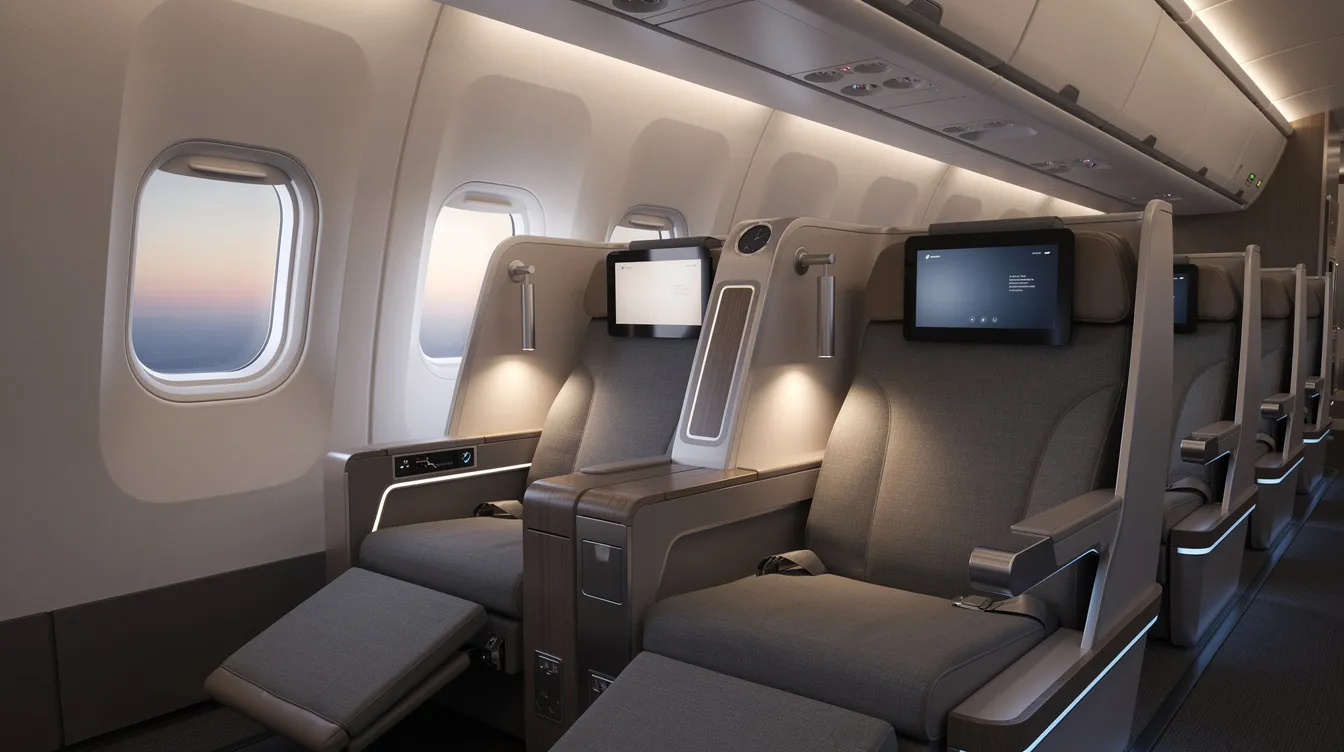
Flying business class in flight changes the travel equation. Instead of cramped seats and rigid schedules, travelers get lie-flat beds, priority services, and airport lounge access that make long-haul trips productive rather than exhausting. But business class is not the ceiling. For travelers who need total schedule control and privacy, private jet charter through platforms like Jettly offers an alternative worth considering.
This guide breaks down what business class includes, what it costs, when it justifies the price, and how private jet charter compares for time-sensitive travel.
Business class sits between economy class and first class, offering lie-flat seats, priority boarding, lounge access, gourmet meals, and flexible ticket rules that justify its premium on long-haul flights.
A one-way business class ticket from New York to London costs $1,500 to $5,000, and tickets can cost two to three times more than economy depending on airline, route, and season.
Business class is most worth the extra cost on overnight flights over 6–7 hours, such as New York–London or Los Angeles–Tokyo, where rest and productivity on arrival matter.
Jettly's private jet charter goes beyond business class with on-demand scheduling, full aircraft privacy, access to 20,000+ aircraft, and door-to-door time savings that commercial flights cannot match.
Travelers can find better-value business class deals by booking 2–4 months ahead, using airline miles, and monitoring upgrade opportunities through airline apps.
Business class is a premium cabin category that sits above economy class and below first class on most international routes and many domestic flights. It is designed for travelers who need more comfort, flexibility, and productivity than economy provides, without necessarily paying for a first-class suite.
Modern travel classes follow a clear spectrum: basic economy, standard economy, premium economy, business class, and first class. While premium economy adds legroom and slightly better meals, business class delivers a fundamentally different experience.
Many airlines offer branded business class products with distinct identities. Qatar Airways has its Qsuite, Delta Air Lines operates Delta One, United Airlines flies United Polaris, and Air Canada markets its top cabin as Signature Class. Each of these delivers lie-flat seating, priority services, and enhanced dining, though the specific hard product varies by aircraft.
Business class passengers typically receive priority check-in, priority boarding, increased baggage allowance, enhanced in-flight meal service, and airport lounge access. Flexibility in ticketing allows changes without high fees on most fare types, which is a major draw for business travelers with shifting schedules.
The key contrast with private jet charter is structure. Commercial business class operates on fixed schedules through major airports with shared cabins. Private jets offer on-demand departure, access to smaller regional and exclusive airports, and a private space for the entire journey.
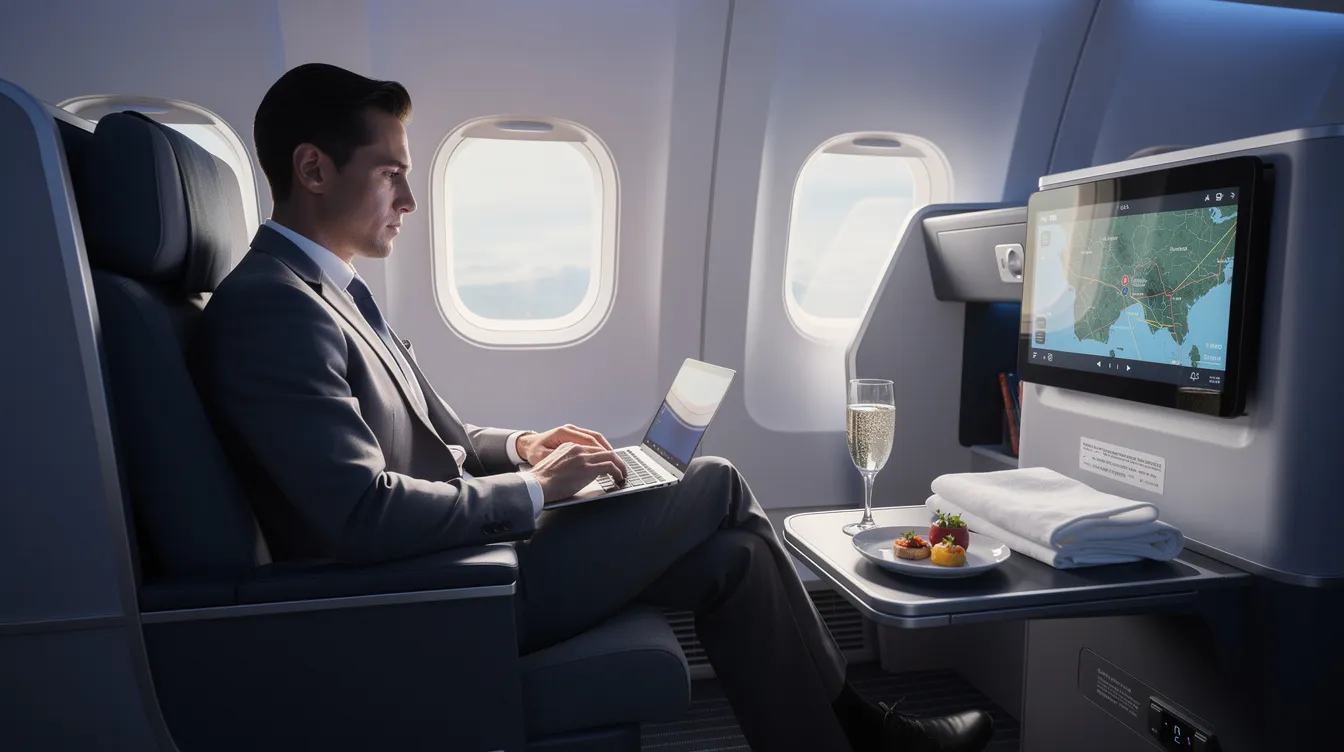
Travelers choose business class travel for three reasons: comfort during the flight, productivity in the air, and time saved on the ground. Business class typically offers an elevated travel experience compared to economy class, and those gains compound on longer routes.
The business class cabin is quieter and less densely packed than economy. Seats are larger with more space to work or rest. Business class typically includes a higher crew-to-passenger ratio for personalized service, meaning drink refills and meal courses arrive without flagging anyone down. Noise-canceling headphones, amenity kits, and premium bedding round out the soft product.
These benefits help business travelers arrive rested and ready for meetings, even after crossing multiple time zones. On routes like New York–London, Toronto–Vancouver, or Los Angeles–Sydney, the difference between stepping off a plane groggy from a cramped economy seat versus alert after a flat-bed sleep is significant.
Many airlines have made business class their top cabin. Between 2018 and 2026, carriers increasingly eliminated or minimized traditional first class cabins, investing instead in suite-style business class seats with doors, better dining, and improved hard product. On popular routes, business class is often the highest class available.
Seat types vary by route. On many domestic flights and other short-haul routes, business class seats are typically enhanced recliners with more legroom and width rather than lie-flat beds. On long-haul flights, airlines deploy full lie-flat beds, often in 1-2-1 configurations so every passenger has direct aisle access. Business class typically has more legroom than economy class, with pitch often exceeding 60 inches compared to economy's 30–32 inches.
Cabin configurations in business class often provide direct aisle access for every passenger, eliminating the need to climb over seatmates. Width ranges from 20 to 22+ inches in standard pods, compared to economy's 17–18 inches. Exceptional products go further: ANA's THE Room on the Boeing 777-300ER offers seats up to 38–41.5 inches wide with sliding doors and a flat bed roughly 78 inches long.
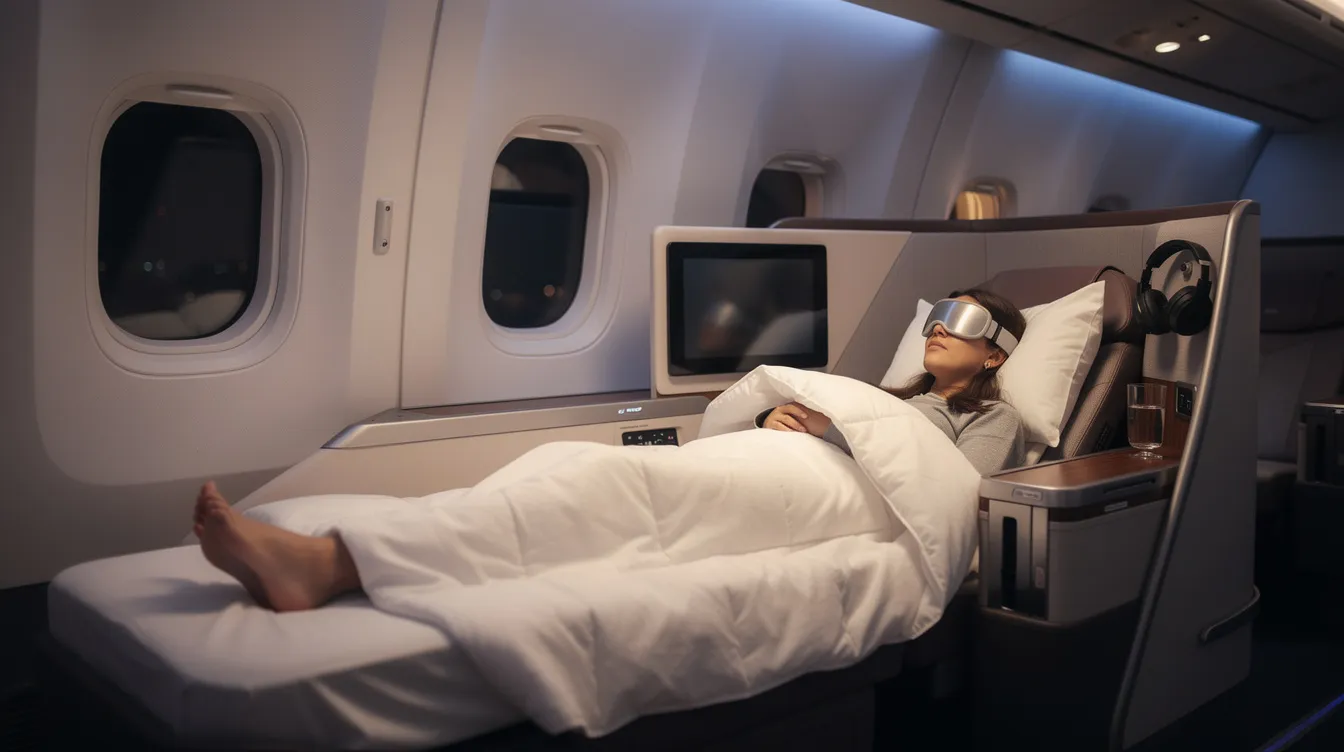
On overnight international flights, the sleep experience is the main draw. Business class offers lie-flat seats on long-haul flights, often supplemented by mattress toppers, duvets, and ambient lighting designed for rest. Business class provides complimentary designer amenity kits during flights, typically including eye masks, moisturizer, and lip balm.
Privacy features have accelerated since Qatar's Qsuite launched in 2017. ANA's THE Room, British Airways Club Suite, and Delta One Suite all feature high shells or closing doors. These private suites reduce visual and noise disturbance, making sleep on a red-eye genuinely restorative.
Business class dining is a major part of the business class worth equation for many travelers. Gourmet dining options are standard in business class, and the gap between a foil-wrapped economy tray and a multi-course business class meal is substantial.
The typical service flow starts with a pre-departure drink (often champagne or juice), followed by a multi-course meal after takeoff. Mid-flight, a snack bar or made-to-order options are available. Before landing, a lighter breakfast or meal rounds out the service. Business class meals are often curated by renowned chefs—Singapore Airlines partners with an international culinary panel, while Lufthansa offers regionally inspired dishes like pan-seared duck breast with seasonal vegetables.
Curated wine and cocktail lists are standard. Complimentary beverages include premium spirits, and some aircraft feature bar areas—Emirates' A380 business class lounge is a well-known example. Complimentary drinks and espresso service are available throughout the flight on most carriers.
Passengers enjoy gourmet meals crafted by renowned chefs, and special dietary needs (vegetarian, vegan, kosher, gluten-free) can be accommodated when requested in advance during the business class ticket booking process.
The ground experience is one of the biggest differentiators between business class and economy class. Before passengers even board, the airport process diverges sharply.
Premium check-in zones offer shorter lines, dedicated staffed counters, and sometimes separate terminal entrances at major hubs like London Heathrow, JFK, and Frankfurt. Faster check-in means less time standing in queues and more time in the lounge or at the gate.
Business class passengers enjoy priority boarding and expedited security clearance. Many airports offer fast-track security lanes for business and first-class passengers, and some routes include expedited immigration queues. This saves 15–30 minutes at busy international hubs.
Priority boarding is a standard amenity in business class. Boarding first or among the first groups means more overhead bin space, a calmer boarding process, and time to settle in before departure. Compare this with basic economy, which often boards in the last group and may restrict full carry-on privileges.
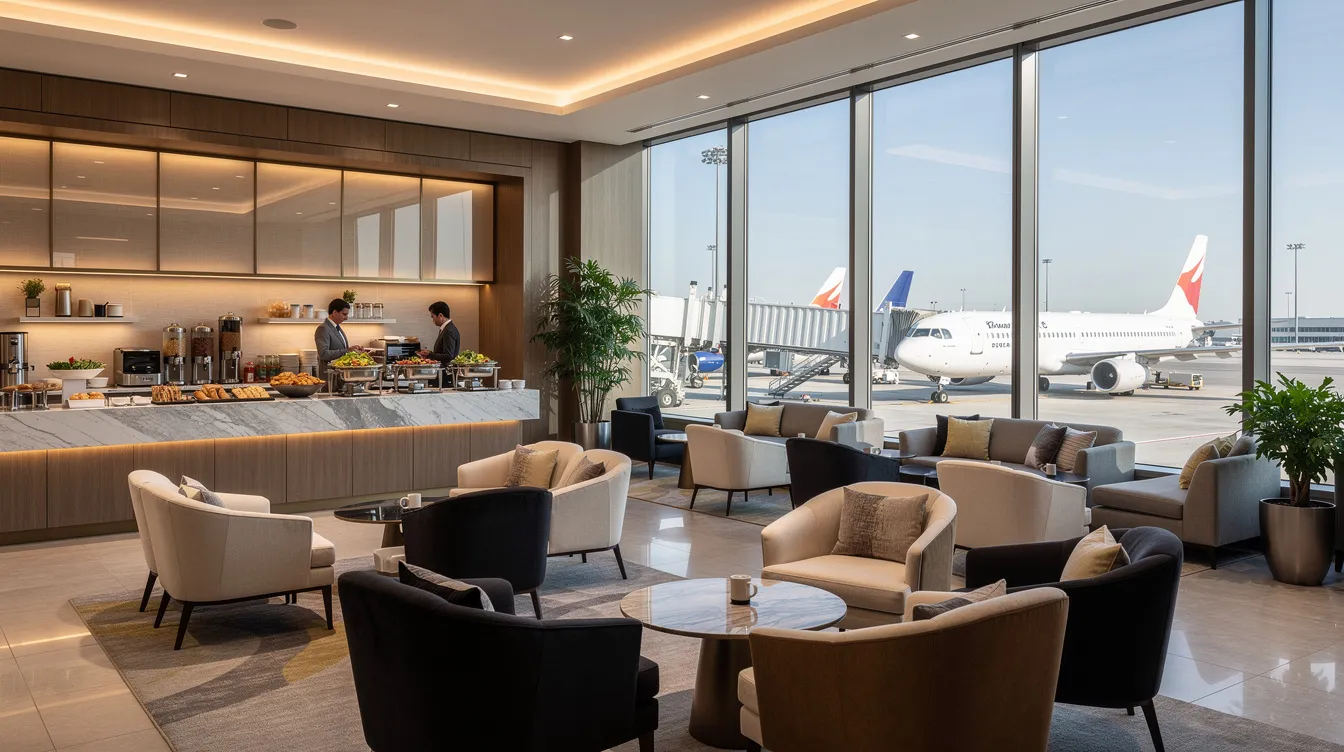
Most long-haul business class tickets include access to airline-operated or partner exclusive airport lounges. Some airlines also market select premium spaces as private lounges for eligible business class travelers. This benefit alone can shift the airport experience from stressful to productive.
Typical lounge amenities include quiet seating areas, workspaces, free Wi-Fi, hot food and snacks, bar service, showers, and sometimes nap rooms. Business class includes access to exclusive airport lounges, giving travelers a private space to work or rest before flights.
Concrete examples include the Qatar Airways Al Mourjan Business Lounge in Doha, which offers à la carte dining and spa-like shower suites, and the Lufthansa Business Lounge in Frankfurt with its extensive buffet and workspace areas. These lounges support both productivity (Wi-Fi, printing, meeting areas) and relaxation (showers, quiet zones) between connections.
To access airport lounges, travelers typically need a same-day business class boarding pass. Alliance partnerships—Star Alliance, Oneworld, SkyTeam—expand access across partner airlines. Most lounges limit guest entry, so confirming the rules at booking avoids surprises.
Modern business class strongly emphasizes connectivity and entertainment options. Since around 2020, airlines have invested heavily in onboard technology to keep class passengers productive and entertained.
Enhanced in-flight entertainment systems are available in business class, typically featuring large HD screens with on-demand movies, series, music, live TV, and moving maps. Passengers can enjoy noise-canceling headphones on most business class flights, which pair well with the entertainment system on long sectors.
Wi-Fi availability varies. Some airlines offer free Wi-Fi to business class passengers on select routes (Delta and JetBlue lead on certain corridors), while others sell tiered data plans. Business class passengers may receive complimentary or discounted Wi-Fi vouchers, while economy class passengers often pay more or face stricter data caps.
These tools let business travelers work in flight—checking email, accessing cloud documents, and even joining video calls on airlines that allow it. On a 10-hour transpacific sector, reliable Wi-Fi turns dead time into productive hours.
Business class pricing varies widely by airline and route, season, and how far in advance travelers book. There is no single "business class price" — the range is broad enough that research pays off.
A one-way business class ticket from New York to London costs $1,500 to $5,000. Round-trip, economy class on the same route often runs $500–$1,200, while business class ranges from roughly $2,000 to $5,000+. Business class tickets can cost two to three times more than economy on most corridors. On routes like Los Angeles–Tokyo, published round-trip business class fares climb to $6,500–$12,000, though negotiated fares drop to $3,700–$7,500.
Business class fare types matter. Fully flexible tickets allow changes and cancellations at no extra cost. Semi-flexible fares charge moderate fees. Discounted fares or "business lite" tickets carry stricter rules around changes, refunds, and frequent flyer miles earning.
Demand and seasonality significantly affect business class pricing. Summer, year-end holidays, and major events push fares higher. Fuel prices add to surcharges, which represent a larger absolute amount on premium cabin tickets. Booking business class early can lead to better prices, particularly on competitive transatlantic routes.
|
Feature |
Economy Class |
Business Class |
|---|---|---|
|
Seat Pitch |
30–32 inches |
60+ inches |
|
Seat Width |
17–18 inches |
20–22+ inches |
|
Seat Type |
Standard Recliner |
Lie-flat or Enhanced Recliner |
|
In-flight Meals |
Basic Meal Tray |
Multi-course Gourmet Dining |
|
Lounge Access |
No |
Yes |
|
Priority Boarding |
No |
Yes |
|
Baggage Allowance |
Standard |
Increased |
|
In-flight Entertainment |
Basic Screens |
Large HD Screens, Noise-canceling headphones |
|
Ticket Flexibility |
Limited |
Flexible with Change Options |
Whether business class is worth it depends on flight length, personal comfort needs, and how travelers value time and rest.
Business class is usually justified on overnight red-eyes, long-haul flights over 6–7 hours, and trips where back-to-back meetings start immediately after landing. On a New York–London red-eye, arriving rested after six hours in a lie-flat bed rather than cramped in economy can determine how the next day goes.
Economy or premium economy may be enough on short-haul flights under 3 hours, leisure trips with flexible schedules, or for travelers who sleep easily in any seat. Many domestic flights also do not offer the same flat-bed comfort as international business class, which changes the value calculation. The flight experience on a 90-minute hop does not change dramatically between classes.
A useful framework: if business class adds $1,500 on an 8-hour overnight flight, that is roughly $188 per hour of flat-bed sleep and better service. Spread the same extra cost over a 90-minute flight, and the cost per hour of marginal improvement jumps to $1,000—harder to justify. Employers and frequent travelers should also factor in reduced jet lag, better sleep, and potential productivity gains when evaluating the upgrade.
Many travelers pay less than the published sticker price by using flexible strategies. Book business class tickets early for better availability—on popular transatlantic routes, booking 2–4 months in advance often balances seat choice and pricing. Off-peak windows like late January through mid-March typically yield the cheapest fares.
Airline miles and credit-card points redemptions offer strong value. Off-peak awards can cut redemption costs significantly, and transfer bonuses from major loyalty programs sweeten the return. Some products like ANA's THE Room offer exceptional value through partner award programs.
Monitor airline apps for upgrade opportunities before departure. Bidding for upgrades is available on select international flights—carriers like Air Canada and Turkish Airlines run bid-for-upgrade systems. Last-minute upgrade offers at the airport can also provide business class deals at a fraction of the full fare. Elite status with airlines increases chances for complimentary upgrades on departure day.
Before selecting the cheapest fare, compare business class ticket rules around changes, refunds, and mileage earning. A deeply discounted fare that cannot be changed may cost more in the long run than a slightly pricier semi-flexible option.
Understanding where business class sits among travel classes helps travelers pick the right level for each trip.
Basic economy restricts changes, seat selection, and sometimes carry-ons. Standard economy class improves on this with seat choice and full cabin bag privileges. Economy class passengers get the job done on shorter flights but face tight quarters on long sectors.
Premium economy narrows the gap with spacious seating, improved meal service, and sometimes priority boarding. But it lacks true lie-flat seats and top-tier lounge access—two of the biggest business class differentiators.
First class, where still offered, goes further with international first class suites, caviar service, and extras like onboard showers on the Emirates A380. First class fares often run $9,000–$20,000+ round-trip on transatlantic routes, sometimes double the cost of business class. First class seats and first class cabins deliver the ultimate luxury, but the marginal improvement over a strong business class suite product is debatable on many routes.
For a traveler flying New York–London, premium economy at $800–$1,200 may work for daytime flights. Business class at $2,000–$5,000 justifies itself on overnight crossings. First class at $10,000+ serves a narrower audience. The higher class you choose, the steeper the diminishing returns.
For travelers who have outgrown even the best commercial business class flight, private jet charter offers a fundamentally different experience. Jettly is a digital private aviation platform offering on-demand private jet charter globally, used by the same audience that flies business and first class on commercial carriers.
The differences are structural. Private jets provide full aircraft privacy, customized departure times, use of smaller airports closer to city centers, and minimal security lines. There is no forward cabin hierarchy—the entire aircraft is yours. Jettly connects travelers to a global inventory of over 20,000 private charter aircraft (light jets, midsize jets, heavy jets, turboprops, helicopters) with instant pricing and online booking.
Jettly outperforms commercial business class in specific scenarios: multi-city corporate roadshows with tight itineraries, same-day returns where commercial schedules do not align, remote destinations without frequent commercial service such as Kolkata and the wider West Bengal region, or family travel with pets.
Consider a New York–Miami trip. A commercial business class itinerary through a major hub involves 2+ hours at the airport, a possible connection, and ground transport on both ends. A Jettly charter flies direct from Teterboro to Opa-Locka, often saving 3–4 hours door-to-door—just as private charter to New Delhi and the broader Delhi region can bypass congested commercial schedules in India.
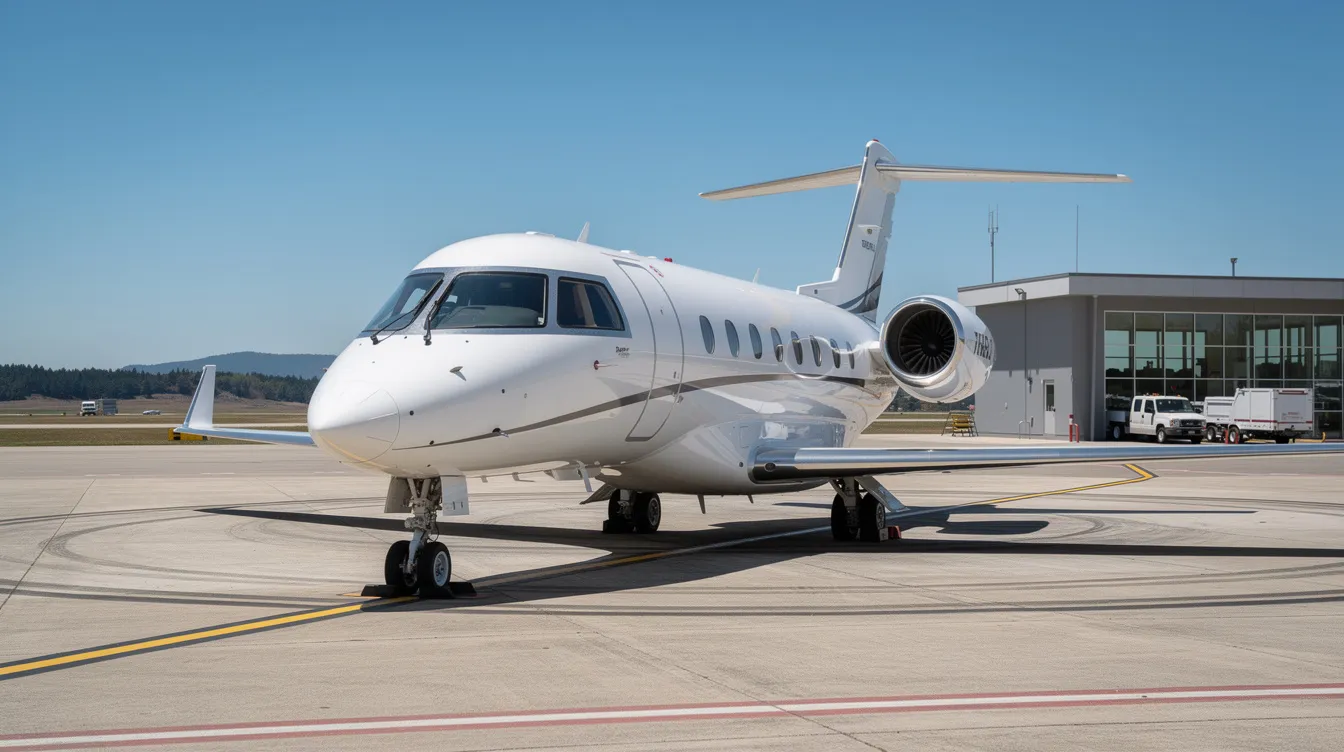
Jettly focuses on transparency, digital convenience, and flexible access rather than complex ownership structures, offering flexible private jet memberships instead of long-term ownership commitments. The platform eliminates the friction that has historically kept private air travel opaque.
Travelers search routes online or via the Jettly app, receive instant charter pricing or use a jet card flight cost estimator, and filter results by aircraft size, amenities (Wi-Fi, cabin layout, luggage capacity), and availability. The booking experience is closer to booking a hotel room than negotiating with a broker.
Unlike fractional ownership or traditional jet cards, Jettly avoids long-term financial commitments and annual flight minimums, while still offering structured jet card programs for travelers who prefer predictable hourly rates. On-demand access means paying per trip, with no lock-ins. Integration options include arranging catering, ground transportation, and tailoring in-flight services for business meetings or family trips.
Learn more about Jettly's charter options at jettly.com.
Business class seats occupy more cabin space per passenger than economy, which translates to a higher per-passenger carbon footprint. Long-haul business class can emit roughly 2–3 times more CO₂ per passenger-kilometer than economy class. First class can be higher still.
Airlines are responding with fleet renewal to more efficient aircraft like the Boeing 787 and Airbus A321neo, operational efficiencies, and the gradual adoption of sustainable aviation fuel. These steps are meaningful but incremental.
Private jet travel, including via platforms like Jettly, typically has higher per-passenger emissions unless the aircraft is near capacity. However, travelers can act: choosing more efficient routes, offsetting carbon emissions via reputable programs, combining trips to reduce total flights, and selecting efficient aircraft types for a given mission, sometimes via structured solutions like jet card programs and their cost frameworks. Jettly increasingly offers options to calculate costs and consider emissions when choosing aircraft.
Jet rentals versus first-class tickets is a similar comparison in the private aviation world, underscoring that better value depends on your specific route, schedule pressure, and group size.
Not always. Business class offers lie-flat seats, lounge access, and more flexibility, while premium economy focuses on extra legroom and slightly better service at a lower price point. Premium economy can be the sweet spot on daytime flights of 4 to 6 hours. Business class tends to justify its price more clearly on overnight or ultra-long-haul flights where sleep quality matters. Always check the specific aircraft and seat type on your route; some "business" cabins on short-haul routes only use enhanced recliner seats rather than true lie-flat beds.
As with choosing among different charter airlines and private aviation models, the exact benefits depend on the airline, route, and fare type.
Most true long-haul business class tickets on major airlines include both lounge access and priority boarding. However, some discounted or "business lite" fares may limit lounge access, changes, or mileage earning—especially within Europe or on short-haul or domestic flights. Check fare rules and benefits carefully at booking to confirm whether lounge entry, baggage handling priority, and other services are included with your specific fare class.
Small companies weighing commercial cabins against chartering can also explore broader affordable aircraft rental options to understand how different access models affect total travel cost.
Many small businesses mix classes strategically: economy class for routine trips, business class for critical client meetings or red-eye flights, and private jets when timing and routing make scheduled flights impractical. Private jet charter via Jettly can be cost-effective when several team members share the aircraft and would otherwise buy multiple last-minute business class tickets, especially on international private jet routes where commercial connections are inefficient. Evaluate total cost including lost time, hotel nights, and productivity—not just the ticket price.
Private fliers asking a similar timing question can look at ways to get a seat on a private jet easily, where last-minute empty legs and shared options sometimes flip the usual "book early" advice.
For popular long-haul routes like US to Europe, booking business class 2 to 5 months in advance often balances availability and pricing. Very early bookings (9 to 12 months out) can secure choice seats but are not always the cheapest—fares fluctuate based on demand and corporate travel patterns. Use price alerts and flexible dates to monitor trends. Waiting purely for last-minute business class deals can backfire on busy international routes and peak seasons.
In addition to full-aircraft charters, Jettly also enables crowdsourced private jet flights and shared empty seats, which can narrow the price gap with business class when you don’t need the entire aircraft.
Jettly's private jet charter is particularly compelling for multi-city trips in a single day, destinations with poor commercial service, flights with tight meeting schedules, or privacy-sensitive travel. Travelers who don’t need a whole plane can explore buying a single seat on a private jet or other shared models. Jettly allows travelers to depart from and arrive at smaller airports closer to home or office, often cutting hours off total door-to-door time. Frequent business class passengers should compare shared versus full charter options, and charter quotes for missions involving 4 to 6 travelers, where a private aircraft can approach or even beat the combined cost of multiple business class tickets.
Business class transforms long-haul air travel with better seats, lounge access, priority boarding, enhanced Wi-Fi, and gourmet meals that economy class simply cannot match. On overnight or ultra-long-haul flights, these benefits translate into real productivity and well-being gains that justify the extra cost for many business travelers.
But commercial business class still operates on someone else's schedule, through crowded airports, in a shared cabin. Private jet charter through Jettly is the next step: total schedule control, privacy, and time savings across the entire journey—not just in the cabin—positioning Jettly as a compelling NetJets alternative for flexible private travel. For international business trips, multi-city roadshows, or stress-free travel where every hour counts, the comparison is worth making.
Ready to experience private travel on your terms? Explore flight options or request a quote at https://www.jettly.com, and compare Jettly with other top private jet charter companies to find the best fit for your needs.
Share this post:
Jay Franco Serevilla
Oct 14, 2026
|
5
min read
Discover tips and trends in the industry.
5
min read
Airplanes: How They Work, Evolve, and Power Modern Private Travel
Airplanes have transformed global travel, enabling rapid movement of people and goods. This guide explores how airplanes work, their evolution, and the advantages of private jet travel. Understanding the mechanics and types of aircraft can help travelers make informed decisions for their journeys.
Read More
5
min read
Empty Weight of Cessna 172: What It Is, Why It Matters, and How to Use It
The empty weight of a Cessna 172 is crucial for pilots as it influences the aircraft's load capacity, center of gravity, and overall flight safety. Understanding how to calculate and utilize this weight is essential for effective preflight planning, especially for varying models of the 172. This guide provides insights into the significance of empty weight and its impact on flight operations.
Read MoreStay updated with our latest insights and tips to elevate your journey with us.
MEMBERSHIPS AND ASSOCIATIONS



Disclaimer: Jettly operates as a charter broker, offering access to a global digital jet charter marketplace. Jettly is not a direct air carrier and does not own or operate aircraft. All advertised flights are conducted by third-party air carriers that are fully licensed and hold the appropriate Part 135 or Part 121 certifications issued by the Federal Aviation Administration (FAA) or equivalent regulatory authorities under U.S. or foreign law. Jettly complies fully with the U.S. Department of Transportation's Part 295 and Part 298 Charter Broker regulations. Jettly does not carry additional liability insurance. Passengers are covered by aircraft operator insurance. TICO: 50023770


