


Login
Get Instant Pricing On 23,000+ Aircraft

>
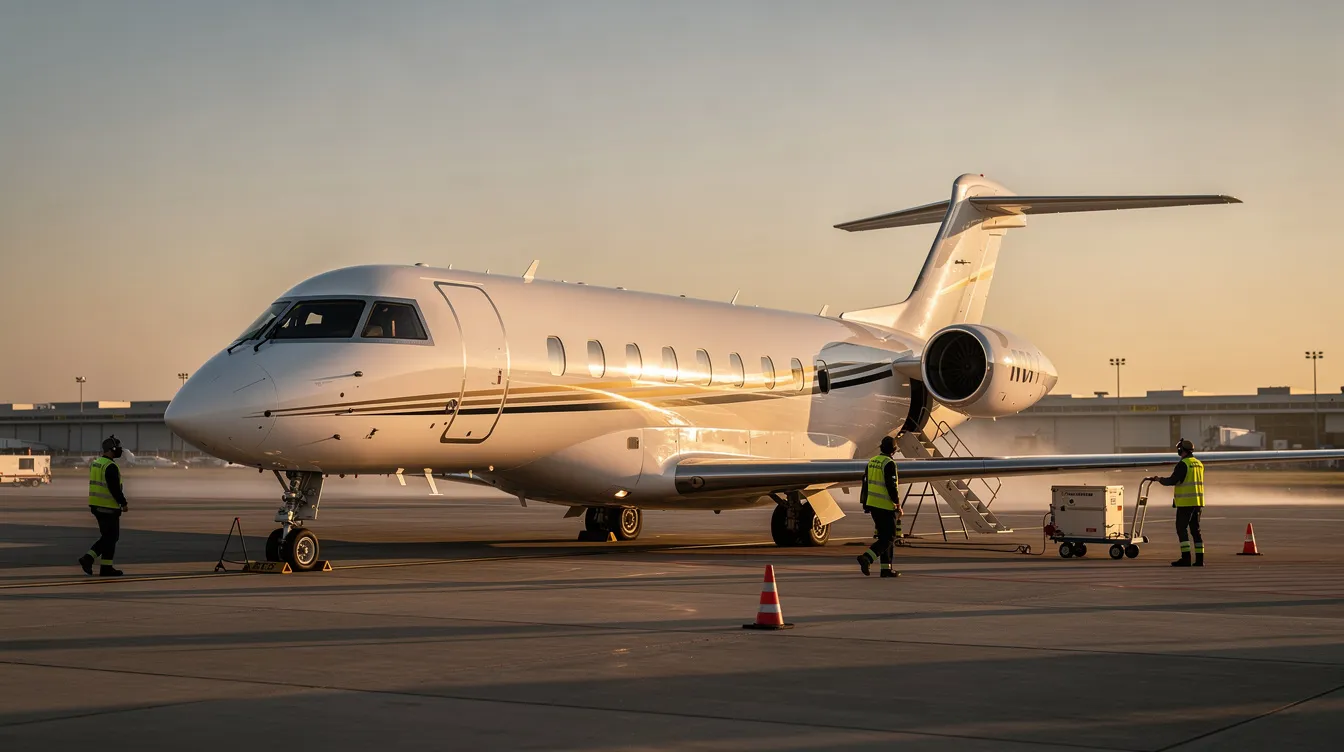
The best executive jet is not a single aircraft model. It is the aircraft that matches a specific trip: the distance, the passenger count, the cabin requirements, and the budget. This article breaks down every category of private aircraft used for business travel, compares flagship models with real specs and route examples, and shows how to match each mission to the right jet.
The ideal executive jet choice depends on mission profile, passenger count, and operating costs. A CEO flying New York to Hong Kong needs a different aircraft than a CFO hopping from Dallas to Houston.
For most executives mixing domestic and international travel, super midsize jets offer 90% of the cabin comfort found in heavy jets at roughly 70% of the cost, making them the practical sweet spot for regular business aviation.
Flagship ultra-long-range jets lead the private jet market for global executives: the Bombardier Global 7500 covers 7,700 nautical miles, the Gulfstream G700 reaches 7,750 nautical miles, and the Gulfstream G800 extends to 8,200 nautical miles. The Dassault Falcon 10X, expected in 2027, targets 7,500 nautical miles with the widest cabin in its class.
Chartering through a digital platform like Jettly lets executives access the best private jets per trip without jet cards, ownership, or long contracts; the platform connects travelers to over 20,000 aircraft globally.
This article compares jet categories from very light jets to ultra-long-range aircraft, gives concrete model specs, and explains how Jettly helps match each mission to the right aircraft.
Today's executive jets are judged by cabin comfort, efficiency, range, and fuel efficiency, not sticker price alone. The best executive jet for a given trip is the one that maximizes time savings, onboard productivity, and passenger comfort for that specific mission. A $70 million ultra-long-range jet is wasted on a 90-minute domestic hop, just as a light jet falls short on an overnight transatlantic crossing.
Core criteria executives should evaluate:
Nonstop range: Can the aircraft fly the planned route without fuel stops? Each stop adds 60 to 120 minutes of total flight time.
Airport accessibility: Can it operate from smaller airports closer to meeting locations, cutting ground transfer time?
Cabin layout: Does it have enough zones for work, dining, and rest? Is there an enclosed lavatory, a flat-floor cabin, and lie-flat seating?
Connectivity: High-speed Ka-band satellite Wi-Fi is standard in top executive jets for global connectivity. Video calls at 45,000 feet require it.
Baggage capacity: Roadshows and multi-city trips demand room for equipment, samples, and luggage for multiple travelers.
Operating cost per hour: What does chartering this aircraft actually cost door to door, and how do its operating economics affect total trip value?
Needs shift between domestic and international travel, and aircraft choice starts with how many passengers are flying because that determines the right cabin size. A New York to Chicago flight (740 nm) works well in a light jet. New York to London (3,000 nm) requires at least a super midsize. New York to Dubai (6,800 nm) demands a heavy or ultra long-range aircraft. Many executives split usage between short regional trips and long-haul flights; a flexible marketplace like Jettly lets them pick a different aircraft category for each leg.
Business jets are grouped into very light jets, light jets, midsize jets, super midsize jets, large cabin jets, and ultra-long-range heavy jets. Each category trades off range, speed, cabin space, and hourly operating costs, and some top-end large cabin and ultra-long-range models are adapted from commercial aircraft platforms as bespoke bizliners.
Very light and light jets: Built for short regional trips under 3 to 4 hours with 1 to 5 passengers. Lower charter rates, access to shorter runways. Examples: Embraer Phenom 300E, Cessna Citation CJ4.
Midsize and super midsize jets: Cover coast-to-coast US routes and medium international legs. Stand-up cabin height, enclosed lavatory, seating for six to eight passengers. Examples: Citation Latitude, Bombardier Challenger 3500, Embraer Praetor 500.
Large cabin and heavy jets: Purpose-built for nonstop intercontinental flights with 8 to 16 passengers. Multiple cabin zones, lie-flat beds, low cabin altitude. Examples: Gulfstream G500/G600, Dassault Falcon 8X, Bombardier Global 6500.
Ultra-long-range flagships: The top tier for global executives. Range exceeding 7,000 nm, residential-grade interiors. Examples: Bombardier Global 7500, Gulfstream G700, Gulfstream G800.
Jettly's platform accesses over 20,000 private aircraft across all these categories, allowing executives to compare aircraft types per trip instead of locking into a single size through a jet card.
Light jets are ideal for trips under four hours with 1 to 5 executives. Think San Francisco to Los Angeles, London to Geneva, or Toronto to New York. These business jets keep hourly charter rates in the $4,000 to $5,500 range, access smaller airports near city centers, and minimize ground transfer time for dense meeting schedules.
The Embraer Phenom 300E has a range of 2,010 nautical miles, a top speed near Mach 0.80, and a best-in-class cabin altitude for its size. It is also the most requested jet of 2025, according to charter demand data. The Cessna Citation CJ4 has a range of 2,165 nautical miles and seats up to 9, bridging light and midsize territory. The Learjet 75 rounds out this class with similar range and speed.
Light jets are not the right aircraft when the mission involves larger teams, nonstop transcontinental range, or the need for an onboard conference space with lie-flat seating. For groups exceeding 5 or legs exceeding 2,100 nm, a midsize or super midsize jet covers the gap.
On Jettly, executives can instantly compare pricing for light jets against midsize jets to see exactly when a small cost increase justifies more cabin comfort and range.
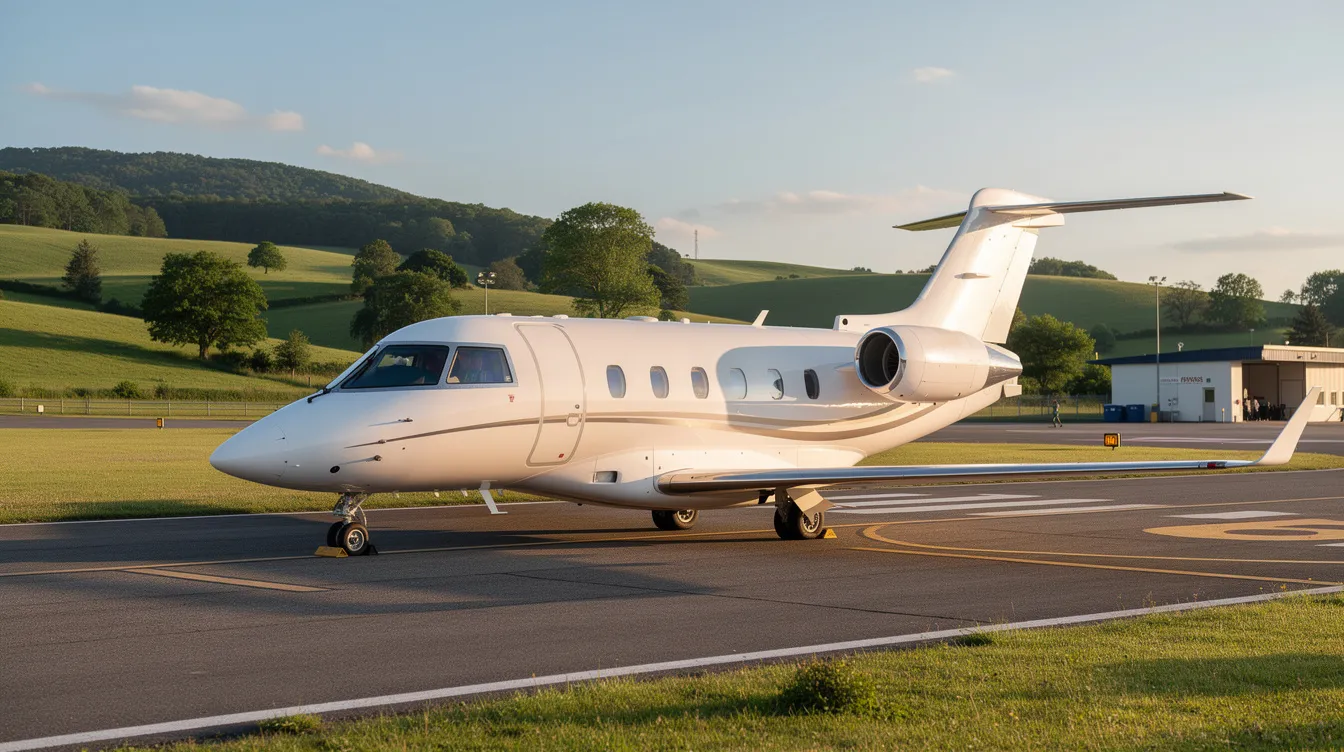
Midsize and super midsize jets are the most practical choice for many executives who mix domestic and international travel. Super midsize jets are the most requested charter category in North America, and for good reason: they fly nonstop coast-to-coast (LA to New York, Dallas to Seattle) and handle medium international legs (London to Dubai, New York to Bogotá) while keeping charter costs manageable.
Popular models in this class:
Cessna Citation Latitude: 2,700 nm range, 6-foot stand-up cabin, seats up to 9, takeoff from runways as short as 3,580 feet.
Bombardier Challenger 3500: 3,400 nm range, zero-gravity recline seats, and a 99.8% dispatch reliability rate. Fits six to eight passengers comfortably.
Cessna Citation Longitude: 3,500 nm range and the quietest cabin in its class, with a flat floor design throughout.
Embraer Praetor 500: 3,340 nm range, fly-by-wire controls, cabin pressure equivalent to about 5,800 feet at cruise.
Gulfstream G280: Bridges the super midsize and heavy categories with a larger cabin and higher cruise speed.
Many executive teams of six to eight passengers find this class the best private solution. Enough room for laptops, meetings, and productive business travel without the heavy jet price jump. Super midsize jets are best for regional and transcontinental flights; a 4-city US roadshow over 2 to 3 days is a textbook use case. Jettly helps pick super midsize jets for exactly these itineraries.
Large cabin jets and heavy jets redefine what is possible for global air travel. Built for 8 to 16 passengers on flights of 8 to 14+ hours, these larger jets provide multiple living zones (work, dining, relaxation), lie-flat beds, and low cabin altitude that keeps fatigue manageable on long-haul flights.
Key models that remain widely chartered:
Gulfstream G500/G600: Range of roughly 5,200 to 6,600 nm; fast cruise speeds; cabin designed for both work and rest.
Dassault Falcon 6X: Wide-body cabin feel in its class; advanced digital flight controls.
Dassault Falcon 8X: The Dassault Falcon 8X features short-field agility and exceptional acoustic comfort, with range near 6,450 nm. It can operate from constrained airports that rule out other heavy jets.
Bombardier Global 6000/6500: Range of 5,900 to 6,600 nm; Bombardier Global cabin experience with multiple zones.
These aircraft matter for high-stakes business travel because executives can depart New York at 8 PM, sleep in a lie-flat bed, and arrive rested for a 9 AM board meeting in London. While hourly charter rates run $11,000 to $15,000 for heavy jets, using Jettly to select a heavy jet only on missions that truly need it helps optimize the annual travel budget. Booking a light jet for short-haul trips and a heavy jet for intercontinental range legs is the best way to lower costs while achieving maximum efficiency across the annual travel program.
For global CEOs, the best executive jet is often an ultra-long-range flagship that can fly nonstop between major financial centers. The top executive jets today are concentrated in the ultra-long-range large-cabin category, and these aircraft rank among the best jets for nonstop global executive travel, connecting world capitals without needing a refueling stop.
Bombardier Global 7500: The Bombardier Global 7500 has a maximum range of 7,700 nautical miles and features four distinct living spaces: forward club, dining/conference area, private suite, and aft lounge. Cabin height is 6 feet 2 inches, width is 8 feet, and baggage capacity reaches 195 cubic feet. Top speed: Mach 0.925.
Gulfstream G700: The Gulfstream G700 has a maximum range of 7,750 nautical miles at Mach 0.85 with 8 passengers. It has the tallest cabin at 6 feet 3 inches, with up to five living areas and 20 panoramic oval windows.
Gulfstream G800: The Gulfstream G800 has a range of 8,200 nautical miles, making it the longest-range production business jet available. It maintains a cabin altitude of 2,840 feet at 41,000 feet cruise.
Dassault Falcon 10X (expected 2027): 7,500 nm range, the widest cabin in its class at 9 feet 1 inch, height of 6 feet 8 inches, and modular four-zone baseline layout.
These ultra-long-range jets can cover over 7,500 nautical miles nonstop. Real-world nonstop city pairs include New York to Hong Kong, Los Angeles to Sydney, Paris to Santiago, and São Paulo to Dubai. Executive aviation blends ultra-long-range performance with residential-grade interior luxury in this class. Jettly's inventory includes access to many of these flagships via vetted operators.
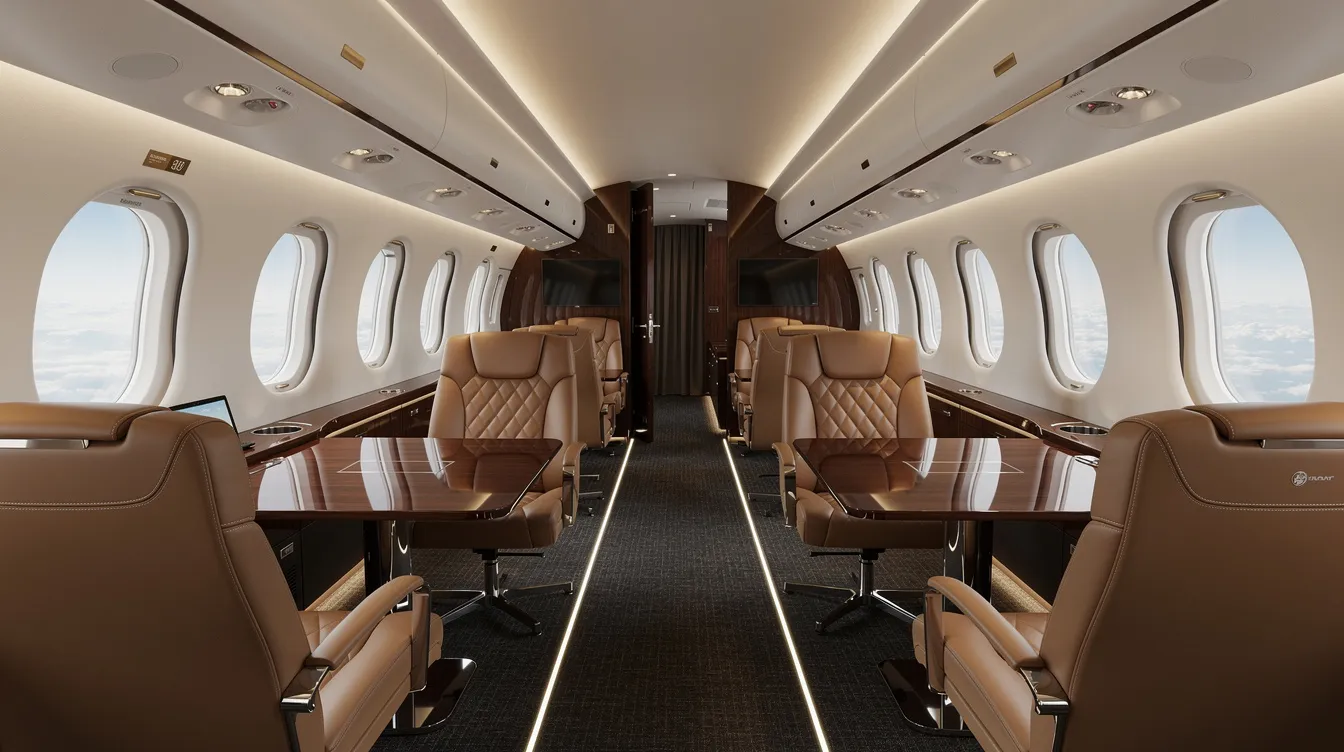
For executive travelers, the cabin is an airborne office and meeting room. Modern executive jets focus on enhancing passenger experience over speed alone, and cabin design affects productivity as much as range does.
|
Jet Category |
Range (nautical miles) |
Passenger Capacity |
Typical Hourly Charter Cost |
Ideal Use Case |
|---|---|---|---|---|
|
Very Light & Light Jets |
1,500 - 2,100 |
1 - 5 |
$2,000 - $5,500 |
Short regional trips under 4 hours |
|
Midsize & Super Midsize |
2,700 - 3,500 |
6 - 9 |
$4,000 - $8,000 |
Coast-to-coast and medium intl. legs |
|
Large Cabin & Heavy Jets |
4,000 - 6,600 |
8 - 16 |
$11,000 - $15,000 |
Long-haul, intercontinental flights |
|
Ultra-Long-Range Jets |
7,500 - 8,200+ |
8 - 19 |
$15,000 - $25,000+ |
Global nonstop executive travel |
Key elements that define the cabin experience:
Stand-up cabin height and seat ergonomics: The G700 cabin at 6 feet 3 inches accommodates tall executives; the Falcon 10X at 6 feet 8 inches sets a new standard. The Bombardier Challenger 3500's zero-gravity recline seats reduce fatigue over multi-hour flights.
Multiple cabin zones: Cabin designs now include club-seating meeting areas, private dining rooms, and dedicated bedrooms. The Bombardier Global 7500 features four distinct living spaces; the G700 offers up to five.
Connectivity: High-speed Ka-band satellite Wi-Fi is standard in top executive jets, enabling video calls, file transfers, and real-time collaboration at cruise altitude.
Cabin wellness features: Modern executive jets feature ultra-low cabin altitudes to reduce fatigue on long-haul flights. The G800 maintains 2,840 feet cabin altitude at 41,000 feet. Advanced air quality systems in jets simulate ground-level pressure for traveler comfort. Circadian lighting adjusts for time zone changes.
Sound insulation: The Citation Longitude holds the quietest cabin in its class, a feature that reduces fatigue on multi-leg days.
Top-performing business jets offer a balance of cabin comfort, operational efficiency, and range. Jettly's booking process can factor in cabin layout, cabin dimensions, and Wi-Fi requirements when presenting the best options for executive missions.
Nonstop range in nautical miles is one of the most important metrics when choosing the best executive jet for both domestic and international travel. Each fuel stop adds 60 to 120 minutes and disrupts sleep schedules and meeting timelines.
Range benchmarks by category:
Light jets: ~1,500 to 2,100 nm (the Embraer Phenom 300E at 2,010 nm)
Super midsize jets: ~2,700 to 3,500 nm (Citation Longitude at 3,500 nm)
Heavy and ultra long range jets: ~4,000 to 8,200 nm (Global 7500 at 7,700 nm; G800 at 8,200 nm)
Route examples and which categories handle them nonstop:
New York to Miami (~1,100 nm): any category, including light jets
Los Angeles to New York (~2,450 nm): midsize and above
London to Riyadh (~2,600 nm): super midsize and above, a common premium business route into the Middle East
LA to Tokyo (~4,800 nm): large cabin or ultra-long-range jets
New York to Hong Kong (~7,000 nm): ultra-long-range aircraft only
Avoiding fuel stops saves flight time, preserves sleep, and reduces customs processing on international travel legs. Jettly's instant pricing engine shows which private aircraft can fly nonstop versus those needing a stop, helping decision-makers balance cost, time, and cabin comfort.
Three models define how executives access private aviation: on-demand charter, jet cards, and full or fractional ownership.
Jet cards typically require six-figure prepayments ($100,000 to $500,000+) and work best for consistent annual hours on one or two categories of aircraft. They may reduce per-hour cost when hours are high but limit flexibility. Fractional ownership requires a substantial upfront investment and adds fixed costs for crew, maintenance, hangar, and insurance.
Ownership provides consistency in cabin experience and availability but is rational only above roughly 150 to 200 flight hours per year. Below that threshold, the fixed costs per hour exceed charter rates.
On-demand charter through Jettly's private jet services suits executives who want transparent per-trip pricing, no long-term contracts, and the ability to switch between light jets, super midsize, and heavy jets as needs change. Chartering offers flexibility for variable travel schedules and allows access to a variety of aircraft types.
Charter costs can range from $2,000 to $8,000 per hour depending on aircraft category, with hourly operating costs ranging from $2,000 to $8,000+ across light to super midsize classes. Ultra long-range jets run $10,000 to $25,000 per hour. For a detailed breakdown of these models, see Jettly's comparison of charter, jet cards, and fractional ownership.
Jettly is a digital private aviation platform that simplifies access to a global fleet of business jets without the complexity of jet cards or ownership. Executives enter route, dates, and passenger count to see instant pricing across multiple aircraft types, from light jets to heavy long-range models, on a single screen.
Key platform features:
Access to 20,000+ aircraft worldwide across all jet categories
Transparent pricing showing hourly rate, fuel, positioning, and fees
Filters for cabin space, Wi-Fi availability, baggage capacity, and operator safety ratings
Support for both domestic and international travel itineraries, including multi-leg roadshows, board tours, and last-minute emergency flights
Aircraft selection no longer requires a broker phone call or a fixed card commitment. Executives can estimate costs instantly using Jettly's charter cost calculator and book the right jet for each mission.
The best private jets look different for every mission. Here are three scenarios showing how aircraft selection changes with the trip.
Scenario 1: Same-day European board meetings. A three-person executive team flies Paris to Frankfurt to Milan, each leg under 90 minutes. A light jet like the Phenom 300E or a midsize jet like the Citation Latitude accesses city-center airports, keeps costs low, and minimizes turnaround time. No need for a heavy jet on short regional routes.
Scenario 2: Quarterly global CEO tour. A CEO flies New York to London to Dubai to Singapore to Los Angeles over 10 days. Several legs exceed 5,000 nm. An ultra-long-range aircraft like the Bombardier Global 7500 or Gulfstream G800 delivers maximum nonstop coverage, multiple cabin zones for work and rest, and long-range capabilities that eliminate fuel stops and customs delays at intermediate airports.
Scenario 3: Executive retreat with family. Eight to ten people combine business meetings with leisure travel, flying from the US West Coast to the Caribbean. Large cabin jets with multi-zone layouts support conference calls in the forward cabin and relaxation aft. A corporate aircraft charter through Jettly allows the group to compare heavy jets for this mission, see instant costs, and book the optimal aircraft for the leg.
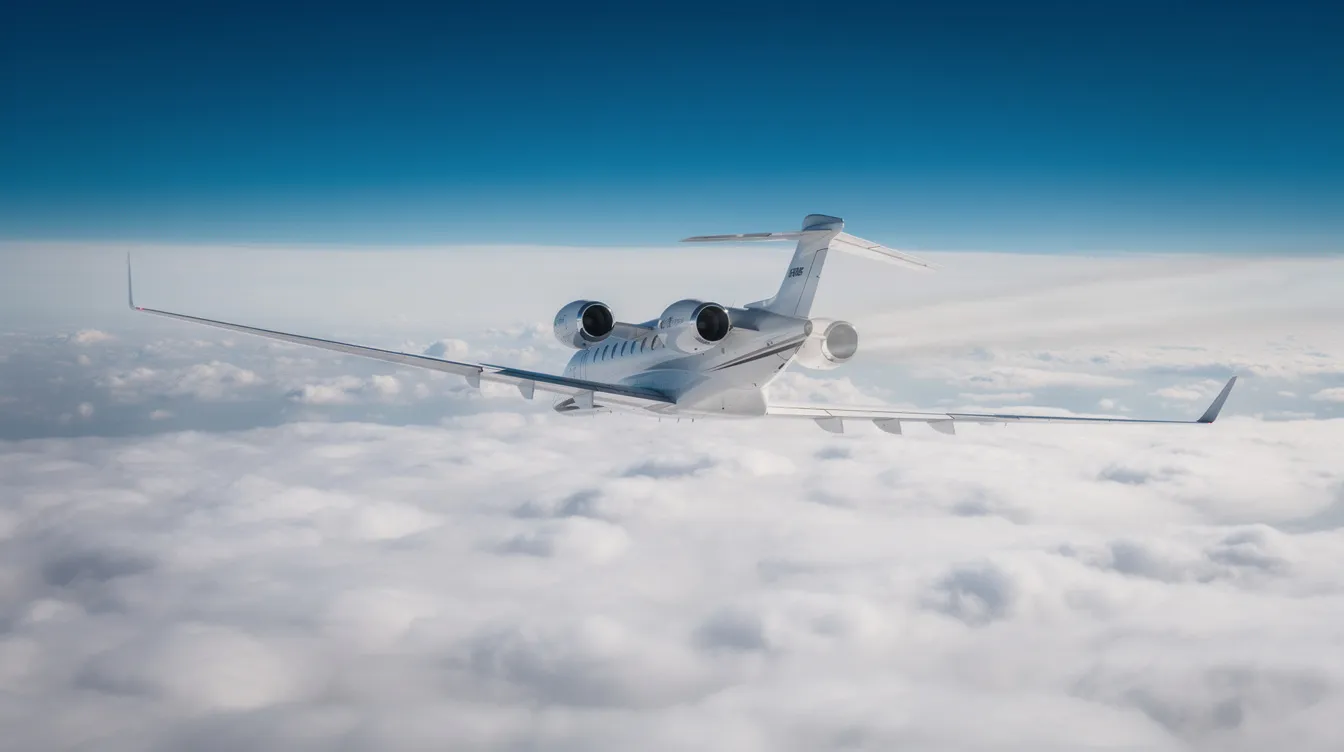
These answers cover common questions executives have about choosing and chartering business jets beyond what the main sections addressed.
For frequent US or European domestic travel under 4 to 5 hours, midsize and super midsize jets like the Citation Latitude (2,700 nm range), Bombardier Challenger 3500 (3,400 nm range), or Embraer Praetor 600 offer the best mix of cost, cabin comfort, and nonstop range. Executives who often fly alone or with 2 to 3 colleagues on short hops may find a light jet like the Phenom 300E more economical through Jettly's on-demand charter services.
Ultra long-range heavy jets such as the Bombardier Global 7500 (7,700 nm), Gulfstream G700 (7,750 nm), Gulfstream G800 (8,200 nm), and Dassault Falcon 8X are purpose-built for nonstop international travel between continents. These large cabin aircraft feature low cabin altitude, multiple living zones, and intercontinental range that make them the ideal aircraft for overnight flights where rest and productivity matter most. The Dassault Falcon 10X will join this group when deliveries begin.
Booking 7 to 10 days ahead usually yields the best aircraft selection and pricing, especially for large cabin jets and peak days (Mondays, Fridays, holiday periods). Jettly can often accommodate last-minute bookings for urgent business travel through its same-day charter process, though flexibility in departure time or aircraft type may be required.
Jet cards can reduce per-hour cost for very predictable flying (50 to 100 hours per year on similar routes), but they require large upfront deposits and limit aircraft selection to one or two categories. Many charter clients prefer on-demand charter with Jettly because it offers transparent trip-by-trip pricing, no long-term commitment, and the ability to choose from multiple aircraft categories each time. For a deeper comparison, see jet card vs on-demand charter.
Jettly works only with certified operators meeting strict regulatory standards (FAA Part 135 or equivalent). Safety ratings from organizations like ARGUS and Wyvern, aircraft age, maintenance history, and operator credentials are factored into search results. Executives can review these details within the platform before booking, adding confidence to each flight. Single-pilot operations are excluded for certain jets where dual-crew requirements apply, and all operators undergo vetting before joining the network.
The best executive jet is the one that fits each trip's mission profile, not the one with the highest price tag. Light jets handle short regional trips with cost efficiency. Super midsize jets cover the bulk of regular business travel. Heavy jets like the Bombardier Global 7500 or Gulfstream G700 serve global executives who need to fly nonstop between continents and arrive rested.
Committing to a single aircraft through ownership or a fixed jet card limits what frequent flyers can access. A flexible charter platform like Jettly gives executives the ability to pick the right jet for each leg, compare instant pricing, and book with confidence across a network of 20,000+ aircraft and vetted operators.
Ready to find the best executive jet for your next mission? Explore flight options or request a quote at https://www.jettly.com.
Share this post:
Jay Franco Serevilla
Sep 15, 2026
|
5
min read
Discover tips and trends in the industry.

5
min read
Private Jet LA to Miami: Charter Guide, Costs, and Best Airports
Traveling from New York to Miami offers various options including flights, driving, buses, and private jets. The distance is approximately 1,280 miles by road and 1,090 miles by air, with direct flights taking about 3 to 3.5 hours. This guide provides insights on travel times, costs, and the best ways to plan your journey.
Read More
5
min read
New York to Miami Distance: Routes, Flight Times, and Private Jet Options
Traveling from New York to Miami offers various options, including direct flights, driving, and private jet charters. The aerial distance is about 1,090 miles, while driving spans approximately 1,280–1,300 miles. This guide provides insights into travel times, costs, and the best routes for your journey.
Read MoreStay updated with our latest insights and tips to elevate your journey with us.
MEMBERSHIPS AND ASSOCIATIONS



Disclaimer: Jettly operates as a charter broker, offering access to a global digital jet charter marketplace. Jettly is not a direct air carrier and does not own or operate aircraft. All advertised flights are conducted by third-party air carriers that are fully licensed and hold the appropriate Part 135 or Part 121 certifications issued by the Federal Aviation Administration (FAA) or equivalent regulatory authorities under U.S. or foreign law. Jettly complies fully with the U.S. Department of Transportation's Part 295 and Part 298 Charter Broker regulations. Jettly does not carry additional liability insurance. Passengers are covered by aircraft operator insurance. TICO: 50023770


