


Login
Get Instant Pricing On 23,000+ Aircraft

>
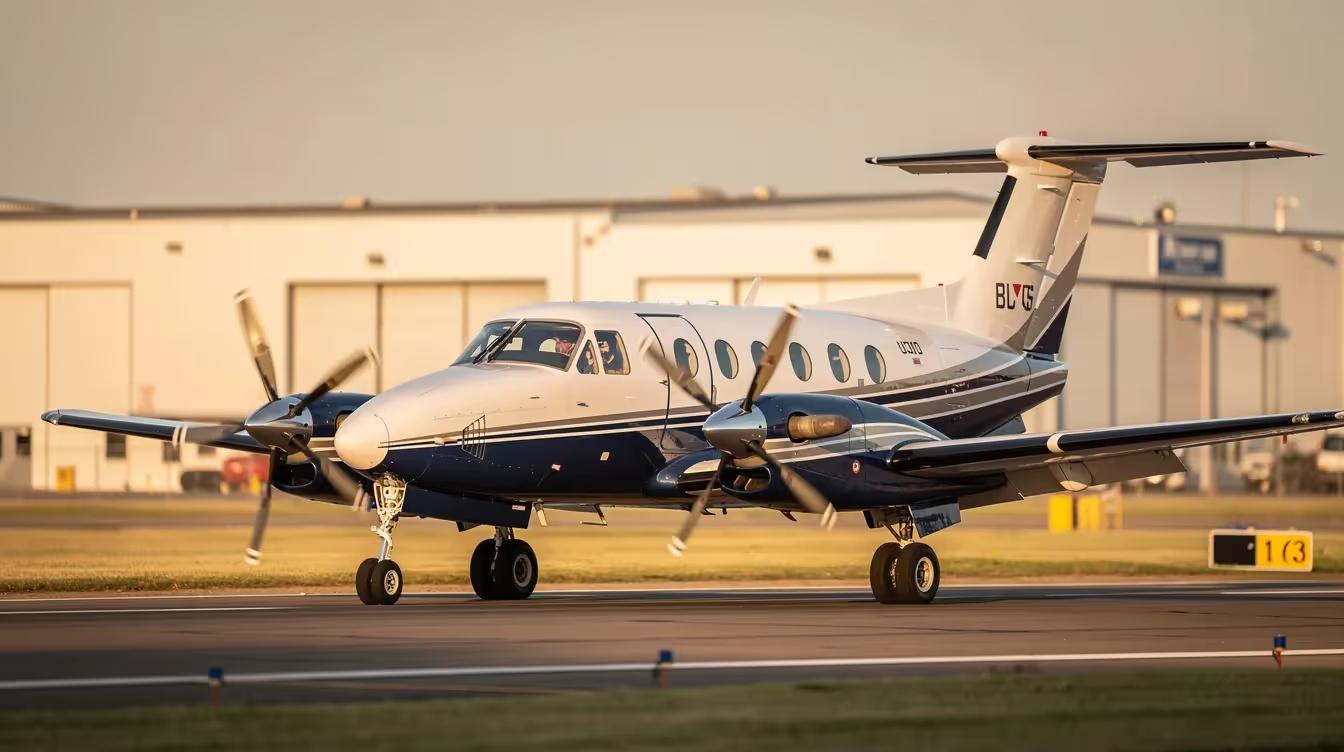
The Beech C90 King Air stands as one of the most reliable twin-engine turboprops in private aviation. For decades, this aircraft has served corporate travelers, charter operators, and medical transport teams with consistent performance and practical cabin comfort. Through platforms like Jettly, travelers can access King Air C90 aircraft on demand, with transparent pricing and instant quotes for regional missions worldwide.
The Beechcraft King Air C90 is a versatile twin-engine turboprop aircraft renowned for its reliability, spacious cabin, and exceptional short-runway performance, making it ideal for regional charter flights under 900 nm.
Typical configurations seat 4–6 passengers in club-style seating, with cruise speeds around 220–230 ktas, a range near 840 nm, and a service ceiling of approximately 30,000 ft powered by Pratt & Whitney PT6A-20 or PT6A-21 engines.
The King Air 90 series has been produced in numerous variants since the 1960s, with the C90 among the most popular due to its combination of reliability, cabin comfort, and short-field capability.
Through Jettly’s digital marketplace, travelers can charter King Air C90 aircraft on demand, comparing options instantly and booking with transparent pricing.
This article covers the C90’s history, performance specifications, interior configuration, air ambulance applications, operating economics, and how to book through Jettly.
The King Air C90 belongs to the Beechcraft King Air 90 family, a direct evolution from the earlier Queen Air series. Produced from the early 1970s through the early 1990s, this King Air aircraft established itself as a dependable choice for 4–6 passengers on regional routes. The company behind the King Air C90, Beechcraft, is renowned for its long-standing reputation for quality and support in the aviation industry, contributing significantly to the aircraft's enduring popularity.
When aviation professionals reference the King Air 90, model 90, or King Air C90, they’re discussing the smaller end of the King Air family. These aircraft differ from larger models like the King Air 200 or 360 series in capacity and range but excel in operational flexibility.
The C90 is commonly used for corporate and business travel, air charter, cargo utility, special missions, and personal use. Its twin-engine design provides redundancy that single-engine turboprops cannot match.
Jettly regularly sources Beech King Air aircraft and other turboprops from a global pool of over 20,000 private charter aircraft, making the C90 a cost-efficient option for short and medium-range charter flights. The C90 series offers a balanced combination of reliability, cabin comfort, and operational flexibility that remains a benchmark for the segment.

The story begins with the Beechcraft Queen Air of the early 1960s. This piston-powered aircraft featured a conventional tail and an unpressurized cabin but struggled with high-altitude performance. Beechcraft introduced the King Air 90 on January 24, 1964, replacing piston engines with Pratt & Whitney PT6A turboprops and adding a T-tail configuration.
The C90 model, introduced in 1971, included a pressurized cabin system using bleed air from the engines, enhancing passenger comfort during flights. This variant stretched the fuselage to 12 ft 4 in, widened the wingspan to 50 ft 3 in, and upgraded to PT6A-20 engines rated at 550 shp.
Key production milestones shaped the lineage:
Base C90 (1971–1982): 605 units built with PT6A-20 engines
C90A (1983–1992): 235 units featuring improved PT6A-21 engines
C90B (1992–2005): 456 units, adding four-bladed propellers and noise reduction
C90GTx (2009–present): Modern avionics with Pro Line Fusion cockpit
By 2010, over 3,100 King Air 90 and 100 series aircraft had been delivered globally. The company ownership transitioned from Beech Aircraft Company to Raytheon Company, then Hawker Beechcraft Company, and eventually Textron Aviation Company, each playing a significant role in the King Air's development and support. Travelers booking these aircraft typically fly with licensed Part 135 charter companies that meet stringent safety and regulatory standards. Today, Textron Aviation continues supporting the Beechcraft King Air production line.
Understanding the King Air C90’s capabilities helps charter customers plan effective regional travel. The aircraft delivers solid cruise performance while accessing airports that jets cannot reach, especially when paired with an airport locator tool to identify suitable runways along a route.
Powerplant and Speed: The Beechcraft King Air C90 is powered by either PT6A-20 or PT6A-21 engines, depending on the variant. These twin-engine powerplants each produce 550 shp with a time between overhauls of 3,600 hours. Max cruise speed reaches approximately 223 ktas at 25,000 ft, with long-range cruise settling around 208 ktas.
Range and Service Ceiling: Fuel capacity of 384 gallons supports a range of approximately 840 nm with four passengers and reserves. This covers routes like Toronto–New York, Los Angeles–Denver, or London–Munich without fuel stops, and supports regional missions such as private jet charter in Kolkata, West Bengal, and other emerging business hubs. Service ceiling reaches 30,000 ft, with single-engine ceiling around 15,000–18,000 ft.
Runway Performance: The C90 has excellent short-field capabilities, requiring only approximately 2,557 feet for takeoff and 2,040–3,417 feet for landing. The C90 can operate from shorter, narrower, and unpaved runways that jets cannot access, providing significantly higher operational flexibility. The King Air C90’s robust landing gear system, along with thorough maintenance and overhaul records, is crucial for ensuring safe and reliable operations on these varied surfaces.
Dimensions and Payload:
Cabin length: 12 ft 4 in
Cabin height: 4 ft 9 in
Cabin width: 4 ft 6 in
Maximum take off weight: 10,000–10,100 lb
Useful load: approximately 2,113 lb
The C90 is often favored for its rugged construction, cabin comfort, and short-field performance, though it can sacrifice top-end speed compared to light jets. These specifications translate into real-world charter benefits: access to more airports than jets, reliable performance in hot-and-high conditions, and dependable PT6 power for frequent operations within the broader charter airlines landscape.
|
Specification |
Detail |
|---|---|
|
Engines |
2 × Pratt & Whitney PT6A-20 or PT6A-21 (550 shp each) |
|
Maximum Cruise Speed |
223 ktas |
|
Range |
~840 nautical miles |
|
Service Ceiling |
30,000 ft |
|
Takeoff Distance |
~2,557 ft |
|
Landing Distance |
2,040–3,417 ft |
|
Cabin Length |
12 ft 4 in |
|
Cabin Width |
4 ft 6 in |
|
Cabin Height |
4 ft 9 in |
|
Maximum Takeoff Weight |
10,000–10,100 lb |
|
Useful Load |
~2,113 lb |
|
Passenger Capacity |
Typically 4–6 |
The King Air C90 features a spacious interior that can accommodate six passengers in a club-style layout, with an internal luggage compartment for passenger access during flight. Most configurations position four seats in a forward club arrangement with two additional rear seats.
The spacious cabin measures roughly 200 cubic feet, with many charter aircraft finished in leather seating, fold-out tables, sidewall storage, and LED lighting. The C90 typically seats up to seven people and may include a functional belted potty system for longer flights.
C90B models introduced four-bladed propellers, reducing cabin noise to 82–85 dBA
Dynamic vibration absorbers cut noise by up to 5 dB compared to earlier models
Enhanced dual-zone climate control with hot/cold deck systems
Raisbeck soundproofing kits can reduce cabin noise further to 78 dBA
Jettly’s platform allows travelers to view photos and interior layouts of specific King Air C90 aircraft before booking, helping them choose cabin configurations that fit business meetings, family groups, or medical teams, while also comparing options among the best private jet charter companies in the industry.
Use Case Example: A four-person executive team flying a same-day round trip between Chicago and Milwaukee can use the club seating to hold meetings on board. The 200 nm flight takes roughly 50 minutes, saving hours compared to commercial schedules while providing a productive workspace at altitude.

Multiple King Air 90 variants exist, with differences that matter for range, payload, cabin comfort, and charter suitability.
C90 (1971–1982): Original variant with PT6A-20 engines, 223 ktas cruise, 840 nm range
C90A (1983–1992): Improved PT6A-21 engines with better hot-section durability
C90B (1992–2005): Three-bladed propellers replaced by four-bladed propellers, redesigned engine cowlings, balanced controls, and reverse pitch props for quieter, more refined operations
C90GTx (2009–present): Pro Line Fusion glass cockpit with synthetic vision, swept-blade props, and 270 ktas max cruise speed
The 90 series relates to other King Air models as the entry point of the family. The King Air 200 offers 8–9 seats with 1,720 nm range, while the 360 series carries 9–11 passengers over 1,800+ nm. The C90 wins for cost-sensitive, short-haul missions.
The Japan Maritime Self-Defense Force (JMSDF) has operated a total of 40 C90 and C90A King Airs, including 34 TC-90 trainers and five LC-90 transports, since deliveries began in 1973. The U.S. military has utilized King Air 90s in various roles, primarily for VIP and liaison transport, with designations including VC-6A, T-44 Pegasus, and U-21 Ute. The T-44A Pegasus, a trainer version of the King Air, was used to train U.S. Navy, Marine Corps, Coast Guard, and Air Force pilots to fly multi-engine aircraft, with 61 delivered to the U.S. Navy between 1977 and 1980.
A number of aftermarket modifications and upgrades are available for 90 and 100 Series King Airs, including engine upgrades and airframe modifications. An engine upgrade for earlier-build 90 Series aircraft involves re-engining with the PT6A-135A engines of the C90GT. Airframe modifications available for the King Air include a cargo conversion called the CargoLiner, which replaces the rear door with a large pallet-accessible cargo door. Additional options include Blackhawk XP42 engines for 42% more power, Raisbeck wing lockers for extra payload, and recontoured rear fuselage kits for improved cruise performance.
Jettly’s team can help match travelers with specific King Air models or modified C90S tailored to their mission profile through its global network of operators, such as Dexter Air Taxi and many others.
The King Air C90 has become a popular air ambulance platform due to its pressurized cabin, rear cargo door options, dependable twin-engine safety, and access to smaller regional airports close to hospitals.
2 pilots + 2 medical attendants + 1 patient on stretcher
Space for monitors, oxygen systems, and ventilators
Removable interiors that can revert to passenger layouts
48–54 cubic feet of internal baggage space for medical equipment
As a twin-engine turboprop, the C90 offers an extra layer of safety and redundancy compared to single-engine turboprops. This matters for time-critical medical flights where reliability cannot be compromised.
Access to short or unpaved runways near rural hospitals
Lower operating costs than jets on frequent regional legs ($1,200/hr vs $3,000+ for Citation jets)
Strong field support networks for the Pratt Whitney PT6 engines with overhaul facilities in 175+ countries
Cabin pressure maintained at 8,000 ft altitude at 27,000 ft for patient comfort
Medical assistance organizations, insurers, and families can use Jettly’s on-demand platform to locate suitable King Air C90 air ambulance aircraft quickly in time-critical situations, or even offset costs by crowdsourcing private jet flights and sharing empty seats when appropriate.
Beyond air ambulance, the C90 serves as a platform for aerial survey (laser altimeters), pilot training (the low wing loading suits ab initio instruction), and cargo operations where range and reliability matter more than speed, and it can occasionally appear on heavily discounted empty leg flights when repositioning between missions.

Understanding operating costs helps travelers decide between chartering and ownership. For many businesses, accessing a Beechcraft King Air through charter platforms proves more practical than purchasing, especially when they first run numbers through a private jet charter cost estimator to compare scenarios.
The average price of a pre-owned Beechcraft King Air C90 is approximately $560,000 (USD). Current listings for the Beechcraft King Air C90 range from $630,000 to $630,000, reflecting strong market liquidity and residual values. The King Air C90 is a popular model to buy and sell on the pre-owned market, with strong demand among operators and private owners. Pricing varies by airframe hours, avionics upgrades, and engine time remaining.
Operating costs for the Beechcraft King Air C90 are estimated to be around $1,200 to $1,500 per flight hour, which includes fuel, crew, maintenance reserves, insurance, and hangar costs. Those looking to optimize budgets can also review Jettly’s guide on affordable private jet charter to understand cost drivers and savings strategies. A typical breakdown includes:
Fuel: $250–500/hr (50–71 gph at $5–7/gal)
Engine reserves: $300/hr (PT6 overhauls ~$250k per engine every 3,600 hrs)
Maintenance: $200/hr
Fixed annual costs: ~$200,000 (hangar, insurance, crew)
The C90’s hourly operating cost compares favorably to light jets (Citation Mustang at $2,200/hr) while remaining competitive with single-engine turboprops (PC-12 at $1,000/hr) that lack twin-engine redundancy.
Many King Air airframes exceed 15,000–20,000 hours of service with proper maintenance. Textron Aviation maintains global service networks, and PT6 overhaul facilities operate in 175+ countries. C90B models have held approximately 85% of their value over 10 years, according to VREF market reports.
Jettly’s instant pricing tools allow travelers to compare King Air C90 flights with light jets and other turboprops on specific routes, making cost comparisons straightforward and complementing its jet card flight cost estimator for those exploring membership-based flying.
Jettly functions as a digital private aviation platform and charter broker, providing on-demand access to King Air C90 aircraft alongside thousands of other turboprops, jets, and helicopters worldwide, with optional private jet memberships for frequent flyers.
Enter route and travel dates on Jettly’s platform
Filter for turboprop or specific King Air models
Review instant pricing and aircraft details (photos, seating, baggage)
Confirm the preferred option through the platform
For frequent business shuttles or predictable monthly hours, Jettly’s jet card programs can lock in rates while preserving the flexibility of on-demand charter.
Transparent pricing without opaque surcharges
Access to over 20,000 unique aircraft worldwide
Side-by-side comparison of multiple aircraft types
Instant quotes rather than waiting for callbacks
Jettly offers membership options for frequent flyers seeking lower commissions, while occasional travelers can book individual trips as needed without commitments.
Trip Coordination: Jettly handles extras around a King Air C90 charter: in-flight catering via Jettly Eats, ground transportation, and special requests like pets, sports equipment, or medical escorts.
Ready to explore King Air C90 availability and pricing for your next regional business trip, family getaway, or medical transport? Visit https://www.jettly.com.
The King Air family spans from the compact model 90 to the larger 260 and 360 series. Choosing the right Beechcraft King Air depends on passenger count, range requirements, and budget.
|
Specification |
King Air C90 |
King Air 260 |
King Air 360 |
|---|---|---|---|
|
Typical Seats |
4–6 |
8–9 |
9–11 |
|
Range |
~840 nm |
~1,720 nm |
~1,800+ nm |
|
Cruise Speed |
223 ktas |
312 ktas |
312 ktas |
|
Hourly Cost |
~$1,300–1,500 |
~$1,800 |
~$2,200 |
Regional hops under 800 nm with 2–5 passengers
Focus on cost efficiency and full fuel payload flexibility
Need for short-field access that larger aircraft cannot match
Twin-engine safety without jet-level operating costs
Cross-country flights exceeding 1,000 nm
Larger executive teams requiring 6+ comfortable seats
Missions requiring more gross weight capacity and baggage
For very short hops or minimal passenger loads, other turboprops and light jets may appear in Jettly’s search results, giving customers flexibility to choose between speed, price, and cabin size. The platform’s support team can advise first-time charterers on whether the King Air C90 or another Beechcraft King model aligns best with their route and budget, or if a different provider like NetJets makes sense compared with Jettly’s NetJets alternative model.

Turboprops like the King Air C90 typically burn less fuel than similar-sized jets on short sectors. This efficiency reduces both operating costs and emissions per passenger on regional routes.
Fuel burn of 0.51 lb/nm (C90GTi) vs 0.8 lb/nm for light jets
Lower CO2 output: approximately 450 lb/hr vs 600 lb/hr for comparable jets
Optimal performance on flights under 800 nm, where jets waste fuel climbing to cruise altitude
Well-maintained PT6A engines and modern avionics upgrades (GPS-based navigation, performance-optimized flight planning) enhance both efficiency and safety. The rudder boost system and all-metal construction of the low-wing design contribute to predictable handling across conditions.
Jettly encourages efficient trip planning by helping travelers choose right-sized aircraft, consolidate legs where possible, and consider empty leg flights to reduce repositioning waste. Environmentally conscious travelers can inquire through Jettly about carbon offsetting options and fuel-efficient aircraft choices, and may also weigh shared charter flights versus full charters to balance cost with flexibility.
This FAQ section addresses common questions about chartering the King Air C90, focusing on practical concerns for travelers new to private aviation.
While the aircraft can technically fly seven passengers in some configurations, 4–5 passengers is ideal for maximum comfort and baggage space. Air ambulance or cargo configurations reduce seat count to accommodate medical equipment or freight. Jettly’s aircraft profiles display exact seating configurations, allowing travelers to confirm capacity before booking.
The King Air C90 uses twin Pratt & Whitney PT6A engines with over 50,000 units produced globally and a time between failures exceeding 10,000 hours. The aircraft is certified to stringent aviation standards identical to comparable business aircraft. Charter flights booked through Jettly are operated by licensed air carriers complying with civil aviation regulations. Travelers can request operator safety ratings through the platform.
Charter rates generally fall in the $2,500–5,500 per flight hour range depending on region, availability, and aircraft configuration. Total trip cost varies based on flight distance, positioning time, airport fees, and optional services like catering. Use Jettly’s online tools for instant, route-specific pricing that includes major fees upfront.
Typical baggage capacity supports 350 lb of luggage—enough for several medium suitcases for four passengers. The internal baggage area allows access during flight, though heavy or oversized items may require external stowage. Confirm baggage details with Jettly’s support team before departure, especially for golf clubs, skis, or medical equipment. Travel advisors, bloggers, and influencers who regularly recommend these flights can also benefit from Jettly’s high ticket affiliate program to earn commissions on referrals.
Same-day or next-day bookings succeed roughly 70% of the time, but booking several days ahead typically yields more aircraft choices and better pricing. Complex missions like international travel or air ambulance flights benefit from additional planning time for permits, medical crew, and ground logistics. Jettly’s platform enables quick turnaround, allowing users to search, price, and confirm flights rapidly when needed, whether choosing a turboprop like the C90 or a long-range jet such as the Falcon 900B for rent.
The King Air C90 remains a proven, versatile model 90 turboprop that balances cost, comfort, and reliability for regional private flights, corporate shuttles, and air ambulance missions. With a type certificate dating to the early 1970s and continuous improvements since, this airplane has earned its reputation among pilots, operators, and passengers alike.
The main benefits speak for themselves: a 4–6 passenger cabin with spacious interior, strong performance from PT6A engines, flexible interior layouts, and access to smaller airports that jets cannot reach. For routes under 800–900 nm, a King Air C90 often delivers a more economical solution than many jets—especially when booked on demand rather than owned outright.
Jettly’s platform simplifies access to Beech King Air aircraft and other turboprops worldwide, with instant pricing, transparent options, and integrated trip support from catering to ground transport, positioning it as a compelling XO charter flights alternative for app-based private travel.
Ready to experience private travel on your terms? Explore King Air C90 charter options or request a tailored quote at https://www.jettly.com. Compare aircraft in moments and book entirely online.
Share this post:
Jay Franco Serevilla
May 13, 2026
|
5
min read
Discover tips and trends in the industry.
5
min read
Jet Stream Turbulence: What Private Fliers Need to Know
Jet stream turbulence is a common challenge for private fliers, occurring unexpectedly in clear skies and often causing discomfort. Understanding its causes and effects can help travelers manage their flights more effectively, especially as climate change is projected to increase turbulence severity. This article outlines practical strategies for navigating jet stream turbulence, including flexible routing and aircraft selection.
Read More
5
min read
Turbulence in Planes: What It Is, How Pilots Handle It, and Why Private Jets Feel Different
Turbulence is a common concern for air travelers, often misunderstood but generally not dangerous. This guide explains the science behind turbulence, how pilots manage it, and why private jets can offer a smoother experience. Understanding turbulence can help alleviate anxiety and enhance confidence during flights.
Read MoreStay updated with our latest insights and tips to elevate your journey with us.
MEMBERSHIPS AND ASSOCIATIONS



Disclaimer: Jettly operates as a charter broker, offering access to a global digital jet charter marketplace. Jettly is not a direct air carrier and does not own or operate aircraft. All advertised flights are conducted by third-party air carriers that are fully licensed and hold the appropriate Part 135 or Part 121 certifications issued by the Federal Aviation Administration (FAA) or equivalent regulatory authorities under U.S. or foreign law. Jettly complies fully with the U.S. Department of Transportation's Part 295 and Part 298 Charter Broker regulations. Jettly does not carry additional liability insurance. Passengers are covered by aircraft operator insurance. TICO: 50023770


