


Login
Get Instant Pricing On 23,000+ Aircraft

>

The term "baj jets" has become a common shorthand for a new generation of digital private aviation platforms that let travellers search, compare, and book private jet flights online. What started as a niche concept has grown into a significant shift in how people access private aircraft—without ownership, without brokers on speed dial, and without six-figure upfront commitments.
Jettly sits at the centre of this movement as a digital marketplace offering live pricing and access to more than 20,000 aircraft worldwide. This article breaks down what BAJ-style platforms actually do, how pricing works, what aircraft options are available, and what the booking experience looks like from start to finish.
The term "BAJ jets" generally refers to digital, broker-led private aviation platforms. BAJit, launched by ONEflight International in 2017, is one well-known example, and it also offered the BAJit Jet Club as a membership option. Jettly operates in the same space as a tech-driven marketplace, connecting travellers with certified operators for on-demand private jet travel. BAJit offers a pay-as-you-fly model for occasional travellers, while Jettly similarly provides flexible trip options without requiring aircraft ownership or fractional shares.
Platforms like Jettly and BAJit do not hold full operational control of aircraft. Instead, they arrange flights with Part 135 certified operators (or international equivalents) who manage pilots, maintenance, safety systems, and regulatory compliance. This distinction matters: the platform handles the booking and the operator handles the flying. Travellers can safely rely on this model because operational control stays with credentialed carriers.
Modern private aviation platforms give travellers instant online access to thousands of private jets, transparent quotes, and both membership and on-demand options. Jettly's marketplace provides live pricing, digital booking, and access to over 20,000 aircraft worldwide—suitable for customers flying a few times per year or dozens of hours per month. Whether the goal is a last-minute business trip or a planned family vacation, these platforms offer a level of convenience and choice that traditional brokers rarely match.
This article covers how BAJ-style pricing works, what to expect from the booking experience, which aircraft categories suit different trip profiles, and how sustainability and emissions are being addressed across the industry.

"BAJ jets" is shorthand for Book-A-Jet–style digital platforms that brought private aviation into the app era. The most direct reference is BAJit, a platform built by ONEflight International and publicly launched in 2017. BAJit was designed to function similarly to consumer ride-sharing apps—giving users the ability to search, compare, and book private jet flights without traditional broker negotiations. Jettly fits into this same broader trend: a tech-first marketplace where travellers can access a global inventory of private aircraft through a website or app, with live pricing and transparent quotes.
Before these platforms existed, booking a private jet typically meant calling a broker, waiting for a quote by email, and accepting opaque pricing that often changed by the time a contract was signed. The process favoured insiders and repeat clients. In recent years, platforms like BAJit and Jettly shifted the market toward digital, self-service private jet travel. BAJit is recognised as a live-pricing platform for private flights, offering access to over 7,000 private jets across more than 700 operators. Jettly operates at an even larger scale, connecting travellers with 23,000-plus unique aircraft globally.
From Jettly's perspective, the platform is a B2C charter marketplace—brand-agnostic, connecting travellers with thousands of vetted operators worldwide without requiring long-term ownership commitments. It shares the same DNA as BAJit but leans further into marketplace breadth and pricing transparency.
Here's a quick comparison of three common models in private aviation:
|
Model |
Commitment Level |
Pricing Transparency |
Flexibility |
Best For |
|---|---|---|---|---|
|
Traditional jet cards |
Prepaid block hours ($50K–$250K+) |
Fixed hourly rates, locked for a term |
Moderate - hours must be used within a window |
25–100+ hours/year |
|
BAJ-style on-demand booking |
Pay-per-trip, no upfront hours |
Live market pricing, variable |
High - book when needed |
Occasional to moderate flyers |
|
Digital marketplace (Jettly) |
On-demand or optional membership |
Live pricing with instant quotes |
Very high - no minimums |
1–100+ hours/year |
This evolution has opened private aviation to a wider audience. Executives, entrepreneurs, and families who fly anywhere from one to a hundred hours per year now have access to the same aircraft and routes that were once reserved for jet card holders and fractional ownership members. The emphasis has shifted from luxury clichés to practical convenience—saving time, avoiding commercial delays, and reaching destinations on your own schedule.
Platforms like BAJit and Jettly sit between travellers and certified operators. They handle the search, comparison, and payment process, while the operators retain operational control of each private jet. Neither BAJit nor Jettly owns or flies the aircraft—they arrange contracts with Part 135 carriers who manage crews, maintenance, and safety compliance.
Here's how a typical booking works, step by step:
Search - The traveller enters a route (for example, New York to Miami), date, time, and passenger count. BAJit allows booking private jets via PC or mobile device; Jettly's platform works the same way.
Compare - The platform returns live pricing options across aircraft categories. BAJit allows members to track planes and compare options transparently. Jettly surfaces instant quotes from its global fleet.
Select - The traveller picks an aircraft, reviews cabin details, and enters passenger information. Special requests like catering, pets, or children's seats can be added at this stage.
Book - A charter contract is signed, and payment is processed. BAJit provides instant, transparent flight quotes, and Jettly follows a similar model.
Fly - The platform sends a complete itinerary with FBO details, crew information, and airport logistics. Private jets can land at smaller regional airports not serviced by commercial airlines, expanding the range of destinations available.

The concept of live pricing is central to how these platforms work. Rather than generating a rough estimate that gets revised with surcharges later, modern platforms pull real-time or near-real-time rates from operators' available fleets. This reduces the gap between the initial quote and the final price—a major improvement over the pre-2015 "estimate plus surcharge" model.
Lead times vary depending on the trip. For many domestic routes, same-day or next-day availability is common, especially for light jets and turboprops. BAJit allows users to book flights up to six months in advance, and Jettly similarly supports future-dated itineraries for travellers who prefer to plan ahead. More complex requests—heavy jets, international routes, or peak-season travel—benefit from booking weeks or months in advance to secure more competitive pricing and better aircraft selection.
BAJit also allows travellers to bypass long security lines and check-in delays, a perk shared across private aviation. Arriving at a private terminal (FBO) typically means showing up 15–30 minutes before departure, not hours.
Understanding how private jet pricing works starts with the hourly rate, which varies by aircraft category. On top of the base rate, travellers pay for repositioning (if the aircraft needs to fly empty to reach the departure airport), airport and handling fees, crew overnight costs when applicable, and taxes (including the 7.5% Federal Excise Tax on domestic charters in the US). These add-ons can increase total cost by 15–40% beyond the base hourly rate.
Here are current hourly rate benchmarks for common aircraft categories:
|
Aircraft Category |
Approximate Hourly Rate |
|---|---|
|
Turboprops |
Starting at $5,288/hr |
|
Very light jets |
Starting at $6,755/hr |
|
Light jets |
$6,000–$9,000/hr |
|
Midsize jets |
$9,000–$12,500/hr |
|
Super-midsize jets |
$10,000–$12,500+/hr |
|
Large cabin / heavy jets |
$12,000–$20,000+/hr |
For a concrete example, the average cost for a round-trip flight on a light aircraft ranges from $75,000 to $100,000, depending on route distance, aircraft age, and season. A one-way light jet trip from New York to Miami might total $18,000–$25,000 all-in.
The private jet travel market offers two main access models, and the right choice depends on how often someone flies.
On-demand charter (pay-per-trip) is what platforms like Jettly specialise in. On-demand access allows booking without long-term contracts. Travellers pay the quoted price for each trip and carry no ongoing obligation. This suits consumers who fly fewer than 25 hours per year or whose schedules are unpredictable.
Jet cards and membership programs lock in fixed pricing for flights, typically sold in blocks of hours. For example, ONEflight's Classic BAJ25 membership costs $50,000 for 25 hours, while the Club Elite membership costs $39,500 for 25 hours; BAJit Jet Club uses a deposit-based structure with an initiation fee and fixed membership term. These programs offer price predictability and often include perks—some membership programs include benefits like complimentary flights and events for members. BAJit allows flights on any day without blackout dates for certain memberships. The trade-off is a significant upfront commitment.
Jettly's positioning focuses on on-demand live pricing plus flexible private jet memberships that can reduce per-flight fees and unlock additional concierge or support services. Critically, Jettly does not require the six-figure prepayments typical of some legacy jet cards. Instead, travellers can start with on-demand booking and upgrade to a membership as their usage grows.
Use Jettly's private jet charter cost estimator to get a quick sense of pricing for specific routes.
Executive flying Toronto–Vancouver twice monthly: With 20–25 flights per year, a membership or jet card program with fixed hourly rates makes sense. Predictable costs and guaranteed availability outweigh the flexibility of on-demand pricing.
Family shuttling between New York and Palm Beach seasonally: Four to six round trips per year is solidly in on-demand territory. Booking through Jettly's marketplace keeps costs aligned with actual usage—no prepaid hours sitting idle for months.
Startup team doing a West Coast investor roadshow: A multi-city trip over several days benefits from on-demand charter with optimised routing. Jettly's platform can coordinate sequential legs (San Francisco → Los Angeles → San Diego → Las Vegas) and right-size the aircraft for a small group, similar to the way leading charter airlines and private operators structure complex itineraries.
Urgent medical or time-sensitive mission: Same-day availability is the priority. On-demand platforms excel here, often getting passengers airborne within hours and offering various options for getting a seat on a private jet quickly. No membership required.
|
Traveler Type |
Annual Hours |
Best Access Model |
|---|---|---|
|
Occasional (1–3 trips/year) |
Under 10 hours |
On-demand charter via Jettly |
|
Moderate (25–50 hours/year) |
25–50 hours |
Jettly membership or industry jet card |
|
Heavy (75–100+ hours/year) |
75–100+ hours |
Jet card, membership, or fractional ownership |
For travellers exploring what a jet card is, how it works, and typical costs in more depth, the key question is whether usage volume justifies the upfront capital.
BAJ-style platforms and Jettly give travellers access to a wide range of private charter aircraft types worldwide. Membership programs provide access to a diverse fleet, and on-demand marketplaces expand the choice further. Each aircraft category suits different trip lengths, group sizes, and budgets.
|
Category |
Example Aircraft |
Passengers |
Typical Range |
Best For |
|---|---|---|---|---|
|
Turboprops |
Pilatus PC-12, King Air 350 |
4–9 |
Up to 1,800 mi |
Short regional hops, cost-conscious trips |
|
Very light jets |
HondaJet, Phenom 100 |
2–4 |
600–1,200 mi |
Quick city pairs, 1–2 passengers |
|
Light jets |
Citation CJ4, Phenom 300 |
4–6 |
1,200–2,000 mi |
Short to mid-range routes |
|
Midsize jets |
Hawker 800XP, Learjet 60 |
6–8 |
2,000–3,000 mi |
Cross-country domestic |
|
Super-midsize jets |
Praetor 600, Citation Longitude |
8–10 |
3,000–4,000 mi |
Coast-to-coast, longer cabin comfort |
|
Large cabin / heavy jets |
Gulfstream G550, Falcon 7X |
10–16 |
5,000–7,500 mi |
Transatlantic, long-haul international |
For a Los Angeles to Las Vegas trip (roughly 230 miles), a light jet or even a very light jet works well—short flight, small group, lower cost. A Boston to Palm Beach trip (roughly 1,200 miles) calls for a super-midsize jet with more cabin space, better range, and room for luggage.
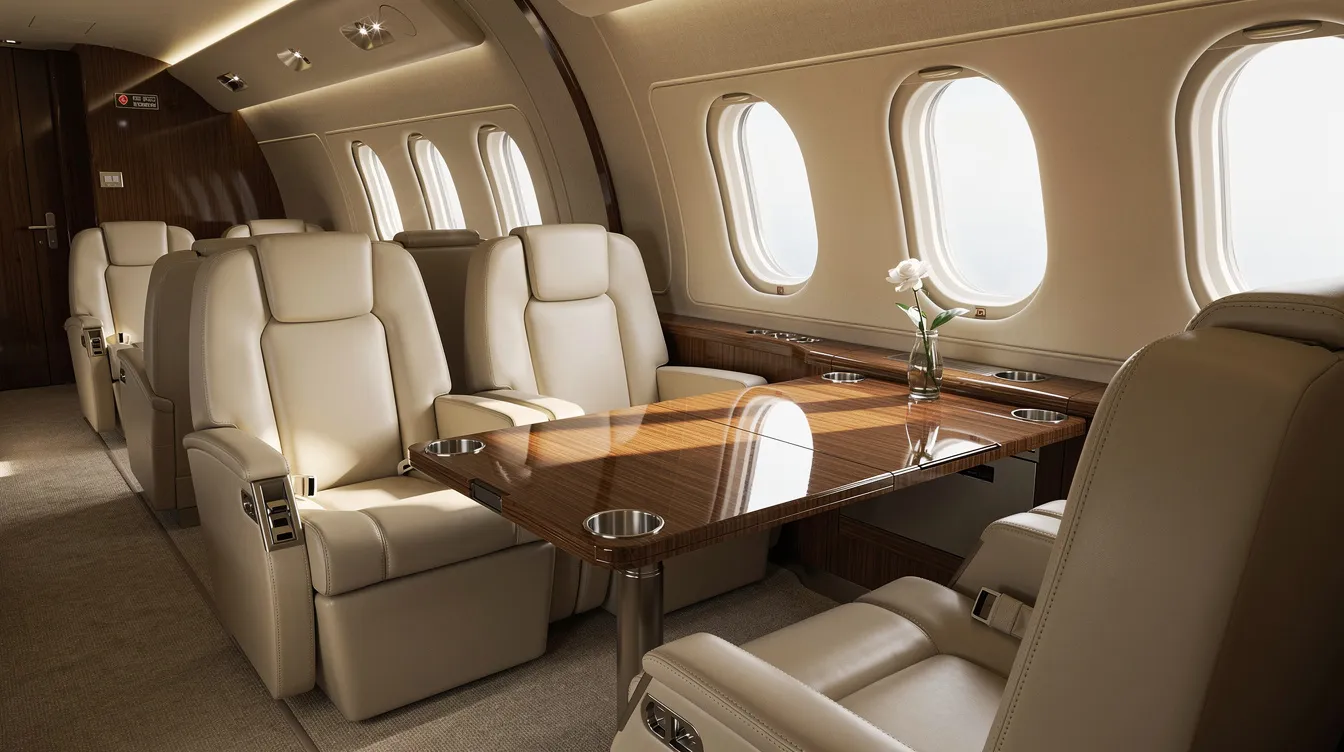
On platforms like Jettly, travellers can usually view cabin details before booking: seat layouts, Wi-Fi availability, galley size, luggage capacity, and the age of the interior. Private jets offer amenities like Wi-Fi and spacious cabins that scale with aircraft size—a turboprop cabin is functional, while a large-cabin jet may include a full galley, sleeping accommodations, and a separate lavatory. Pet policies, accessibility features, and maximum baggage dimensions are also listed where applicable, helping passengers plan around children, pets, or oversized equipment, and dedicated services like Jettly Eats in-flight catering can further customize the onboard experience.
Learn more about aircraft amenities and cabin configurations to compare what different categories offer.
This is a critical distinction that every private jet traveller should understand. Charter brokers and marketplaces such as Jettly or BAJit arrange flights but do not operate aircraft. Part 135 charter companies retain full operational control of flights—they employ the pilots, maintain the aircraft, manage safety systems, and comply with FAA (or equivalent) regulations. The platform's job is to connect the traveller with the right operator for the route and aircraft type.
Over 700 charter operators are safety-rated for private flights across the industry. ONEflight International, which operates BAJit, holds ARGUS and WYVERN Certified Broker certifications—two of the most recognised safety audit standards in private aviation. Reputable marketplaces work only with operators that meet or exceed standards such as ARGUS, WYVERN, or IS-BAO, a standard also followed by fractional leaders like NetJets, the industry’s flagship provider. Jettly screens operators based on pilot experience, maintenance history, insurance coverage, and incident records. The company is the first broker worldwide to combine this scale of aircraft access with a commitment to working exclusively with vetted, safety-rated carriers.
Modern private aviation is about more than the aircraft. Platforms like Jettly aim to streamline the entire journey—from ground transportation at both ends to in-flight meals, and increasingly, environmental accountability.
Users can manage travel details through the platform, including in-flight catering and transportation. Concierge services available through Jettly and similar platforms typically include:
Ground transportation: Booking chauffeured cars or vetted rides at departure and arrival airports
In-flight catering: Arranging meals suited to dietary preferences, from simple snacks to multi-course menus
Special requests: Coordinating pet handling, child seats, ski or golf equipment, and oversized luggage
Airport handling: FBO coordination, customs pre-clearance for international flights, and VIP lounge access where available
Membership can include perks like complimentary flights and events, adding value for clients who fly frequently and want a more complete travel experience beyond just the flight itself.
Jettly's platform includes tools such as an airport locator for thousands of global destinations and other features designed to save time on repeat bookings and trip planning:
Account dashboards with trip histories and upcoming itineraries
Stored passenger profiles (no re-entering passport numbers or dietary notes)
Saved routes for frequent city pairs (for example, London to Nice, or Chicago to Aspen)
Live support chat for complex requests or itinerary changes
Empty leg search tools and crowdsourced shared flights to fill empty seats for travellers with schedule flexibility looking for more competitive pricing
The app and website both support the full booking flow, from initial search to payment and itinerary delivery. For first-time private jet travellers, the digital interface removes much of the uncertainty that historically came with chartering. ONEflight announced in September that it was pausing all flight activity, which is a reminder to verify a platform's current operating status and operator network.

Private aviation faces legitimate scrutiny over its carbon footprint. A single super-midsize flight from Boston to Palm Beach can generate several tons of CO₂. The industry is responding, and platforms play a role in making that response practical.
Jettly and other platforms can support more efficient flying through:
Right-sizing aircraft: Matching the smallest suitable jet to the trip, avoiding the emissions and cost of flying a heavy jet for four passengers on a short route
Optimised routing: Reducing unnecessary fuel burn through direct routing and efficient altitude planning
Empty leg utilisation: Filling repositioning flights reduces the total number of wasted flights in the system (empty legs typically save 25–75% off standard charter rates)
Carbon offset integration: Many operators now calculate CO₂ per traveller leg and offer offsetting via reforestation or renewable energy projects
For a deeper look at private jet emissions and what the industry is doing about them, Jettly publishes detailed breakdowns of environmental impact by aircraft type and route, along with comparisons for travelers considering Jettly as a flexible alternative to programs like NetJets.
The tone here is practical, not promotional. Sustainability in private aviation is a work in progress, and transparency about the trade-offs matters more than greenwashing.
No. Platforms like BAJit and Jettly provide access to private jets without any asset ownership. Owning a jet means carrying the full burden of acquisition cost, hangar fees, crew salaries, insurance, and depreciation. Fractional ownership splits those costs among multiple owners but still involves capital commitment and liquidity risk, as outlined in many guides on how much a private jet really costs. Jet cards offer prepaid hours without ownership. BAJ-style platforms and Jettly sit at the lightest end of the commitment spectrum; travellers pay per trip or through optional memberships, with no aircraft on their balance sheet.
Yes. Jettly supports international routes such as New York to London, Toronto to Cabo, and private jet charter to hubs like New Delhi, along with travellers' cross-border itineraries. The platform coordinates with operators who hold the necessary organised overflight rights and customs/immigration handling for international travel. Complex itineraries may require more advance notice—booking several weeks or months ahead gives travelers better aircraft selection and pricing for international legs.
For many domestic routes, a private jet can be organised within a few hours. Same-day bookings are common for light jets and turboprops on high-traffic corridors. Larger aircraft, peak travel dates (holidays, major events), or international flights with permit requirements may need days or weeks of advance planning. BAJit allows booking up to six months in advance, and Jettly supports similar advance scheduling for travellers who prefer to lock in details early.
Live pricing reflects real-time market conditions—fuel costs, aircraft positioning, demand, and operator availability. This can be more cost-effective for flexible travelers who can adjust dates or departure airports. Fixed-rate jet cards prioritize price predictability: the hourly rate is locked for a term, regardless of market fluctuations, and tools like Jettly's jet card flight cost estimator help benchmark those expenses. Heavy users with consistent routes often prefer cards for budgeting. Occasional flyers typically save money with on-demand live pricing because they avoid prepaying for hours they may not use, especially when they use tools that break down affordable private jet charter pricing and cost drivers. The choice comes down to how much someone flies and how much budget certainty they need.
The concept behind BAJ jets represents a broader shift toward digital, on-demand private aviation. Platforms like Jettly deliver live pricing, transparent options, and global aircraft access without the complexity of ownership, fractional shares, or large prepaid commitments. Whether someone flies three times a year or fifty, the barriers to private jet travel have dropped tremendously since the industry founded its first digital booking tools in the mid-2010s, with more options for buying individual seats on shared or semi-private jets than ever before.
Understanding aircraft categories, pricing structures, and the role of operational control helps travelers choose between on-demand charter, memberships, and traditional jet cards. The right option depends on flight frequency, high-ticket sensitivity, and budget tolerance. There is no single answer—a startup traveller doing a one-off investor roadshow has different needs than a family flying seasonally between two cities.
Jettly offers a straightforward way to explore private aviation and offers an ULTRA high-ticket affiliate program for partners who want to refer new members and travellers. With access to over 20,000 aircraft, instant digital booking, and optional membership benefits for frequent flyers, the platform suits both newcomers and experienced private travelers looking for better flexibility and transparency.
Share this post:
Jay Franco Serevilla
Sep 27, 2026
|
5
min read
Discover tips and trends in the industry.

5
min read
How Far Is Las Vegas to Arizona? Distance, Driving Times, and Scenic Private Jet Options
Traveling from Las Vegas to Arizona varies significantly based on your destination, with distances ranging from 35 miles to over 420 miles. Popular spots like the Grand Canyon and Hoover Dam are easily accessible, making for memorable day trips. Whether you choose to drive, take a guided tour, or fly privately, each option offers unique experiences and scenic views along the way.
Read More
5
min read
Jet It: What Happened, What It Means for Private Aviation, and Smarter Alternatives
Jet It, a fractional jet ownership company, ceased operations in mid-2023 due to financial and operational challenges, highlighting the risks of low-cost models in private aviation. Its collapse serves as a cautionary tale for potential buyers, emphasizing the importance of understanding costs and flexibility in private flight options. As a result, many customers are now turning to platforms like Jettly for more reliable and adaptable private aviation solutions.
Read MoreStay updated with our latest insights and tips to elevate your journey with us.
MEMBERSHIPS AND ASSOCIATIONS



Disclaimer: Jettly operates as a charter broker, offering access to a global digital jet charter marketplace. Jettly is not a direct air carrier and does not own or operate aircraft. All advertised flights are conducted by third-party air carriers that are fully licensed and hold the appropriate Part 135 or Part 121 certifications issued by the Federal Aviation Administration (FAA) or equivalent regulatory authorities under U.S. or foreign law. Jettly complies fully with the U.S. Department of Transportation's Part 295 and Part 298 Charter Broker regulations. Jettly does not carry additional liability insurance. Passengers are covered by aircraft operator insurance. TICO: 50023770


